Back to all blogs
Learn what AI interviews are, how they work, their types, benefits and drawbacks, what they assess, and best practices for conducting effective AI interviews.

Abhishek Kaushik

For many candidates, the first interviewer they meet is no longer a person. Artificial intelligence is becoming a bigger part of the hiring process, from screening applications to conducting interviews and evaluating candidate responses. According to Greenhouse’s 2026 Candidate AI Interview Report, nearly two-thirds (63%) of U.S. job seekers surveyed said they had already experienced an AI interview. But adoption is moving faster than trust: 70% of U.S. candidates with AI-interview experience said AI was not clearly disclosed before their most recent interview.
AI interviews can help companies manage large candidate volumes, automate repetitive screening tasks, ask standardized questions, and collect structured responses. They can also make parts of the hiring process more consistent. For candidates, however, an AI-led interview can feel very different from speaking with a recruiter or hiring manager. Instead of interacting directly with a person, they may respond to an AI system that asks questions, analyzes answers, or evaluates specific skills.
For employers, using AI in interviews is not simply about adding another tool to the hiring workflow. The technology needs to support reliable hiring decisions while maintaining transparency and candidate trust. Companies also need to understand the benefits and limitations of AI interviewing before making it part of their recruitment process.
In this guide, we’ll explain what an AI interview is, how it works, the different types of AI interviews, and their key benefits and drawbacks. We’ll also explore how companies can use AI-powered interviews responsibly while keeping human oversight, transparency, and trust at the center of the hiring process.
What Is an AI Interview?
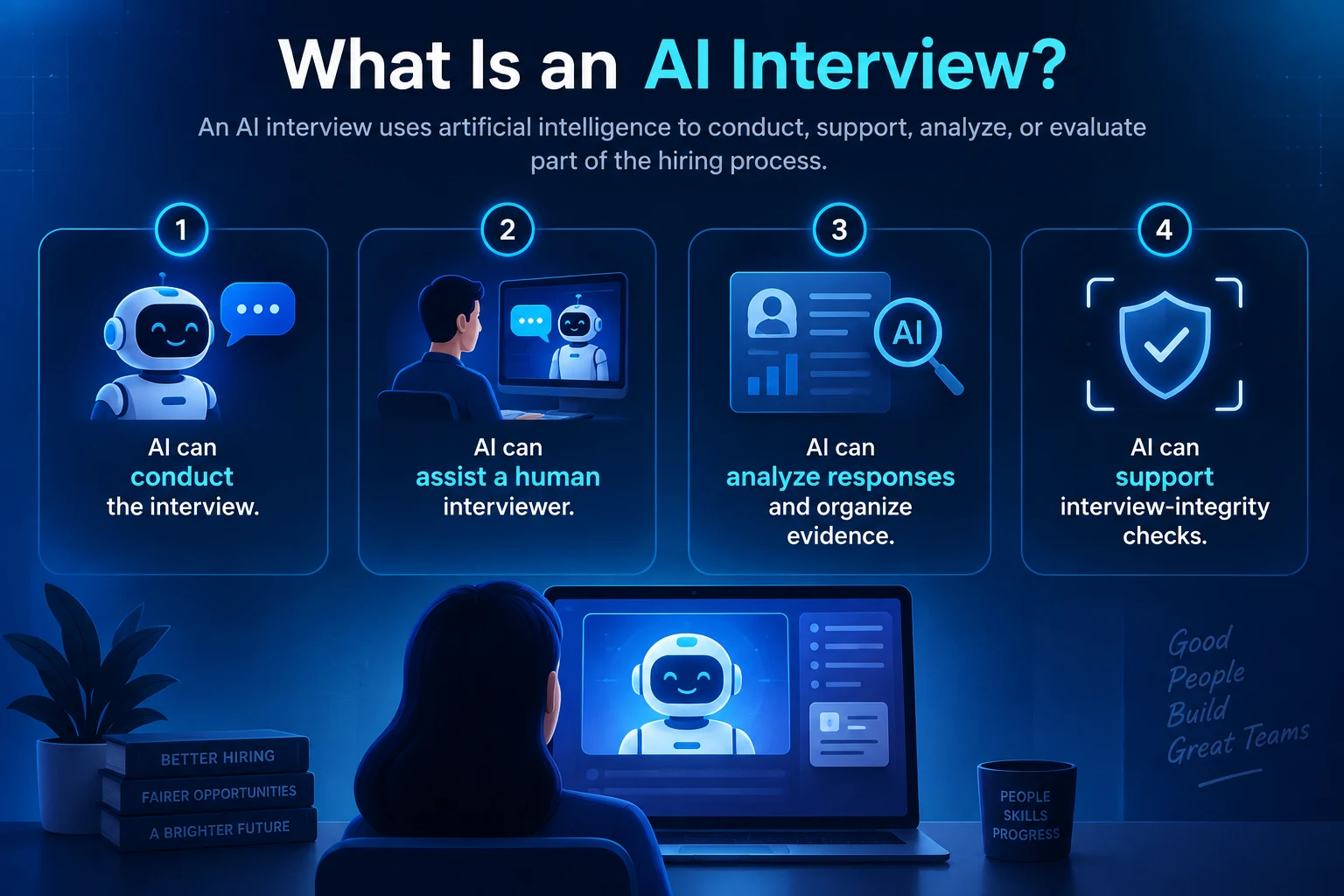
An AI interview is a job interview that uses artificial intelligence to conduct, support, analyze, or evaluate part of the interview process. Depending on the system, AI may generate interview questions, interact with candidates, analyze answers, evaluate specific competencies, or produce an interview report for recruiters.
An AI interview does not necessarily mean a candidate is speaking to a fully autonomous AI interviewer. In some hiring processes, AI supports a human interviewer behind the scenes. In others, an AI system conducts the conversation directly. Sherlock AI and similar tools analyze recorded or asynchronous responses rather than holding a live conversation.
The important distinction is what role AI plays in the process. A hiring team may use AI to make interviews more consistent and scalable, but the quality of the outcome still depends on the criteria, questions, data, oversight, and safeguards surrounding the technology.
AI can conduct the interview.
AI can assist a human interviewer.
AI can analyze responses and organize evidence.
AI can support interview-integrity checks.
AI Interview vs. Traditional Interview
Factor | AI Interview | Traditional Interview |
Questioning | AI may generate or deliver structured questions | Human interviewer selects and asks questions |
Evaluation | AI can analyze responses against predefined criteria | Human interviewer evaluates responses |
Scale | Can support large candidate volumes | Limited by interviewer time and availability |
Consistency | Can apply the same framework across candidates | Can vary between interviewers |
Human interaction | May be limited depending on the format | Direct interaction with a person |
Decision-making | AI output can support the decision | Usually led by human judgment |
Learn more about: AI Interview Cheating vs Traditional Interview Cheating
Why Are AI Interviews Becoming More Common?
The biggest driver is scale. Hiring teams often need to evaluate many candidates while maintaining a consistent process. AI can automate repetitive parts of interviewing and help recruiters spend more time on candidates who move further through the process.
Key Reasons for AI Interview Adoption
AI interviews are becoming more common as companies look for faster and more scalable ways to manage hiring. By automating parts of the interview and screening process, they can reduce repetitive work for recruiters and handle larger applicant volumes. AI tools can also help capture and organize interview data for easier review. As recruitment becomes more technology-driven, these capabilities are encouraging organizations to explore AI-powered interviews.
Greater Structure and Consistency
Another reason is structure. A well-designed AI interview can ask candidates comparable questions and evaluate responses against predefined competencies. That can reduce some of the variation introduced when different interviewers approach the same role in very different ways.
Flexible Interview Formats
Flexibility also matters. Asynchronous interviews can let candidates respond at a convenient time, while conversational systems can conduct first-round screening without requiring a recruiter to schedule every conversation.
Trust and Human Oversight
Growing adoption does not automatically translate into candidate confidence. According to Greenhouse's 2026 Candidate AI Interview Report, only 18% of U.S. candidates with AI interview experience said most employers had clear AI policies explaining how the technology would be used. The gap between widespread adoption and limited transparency shows why human oversight and clear communication are essential parts of responsible AI interviewing.
Types of AI Interviews
AI interviews can take different forms depending on how the interview is conducted, how candidates interact with the system, and what the employer wants to assess. Common formats include AI-assisted interviews, AI-led interviews, conversational interviews, asynchronous interviews, and AI-powered interviews for specific roles or assessment areas.
1. AI-Assisted Interviews
In an AI-assisted interview, a human interviewer remains in control while AI supports the process. The system might suggest questions, summarize responses, identify relevant skills, or organize interview notes.
This format keeps the human conversation at the center while reducing administrative work. It can be useful when recruiters want AI efficiency without handing the entire interview to an automated system.
2. AI-Led Interviews
An AI-led interview is conducted primarily by an AI interviewer. The system can introduce the interview, ask questions, listen to responses, and move through a predefined or adaptive interview flow.
AI-led interviews are often used for high-volume screening because one system can conduct many first-round interviews without requiring recruiters to attend every session.
3. Conversational AI Interviews
Conversational AI interviews are designed to feel more like a two-way conversation than a fixed questionnaire. The AI can interpret a candidate's response and ask a follow-up question based on what was said.
The quality of these interviews depends heavily on how well the system understands context. A conversational experience should still be tied to clear job-related competencies rather than simply rewarding candidates who sound confident or conversational.
4. Asynchronous AI Interviews
In an asynchronous interview, candidates record responses to questions rather than speaking with an interviewer live. AI can then help analyze or organize those responses.
This format gives candidates scheduling flexibility and allows hiring teams to review responses later. However, companies should clearly explain how recordings are evaluated, how long they are retained, and whether AI contributes to the assessment.
5. AI-Powered Technical Interviews
AI-powered technical interviews use AI to assess technical knowledge, coding ability, problem-solving, or role-specific expertise. Depending on the platform, the system may generate technical questions, evaluate code, ask follow-ups, or identify areas that need deeper assessment.
Technical interviews also create an important integrity challenge. A candidate may use a second device, hidden notes, an AI copilot, or another form of external assistance without the interviewer realizing it. In these situations, a technically correct answer does not necessarily prove that the candidate independently demonstrated the required skill.
6. AI-Powered Video Interviews
AI-powered video interviews use video and audio as part of the interview experience. AI may analyze spoken responses, organize interview information, or support integrity checks. The use of video does not necessarily mean that AI evaluates facial expressions, appearance, or emotions. The specific signals analyzed depend on the system and its intended purpose. Sherlock AI can support this type of interview by helping hiring teams identify potential integrity concerns during remote video interviews and providing signals that can be reviewed by human interviewers.
Because video interviews involve identity, voice, behavior, and potentially sensitive personal information, employers need to be especially careful about transparency, accessibility, privacy, and human review.
How Does an AI Interview Work?
The exact workflow differs by platform, but most AI interviews follow a similar sequence from role definition to candidate evaluation.
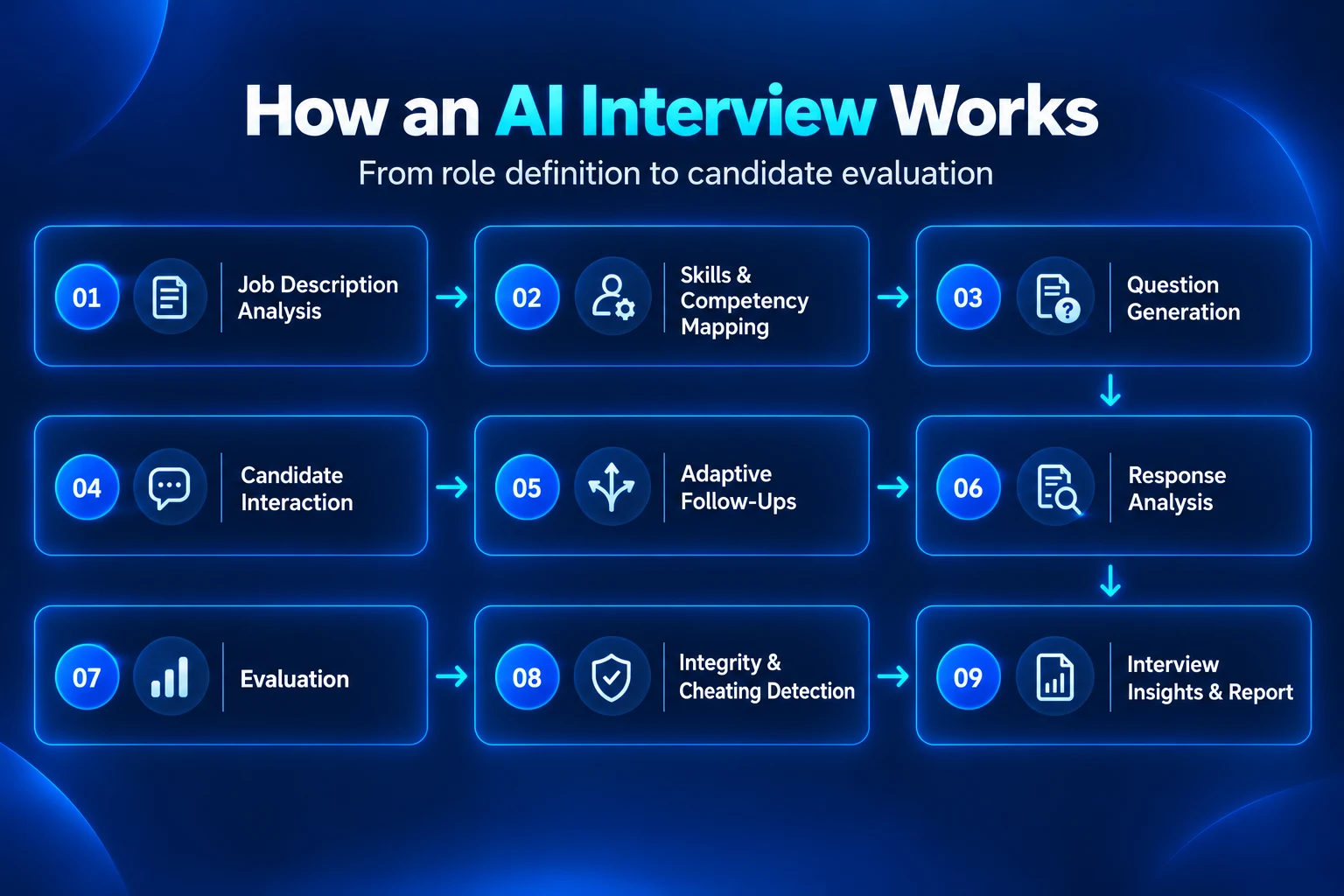
1. Job Description Analysis
The process often starts with the job description. AI can identify responsibilities, required skills, experience, qualifications, and other role requirements.
The goal is to turn a broad job description into specific competencies that can actually be assessed during the interview.
2. Skills and Competency Mapping
The system maps the role requirements to measurable areas such as technical knowledge, communication, problem-solving, leadership, or customer-handling ability.
This step is important because an interview can only be as useful as the criteria it measures. If the criteria are vague or unrelated to job performance, automation can make an inconsistent process faster without making it better.
3. Question Generation
AI can generate or recommend questions based on the role and selected competencies. Questions may cover technical knowledge, previous experience, behavioral situations, or role-specific scenarios.
A strong process uses a structured question framework rather than allowing the system to improvise without boundaries.
4. Candidate Interaction
Candidates should be told when AI is being used and what role it plays in the interview process. Clear disclosure before the interview helps candidates understand what to expect, how their responses may be assessed, and whether a human reviewer will be involved. This transparency can also give candidates an opportunity to raise accessibility concerns or ask questions about the process.
5. Adaptive Follow-Ups
Some systems use the candidate's response to determine the next question. For example, if a candidate describes solving a difficult production incident, the AI may ask what they personally did, what trade-offs they considered, or how they measured the outcome.
Adaptive questions can make an interview more informative, but they should remain tied to the role's evaluation framework.
6. Response Analysis
AI can analyze responses for information relevant to the predefined criteria. Depending on the system, this may include technical accuracy, completeness, communication, or evidence of specific competencies.
This is where employers should be careful not to confuse measurable interview signals with a complete assessment of a person. A candidate's accent, speech pattern, disability, or communication style should not become an unintended proxy for job suitability.
7. Evaluation
The system may produce scores, summaries, competency ratings, or structured interview notes. These outputs can help recruiters compare candidates against the same framework.
However, an AI score should not automatically become the hiring decision. Human reviewers need enough context to understand what the system evaluated and where its limitations may affect the result.
8. Integrity and Cheating Detection
Some AI interview systems or connected tools also monitor for signs of external assistance or identity-related issues. These may include unusual response patterns, off-screen activity, additional devices, proxy participation, or other signals that a candidate is not completing the interview independently.
These signals should be treated as evidence for review, not automatic proof of misconduct. Multiple independent signals and human investigation are stronger than a single anomaly.
9. Interview Insights and Report
Finally, the system can organize the interview into a report that highlights competencies, responses, potential concerns, and other relevant observations.
A useful report should help a recruiter understand what happened during the interview rather than simply presenting an unexplained score.
Learn more about: The Buyer’s Guide to AI Interview Note-Takers for Zoom, Teams & Meet |
What Do AI Interviews Assess?
AI interviews can assess a range of skills, knowledge, and competencies relevant to a specific role. The areas assessed depend on the job requirements, interview structure, and evaluation criteria. Employers can use AI interviews to evaluate both technical capabilities and broader workplace skills through structured questions, scenarios, and follow-up prompts.
1. Technical Skills
AI interviews can evaluate whether candidates have the technical knowledge and capabilities required to perform a specific job. Depending on the role, this can include:
Programming and coding
Data analysis and interpretation
System design and engineering concepts
Cybersecurity knowledge
Technical troubleshooting
Knowledge of industry-specific tools and technologies
For example, a software engineering interview may ask candidates to explain an algorithm, review code, or describe how they would design a scalable application.
2. Problem-Solving Skills
AI interviews can assess how candidates approach unfamiliar or complex situations. Instead of focusing only on the final answer, questions can explore the reasoning and decision-making process behind it.
Candidates may be assessed on their ability to:
Identify and understand a problem
Gather and evaluate relevant information
Consider multiple solutions
Prioritize competing requirements
Evaluate risks and trade-offs
Adapt when an initial solution does not work
For example, candidates may be presented with a delayed project or customer issue and asked to explain how they would handle the situation.
3. Communication Skills
AI interviews can evaluate communication based on the requirements of the role. This is particularly relevant for positions where employees need to explain information, collaborate with others, or communicate with customers.
The assessment may focus on whether candidates can:
Explain ideas clearly
Provide relevant and structured responses
Respond directly to questions
Explain complex information in simple terms
Adapt communication to different audiences
The focus should remain on job-related communication skills rather than factors such as accent, personality, or individual speaking style.
4. Behavioral Competencies
AI interviews can use behavioral questions to understand how candidates have handled situations they encountered in previous roles. These questions can provide insight into competencies that are difficult to assess through technical questions alone.
Common areas include:
Leadership
Teamwork and collaboration
Accountability
Adaptability
Conflict management
Decision-making
Ownership and responsibility
For example, candidates may be asked to describe a time they resolved a conflict within a team and explain the actions they took and the outcome.
5. Role-Specific Knowledge
AI interviews can be customized to assess knowledge directly related to the responsibilities of a particular position. This allows employers to move beyond generic interview questions and focus on what candidates would actually need to know in the role.
Depending on the position, this may include:
Industry knowledge
Role-specific processes
Functional expertise
Strategic thinking
Decision-making
Knowledge of relevant business metrics
For example, a financial analyst may be asked about forecasting and financial modeling, while a marketing candidate may be assessed on campaign measurement and audience segmentation.
6. Practical Experience
AI interviews can also explore whether candidates have applied their knowledge in real-world situations. Rather than asking only what candidates know, interview questions can examine what they have actually done.
Candidates may be asked about:
Projects they have worked on
Their specific responsibilities
Challenges they encountered
Decisions they made
Results they achieved
Mistakes or setbacks they experienced
Lessons they learned
Follow-up questions can help employers understand the depth and relevance of a candidate's experience.
7. AI Fluency
For roles that involve artificial intelligence, interviews can assess whether candidates know how to use AI tools effectively and responsibly. This can include both practical AI skills and the ability to apply human judgment when working with AI.
Candidates may be assessed on their ability to:
Use AI tools for research, content creation, coding, or analysis
Write effective prompts
Verify AI-generated information
Identify potential errors or bias
Understand the limitations of AI systems
Determine when human review is necessary
Use AI while maintaining appropriate oversight
For example, candidates may be asked how they would handle a situation where an AI tool generates a confident answer that cannot be independently verified.
Pros of AI Interviews
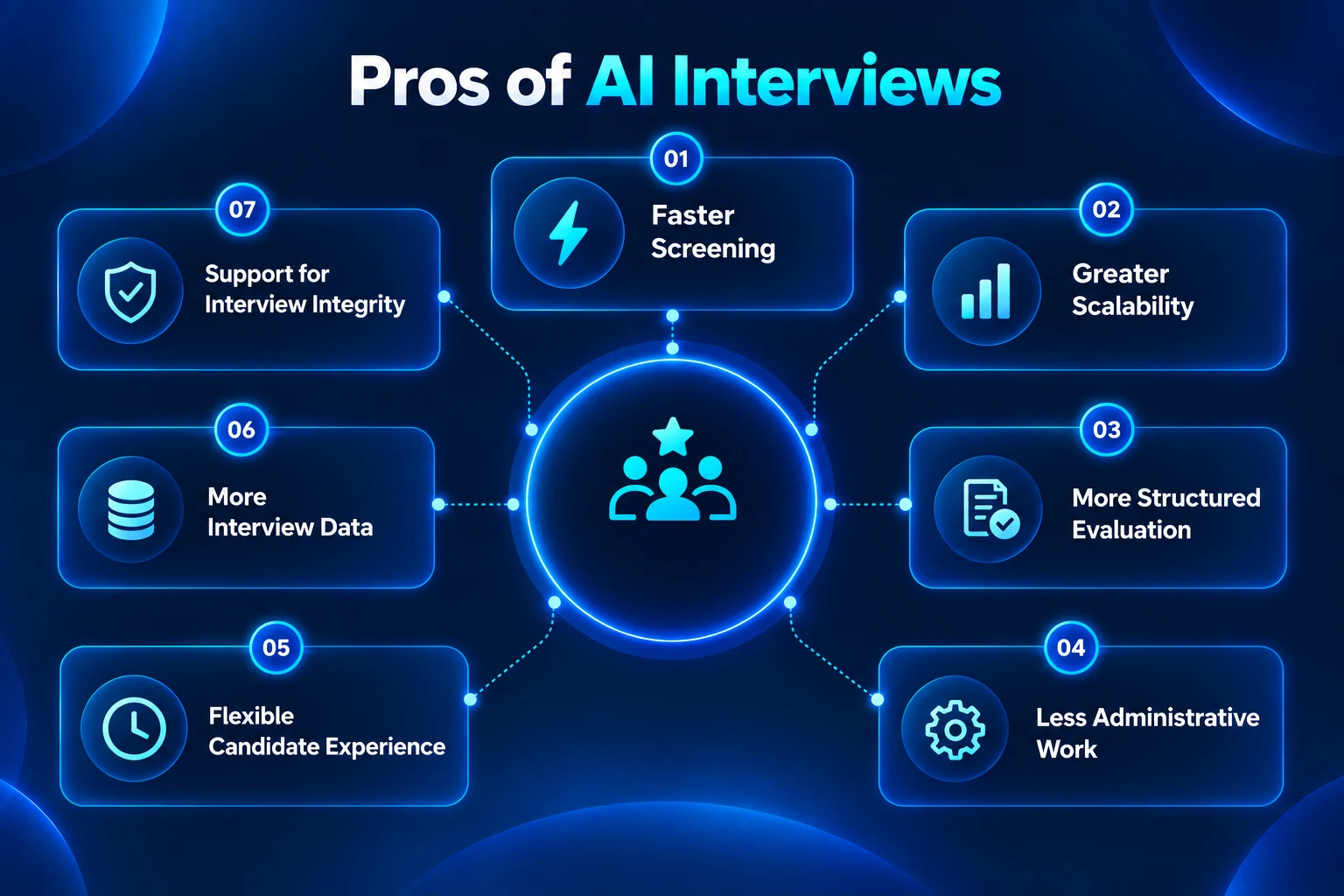
AI interviews can help organizations streamline parts of the hiring process while handling large numbers of candidates. They can reduce repetitive tasks, support structured evaluations, and make interview data easier to organize and review.
1. Faster Screening
AI interviews can speed up the early stages of recruitment by handling repetitive screening tasks automatically. Instead of recruiters conducting the same initial interview with every applicant, AI can ask predefined questions, collect responses, and organize the results for further review. This allows hiring teams to spend more time evaluating candidates who meet the requirements of the role.
2. Greater Scalability
AI interviews make it easier to interview large numbers of candidates without requiring recruiters to be available for every conversation. Candidates can complete interviews across different locations and time zones, while the same interview structure can be used throughout the process. This can be particularly useful for organizations hiring for multiple roles or managing high-volume recruitment campaigns.
3. More Structured Evaluation
A predefined set of questions and evaluation criteria can give recruiters a more consistent framework for assessing candidates. AI can help ensure that candidates are asked similar questions and that responses are reviewed against role-specific criteria. This structure can make it easier for hiring teams to organize interview information and reduce inconsistencies between different interview sessions.
4. Less Administrative Work
AI can automate several tasks that typically require recruiter involvement, including interview scheduling, transcription, note-taking, and generating interview summaries. Reducing this administrative workload gives recruiters more time to focus on candidate communication, deeper evaluations, and other parts of the hiring process that require human involvement.
5. Flexible Candidate Experience
Asynchronous AI interviews allow candidates to complete an interview without coordinating a specific meeting time with a recruiter. This can be useful for candidates who are in different time zones or have limited availability during standard working hours. However, organizations still need to make sure that flexibility does not come at the expense of accessibility or candidate support.
6. More Interview Data
AI can organize transcripts, responses, scores, and other interview information in a structured format. This gives hiring teams more data to review when assessing candidates and can make it easier to identify relevant skills or experiences across a large candidate pool. The data is most useful when it is tied to clear, job-related evaluation criteria rather than treated as a standalone hiring decision.
7. Support for Interview Integrity
AI-powered interview systems can include safeguards designed to identify potential forms of interview fraud, such as impersonation, proxy participation, or unauthorized assistance. These tools can provide additional signals for recruiters to review, particularly in remote hiring processes. They should complement established verification and interview practices rather than automatically determine whether a candidate has acted improperly.
Cons of AI Interviews
Despite their potential benefits, AI interviews can create challenges for both employers and candidates. Concerns include limited human interaction, transparency, potential bias, accessibility, privacy, technical issues, and overreliance on automated evaluations.
1. Less Human Interaction
AI interviews can reduce opportunities for candidates to have meaningful conversations with recruiters or hiring managers. Some candidates may find it harder to demonstrate personality, communication style, or context through an automated interaction. If the process contains too little human contact, candidates may also feel disconnected from the organization.
2. Lack of Transparency
Candidates often want greater clarity about when AI is being used, how their responses are evaluated, and what role automated systems play in hiring decisions. According to Greenhouse's 2026 Candidate AI Interview Report, around 80% of U.S. candidates with AI interview experience said employer AI policies were vague, rare, or completely absent. These findings highlight why organisations should clearly explain where AI is used, what it measures, and how human reviewers remain involved throughout the hiring process.
3. Potential Bias
AI does not automatically eliminate bias from the hiring process. The International Labour Organization (ILO) notes that AI systems used in human resource management can reflect limitations in their objectives, data, and programming. When flawed assumptions or unsuitable data are incorporated into an AI system, they can contribute to inaccurate or discriminatory outcomes and potentially scale those issues through automation.
Employers can help reduce these risks by using job-related assessment criteria, testing whether the system produces materially different outcomes across relevant candidate groups, ensuring appropriate accessibility and accommodation processes, and maintaining meaningful human oversight of high-stakes hiring decisions.
4. Accessibility Concerns
Automated interviews can create difficulties for candidates with disabilities if systems rely heavily on speech patterns, facial behavior, response timing, or other characteristics that may vary for reasons unrelated to job performance. Interview processes should therefore provide accessible alternatives and reasonable accommodations where required, rather than assuming every candidate can interact with the technology in the same way.
5. Privacy and Data Concerns
AI interviews may involve the collection of video, audio, transcripts, identity information, and other candidate data. This creates questions about how information is collected, stored, accessed, retained, and eventually deleted. Employers need clear data-handling policies so candidates understand what information is being collected and why it is necessary.
6. Technical Problems
Technical issues can interrupt an otherwise valid interview. Poor internet connections, microphone or camera failures, browser compatibility problems, and software errors can prevent candidates from completing an interview or affect the quality of their responses. Providing technical support and alternative ways to complete an interview can help reduce the impact of these problems.
7. Overreliance on Scores
Automated scores can make interview evaluation appear more precise than it actually is. A numerical score may not capture important context, such as a candidate's career history, unusual experience, or the reasoning behind a response. AI-generated assessments are therefore more useful when treated as one input into a broader evaluation rather than as the sole basis for a hiring decision.
8. Candidate Pushback
Not every candidate is comfortable with AI being involved in the interview process. Some candidates may prefer speaking directly with a human interviewer or may have concerns about how AI evaluates their responses, uses their data, or affects hiring decisions. Organizations can address these concerns by clearly explaining how AI is used, what role it plays in the hiring process, and how candidates can request human involvement or appropriate alternatives when needed. Transparent communication and meaningful human interaction can help create a more comfortable and trustworthy candidate experience.
How to Conduct Effective AI Interviews
Conducting an effective AI interview requires more than technical questions. Interviewers should assess candidates’ AI knowledge, problem-solving skills, practical experience, and ability to apply AI tools to real-world situations. A structured process with role-specific questions, practical assessments, and follow-ups helps ensure consistent evaluation while understanding a candidate’s technical approach and reasoning.
1. Define What You Are Measuring
Start with the job-related competencies the candidate needs to demonstrate. For example, customer-service roles may require communication, problem-solving, and empathy, while software engineering roles may require coding, debugging, and technical reasoning. Define these competencies before choosing an AI tool so the technology supports a clear hiring objective.
2. Use Structured Evaluation Criteria
Set consistent criteria for what strong, acceptable, and weak evidence looks like. Instead of judging whether someone is a “good communicator,” define observable indicators such as explaining information clearly, responding directly, and adapting to the audience. Clear criteria make candidate evaluations more consistent and easier for hiring teams to review.
3. Tell Candidates When AI Is Being Used
Be clear about where AI is used, what it evaluates, and whether a human reviews its output. Candidates should know whether AI is conducting questions, analyzing responses, assessing skills, or supporting a hiring decision. Clear communication also gives candidates an opportunity to raise accessibility concerns or ask about alternative options.
4. Keep Humans in the Decision Loop
AI can organize information and identify patterns, but hiring teams should remain responsible for final decisions. Human reviewers should be able to question an automated recommendation and consider relevant circumstances, such as technical issues or accessibility needs. An AI-generated score should support the decision, not automatically determine it.
5. Provide Accessibility and Accommodation Options
Consider whether the interview format could create barriers for candidates with disabilities. Make accommodation information easy to find and provide a clear process for requests. Where appropriate, offer an alternative assessment method that measures the same job-related competency without relying on a format that creates an unnecessary barrier.
6. Validate the System
Test whether the interview measures the competencies it was designed to assess and whether its results relate to job performance. Continue reviewing the system after launch by examining assessment outcomes and relevant hiring results. If the system consistently produces unexpected or unreliable results, investigate the assessment rather than assuming the candidates are the problem.
7. Protect Interview Integrity
Define what forms of AI assistance are allowed before the interview begins. Employers may permit accessibility tools while restricting undisclosed systems that generate answers during an assessment. Integrity controls should be proportionate to the role and risk involved, with the focus on verifying authentic candidate skills rather than unnecessary or intrusive monitoring.
8. Communicate Outcomes
A transparent interview process should not end with silence. Tell candidates what to expect, including when they should receive an update, and communicate if timelines change. Even when a candidate is not selected, timely communication creates a more predictable experience and helps recruiters manage the hiring process consistently.
Are AI Interviews Reliable and Fair?
AI interviews can be useful, but reliability and fairness do not automatically come from using AI. They depend on how the interview is designed, what the system measures, how its outputs are validated, and whether humans remain accountable for hiring decisions.
Candidate trust remains a major challenge. According to Gartner's 2025 survey only 26% of surveyed job applicants trusted AI to fairly evaluate them, while 32% were concerned that AI could negatively affect their applications. The findings suggest that trust depends not only on the technology itself but also on transparency, consistent evaluation criteria, and visible human oversight throughout the hiring process.
Reliability also depends on what the interview is designed to prove. If the goal is to assess technical skill, the process should produce evidence of technical skill. If the goal is to assess communication, it should use job-relevant communication criteria. A polished AI-generated answer, a particular accent, or an unusual facial expression should not be treated as a complete proxy for competence.
Finally, interview integrity matters. Gartner reported that 6% of surveyed candidates admitted to participating in interview fraud, either by posing as someone else or having someone else pose as them. For high-stakes roles, employers need to establish not only whether a candidate gave a good answer, but whether the answer genuinely came from the person being assessed.
· Verify that the intended candidate is the person participating.
· Watch for potential external assistance or proxy participation.
· Use multiple signals instead of treating one anomaly as proof.
· Give trained reviewers enough evidence to investigate before deciding.
Conclusion
AI interviews are becoming an increasingly common part of modern hiring, helping organizations manage candidate volume, standardize parts of the interview process, and reduce repetitive recruiting tasks. When designed around clear, job-related criteria, they can assess areas such as technical skills, problem-solving, communication, behavioral competencies, and role-specific knowledge.
However, AI interviews also come with challenges, including limited human interaction, transparency concerns, potential bias, accessibility barriers, privacy risks, and overreliance on automated scores. Employers need to consider these limitations carefully and ensure candidates understand when AI is being used and how their responses may be evaluated.
An effective AI interview should therefore combine technology with structured evaluation, clear communication, accessibility, appropriate integrity safeguards, and meaningful human oversight. AI can support the hiring process, but human judgment remains important when interpreting interview evidence and making final hiring decisions.