Back to all blogs
Learn how behavioral interviewing works, explore proven techniques and questions, and discover how to evaluate candidate responses with greater consistency.

Abhishek Kaushik

Hiring teams often hear polished answers during interviews. The harder challenge is determining whether those answers reflect skills and behaviors a candidate has actually demonstrated. Resumes can summarize experience, while traditional interview questions may reveal motivation, preferences, or communication style. However, they do not always show how a candidate handled a difficult customer, managed competing priorities, responded when a project failed, or influenced others without formal authority.
Behavioral interviewing helps hiring teams uncover that evidence. Instead of asking candidates what they would do in a hypothetical situation or how they describe their own strengths, behavioral interviews ask candidates to share specific examples from their past. Interviewers can then explore the situation, the candidate’s responsibilities, the actions they personally took, the decisions they made, and the results that followed.
This approach gives interviewers more concrete evidence than statements such as “I’m a strong problem-solver” or “I work well under pressure.” The goal is not to reward the candidate who tells the most compelling story. It is to understand what they actually did and evaluate that experience against the competencies required for the role.
Research supports this focus on past behavior. A 2019 study published in the Journal of Business Research found that past-behavioral interview question ratings significantly predicted subsequent job performance. The study compared past-behavioral questions with situational, background, and job-knowledge questions in a real hiring context.
For modern hiring teams, behavioral interviewing is more than asking candidates to “Tell me about a time when…” It works best as a structured process: identify the behaviors that matter for the role, ask for specific examples, probe for the candidate’s individual contribution, evaluate responses against clearly defined criteria, and document the evidence behind each rating.
This guide explains how behavioral interviewing works, the techniques that improve interview quality, its key benefits, practical behavioral interview questions, and how to evaluate responses more consistently.
What Is Behavioral Interviewing?
Behavioral interviewing is an interview technique that asks candidates to describe real situations they have handled in the past so the interviewer can evaluate job-relevant behaviors, skills, judgment, and patterns of action.
A typical behavioral interview question might be:
“Tell me about a time you had to deliver an important result with incomplete information.”
The interviewer can then explore:
What was happening?
What was the candidate responsible for?
What did they personally do?
Why did they choose that approach?
What alternatives did they consider?
What happened as a result?
What would they do differently now?
This differs from a question such as:
“Are you good at working under pressure?”
A candidate can answer that question with an opinion about themselves. A behavioral question requires them to provide a real example that can be examined.
Behavioral interviewing is often associated with the behavioral consistency principle: past behavior can provide useful information when assessing how someone may respond to similar demands. That does not mean people never change or that one story can perfectly predict future performance. Context, role demands, team dynamics, learning, and experience all matter. The practical value of the method is narrower: past examples give interviewers observable evidence to discuss and score, rather than relying only on self-description, intuition, or first impressions.
Importantly, “behavioral” and “structured” are not opposites. Behavioral describes the type of evidence the interviewer asks for. Structured describes the consistency of the interview process. A hiring team can run an unstructured behavioral conversation, but a structured behavioral interview where candidates receive the same core questions and are rated against the same criteria is usually easier to compare and defend.

How Does Behavioral Interviewing Work?
A strong behavioral interview starts before the candidate enters the interview.
Step 1: Identify Job-Relevant Competencies
The hiring team first determines which behaviors and competencies are genuinely important for success in the role.
For example, a customer success manager might need:
Customer judgment
De-escalation
Prioritization
Cross-functional communication
An engineering manager might need:
Technical judgment
Coaching
Decision-making
Handling trade-offs
The goal is to identify behaviors that candidates will actually need to demonstrate on the job.
Step 2: Create Behavioral Questions
Once the competencies are defined, interviewers create questions that encourage candidates to describe relevant experiences.
For example, instead of asking:
“Are you good at managing stakeholders?”
Ask:
“Tell me about a time you had to move a project forward when an important stakeholder strongly disagreed with your approach.”
The second question creates an opportunity to examine a real situation rather than relying on self-assessment.
A meta-analysis comparing past-behavior and situational interview questions found that, when descriptively anchored rating scales were used, past-behavior questions produced a higher mean validity estimate of 0.63 compared with 0.47 for situational questions.
This supports combining behavioral questions with clear evaluation criteria rather than relying solely on conversational impressions.
Step 3: Ask for a Specific Example
During the interview, encourage candidates to focus on one specific situation.
If a candidate starts describing several unrelated examples, bring the conversation back to one event.
For example:
“Let's stay with that example for a moment. What was your specific role in resolving the issue?”
This makes the evidence easier to understand and evaluate.
Step 4: Probe for Evidence
The first answer rarely contains everything the interviewer needs.
A candidate might describe the situation and outcome but provide little information about their own actions.
Useful neutral follow-up questions include:
“What did you do next?”
“What was your reasoning at that point?”
“What alternatives did you consider?”
“What was your individual role?”
“How did the other person respond?”
“How did you know the approach worked?”
“What would you do differently now?”
The interviewer should avoid leading the candidate toward a preferred answer.
Instead of:
“So you involved the customer early, right?”
Ask:
“At what point did you involve the customer?”
The second approach allows the candidate to provide the evidence without being guided toward an expected response.
Step 5: Evaluate the Evidence
The interviewer should then assess what the candidate actually demonstrated.
Instead of asking:
“Did I like this candidate?”
Ask:
“What did this example demonstrate about the competency we are assessing?”
Notes and ratings should focus on observable behavior rather than personality impressions.
Step 6: Calibrate Interviewers
When multiple interviewers are involved, a short calibration exercise can improve consistency.
Interviewers can review a sample answer, score it independently, and discuss why they selected different ratings.
The objective is not to force everyone to have identical opinions. It is to ensure interviewers have a broadly consistent understanding of the competency and rating criteria.
This is particularly useful for large hiring campaigns where multiple managers may interpret “strong evidence” differently.
Behavioral Interviewing Techniques That Improve Interview Quality
A good behavioral interview is not just about asking candidates to “Tell me about a time…” The real difference comes from how the interview is planned, how the interviewer follows up, and how consistently the evidence is evaluated. When these elements are handled well, behavioral questions can reveal much more than a candidate’s ability to give a polished answer.
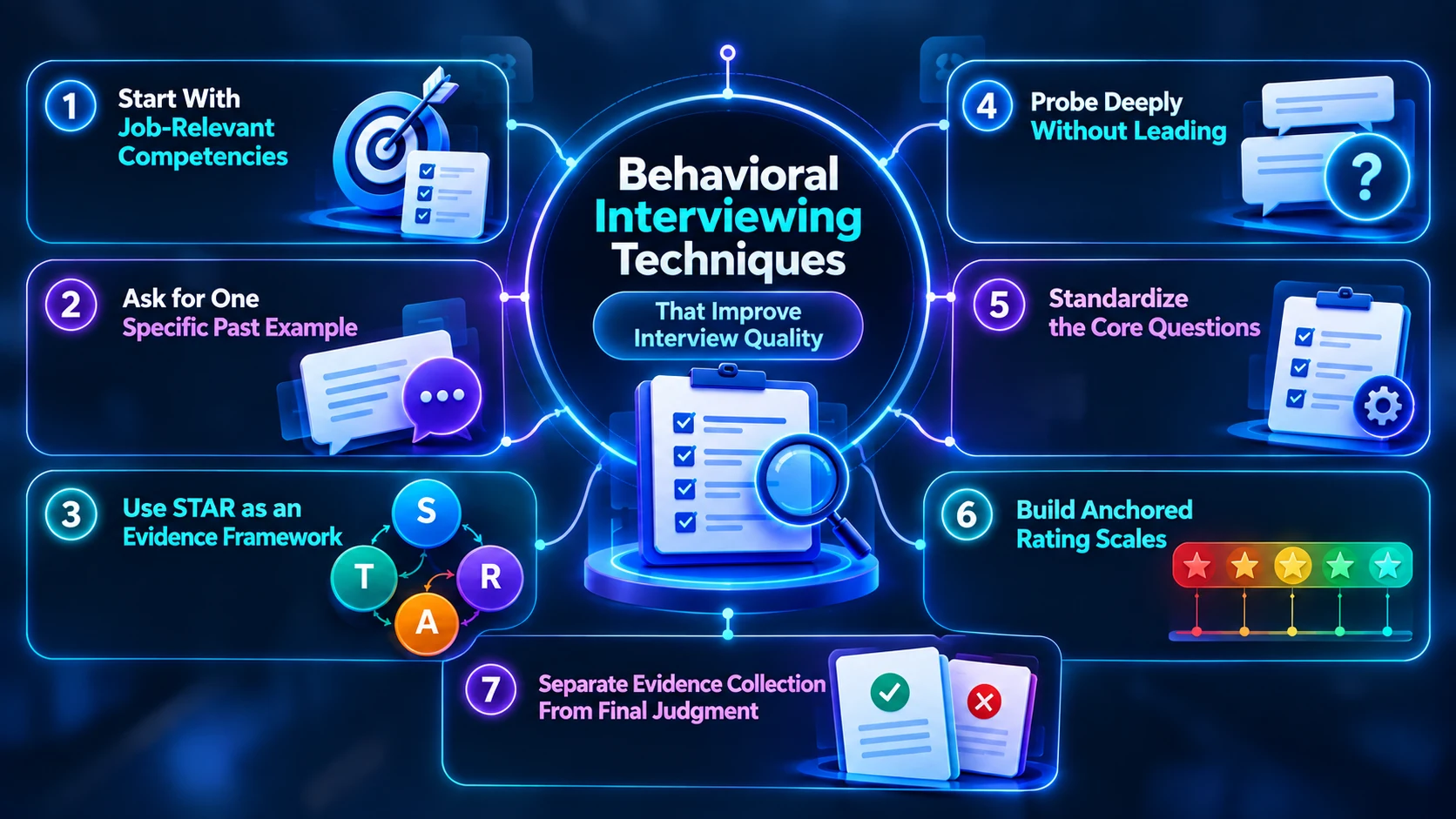
1. Start With Job-Relevant Competencies
The first step is to decide what actually matters in the role. Starting with a generic list of behavioral questions often leads to interviews that sound structured but do not necessarily test the skills needed for the job. Instead, think about the situations the person will face regularly, what they will need to do well, where the role is likely to become difficult, and what kind of behavior separates someone who can perform the job adequately from someone who can perform it really well.
For example, “collaboration” on its own is too broad. A product manager may need to influence stakeholders without formal authority, while a nurse manager may need to coordinate safely across different shifts. A sales leader may need to manage disagreements over account ownership. The competency becomes useful only when it reflects the actual work. Once that behavior is clear, it becomes much easier to write a relevant question and decide what a strong answer should contain.
2. Ask for One Specific Past Example
Broad questions usually lead to broad answers. If you ask, “How do you deal with difficult stakeholders?”, the candidate can describe the approach they believe they would normally take. That may sound convincing, but it does not give the interviewer much evidence to assess.
A better question asks the candidate to go back to one real situation. For example, instead of asking how they generally deal with disagreement, ask, “Tell me about a time you had to move a project forward when an important stakeholder strongly disagreed with your approach.” That one change gives the interviewer something concrete to work with. You can explore what caused the disagreement, how the candidate responded, what options they considered, what they personally did, and what happened afterward.
Keeping the conversation around one example also makes it easier to notice gaps or inconsistencies. If the answer keeps jumping between different situations, it becomes much harder to understand what the candidate actually did.
3. Use STAR as an Evidence Framework, Not a Script
STAR stands for:
Situation
Task
Action
Result
STAR is usually associated with how candidates structure their answers, but it can be just as useful for the interviewer. The candidate does not need to formally explain each part. It works better as a simple framework for checking whether enough evidence has been gathered.
The interviewer should understand what was happening, what the candidate was responsible for, what they personally did, and what happened as a result. If the candidate explains the situation in detail but says very little about their own actions, the answer still needs more probing. Similarly, if they describe several actions but never explain the outcome, the result is still missing.
The Action part usually deserves the most attention because candidates naturally describe team achievements using “we.” There is nothing wrong with that, but the interviewer still needs to understand the candidate’s individual contribution. If someone says, “We managed to recover the client account,” the interviewer should ask what they personally did to make that happen. The purpose is not to force the answer into a rigid format, but to make sure there is enough evidence to assess the competency properly.
4. Probe Deeply Without Leading the Candidate
The first answer is rarely the full answer. Candidates may leave out important context, skip over their own role, or describe the outcome without explaining how they reached it. This is where good follow-up questions become important.
Neutral questions such as “What did you do next?”, “What was your reasoning at that point?”, “What alternatives did you consider?”, “What was your individual role?”, “How did you know the approach worked?”, and “What would you do differently now?” help uncover more detail without directing the candidate toward a preferred answer.
Leading questions should be avoided. Asking, “So you involved the customer early, right?” suggests the response the interviewer wants to hear. A more neutral question would be, “At what point did you involve the customer?” The difference is small, but it helps protect the quality of the evidence and keeps the answer focused on what actually happened.
5. Standardize the Core Questions
Behavioral interviews become much more useful when candidates are assessed on the same core areas. If every interview follows a completely different direction, the final comparison can become more about conversation style than actual job related evidence.
The core competencies and main questions should remain consistent across candidates. Interviewers can still ask different follow up questions depending on the answer, but the basic assessment should stay the same. This does not mean the interview has to sound robotic. Natural conversation is still important, and interviewers can clarify points, acknowledge answers, and probe wherever more detail is needed.
Without that consistency, one candidate may spend a large part of the interview discussing leadership while another spends the same amount of time talking about career history or general interests. In the end, both interviews may have felt productive, but the evidence is difficult to compare because the candidates were effectively assessed on different things.
6. Build Anchored Rating Scales Before Interviews Begin
A 1-to-5 rating scale can look objective without actually being objective. Different interviewers often attach different meanings to the same number. One interviewer may give a high score because the candidate spoke confidently, while another may reserve that score for candidates who demonstrate clear ownership and measurable results.
Behavioral anchors make the scale more useful by describing what different levels of performance actually look like. For a competency such as ownership, low evidence might mean the candidate waits for direction, cannot clearly explain their contribution, or shows limited follow-through. Moderate evidence might mean they take responsibility for assigned work and handle routine barriers with appropriate support. Strong evidence might mean they identify an important issue, act within appropriate boundaries, coordinate others when necessary, follow through, and can explain the impact of their decision.
The value of the scale comes from these descriptions rather than the number itself. They give interviewers a shared reference point and help keep scoring focused on the evidence presented in the interview.
7. Separate Evidence Collection From Final Judgment
Interviewers naturally begin forming an opinion as the conversation progresses. The problem starts when that early impression begins replacing the evidence collected during the interview.
A useful approach is to record what the candidate actually did before deciding what you think of the candidate overall. For example, a note such as “Clarified the customer’s priority, proposed two recovery options, secured operations support, and restored the account within 48 hours” gives clear evidence that can be reviewed later. A note such as “Great communicator” gives very little information about why that conclusion was reached.
The same principle matters in panel interviews. Where possible, interviewers should complete their own notes and ratings before the group discussion begins. This helps prevent one panel member’s opinion from shaping how everyone else remembers the candidate’s answers.
Behavioral interviewing works best when evidence is collected first and judgment comes afterward. That separation makes the final assessment easier to compare, explain, and support.
Benefits of Behavioral Interviewing
Behavioral interviewing is valuable because it improves the quality of information available to the hiring team. Its benefits are strongest when the questions are job-related, the process is structured, and interviewers are trained to probe and score consistently.
More Concrete Evidence of Skills
A resume may say “strong stakeholder management,” but a behavioral interview asks the candidate to prove what that looked like in practice. Real examples reveal the level of difficulty, the choices made, the candidate’s role, and the consequences of those choices.
This is particularly useful for competencies that are hard to verify through a résumé alone, such as judgment, conflict management, resilience, influence, coaching, and adaptability.
Better Comparability Across Candidates
When all candidates answer the same core questions and are rated against the same behavioral standards, interviewers have a common basis for comparison.
Structured interviews improve consistency by ensuring that all candidates are asked similar job-relevant questions and are evaluated against the same criteria. A clear interview format also helps reduce variation between interviewers, makes candidate responses easier to compare, and supports more consistent scoring. Using predefined questions, rating scales, and evaluation guidelines can therefore make the interview process more systematic, transparent, and aligned with the requirements of the role.
Less Reliance on “Gut Feel”
Behavioral interviewing does not remove human judgment. It gives that judgment better inputs.
Instead of deciding based primarily on charisma, similarity, confidence, or conversational chemistry, interviewers have to point to examples. A quieter candidate with strong evidence can therefore be evaluated on what they actually did, while a highly polished candidate still has to demonstrate substance.
Stronger Interview Documentation
Evidence based notes make debriefs more useful. Hiring teams can discuss whether a candidate demonstrated a competency and why, rather than trading vague impressions.
Clear documentation also helps organizations review whether their interview process is working. If a competency is repeatedly producing weak or ambiguous evidence, the question or scoring anchor can be improved.
A More Consistent Candidate Experience
A structured process gives comparable candidates a more consistent opportunity to demonstrate relevant experience. It also helps limit interviewer drift, where candidates are effectively assessed through different conversations rather than the same core evidence.
Consistency should extend to lawful, job-related questioning.
Behavioral interviewing does not replace legal review, but a job-focused question set can help keep interviews centered on relevant evidence.
Behavioral Interview Question Examples by Competency
The strongest behavioral questions are built around situations candidates are likely to face in the role. The examples below can be adapted depending on the responsibilities, level of seniority, and working environment of the position.
1. Adaptability
Question: “Tell me about a time an important priority changed after you had already invested significant effort. What did you do?”
This question helps show how someone reacts when plans shift unexpectedly. Listen for how they decided what still mattered, what could be changed or dropped, and how they communicated the new direction to others. It is also useful to understand how they handled work that had already been completed and whether they were able to keep progress moving without becoming stuck on the original plan.
2. Problem-Solving
Question: “Describe a problem you were responsible for solving when the cause was not obvious. How did you work through it?”
The answer can give a good sense of how the candidate thinks when the solution is not immediately clear. Look at how they gathered information, narrowed down possible causes, tested assumptions, and compared different options. The important part is not simply whether the problem was solved, but how they reached the decision and whether their reasoning was deliberate and practical.
3. Ownership
Question: “Tell me about a time you noticed an important issue that was not clearly assigned to anyone. How did you handle it?”
This helps explore whether the candidate is willing to step in when something important might otherwise be overlooked. Their answer should show how they judged whether to act, who they involved, and how they kept responsibility for the issue until it was addressed. It can also show whether they understand the difference between taking initiative and stepping beyond appropriate boundaries.
4. Collaboration
Question: “Tell me about a time you worked closely with someone whose working style was very different from yours.”
Different working styles often create friction, so this question can reveal how flexible the candidate is when collaboration is not easy. Pay attention to whether they tried to understand the other person’s approach, discussed expectations openly, and made practical adjustments. A useful answer should show how both people were able to work toward the same outcome despite their differences.
5. Influence Without Authority
Question: “Give me an example of a time you needed support from people you could not directly manage. How did you gain their commitment?”
This is particularly useful for roles that require cross-functional work or stakeholder management. Listen for how the candidate understood what mattered to other people, presented their case, and dealt with resistance. Strong examples often involve persuasion, evidence, negotiation, or relationship building rather than relying on position or pressure.
6. Customer Judgment
Question: “Tell me about a difficult customer situation where the most obvious solution was not necessarily the right one.”
This question can show how the candidate balances customer expectations with business needs, policies, or risk. Look at how they identified the real issue, handled the conversation, and decided what could reasonably be offered. The response should also make clear whether they were able to protect the customer relationship without making a decision that created unnecessary problems elsewhere.
7. Decision-Making Under Uncertainty
Question: “Describe an important decision you had to make before you had all the information you wanted.”
Most roles involve decisions where complete information is not available. This question helps show how comfortable the candidate is working with that uncertainty. Listen for how they decided what information was essential, what risks they were prepared to accept, and whether they consulted others before acting. It is also worth noting how they reviewed the decision once more information became available.
8. Learning From Failure
Question: “Tell me about a project or decision that did not produce the result you expected. What happened, and what did you change afterward?”
The most useful answers are usually specific and balanced. Look for whether the candidate can explain their own role in what went wrong without blaming everyone else. More importantly, listen for what they changed afterward. A genuine lesson should show up in later decisions, habits, or ways of working, rather than ending with a general statement about what they learned.
9. Prioritization
Question: “Tell me about a time you had several urgent demands and could not complete all of them at once. How did you decide what came first?”
This question helps uncover how the candidate makes trade-offs when several tasks compete for attention. Pay attention to the factors they used to set priorities, such as deadlines, risk, business impact, dependencies, or customer needs. Their answer should also show how they communicated delays or changes and whether they involved others when priorities needed to be reset.
10. Leadership and Coaching
Question: “Describe a time someone on your team was struggling to meet expectations. How did you respond?”
A useful response should show more than simply giving feedback. Listen for whether the candidate first tried to understand why performance had dropped and then chose an appropriate response. That might include clearer expectations, coaching, additional support, or closer follow up. The way they balanced support with accountability can reveal a lot about their leadership style.
11. Ethical Judgment
Question: “Tell me about a time you were under pressure to take a shortcut that you believed created a meaningful risk.”
This question explores how the candidate responds when pressure conflicts with good judgment. Look for how they recognised the risk, raised the concern, and supported their position with relevant facts, standards, or policies. It is also useful to understand whether they suggested a practical alternative and how they handled the situation if others continued to push for the shortcut.
12. Communication
Question: “Tell me about a time you had to explain a complex or unpopular decision to people who did not initially agree with it.”
This can show how well the candidate handles difficult communication. Listen for how they explained the reasoning behind the decision, adjusted the message for the audience, and responded to questions or disagreement. A good example should also show whether they were able to maintain trust while staying clear and accurate about the facts.
These examples are starting points rather than a fixed script. The most useful behavioral questions reflect situations the person is genuinely likely to face in the role and give each candidate a fair opportunity to demonstrate relevant experience.
How to Evaluate Behavioral Interview Answers
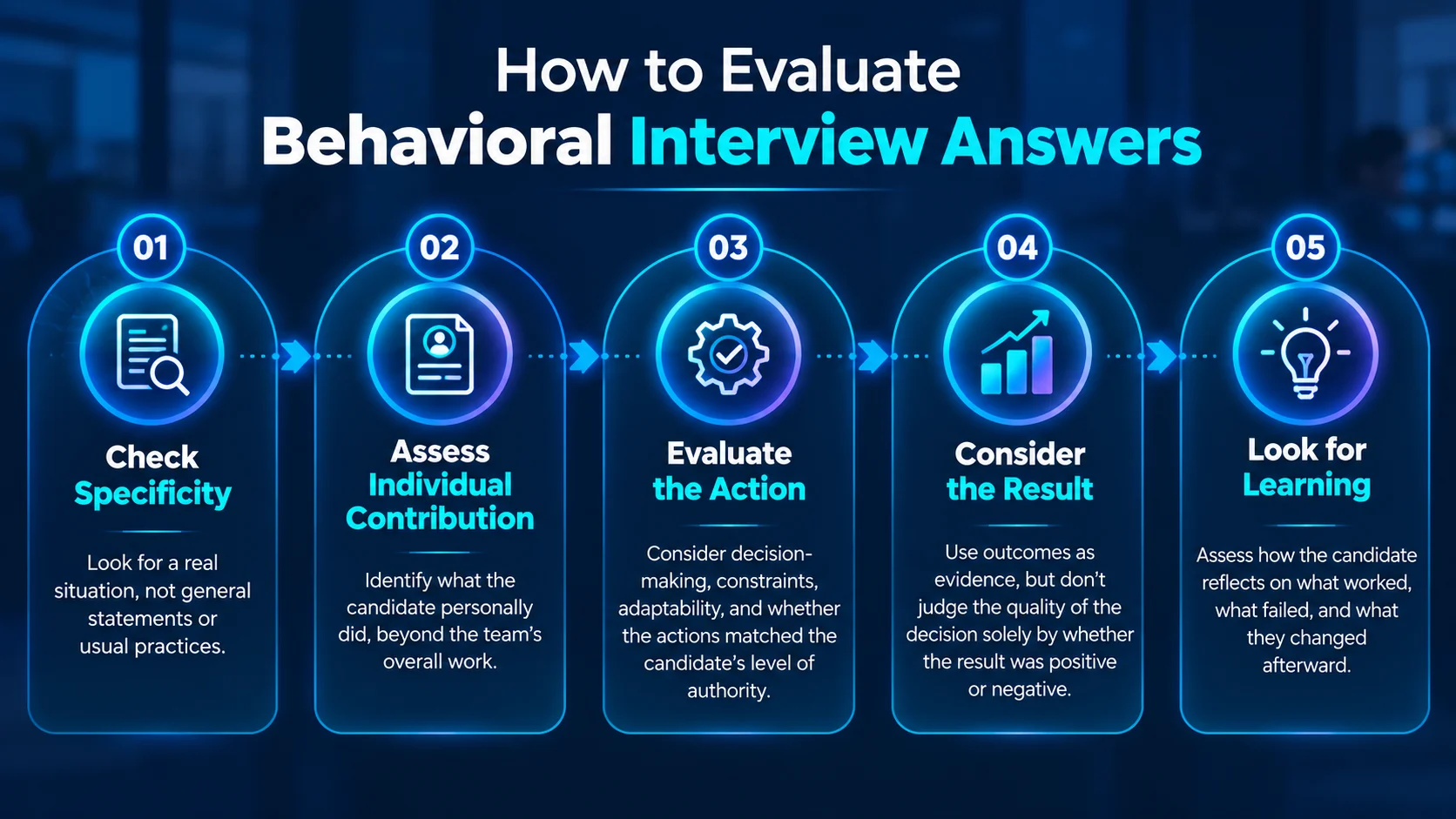
A strong answer is not simply long, confident, or perfectly organized. The interviewer is looking for credible evidence that maps to the competency being assessed.
Start by checking whether the example is specific. If the candidate speaks only about what they “usually do,” ask for one actual situation. Then clarify the candidate’s individual contribution. Team context matters, but the score should reflect what the candidate personally demonstrated.
Next, evaluate the quality of the action. Did the candidate make a thoughtful decision? Did they consider relevant constraints? Did they adapt when new information appeared? Were their actions appropriate for their level of authority?
Results matter, but they should not be interpreted simplistically. A good decision can still produce a poor outcome because of factors outside the candidate’s control. Conversely, a positive result does not always prove good judgment. Interviewers should score the behavior demonstrated, using the outcome as one part of the evidence.
Finally, look for learning. In many competencies, the ability to reflect on what worked, what failed, and what changed afterward can be as informative as the original event.
A practical scoring process is:
1. Capture factual notes during the answer.
2. Identify evidence relevant to the target competency.
3. Compare it with the predefined rating anchors.
4. Assign the rating before the debrief.
5. Record a short evidence-based rationale.
Common Behavioral Interviewing Mistakes
Even well-written behavioral questions can fail when the process around them is inconsistent.
1. Treating Every Detailed Story as Strong Evidence
A detailed story can still be irrelevant to the competency being assessed.
Score what the candidate demonstrated—not how entertaining, confident, or polished the answer sounded.
2. Accepting “We” Without Clarifying “I”
Team achievements are valuable, but the interviewer needs to understand the candidate's individual contribution.
Ask:
“What did you personally do?”
3. Over-Probing One Candidate and Under-Probing Another
Follow-up questions should recover missing evidence rather than give certain candidates more opportunities to improve their answers.
Use a consistent probing framework across candidates.
4. Scoring From Memory at the End
Waiting until the end of the interview can cause interviewers to rely on incomplete recollections.
Capture evidence during the interview and rate competencies while the information is still fresh.
5. Asking Generic Questions With No Role Connection
Questions such as:
“Tell me about a challenge.”
can produce almost anything.
Instead, describe the type of challenge that matters for the specific role.
6. Using Behavioral Questions as a Legal Safe Harbor
Calling a question “behavioral” does not automatically make it appropriate.
Interview questions should remain job-related and should be reviewed against applicable employment requirements.
Behavioral Interview vs. Structured, Situational, Case and Unstructured Interviews
Behavioral, structured, situational, case, and unstructured interviews describe different aspects of an interview.
Behavioral and situational approaches primarily describe the type of evidence requested, while structured and unstructured approaches describe how consistently the interview is conducted. A case interview describes a particular problem-solving assessment format.
Interview Format | Main Focus | Typical Question Style | Common Use |
|---|---|---|---|
Behavioral Interview | Evidence of how a candidate behaved in real past situations | “Tell me about a time when…” | Assessing demonstrated competencies such as leadership, adaptability, collaboration, judgment, and problem-solving |
Structured Interview | Consistent assessment across candidates | Same core questions and predefined rating criteria | Improving consistency and evidence-based comparison |
Situational Interview | How a candidate would respond to a hypothetical situation | “What would you do if…?” | Assessing judgment and reasoning |
Case Interview | How a candidate analyzes a problem in real time | Business problem, scenario, dataset, or case | Evaluating analytical thinking, problem-solving, domain reasoning, and communication |
Unstructured Interview | Open conversation guided by the discussion | Questions vary between candidates | Exploratory conversations where flexibility is prioritized |
These formats can also be combined.
For example, a structured interview might include:
Two behavioral questions
One situational question
One case exercise
One work sample
The important consideration is whether the method matches the competency being assessed and whether candidates are evaluated using clear and consistent standards
Conclusion
Behavioral interviewing gives hiring teams a practical way to move from broad impressions to job-relevant evidence. Instead of relying mainly on statements such as “I work well under pressure” or “I am a strong leader,” interviewers ask candidates to describe specific experiences and then examine the actions, decisions, trade-offs, and outcomes behind those claims.
The method is strongest when it is part of a structured process. Define the competencies before the interview, ask the same core questions of comparable candidates, use neutral follow-up probes, and score responses against clear behavioral anchors. That approach does not eliminate human judgment; it gives interviewers a more consistent and traceable basis for using it. It also makes the debrief more useful because the discussion can center on demonstrated evidence rather than charisma, confidence, or vague “fit” impressions.
Technology can support that process by helping teams organize interviews, document evidence, and protect the integrity of remote assessments. It should not replace well-designed questions, trained interviewers, or human review. In an AI assisted interview environment, deeper probing may help reveal gaps or inconsistencies, but no single conversational signal should be treated as proof of external assistance.
Ultimately, behavioral interviewing works best as a disciplined hiring method rather than a collection of popular questions. When questions reflect real job demands and answers are evaluated consistently, hiring teams can make more informed comparisons while giving candidates a clearer opportunity to demonstrate what they have actually done.