Back to all blogs
Discover 15 common hiring mistakes and learn how to improve hiring with structured interviews, better candidate evaluation, clear communication, and post-hire measurement.

Abhishek Kaushik

Hiring mistakes rarely begin with one dramatic decision. More often, they start with small gaps in the process: a vague job description, unclear evaluation criteria, rushed interviews, weak candidate communication, or an onboarding plan that stops after the first day. Each issue can look manageable on its own, but several together can make hiring slower, less consistent, and more expensive.
The pressure on hiring teams remains real. SHRM’s 2026 Talent Trends research found that 68% of HR professionals reported difficulty recruiting full-time employees among more than 2,000 HR professionals surveyed.
Avoiding hiring mistakes does not mean adding layers of bureaucracy. It means deciding what good hiring looks like before an open role creates urgency. Clear requirements, relevant skills evidence, structured interviews, timely communication, thoughtful onboarding, and post-hire measurement can make the process more deliberate without making it unnecessarily slow.
This guide breaks down 15 common hiring mistakes and practical ways to avoid them. Each mistake follows the same structure: the problem, why it matters, and what hiring teams can do differently. The goal is not a perfect process. It is a process that collects better evidence, treats candidates consistently, and learns from its own results.
Quick Takeaway
Define the role around outcomes and job-relevant skills before sourcing candidates.
Use structured, comparable evidence instead of relying on impressions or credentials alone.
Keep hiring technology subject to appropriate human review and legal safeguards.
Communicate clearly with candidates and remove process steps that do not add useful evidence.
Measure what happens after the hire so the hiring process can improve over time.
15 Common Hiring Mistakes
Hiring mistakes can lead to poor candidate experiences, longer hiring cycles, increased costs, and the wrong hires. Many of these issues happen when hiring teams rely on inconsistent processes, unclear evaluation criteria, or incomplete candidate verification. Here are 15 common hiring mistakes organizations should avoid.
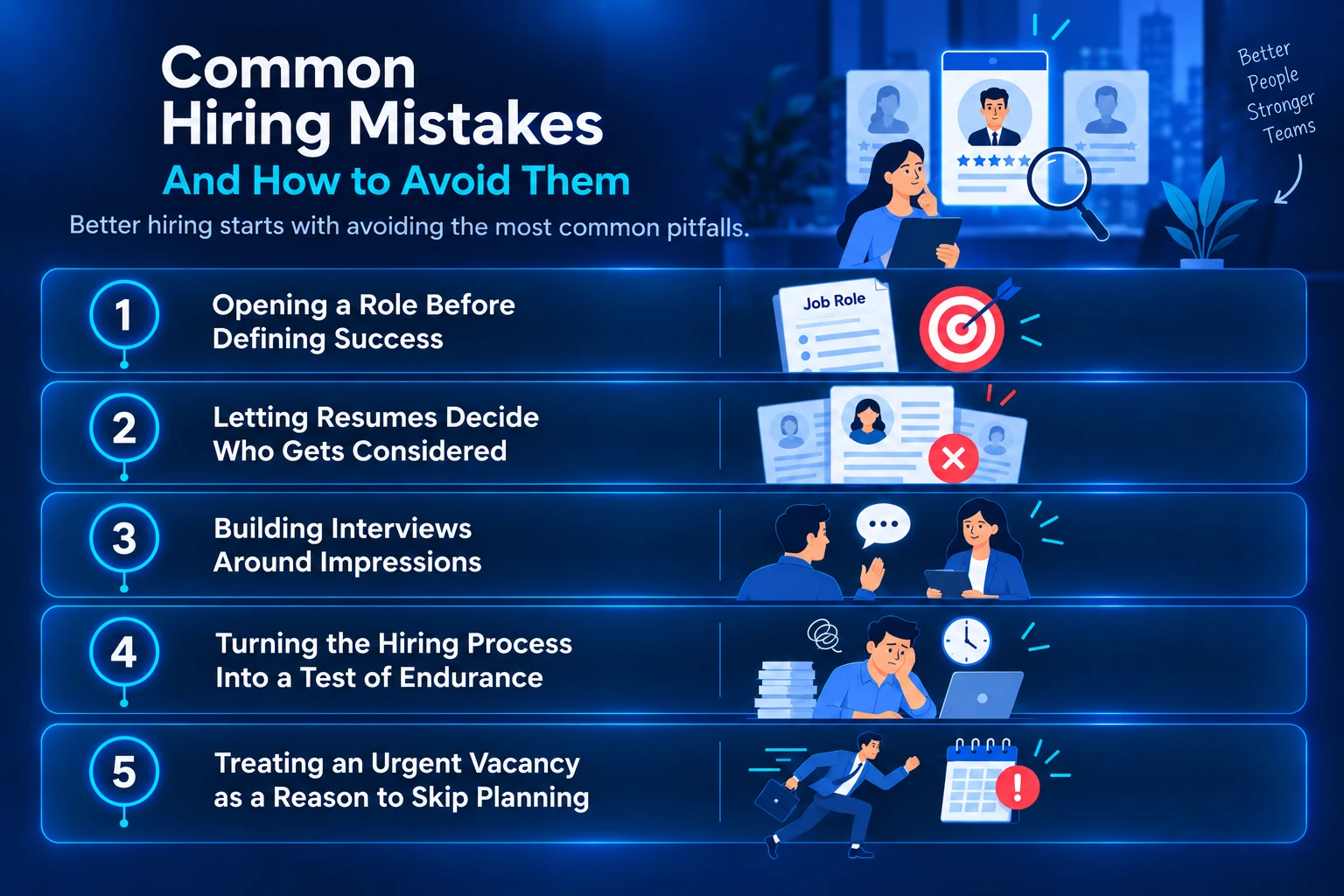
Mistake #1: Opening a Role Before Defining What Success Looks Like
A hiring process becomes difficult to manage when the team starts searching before agreeing on what the role actually needs to accomplish.
A job description can contain pages of responsibilities and still fail to answer a basic question: what should this person achieve after joining? When that expectation is unclear, recruiters may screen for different qualities, interviewers may focus on different capabilities, and candidates may receive inconsistent descriptions of the same position.
The problem is therefore bigger than writing a better job description. The organization needs a shared definition of the work before it starts evaluating people for it.
How to Avoid This Hiring Mistake
Define first-year outcomes: Identify the most important results the person should deliver during the first six to 12 months.
Separate requirements from preferences: Distinguish skills that are genuinely necessary from qualifications that would simply be useful.
Describe the work clearly: Explain responsibilities and expectations in language candidates can understand without relying on internal terminology.
Connect the role to the rest of the process: Use the agreed outcomes and skills to shape screening questions, assessments, interview criteria, and onboarding expectations.
Include required pay information: Where local law requires salary disclosure, include it in the job posting.
Mistake #2: Letting Resumes Decide Who Deserves a Closer Look
Résumés provide useful information about a candidate’s background, but they do not necessarily demonstrate whether someone can perform the actual work.
Degrees, job titles, certifications, and years of experience can provide context without proving capability. Problems arise when those credentials become a shortcut for deciding who is worth evaluating further.
A candidate with a nontraditional background may have the skills required for the job but fail an initial screen because their experience does not match an expected career pattern. At the same time, a candidate with an impressive résumé may still need to demonstrate the specific capabilities the role requires.
How to Avoid This Hiring Mistake
Identify the skills that matter: Start with the capabilities required to perform the actual responsibilities of the position.
Use work samples where appropriate: Depending on the role, consider coding tasks, writing samples, sales scenarios, design exercises, data-analysis problems, customer-service role plays, or short case studies.
Keep assessments job-relevant: A test should measure something genuinely connected to the work rather than adding difficulty for its own sake.
Keep assignments proportionate: Candidates should not have to complete extensive unpaid work simply to demonstrate basic suitability.
Use credentials as context: Education, certifications, and experience can remain relevant when the role genuinely requires them, but they should not automatically replace evidence of capability.
Mistake #3: Building Interviews Around Impressions Instead of Evidence
Interviews can become unreliable when every interviewer decides independently what a good candidate looks like.
One interviewer may focus on confidence, another on technical knowledge, and another on personal chemistry. Those observations may all feel meaningful, but they do not necessarily provide comparable evidence.
The result can be a hiring decision driven by impressions rather than by what candidates actually demonstrated during the process.
How to Avoid This Hiring Mistake
Define competencies before interviewing: Agree on the capabilities that matter before candidates enter the interview process.
Prepare core questions: Use consistent questions for comparable candidates so that interviewers collect evidence against the same areas.
Focus on evidence: Encourage interviewers to record what the candidate said, did, or demonstrated rather than using labels such as “confident” or “good fit.”
Use a simple evaluation framework: Give interviewers clear criteria for distinguishing strong, adequate, and insufficient evidence.
Collect feedback independently first: Where practical, have interviewers record their assessments before group discussion so the most senior or vocal person does not automatically shape everyone else’s view.
Mistake #4: Turning the Hiring Process Into a Test of Candidate Endurance
A longer hiring process is not automatically a more accurate one.
Organizations sometimes add interviews, assessments, presentations, approvals, and meetings without checking whether each stage provides new information. Candidates may then spend considerable time repeating similar conversations while hiring teams spend additional time coordinating them.
Complexity can also make it harder for candidates to understand what the organization actually values.
How to Avoid This Hiring Mistake
Give every stage a purpose: Identify the specific decision or competency each stage is designed to assess.
Remove duplication: If two interviews measure essentially the same thing, consider combining them.
Avoid repeated assessments: If a work sample already provides strong evidence of a particular skill, do not repeatedly test the same capability without a clear reason.
Set a reasonable timeline: Reduce unnecessary gaps between stages instead of simply adding more evaluation steps.
Review the process regularly: Ask whether each stage still contributes useful evidence or has become part of the process simply because it has always been there.
Mistake #5: Treating an Urgent Vacancy as a Reason to Skip Planning
An open position can create pressure to start sourcing immediately. When a team is short-staffed, getting candidates into the pipeline can feel more important than agreeing on the details of the search.
That approach can create problems later. Hiring requirements may change after candidates have already applied, different decision-makers may look for different qualities, or the team may discover halfway through the process that it has not agreed on how candidates should be evaluated.
The initial rush can therefore create more work rather than less.
How to Avoid This Hiring Mistake
Create a hiring brief: Record why the role is needed, what the person is expected to accomplish, and which skills are essential.
Identify decision-makers early: Make sure everyone involved understands their role in the process before interviews begin.
Set the evaluation stages: Decide in advance which screening, assessment, and interview steps candidates will complete.
Set target dates: Establish realistic dates for sourcing, interviews, decisions, and offers.
Speed up coordination, not evidence gathering: When a role is urgent, shorten waiting periods between stages rather than removing steps that provide important evidence.
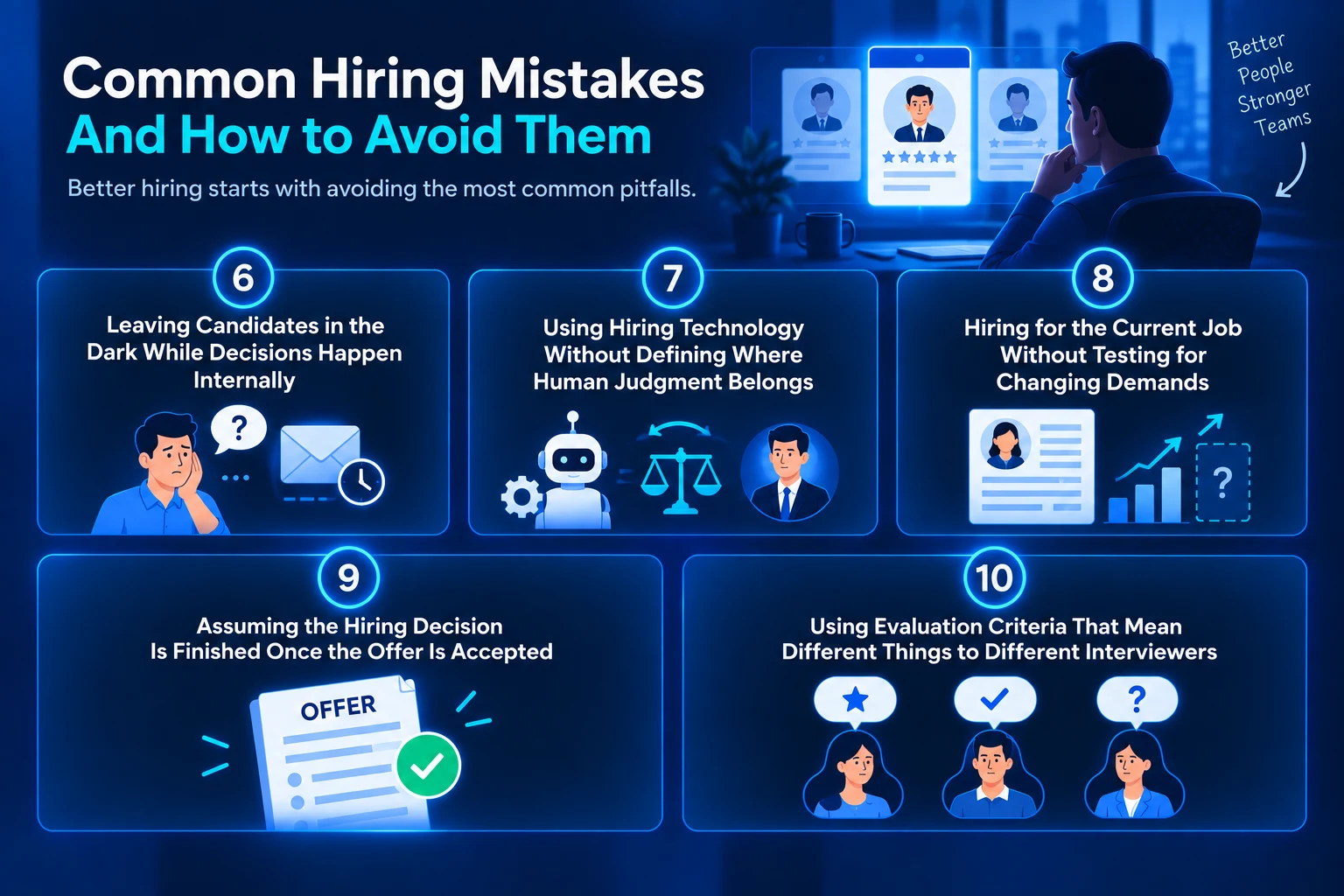
Mistake #6: Leaving Candidates in the Dark While Decisions Happen Internally
Candidate communication can break down when recruiters are waiting for hiring managers, managing multiple vacancies, or dealing with internal delays.
A candidate may complete an interview and then hear nothing for weeks. Even when the hiring team is still actively considering the person, silence can make the process appear disorganized.
Good communication does not mean sending constant updates. It means making the process predictable enough that candidates understand what has happened, what happens next, and when they can reasonably expect to hear from the organization.
How to Avoid This Hiring Mistake
Set expectations early: Explain the stages, likely participants, and expected timeline at the beginning of the process.
Give candidates a next step: Every communication should make it clear what the candidate should expect next.
Communicate delays: If an internal decision takes longer than expected, tell candidates rather than leaving them to guess.
Use templates carefully: Automated or templated messages can save time, but they should accurately reflect the candidate’s current stage.
Review communication gaps: Track where candidates regularly wait too long and identify whether internal approval or scheduling issues are causing the delay.
Mistake #7: Using Hiring Technology Without Defining Where Human Judgment Belongs
Recruiting technology can reduce repetitive work, but not every use of technology carries the same level of risk.
Scheduling interviews or organizing applications is different from using an automated system to rank candidates, filter applications, or generate recommendations that influence who advances.
The problem is not simply using technology. It is failing to understand what the system does, where its output influences decisions, and where human review is necessary.
Accessibility is also important. The EEOC explains that algorithmic or AI decision-making tools may unintentionally or intentionally screen out people with disabilities and that employers may need to provide reasonable accommodation, such as an alternative testing format, when appropriate.
How to Avoid This Hiring Mistake
Map technology to decisions: Document which tools are used and whether they only support administration or influence candidate evaluation.
Keep appropriate human review: Do not treat an automated score, recommendation, or ranking as a complete hiring decision.
Check accessibility: Make sure candidates have an appropriate way to request accommodation when technology could create barriers.
Account for EU requirements where applicable: The EU AI Act classifies certain AI systems used for recruitment and selection as high-risk, including systems used to target job advertisements, filter applications, or evaluate candidates.
Document the process: Keep a record of where technology affects candidate decisions and what human oversight is applied.
Mistake #8: Hiring for the Current Job Without Testing for Changing Demands
A candidate may be able to perform today’s responsibilities but struggle when the role changes.
This can matter when responsibilities are expected to expand, technology is evolving, or customer needs are shifting. At the same time, hiring for vague “potential” can create another problem if the team cannot explain what future capability actually means.
The answer is to consider future requirements without turning adaptability into a subjective personality test.
How to Avoid This Hiring Mistake
Look ahead: Consider how the responsibilities of the position could change over the next 12 to 24 months.
Ask for examples: Ask candidates about situations where they learned new skills, handled changing priorities, or solved unfamiliar problems.
Test relevant adaptability: Use job-related scenarios when possible instead of asking broad questions about whether someone is “flexible.”
Define potential: Decide what future capability means for the specific role before evaluating candidates against it.
Balance present and future needs: A candidate still needs to meet the requirements of the current position; future adaptability should complement rather than replace those requirements.
Mistake #9: Assuming the Hiring Decision Is Finished Once the Offer Is Accepted
An accepted offer is an important milestone, but it does not guarantee a successful transition into the organization.
A new employee can arrive without equipment, system access, documentation, introductions, or clear priorities. The employee may then spend their first weeks trying to understand basic processes instead of becoming productive in the role.
This is also where the expectations created during recruitment become reality. If the experience promised during hiring does not match the experience after joining, the organization has a process problem to address.
How to Avoid This Hiring Mistake
Prepare before day one: Arrange equipment, system access, accounts, documentation, and required permissions before the employee starts.
Create a first-week plan: Give the new employee a clear schedule covering introductions, training, responsibilities, and immediate priorities.
Set early expectations: Explain what success should look like during the first 30, 60, and 90 days.
Schedule manager check-ins: Regular conversations can identify questions or obstacles before they become larger problems.
Connect onboarding to the hiring process: Make sure the expectations discussed during interviews are reflected in the employee’s actual responsibilities and early goals.
Mistake #10: Using Evaluation Criteria That Mean Different Things to Different Interviewers
Even structured interviews can become subjective when the hiring team has not agreed on what each criterion means.
Words such as “leadership,” “communication,” “culture fit,” or “strong candidate” can mean different things to different interviewers. One person may interpret leadership as decisiveness, while another may associate it with collaboration or delegation.
When those differences are not addressed, candidates may effectively be evaluated against different standards.
How to Avoid This Hiring Mistake
Define each competency: Explain what the organization means by every criterion used in the evaluation.
Use observable behaviors: Replace broad labels with behaviors that interviewers can actually identify.
Set evidence levels: Describe what strong, acceptable, and insufficient evidence looks like.
Keep criteria job-related: Only assess characteristics that are genuinely relevant to performing the role.
Use common criteria for comparable candidates: This makes candidate discussions more consistent and easier to support with evidence.
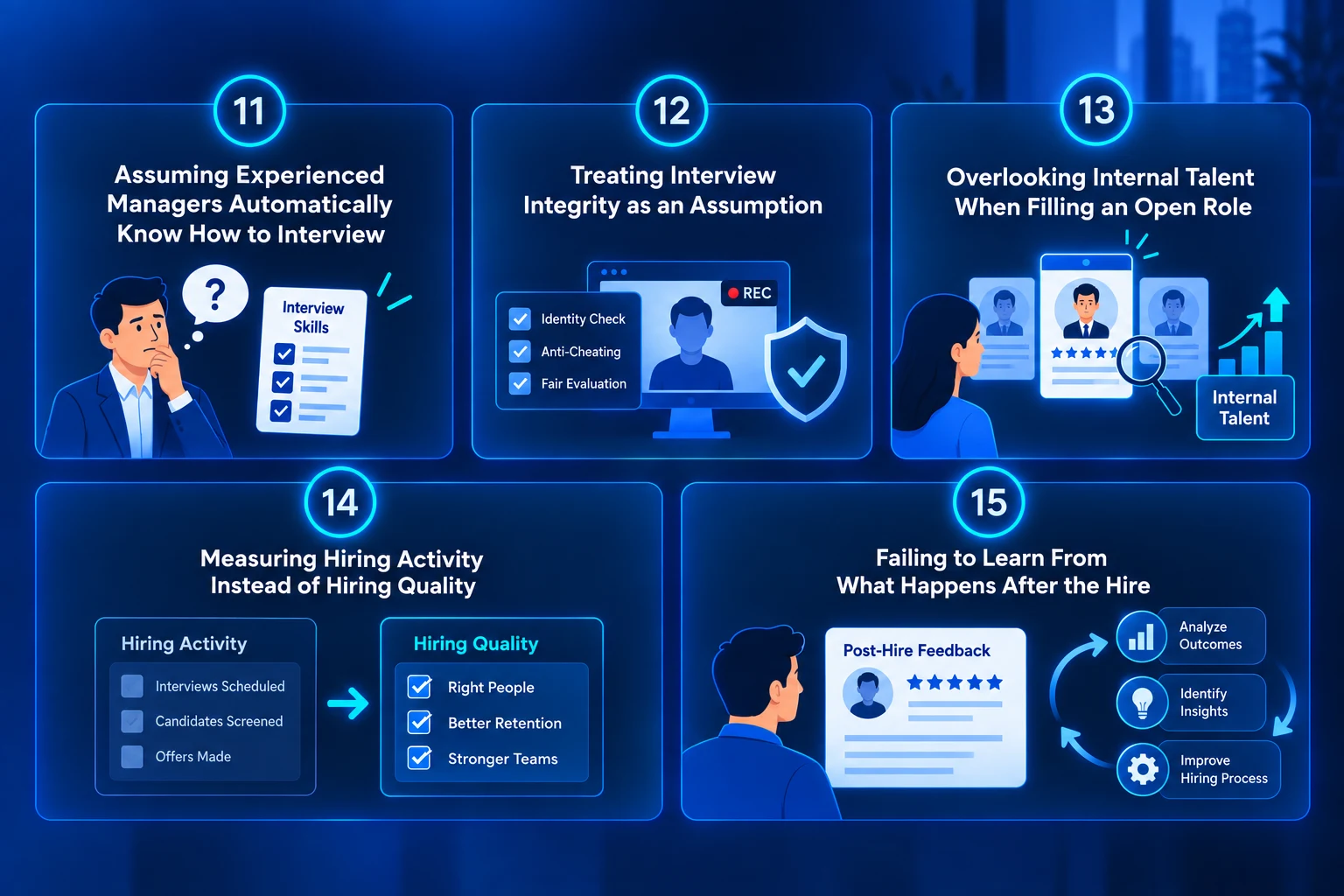
Mistake #11: Assuming Experienced Managers Automatically Know How to Interview
Managing employees and evaluating candidates require overlapping but different skills.
An experienced manager may understand the job extremely well but still ask leading questions, talk too much during interviews, overlook evidence, or unintentionally steer candidates toward particular answers.
Without preparation, even a strong hiring manager can turn a structured process into an informal conversation based largely on personal preference.
How to Avoid This Hiring Mistake
Train interviewers: Cover question design, structured evaluation, note-taking, evidence-based follow-ups, and appropriate interview boundaries.
Explain the evaluation framework: Interviewers should understand exactly what they are assessing and why.
Practice with sample responses: Give interviewers the same candidate response and ask them to evaluate it independently.
Discuss differences: Calibration exercises can reveal why different interviewers interpret the same evidence differently.
Review interviewer performance: Look for recurring patterns such as inconsistent scoring, excessive talking, or repeated questions that do not produce useful evidence.
Mistake #12: Treating Interview Integrity as an Assumption
Remote hiring can create challenges around identity continuity and assessment integrity.
For some roles, it may be difficult to establish that the person participating in a later interview is the same person who completed an earlier assessment. External assistance may also be harder to detect during a standard video conversation.
That does not mean unusual behavior should automatically be treated as misconduct. Verification should be proportionate to the role, the assessment, and the potential impact of the concern.
How to Avoid This Hiring Mistake
Use proportionate verification: Consider identity checks at appropriate stages when the role or assessment warrants them.
Ask candidates to explain their work: Follow technical or written assessments with questions about the candidate’s approach, reasoning, and trade-offs.
Look for multiple signals: Avoid making a hiring decision based on one unusual behavior or isolated anomaly.
Maintain consistency: Use the same integrity process for comparable candidates rather than applying different standards.
Document serious concerns: If an integrity issue could affect the hiring decision, record the evidence and follow a defined escalation process.
Mistake #13: Overlooking Internal Talent When Filling an Open Role
External recruitment is not always the only route to filling a vacancy.
Existing employees may already understand the organization’s customers, systems, processes, and expectations. They may also have skills that can transfer to a new position with targeted development.
Ignoring internal talent can mean missing an opportunity to use existing capabilities while also limiting employees’ visibility into career opportunities within the organization.
How to Avoid This Hiring Mistake
Consider internal recruitment: Where appropriate, make eligible employees aware of open roles before or alongside external sourcing.
Explain the requirements: Give internal candidates the same clarity about responsibilities and skills that external candidates receive.
Use consistent criteria: Evaluate internal candidates against the requirements of the role rather than assuming familiarity automatically makes someone qualified.
Consider development gaps: If an employee lacks one skill, determine whether reasonable training or development could close the gap.
Keep the process fair: Internal consideration should not mean automatically selecting an existing employee; candidates should still be evaluated against the requirements of the position.
Mistake #14: Measuring Hiring Activity Instead of Hiring Quality
Recruiting teams often track metrics such as applications, interviews, time-to-fill, source volume, and offers.
These measures can be useful for understanding workflow, but they do not necessarily show whether the organization is making successful hiring decisions.
How to Avoid This Hiring Mistake
Track post-hire outcomes: Depending on the role, consider retention, time to productivity, performance against agreed goals, manager feedback, or progression.
Keep recruitment metrics: Time-to-fill and candidate volume still have value, but use them alongside outcome measures.
Connect outcomes to hiring sources: Review whether particular sourcing channels consistently produce successful hires.
Review assessment value: Consider whether the assessments and interviews used during hiring actually provide useful information about later performance.
Look for process drop-off: If strong candidates repeatedly leave at a particular stage, investigate whether that stage is creating unnecessary friction.
Mistake #15: Failing to Learn From What Happens After the Hire
Collecting post-hire data is useful, but the process does not improve unless the organization acts on what the data shows.
If new hires repeatedly struggle with the same expectation, strong candidates regularly leave during the same stage, or a particular sourcing channel consistently produces poor matches, the organization has information that can be used to change the process.
Without that feedback loop, the same problems can repeat with every hiring cycle.
How to Avoid This Hiring Mistake
Set a review point: Decide when hiring outcomes should be reviewed after an employee has had enough time to demonstrate early performance.
Compare hiring evidence with outcomes: Look at whether interview assessments, work samples, and other selection evidence correspond with what happens after hiring.
Investigate repeated problems: If new hires consistently miss the same expectations, check whether the role definition or evaluation criteria need to change.
Review candidate drop-off: Identify where strong candidates leave the process and whether delays or unnecessary steps contribute to that pattern.
Make changes based on evidence: Use findings to adjust sourcing, screening, interviews, assessments, onboarding, or other parts of the hiring process.
Hiring Mistake Prevention Checklist
The 15 mistakes are connected. A poorly defined role can create weak screening criteria. Weak criteria can produce inconsistent interviews. An unnecessarily long process can cause candidate drop-off. Poor onboarding can undermine an otherwise well-supported hiring decision. And without post-hire measurement, organizations may not know which parts of the process are working.
A practical hiring process should therefore connect each stage to the next.
Before Opening the Role
Define the outcomes and skills required for the position.
Separate essential requirements from preferences.
Establish evaluation criteria before reviewing candidates.
Confirm the hiring stages, decision-makers, and timeline.
During Candidate Evaluation
Use job-relevant evidence rather than relying on credentials alone.
Train interviewers and give them shared evaluation criteria.
Keep interview and assessment stages proportionate.
Use technology with appropriate human oversight and accessibility safeguards.
Maintain consistent procedures for identity and interview-integrity concerns where appropriate.
During the Candidate Experience
Explain the process and expected timeline.
Communicate delays rather than leaving candidates waiting.
Provide required pay information where applicable.
Consider qualified internal candidates where appropriate.
After the Hiring Decision
Prepare onboarding before the employee starts.
Measure post-hire outcomes and use those findings to improve future hiring.
Conclusion
The most common hiring mistakes are usually process problems rather than isolated recruiter errors. Unclear role expectations, credential-heavy screening, inconsistent interviews, unnecessary process steps, weak communication, poorly controlled technology, and limited post-hire measurement can all make hiring less effective.
The answer is not to add complexity for its own sake. A stronger process starts by defining what the organization needs, then collecting relevant evidence at each stage.
Hiring teams can make the process more deliberate by evaluating job-relevant skills, using consistent criteria, preparing interviewers, keeping candidates informed, applying appropriate human oversight to technology, and preparing new employees for the transition into the role.
Most importantly, hiring should not stop being measured once an offer is accepted. Looking at what happens after the hire gives organizations an opportunity to understand which parts of their process are producing useful results and which need to change.
A hiring process becomes stronger when every stage has a clear purpose, every decision is supported by relevant evidence, and the organization learns from the outcomes it produces.