Back to all blogs
Explore group interviews, including how they work, common types, key benefits, practical uses, and differences from one-on-one and panel interviews.

Abhishek Kaushik
Picture yourself walking into an interview and finding several other candidates there. Instead of meeting the recruiter alone, everyone is asked to take part in the same discussion or activity. This is what a group interview looks like. It gives employers a chance to assess multiple candidates while also seeing how they interact with others.
In a group interview, several candidates are assessed together by one or more interviewers. The session may involve questions, discussions, presentations, problem-solving tasks, case studies, or role-play exercises. The exact format usually depends on the position and the skills the employer wants to assess.
What makes this format different from a regular one-on-one interview is the interaction between candidates. Recruiters can observe how people communicate their ideas, listen to others, respond to different opinions, contribute to a discussion, and work towards a shared goal. These observations can be useful for roles where teamwork and communication are part of everyday work.
Group interviews are not limited to a particular stage of hiring. An organisation may use one early in the selection process to assess several applicants or later in the process when candidates need to demonstrate specific skills through a practical activity.
Research has also looked at whether group assessments can provide useful selection information. A study of 68 student-teachers found that group-assessment ratings were related to later student-teaching performance, with assessors showing strong agreement in their evaluations. The assessment considered verbal, interpersonal, leadership, and overall performance. The study was conducted in teacher education, so its findings should be viewed within that particular selection setting.
What Is a Group Interview?
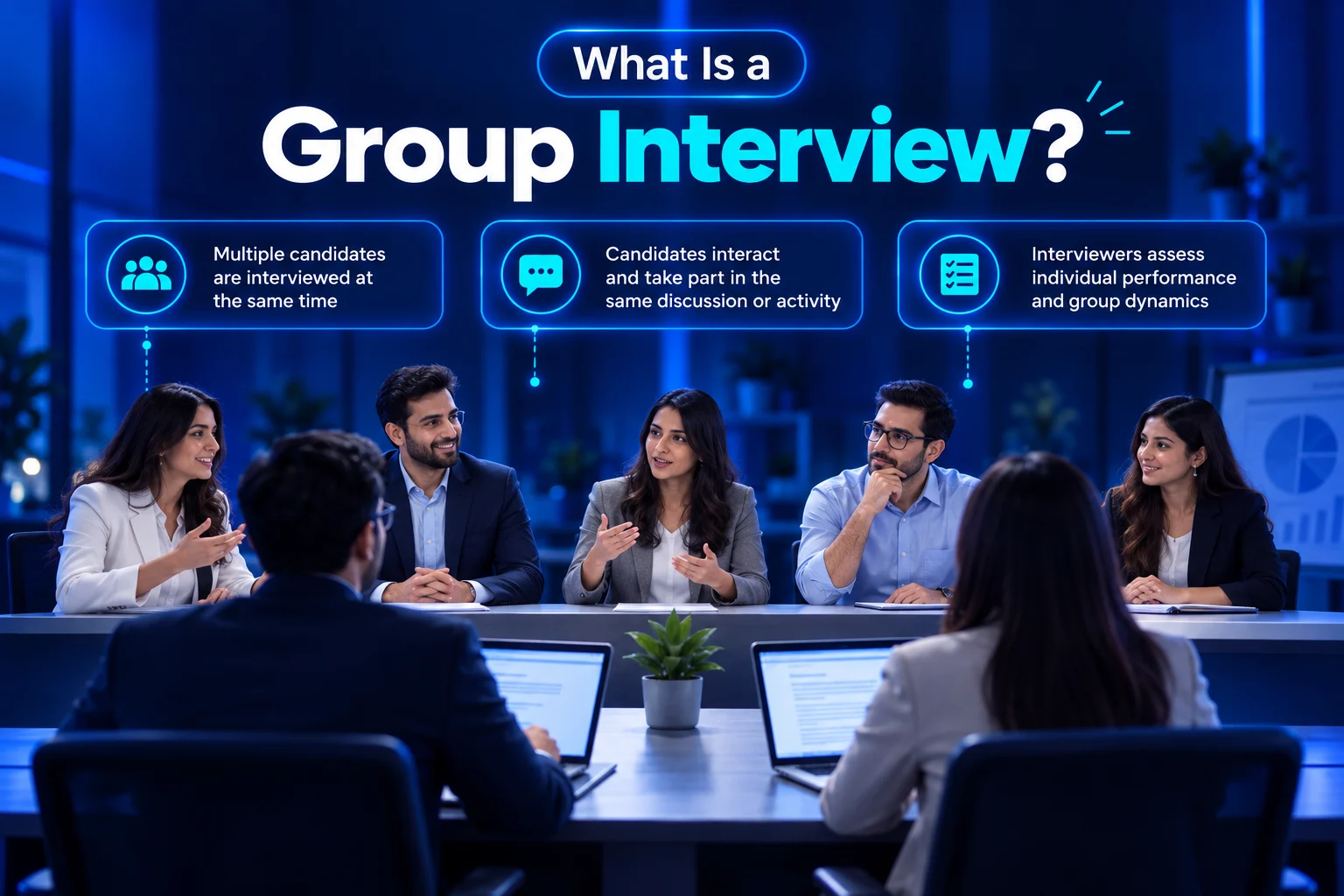
A group interview is a hiring interview where several candidates are interviewed or assessed at the same time by one or more interviewers. Rather than meeting each person separately, the candidates take part in the same interview or activity.
The main difference is that candidates are assessed while they are interacting with other people. This gives interviewers a chance to see how they communicate, listen to others, share their thoughts, respond to different opinions, and take part in a discussion.
There is no single format for a group interview. Depending on the role and the hiring process, it might include questions, group discussions, problem-solving activities, presentations, case studies, or role-play exercises. Some organisations may also conduct these interviews online.
During the session, interviewers can look at both the individual contribution of each candidate and how they work with the group. Speaking the most does not necessarily mean someone is performing better; the relevance of their ideas and the way they respond to others also matter.
In simple terms, a group interview brings multiple candidates into the same assessment and gives employers an opportunity to see how they communicate and interact with others, along with what they can bring to the role individually.
How Does a Group Interview Work?
A typical group interview begins with an introduction from the recruiter or hiring team. Candidates may be asked to introduce themselves before moving into questions, discussions, role-play exercises, case studies, presentations, or problem-solving activities.
The exact structure depends on the role and hiring process. Recruiters may explain the activity and its instructions before candidates begin. Throughout the session, interviewers observe how candidates communicate, participate, and respond to others.
The interviewer usually observes several dimensions of behavior, including communication, listening, cooperation, initiative, leadership, reasoning, and respect for other participants. The purpose is not necessarily to identify the person who speaks the most. Instead, the interviewer should look for behaviors that are relevant to the requirements of the position.
What Do Interviewers Usually Observe?
Communication: How clearly candidates express their ideas.
Teamwork: How well they cooperate with other participants.
Problem-solving: How they approach questions or group tasks.
Professional behavior: How they listen, handle disagreements, and respect others.
Example: Imagine a company hiring customer-service representatives. Five candidates are given a situation involving an unhappy customer and asked to discuss how they would resolve it. One candidate may demonstrate empathy, another may organize the discussion, another may identify a practical solution, and another may show strong listening skills. The exercise gives the recruiter several behaviors to evaluate within the same situation.
A group interview gives recruiters an opportunity to observe candidates in an interactive setting while assessing skills that are relevant to the role.
Why Do Employers Use Group Interviews?
Employers commonly use group interviews when interpersonal behavior is important to job performance or when they need to evaluate multiple applicants efficiently. Research on group selection interviews notes that organizations may use them as a cost-effective alternative when assessing many applicants, particularly when a full assessment-center process would require greater resources.
Group interviews can serve several purposes in the hiring process:
To observe real-time interaction: Unlike a traditional interview where candidates mainly describe their behavior, group interviews allow recruiters to observe how candidates communicate and respond to others during the assessment.
To assess multiple candidates efficiently: Employers can evaluate several applicants in the same session, which can be useful when a large number of candidates are applying for the same position.
To understand teamwork: Group activities can show how candidates share ideas, listen to others, divide responsibilities, and contribute toward a common objective.
To evaluate communication in a shared setting: Recruiters can observe whether candidates express their ideas clearly while also giving other participants an opportunity to speak.
To observe decision-making: When candidates are given a problem or task, employers can see how they evaluate different options and contribute to reaching a group decision.
To create job-related situations: Group interviews can be designed around realistic workplace activities, making it possible to assess skills that candidates may need in the actual role.
Example: A company recruiting management trainees could ask candidates to solve a business problem as a team. Rather than relying entirely on each candidate saying, “I am a good team player,” recruiters can observe whether the candidate listens, contributes ideas, handles disagreement, and helps the group reach a decision.
The effectiveness of a group interview depends largely on how well the exercise is designed. The questions or activities should relate to the job, give candidates a fair opportunity to participate, and provide recruiters with clear criteria for evaluating performance. This helps ensure that the group format adds useful information to the hiring process rather than simply bringing candidates together in the same room.
What Are the Types of Group Interviews?
Group interviews are not all conducted in the same way. The format can change depending on the role, the hiring process, and what the interviewer wants the candidates to do during the session.
Some group interviews are based mainly on questions and discussion, while others involve a task or activity. The following are some of the common types of group interviews.
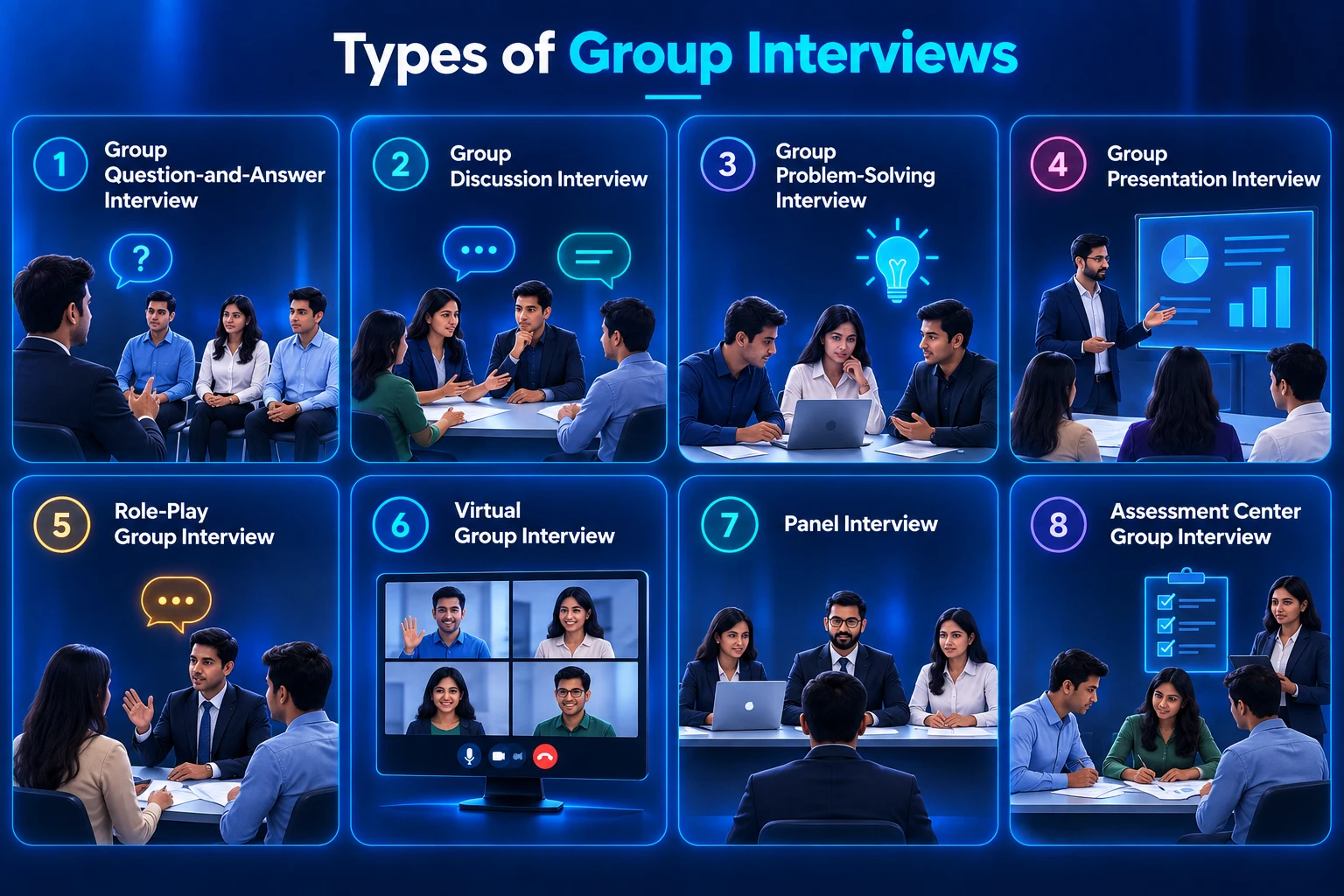
1. Group Question-and-Answer Interview
A group question-and-answer interview is one of the more straightforward types of group interviews. Several candidates attend the same interview, and the interviewer asks questions either to the whole group or to candidates individually.
Candidates usually take turns answering, although the interviewer may also invite anyone in the group to respond. Follow-up questions can be asked when an answer needs more detail. Since everyone is part of the same session, candidates also have to remain attentive while others are answering.
2. Group Discussion Interview
In a group discussion interview, candidates are given a topic, question, or issue to discuss together. The interviewer normally introduces the topic and then allows the candidates to carry most of the conversation.
The discussion may have a fixed time limit, and candidates are expected to share their views and respond to what others say. The interviewer may not take an active part in the conversation, but observes how the discussion develops from the beginning to the end.
3. Group Problem-Solving Interview
A group problem-solving interview gives candidates a problem or situation that they need to work through together. The task is usually designed around a situation that is relevant to the type of work or responsibilities involved in the role.
Candidates discuss the problem, suggest possible solutions, consider different options, and decide how they want to approach the situation. The focus of the activity is not always on finding one perfect answer. The way the group works through the problem is also part of the assessment.
4. Group Presentation Interview
A group presentation interview involves candidates preparing and presenting information during the interview. Depending on the hiring process, they may give a presentation individually or work with other candidates to prepare one as a team.
The presentation may be prepared before the interview or candidates may be given a topic and some preparation time during the session. In a team presentation, candidates also need to coordinate with one another and decide how the presentation will be organised.
5. Role-Play Group Interview
A role-play group interview puts candidates into a simulated workplace situation. Each candidate may be given a particular role, responsibility, or objective and then asked to interact with the other participants.
The situation can develop as the candidates respond to one another, rather than following a fixed set of questions. This makes the interview more interactive and gives candidates an opportunity to respond to a situation as it unfolds.
6. Virtual Group Interview
A virtual group interview takes place online instead of in a physical interview room. Several candidates join the same video call, while one or more interviewers conduct and monitor the session.
The format can include regular interview questions, group discussions, presentations, or activities. Candidates need to communicate and participate through the video-conferencing platform, so the session may also involve features such as chat, screen sharing, or breakout rooms when required.
7. Panel Interview
A panel interview involves one candidate being interviewed by two or more interviewers during the same session. The panel may include people from different functions or levels within the organization, with each interviewer focusing on a particular aspect of the candidate’s background or suitability for the role.
Although it includes multiple people, a panel interview differs from other group formats because the candidates are not being interviewed as a group. The interviewers form the group, while the candidate is assessed individually.
8. Assessment Center Group Interview
An assessment center group interview is part of a broader assessment process in which candidates take part in multiple exercises or activities. These may include group discussions, problem-solving tasks, presentations, role-plays, or other job-related exercises.
Candidates may be assessed by one or more observers throughout the activities. Rather than relying on a single conversation, the assessment center format can involve several exercises designed to evaluate different skills and behaviours relevant to the position.
What Are the Uses of a Group Interview?
The value of a group interview depends largely on what the employer wants to measure. It should not be used simply because it allows more candidates to be interviewed at once.
1. Assessing Teamwork
One of the most important uses of a group interview is observing how candidates work with other people. Teamwork is difficult to evaluate accurately through questions alone because candidates can describe themselves as collaborative without demonstrating that behavior.
A group exercise provides an opportunity to observe whether candidates share information, listen to others, contribute ideas, support productive discussion, and help the group move toward an objective.
Example: A software company hiring project coordinators asks candidates to create a project plan together. One candidate may naturally organize the discussion, while another may identify risks that others overlook.
2. Assessing Communication Skills
Group interviews can show how candidates communicate when they are speaking to several people and responding to competing viewpoints.
Effective communication is not simply speaking clearly. It also includes listening, adapting explanations, asking useful questions, responding appropriately, and knowing when to allow another person to contribute.
Example: During a group discussion, one candidate explains a complicated idea in simple language and then asks another participant for their perspective. This demonstrates communication combined with active listening.
3. Identifying Leadership Behavior
Group interviews can also help employers observe leadership behavior without explicitly asking candidates whether they consider themselves leaders.
Leadership can appear through behaviors such as organizing a discussion, clarifying objectives, encouraging quieter participants, resolving disagreements, and helping the group make a decision. Importantly, leadership does not necessarily mean dominating the conversation.
Example: Five candidates are asked to prioritize ten actions during a business crisis. One candidate proposes a clear method for ranking the options, invites other opinions, and helps the group reach a decision without attempting to control every response.
4. Assessing Problem-Solving and Decision-Making
Group interviews can place candidates in situations where they must analyze information and make decisions while considering other people's views.
This is particularly useful for jobs in which employees regularly solve problems collectively. Recruiters can observe whether candidates identify relevant information, compare alternatives, explain their reasoning, and adjust their approach when new information appears.
Example: Candidates for an operations role receive a scenario involving a supply shortage. They must determine which customer orders should receive priority and explain their reasoning to the group.
5. Evaluating Interpersonal Behavior
A group interview provides an opportunity to observe interpersonal behavior in real time. Candidates may demonstrate patience, respect, adaptability, confidence, cooperation, or conflict-management skills.
However, recruiters should be careful not to treat personality style as a direct measure of job performance. Research involving 97 applicants in Norwegian high-school teacher selection found that perceptions of procedural fairness in group selection interviews were related to interactions among personality characteristics, showing that candidate reactions to the format can be more complex than simply labeling someone as “introverted” or “extroverted.”
Example: Two candidates may contribute the same number of ideas, but one may build on other participants' suggestions while the other repeatedly dismisses them. If collaboration is important to the job, the difference in interaction may be relevant.
What Are the Benefits of Group Interviews?
Group interviews can provide several practical benefits when they are designed around clear selection criteria and evaluated consistently.They allow recruiters to assess multiple candidates in the same setting while observing how they communicate, interact, and respond to different situations.
This format can be particularly useful for roles that involve teamwork, communication, problem-solving, or regular interaction with others. It can also make certain stages of the hiring process easier to manage.
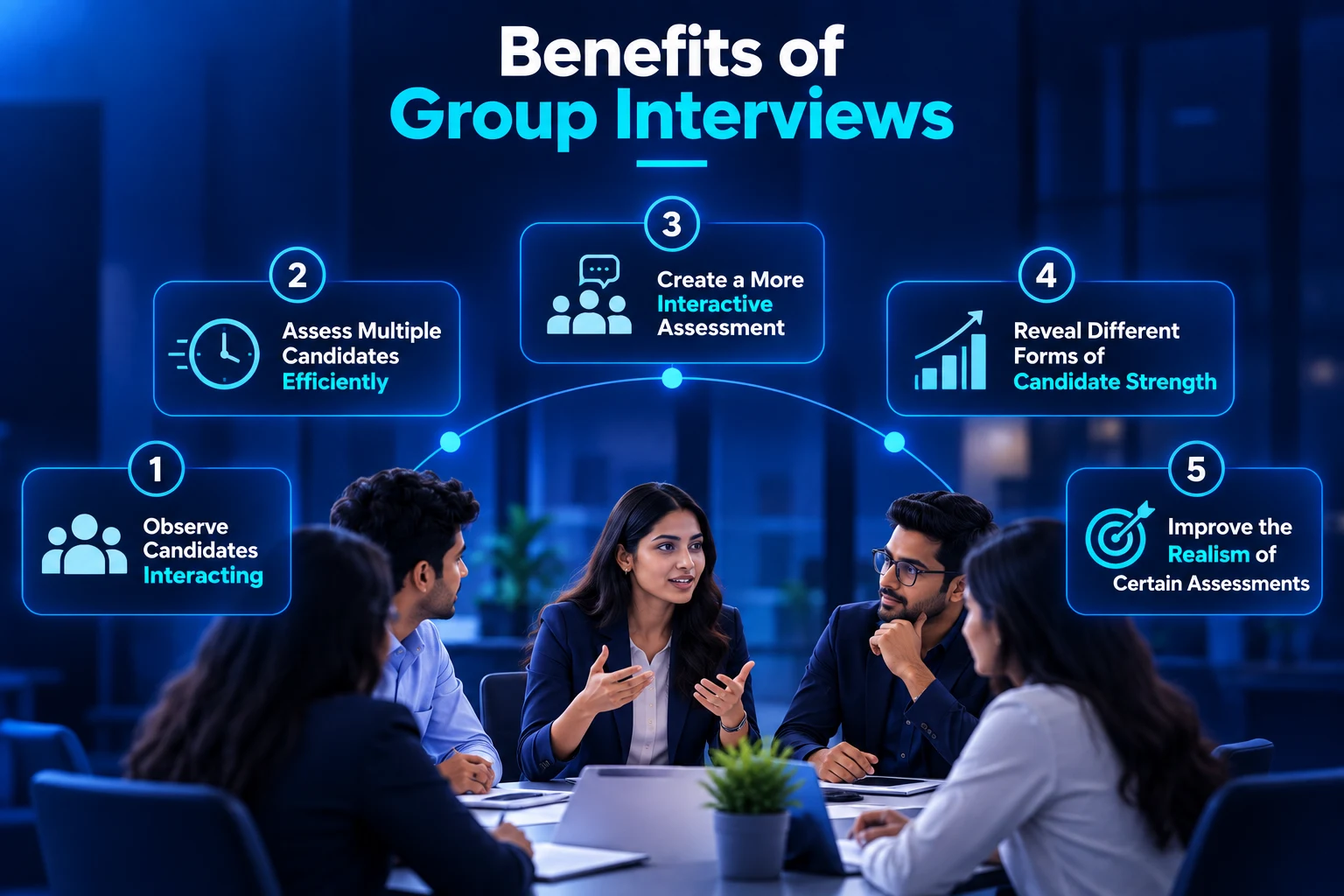
1. They Allow Employers to Observe Candidates Interacting
One of the main benefits is that recruiters can observe candidates in an environment where interaction is part of the assessment. This can reveal behaviours that a traditional question-and-answer interview may not capture.
Candidates can demonstrate how they listen, communicate, negotiate, cooperate, and respond to disagreement instead of simply describing those abilities.
Example: Rather than asking every candidate, “How do you handle conflict?”, a recruiter can give the group a realistic disagreement scenario and observe how candidates respond.
This gives employers an opportunity to assess interpersonal behaviour as it occurs rather than relying entirely on candidates’ descriptions of their own skills.
2. They Can Help Assess Multiple Candidates Efficiently
When an organization has many applicants, interviewing each person individually can require considerable time and resources. Group interviews allow several candidates to participate in the same assessment session.
A 2025 study found that group interviews reduced interview-associated costs by approximately 50% and shortened the interview process from an estimated 10 days to 4 days. Although the study was conducted in a specific setting, it illustrates how group interviews can support more efficient hiring.
Example: A company hiring 30 graduate trainees could organize several structured group sessions instead of scheduling 30 separate initial interviews.
3. They Create a More Interactive Assessment
Traditional interviews are often interviewer-led, with the recruiter asking a question and the candidate responding. Group interviews create a more dynamic setting where candidates need to listen, respond, adapt, and cooperate with others.
This can be particularly useful for positions where employees regularly work in teams rather than independently.
Example: A consulting firm could ask candidates to analyse a business scenario together, allowing recruiters to observe how they develop ideas, challenge assumptions, and build on the contributions of others.
The interaction can also show whether candidates can express their views while giving others enough space to participate.
4. They Can Reveal Different Forms of Candidate Strength
Not every useful candidate behaviour looks the same. One person may demonstrate strong analytical thinking, another may facilitate the discussion, while another may communicate clearly or identify risks that others overlook.
A carefully designed group exercise can therefore reveal different job-related strengths within the same assessment environment.
Example: During a product-launch exercise, one candidate may develop the strategy, another may identify customer concerns, and another may organize the group’s final presentation.
This gives recruiters a broader view of how different candidates contribute to a shared task rather than judging everyone through exactly the same type of individual response.
5. They Can Improve the Realism of Certain Assessments
For jobs involving teamwork, customer interaction, negotiation, collaboration, or leadership, an interactive exercise can resemble situations employees may encounter at work.
This does not mean a group interview is automatically more effective than a one-on-one interview. Its value depends on whether the activity is relevant to the role and whether recruiters have clear criteria for evaluating candidate behaviour.
Example: If a role requires employees to coordinate projects across departments, recruiters could ask candidates to solve a shared planning problem and observe how they communicate, prioritize tasks, and reach a decision.
When the exercise reflects genuine job requirements, the group setting can give recruiters practical evidence of how candidates apply relevant skills in an interactive situation.
Group Interview vs. One-on-One Interview vs. Panel Interview
These three interview formats are often confused, but they differ mainly in who is being interviewed and who is doing the evaluating.A group interview involves several candidates, a one-on-one interview involves one candidate and one interviewer, while a panel interview involves one candidate and multiple interviewers.
The difference becomes clearer when you look at what happens during the interview. In a one-on-one setting, the conversation is mainly between two people. A group interview adds other candidates to the discussion, while a panel interview brings several interviewers into the same conversation. Each format changes how candidates communicate, respond to questions, and interact with others, giving recruiters different ways to assess candidates during the hiring process. The main differences are outlined below.
Interview format | Who participates? | Main focus | What employers can observe | Typical use |
Group interview | Several candidates and one or more interviewers | Candidate interaction and individual responses within a group | Teamwork, communication, leadership, listening, collaboration, problem-solving | Graduate hiring, high-volume recruitment, team-oriented roles |
One-on-one interview | One candidate and one interviewer | Individual candidate assessment | Experience, knowledge, motivation, communication, job-specific competencies | Most professional and specialist hiring processes |
Panel interview | One candidate and several interviewers | Individual candidate assessment from multiple evaluators | Candidate's responses, expertise, communication, and fit with different stakeholders | Senior roles, specialist roles, structured hiring panels |
A group interview places several candidates together, while a panel interview places several interviewers together with one candidate.
Conclusion
A group interview is a structured hiring method in which several candidates are assessed together, giving employers an opportunity to observe communication, teamwork, leadership, problem-solving, and interpersonal behavior in an interactive environment.
Its effectiveness depends on how the interview is designed. Group discussions, problem-solving exercises, presentations, role plays, question-and-answer sessions, and virtual assessments can all serve different purposes. The important consideration is whether the activity measures competencies that genuinely relate to the job.
Research also shows why employers should use the format thoughtfully. Group interviews can reveal valuable behavioral information, but factors such as response order, group dynamics, and candidate perceptions can influence the assessment. A structured scoring system, consistent questions, job-related exercises, and clear evaluation criteria can therefore make the process more meaningful.
For organizations, the goal should not simply be to interview more candidates at once. The goal should be to create an assessment that gives each candidate a fair opportunity to demonstrate the skills and behaviors the role actually requires.