Back to all blogs
75 Interview Fraud Statistics, covering AI cheating, deepfake candidates, proxy interviews, and resume fraud. Essential guide for recruiters.

Abhishek Kaushik
Remote hiring has transformed the way organizations attract and evaluate talent. Recruiters can now interview candidates from anywhere in the world, shorten hiring cycles, and access a much larger talent pool. However, this shift has also created new opportunities for interview fraud. AI-generated resumes, real-time interview assistants, proxy candidates, deepfakes, and identity impersonation are making it increasingly difficult to determine whether a candidate is genuinely demonstrating their own skills.
The rise of generative AI has accelerated this challenge. Today, candidates can use AI tools to generate polished resumes, receive real-time answers during interviews, or even manipulate their identity in virtual hiring environments. According to Gartner, 39% of job candidates have already used AI during the job application process, including generating resumes, cover letters, and responses to application questions. It also found that 6% of candidates admitted to participating in interview fraud, either by impersonating someone else or allowing another person to interview on their behalf.
75 Interview Fraud Statistics & Trends Every Recruiter Should Know
To help recruiters understand the scale of this problem, we have compiled 75 interview fraud statistics and hiring trends from trusted industry reports, research firms, and reputable organizations. These statistics cover AI-assisted interview cheating, candidate impersonation, resume fraud, identity verification, remote hiring risks, recruiter challenges, and emerging trends shaping the future of hiring. Whether you're building a secure hiring process, evaluating interview fraud detection tools, or simply staying informed, these insights will help you make more confident, data-driven recruitment decisions.
The Scale of the Problem
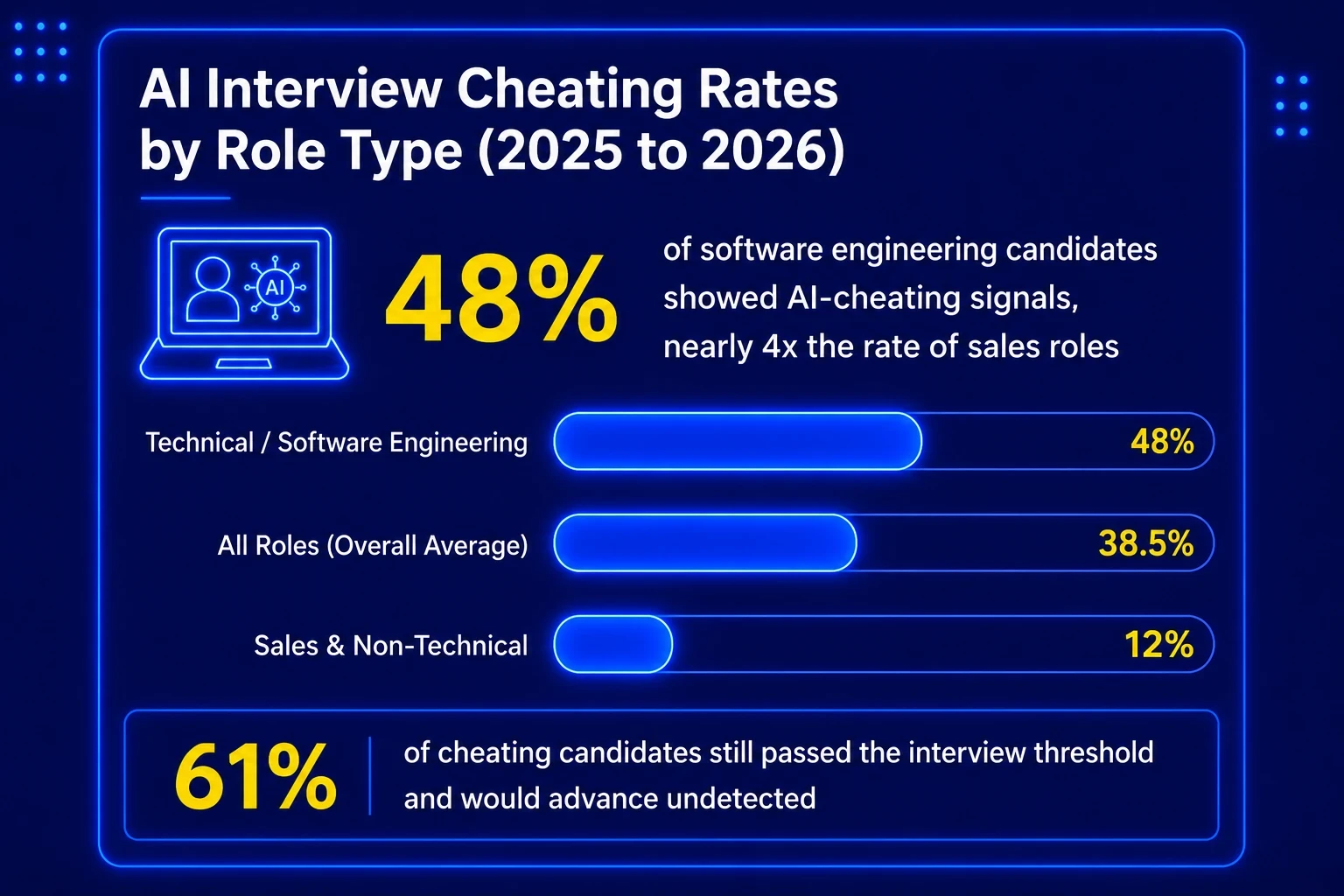
1. 38.5% of Candidates Were Flagged for AI-Cheating Behavior Across 19,368 Live Interviews
As AI-powered interview assistance tools become more accessible, recruiters are seeing a noticeable increase in candidates relying on them during live interviews. According to Fabric's 2026 research, 38.5% of candidates were flagged for AI-cheating behavior across 19,368 live interviews. These behaviors included the use of AI copilots, hidden interview assistance software, and other technologies designed to generate real-time responses during interviews.
The findings demonstrate that AI-assisted cheating is no longer an isolated issue but a growing challenge affecting organizations across industries. As remote and virtual hiring continue to expand, recruiters need stronger interview integrity measures that can identify suspicious behavior without disrupting the candidate experience. Organizations that rely solely on manual observation may struggle to detect increasingly sophisticated forms of AI-assisted interview fraud.
What This Means for Recruiters?
Nearly four out of every ten candidates showing signs of AI-assisted cheating highlights the need for stronger interview verification processes. Recruiters should complement structured interviews with technologies that detect AI assistance, monitor interview behavior, verify candidate identity, and flag suspicious activity in real time. These measures help ensure hiring decisions are based on genuine candidate skills rather than AI-generated responses.
2. AI-Cheating Flag Rate Tripled from 9% to 45% in Just Three Months
The rapid adoption of AI interview assistance tools is accelerating the challenge of maintaining interview integrity. According to Fabric's 2026 data, cited by The Interview Guys, the AI-cheating flag rate increased from just 9% to 45% in only three months during late 2025. This dramatic rise suggests that AI-assisted interview cheating is evolving much faster than many hiring teams anticipated.
The sharp increase reflects how quickly candidates are discovering and adopting AI-powered interview copilots, browser extensions, and desktop applications that provide real-time answers during interviews. As these tools become more sophisticated and easier to access, traditional interviewing methods alone are becoming less effective at identifying candidates who rely on unauthorized assistance.
What This Means for Recruiters?
A fivefold increase in AI-cheating incidents within a single quarter shows that interview fraud is evolving rapidly. Recruiters should regularly update their interview processes, implement AI-assisted cheating detection tools, strengthen candidate verification procedures, and train interviewers to recognize behavioral indicators that may signal external assistance. Proactive interview integrity measures are becoming essential for organizations conducting remote and virtual hiring.
3. 78% of Job Seekers Say They Did, or Would, Misrepresent Themselves to Get Hired
Competition for jobs continues to push many candidates toward dishonest behavior during the hiring process. According to an eSkill survey, 78% of job seekers said they either have misrepresented themselves or would consider doing so to secure a job offer. This includes exaggerating qualifications, overstating experience, misrepresenting technical skills, or using unauthorized assistance during interviews.
The findings suggest that candidate dishonesty extends beyond resume embellishments. As AI tools make it easier to generate convincing answers, improve resumes, and receive real-time interview assistance, recruiters face greater challenges in determining whether a candidate's performance accurately reflects their actual abilities. Without proper verification, organizations risk hiring individuals who may lack the skills required for the role.
What This Means for Recruiters?
When nearly eight out of ten candidates admit they have misrepresented themselves or would consider doing so, recruiters cannot rely solely on resumes or interview performance. Implementing structured interviews, employment verification, skills assessments, identity verification, and interview integrity technologies can help organizations distinguish genuine candidates from those using deceptive practices, reducing the risk of costly bad hires.
4. Gartner Predicts Up to 25% of Candidate Profiles Could Be Fraudulent by 2028
The rise of AI-generated resumes, deepfake technology, and identity impersonation is expected to make hiring fraud significantly more common over the next few years. According to Gartner, up to 25% of candidate profiles worldwide could be fraudulent by 2028. This projection highlights how advances in generative AI are making it easier for bad actors to create convincing fake identities, fabricated work histories, and misleading credentials.
As organizations increasingly recruit remotely and expand their global talent pools, verifying candidate authenticity becomes more challenging. Fraudulent profiles can lead to poor hiring decisions, security risks, compliance issues, and financial losses, particularly for organizations hiring for sensitive or technical roles. Gartner's forecast underscores the need for stronger identity verification and interview integrity practices throughout the hiring process.
What This Means for Recruiters?
If one in four candidate profiles could be fraudulent within the next few years, recruiters must move beyond traditional resume screening. Identity verification, credential validation, structured interviews, live interview monitoring, and AI-powered fraud detection can help employers identify suspicious candidates before extending an offer. Taking a proactive approach today will better prepare organizations for the growing threat of AI-enabled hiring fraud.
5. 16.8% of Job Applicants Show Signs of Digital Manipulation or Possible Fraud
As hiring becomes increasingly digital, organizations are encountering more applicants who attempt to manipulate their identities or credentials. According to internal data from Pindrop, cited by Raconteur, 16.8% of job applicants showed signs of digital manipulation or potential fraud during the hiring process. These indicators included suspicious identity signals, inconsistencies in digital profiles, and behaviors commonly associated with impersonation or synthetic identities.
The findings illustrate that hiring fraud is no longer limited to exaggerated resumes or falsified qualifications. Digital manipulation can involve AI-generated identities, altered documents, voice cloning, or other techniques designed to bypass traditional screening methods. As these tactics become more sophisticated, employers need stronger verification processes throughout the recruitment lifecycle.
What This Means for Recruiters?
With nearly one in six applicants displaying signs of possible digital fraud, recruiters should strengthen candidate verification before making hiring decisions. Combining identity verification, document authentication, structured interviews, and interview integrity technologies can help organizations detect suspicious candidates early, reducing the risk of fraudulent hires and protecting business operations.
AI Cheating in Live Interviews Statistics
6. 40% of Candidates Interviewing for Technical Roles Were Flagged for AI-Cheating Behavio
AI-assisted interview cheating is significantly more common in technical hiring than in non-technical roles. According to InterviewMan's analysis of live interview data, 40% of candidates interviewing for technical roles were flagged for AI-cheating behavior. This fourfold difference suggests that candidates in coding and technical interviews are far more likely to rely on AI-powered assistance during assessments.
Technical interviews often involve complex coding problems, system design questions, and real-time problem-solving, making them attractive targets for AI copilots and coding assistants. As AI tools become increasingly capable of generating accurate technical responses, recruiters face greater difficulty distinguishing genuine expertise from AI-assisted performance.
What This Means for Recruiters?
Organizations hiring for technical positions should strengthen interview integrity measures beyond traditional coding assessments. Combining live coding exercises, identity verification, AI-assisted cheating detection, behavioral questioning, and follow-up technical discussions can help recruiters better evaluate a candidate's true capabilities and reduce the risk of hiring individuals who rely on unauthorized AI assistance.
7. Early-Career Candidates Cheat at Nearly Twice the Rate of Senior Professionals
Interview fraud appears to be more common among less experienced candidates. According to InterviewMan, candidates with 0–5 years of professional experience were nearly twice as likely to be flagged for AI-assisted cheating as senior candidates. This trend suggests that early-career professionals may feel greater pressure to compete in an increasingly competitive job market.
Many entry-level candidates face limited work experience while competing against larger applicant pools. Easy access to AI interview assistants and real-time answer generation tools can make it tempting to seek unauthorized support during interviews. Although experienced professionals also use AI, the data indicates that younger candidates are more likely to depend on these tools during live assessments.
What This Means for Recruiters?
Recruiters hiring for entry-level and junior positions should design interview processes that assess genuine problem-solving ability rather than memorized or AI-generated responses. Scenario-based questions, follow-up discussions, and interview integrity technologies can help ensure hiring decisions reflect actual candidate skills.
8. 71% of Job Seekers Admit to Cheating During the Hiring Process
Recent research shows that 71% of job seekers admitted to cheating during the hiring process, using methods such as AI tools, online searches, and generative AI to complete interviews and assessments.
The problem continues to grow across organizations. Nearly 60% of hiring managers suspect candidates are using AI to fake their abilities during live interviews and assessments, while 62% believe candidates are better at using AI to cheat than recruiters are at detecting it.
The increase in AI-assisted interview fraud is also reflected in hiring trends. In technical hiring, some employers estimate that up to 80% of candidates use large language models (LLMs) during coding assessments, despite being instructed not to.
These statistics show that AI-assisted interview cheating is no longer an isolated issue but a growing challenge affecting hiring teams across industries.
What This Means for Recruiters?
Recruiters should adopt interview integrity solutions that can identify AI-assisted cheating while maintaining a fair candidate experience. Detecting suspicious behavior early helps organizations make more confident hiring decisions and ensures candidates are evaluated based on their actual skills.
9. At Least 20% of Candidates May Use AI Tools During Live Interviews
AI-powered interview assistants are becoming increasingly common among job seekers. According to eSkill, at least 20% of candidates may be using AI tools to assist them during live interviews. These tools can generate responses, answer technical questions, summarize prompts, and provide real-time guidance without the interviewer immediately noticing.
As generative AI becomes more sophisticated, candidates can receive assistance through browser extensions, desktop applications, hidden devices, or secondary screens. This makes traditional interview observation less effective, particularly during remote hiring.
What This Means for Recruiters?
Recruiters should assume that AI assistance may be present in a meaningful portion of virtual interviews. Incorporating identity verification, AI-assisted cheating detection, structured questioning, and practical skill assessments can help organizations evaluate authentic candidate abilities.
10. More Than 20 AI Interview Assistance Tools Are Now Available
The market for AI-powered interview assistance has expanded rapidly. According to InterviewMan, more than 20 dedicated AI interview assistance tools are currently available, including browser extensions, desktop applications, coding copilots, and real-time response generators designed specifically for job interviews.
Many of these tools promise candidates instant answers, coding assistance, interview coaching, or AI-generated responses during live interviews. Their growing availability makes interview fraud more accessible than ever before and increases the challenge of maintaining interview integrity.
What This Means for Recruiters?
Recruiters should recognize that interview cheating is supported by an expanding ecosystem of specialized AI tools. Organizations should regularly update interview policies, educate hiring managers about emerging cheating methods, and implement technologies capable of detecting unauthorized AI assistance during interviews.
11. AI Interview Assistance Tools Cost Between $12 and $299 Per Month
AI-powered interview cheating has become increasingly accessible because many tools are inexpensive and easy to obtain. InterviewMan reports that AI interview assistance tools are priced from approximately $12 per month to as much as $299 per month for advanced coding interview solutions.
Affordable subscription models have lowered the barrier to entry, allowing candidates to access sophisticated interview copilots without significant investment. As these tools continue to improve, recruiters should expect AI-assisted cheating attempts to become more frequent across both technical and non-technical hiring.
What This Means for Recruiters?
The affordability of AI interview tools means organizations cannot assume cheating is limited to a small group of candidates. Recruiters should establish interview integrity practices that detect AI assistance regardless of the specific software candidates choose to use.
12. Cluely Data Breach Exposed 83,000 Users of an AI Interview Tool
The risks associated with AI interview assistance extend beyond hiring integrity. According to InterviewMan, the AI interview tool Cluely experienced a security breach in mid-2025 that exposed data belonging to approximately 83,000 users.
The incident illustrates that candidates who rely on unauthorized AI tools may also expose their personal information to cybersecurity risks. It also highlights the rapid growth of AI interview assistance platforms and the importance of understanding the broader ecosystem surrounding interview fraud.
What This Means for Recruiters?
Recruiters should educate candidates about interview expectations while maintaining clear policies regarding unauthorized AI assistance. Organizations should also remain aware of emerging interview technologies and update hiring processes to address evolving fraud techniques.
13. The Cluely Breach Revealed Which Interviews Users Had Used the Tool In
The Cluely security breach exposed more than user account information. According to InterviewMan, the leaked data reportedly revealed the specific interviews in which users had utilized the AI interview assistance tool. This demonstrates how records of AI-assisted interview activity can become part of a broader cybersecurity incident.
The breach serves as a reminder that candidates using unauthorized interview tools may leave digital evidence of their activity. It also raises concerns about data privacy, security practices, and the growing reliance on third-party AI applications during hiring.
What This Means for Recruiters?
Organizations should clearly communicate interview integrity policies and encourage candidates to rely on their own knowledge during assessments. Transparent expectations, combined with interview monitoring and verification technologies, help maintain fairness while discouraging the use of unauthorized AI tools.
14. 65% of Hiring Managers Have Caught Candidates Using AI Deceptively During the Hiring Process
Artificial intelligence is becoming increasingly common during interviews, but many candidates are crossing the line from preparation to deception. According to Greenhouse's 2025 AI in Hiring Report, 65% of hiring managers say they have caught applicants using AI deceptively during the hiring process. This includes candidates relying on AI-generated answers, real-time interview assistants, or other tools that misrepresent their actual knowledge and abilities.
The finding highlights that AI-assisted interview cheating is no longer an isolated issue. Recruiters are encountering it frequently enough that interview integrity has become a growing priority across hiring teams.
What This Means for Recruiters?
Recruiters should establish clear AI usage policies and implement safeguards during live interviews. Combining structured interview questions, identity verification, and AI interview monitoring can help distinguish legitimate candidate preparation from deceptive AI-assisted behavior.
15. 74% of Hiring Managers Are More Concerned About AI-Driven Hiring Fraud Than Last Year
Concerns about interview fraud continue to grow as AI tools become more sophisticated. The Greenhouse 2025 AI in Hiring Report found that 74% of hiring managers are more concerned about fake credentials, deepfakes, and misrepresented work experience than they were just one year earlier.
The increase reflects how quickly AI-enabled deception has evolved. Hiring teams are no longer focused only on resume fraud. They are also preparing for deepfake interviews, identity impersonation, AI-generated responses, and other forms of interview manipulation that can compromise hiring decisions.
What This Means for Recruiters?
Organizations should strengthen interview verification processes before AI-assisted fraud becomes a larger business risk. Identity verification, live interview monitoring, behavioral analysis, and post-interview fraud detection can help recruiters identify suspicious activity while maintaining an efficient candidate experience.
16. 86% of Recruiters Have Caught or Suspected Candidate Fraud in the Past 12 Months
Greenhouse's 2026 AI in Hiring Report found that 86% of recruiters have caught or suspected candidate fraud in the past 12 months, with an additional 5% believing it may be happening undetected. Recruiters most often flagged fake references, CV exaggeration, and candidates using AI during interviews as the specific behaviors observed.
What This Means for Recruiters?
When the vast majority of recruiters are already encountering fraud firsthand, treating it as a rare edge case is no longer realistic. Recruiters should build fraud checks into standard workflow rather than reactive investigation, and should recognize that the 5% who suspect undetected fraud is likely an undercount of the true scope.
Deepfake & Synthetic Identity Fraud Statistics
17. 17% of Hiring Managers Have Encountered Deepfake Candidates During Interviews
Deepfake technology is becoming an emerging threat in recruitment. According to Avvanz, 17% of hiring managers say they have encountered candidates using deepfake technology during job interviews. These incidents involve AI-generated or manipulated video and audio that can disguise a candidate's identity, allowing fraudsters to impersonate qualified professionals during virtual interviews.
As deepfake tools become more realistic and accessible, distinguishing genuine candidates from manipulated identities is becoming increasingly difficult through manual observation alone. This growing threat highlights the importance of combining identity verification with interview integrity measures, particularly for remote hiring.
What This Means for Recruiters?
Recruiters should recognize that deepfake interviews are no longer theoretical. Incorporating identity verification, live facial validation, behavioral analysis, and AI-powered deepfake detection can help organizations verify candidate authenticity before making hiring decisions.
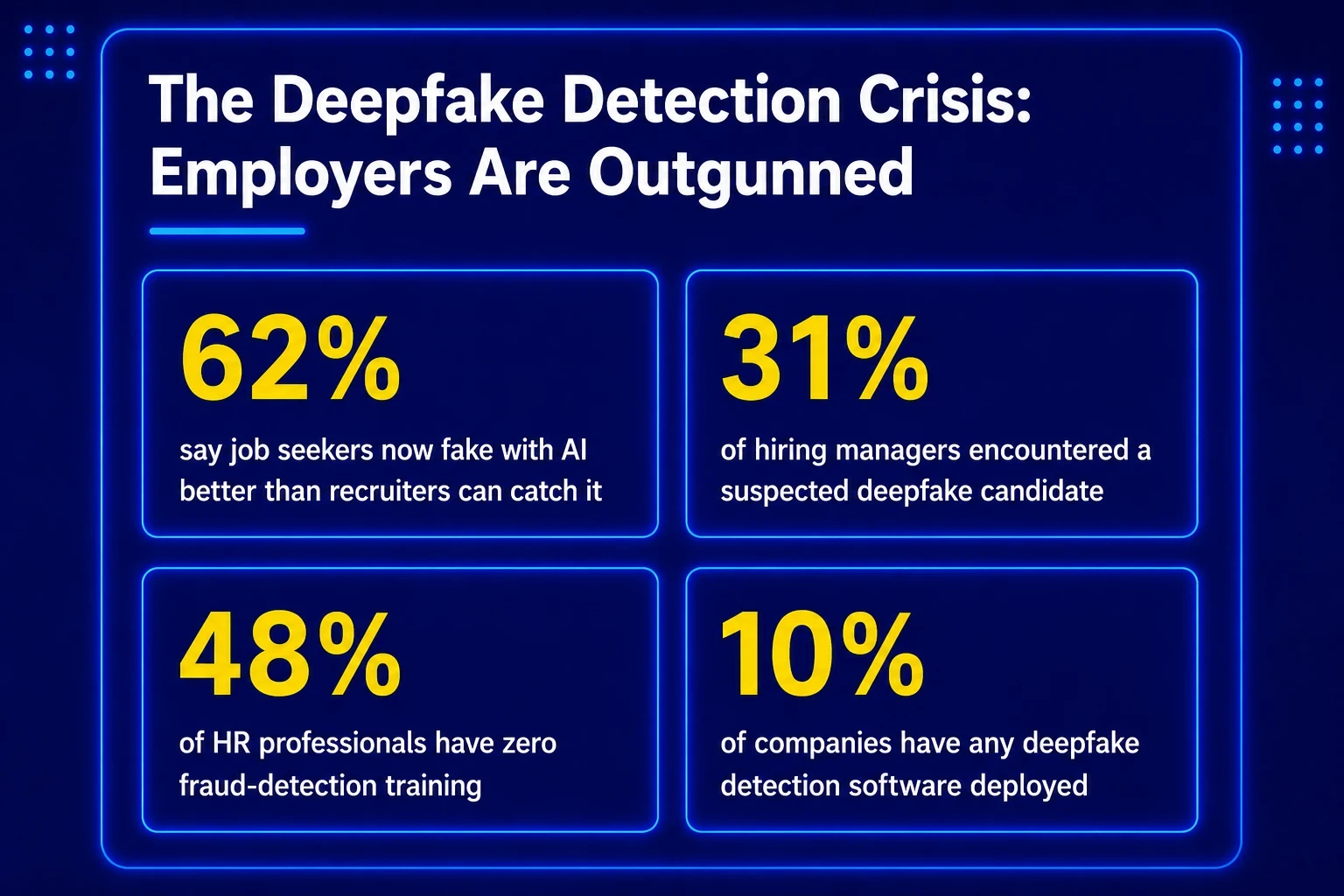
Source: Greenhouse Survey (n=4,136) | Software Finder Survey (n=874 HR Pros) Aug 2025 | The Interview Guys
18. Q1 2025 Recorded 179 Deepfake Incidents, Exceeding All of 2024
The growth of AI-generated identity fraud is accelerating at an unprecedented pace. According to InterviewMan, 179 deepfake incidents were recorded in the first quarter of 2025 alone, surpassing the total number reported throughout all of 2024. This sharp increase illustrates how rapidly deepfake technology is being adopted by cybercriminals and fraudsters.
The rise in incidents reflects advances in generative AI that enable realistic synthetic video and audio with minimal technical expertise. As these tools become more widely available, organizations face greater challenges in verifying candidate identities during remote interviews.
What This Means for Recruiters?
The rapid increase in deepfake incidents demonstrates that identity verification should become a standard part of remote hiring. Recruiters should strengthen interview security by using multi-factor identity verification, live video authentication, and technologies capable of detecting manipulated audio and video.
19. AI Deepfake Scams Increased by 700% in 2025
Deepfake-enabled fraud has expanded dramatically alongside advances in generative AI. According to InterviewMan, AI deepfake scams increased by 700% in 2025, making synthetic media one of the fastest-growing forms of digital fraud affecting businesses and individuals alike.
The availability of AI-generated voice cloning, face swapping, and realistic video creation has lowered the barriers for fraudsters. These technologies are increasingly being used to impersonate job candidates, bypass identity verification, and deceive recruiters during remote hiring processes.
What This Means for Recruiters?
As deepfake attacks continue to grow, organizations should move beyond visual verification alone. Recruiters should adopt layered security measures, including identity verification, behavioral analysis, document validation, and AI-powered deepfake detection to reduce hiring fraud risks.
20. Deepfake Fraud Losses in the U.S. Tripled to $1.1 Billion in 2025
The financial impact of deepfake fraud is rising alongside the technology's adoption. According to InterviewMan, deepfake-related fraud losses in the United States increased from approximately $360 million to $1.1 billion in 2025, highlighting the growing economic consequences of AI-enabled deception.
Although these losses span multiple industries beyond recruitment, they demonstrate how synthetic identities and manipulated media are becoming increasingly effective at bypassing traditional verification processes. Employers that rely heavily on remote hiring should consider these broader fraud trends when evaluating recruitment security.
What This Means for Recruiters?
The increasing financial impact of deepfake fraud reinforces the need for stronger hiring safeguards. Organizations should invest in identity verification, interview monitoring, and fraud detection technologies to prevent fraudulent candidates from gaining access to sensitive systems and business data.
21. Identity Fraud Has Increased by Approximately 12% Annually Since 2020
Identity fraud continues to grow year after year across digital ecosystems. According to Snappt, identity fraud cases have increased by roughly 12% annually since 2020, reflecting the expanding use of stolen identities, synthetic identities, and AI-generated credentials across multiple industries.
As organizations digitize more of their hiring processes, identity fraud increasingly affects recruitment, particularly for remote positions where recruiters may never meet candidates in person. Strong verification practices are becoming essential to reduce hiring risks.
What This Means for Recruiters?
Recruiters should treat identity verification as a core component of hiring rather than an optional step. Verifying government-issued identification, validating employment history, and confirming candidate identity throughout the interview process can significantly reduce fraud.
22. Consumer Identity Fraud Losses Exceed $1 Billion Every Year
Identity fraud continues to impose a substantial financial burden on consumers. According to Snappt, consumer out-of-pocket losses from identity fraud now exceed $1 billion annually. Criminals increasingly exploit stolen identities, synthetic identities, and AI-generated documents to commit financial fraud and other forms of deception.
Although this statistic extends beyond recruitment, it illustrates the broader environment in which hiring fraud occurs. Stolen identities used in financial crimes can also be leveraged to create convincing candidate profiles and bypass employer verification processes.
What This Means for Recruiters?
Recruiters should recognize that identity fraud affects both consumers and employers. Implementing identity verification and document authentication during recruitment helps reduce the likelihood of fraudulent candidates entering the hiring pipeline.
23. Healthcare Identity Fraud Costs More Than $5 Billion Every Year
Identity fraud has significant financial consequences across multiple industries, including healthcare. According to Snappt, healthcare-sector identity fraud costs more than $5 billion annually, making it one of the industries most heavily affected by identity-related crimes. Fraudsters use stolen or synthetic identities to access medical services, submit false insurance claims, and exploit sensitive personal information.
Although this statistic focuses on healthcare, it demonstrates the broader impact of identity fraud and the sophistication of modern fraud techniques. The same technologies used to create synthetic identities for financial crimes can also be used to deceive employers during recruitment, particularly in remote hiring environments.
What This Means for Recruiters?
The growing cost of identity fraud across industries highlights the importance of verifying candidate identities before granting access to company systems or sensitive information. Recruiters should implement identity verification, document validation, and secure onboarding processes to reduce hiring-related fraud risks.
24. Trust in Companies to Protect Biometric Data Dropped from 29% to 5% in Two Years
Public confidence in how organizations handle biometric information has declined sharply. According to Snappt, trust in technology companies to safeguard biometric data fell from 29% in 2022 to just 5% in 2024. As more organizations adopt facial recognition, voice authentication, and other biometric verification technologies, concerns about data privacy and security continue to grow.
For employers, this decline in trust presents a challenge. While biometric verification can strengthen recruitment security and reduce identity fraud, organizations must also demonstrate transparency, compliance, and responsible handling of sensitive candidate data.
What This Means for Recruiters?
Recruiters using biometric verification should clearly explain why the data is collected, how it is protected, and when it will be deleted. Transparent communication and compliance with privacy regulations can improve candidate trust while strengthening interview security.
25. AI-Powered Fraud Detection Has Reduced Fraud Incidents by an Estimated 30%
Artificial intelligence is becoming an important tool not only for fraudsters but also for fraud prevention. According to Snappt, AI-driven fraud detection solutions have helped reduce fraud incidents by an estimated 30% by identifying suspicious patterns, detecting forged documents, and flagging abnormal user behavior more accurately than traditional manual reviews.
As hiring fraud becomes more sophisticated, AI-powered detection systems enable recruiters to identify identity inconsistencies, behavioral anomalies, and document manipulation earlier in the recruitment process. These technologies help organizations improve hiring security while reducing the burden on recruitment teams.
What This Means for Recruiters?
Recruiters should view AI as both a risk and a solution. While candidates may misuse AI during interviews, organizations can leverage AI-powered verification and fraud detection tools to identify suspicious behavior, validate candidate identities, and strengthen interview integrity.
26. Digital Wallet Fraud Is Increasing by Approximately 15% Each Year
The expansion of digital payment platforms has created new opportunities for identity-related fraud. According to Snappt, fraud involving digital wallets such as Apple Pay and Google Pay is increasing by around 15% annually, largely due to weaknesses in identity verification and account authentication.
Although this trend is not exclusive to recruitment, it reflects the broader growth of digital identity fraud across online services. The same verification gaps exploited in financial fraud can also be targeted during remote hiring when employers rely on digital interactions without robust identity validation.
What This Means for Recruiters?
The steady rise in digital identity fraud reinforces the need for stronger verification throughout the hiring process. Recruiters should combine document verification, identity authentication, and secure interview practices to ensure candidates are who they claim to be before extending employment offers.
Proxy Interviews & Candidate Impersonation Statistics
27. 6% of Candidates Admitted to Interview Fraud, Including Having Someone Else Attend Their Interview
Candidate impersonation remains a persistent challenge in remote hiring. According to a Gartner survey cited by Testlify, 6% of 3,000 candidates admitted to committing interview fraud, including having someone else pose as them during an interview. While the percentage may appear relatively small, it represents a significant risk for organizations hiring at scale, where even a handful of fraudulent hires can lead to security, financial, and operational consequences.
Interview fraud can take several forms, including proxy interviews, identity impersonation, AI-assisted responses, and stand-in candidates who complete technical interviews on behalf of another person. As remote hiring continues to grow, these tactics have become increasingly difficult to detect through manual observation alone.
What This Means for Recruiters?
Recruiters should treat interview impersonation as a real hiring risk rather than a rare occurrence. Identity verification, continuous candidate authentication, live technical assessments, and interview monitoring can help ensure the person being interviewed is the same individual who ultimately joins the organization.
28. Proxy Interviewing Has Become an Organized Paid Service
Proxy interviewing has evolved from occasional impersonation into a structured underground business. According to Verif_Hire, proxy interviews are now offered as paid services through online marketplaces, where individuals are hired to attend technical interviews on behalf of job applicants. These services often advertise guaranteed interview success, experienced stand-ins, and specialized technical expertise.
The commercialization of proxy interviewing demonstrates how hiring fraud has become increasingly organized. Fraudsters can now coordinate fake identities, AI-generated resumes, and professional interview proxies, making it much harder for recruiters to detect deception using traditional interview methods.
What This Means for Recruiters?
Organizations should assume that proxy interviewing may involve organized fraud rather than isolated incidents. Identity verification before and during interviews, live coding exercises, behavioral questioning, and continuous candidate authentication can help detect stand-ins before they progress through the hiring process.
29. Delayed Responses and Inconsistent Answers Are Common Signs of Proxy Interviews
Recruiters often observe behavioral patterns that indicate a candidate may not be answering independently. According to BarRaiser, common red flags for proxy interviews include delayed responses, unusually long pauses, inconsistent explanations, and difficulty answering detailed follow-up questions. These behaviors may suggest that candidates are receiving external assistance or communicating with another person during the interview.
Although these indicators do not automatically prove fraud, they provide valuable signals when combined with identity verification and structured interview techniques. Paying close attention to candidate behavior can help interviewers identify suspicious activity before making hiring decisions.
What This Means for Recruiters?
Recruiters should train interviewers to recognize behavioral indicators associated with proxy interviews while avoiding assumptions based on a single signal. Combining observation with identity verification, practical assessments, and interview integrity technologies provides a more reliable approach to detecting candidate impersonation.
Resume & Credential Fraud Statistics
30. 44% of Job Seekers Admitted to Lying During the Hiring Process
Resume fraud and candidate misrepresentation continue to be widespread challenges for employers. According to a Resume Builder survey cited by Avvanz, 44% of job seekers admitted to lying somewhere during the hiring process. These misrepresentations ranged from exaggerating work experience and technical skills to providing false educational qualifications or employment history.
While some candidates view embellishing their credentials as harmless, inaccurate information can lead to poor hiring decisions, reduced productivity, and increased turnover. As competition for jobs intensifies and AI tools make it easier to create convincing resumes, employers face greater difficulty distinguishing genuine qualifications from fabricated ones.
What This Means for Recruiters?
Recruiters should verify key candidate claims rather than relying solely on resumes or interviews. Employment verification, education checks, skills assessments, and structured interviews can help organizations identify inconsistencies before extending an offer.
31. 24% of Job Seekers Admitted to Falsifying Their Resumes
Resume falsification remains one of the most common forms of hiring fraud. According to Avvanz, 24% of job seekers admitted to intentionally falsifying information on their resumes, including work experience, education, certifications, and professional accomplishments.
The availability of AI resume-writing tools has made it easier for candidates to create polished resumes that may exaggerate or fabricate qualifications. Without verification, employers risk advancing candidates who lack the experience or expertise required for the role.
What This Means for Recruiters?
Recruiters should treat resumes as a starting point rather than definitive proof of a candidate's qualifications. Verifying employment history, educational credentials, and professional certifications can significantly reduce the risk of resume fraud.
32. 23.2% of Applicants Were Flagged as Potential Fraud Risks
Fraud detection systems are identifying a growing number of suspicious applicants during recruitment. According to Huntress/Endorsed data, cited by Avvanz, 23.2% of applicants were flagged as potential fraud risks between September and November 2025. These risks included suspicious identities, inconsistent application data, and behaviors commonly associated with fraudulent candidates.
The findings suggest that nearly one in four applicants may require additional verification before progressing through the hiring process. As hiring fraud becomes more sophisticated, organizations are increasingly relying on technology to identify suspicious patterns early.
What This Means for Recruiters?
Recruiters should establish clear verification procedures for applicants flagged as high risk. Combining identity verification, employment validation, and structured interviews helps reduce the likelihood of fraudulent hires while maintaining a fair candidate experience.
33. 40% of Resumes Contain Exaggerations or False Information
Resume embellishment continues to be a widespread issue across industries. According to the Association of Certified Fraud Examiners (ACFE), cited by SimpliVerified, 40% of resumes contain some form of exaggeration or falsehood. These inaccuracies commonly involve inflated job titles, extended employment dates, exaggerated responsibilities, or fabricated technical skills.
Although not every exaggeration leads to a bad hire, inaccurate resumes make it more difficult for employers to accurately assess candidate qualifications. Without proper screening, organizations may unknowingly hire individuals who lack the capabilities required for the role.
What This Means for Recruiters?
Recruiters should verify critical resume information before making hiring decisions. Employment verification, reference checks, and skills assessments help distinguish qualified candidates from those who exaggerate their experience.
34. Approximately 53% of Job Applications Contain Inaccurate Information
Candidate misrepresentation extends beyond resumes to the broader job application process. According to SHRM, cited by AuthBridge, approximately 53% of job applications contain inaccurate or misleading information. These inaccuracies may involve employment history, educational qualifications, certifications, salary details, or other application information.
As organizations increasingly automate candidate screening, inaccurate applications can progress further through the hiring process if verification is delayed. Early validation of key candidate information helps reduce hiring risks and improves recruitment quality.
What This Means for Recruiters?
Recruiters should validate critical application details before moving candidates to later hiring stages. Early screening, background verification, and structured assessments help ensure hiring decisions are based on accurate information.
35. 85% of Employers Found Lies on Resumes or Job Applications
Background screening continues to uncover widespread candidate misrepresentation. According to the HireRight 2023 Global Benchmark Report, cited by AuthBridge, 85% of employers discovered a lie or misrepresentation on a candidate's resume or job application during the screening process.
These discrepancies ranged from inaccurate employment history and education claims to false certifications and omitted employment details. The findings demonstrate the value of comprehensive background checks before making hiring decisions.
What This Means for Recruiters?
Resume verification should be a standard part of every hiring process. Conducting background checks before onboarding helps organizations identify inaccuracies early, reducing the risk of costly hiring mistakes and protecting workplace integrity.
36. Most Companies Discovered Candidate Discrepancies During Background Screening
Background screening remains one of the most effective ways to identify candidate fraud before hiring. According to the HireRight 2026 Global Benchmark Report, most employers reported uncovering discrepancies in candidate information during background screening within the past 12 months. These inconsistencies ranged from inaccurate employment history and educational qualifications to undisclosed criminal records and identity-related issues.
The findings reinforce that resume fraud and application inaccuracies remain common across industries and geographies. As hiring becomes increasingly digital and AI-generated resumes become more sophisticated, employers are relying more heavily on structured background checks to verify candidate information before extending job offers.
What This Means for Recruiters?
Recruiters should make background screening a standard step in the hiring process rather than an optional safeguard. Verifying candidate information before onboarding helps identify discrepancies early, reduces hiring risks, and improves the overall quality of recruitment decisions.
37. Employment Verification Uncovers More Candidate Discrepancies Than Any Other Screening Check
Among all background screening methods, employment verification continues to identify the highest number of inconsistencies. According to the HireRight 2026 Global Benchmark Report, employment verification is the screening component most likely to uncover discrepancies in candidate information worldwide.
Candidates may exaggerate job titles, extend employment dates, inflate responsibilities, or omit previous employment altogether. Employment verification helps employers confirm whether a candidate's work history accurately reflects the information provided during the hiring process.
What This Means for Recruiters?
Employment history should never be accepted at face value. Recruiters should prioritize employment verification alongside identity checks and reference verification to reduce resume fraud and ensure candidates possess the experience required for the role.
38. Enterprise Organizations Report the Highest Rates of Candidate Discrepancies
Larger organizations continue to face greater hiring fraud risks due to their recruitment scale. According to the HireRight 2026 Global Benchmark Report, enterprise-sized companies reported the highest rates of candidate discrepancies during background screening.
Organizations hiring thousands of employees annually typically process larger application volumes, recruit globally, and fill a wider variety of technical and remote roles. These factors increase the likelihood of encountering inaccurate resumes, identity fraud, and credential misrepresentation.
What This Means for Recruiters?
Enterprise hiring teams should adopt standardized verification processes across all business units. Automated background screening, identity verification, and structured hiring workflows can help organizations maintain consistent hiring quality while reducing fraud risks at scale.
39. Company Values Now Outrank the Cost of a Bad Hire as a Top Screening Priority in EMEA and APAC
Candidate screening is evolving beyond qualifications and experience alone. According to the HireRight 2026 Global Benchmark Report, employers in EMEA and APAC now rank alignment with company values above the cost of a bad hire as a key reason for conducting background screening.
This shift reflects growing recognition that hiring employees who lack integrity or ethical alignment can have long-term consequences beyond financial losses. Organizations increasingly view background checks as a way to protect workplace culture, maintain compliance, and reduce reputational risk alongside verifying candidate credentials.
What This Means for Recruiters?
Recruiters should evaluate both a candidate's qualifications and their overall suitability for the organization. Combining background verification, behavioral interviewing, reference checks, and structured assessments helps employers make more informed hiring decisions that support long-term organizational success.
Emerging AI Hiring Fraud Trends & Recruiter Preparedness
40. Humans Detect Deepfakes With Only 56% Accuracy
Deepfake technology has become so realistic that people struggle to identify manipulated content. A meta-analysis of 56 studies found that humans detect deepfakes with only 56% accuracy, only slightly better than random guessing. This highlights the limitations of relying solely on interviewer observation to identify AI-generated candidates during virtual interviews.
What This Means for Recruiters?
Visual inspection alone is no longer sufficient for verifying candidate authenticity. Organizations should combine interviewer judgment with identity verification, liveness detection, and AI-powered deepfake detection tools to reduce the risk of sophisticated impersonation.
41. Deepfake Fraud Attempts Increased by 2,137% Over Three Years
Deepfake-enabled fraud has grown at an unprecedented pace. According to Signicat's The Battle Against AI-Driven Identity Fraud report, deepfake fraud attempts increased by 2,137% over the last three years, rising from 0.1% to 6.5% of all reported fraud attempts.
What This Means for Recruiters?
As deepfake technology becomes increasingly accessible, recruiters should implement layered identity verification and authentication measures instead of relying solely on video interviews.
42. 65% of Hiring Managers Have Caught Applicants Using AI Deceptively, Including Deepfakes
A Greenhouse survey found that two in every three (65%) hiring managers have caught applicants using AI deceptively, like reading from AI-generated scripts (32%), hiding prompt injections in resumes (22%), or showing up as deepfakes (18%). The fraud fears are escalating: 74% of hiring managers say they’re more concerned about fake credentials, deepfakes, or misrepresented experience than they were a year ago.
What This Means for Recruiters?
Deepfake interviews and AI-assisted responses are becoming mainstream concerns. Recruiters should establish clear AI usage policies and strengthen interview integrity with identity verification and behavioral assessments.
43. Only 28% Prioritize Deepfake-Resistant Identity Verification
According to GetReal Security research, only 28% of organizations consider deepfake-resistant identity verification tools a priority for identity and access management modernization, even as AI-driven identity threats continue to grow.
What This Means for Recruiters?
Many organizations remain underprepared for AI-enabled hiring fraud. Investing in deepfake-resistant verification technologies today can significantly strengthen hiring security and reduce identity-related risks.
Identity Verification & Hiring Fraud Statistics
44. Only 31% of CHROs Say They Have Strong Fraud Prevention Controls in Place
As interview fraud becomes more sophisticated, many organizations acknowledge that their hiring processes are not fully prepared to address the challenge. According to SelectSoftwareReviews, citing Checkr, only 31% of Chief Human Resources Officers (CHROs) say their organizations have strong fraud prevention controls in place. This suggests that while awareness of hiring fraud is increasing, many employers still lack comprehensive safeguards to detect identity fraud, candidate impersonation, and AI-assisted interview cheating.
The rapid adoption of remote hiring and generative AI has outpaced many traditional recruitment practices. Fraudsters can now exploit gaps in identity verification, background screening, and interview monitoring to misrepresent themselves during the hiring process. Organizations without robust fraud prevention strategies face a greater risk of making costly hiring decisions based on inaccurate or fraudulent candidate information.
What This Means for Recruiters?
Interview fraud is no longer a niche problem affecting only a few organizations. Recruiters should evaluate whether their hiring process includes adequate fraud prevention measures, such as identity verification, document authentication, structured interview workflows, and interview integrity monitoring. Strengthening these controls can help reduce the likelihood of fraudulent hires while improving confidence in hiring decisions.
45. 45% of CHROs Say Their Fraud Prevention Controls Still Have Gaps
While some organizations have implemented safeguards against hiring fraud, many acknowledge that their defenses remain incomplete. According to SelectSoftwareReviews, citing Checkr, 45% of Chief Human Resources Officers (CHROs) say their organizations have only partial fraud prevention controls, leaving significant gaps in their hiring processes. These weaknesses can make it easier for fraudulent candidates to bypass screening through identity impersonation, AI-assisted interview cheating, or falsified credentials.
As recruitment becomes increasingly digital, relying solely on resumes, video interviews, or manual verification is no longer sufficient. Organizations with fragmented fraud prevention measures may struggle to identify sophisticated forms of candidate deception, particularly during remote hiring.
What This Means for Recruiters?
Partial fraud controls leave organizations vulnerable to increasingly advanced interview fraud techniques. Recruiters should review their hiring process from application to onboarding and identify areas where stronger identity verification, background screening, interview monitoring, and AI-powered fraud detection can improve hiring integrity and reduce risk.
46. 35% of CHROs See Identity Fraud Detection as AI's Biggest Hiring Opportunity
Artificial intelligence is becoming an essential tool not only for improving recruitment efficiency but also for protecting hiring integrity. According to SelectSoftwareReviews, citing Checkr, 35% of CHROs identify detecting identity fraud as one of the biggest opportunities for AI in talent acquisition. HR leaders increasingly recognize that AI can analyze patterns and identify suspicious behavior far more efficiently than manual review alone.
As identity fraud techniques become more sophisticated, organizations are looking beyond traditional screening methods. AI-powered verification can help detect inconsistencies in candidate identities, identify unusual behaviors during interviews, and strengthen confidence in hiring decisions.
What This Means for Recruiters?
Recruiters should view AI as more than an automation tool. AI-powered identity verification, interview monitoring, and fraud detection can strengthen hiring security while allowing recruitment teams to focus on evaluating candidate skills and cultural fit.
47. 40% of CHROs Rank Faster and More Accurate Background Checks as AI's Top Hiring Opportunity
Background verification remains one of the most time-consuming stages of recruitment. According to SelectSoftwareReviews, citing Checkr, 40% of CHROs believe increasing the speed and accuracy of background checks is the most valuable application of AI in hiring.
AI-powered background screening can automate identity validation, flag inconsistencies across multiple data sources, and accelerate verification without compromising accuracy. This enables organizations to make hiring decisions more quickly while reducing the likelihood of overlooking fraudulent information.
What This Means for Recruiters?
Improving background screening is not only about reducing hiring time but also about increasing hiring confidence. Recruiters should explore technologies that combine automated verification with human oversight to improve both efficiency and interview integrity.
48. Identity Fraud Became One of the Top Five Hiring Priorities for CHROs
Identity fraud has rapidly climbed the HR agenda. According to Phenom, citing Checkr, identity fraud moved into the top five hiring priorities for CHROs between 2025 and 2026. The increase reflects growing concern over AI-generated resumes, candidate impersonation, proxy interviews, and fraudulent identities entering recruitment pipelines.
As organizations expand remote hiring and recruit globally, ensuring candidates are who they claim to be has become just as important as evaluating their qualifications.
What This Means for Recruiters?
Identity verification should be integrated throughout the hiring journey rather than treated as a final onboarding task. Verifying candidate identity before and during interviews helps reduce fraud while improving hiring confidence.
49. Only 31% of HR Leaders Feel Equipped to Prevent Identity Fraud
Although awareness of hiring fraud is increasing, many HR leaders still feel unprepared to address it effectively. According to Phenom, citing Checkr, only 31% of HR leaders believe they are adequately equipped to prevent identity fraud during recruitment.
The rapid evolution of AI-assisted interview cheating, deepfake technology, and candidate impersonation has outpaced traditional hiring practices. Many organizations continue to rely on manual verification processes that were not designed to detect modern forms of interview fraud.
What This Means for Recruiters?
Recruiters should regularly review their hiring processes and invest in technologies that support identity verification, interview monitoring, and fraud detection. Building stronger hiring controls today can reduce hiring risks as interview fraud continues to evolve.
50. 41% of Organizations Have Unknowingly Hired a Fraudulent Candidate
Identity fraud has become a growing concern for employers worldwide. According to GetReal Security, 41% of organizations have unknowingly hired a fraudulent candidate, demonstrating that fake identities and impersonation are slipping through traditional hiring processes. As AI-generated resumes, deepfake interviews, and identity spoofing become more sophisticated, organizations are increasingly vulnerable without stronger verification measures.
What This Means for Recruiters?
Hiring fraud is no longer an isolated issue. Recruiters should verify candidate identities throughout the hiring process using identity verification, interview monitoring, and fraud detection tools instead of relying solely on resumes and interviews.
51. Only 31% of Companies Have Implemented AI or Deepfake Detection Software
Despite the increasing risk of hiring fraud, many organizations remain underprepared. According to a Software Finder survey of 874 HR professionals, only 31% of companies have deployed AI or deepfake detection software, while 10% use no fraud detection tools at all. Additionally, nearly half of HR professionals reported receiving no training on AI-driven hiring fraud.
What This Means for Recruiters?
As hiring fraud becomes more sophisticated, organizations that fail to adopt identity verification and AI fraud detection technologies face a higher risk of fraudulent hires. Investing in both technology and recruiter training can significantly improve hiring security.
52. Identity Fraud Continues to Cause Billions of Dollars in Losses Each Year
The financial impact of identity fraud extends across industries worldwide. According to Snappt, consumer identity fraud results in more than $1 billion in annual out-of-pocket losses, while healthcare identity fraud alone exceeds $5 billion each year. Although these figures are not exclusive to recruitment, they illustrate the growing sophistication and scale of identity-related crime.
The same techniques used to commit financial and healthcare fraud—including stolen identities, synthetic identities, and forged documents—are increasingly appearing in recruitment. As hiring becomes more digital, organizations should expect identity fraud to become a persistent challenge.
What This Means for Recruiters?
Identity fraud is no longer limited to banking or healthcare. Recruiters should adopt stronger identity verification practices throughout the hiring process to ensure candidates are genuine before granting access to company systems, sensitive information, or employment opportunities.
53. Identity Fraud Continues to Cause Billions of Dollars in Losses Each Year
Background-screening firm Checkr found that 23% of companies have already reported identity fraud among new hires fraud confirmed only after the person was hired, not just suspected during the interview process.
What This Means for Recruiters?
Nearly one in four organizations discovering fraud after onboarding shows that pre-hire screening alone isn't catching everything. Recruiters should pair upfront verification with ongoing identity checks during the first months of employment, particularly for remote roles with system access.
Financial Impact of Interview Fraud Statistics
54. A Bad Hire Costs Employers Between $4,700 and $28,000
Hiring the wrong candidate can be an expensive mistake for organizations of all sizes. According to Tofu, the cost of a bad hire typically ranges between $4,700 and $28,000, factoring in recruitment expenses, onboarding, training, lost productivity, and the resources required to replace the employee.
When the bad hire results from interview fraud or candidate misrepresentation, the financial impact often extends beyond recruitment costs. Employers may also face project delays, reduced team productivity, increased turnover, and the need to restart the hiring process.
What This Means for Recruiters?
Investing in interview integrity measures is often far less expensive than replacing a bad hire. Recruiters should strengthen candidate verification, structured interviewing, and skills validation to reduce hiring mistakes before they become costly.
55. Fraudulent Hires Can Cost Significantly More Than Traditional Bad Hires
The financial consequences of hiring a fraudulent candidate can extend well beyond the typical costs associated with a poor hiring decision. According to Tofu, fraudulent hires can become substantially more expensive once cybersecurity risks, unauthorized system access, compliance violations, and business disruption are factored in.
Unlike an underperforming employee, a fraudulent hire may gain access to confidential data, intellectual property, customer information, or critical systems before their deception is discovered. The resulting damage can significantly increase the overall cost to the organization.
What This Means for Recruiters?
Preventing interview fraud is also a security initiative. Recruiters should combine identity verification, employment verification, and background screening to reduce the likelihood of fraudulent candidates entering the organization.
56. The Average Bad Hire Costs Employers Approximately $22,400
Poor hiring decisions continue to have a measurable financial impact. According to SimpliVerified, the average bad hire in 2026 costs employers an estimated $22,400, representing roughly 30% of an employee's first-year earnings.
These costs include recruiting, onboarding, training, lost productivity, management time, and replacement hiring. When interview fraud contributes to the hiring decision, organizations may also incur additional expenses related to investigations, security reviews, and operational disruption.
What This Means for Recruiters?
Thorough candidate verification before hiring can save organizations thousands of dollars per employee. Investing in interview integrity and fraud prevention helps reduce hiring mistakes while improving workforce quality.
57. A Failed Hire Can Cost 30% to 50% of an Employee's Annual Salary
The true cost of a failed hire extends well beyond recruitment expenses. According to Avvanz, organizations may lose between 30% and 50% of an employee's annual salary after accounting for recruitment costs, onboarding, lost productivity, training, management time, and replacement hiring.
When hiring failures result from interview fraud, resume misrepresentation, or candidate impersonation, these costs can increase further because employers must also investigate the incident and repeat the hiring process.
What This Means for Recruiters?
Reducing interview fraud directly reduces hiring costs. Recruiters should prioritize identity verification, employment validation, and structured interview processes to improve hiring quality and minimize expensive hiring mistakes.
58. A Bad Hire Can Cost Up to Five Times an Employee's Annual Salary
The long-term consequences of hiring the wrong person can be substantial. According to SHRM, cited by ClearCheck, a bad hire may cost employers up to five times an employee's annual salary after accounting for recruiting, onboarding, lost productivity, turnover, training, and business disruption.
Although not every bad hire results from interview fraud, candidates who exaggerate qualifications, falsify credentials, or use AI-assisted interview cheating increase the likelihood of expensive hiring mistakes.
What This Means for Recruiters?
The cost of preventing interview fraud is significantly lower than the cost of replacing a fraudulent hire. Strong identity verification, background screening, and structured interviewing help organizations make more confident hiring decisions.
59. Bad Hiring Decisions Cost Businesses an Estimated $600 Billion Every Year
The financial impact of poor hiring decisions extends far beyond individual organizations. According to Avvanz, industry-wide losses from bad hires are estimated to reach approximately $600 billion annually. These losses include recruitment costs, productivity declines, employee turnover, training expenses, operational disruption, and missed business opportunities.
While not every bad hire is the result of interview fraud, candidate impersonation, AI-assisted cheating, and resume falsification all contribute to poor hiring outcomes that increase these costs.
What This Means for Recruiters?
Improving interview integrity benefits both individual organizations and the broader hiring ecosystem. Investing in stronger verification and assessment processes helps reduce costly hiring mistakes and improves long-term workforce quality.
60. Background Checks Typically Cost Between $20 and $500 Per Candidate
Background screening remains one of the most effective investments organizations can make to reduce hiring fraud. According to gCheck, background checks typically cost between $20 and more than $500 per candidate, depending on the scope of verification, geographic coverage, and types of records being reviewed.
Although background screening represents an upfront hiring expense, it is often significantly less costly than dealing with the financial and operational consequences of a fraudulent hire.
What This Means for Recruiters?
Recruiters should view background screening as a risk mitigation strategy rather than an administrative cost. Selecting the appropriate level of screening based on the role can help prevent expensive hiring mistakes while improving confidence in candidate verification.
61. Small Businesses Spend 30% More Time Verifying Candidate Credentials Than Before
The rise in hiring fraud is placing additional pressure on recruitment teams, particularly within smaller organizations. According to SimpliVerified, small businesses report spending 30% more time verifying candidate credentials than in previous years due to increasing concerns about resume fraud, identity theft, and AI-assisted interview cheating.
Unlike large enterprises with dedicated background screening teams, many small businesses rely on limited HR resources. As candidate fraud becomes more sophisticated, verification has become a more time-consuming but essential part of the hiring process.
What This Means for Recruiters?
Recruiters should look for ways to automate routine verification tasks while maintaining high hiring standards. AI-powered identity verification, employment validation, and structured interview processes can reduce manual effort while improving hiring accuracy.
62. 23% of Companies Lost More Than $50,000 to Hiring Fraud in the Past Year
Checkr's 2025 survey of 3,000 US hiring managers found that 23% of companies reported losses exceeding $50,000 due to hiring or identity fraud in the past year, with 10% reporting losses above $100,000. Separately, 70% of managers believe hiring fraud is an underestimated financial risk that deserves more attention from company leadership.
What This Means for Recruiters?
These aren't abstract industry-wide projections they're direct, self-reported losses at the company level, which makes the case for fraud prevention easier to bring to leadership in dollar terms. Recruiters should use figures like this to justify budget for identity verification and fraud-detection tools by framing them as loss-prevention investments rather than added hiring overhead.
How Recruiters Are Responding to Interview Fraud
63. 72% of Companies Now Use In-Person Interviews to Counter AI-Enabled Fraud
As AI-assisted interview cheating becomes more common, many organizations are bringing candidates back for face-to-face interviews. According to The Interview Guys, 72% of companies now use in-person interviews specifically to reduce AI-enabled fraud. Employers believe that meeting candidates in person makes it easier to verify identity, assess genuine communication skills, and reduce the risk of unauthorized AI assistance during interviews.
While virtual interviews remain valuable for speed and convenience, many organizations are introducing in-person interviews for final hiring stages, especially for high-risk or technical positions where interview integrity is critical.
What This Means for Recruiters?
A hybrid interview strategy can provide the best balance between efficiency and security. Recruiters should consider combining virtual screening with in-person interviews or additional identity verification for roles that require a higher level of trust.
64. 73% of Recruiting Leaders Conduct In-Person Interviews to Combat Impersonation and Fraud
Recruiting leaders are increasingly adapting their hiring processes to address rising concerns about candidate impersonation and AI-assisted cheating. According to Gartner, cited by eSkill, 73% of recruiting leaders report conducting in-person interviews to combat impersonation and hiring fraud.
This shift reflects growing recognition that traditional remote interviews alone may not be sufficient for verifying candidate identity. Rather than abandoning virtual hiring entirely, many organizations are adding additional verification steps for high-value and sensitive roles.
What This Means for Recruiters?
Recruiters should evaluate where stronger verification measures are most valuable within their hiring process. Combining virtual interviews with identity verification, structured assessments, and selective in-person interviews helps reduce fraud while maintaining an efficient candidate experience.
65. Employers Are Combining Background Checks, Employment Verification, and Technical Assessments to Detect Proxy Fraud
Organizations are adopting layered hiring strategies to make interview fraud more difficult. According to BarRaiser, employers are increasingly combining background checks, employment verification, identity validation, and live technical assessments to detect proxy interviews and candidate impersonation.
Rather than relying on a single verification step, employers are using multiple checkpoints throughout the recruitment process. This layered approach helps identify inconsistencies that might otherwise go unnoticed when resumes or interviews are evaluated in isolation.
What This Means for Recruiters?
No single hiring practice can eliminate interview fraud. Recruiters should implement multiple verification layers throughout the hiring process, combining identity checks, technical evaluations, and employment verification to strengthen interview integrity.
66. Behavioral Interviews Are Being Used to Make Candidate Fabrication More Difficult
Behavioral interviewing is becoming an increasingly valuable tool for identifying candidate misrepresentation. According to Avvanz, employers are adopting behavioral interview techniques that require candidates to explain real-world experiences and walk through past situations in detail, making it significantly harder to fabricate responses or rely on AI-generated answers.
Unlike theoretical or memorized questions, behavioral interviews require candidates to provide specific examples, explain decision-making processes, and discuss measurable outcomes. This helps recruiters evaluate both technical competence and authenticity.
What This Means for Recruiters?
Recruiters should incorporate behavioral interviewing into their hiring process, particularly for remote and technical roles. Follow-up questions and detailed scenario discussions can help distinguish genuine experience from rehearsed or AI-assisted responses.
67. AI Adoption Among HR Professionals Increased from 58% to 72% in One Year
Artificial intelligence is becoming a mainstream tool within recruitment. According to HireVue, cited by The Interview Guys, AI adoption among HR professionals increased from 58% to 72% in just one year. Recruiters are increasingly using AI to automate administrative tasks, improve candidate screening, support interview scheduling, and strengthen fraud detection.
The rapid adoption reflects growing confidence that AI can improve recruitment efficiency while helping organizations respond to increasingly sophisticated forms of hiring fraud.
What This Means for Recruiters?
AI should be viewed as a tool that complements human decision-making rather than replacing it. Recruiters can leverage AI to automate repetitive tasks while focusing their expertise on evaluating candidate skills, cultural fit, and interview authenticity.
68. 93% of Recruiters Plan to Expand Their Use of AI in 2026
The use of artificial intelligence in recruitment is expected to continue growing rapidly. According to HireVue, cited by The Interview Guys, 93% of recruiters plan to expand their use of AI during 2026. Planned applications include candidate screening, interview scheduling, skills assessments, fraud detection, and hiring analytics.
As interview fraud becomes more advanced, organizations increasingly see AI as an important part of maintaining hiring quality while improving recruitment efficiency.
What This Means for Recruiters?
Recruiters should develop a balanced AI strategy that improves efficiency without sacrificing fairness or interview integrity. Combining AI-powered automation with human oversight helps organizations make faster, more informed hiring decisions.
69. Organizations Are Deploying Real-Time Identity Verification During Interviews
Hiring teams are moving beyond one-time identity checks at the start of an interview. According to Phenom, organizations are increasingly deploying real-time identity match scoring and continuous video interview analysis to detect impersonation and suspicious behavior while interviews are taking place.
Unlike traditional verification methods that authenticate a candidate only once, continuous monitoring helps identify situations where another individual replaces the candidate or where suspicious behavior emerges during the interview.
What This Means for Recruiters?
Continuous identity verification provides an additional layer of protection against interview fraud. Recruiters hiring remotely should consider technologies that monitor identity consistency throughout the interview process rather than relying solely on initial document verification.
70. In-Person Interview Requests Surged 500% in a Single Year
In-person interview requests at major recruitment firms jumped from 5% in 2024 to 30% in 2025, a 500% increase. Google, McKinsey, and Deloitte's UK graduate program all reintroduced mandatory in-person interview rounds by mid-2025 specifically to counter AI-assisted fraud.
What This Means for Recruiters?
When companies known for pioneering remote and digital-first hiring are pulling candidates back into a room, it signals that no amount of software alone currently offsets the trust lost to AI-enabled fraud. Recruiters should evaluate which stages of their pipeline most need in-person or live verification, rather than reintroducing it across every role indiscriminately.
Future Trends in Interview Fraud
71. Industry Experts Warn That One in Four Faces on Video Calls May Not Be Real
Advances in generative AI are making synthetic identities and deepfake technology increasingly difficult to detect. According to The Interview Guys, industry experts warn that by 2028, "one in four faces on the call may not be real," highlighting how AI-generated video and identity manipulation could become commonplace during virtual interviews.
As deepfake technology becomes more accessible, recruiters can no longer rely solely on visual observation to confirm a candidate's identity. Organizations will need more sophisticated verification methods capable of detecting manipulated video, voice cloning, and identity impersonation.
What This Means for Recruiters?
Future interview processes should include multiple verification layers rather than depending only on video calls. Identity authentication, behavioral analysis, and AI-powered deepfake detection will become increasingly important for maintaining hiring integrity.
72. Deepfake Job Candidates Are Emerging as One of the Biggest Hiring Fraud Risks
Deepfake technology is expected to become one of the most significant fraud challenges facing employers. According to Experian, deepfake job candidates rank among the top five fraud threats organizations are expected to face in the coming year. Fraudsters are increasingly using AI-generated video, voice cloning, and synthetic identities to impersonate legitimate candidates during remote hiring.
As these technologies become more realistic, organizations will need stronger identity verification and interview integrity solutions to distinguish genuine applicants from sophisticated AI-enabled fraud attempts.
What This Means for Recruiters?
Recruiters should prepare for a future where deepfake detection becomes a routine part of virtual hiring. Implementing identity verification and AI-powered interview monitoring will help organizations reduce the risk of hiring fraudulent candidates.
73. Security Experts Say Hiring Fraud Has Become a Mainstream Enterprise Risk
Hiring fraud is no longer limited to isolated incidents or small organizations. According to Axios, cited by HeroHunt, security officials report they have yet to encounter a Fortune 500 company that has not accidentally hired at least one fraudulent remote IT worker. The statement reflects how widespread identity fraud has become as organizations increasingly recruit remote talent across global markets.
The rise of organized fraud networks, AI-assisted impersonation, and fake identities has transformed interview fraud into a business-wide security concern rather than simply a recruitment issue.
What This Means for Recruiters?
Recruiters should work closely with IT, security, and compliance teams to strengthen hiring controls. Preventing interview fraud requires collaboration across departments to ensure candidate identities are verified before access to company systems is granted.
74. Identity Verification Is Becoming Core Hiring Infrastructure
Hiring experts increasingly agree that identity verification can no longer be treated as an optional step. According to The Interview Guys, organizations that embed identity verification into every stage of the hiring process will be better positioned to reduce interview fraud and confidently verify who joins their workforce.
As AI-generated resumes, deepfake interviews, and candidate impersonation become more sophisticated, hiring processes built around trust alone will become increasingly vulnerable. Continuous identity verification is expected to become as fundamental as resume screening or background checks.
What This Means for Recruiters?
Organizations should begin designing hiring workflows where identity verification is integrated throughout recruitment rather than performed only before onboarding. Building verification into interviews, assessments, and final hiring decisions will help create more secure and trustworthy recruitment processes.
75. Organizations That Invest in Interview Integrity Today Will Be Better Prepared for Tomorrow's Hiring Risks
Interview fraud is evolving alongside advances in artificial intelligence, remote hiring, and digital identity technologies. Industry experts predict that organizations adopting proactive interview integrity measures today will be better equipped to handle future threats, including AI-assisted cheating, deepfake candidates, proxy interviews, and identity impersonation.
Rather than relying on traditional screening methods alone, leading employers are combining identity verification, structured interviews, behavioral assessments, AI-powered fraud detection, and continuous monitoring to build more resilient hiring processes. As interview fraud continues to evolve, prevention will become a competitive advantage for organizations seeking to hire qualified, trustworthy talent.
What This Means for Recruiters?
The future of hiring will depend on balancing speed with trust. Recruiters that invest in interview integrity technologies, standardized verification processes, and fraud-aware hiring practices today will be better positioned to make confident hiring decisions while protecting their organizations from increasingly sophisticated interview fraud.
Conclusion
Interview fraud has moved from an occasional red flag to a structural challenge in modern hiring. Between AI copilots feeding real-time answers, deepfake video manipulating candidate identity, and proxy interviewers standing in for applicants, recruiters can no longer rely on a resume and a video call to confirm who they're actually hiring. The data throughout this report tells a consistent story. Fraud is rising quickly, most organizations know it, and few feel fully equipped to stop it.
What makes this moment different from past waves of resume padding or exaggerated credentials is scale and accessibility. AI interview assistants cost as little as $12 a month. Deepfake tools no longer require technical expertise. Proxy interviewing has become an organized, paid service rather than a favor between friends. The barrier to committing hiring fraud has dropped just as fast as the barrier to detecting it has risen, and that gap is what's putting pressure on every recruiter reading this.
The good news is that the same AI driving this problem is also part of the solution. Identity verification, deepfake detection, behavioral interviewing, and layered background screening are proving effective when organizations commit to using them consistently, not as a one-time checkpoint at the start of the hiring funnel. The recruiters who treat interview integrity as an ongoing process, built into every stage from application to onboarding, will be the ones best positioned to make confident, trustworthy hiring decisions as fraud tactics keep evolving.
No single tool or policy will solve this on its own. But organizations that combine identity verification with structured interviews, technical assessments with behavioral follow-up, and technology with human judgment will consistently outperform those relying on any one safeguard alone. As AI reshapes both sides of the hiring table, the employers who invest in interview integrity today are the ones who will be able to trust who they're hiring tomorrow.
Ready to strengthen your hiring process? Discover how Sherlock AI helps organizations detect and prevent AI hiring fraud before it impacts your business. 👉 Book a Demo Today and see Sherlock AI in action. |
|---|