Back to all blogs
Learn what interview impersonation is, how candidates use it to cheat, common warning signs, real examples, and how employers can detect and prevent it.
Abhishek Kaushik

Remote hiring has transformed the way companies recruit talent. Organizations can now interview candidates across different cities and countries without geographical limitations. While this shift has improved hiring speed and accessibility, it has also introduced a serious challenge known as interview impersonation.
Interview impersonation happens when someone other than the actual candidate attends or assists during the interview process. In many cases, fraudsters use fake identities, AI-generated profiles, deepfake technology, voice changers, or proxy interviewers to deceive recruiters. What once involved simple resume fraud has now evolved into sophisticated digital impersonation attacks that are difficult to detect during virtual interviews.
The scale of this problem is growing rapidly. According to Gartner, 6% of job candidates admitted participating in interview fraud by either posing as someone else or having another person appear on their behalf during interviews. For companies, the consequences extend far beyond a bad hire. A fraudulent candidate can expose organizations to cybersecurity threats, financial losses, data breaches, compliance risks, and reputational damage. This is especially dangerous in remote hiring environments where recruiters rely heavily on virtual interactions to evaluate candidates.
As interview fraud becomes more advanced, recruiters and HR teams must understand how interview impersonation works, the warning signs to watch for, and the technologies available to prevent it.
In this guide, we will explore everything you need to know about interview impersonation, including how it happens, why it is increasing, the most common red flags, and how companies can protect their hiring process from modern interview fraud.
What Is Interview Impersonation?
Interview impersonation is rapidly becoming one of the biggest threats to modern hiring. As companies continue to adopt remote recruitment and virtual interviews, fraudsters are finding new ways to manipulate the hiring process using fake identities, proxy candidates, deepfake technology, and AI assisted cheating tools.
In a typical interview impersonation case, the person attending the interview is not the same individual who later joins the organization. Sometimes a more skilled professional secretly appears on behalf of the actual candidate during technical interviews or coding rounds. In more advanced cases, fraudsters use AI generated voices, lip sync manipulation, remote assistance tools, or deepfake video technology to deceive recruiters without raising suspicion.
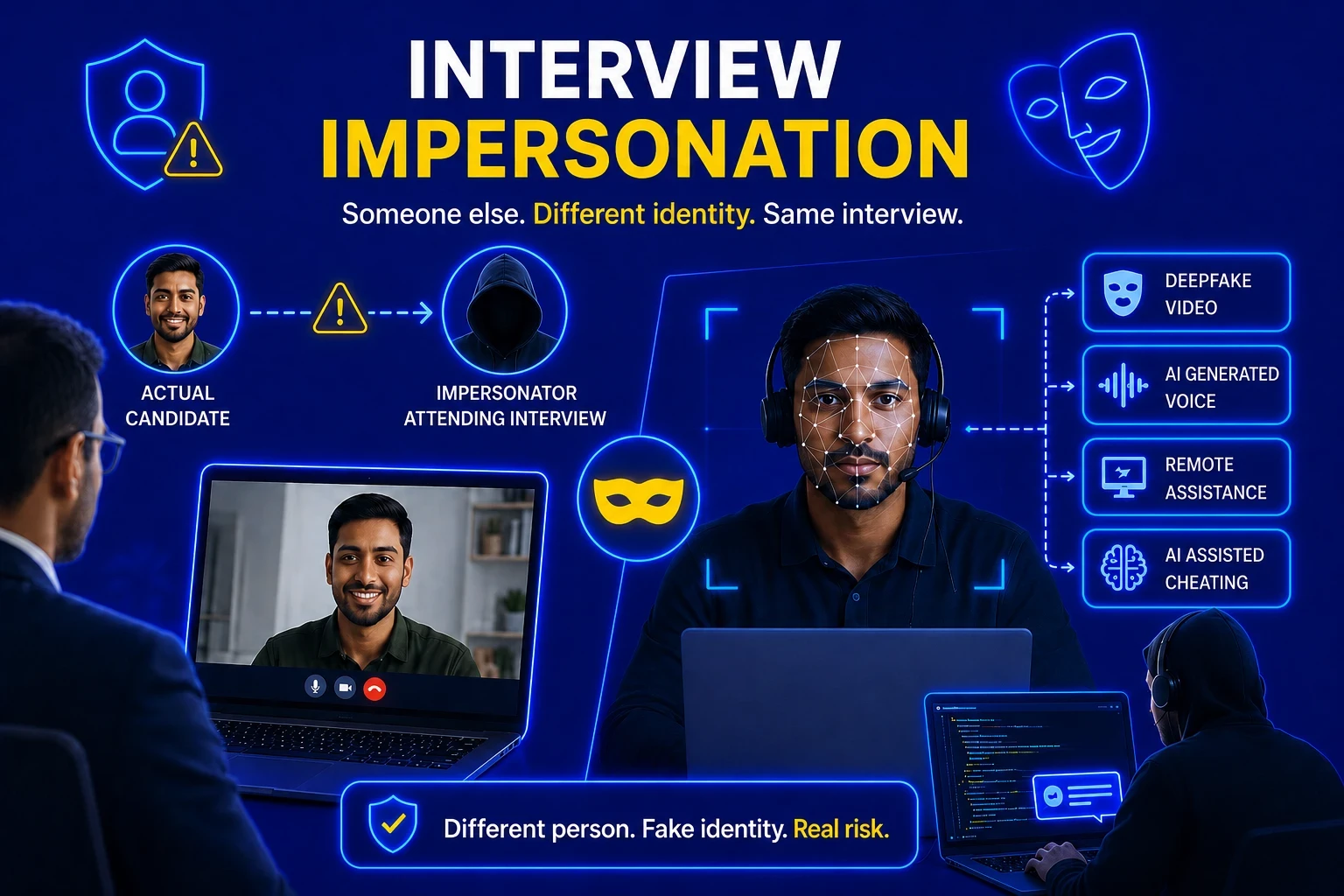
What once seemed like an isolated hiring issue has now evolved into a global recruitment challenge affecting enterprises, staffing firms, and fast growing startups alike.
The impact of interview impersonation goes far beyond a bad hire. Companies may face:
Security breaches and unauthorized system access
Financial losses caused by fraudulent employees
Productivity decline due to unqualified hires
Legal and compliance risks
Damage to employer reputation and hiring credibility
Increased employee turnover and rehiring costs
The problem is especially critical in remote hiring environments where recruiters have limited visibility into candidate authenticity. Traditional verification methods are no longer enough to detect sophisticated impersonation attempts.
Why Interview Impersonation Is Increasing in Remote Hiring
Interview impersonation is increasing rapidly as companies continue to adopt remote and virtual hiring processes. While online recruitment helps organizations hire talent faster and expand globally, it has also created new opportunities for fraudsters to manipulate interviews using AI tools, proxy candidates, and identity deception techniques.
Unlike traditional face to face hiring, remote interviews limit physical verification and make it harder for recruiters to identify suspicious behavior in real time. As a result, impersonation tactics are becoming more sophisticated, scalable, and difficult to detect manually.
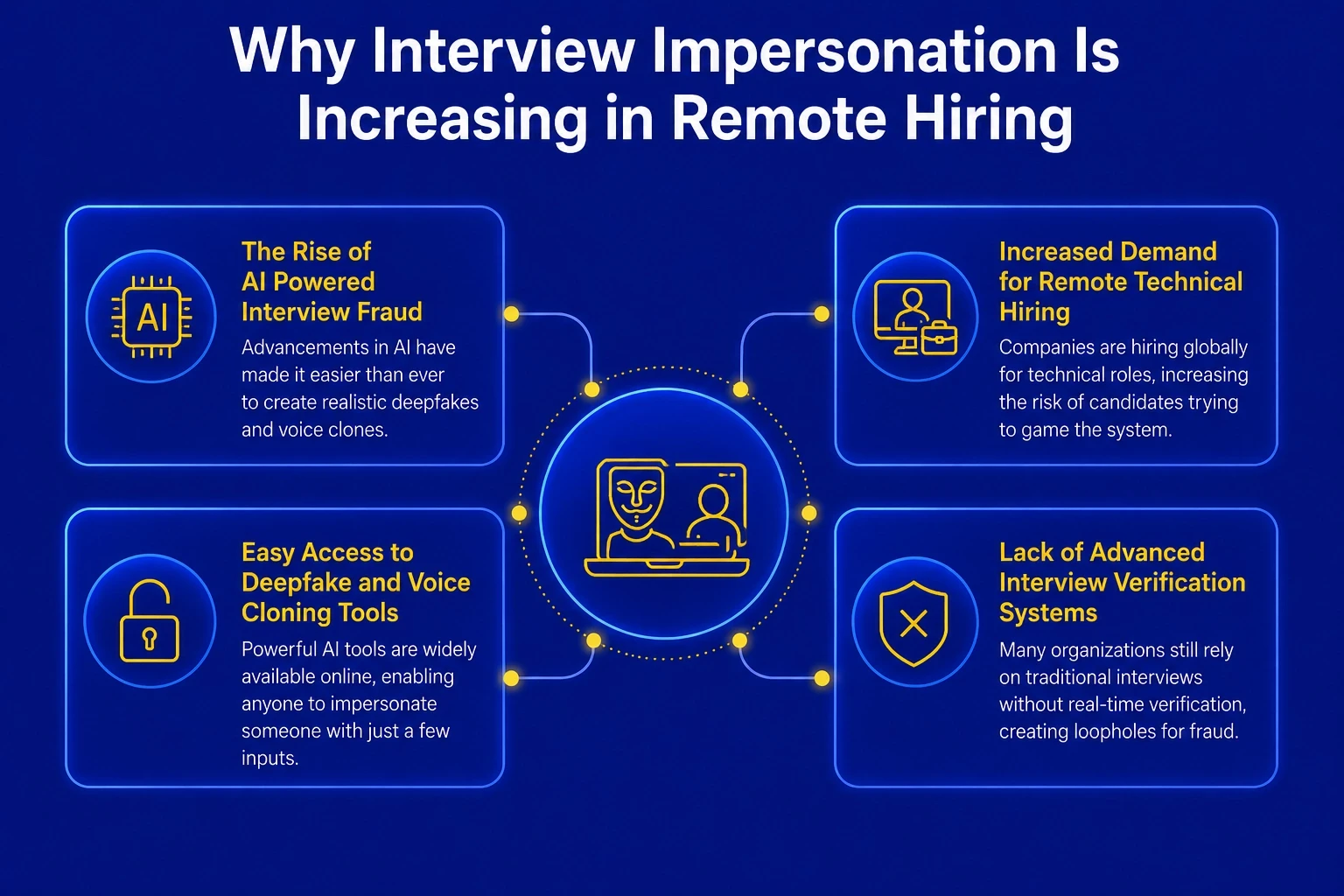
Below are some of the major reasons why interview impersonation is growing across industries.
The Rise of AI Powered Interview Fraud
Artificial intelligence has significantly changed the way interview fraud is executed. Candidates now have access to AI generated answers, voice cloning software, deepfake technology, and real time assistance tools that can help them manipulate virtual interviews.
Some fraudsters use advanced AI systems to generate natural sounding responses during technical discussions, while others rely on manipulated video feeds or synthetic voices to hide their real identity. These technologies make impersonation attempts appear more convincing during live interviews.
According to Europol, deepfake technology is becoming a growing challenge for identity verification and online trust systems worldwide.
Increased Demand for Remote Technical Hiring
The demand for remote software developers, cloud engineers, cybersecurity professionals, and IT specialists has increased dramatically over the last few years. Many organizations now conduct complete hiring cycles virtually, including coding assessments and technical interviews.
This rapid shift toward online technical hiring has created more opportunities for interview fraud. In many cases, proxy candidates attend technical interviews on behalf of less qualified applicants to secure high paying remote jobs.
Recruiters handling large hiring volumes may struggle to identify subtle signs of impersonation during virtual technical rounds, especially without advanced monitoring systems.
Easy Access to Deepfake and Voice Cloning Tools
Deepfake and voice cloning tools are now widely available online, making interview impersonation easier than ever before. Earlier, creating realistic manipulated video or audio required specialized expertise, but modern AI platforms have simplified the process significantly.
Fraudsters can now alter facial expressions, synchronize fake lip movements, or generate cloned voices capable of imitating real human conversations during interviews. These manipulations can make it difficult for recruiters to identify suspicious activity through manual observation alone.
As these technologies continue to evolve, organizations face growing challenges in verifying candidate authenticity during remote interviews.
Lack of Advanced Interview Verification Systems
Many organizations still rely on traditional video conferencing platforms that were not designed to detect sophisticated interview fraud. Standard virtual interview tools cannot effectively identify deepfakes, proxy assistance, AI generated responses, or behavioral inconsistencies.
Recruiters often depend on manual monitoring, which makes it difficult to consistently detect suspicious patterns such as:
Lip sync mismatches
Unnatural eye movement
Audio and video inconsistencies
Delayed responses
Multiple face detection
Real time external assistance
Without AI powered interview verification systems, many impersonation attempts remain undetected until after hiring decisions are made.
Platforms like Sherlock AI help organizations address these challenges through real time interview monitoring, candidate verification, deepfake detection, behavioral analysis, and AI powered fraud prevention technologies.
What’s at Stake in Interview Impersonation?
Interview impersonation may appear to be a small hiring issue at first, but the long term consequences can affect every part of an organization. From financial losses to security threats, a single fraudulent hire can create serious operational and reputational damage.
As remote hiring becomes more common, organizations must understand the broader risks associated with fake candidates, proxy interviews, and AI driven hiring fraud.
Incorrect Hiring and Unverified Candidates: You may end up hiring someone whose real identity, qualifications, skills, or employment history were never properly verified. In many impersonation cases, the person who clears the interview is not the same individual who eventually joins the organization.
This creates major concerns around job performance, accountability, and workforce reliability, especially for technical or client facing roles.
Compliance and Legal Exposure: Interview impersonation can expose organizations to compliance violations and legal risks, particularly in industries such as BFSI, healthcare, cybersecurity, and IT services where employee verification is critical.
Hiring unverified individuals may create issues related to data protection, regulatory audits, access control policies, and client security requirements.
Reputation and Trust Damage: A fraudulent hiring incident can negatively affect employer credibility and stakeholder trust. Customers, investors, and clients expect organizations to maintain secure and reliable hiring practices.
If impersonation leads to security incidents, operational failures, or poor service quality, it can damage the company’s reputation and impact future business opportunities.
Internal Productivity and Team Disruption: An employee hired through impersonation may struggle to meet performance expectations after onboarding. This can increase pressure on managers and team members who must compensate for missed deadlines, skill gaps, or low quality work.
Over time, this affects productivity, collaboration, and overall team morale.
According to estimates widely attributed to the U.S. Department of Labor, a bad hire can cost organizations up to 30% of the employee’s first year earnings, making hiring fraud a serious financial concern for businesses. This staggering figure encompasses not just salary, but also the resources spent on recruitment, training, and the lost opportunity of having a more competent individual in the role.
Red Flags to Watch For in Interview Impersonation
Interview impersonation is becoming harder to detect as fraudsters use advanced technologies such as deepfake videos, AI generated responses, proxy candidates, and hidden assistance tools during remote interviews. While some impersonation attempts are obvious, many appear highly convincing and can easily bypass traditional hiring checks if recruiters are not trained to identify suspicious behavior.
In virtual hiring environments, recruiters must pay close attention to behavioral inconsistencies, technical irregularities, and communication patterns that may indicate fraudulent activity. Identifying these warning signs early can help organizations prevent incorrect hiring decisions, security risks, and operational disruptions.
Below are some of the most common red flags recruiters should watch for during interviews.
Lip sync mismatches between speech and facial movement
Unnatural eye movement or repeated side glances
Delayed responses during technical questions
Audio and video inconsistencies during conversations
Multiple face detection or suspicious background activity
Overly scripted or robotic communication patterns
Frequent connectivity interruptions during verification requests
Sudden changes in voice tone or communication style
Avoidance of live identity verification checks
Inconsistent technical knowledge across interview rounds
While a single indicator may not always confirm interview impersonation, multiple suspicious behaviors together can signal potential fraud risks during the hiring process. As impersonation tactics continue to evolve, organizations need stronger verification systems capable of detecting behavioral anomalies and interview manipulation in real time
Real World Examples of Interview Impersonation
Interview impersonation is becoming increasingly common in remote hiring, especially in technical and high paying job roles. Fraudsters are using advanced methods such as proxy interviews, stolen identities, and AI powered manipulation to bypass recruitment processes and secure jobs fraudulently.
These real world scenarios highlight how interview fraud can impact hiring integrity, cybersecurity, and organizational trust.
Case 1: Proxy Candidate in a Technical Interview
A candidate applies for a remote software engineering role with an impressive resume and strong technical credentials. During the virtual coding interview, the candidate performs exceptionally well and clears multiple technical rounds.
However, after joining the company, the employee struggles with basic development tasks and fails to demonstrate the same technical expertise shown during the interview process. The organization later discovers that another experienced professional attended the technical interview on behalf of the actual candidate.
This type of proxy interview fraud is becoming increasingly common in remote technical hiring.
Case 2: Fake Identity Used for Remote Hiring
A remote candidate successfully clears interviews using stolen identity documents and manipulated credentials. The hiring team completes onboarding without identifying any major verification concerns.
After gaining access to company systems, the employee begins handling sensitive internal data and confidential business operations. The organization later discovers that the individual was operating under a fake identity and had provided fraudulent employment records during the hiring process.
Case 3: AI Assisted Interview Manipulation
A candidate attends a virtual interview using hidden AI powered assistance tools that generate real time answers during technical discussions. Throughout the interview, the candidate shows delayed responses, unnatural eye movement, and inconsistent communication patterns.
Recruiters later identify suspicious lip sync mismatches and behavioral irregularities suggesting possible AI generated assistance during the interview process.
As AI tools become more accessible, organizations are increasingly facing challenges detecting deepfake videos, voice cloning, and AI assisted interview fraud during remote hiring.
How to Prevent Interview Impersonation?
As interview impersonation continues to rise in remote hiring, organizations need stronger verification systems to protect hiring integrity and reduce fraud risks. Traditional interview methods are no longer enough to detect advanced impersonation tactics such as deepfake videos, proxy candidates, AI generated responses, and hidden interview assistance tools.
Companies must adopt a multi layer approach that combines identity verification, behavioral analysis, real time monitoring, and AI powered fraud detection to secure virtual hiring processes effectively.
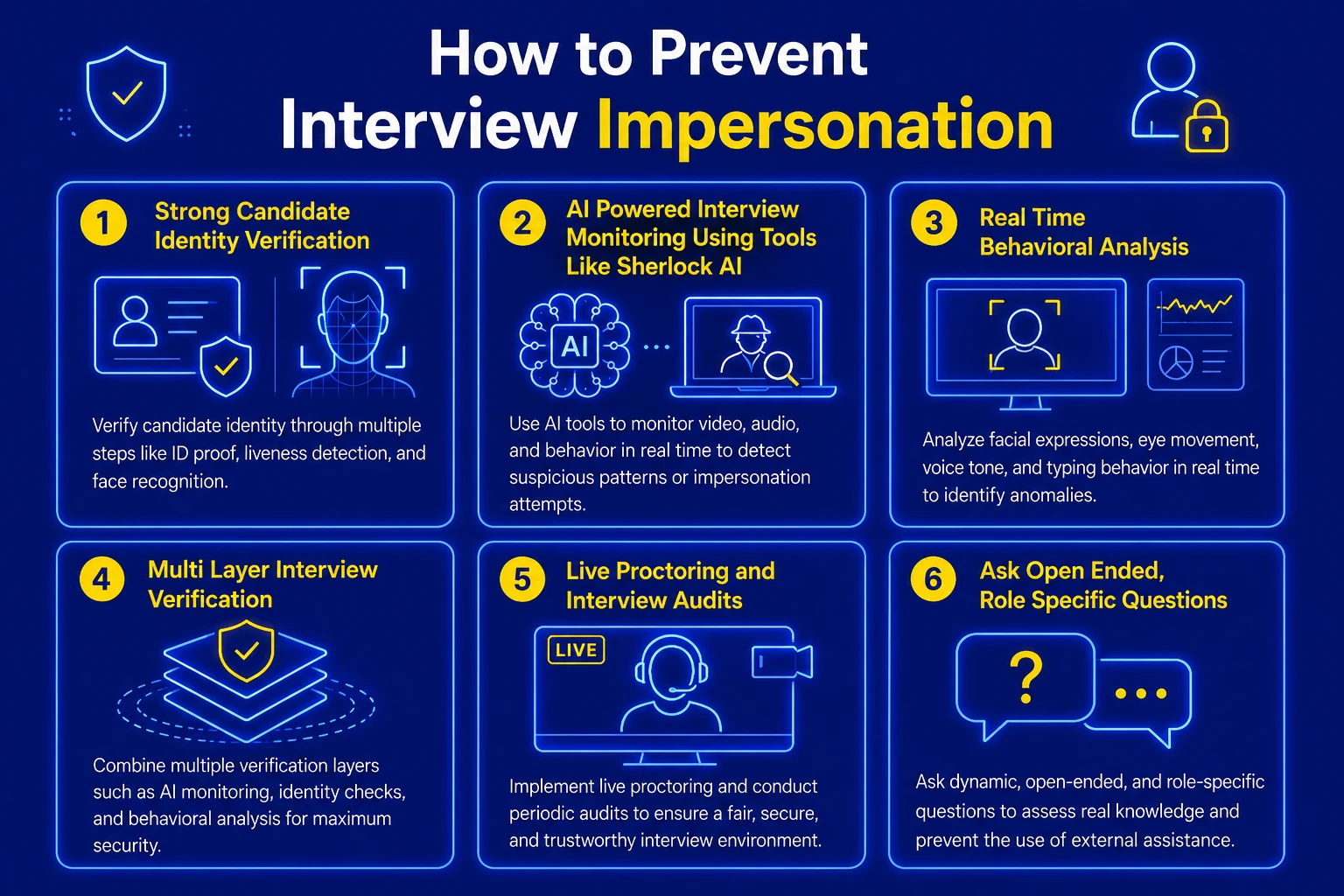
1. Strong Candidate Identity Verification
Preventing interview impersonation starts with verifying that the person attending the interview is genuinely the candidate applying for the role. In remote hiring environments, organizations cannot rely solely on resumes or manual observation because fraudsters often use fake identities, proxy candidates, or manipulated credentials to bypass hiring checks.
A strong identity verification process helps recruiters confirm candidate authenticity throughout every stage of the hiring journey.
Validates government issued identity documents in real time
Matches live candidate appearance with submitted ID records
Prevents candidate switching between interview rounds
Reduces the risk of fake profiles and stolen identities
Strong identity verification creates a more secure hiring process and helps organizations identify impersonation attempts before fraudulent candidates move further in the recruitment cycle.
2. AI Powered Interview Monitoring Using Tools Like Sherlock AI
Manual interview monitoring is no longer enough to detect advanced impersonation tactics. Fraudsters now use deepfake technology, AI generated responses, and hidden assistance tools that can easily go unnoticed during virtual interviews.
AI powered interview monitoring systems like Sherlock AI help organizations identify suspicious behavior patterns and detect interview fraud in real time.
Detects lip sync mismatches during video interviews
Identifies unusual facial movement and eye behavior
Flags multiple face detection or suspicious background activity
Monitors audio and video inconsistencies during interviews
AI driven interview monitoring improves hiring integrity and helps recruiters identify fraudulent behavior more accurately.
3. Real Time Behavioral Analysis
Behavioral analysis plays a critical role in identifying suspicious interview activity that may indicate impersonation or hidden assistance. Candidates involved in interview fraud often display unnatural communication patterns or inconsistent behavior during virtual interactions.
Real time behavioral analysis helps organizations detect these anomalies before hiring decisions are finalized.
Tracks delayed responses during technical discussions
Detects robotic or overly scripted communication patterns
Identifies suspicious eye movement and repeated side glances
Monitors inconsistencies in candidate interaction behavior
Behavioral intelligence adds an additional layer of protection against interview manipulation and AI assisted cheating.
4. Multi Layer Interview Verification
Relying on a single interview round increases the risk of impersonation fraud. Organizations need multiple verification layers across the hiring process to validate candidate authenticity consistently.
A multi layer approach makes it harder for fraudsters to manipulate interviews or switch candidates during different hiring stages.
Compares candidate performance across multiple interview rounds
Validates technical skills through live assessments
Conducts follow up verification during final hiring stages
Identifies inconsistencies between interview and onboarding phases
Layered verification strengthens recruitment security and reduces the chances of fraudulent hiring.
5. Live Proctoring and Interview Audits
Live proctoring helps organizations monitor interview environments more effectively and identify suspicious activity during virtual hiring sessions. Post interview audits also allow recruiters to review recordings and investigate irregular behavior patterns.
This creates greater visibility into remote interview interactions.
Monitors candidate activity during live interviews
Records interview sessions for verification and review
Detects suspicious environmental or background changes
Flags unusual interview behavior for manual investigation
Proctoring and audit systems help organizations improve transparency and reduce interview fraud risks.
6. Ask Open Ended, Role Specific Questions
Structured and predictable interview questions make it easier for candidates to rely on scripted answers, AI generated responses, or external assistance during interviews. Asking open ended, role specific questions helps recruiters evaluate real experience, problem solving ability, and communication authenticity more effectively.
These questions encourage candidates to explain their thought process in detail, making impersonation and proxy assistance harder to maintain during live interviews.
Assesses practical knowledge through real world scenarios
Makes scripted or AI generated responses easier to identify
Evaluates communication consistency and technical depth
Helps recruiters detect hesitation or external assistance patterns
Open ended discussions create more natural interview interactions and help organizations identify candidates who genuinely possess the required skills and experience for the role.
How Sherlock AI Helps Prevent Interview Impersonation
As interview impersonation techniques become more advanced, organizations need intelligent systems that can identify suspicious activity beyond traditional manual verification methods. Deepfake videos, proxy candidates, AI generated responses, and hidden interview assistance tools are making remote hiring fraud increasingly difficult to detect through standard interview processes.
This is where AI powered interview intelligence platforms like Sherlock AI help organizations strengthen hiring integrity and reduce interview fraud risks. Sherlock AI combines real time interview monitoring, behavioral analysis, identity verification, and fraud detection technologies to help recruiters identify suspicious candidate activity during virtual hiring.
1. Real Time Interview Fraud Detection Using Sherlock AI
Interview fraud often happens in subtle ways that human interviewers may miss during live conversations. Sherlock AI continuously monitors interviews in real time to identify suspicious behaviors and potential impersonation attempts as they happen.
Detects unusual interview behavior patterns in real time
Flags suspicious candidate activity during live interviews
Identifies possible proxy participation and hidden assistance
Prevents fraudulent candidates from progressing unnoticed
Real time fraud detection helps organizations stop impersonation attempts before they impact hiring decisions.
2. AI Based Lip Sync and Deepfake Detection
Deepfake technology and manipulated video feeds are becoming major challenges in remote hiring. Sherlock AI helps recruiters identify visual inconsistencies that may indicate AI generated or manipulated interview activity.
Detects lip sync mismatches during video interviews
Identifies unnatural facial movement patterns
Flags potential deepfake video manipulation attempts
Monitors visual inconsistencies in candidate interactions
AI powered deepfake detection improves interview authenticity and strengthens hiring security.
3. Behavioral Analysis and Suspicious Activity Monitoring
Candidates using external assistance or AI generated responses often display unusual communication patterns during interviews. Sherlock AI analyzes candidate behavior to identify suspicious interaction signals.
Tracks delayed responses during technical discussions
Detects unnatural eye movement and repeated side glances
Identifies robotic or scripted communication behavior
Monitors inconsistencies in interview interactions
Behavioral intelligence helps recruiters detect interview manipulation more effectively.
4. Candidate Identity Verification and Authentication
Verifying candidate identity is critical for preventing fake profiles, stolen credentials, and candidate switching during remote hiring. Sherlock AI supports stronger identity validation throughout the interview process.
Supports live candidate verification during interviews
Helps validate identity consistency across hiring stages
Reduces risks associated with fake candidate profiles
Strengthens authentication during remote recruitment
Identity verification improves trust and transparency throughout virtual hiring processes.
5. AI Powered Interview Integrity Reports
Interview fraud indicators are often difficult to document manually during large scale hiring operations. Sherlock AI generates interview integrity insights that help recruiters review suspicious activity more efficiently.
Provides detailed interview risk analysis reports
Highlights suspicious behavior patterns during interviews
Supports post interview fraud investigations
Helps recruiters make more informed hiring decisions
Interview integrity reporting improves visibility into potential hiring risks and strengthens recruitment decision making.
6. Scalable Protection for Remote Hiring
As organizations increase remote hiring across regions and job roles, manual interview monitoring becomes difficult to scale. Sherlock AI helps companies maintain hiring security across high volume recruitment operations.
Supports secure large scale virtual hiring processes
Improves consistency in interview fraud detection
Helps reduce manual verification effort for recruiters
Strengthens hiring integrity across distributed teams
Scalable fraud prevention systems help organizations secure remote recruitment while maintaining hiring efficiency.
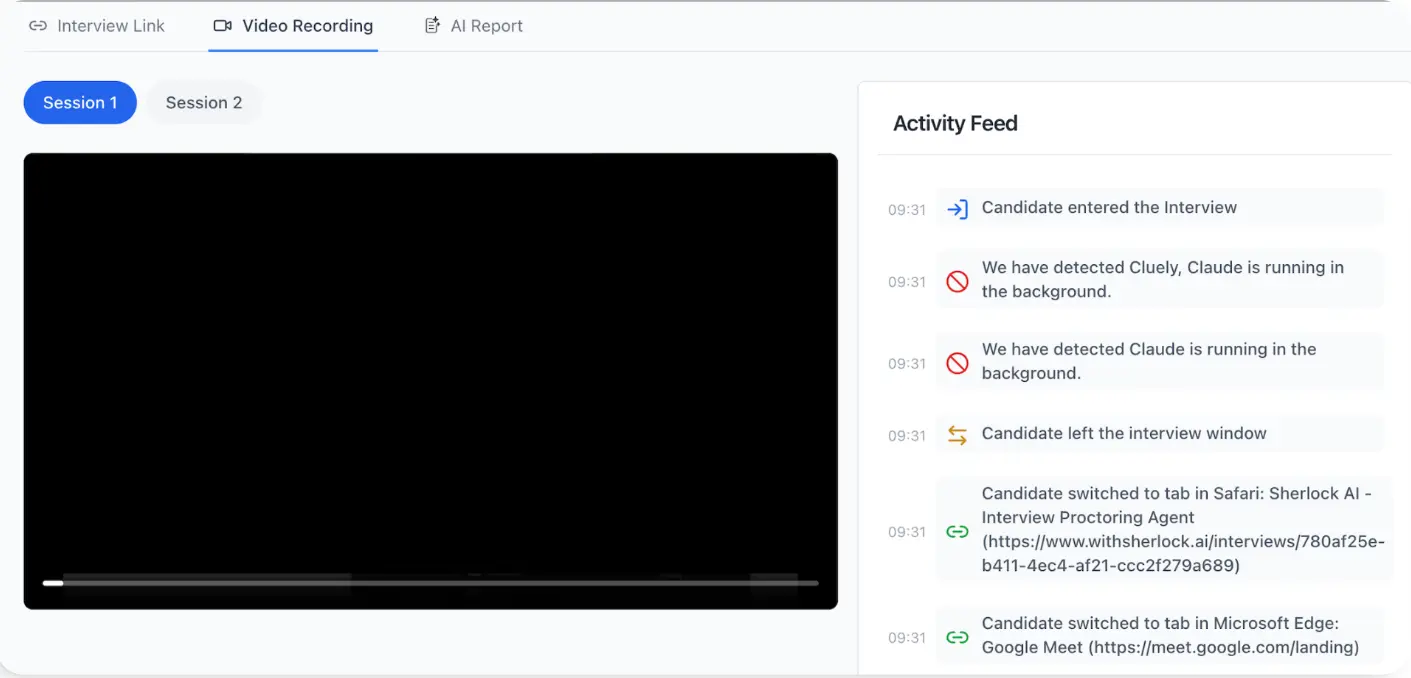
By combining AI powered monitoring, behavioral analysis, identity verification, and deepfake detection, Sherlock AI helps organizations reduce interview impersonation risks and build more secure, trustworthy remote hiring processes.
Why Interview Impersonation Is Not Just an HR Problem
Interview impersonation is often viewed as a recruitment challenge, but its impact extends far beyond the HR department. A single fraudulent hire can create serious risks across cybersecurity, compliance, operations, finance, and overall business performance. When organizations fail to detect impersonation during the hiring process, they may unknowingly grant sensitive access and critical responsibilities to unverified individuals.
The risks associated with interview impersonation affect multiple areas of the organization, including:
Cybersecurity risks caused by unauthorized system and data access
Compliance and legal issues related to employee verification failures
Operational disruption due to underqualified or fraudulent hires
Financial losses from rehiring, retraining, and productivity decline
Reputation damage affecting customer and stakeholder trust
The Future of Secure Remote Hiring
Remote hiring is transforming the way organizations recruit talent across industries. Companies now have access to global talent pools, faster recruitment processes, and more flexible hiring models than ever before. However, as virtual hiring continues to expand, interview impersonation and AI driven hiring fraud are becoming increasingly sophisticated challenges for recruiters and enterprises.
Traditional interview methods are no longer enough to detect modern impersonation tactics such as proxy interviews, deepfake videos, AI generated responses, and hidden external assistance. Organizations must now rethink how they verify candidate authenticity and secure remote recruitment processes. Hiring integrity is becoming just as important as hiring speed and scalability.
The future of secure remote hiring will depend on the adoption of intelligent verification systems that can identify suspicious behavior in real time while maintaining a seamless candidate experience. Businesses that invest in stronger interview security, behavioral analysis, and AI powered monitoring will be better prepared to reduce hiring risks, protect sensitive systems, and maintain trust in their recruitment processes.
As hiring fraud techniques continue to evolve, organizations need solutions that go beyond manual observation and traditional verification methods. Sherlock AI is helping companies build more secure remote hiring environments through AI powered interview monitoring, deepfake detection, candidate verification, and real time fraud prevention technologies.
Secure hiring is no longer just an HR priority. It is a critical business requirement for organizations building the future of remote work.
Ready to transform your hiring process with smarter AI powered interview security and real time candidate verification? Explore how Sherlock AI helps teams detect interview impersonation while keeping hiring fast, fair, and human centered. Book a demo to get started. |