Back to all blogs
Learn what a one-on-one interview is, how it works, its types, techniques, benefits, pros and cons, and best practices for effective hiring.

Abhishek Kaushik
Unlike a panel interview, where several interviewers assess a candidate together, a one-on-one interview involves one interviewer and one candidate. With fewer people involved, the conversation can remain focused, making it easier to explore answers in more detail and ask follow-up questions based on the candidate’s responses.
The approach can vary depending on the role and the organisation.SEEK research found that 57% of people prefer a one-on-one interview over a panel or group interview. Some interviews follow a structured set of questions, while others allow the conversation to develop based on the candidate’s responses. Interviewers may use behavioural, situational, technical, or experience-based questions to understand how a candidate has handled situations in the past or might respond to situations at work.
The format has its own strengths and limitations. A focused conversation can make it easier to ask follow-up questions and understand a candidate’s experience, while having only one interviewer can also mean fewer perspectives during the assessment. The quality of the interview therefore depends not only on the conversation itself but also on how questions are prepared and how responses are evaluated.
Understanding how one-on-one interviews work, the techniques interviewers use, and their benefits and limitations can help both employers and candidates approach the process more effectively.
What Is a One-on-One Interview?
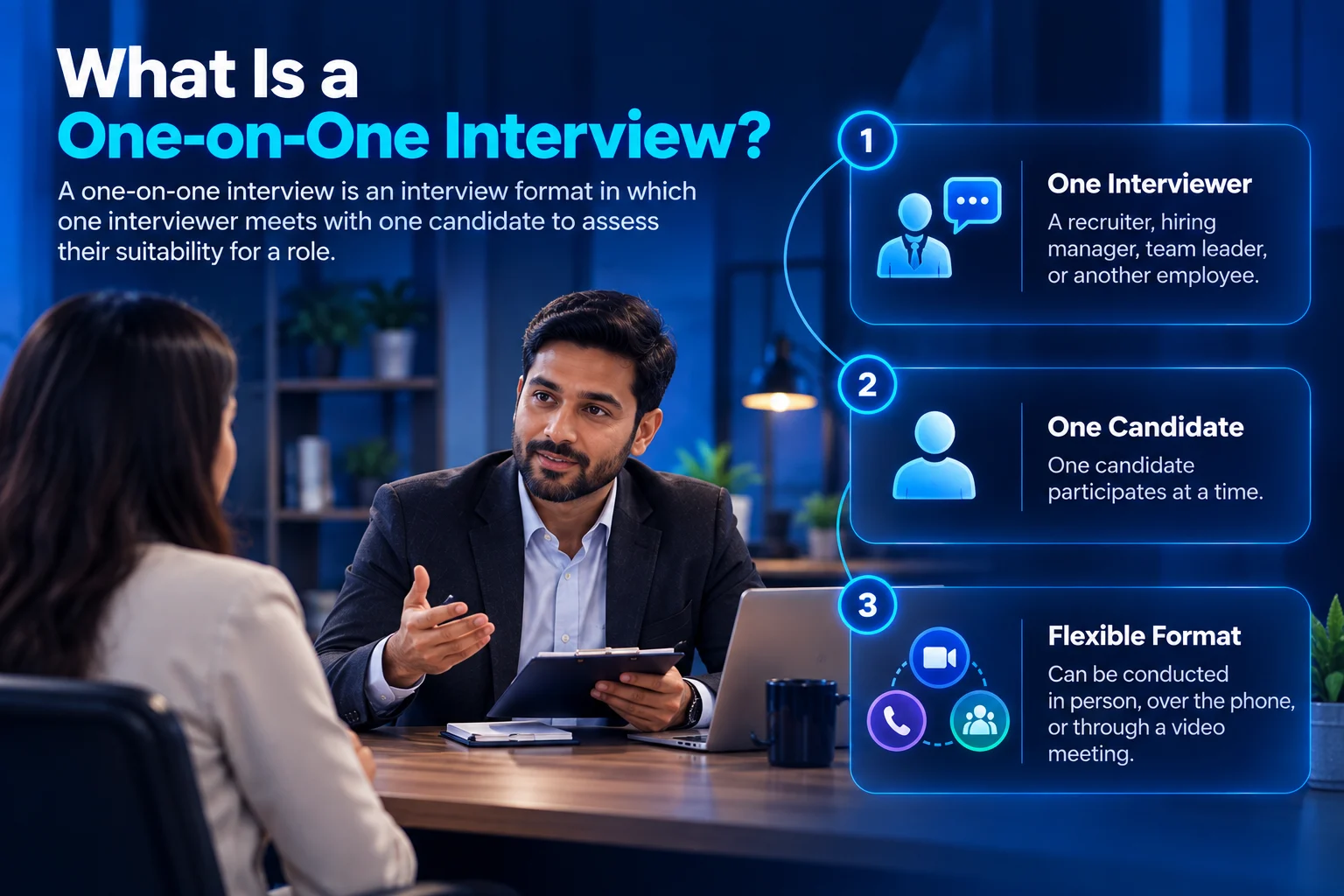
A one-on-one interview is an interview format in which one interviewer meets with one candidate to assess their suitability for a role.
The interviewer may be a recruiter, hiring manager, team leader, or another employee involved in the hiring process. The discussion can cover the candidate’s qualifications, work history, skills, experience, behaviour, and knowledge related to the position.
The interview can be conducted face-to-face, over the phone, or through a video meeting. Its structure also varies. A structured interview may follow the same questions for every candidate, while a semi-structured or unstructured interview gives the interviewer more freedom to explore the conversation.
The defining feature is simple: there is one interviewer and one candidate participating in the interview at a time.
How Does a One-on-One Interview Work?
The exact process of a one-on-one interview depends on the company, position, and purpose of the interview. Although there is no fixed format that every organisation follows, the conversation generally moves through a few common stages, starting with an introduction and moving towards questions about the candidate, role-specific assessment, and closing.
1. Introduction and Opening
The interviewer normally begins by introducing themselves and explaining their role in the hiring process. They may also briefly describe the position, the purpose of the interview, or how the conversation will be conducted.
This opening gives both people a chance to settle into the conversation before moving into more detailed questions. It also helps establish the direction of the discussion and gives the candidate some context about what to expect.
2. Background and Experience
The interviewer then asks about the candidate’s education, previous work, projects, responsibilities, skills, or other experience related to the position. This part of the conversation helps the interviewer understand the candidate’s background and identify experience that may be relevant to the role.
The discussion may also include questions about specific situations, responsibilities, or challenges the candidate has handled. This allows the interviewer to understand how the candidate has applied their skills in practical situations and how their previous experience relates to the requirements of the role.
3. Role-Specific Discussion
The conversation usually moves towards areas that are directly connected to the position. Depending on the role, this may include technical knowledge, problem-solving, communication, decision-making, or other skills required for the job.
The interviewer may also explore specific responsibilities or projects mentioned on the candidate’s resume. For example, they may ask the candidate to explain their role in a project, how they handled a particular challenge, or why they chose a certain approach.
4. Follow-Up Discussion
The interviewer can ask additional questions based on the candidate’s previous answers. This allows them to clarify information, explore an experience in greater depth, or understand the reasoning behind a particular decision.
For instance, if a candidate mentions that they improved a process at a previous job, the interviewer can ask how they identified the problem, what action they took, and what happened afterwards. These follow-up questions can make the conversation more detailed and help the interviewer understand the candidate’s experience beyond the initial answer.
5. Candidate Questions and Closing
Towards the end of the interview, the candidate usually gets an opportunity to ask questions about the position, team, responsibilities, work environment, or hiring process. This gives the candidate a chance to clarify anything that was not covered during the discussion.
The interviewer may then explain what happens next, such as another interview, an assessment, reference checks, or communication about the hiring decision. The exact next step varies between organisations and may depend on where the candidate is in the recruitment process.
Types of One-on-One Interviews
One-on-one interviews can take different forms depending on how the interviewer conducts the conversation and what they want to assess. Some focus on consistency, while others give the interviewer more freedom to explore a candidate’s experience.
The type of interview can also depend on the position. A recruiter may use a structured approach for an initial screening, while a technical interviewer may use practical problems to assess job-specific knowledge. Understanding these formats helps both interviewers and candidates know what to expect from the conversation.
1. Structured One-on-One Interview
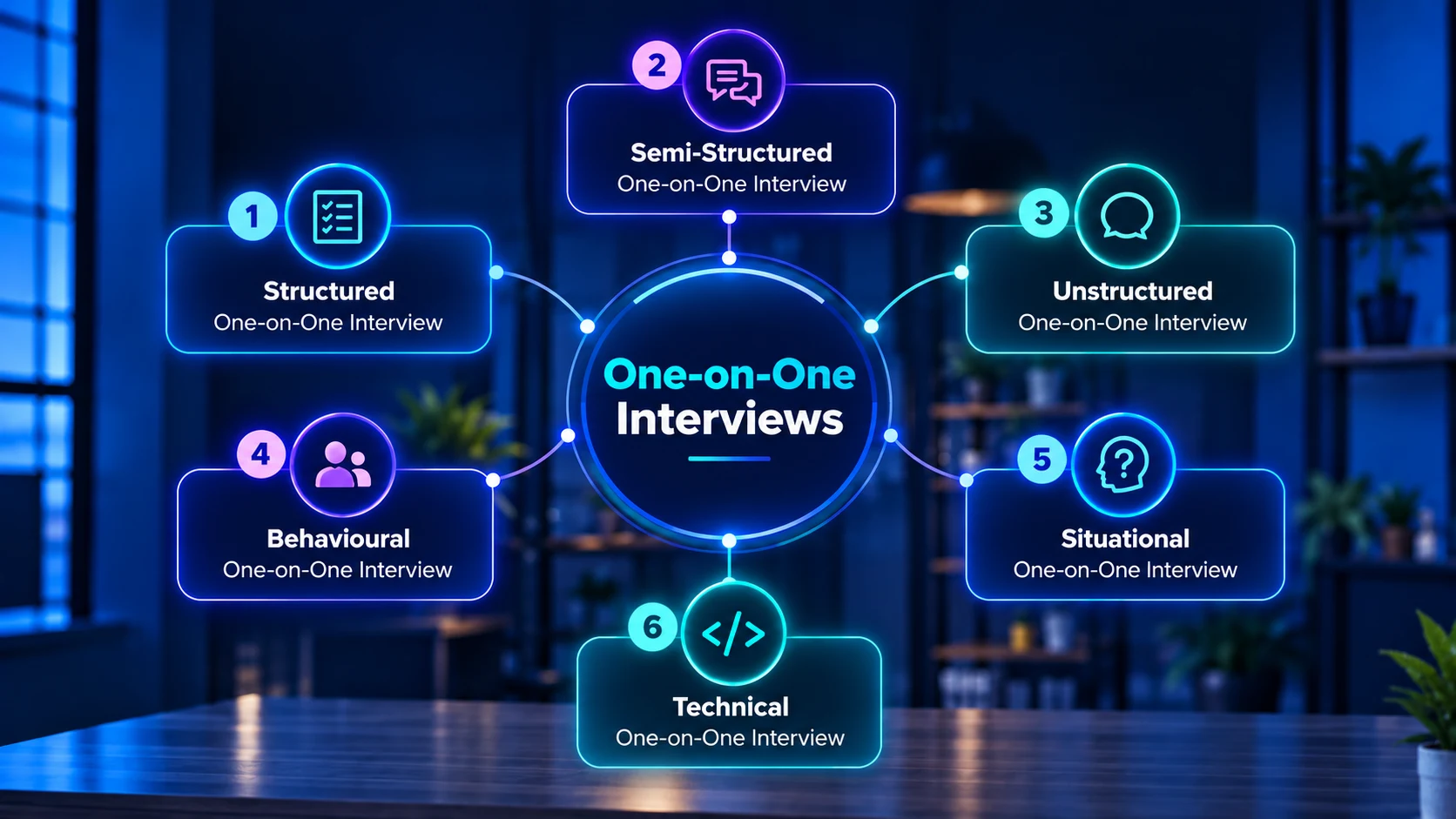
A structured one-on-one interview follows a predefined set of questions and an established evaluation method. The interviewer generally asks every candidate the same core questions, usually in the same or a similar order, and assesses their responses using predetermined criteria.
The main purpose is to create a consistent basis for evaluating candidates. Because the interviewer has already decided what needs to be covered, the conversation is less dependent on individual preferences or the direction in which the discussion happens to move. Structured interviews can be particularly useful when an organisation is assessing several candidates for the same position and wants to compare responses against the same requirements.
Example: For a customer-service position, every candidate is asked the same questions about handling difficult customers, teamwork, and problem-solving. The interviewer then evaluates each response against predefined criteria.
2. Semi-Structured One-on-One Interview
A semi-structured one-on-one interview combines a planned set of questions with the flexibility to explore the candidate’s responses further. The interviewer usually prepares the main topics they want to cover but does not have to follow the questions rigidly.
This approach gives the interviewer a balance between consistency and natural conversation. Important areas can be covered with every candidate, while follow-up questions can be added when a response reveals useful information. It is often suitable when the interviewer wants comparable information but also wants to understand the candidate’s individual experience in greater depth.
Example: An interviewer asks every candidate about a previous project, but the follow-up questions differ depending on the candidate’s responsibilities, challenges, and results in that project.
3. Unstructured One-on-One Interview
An unstructured one-on-one interview has little or no fixed sequence of questions. Instead, the interviewer allows the conversation to develop naturally based on the candidate’s background, experiences, interests, and responses.
This format can feel more like an open conversation than a formal question-and-answer session. It gives the interviewer considerable freedom to explore topics that come up during the discussion, but different candidates may end up discussing different areas. As a result, the information collected may be less consistent when several candidates are being assessed for the same position.
Example: An interviewer begins by asking a candidate about their career journey and then allows the discussion to move towards previous projects, challenges they faced, professional interests, and future goals based on the candidate’s answers.
4. Behavioural One-on-One Interview
A behavioural one-on-one interview focuses on situations the candidate has experienced in the past. Instead of asking only whether a candidate possesses a particular skill, the interviewer asks about situations where the candidate actually demonstrated that skill.
The interviewer may explore areas such as teamwork, leadership, communication, adaptability, conflict resolution, or decision-making. Follow-up questions can then be used to understand the situation, the candidate’s specific actions, and the outcome. This makes the discussion more focused on demonstrated behaviour rather than general claims about a candidate’s abilities.
Example: An interviewer asks a candidate to describe a time when they disagreed with a colleague, then explores how the candidate handled the disagreement and what the final outcome was.
5. Situational One-on-One Interview
A situational one-on-one interview presents the candidate with a hypothetical workplace situation and asks how they would respond. The situation is usually connected to a challenge that someone in the role could reasonably encounter.
This type of interview helps the interviewer explore how a candidate approaches decision-making, prioritisation, communication, problem-solving, or handling difficult situations. The interviewer may also ask why the candidate would choose a particular approach, which provides more insight into their reasoning rather than just the final answer.
Example: A customer-support candidate is asked how they would handle a customer who is frustrated because their complaint has not been resolved after several attempts.
6. Technical One-on-One Interview
A technical one-on-one interview is designed to assess the knowledge and practical abilities required for a technical position. It is commonly used for roles where candidates need specific technical skills, tools, concepts, or problem-solving abilities to perform the job.
The format can vary depending on the position. The interviewer may ask conceptual questions, discuss the candidate’s previous technical projects, analyse a problem together, or ask the candidate to explain how they would approach a practical task. The interviewer may also ask follow-up questions to understand whether the candidate can apply their knowledge rather than simply recall definitions.
Example: During a Java developer interview, the interviewer may ask the candidate to explain the difference between an interface and an abstract class and then discuss situations in which each might be appropriate.
When Are One-on-One Interviews Used?
A one-on-one interview can appear at different stages of the hiring process. The timing depends on the organisation, position, recruitment process, and what the employer needs to evaluate at that particular stage. It may be used as an initial conversation, a specialised assessment, or a later-stage discussion before a hiring decision is made.
The interviewer may also change from one stage to another. A recruiter may conduct the first conversation, followed by a hiring manager or a subject-matter expert in a later round. This allows different aspects of a candidate’s background and suitability to be assessed throughout the hiring process.
1. Initial Screening
A company may use a one-on-one interview early in the hiring process to determine whether a candidate meets the basic requirements of the position. This conversation is generally focused on information such as qualifications, relevant experience, skills, availability, and interest in the role.
At this stage, the interviewer may also confirm information from the candidate’s application or resume and explain the position in more detail. If the candidate meets the initial requirements, they may then move to a more detailed interview or another stage of the recruitment process.
2. Hiring Manager Interview
A candidate may have a one-on-one conversation with the manager responsible for the position. Since the hiring manager understands the day-to-day responsibilities of the role, the discussion can go beyond basic qualifications and focus on how the candidate’s experience relates to the actual work.
The hiring manager may explore previous projects, responsibilities, problem-solving approaches, communication, and the candidate’s expectations for the position. This stage can also give the manager a better understanding of how the candidate might approach the responsibilities associated with the role.
3. Technical or Functional Interview
For specialised positions, a one-on-one interview may be used to assess technical or functional knowledge. The interviewer is usually someone with relevant expertise who can evaluate whether the candidate understands the concepts, tools, processes, or skills required for the position.
The discussion may involve technical questions, previous projects, practical problem-solving, or questions about how the candidate would approach a work-related task. The depth of this assessment depends on the role and may be more detailed for positions that require specialised knowledge.
4. Behavioural Interview
A one-on-one interview can also be used to assess how a candidate has handled situations in their previous experience. Instead of focusing only on qualifications or technical knowledge, the interviewer may explore behaviours and competencies such as teamwork, communication, leadership, adaptability, decision-making, and conflict resolution.
The interviewer can ask the candidate to describe relevant experiences and then use follow-up questions to understand what happened, what actions the candidate took, and what the outcome was. This gives the interviewer more information about how the candidate has approached situations that may be relevant to the role.
5. Later-Stage Interview
A one-on-one interview may also take place later in the recruitment process after a candidate has completed one or more earlier rounds. At this stage, the conversation may be used to explore areas that were not fully covered previously or to involve another person in the final assessment.
The discussion can focus on role expectations, specialised responsibilities, team collaboration, career goals, or questions that require clarification before a hiring decision is made. Depending on the organisation, this may be a conversation with a potential manager, senior leader, or another person involved in the final hiring process.
One-on-One Interview Techniques
The quality of a one-on-one interview depends not only on the questions asked but also on how the interviewer manages the conversation. Effective interview techniques help the interviewer collect relevant information, encourage detailed responses, and assess candidates against the requirements of the role.
Since only one interviewer is directly interacting with the candidate, there is more opportunity to listen carefully, ask relevant follow-up questions, and explore specific experiences in greater depth. At the same time, the interviewer needs to maintain enough structure to ensure that the discussion remains focused and consistent.
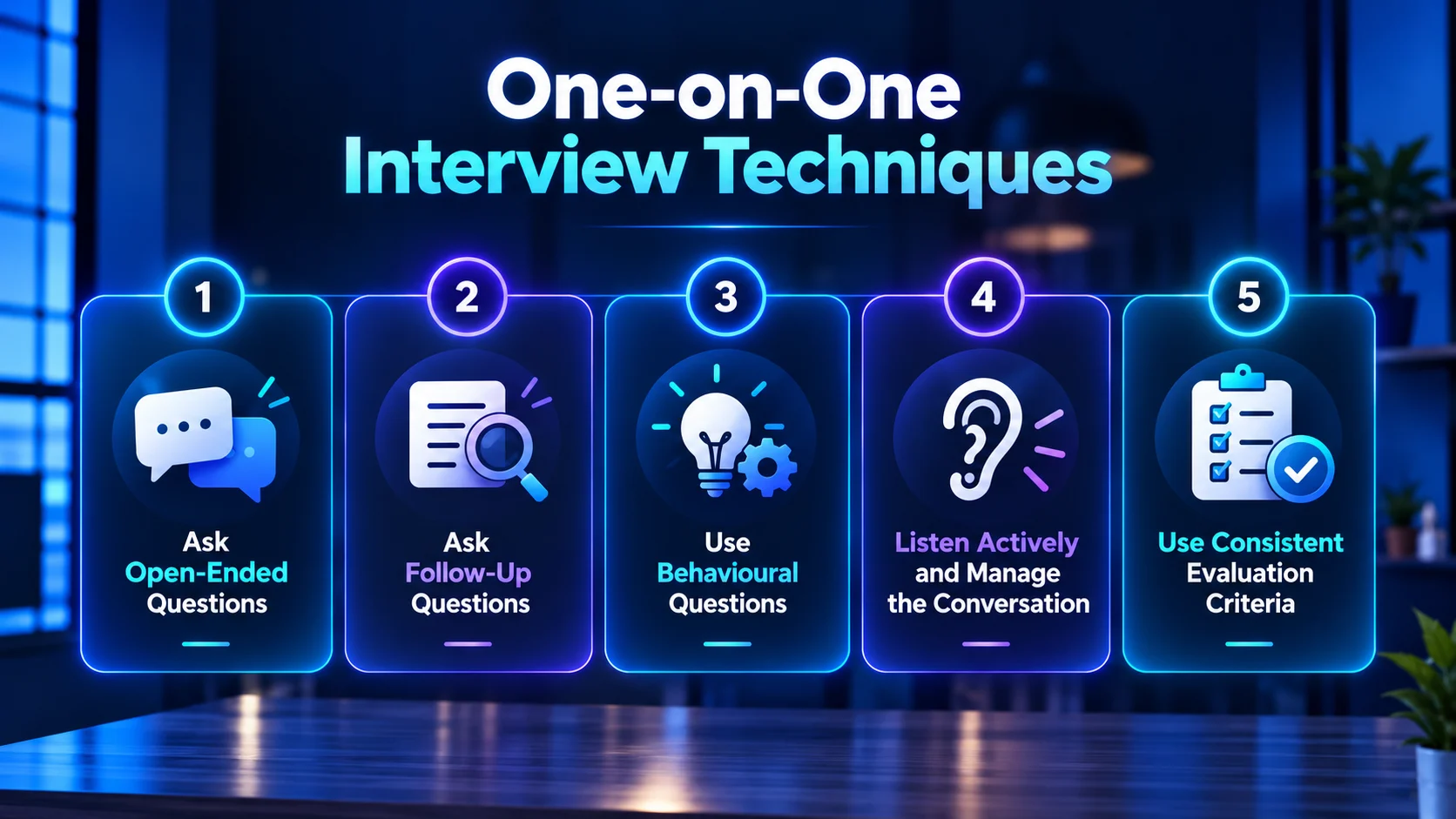
1. Ask Open-Ended Questions
Open-ended questions encourage candidates to provide detailed answers instead of responding with a simple “yes” or “no.” Questions beginning with words such as how, what, why, or tell me about give candidates the opportunity to explain their experiences, decisions, and approaches in their own words.
These questions can help the interviewer understand how a candidate communicates, organises their thoughts, approaches problems, and reflects on previous experiences. They are particularly useful when the interviewer needs more information than a short factual response can provide.
The questions should still be connected to the requirements of the position. Broad questions without a clear purpose can make the conversation unfocused, while well-designed open-ended questions can encourage candidates to discuss information that is relevant to the role.
2. Ask Follow-Up Questions
Follow-up questions allow the interviewer to explore a candidate’s answer before moving to the next topic. A candidate may provide a useful response but leave out important details about their responsibilities, actions, reasoning, or results. Asking an additional question gives the interviewer an opportunity to understand those details.
This technique makes the conversation more flexible because the interviewer can respond to information that comes up during the discussion. It can be used to clarify an unclear statement, understand a candidate’s individual contribution to a project, or explore how they handled a particular situation.
Effective follow-up questions should add new information rather than simply repeat the original question. They help the interviewer move from a general response to a more complete understanding of the candidate’s experience.
3. Use Behavioural Questions
Behavioural questions focus on situations candidates have experienced in the past. Instead of asking only whether a candidate has a particular skill, these questions encourage them to describe how they have used that skill in an actual situation.
They can help assess competencies such as teamwork, communication, leadership, adaptability, decision-making, and conflict management. The interviewer can also ask follow-up questions to understand what the candidate personally did, why they chose a particular approach, and what happened as a result.
Behavioural questions are most useful when they are linked to competencies that matter for the position. This keeps the discussion focused on relevant experience rather than asking candidates to make broad claims about their abilities.
4. Listen Actively and Manage the Conversation
Active listening means paying close attention to the candidate’s response rather than focusing only on asking the next prepared question. The interviewer should listen for relevant details, unclear points, and information that may require further discussion.
Good listening also involves giving the candidate enough time to complete their thoughts and avoiding unnecessary interruptions. Brief note-taking can help the interviewer remember important information, but writing too much during the conversation can reduce engagement.
The interviewer also needs to manage the direction and pace of the discussion. A natural conversation can be encouraged while ensuring that important topics are covered and that the interview does not spend too much time on areas that are unrelated to the role.
5. Use Consistent Evaluation Criteria
Before conducting the interview, the interviewer should identify the qualifications, skills, competencies, and other requirements that need to be assessed. These criteria provide a clear basis for evaluating the candidate’s responses.
Consistent criteria become particularly useful when several candidates are being considered for the same position. If different candidates are judged according to completely different standards, it becomes more difficult to compare the information collected from their interviews.
The interviewer should therefore focus on evidence related to the role rather than relying mainly on general impressions. For example, instead of simply deciding that an answer was “good,” the interviewer can consider whether the response demonstrated the required skill, relevant experience, clear reasoning, or an appropriate approach to the situation.
Benefits of a One-on-One Interview
One-on-one interviews offer several practical benefits because the conversation takes place between only one interviewer and one candidate. The format gives the interviewer more direct interaction with the candidate and provides room to explore relevant areas in greater detail.
1. Focused Conversation
A one-on-one setting allows the interviewer to give their full attention to a single candidate. Unlike a panel interview, the interviewer does not need to divide the conversation between several people or coordinate who will ask the next question.
How it helps:
Keeps the discussion centred on the candidate’s qualifications and experience.
Makes it easier to spend more time on role-related topics.
Reduces interruptions caused by multiple people participating in the conversation.
Allows the interviewer to maintain a clear direction throughout the interview.
2. Easier Follow-Up
The interviewer can respond directly to the candidate’s answers and ask additional questions whenever more information is needed. This is particularly useful when an answer introduces an experience, responsibility, or skill that needs further clarification.
How it helps:
Allows unclear or incomplete answers to be explored immediately.
Helps uncover the candidate’s specific role in a project or situation.
Gives the interviewer more information than a fixed list of questions may provide.
Makes the conversation more responsive to the candidate’s actual experience.
3. Personalised Discussion
Although the interviewer may prepare a common set of topics, a one-on-one conversation can be adapted to the individual candidate. The interviewer can spend more time discussing experiences or skills that are particularly relevant to the position.
How it helps:
Connects the discussion more closely with the candidate’s background.
Allows relevant experience to be explored in greater depth.
Gives candidates an opportunity to explain how their skills relate to the role.
Helps the interviewer gather information that may not emerge from standard questions alone.
4. Direct Candidate-Interviewer Interaction
The candidate communicates directly with the person responsible for conducting the assessment. This creates a straightforward exchange in which questions, answers, clarifications, and discussions about the role take place between the same two people.
How it helps:
Makes it easier for the candidate to ask questions and clarify expectations.
Allows the interviewer to respond directly to the candidate’s concerns.
Gives both sides more opportunity to understand each other’s expectations.
Creates a clear line of communication throughout the interview.
5. More Detailed Exploration
A one-on-one interview gives the interviewer an opportunity to spend additional time on an area that is important to the position. Instead of moving immediately to the next question, the interviewer can explore a candidate’s experience, reasoning, or approach in greater detail.
How it helps:
Provides more opportunity to examine relevant experience.
Allows the interviewer to investigate important answers in greater depth.
Can reveal details that may be missed when the conversation moves too quickly.
Helps the interviewer build a more complete picture of the candidate’s experience.
6. Simpler Interview Coordination
A one-on-one interview usually involves fewer people than a panel interview, which can make the practical organisation of the conversation simpler. The organisation only needs to coordinate the availability of the candidate and the interviewer for that particular session.
How it helps:
Makes scheduling easier when compared with coordinating several interviewers.
Can reduce the number of people who need to be available at the same time.
Makes it easier to arrange another conversation if further discussion is required.
Can simplify communication about interview timing and next steps.
A study of 91 undergraduates who participated in one-on-one or group interviews for a scholarship selection process found that interviewers using the one-on-one format were significantly better at predicting applicants’ academic potential. The finding comes from a specific scholarship-selection setting, so it should not be treated as evidence that one-on-one interviews produce the same result in every employment situation. |
|---|
Pros and Cons of One-on-One Interviews
One-on-one interviews offer a direct and focused way to assess a candidate, but the format also has limitations. The same features that make the format convenient can also create challenges, particularly when the assessment depends heavily on one interviewer.
Pros:
A one-on-one interview offers several advantages because the interviewer can focus entirely on a single candidate. The format allows for a more personal conversation, quick follow-up questions, and flexibility throughout the discussion.
1. Focused Conversation
A one-on-one interview allows the interviewer to give their full attention to one candidate without coordinating the conversation with other interviewers. This can keep the discussion focused on the candidate’s qualifications, experience, and suitability for the position while allowing more time to explore relevant areas.
2. Easier Follow-Up Questions
The interviewer can respond directly to the candidate’s answers and ask additional questions whenever clarification or more information is needed. This can help the interviewer understand the details behind an answer, including the candidate’s responsibilities, reasoning, actions, and results.
3. Direct Communication
The candidate communicates directly with the person conducting the interview, creating a straightforward exchange between the two participants. This can make it easier to clarify expectations, discuss responsibilities, and address questions about the position or hiring process.
4. Flexible Discussion
The interviewer can adjust parts of the conversation based on the candidate’s responses while still covering the main areas planned for the interview. This flexibility allows the interviewer to explore particularly relevant experiences without having to follow an identical conversation from beginning to end.
5. Simpler Coordination
Scheduling generally involves one interviewer and one candidate rather than coordinating several interviewers at the same time. This can make scheduling, rescheduling, and arranging additional conversations easier during the recruitment process.
Cons:
Despite its simplicity, a one-on-one interview also has some limitations. Because the assessment depends primarily on one interviewer, the process may provide fewer perspectives and can be affected by gaps in expertise or inconsistent evaluation.
1. Heavy Dependence on One Interviewer
The interviewer’s preparation, questioning, listening, and evaluation have a significant influence on the assessment. If an important area is overlooked or a candidate’s answer is misunderstood, there may not be another interviewer present to identify the issue.
2. Individual Bias Can Influence Evaluation
A single interviewer may unintentionally allow personal impressions or preferences to influence how they interpret a candidate’s responses. Using structured questions and predefined evaluation criteria can help keep the assessment focused on job-related qualifications and competencies.
3. Fewer Perspectives
Unlike a panel interview, a one-on-one interview provides the assessment from one interviewer during that particular conversation. When a role involves different areas of responsibility, the organisation may need additional interviews or assessments to obtain perspectives that one interviewer cannot provide.
4. Risk of Inconsistent Interviews
If the interviewer does not follow a clear structure, different candidates may be asked substantially different questions or assessed on different areas. A consistent set of core questions and evaluation criteria can make comparisons more meaningful while still allowing relevant follow-up questions.
5. Limited Expertise
One interviewer may not have enough knowledge to assess every technical or functional requirement of a specialised position. Additional technical interviews, work samples, assessments, or subject-matter experts may be needed when the role requires expertise across several areas.
Comparison of Pros and Cons
Aspect | Pros | Cons |
Conversation | One interviewer can focus entirely on the candidate and keep the discussion centred on the role. | The conversation depends on one interviewer’s ability to ask relevant questions and cover important areas. |
Follow-Up | The interviewer can immediately ask for clarification or explore an interesting response in greater depth. | Important areas may be missed if the interviewer does not recognise when further questioning is needed. |
Communication | Direct interaction makes it easier for the candidate and interviewer to exchange information and clarify expectations. | There is no second interviewer present to provide another interpretation of the candidate’s responses. |
Flexibility | The interviewer can adapt parts of the discussion according to the candidate’s experience and answers. | Too much flexibility can result in different candidates receiving different questions or being assessed on different areas. |
Evaluation | A clear set of criteria can allow the interviewer to assess the candidate in a focused manner. | Individual impressions or bias can have a greater influence when only one person is evaluating the candidate. |
Expertise | The format works well when one interviewer has the knowledge needed to assess the key requirements of the role. | One interviewer may not have sufficient expertise to evaluate every technical or functional area of a specialised position. |
Coordination | Scheduling is generally simpler because only one interviewer and one candidate need to coordinate their availability. | A separate interview or assessment may still be required when input from additional people is necessary. |
One-on-One Interview vs Panel Interview
Both formats involve interviewing a candidate, but they differ mainly in the number of interviewers and how the assessment is conducted.
Factor | One-on-One Interview | Panel Interview |
Number of interviewers | One | Two or more |
Conversation | Direct conversation with one interviewer | Conversation involving multiple interviewers |
Evaluation | Mainly one interviewer’s assessment | Multiple interviewers can provide separate perspectives |
Follow-up | Usually straightforward | May involve different panel members |
Scheduling | Generally simpler | Requires coordination among several people |
Candidate interaction | One-to-one | Candidate interacts with several people |
A panel interview may be used when several stakeholders need to assess different aspects of a candidate, while a one-on-one interview keeps the assessment focused between one interviewer and one candidate.
Best Practices for Conducting a One-on-One Interview
A well-conducted one-on-one interview should have enough structure to support a fair assessment while leaving enough flexibility for a useful conversation. The following practices can help interviewers keep the discussion focused, relevant, and consistent.
1. Prepare Before the Interview
Review the candidate’s resume, application, and relevant background before the interview. Identify their key skills, experience, projects, and responsibilities, along with any areas that may need clarification.
Focus on:
Understanding the candidate’s background in advance
Identifying areas that need further discussion
Preparing questions based on the requirements of the role
Planning the main topics to be covered during the interview
Good preparation allows the interviewer to spend more time assessing relevant information instead of trying to understand basic details during the interview.
2. Connect Questions to the Role
Questions should be based on the actual responsibilities, skills, and requirements of the position. The interviewer should focus on information that can help assess whether the candidate has the knowledge, experience, and competencies needed for the role.
Focus on:
Asking questions related to the position
Assessing skills that are relevant to the work
Exploring experience connected to the role
Avoiding questions that do not contribute to the assessment
Role-related questions make the interview more focused and help the interviewer gather information that is useful for evaluating the candidate.
3. Give Candidates Enough Time to Respond
Give candidates enough time to understand each question and organise their thoughts before responding. Some questions may require a detailed explanation, particularly when discussing previous experiences, decisions, or problem-solving approaches.
Focus on:
Avoiding unnecessary interruptions
Giving candidates time to complete their answers
Allowing detailed responses when the question requires them
Guiding the conversation if the response moves too far away from the topic
Allowing candidates enough time can result in more complete responses and gives the interviewer better information to assess.
4. Take Relevant Notes
Take notes throughout the interview, but focus on information that is directly relevant to the assessment. Record specific details about the candidate’s experience, skills, responsibilities, and responses that may be useful when reviewing the interview later.
Focus on:
Recording relevant information rather than every statement
Noting specific evidence from the candidate’s responses
Keeping notes organised and easy to review
Staying engaged with the candidate while taking notes
Relevant notes can reduce reliance on memory and make it easier to compare the information collected during different interviews.
5. Leave Time for Candidate Questions
Reserve time at the end of the interview for the candidate to ask questions. Candidates may want clarification about the role, responsibilities, team, working arrangements, expectations, or the next steps in the hiring process.
Focus on:
Allowing enough time for questions
Providing clear information about the position
Addressing reasonable questions about the hiring process
Explaining what happens after the interview
Making space for candidate questions creates a more complete conversation and ensures that both sides have an opportunity to understand the role and the next stage of the process.
Common Mistakes to Avoid
A one-on-one interview can become less effective when the interviewer focuses more on completing the conversation than on collecting relevant evidence about the candidate.
1. Asking Too Many Generic Questions
Questions that are too broad or unrelated to the position may produce answers that provide little useful information about the candidate’s ability to perform the role.
2. Talking More Than the Candidate
The interviewer needs to guide the conversation without dominating it. Spending too much time explaining or speaking leaves less opportunity for the candidate to demonstrate their knowledge and experience.
3. Making an Early Judgement
Forming an opinion too early can influence how the interviewer interprets the candidate’s later answers. A first impression should not become the main basis for the final assessment.
4. Asking Irrelevant Personal Questions
Interview questions should remain connected to the position and the candidate’s ability to perform the role. Unrelated personal questions can distract from the actual assessment and create an uncomfortable candidate experience.
5. Failing to Record Evidence
Relying only on memory can make it difficult to distinguish between candidates after several interviews. Important details may be forgotten while general impressions remain.
Conclusion
A one-on-one interview is a direct interview between one candidate and one interviewer. It can be used at different stages of recruitment and can focus on experience, technical knowledge, behaviour, problem-solving, or other requirements of the role.
The format can also vary. Structured interviews provide a predefined framework, while semi-structured and unstructured interviews allow more flexibility. Behavioural, situational, and technical approaches can then be used depending on what the interviewer needs to assess.
For interviewers, effective preparation, relevant questions, active listening, follow-up questions, and consistent evaluation can make the conversation more useful. For candidates, understanding the format can make it easier to prepare relevant experiences and communicate their skills clearly.
A one-on-one interview is simple in structure, but its effectiveness ultimately depends on what the interviewer assesses, how the questions are asked, and how the candidate’s responses are evaluated.