Back to all blogs
Learn what a panel interview is, who participates, common questions, preparation tips, pros and cons, and how employers can conduct effective panel interviews.
Abhishek Kaushik
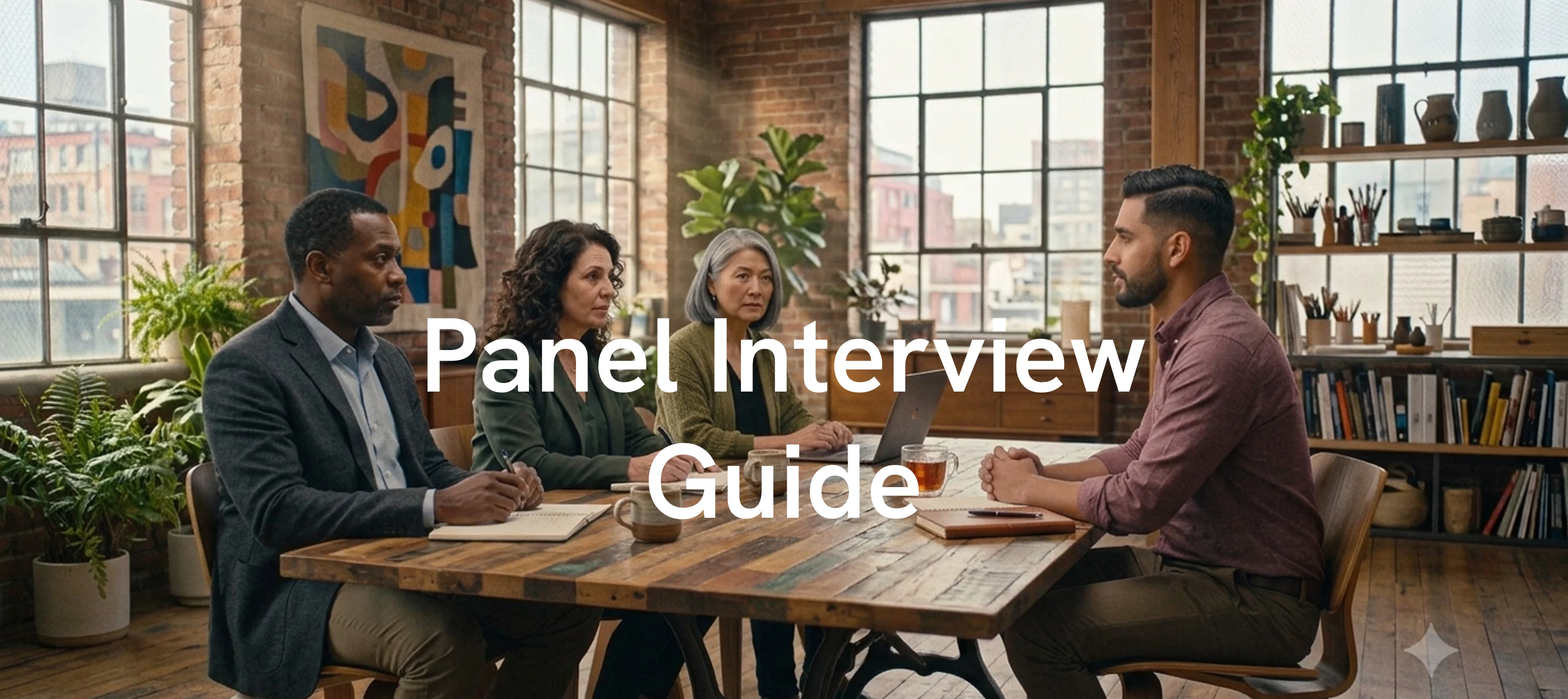
Walking into an interview and seeing several people waiting to ask you questions can feel very different from a typical one-on-one interview. Instead of speaking with just one interviewer, you are answering questions in front of a group of people who may each have a different role in the hiring process. This format is known as a panel interview.
A panel interview is a hiring method in which one candidate is interviewed by two or more interviewers during the same session. The panel may include a hiring manager, HR representative, department head, technical expert, or potential team member. Each interviewer may focus on a different part of the candidate’s experience, skills, or suitability for the position.
Panel interviews have been studied for decades as a method of employee selection. One review examined more than 50 years of research on panel interviews and discussed factors such as interview structure, question types, scoring methods, interviewer training, and the way interviewers’ ratings are combined.
For candidates, the format can require a slightly different approach. Questions may come from different interviewers, and candidates need to stay engaged with the entire panel while keeping their answers clear and focused. They may also need to handle follow-up questions or move between different topics during the same conversation.
For employers, a panel interview brings several people into the same assessment instead of requiring separate interviews with each decision-maker. This can allow different perspectives to be considered during the hiring process. However, simply adding more interviewers does not automatically create a better interview. The panel needs clear responsibilities, relevant questions, and a consistent approach to evaluating candidates.
Understanding the format can help candidates prepare more effectively and help employers create a structured interview experience. This guide covers how panel interviews work, who typically participates, common questions, best practices, advantages, disadvantages, and how they compare with other interview formats.
What Is a Panel Interview?
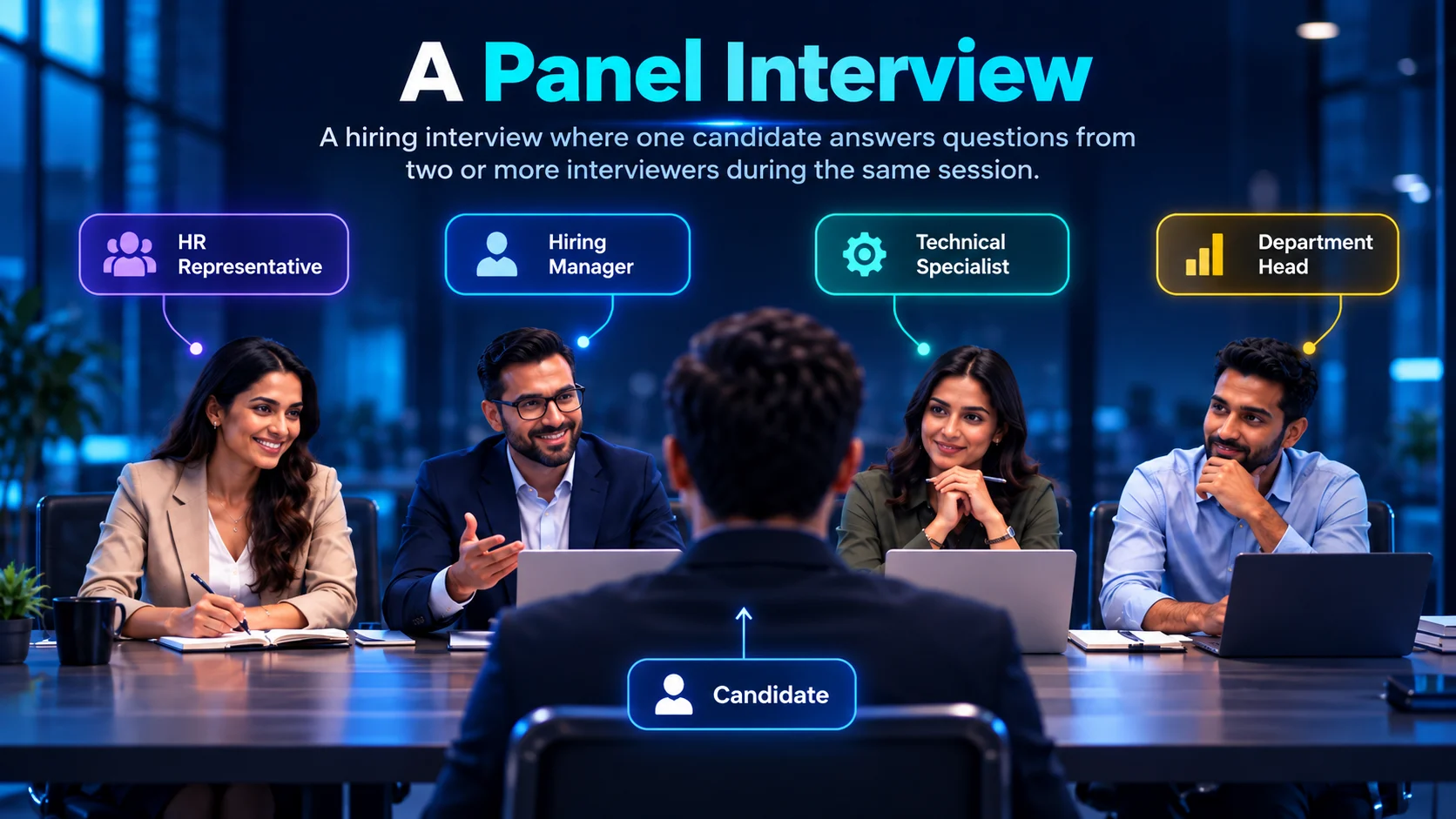
A panel interview is a hiring interview where one candidate answers questions from two or more interviewers during the same session. Instead of speaking with one interviewer, the candidate interacts with a group of people who may be involved in the hiring decision.
The panel can include a hiring manager, HR professional, department head, technical specialist, or potential team member. Depending on the role, each interviewer may focus on a different area, such as the candidate’s experience, technical knowledge, communication, or problem-solving skills.
A panel interview can take place in person or online. Usually, one interviewer leads the conversation while the other panel members ask questions, take notes, or assess specific areas of the candidate’s responses.
The main difference between a panel interview and a one-on-one interview is the number of interviewers involved. The candidate is still interviewed individually, but several people can ask questions and contribute to the evaluation.
For example:
A software company may have a hiring manager, senior developer, and HR representative interview a Java developer.
A marketing company may have a marketing manager, HR representative, and content lead interview a content writer.
In simple terms, a panel interview brings multiple interviewers into the same conversation to assess one candidate.
What Is the Purpose of a Panel Interview?
A panel interview brings several interviewers together to assess one candidate. It allows different people involved in the hiring process to share their views and evaluate the candidate from different angles.
Multiple decision-makers can meet the candidate at the same time, allowing each person to ask questions and form their own impression.
Different interviewers can assess different parts of the candidate’s skills, experience, communication, and suitability for the role.
The panel can observe how the candidate communicates with several people and handles different questions during the interview.
Having multiple interviewers can bring different viewpoints into the assessment and reduce the chance of the decision being based on one person’s opinion.
Who Participates in a Panel Interview?
The people involved in a panel interview depend on the organization, position, and stage of the hiring process. Employers generally select interviewers whose responsibilities or expertise are relevant to the role. A panel may include a hiring manager, HR representative, technical or subject-matter expert, or potential team member.
1. Hiring Manager
The hiring manager is usually closely involved in assessing whether a candidate can meet the practical requirements of the position. Their questions may focus on previous experience, relevant skills, decision-making, and the responsibilities of the role. For instance, a software development manager may ask about a previous development project and the challenges the candidate faced while completing it.
2. HR Representative
An HR representative may focus on areas such as communication, motivation, professional behaviour, and workplace situations. They may also guide the interview and address general recruitment-related questions. For instance, an HR representative may ask why the candidate is interested in the position or how they would handle a disagreement with a colleague.
3. Technical or Subject-Matter Expert
A technical or subject-matter expert may join the panel when the position requires specialized knowledge. Their questions can cover technical concepts, practical situations, or problem-solving related to the role. For instance, a senior developer may ask a candidate how they would identify and debug an error in a Java program.
4. Potential Team Members
A potential team member, senior colleague, or team lead may participate when collaboration is an important part of the role. They may focus on teamwork, communication, and how the candidate handles different viewpoints. For instance, a team lead may ask how the candidate would respond if a colleague disagreed with their approach to completing a task.
The panel does not need to include every type of interviewer. Its composition depends on the role and the people whose input is relevant to the hiring decision.
What Questions Are Asked in a Panel Interview?
Panel interviews can include many of the same questions asked in one-on-one interviews. However, different panel members may focus on different areas, such as the candidate’s experience, technical skills, problem-solving ability, communication, or teamwork.
Here are some common types of panel interview questions:
1. Background and Introduction Questions
These questions help interviewers understand the candidate’s background, experience, and interest in the role.
Common questions include:
Can you tell us about yourself and your professional background?
Why are you interested in this position?
What attracted you to our organization?
What are your key strengths?
2. Experience-Based Questions
These questions explore the candidate’s previous work, academic, internship, or project experience.
Common questions include:
Tell us about a challenging project you worked on.
What was your role in your previous position?
What is an achievement you are particularly proud of?
Tell us about a time you used your skills to solve a problem.
3. Behavioural Questions
Behavioural questions ask candidates to describe how they handled situations they experienced in the past. They may focus on teamwork, leadership, adaptability, conflict management, problem-solving, or working under pressure.
Common questions include:
Tell us about a time you resolved a disagreement with a colleague.
Describe a situation where you had to work under pressure.
Tell us about a time you received difficult feedback.
Describe a situation where you had to adapt to a change.
Candidates can use the STAR method—Situation, Task, Action, and Result—to structure their responses.
4. Technical or Role-Specific Questions
These questions assess the knowledge and skills required for the position. They can cover technical concepts, tools, processes, or practical situations.
Common questions include:
How would you identify and troubleshoot an error in a program?
How would you evaluate the success of a marketing campaign?
How would you approach solving a database problem?
How would you approach developing a website for a client?
The questions will vary depending on the role and the expertise of the panel members.
5. Communication and Teamwork Questions
Panel members may also ask questions about collaboration, communication, feedback, and handling different viewpoints.
Common questions include:
How do you handle feedback from a team member?
How would you explain a technical concept to a non-technical person?
Tell us about a time you disagreed with a teammate.
How do you communicate an important idea to a group?
These questions help interviewers understand how candidates communicate and work with others.
What Are the Best Practices for Succeeding in a Panel Interview?
A successful panel interview involves more than preparing answers to common interview questions. Candidates also need to manage a conversation with several interviewers, who may each focus on a different part of the role. Researching the panel, listening carefully, keeping answers focused, maintaining natural eye contact, and staying composed can help candidates handle the interview more effectively.
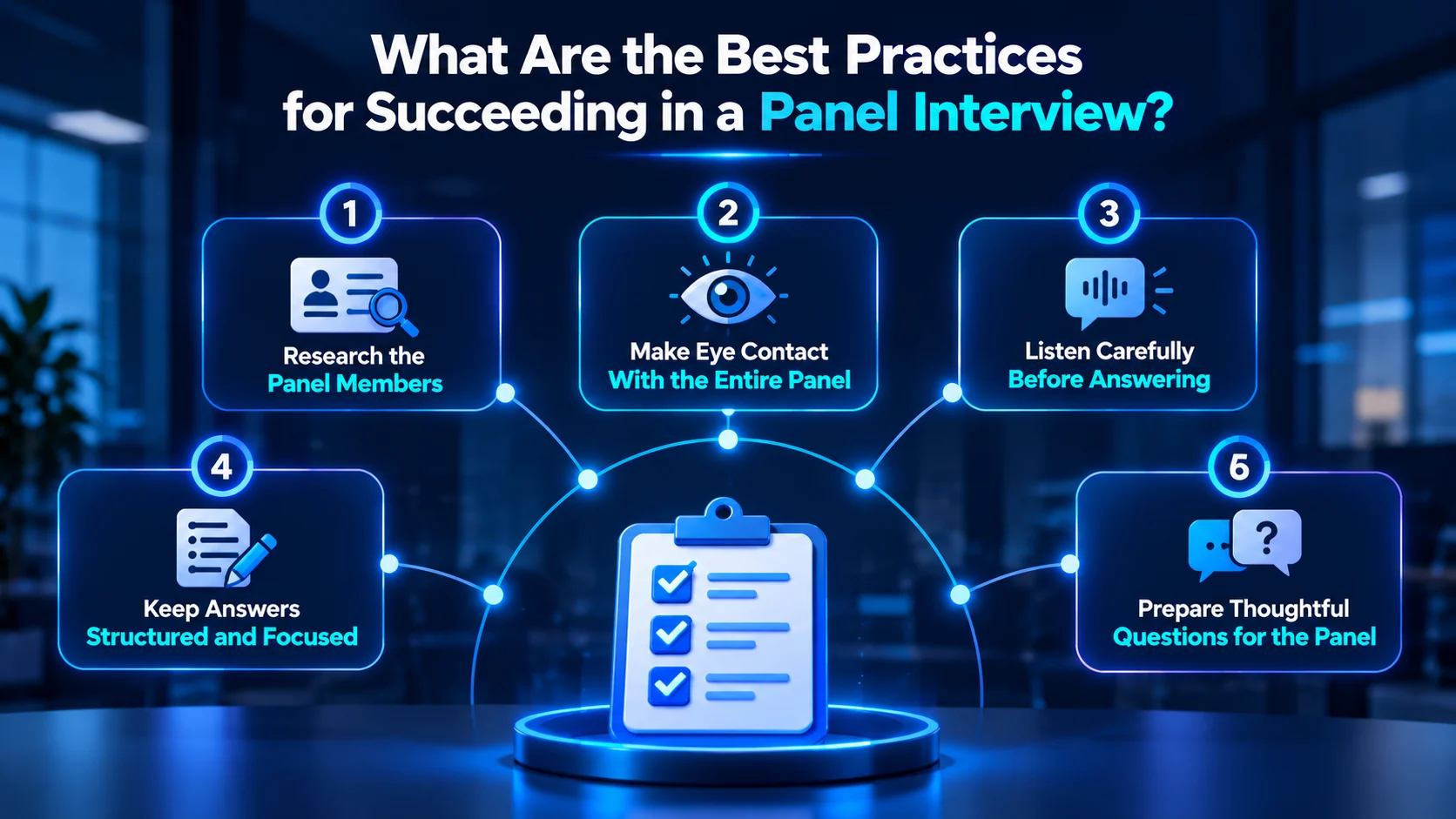
1. Research the Panel Members
If the organization provides the names and roles of the interviewers beforehand, candidates can look into their professional backgrounds and responsibilities. This can help them understand the different perspectives that may be represented during the interview. The goal is not to memorize each interviewer’s profile, but to prepare for the areas they may be most familiar with.
Example: A candidate interviewing for a software developer position may find that the panel includes a technical lead and an HR representative. The candidate can revise programming concepts for the technical discussion while also preparing to discuss motivation, communication, and workplace situations with HR.
2. Make Eye Contact With the Entire Panel
Eye contact can feel more difficult when several interviewers are sitting across from you. A good approach is to begin by looking at the person who asked the question and then naturally include the other panel members while answering. Candidates do not need to look at everyone after every sentence; the aim is to keep the conversation open rather than focusing entirely on one person.
Example: If a technical interviewer asks about a project the candidate completed, the candidate can initially look at that interviewer and then briefly make eye contact with the other panel members while explaining the project, their contribution, and the outcome.
3. Listen Carefully Before Answering
Panel interviews may include several questions and follow-ups, so candidates should listen to the complete question before starting their response. Taking a short pause to organize an answer is acceptable, particularly when the question has multiple parts. If something is unclear, asking for clarification is better than making an assumption and answering the wrong point.
Example: If an interviewer asks, “What was the problem, what did you do to solve it, and what was the result?”, the candidate can pause and answer the three parts in that order instead of focusing only on the solution.
4. Keep Answers Structured and Focused
Candidates should give enough information to support their answer without adding unrelated details. For behavioural questions, the STAR method Situation, Task, Action, and Result can provide a simple structure. For technical questions, candidates can state their approach first and then explain the steps or reasoning behind it.
Example: If asked about handling a disagreement with a teammate, a candidate can briefly describe the situation, explain what they were responsible for, describe how they addressed the disagreement, and finish with the result.
5. Stay Calm When Interviewers Have Different Styles
Panel members may have very different ways of interacting with candidates. One may ask several follow-up questions, another may spend most of the interview taking notes, while another may remain quiet. Candidates should avoid assuming that these reactions automatically indicate whether an answer was good or bad. Staying focused on the questions and responding naturally is more useful than constantly watching the panel for reactions.
Example: One interviewer may smile and nod while another maintains a neutral expression and takes notes. The candidate should not change their answer because of these different reactions and should continue responding to the questions clearly.
6. Prepare Thoughtful Questions for the Panel
Candidates should prepare a few questions about the position, responsibilities, team, or expectations before the interview. Since panel members may have different responsibilities, candidates can direct a question to the person who is most familiar with that area. This can also make the final part of the interview more useful for both sides.
Example: A candidate applying for a software development role could ask the hiring manager, “What would you expect the person in this role to achieve in the first few months?” They could then ask a potential team member, “How does the team usually collaborate on development projects?”
Overall, succeeding in a panel interview requires preparation, clear communication, careful listening, and composure. Candidates who understand the panel, organize their responses, engage naturally with the interviewers, and prepare relevant questions can approach the conversation with greater clarity.
Pros of a Panel Interview
Panel interviews offer several advantages for both employers and candidates. Having multiple interviewers in the same session allows organizations to gather different perspectives, assess various aspects of a candidate’s suitability, and make the interview process more structured and efficient.
1. Multiple Perspectives Can Be Considered
Several interviewers can assess the same candidate from different professional perspectives. Instead of relying on one interviewer’s observations, the organization can consider feedback from people with different roles, responsibilities, and areas of expertise. This can provide a broader view of the candidate’s skills, experience, and suitability for the position.
2. Several Decision-Makers Can Meet the Candidate at Once
A panel interview allows multiple people involved in the hiring decision to interact with the candidate during the same session. This can be useful when a role requires input from different departments, senior team members, or other stakeholders. Bringing them together can also reduce the need to schedule several separate interviews.
3. Different Areas of the Role Can Be Assessed
Panel members can focus on different requirements of the position. A hiring manager may assess overall experience and suitability, while a technical or subject-matter expert can focus on role-specific knowledge. An HR representative may pay more attention to communication, motivation, and workplace-related factors.
4. Candidates Can Meet Several Stakeholders
A panel interview gives candidates an opportunity to interact with several people who may be involved in their work or the hiring decision. This can help candidates understand the team structure, responsibilities, expectations, and different perspectives within the organization.
5. Structured Panels Can Support Consistent Evaluation
When a panel follows a clear interview structure, members can ask relevant questions and assess candidates against the same job-related criteria. Defining each interviewer’s responsibilities beforehand can also reduce duplicated questions and help keep the discussion organized.
Cons of a Panel Interview
Despite its advantages, a panel interview can also have some challenges for both candidates and organizations. Having several interviewers in the same session may create pressure for candidates, make discussions harder to manage, and require more coordination. If the panel is not well organized, it can also affect the consistency and depth of the evaluation.
1. The Format Can Feel Intimidating:
Speaking with several interviewers at the same time can feel more demanding than a one-on-one interview. Candidates may need to respond to different questions, personalities, and reactions while maintaining their focus and confidence throughout the conversation.
2. Strong Personalities Can Influence the Discussion:
Some panel members may naturally take a more active role in the conversation than others. If the discussion is not properly managed, one interviewer may dominate the questioning while other panel members have less opportunity to contribute.
3. More Interviewers Do Not Automatically Mean a Better Evaluation
Having several interviewers does not guarantee a more effective assessment. If panel members use different standards, ask unrelated questions, or focus on different qualities without a shared evaluation framework, the results may become inconsistent.
4. There May Be Less Time for Deeper Discussion
A panel interview has to accommodate questions from several interviewers within a limited amount of time. This can leave less opportunity to explore an interesting response, ask detailed follow-up questions, or discuss a candidate’s experience in depth.
5. Coordinating the Panel Can Be Difficult
A panel interview requires several people to be available at the same time. Scheduling conflicts, unclear responsibilities, or involving more interviewers than necessary can make the process harder to organize and may delay the hiring process.
The pros and cons of a panel interview largely depend on how the session is planned and conducted. Multiple perspectives and shared participation can make the process useful, while unclear roles, inconsistent evaluation, limited time, or poor coordination can create challenges for both candidates and interviewers.
How Should Candidates Prepare for a Panel Interview?
Preparing for a panel interview means getting ready for both the questions and the format itself. Since several interviewers may focus on different parts of your experience, it helps to understand the role, research the company and panel members, and practise answering questions while communicating with multiple people. Candidates should also prepare their questions and check any documents or technical requirements before the interview.
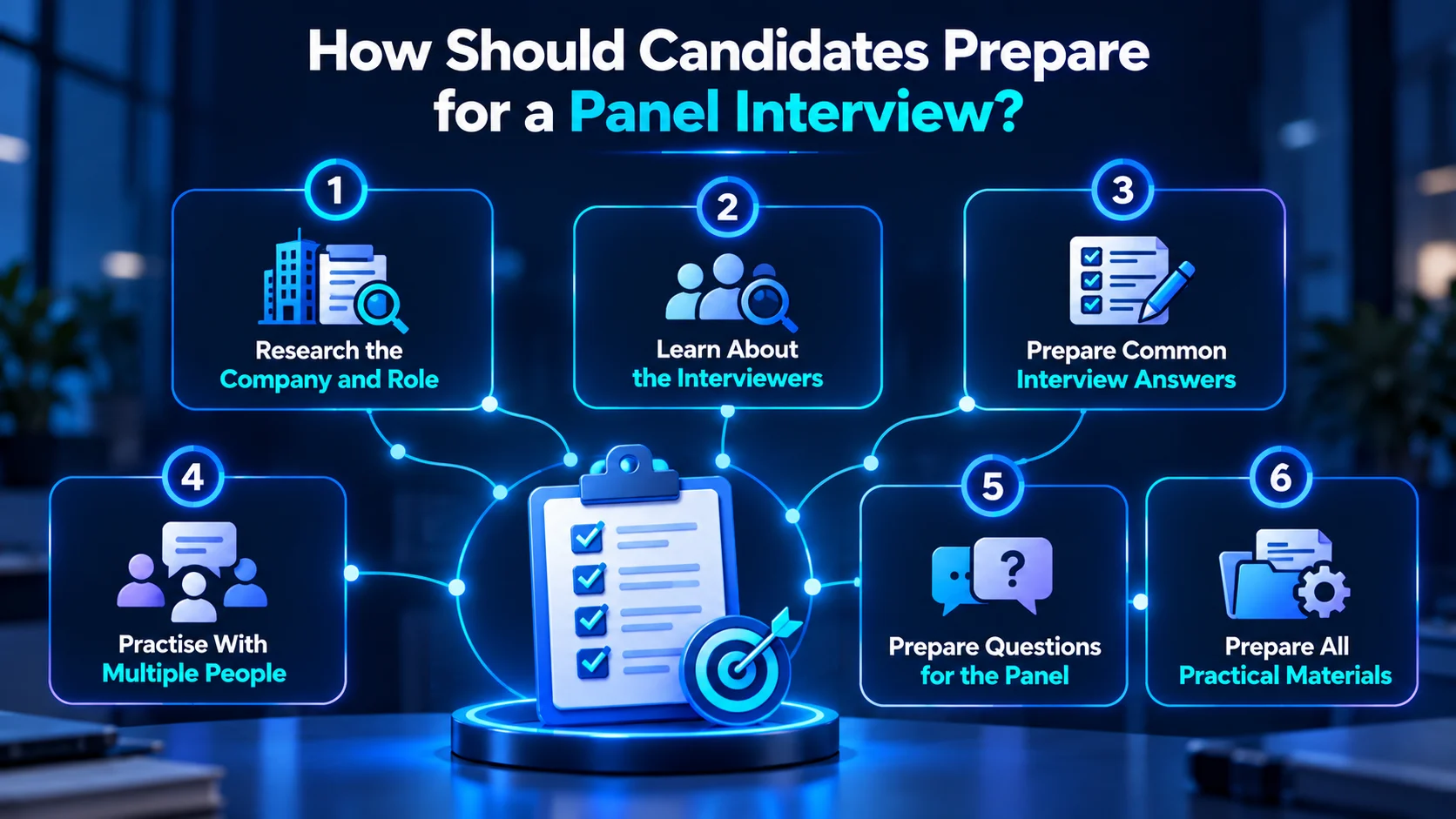
1. Research the Company and Role
Candidates should start by understanding the organization, what it does, and what the position involves. The job description is particularly useful because it shows the skills, responsibilities, and qualifications the employer has mentioned for the role. Candidates can then connect these requirements with their own education, projects, internships, or previous work instead of preparing completely generic answers.
2. Learn About the Interviewers
When the names and roles of panel members are shared in advance, candidates can look at their professional backgrounds and current responsibilities. This is not about trying to predict exactly what each person will ask. It simply helps candidates understand who they will be speaking with and why different people may be part of the interview.
3. Prepare Common Interview Answers
Candidates should prepare for common interview questions but avoid memorizing complete responses. Having a few clear points in mind makes it easier to answer naturally and adjust the response depending on how the conversation develops. Preparation should cover questions about background, strengths, weaknesses, previous experience, achievements, challenges, and problem-solving.
4. Practise With Multiple People
Practising with more than one person can make the actual panel format feel less unfamiliar. It gives candidates a chance to answer questions from different people, shift their attention between interviewers, and handle follow-up questions without losing track of their response. The practice does not need to be formal; even a short mock interview can help.
5. Prepare Questions for the Panel
Candidates should also prepare questions to ask at the end of the interview. These questions can help them understand the position, team, responsibilities, expectations, and working environment. Preparing them beforehand is useful because it can be difficult to think of relevant questions immediately after answering several interview questions.
6. Prepare All Practical Materials
Interview preparation also includes checking everything that may be needed during the session. Candidates should find out whether they need to bring a resume, portfolio, presentation, certificates, or other documents. For online interviews, technical checks are equally important because problems with the microphone, camera, internet connection, or meeting link can interrupt the conversation.
Preparing for a panel interview is mainly about being ready for both the people and the format. Understanding the role, knowing who you may be speaking with, practising your responses with multiple people, and checking the practical details beforehand can help you enter the interview prepared without sounding rehearsed.
When Are Panel Interviews Used?
There is no fixed stage at which every organization uses a panel interview. The timing depends on the role, hiring process, and number of people involved in the decision. A panel may be used after an initial screening, during a technical evaluation, or at the final stage when several decision-makers need to assess the same candidate.
1. After an Initial Screening
Some organizations conduct an initial screening before inviting shortlisted candidates to a panel interview. This allows recruiters to check basic qualifications and narrow down the candidate pool before involving several interviewers.
The first stage may include reviewing applications, conducting a phone or video screening, or checking whether candidates meet the main requirements of the position. Candidates who move forward may then have a more detailed discussion with the hiring manager and other team members. For example, a recruiter may first conduct a short phone interview before arranging a panel with the hiring manager, HR representative, and a potential team member.
2. During Technical Evaluation
Panel interviews can also be used when a position requires input from several technical or subject-matter specialists. This is useful when the role involves specialized knowledge that may be difficult for one interviewer to assess fully.
Different panel members can focus on different technical areas while also looking at how candidates apply their knowledge to practical situations. For example, a software developer may be interviewed by a hiring manager and senior developers, while a financial analyst may meet a finance manager and another specialist from the field.
3. During Final-Stage Interviews
Some organizations use panel interviews near the end of the hiring process, when several decision-makers want to meet shortlisted candidates before making a decision. These panels may include senior managers, potential team members, or other stakeholders connected to the role.
At this stage, the discussion can cover the candidate’s overall experience, role expectations, teamwork, and areas that require further discussion. For example, a candidate may meet the department manager and potential team members before the organization makes its final decision.
How to Conduct an Effective Panel Interview?
An effective panel interview requires more than having several interviewers in the same meeting. Without proper planning, panel members may ask overlapping questions, focus on different criteria, or give too much weight to personal impressions. A well-organized process gives each interviewer a clear role, keeps questions connected to the position, and provides a consistent way to evaluate candidates.
The panel should be planned before the interview begins. Interviewers need to understand what they are assessing, which questions they will ask, and how candidate responses will be evaluated. Clear responsibilities also help prevent the conversation from becoming repetitive or allowing one interviewer to dominate the discussion.
1. Define What Each Interviewer Will Evaluate
Each interviewer should know which skills, competencies, or responsibilities they are expected to assess. This helps the panel cover different areas of the role without several people focusing on the same topic.
The areas can be divided according to each interviewer’s expertise. A technical lead may assess technical knowledge, HR may focus on communication and workplace-related factors, and the hiring manager may examine role-related experience.
2. Use Job-Related Questions
Questions should be directly connected to the responsibilities and competencies required for the position. Keeping questions job-related helps the panel collect information that is relevant to the actual role rather than relying on unrelated or overly general questions.
For a programming position, the panel might ask candidates to explain how they would debug a problem or approach a technical challenge. A customer-service role could include a situation involving a difficult customer to understand how the candidate would respond.
3. Ask Candidates Consistent Questions
Candidates applying for the same position should be assessed using a common set of core questions. Interviewers can ask relevant follow-up questions when they need clarification, but the main areas being assessed should remain consistent.
For example, every candidate could be asked the same behavioural question about handling a workplace challenge and given the same role-specific scenario to discuss. This gives the panel a common basis for comparing responses.
4. Use Clear Rating Criteria
Panel members should have clear criteria for evaluating responses instead of relying only on general impressions. Rating criteria can describe what weak, acceptable, and strong responses look like for each competency.
For a technical interview, the criteria might consider whether the candidate’s solution is accurate, how clearly they explain their reasoning, and how effectively they approach the problem. This gives interviewers a clearer basis for recording their assessments.
5. Train Interviewers
Interviewers should understand how to conduct the interview, ask appropriate questions, take useful notes, and evaluate responses against the agreed criteria. They should also know how to distinguish job-related evidence from personal impressions.
A short briefing or practice session before the interview can help. Interviewers can review the questions, discuss the evaluation criteria, and practise assessing sample responses so that everyone approaches the process in a similar way.
6. Record Individual Assessments Before Group Discussion
After the interview, panel members can record their own observations before discussing the candidate as a group. This gives each interviewer an opportunity to form an initial assessment based on what they personally observed.
For instance, each panel member can complete their notes and ratings before the post-interview discussion. The group can then compare assessments, discuss differences, and consider the evidence behind different observations rather than immediately adopting the opinion of the most vocal interviewer.
A well-conducted panel interview therefore depends on preparation before, during, and after the interview. Clear responsibilities, relevant questions, consistent criteria, interviewer training, and individual assessments can help create a more organized evaluation process.
How Does a Panel Interview Compare to Similar Interview Formats?
Panel interviews are sometimes confused with one-on-one and group interviews. The main difference is who is being interviewed and who is doing the interviewing. In a panel interview, one candidate speaks with multiple interviewers, while a one-on-one interview has one interviewer and one candidate. A group interview involves multiple candidates being assessed together.
Feature | Panel Interview | One-on-One Interview | Group Interview |
|---|---|---|---|
Participants | One candidate and multiple interviewers | One candidate and one interviewer | Multiple candidates and one or more interviewers |
Main focus | Evaluating one candidate from multiple perspectives | Detailed evaluation of one candidate by one interviewer | Observing multiple candidates and their interactions |
Interaction | Candidate interacts with several interviewers | Candidate interacts directly with one interviewer | Candidates interact with interviewers and may interact with one another |
Questioning | Different panel members may ask different questions | One interviewer generally controls the questioning | Interviewers may ask questions to individuals or the whole group |
Evaluation | Multiple interviewers provide assessments of the same candidate | Primarily based on one interviewer’s assessment | Candidates may be compared based on individual responses and group behaviour |
Best suited for | Roles involving multiple stakeholders or several areas of evaluation | Focused individual conversations | Situations where teamwork or group interaction needs to be observed |
Candidate experience | One candidate answers questions while several interviewers observe | More direct one-to-one interaction | Candidate shares the interview setting with other candidates |
Main challenge | Managing several interviewers and perspectives | Depending heavily on one interviewer’s assessment | Standing out while interacting appropriately with other candidates |
The three formats therefore serve different purposes. A panel interview involves one candidate being evaluated by multiple interviewers, a one-on-one interview involves one candidate and one interviewer, while a group interview generally involves multiple candidates in the same interview setting.
Conclusion
A panel interview brings multiple interviewers together to assess one candidate from different perspectives. While the format can help organizations gather broader input, its effectiveness depends largely on how well the interview is structured and conducted.
For candidates, understanding the panel format can make the experience easier to navigate. Researching the role and interviewers, preparing structured responses, listening carefully, and engaging with the entire panel can help candidates communicate their experience more clearly.
For employers, a successful panel interview requires more than involving several people. Clear interviewer responsibilities, job-related questions, consistent evaluation criteria, and proper interviewer preparation can help create a more organized and reliable assessment process.
Ultimately, a panel interview works best when both candidates and interviewers understand their roles and come prepared for a structured conversation.