Back to all blogs
Learn what a situational interview is, explore its types and examples, and understand the pros, cons, and best practices for answering and conducting one.

Abhishek Kaushik

A situational interview is a job interview in which a candidate is given a realistic, job-related scenario and asked how they would respond. The situation may involve an unhappy customer, competing deadlines, a team conflict, a safety issue, a difficult decision, or another challenge that could occur in the role. Instead of focusing only on qualifications or previous experience, the interviewer uses the response to understand how the candidate analyses problems, sets priorities, communicates, follows procedures, and makes decisions.
Research supports the use of carefully designed situational questions. A major meta-analysis published in The Journal of Applied Psychology examined 245 validity coefficients based on 86,311 individuals. It found that interview validity varied according to interview content and structure. For predicting job performance, situational interviews showed a corrected mean validity of .50, compared with .39 for job-related interviews and .29 for psychologically based interviews.
Situational interviews are useful because one scenario can reveal several competencies at the same time. A candidate’s answer may show judgement, communication, problem-solving, prioritisation, rule awareness, and the ability to work under pressure. Candidates do not need to have faced the exact same situation before, making the format useful for experienced professionals, freshers, graduates, and career changers.
However, situational interviews should not be a collection of random “what would you do?” questions. Scenarios should reflect genuine challenges in the role, and employers should define clear scoring criteria before evaluating responses. Candidates should identify the main problem, explain the actions they would take, mention who they would communicate with, and state the expected result.
This guide explains how situational interviews work, their main types, practical examples, how they differ from behavioral interviews, and their major advantages and limitations for candidates and employers.
What Is a Situational Interview?
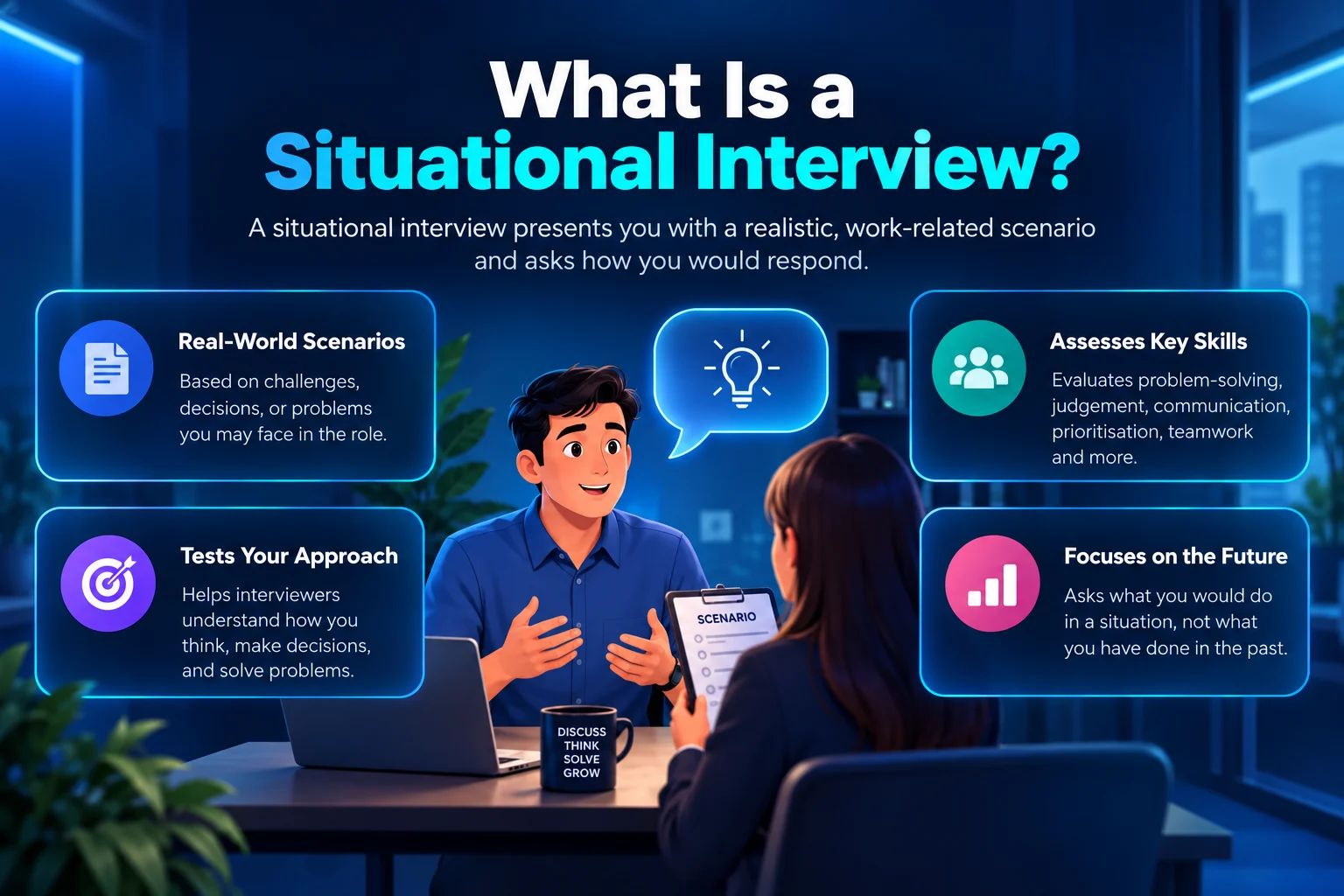
A situational interview is a type of job interview in which a candidate is presented with a hypothetical but realistic work-related situation and asked how they would respond. The situation is designed to reflect a challenge, decision, or problem that could reasonably occur in the role.
The main purpose of a situational interview is to understand how a candidate approaches problems and makes decisions before they actually encounter those situations on the job. The interviewer may assess factors such as problem-solving, judgement, communication, prioritisation, teamwork, customer handling, and adherence to workplace procedures.
Situational interview questions generally focus on future behaviour. They ask what a candidate would do in a given situation rather than asking what the candidate did in a previous experience. This makes the format useful for both experienced candidates and those who may not yet have extensive work experience.
A well-designed situational interview uses scenarios that are directly related to the responsibilities and challenges of the job. Candidates are expected to give practical, logical, and role-appropriate responses rather than simply providing theoretical answers.
How Does a Situational Interview Work?
The process is simple when the interview is designed well:
1. Choose the skill to test. The employer first decides what the question should measure. It may be problem-solving, teamwork, customer service, leadership, prioritization, safety, ethics, or another job-related skill.
2. Create a realistic situation. The scenario should feel like something that could actually happen in the job. It should be clear enough for the candidate to understand the problem without adding unnecessary details.
3. Ask what the candidate would do. The candidate explains the steps they would take. The interviewer may ask simple follow-up questions such as why they chose that action or what they would do if the first plan did not work.
4. Evaluate the answer. The interviewer looks at whether the response is practical, job-related, safe, fair, and well reasoned. In a structured interview, candidates are asked comparable questions and judged against the same standards.
Situational Interview vs. Behavioral Interview
These two interview styles are related, but they ask for different kinds of evidence. A situational question asks what you would do. A behavioral question asks what you did in the past.
Point | Situational Interview | Behavioral Interview |
Time focus | Future or hypothetical | Past experience |
Typical question | “What would you do if…?” | “Tell me about a time when…” |
Main evidence | Planned actions and reasoning | Actions taken in a real event |
Useful when | The exact situation may be new to the candidate | Relevant past experience is available |
Main limitation | A planned answer may differ from real behavior | Past conditions may not match the new job |
Types of Situational Interview Questions
Situational questions can be grouped by the kind of workplace challenge they test. Each type helps the interviewer look at a different part of the candidate’s judgment, communication, and approach to work. The most common types are explained below.
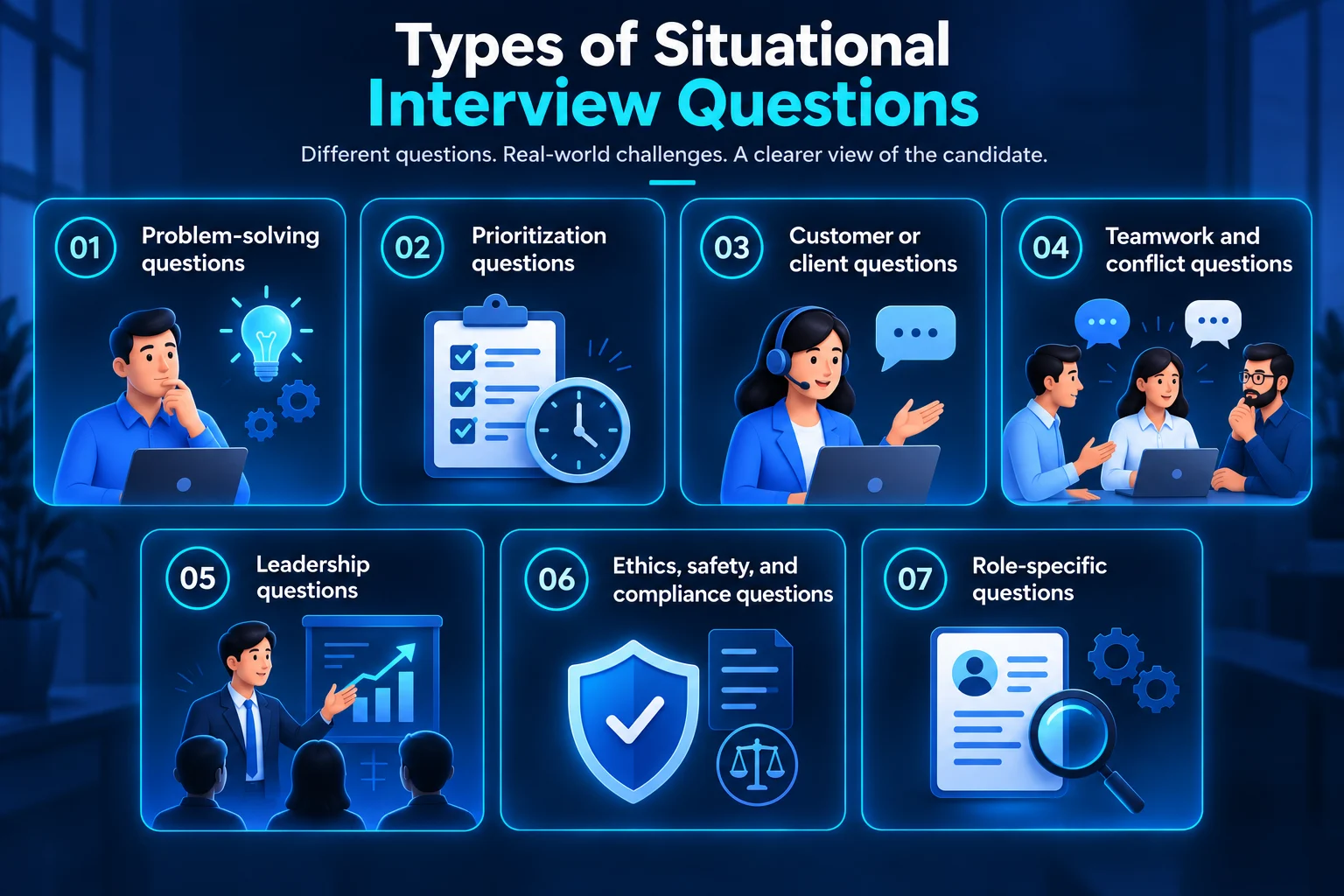
Problem-solving questions
Problem-solving questions give the candidate a work problem that needs a clear and practical solution. The problem may involve an error, a process that is not working, missing information, or an unexpected issue. The interviewer is not only looking for the final answer. They also want to see how the candidate reaches it. A strong response usually starts by understanding the problem, checking the important facts, considering possible options and risks, and then choosing a sensible action. The candidate should also explain how they would check whether the solution worked.
Prioritization questions
Prioritization questions test how a candidate handles several demands at the same time. The situation may include two urgent tasks, a short deadline, limited staff, or a sudden request from a manager or customer. A good answer should show that the candidate does not simply choose the easiest task first. They should look at urgency, business impact, deadlines, dependencies, and possible risks. If everything cannot be completed at once, the candidate should explain how they would communicate the conflict, confirm priorities, and keep the right people updated.
Customer or client questions
Customer or client questions focus on situations where a person is unhappy, confused, demanding, or affected by a service problem. These questions test more than politeness. They show whether the candidate can listen carefully, understand the real issue, stay calm, explain available options, and work within company rules. A strong answer should avoid making promises the candidate cannot keep. It should show a balance between helping the customer and following the correct process. If the issue needs more authority, the candidate should know when to involve a manager or another team.
Teamwork and conflict questions
Teamwork and conflict questions explore how a candidate responds when people disagree or when cooperation starts to break down. The situation may involve different opinions, unclear responsibilities, poor communication, or tension between colleagues. The best answers do not immediately blame one person or take sides. Instead, the candidate should explain how they would understand what is causing the problem, listen to the people involved, bring the discussion back to the shared goal, clarify responsibilities, and agree on practical next steps. If the conflict continues or becomes serious, they should also know when to seek support.
Leadership questions
Leadership questions are common for supervisors, team leads, and managers, but they can also be used for roles that require someone to guide others. These situations may involve poor performance, low motivation, delegation, coaching, missed deadlines, or resistance to a decision. The interviewer wants to see whether the candidate can balance support with accountability. A strong answer should explain how they would understand the situation, set clear expectations, give useful guidance, provide support where needed, and follow up. Good leadership answers focus on solving the problem rather than simply giving orders.
Ethics, safety, and compliance questions
These questions test what a candidate would do when there is pressure to take a shortcut or ignore an important rule. The situation may involve safety procedures, confidential information, company policy, legal requirements, or professional standards. A strong response should show that the candidate can recognize the risk and will not ignore a required process simply to save time or avoid an uncomfortable conversation. The answer should also explain the practical next step, such as stopping an unsafe action, checking the correct procedure, reporting the concern, documenting it when required, or escalating it to the right person.
Role-specific questions
Role-specific questions are designed around situations that are especially relevant to the job being filled. They make the interview more practical because the candidate has to think about a challenge they could realistically face in that role. The strongest questions focus on judgment and decision-making rather than obscure technical trivia. Employers can also combine a role-specific situation with problem-solving, customer service, leadership, or prioritization skills.
Situational Interview Examples
The following examples show how situational questions may appear in different roles. The aim is not to memorize one “perfect” answer. It is to show a clear and sensible process.
Example 1: Competing deadlines
Question: You are working on an important task that is due today when your manager gives you another urgent task with the same deadline. What would you do?
What a strong answer should show: A strong answer would compare the urgency and impact of both tasks, estimate the work needed, and speak with the manager before making assumptions. The candidate could suggest a new order of work, ask for support, or agree on which deadline has priority.
Example 2: An unhappy customer
Question: A customer is upset because your team made a mistake, but the solution they are demanding is outside company policy. What would you do?
What a strong answer should show: A good answer would acknowledge the customer’s concern, check the facts, explain what can be done, offer the best available option, and involve a manager if additional authority is needed.
Example 3: Team conflict
Question: Two team members keep disagreeing, and the conflict is delaying a shared project. You are coordinating the work. How would you handle it?
What a strong answer should show: The candidate should avoid taking sides too quickly. A sensible approach is to speak with the people involved, understand the main issue, bring the discussion back to the shared goal, agree on responsibilities, and follow up later.
Example 4: Falling performance
Question: A usually reliable team member has started missing deadlines and the quality of their work has dropped. What would you do?
What a strong answer should show: A strong response would begin with a private conversation rather than an immediate assumption. The candidate could discuss the change, understand any work-related cause, restate expectations, agree on support or next steps, and review progress after a set period.
Example 5: Safety or compliance pressure
Question: A colleague suggests skipping a required check so the team can finish faster. What would you do?
What a strong answer should show: The answer should show that speed does not come before safety or required rules. The candidate should raise the concern, follow the correct process, and involve the appropriate person if the issue cannot be solved directly.
Example 6: A serious problem before launch
Question: You discover an important technical or quality problem shortly before a planned launch or handover. Fixing it may delay the deadline. What would you do?
What a strong answer should show: A good answer would first confirm the seriousness of the problem. The candidate should explain the risk of continuing, involve the right people, compare the impact of delay with the impact of releasing with the problem, and communicate the final decision clearly.
How to Answer a Situational Interview Question?
A simple five-step approach keeps the answer clear and easy to follow:
1. Understand the problem. Identify what is actually going wrong before jumping to a solution.
2. Decide the main goal. Think about what needs to be protected or achieved, such as safety, quality, customer trust, time, or fairness.
3. Explain your actions in order. Say what you would do first, second, and next. This makes the answer easy to follow.
4. Mention communication. Explain who you would speak with and what information you would share. Many workplace problems become worse when communication is ignored.
5. Finish with the result. Describe what you would expect to happen and how you would check that the problem has been solved.
Keep the answer practical. Avoid giving a long speech about personal qualities. It is stronger to say what you would do, why you would do it, and how you would know the situation was under control.
Pros of a Situational Interview
Situational interviews can be useful for both employers and candidates when the questions are realistic, clearly written, and connected to the actual responsibilities of the role. They allow employers to explore how a candidate may respond to workplace challenges while giving candidates an opportunity to explain their reasoning in a practical way.
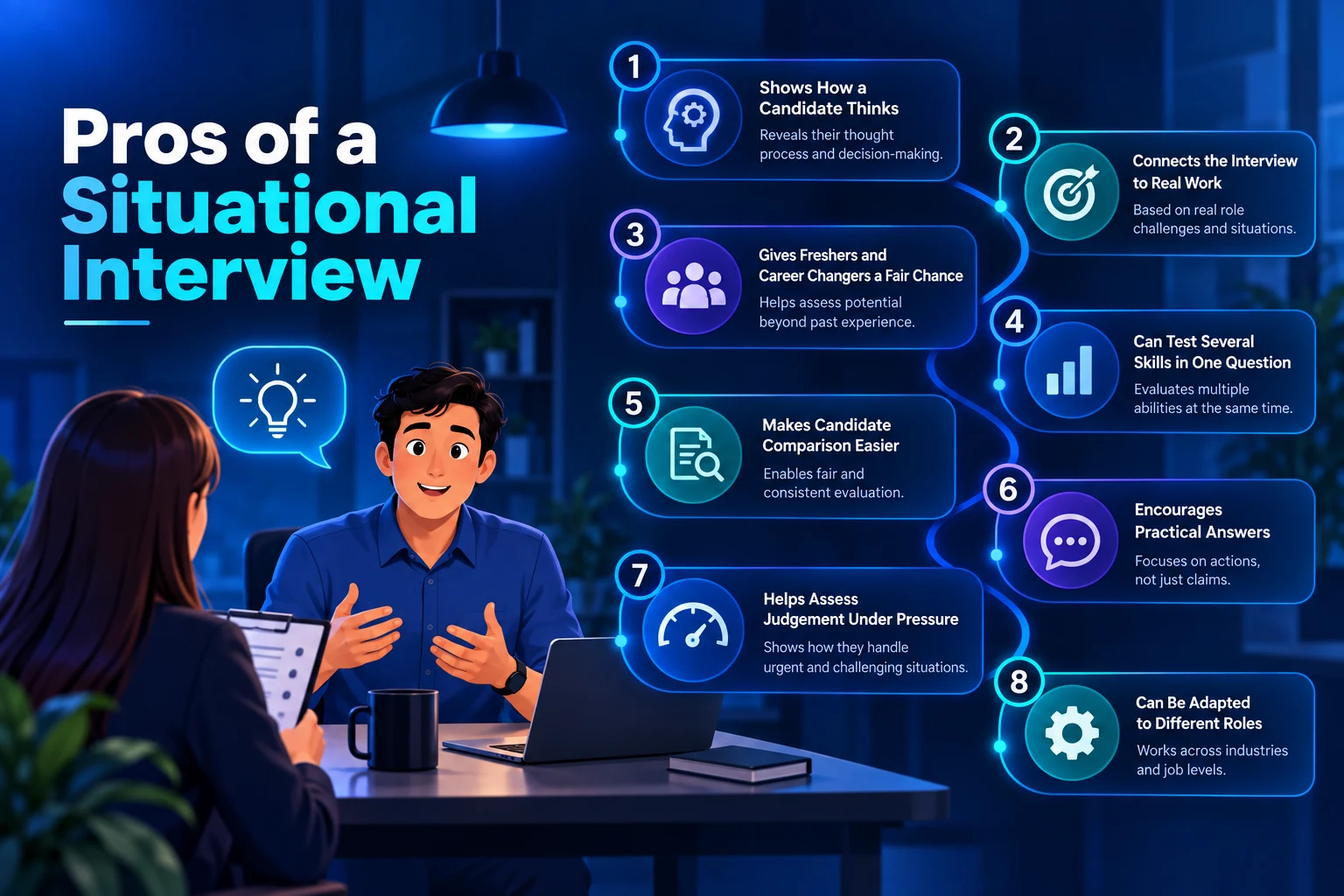
1. Shows How a Candidate Thinks
A résumé tells an employer what a person has done, but it does not always show how they would handle a new or unfamiliar challenge. A situational question gives the candidate a chance to explain their thought process step by step. The interviewer can see whether the candidate understands the problem, checks important facts, identifies risks, sets priorities, considers different options, and chooses a practical course of action. This can be especially useful for roles that involve regular decision-making or problem-solving. The quality of the answer is not only about reaching the right conclusion; the reasoning behind the decision also matters because it shows how the candidate approaches a problem in a practical way.
2. Connects the Interview to Real Work
Good situational questions are based on problems that can genuinely occur in the role, which makes the interview more relevant to actual workplace responsibilities. When the situations reflect real responsibilities, employers can better understand how the candidate may approach the challenges of the job rather than relying only on general statements about confidence or personality.
3. Gives Freshers and Career Changers a Fair Chance
A candidate may have strong judgement and problem-solving ability even if they have not worked in the same position before. Situational questions allow candidates to demonstrate how they would approach a problem without requiring an identical example from previous employment. This can be useful for freshers, graduates, people returning to work, and candidates moving from one industry to another. They may not have a long history of role-specific experience, but they can still demonstrate logical thinking, communication skills, awareness of responsibility, and willingness to follow appropriate procedures. This gives employers another way to assess potential instead of relying only on previous job titles or years of experience.
4. Can Test Several Skills in One Question
A single workplace scenario can reveal several abilities at the same time. This helps employers understand how different skills work together in a realistic situation. However, interviewers should still be clear about which abilities they are assessing so that the question does not become too broad or difficult to score consistently.
5. Makes Candidate Comparison Easier When Used Consistently
If candidates are given the same or very similar situations and their responses are judged using common criteria, employers have a clearer basis for comparison. Each candidate can then be assessed against the same points. This can make interview notes more organized and help reduce differences caused by completely different questions being asked to different candidates, leading to a more consistent assessment process.
6. Encourages Practical Answers
Situational questions encourage candidates to move beyond general claims such as “I am a good problem-solver” or “I work well under pressure.” Instead, candidates have to explain what they would actually do in a particular situation, including the first step they would take, who they would speak to, what information they would check, and how they would decide what to do next. This gives the interviewer more useful information because the response is based on actions rather than only on self-description. It can also make follow-up questions more meaningful because the interviewer can explore why the candidate selected a particular approach.
7. Helps Assess Judgement Under Pressure
Some roles regularly involve urgent decisions, limited time, competing demands, dissatisfied customers, safety concerns, or unexpected problems. A realistic scenario can help the interviewer understand how the candidate approaches such pressure. The interviewer can observe whether the candidate identifies the most important issue first, remains focused on the main objective, avoids unnecessary risks, and knows when to ask for help or escalate the matter. Good judgement does not always mean responding quickly; in some situations, the best response may involve checking important information before taking action.
8. Can Be Adapted to Different Roles
Situational interviewing can be used across many industries and job levels because the method depends on the scenario rather than on one particular profession. The format can therefore be adapted easily, provided the situation reflects the actual responsibilities, risks, and level of authority associated with the specific role.
Cons and Limitations of a Situational Interview
Situational interviews also have important limitations. Understanding these limitations helps employers use the method appropriately and avoid treating one hypothetical answer as complete proof of a candidate’s future performance.
1. A Good Answer Does Not Guarantee Good Performance
A candidate may know what an ideal response sounds like but behave differently when a similar situation occurs in real work. Actual workplaces involve emotions, time pressure, incomplete information, relationships with colleagues, organizational constraints, and unexpected consequences. A person may therefore describe an excellent approach during an interview but find it more difficult to apply in practice. For this reason, a situational interview should be treated as one source of information rather than complete evidence of future performance, especially when the role also requires technical ability, teamwork, or hands-on competence.
2. Weak Scenarios Can Produce Weak Information
The quality of the answer depends heavily on the quality of the situation presented to the candidate. If a question is too broad, unrealistic, vague, or unrelated to the role, the response may tell the employer very little. A stronger scenario gives enough information for the candidate to understand the challenge while still leaving room for judgement. Employers therefore need to make sure that the situation reflects a genuine workplace issue and has a clear purpose.
3. Candidates Can Prepare Polished Answers
Many common situational interview questions are widely available online, so candidates can practise responses in advance and may learn answers that sound strong even if they have limited understanding of how they would apply them in real work. Preparation itself is not a problem, but overly rehearsed answers may make it harder to understand the candidate’s genuine reasoning. Interviewers can address this by asking follow-up questions about why the candidate chose a particular action, what they would do if the first approach failed, or how their response would change if the situation became more difficult.
4. Interviewers May Still Judge Answers Differently
A situational interview does not automatically remove subjectivity because two interviewers may hear the same answer and interpret it differently if there is no clear scoring framework. One interviewer may value speed, while another may focus more on caution, communication, or escalation. Without agreed criteria, similar answers may receive different assessments. Clear scoring standards, common expectations, and interviewer preparation can help make the evaluation more consistent and reduce the influence of personal preferences.
5. Designing Effective Questions Takes Effort
Useful situational questions require preparation because employers need to understand the role, identify important workplace situations, decide which competencies should be assessed, write clear scenarios, and define what a strong response should include. A poorly designed question may test confidence, memory, or speaking style instead of the ability that actually matters for the job. Good questions are usually based on genuine workplace situations and may require input from supervisors, experienced employees, hiring managers, or subject-matter experts who understand the role well.
6. May Not Demonstrate Actual Technical Skill
A candidate may be able to explain how a technical task should be completed without being able to perform it correctly in practice. Situational interviews are therefore more useful for exploring judgement, reasoning, and decision-making than for proving hands-on competence. For technical or practical roles, they may need to be combined with work samples, practical tests, demonstrations, or other forms of assessment.
7. Long or Complex Questions Can Cause Confusion
A scenario can become difficult to answer if it contains too many characters, conditions, deadlines, or unnecessary details. In such cases, the question may start testing memory or reading ability instead of the intended skill, and candidates may become unsure about which part of the situation they are expected to address. A good situational question should provide enough context to make the problem realistic while remaining focused on one main challenge or decision. Additional information can be introduced later through follow-up questions if it is necessary.
8. May Overlook Useful Evidence From Past Experience
Situational questions mainly focus on what a candidate says they would do in the future, which can be useful but does not replace information about what the candidate has actually done in previous situations. For this reason, employers may get a fuller picture by combining situational questions with behavioral questions when appropriate.
How Employers Can Use Situational Interviews Better?
A situational interview becomes more useful when the questions are simple, job-related, and assessed consistently. Employers can follow these basic steps:
1. Start with the real job. List the situations that are important in the role. Use issues that employees genuinely face, not random puzzles.
2. Keep each question clear. Give enough information to understand the problem, but avoid long stories and unnecessary background.
3. Know what a good answer should include. Before interviewing candidates, decide the actions, judgment, communication, or safety points that matter most.
4. Use comparable questions. Candidates do not need every word to be identical in every conversation, but the core situation and the standard used to judge it should remain consistent.
5. Ask simple follow-up questions. Use follow-ups to understand the candidate’s reasoning, not to lead them toward a preferred answer.
6. Combine the interview with other evidence when needed. For roles that depend heavily on technical or hands-on ability, add a suitable work sample or practical assessment rather than relying on interview answers alone.
Conclusion
A situational interview asks a simple but revealing question: What would you do if this happened at work? By placing candidates in realistic workplace scenarios, interviewers can gain insight into how they approach problem-solving, prioritization, communication, teamwork, leadership, safety, and decision-making.
The main strength of situational interviews is that they give candidates an opportunity to demonstrate their reasoning, even when they have not faced the exact situation before. However, a well-structured answer is still a hypothetical response and does not necessarily predict how someone will behave in a real workplace. That is why situational interviews are most effective when questions are based on genuine job responsibilities and candidates are evaluated using clear, consistent criteria.
For employers, combining situational questions with behavioral interviews, work samples, or practical assessments can provide a more complete view of a candidate’s skills and experience. For candidates, the best approach is to focus on the problem, explain their reasoning and actions clearly, communicate when and how they would seek support, and show how they would determine whether the situation was successfully resolved.
When thoughtfully designed and consistently evaluated, situational interviews can provide valuable insight into how candidates think through realistic workplace challenges and approach decisions before they step into the role.