Back to all blogs
Learn what stress interviews are, how they work, common techniques, benefits and risks, and how to conduct fair, job-related stress interviews.

Abhishek Kaushik

An interview is usually designed to help employers understand a candidate’s skills, experience, communication style, and suitability for a role. But not every workplace is calm and predictable. Some jobs require employees to handle demanding customers, tight deadlines, difficult conversations, unexpected problems, or high-pressure decisions. In such situations, employers may want to understand how a candidate responds when the interview itself becomes more challenging.
This is where stress interviews come in.
Research has examined whether stress interviews can provide useful information during the hiring process. One study involving 90 applicants and 62 interviewers found a positive relationship between the use of stress interviews and interviewers’ accuracy in assessing applicants’ emotion-regulation abilities. The same study also found a negative relationship between stress-interview use and applicants’ perceptions of interviewer friendliness and organizational attraction.
Research on employment interviews more broadly also highlights the importance of structure. A major meta-analysis examined 245 validity coefficients across 86,311 individuals and found that interview validity varied depending on the content and method used, with structured interviews showing stronger validity than unstructured interviews.
This guide explains what stress interviews are, how they work, the different techniques employers may use, how to conduct them responsibly, and the benefits and limitations of using them as part of the hiring process.
What Is a Stress Interview?
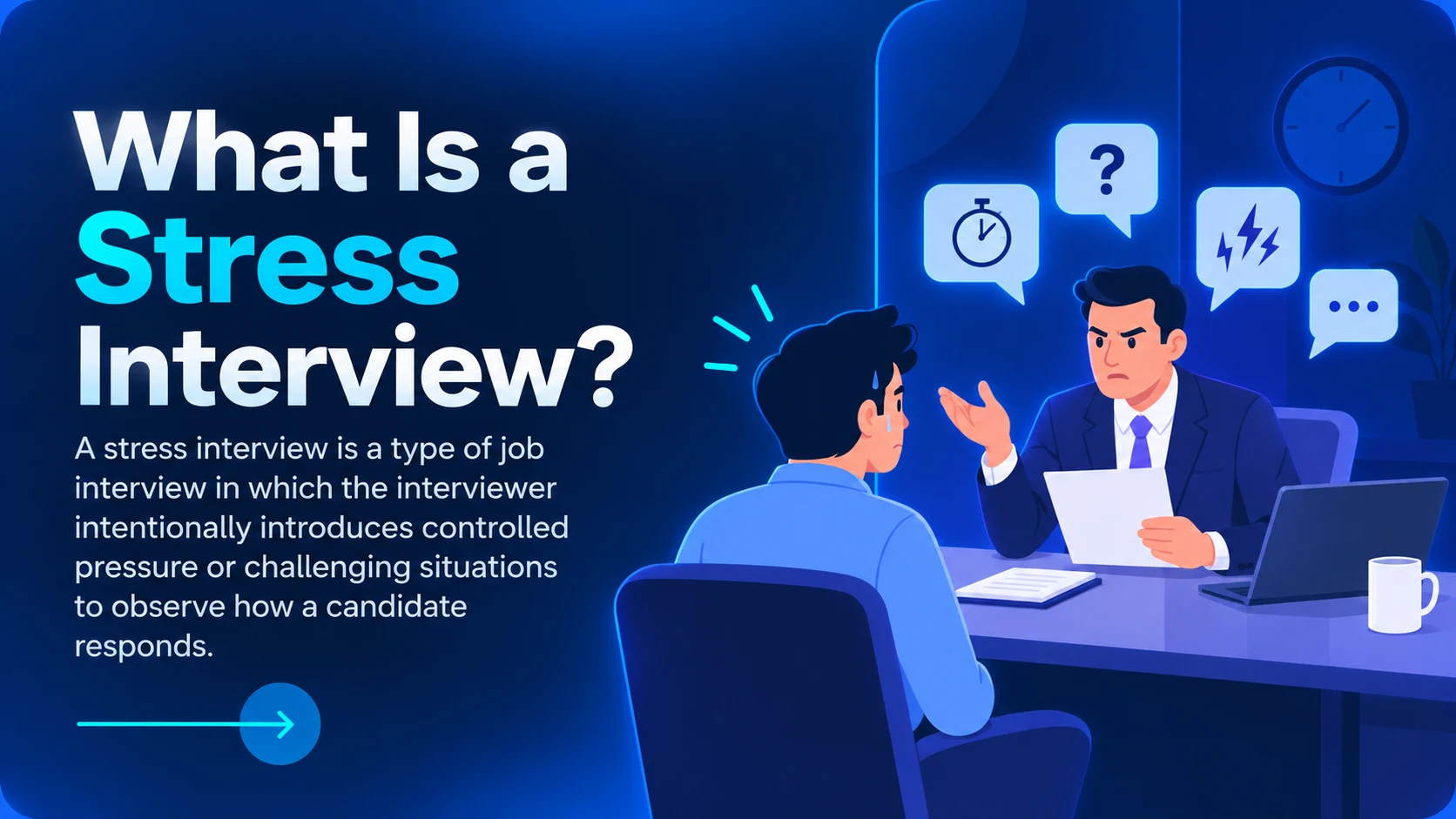
A stress interview is a type of job interview in which the interviewer intentionally introduces controlled pressure or challenging situations to observe how a candidate responds.
The pressure may come from rapid questioning, difficult follow-up questions, unexpected changes in the conversation, long pauses, interruptions, challenging role-play scenarios, or other job-relevant situations.
The purpose is not simply to make a candidate nervous. Instead, the interviewer should be trying to understand how the candidate communicates, thinks, adapts, and maintains professionalism when normal interview conditions become more demanding.
The candidate’s responses can provide insight into how they approach difficult situations and communicate when challenged.
Stress interviews may be particularly relevant for roles where employees regularly deal with pressure, conflict, uncertainty, demanding customers, tight deadlines, or high-stakes decisions.
How Does a Stress Interview Work?
A stress interview generally follows the basic structure of a regular interview, but the interviewer deliberately introduces pressure at selected points in the conversation. The purpose is to observe how candidates respond to challenging situations that may be relevant to the role.
Stress interviews are designed to reveal how candidates manage pressure, maintain their communication, and regulate their emotions when faced with difficult or unexpected situations.
1. Define the assessment objective
Before the interview, the hiring team should identify exactly what it wants to assess. The objective should be connected to the actual requirements of the role rather than simply creating pressure for the candidate. The U.S. Office of Personnel Management recommends identifying competencies through job analysis and focusing interview questions on skills that are important for successful job performance.
2. Select appropriate techniques
Once the objective is clear, the interviewer can choose pressure techniques that reflect realistic workplace situations. The techniques should be relevant to the position and should help assess specific skills rather than creating pressure without a clear purpose.
3. Introduce pressure
Pressure should be introduced during the relevant part of the interview rather than being used throughout the entire conversation. This gives the interviewer an opportunity to observe how the candidate responds when the situation becomes more challenging. The pressure should remain connected to the skills being assessed and should reflect situations the candidate may realistically encounter in the role.
4. Observe the candidate’s response
The interviewer should focus on observable behavior rather than making assumptions based on whether the candidate appears nervous. The aim is to understand how the candidate communicates, thinks, and responds to the situation.
Structured-interview guidance emphasizes observing and evaluating candidates’ responses against defined job-related criteria rather than relying only on general impressions.
5. Evaluate against defined criteria
The candidate’s response should be compared against predetermined assessment criteria rather than the interviewer’s personal impression. This helps make the evaluation more consistent and keeps the focus on job-related behaviors.
6. End the interview professionally
Once the assessment is complete, the interviewer should return the conversation to a normal professional tone. The candidate should understand that the challenging situation was part of the assessment and was not intended as a personal criticism.
A professional closing is particularly important because research has found that stress interviews may affect applicants’ perceptions of interviewer friendliness and organizational attraction.
Why Do Companies Conduct Stress Interviews?
Stress interviews are generally used when the ability to handle pressure is relevant to the job. They can help employers observe specific behaviors that may not be visible during a traditional interview.
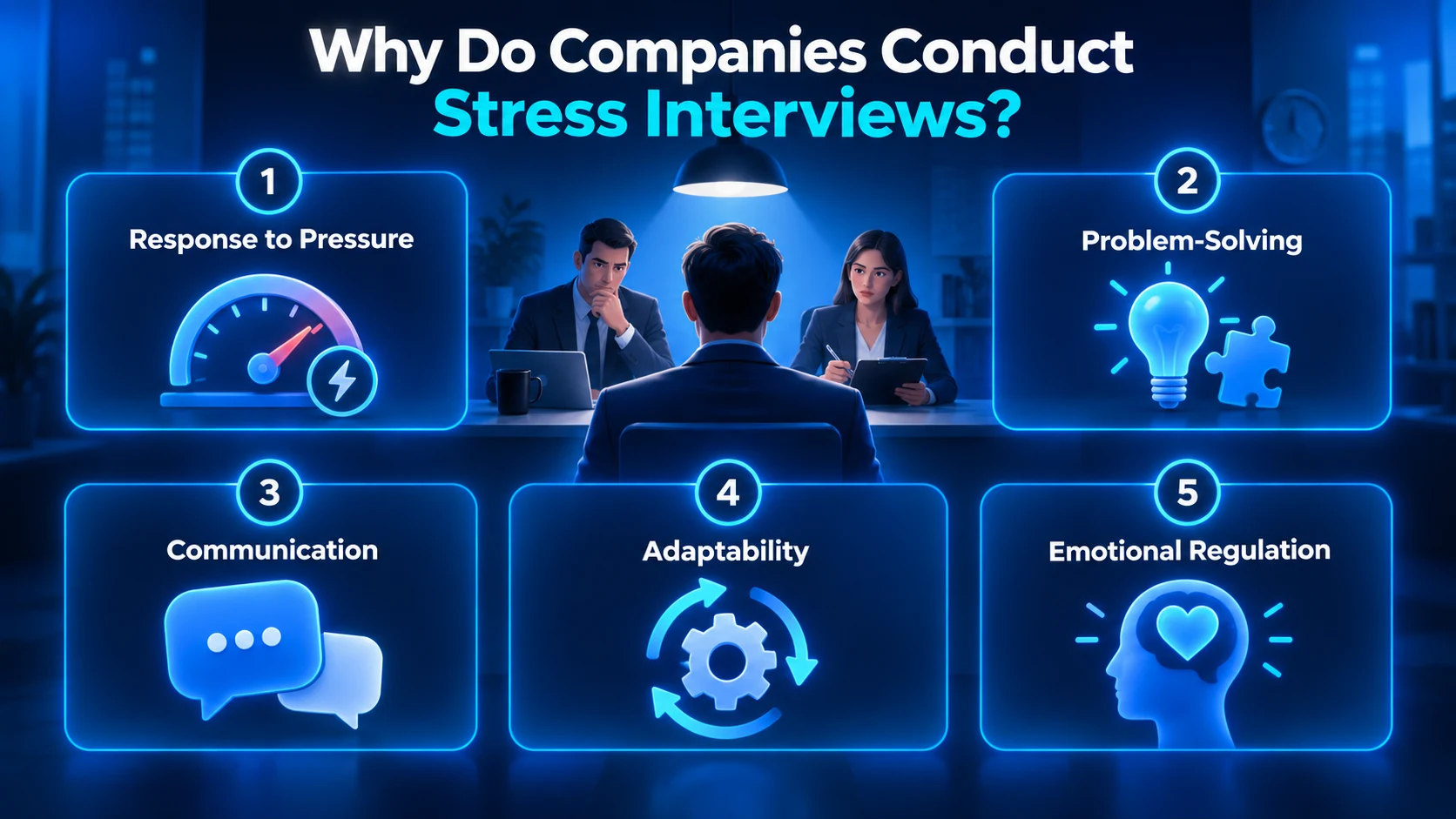
1. Assess response to pressure
Some positions involve demanding customers, strict deadlines, emergencies, negotiations, or frequent changes. A stress interview allows employers to observe how candidates respond to a simulated difficult situation.
This can help assess:
Ability to stay focused
Decision-making under pressure
Professionalism during difficult situations
Ability to continue working toward a solution
2. Evaluate problem-solving
Pressure can affect how people process information and make decisions. Challenging scenarios can help interviewers observe whether candidates remain focused on understanding the problem and identifying possible solutions.
The interviewer may assess:
How the candidate approaches the problem
Whether they ask relevant questions
How they prioritize information
Whether they develop a practical solution
3. Evaluate communication
A candidate may know the right answer but struggle to communicate it during a difficult conversation. Stress interviews can provide additional insight into how clearly and professionally candidates communicate under pressure.
The interviewer may look at:
Clarity of communication
Listening skills
Ability to explain decisions
Tone and professionalism
4. Understand adaptability
Workplace situations do not always follow a predictable pattern. Changing questions or introducing new conditions can help interviewers observe how candidates adjust their approach.
This can include observing whether candidates:
Adapt when new information is introduced
Change their approach when necessary
Remain focused on the objective
Respond constructively to unexpected situations
5. Assess emotional regulation
Stress interviews can also provide information about how candidates regulate their responses during challenging interactions. This is particularly relevant for roles that involve frequent conflict, customer complaints, or high-pressure decisions.
The interviewer may observe:
Whether the candidate remains composed
How they respond to criticism
Whether they maintain professional communication
How effectively they manage difficult interactions
Types of Stress Interviews
Stress interviews can be conducted in different ways depending on the role and what the interviewer wants to understand about a candidate. Some approaches focus on communication, while others look at how someone thinks, adapts, or handles pressure.
1. Rapid-Fire Questioning
In this approach, the interviewer asks several questions one after another, leaving little time between them. It helps show how well a candidate can think quickly, stay focused, and communicate their thoughts clearly under pressure. It can also reveal whether the candidate can prioritize information and give relevant answers without becoming overwhelmed.
2. Challenging Questions
The interviewer may question a candidate’s answer, challenge their reasoning, or ask them to explain why they made a particular decision. This helps assess how comfortably they handle disagreement and whether they can explain their thinking without becoming defensive. It can also show whether candidates are willing to reconsider their ideas when presented with a different perspective.
3. Silence and Delayed Responses
The interviewer may deliberately leave a pause after the candidate answers instead of immediately moving to the next question. This can show how comfortable the candidate is with silence and whether they can stay composed without feeling the need to keep talking. It may also help interviewers understand how candidates manage uncertainty and maintain their confidence during uncomfortable moments.
4. Unexpected Questions
Candidates may be asked questions they were not expecting or be given a situation that requires an immediate response. This helps interviewers see how candidates think on their feet and adapt when they cannot rely on prepared answers. It can also reveal their ability to organize their thoughts quickly and communicate a reasonable response when faced with uncertainty.
5. Role-Playing Difficult Situations
The interviewer presents a workplace situation and asks the candidate to respond as they would in a real situation. This can help assess how they communicate, handle conflict, make decisions, and deal with difficult people or circumstances. It also gives interviewers an opportunity to observe whether the candidate can remain professional while managing a challenging interaction.
6. Changing or Contradictory Questions
The interviewer may introduce new information or change the conditions of a situation after the candidate has already answered. This helps reveal whether the candidate can reconsider their approach, adapt their reasoning, and make decisions when circumstances change. It can also show how effectively they balance flexibility with consistency when solving problems.
How to Conduct a Stress Interview
A stress interview should be planned carefully and conducted with a clear assessment purpose. Simply making a candidate uncomfortable does not provide meaningful information about their abilities. The pressure should be connected to the requirements of the role and applied consistently, professionally, and within appropriate boundaries.
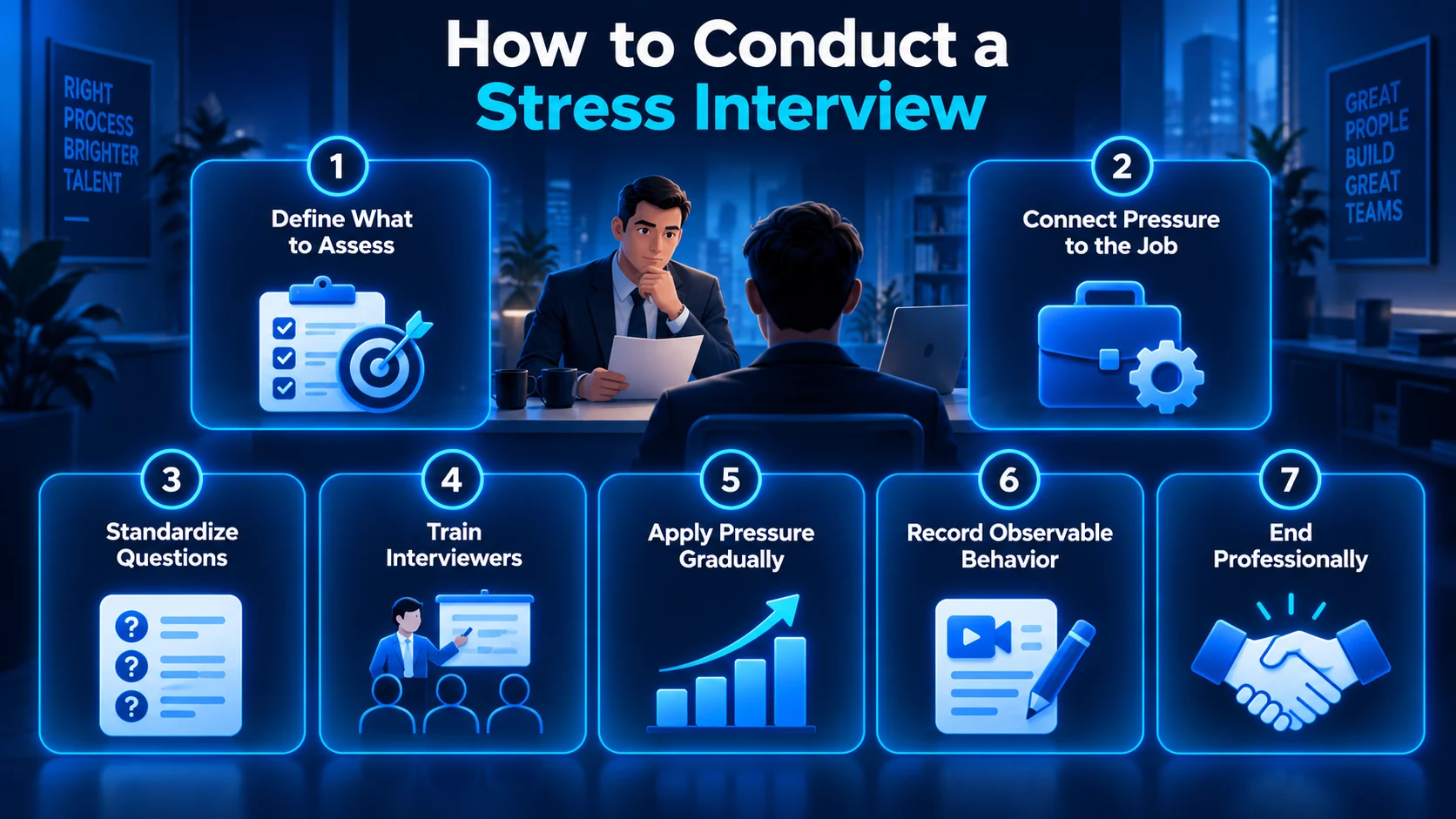
Step 1: Define What You Want to Assess
Begin by identifying the specific competencies that are important for the position. This helps the interviewer determine what type of pressure should be introduced and what candidate behaviors should be observed during the interview.
For example:
Resilience: Staying composed when facing difficult situations.
Decision-making: Choosing an appropriate response under pressure.
Communication: Explaining ideas clearly during challenging conversations.
Adaptability: Adjusting when circumstances or requirements change.
Clearly defining these competencies gives the interview a specific purpose. It also helps ensure that the interviewer focuses on skills that are relevant to the position rather than simply observing whether a candidate becomes uncomfortable.
Step 2: Connect the Pressure to the Job
The pressure used during the interview should reflect situations that the candidate could realistically encounter in the workplace. Job-related scenarios make the assessment more meaningful and allow candidates to demonstrate how they may respond to actual work challenges.
For example:
Customer service: Handling an angry or dissatisfied customer.
Leadership: Making a decision when team members disagree.
Project management: Managing changing deadlines or competing priorities.
Sales: Responding to a client who questions the value of a product.
The objective is to create realistic pressure rather than stressful situations that have no connection to the candidate’s potential responsibilities. The situation should give the interviewer an opportunity to assess how the candidate may respond in a similar workplace setting.
Step 3: Prepare Standardized Questions and Scenarios
Prepare the core questions, challenging scenarios, follow-up questions, and evaluation criteria before conducting the interviews. Candidates applying for the same position should be assessed using comparable standards and job-related expectations.
For example:
Core questions: Questions that every candidate is expected to answer.
Stress scenarios: Similar challenging situations for candidates applying for the same role.
Follow-up questions: Additional questions used to explore important responses.
Evaluation criteria: Specific behaviors or competencies used to assess answers.
A standardized process can make it easier to compare candidates using defined, job-related criteria rather than relying mainly on personal impressions.
Step 4: Train the Interviewers
Interviewers should receive appropriate preparation before conducting stress interviews. They need to understand how to apply pressure, which behaviors to observe, and how to maintain professional boundaries throughout the assessment.
For example:
Permitted techniques: Understanding which stress techniques can be used.
Behavioral indicators: Knowing which candidate behaviors should be observed.
Appropriate pressure: Understanding how much pressure is suitable for the role.
Documentation: Knowing which responses and behaviors should be recorded.
Training helps interviewers use stress techniques consistently and professionally. It also reduces the risk of relying on personal assumptions when interpreting a candidate’s behavior.
Step 5: Apply Pressure Gradually
Pressure should be introduced gradually rather than making the interview highly stressful from the beginning. Starting with moderate challenges allows the interviewer to observe the candidate’s initial response before introducing more demanding situations.
For example:
Moderate pressure: Asking a challenging question about the candidate’s experience.
Increased pressure: Introducing disagreement about a proposed solution.
Higher pressure: Adding a time-sensitive workplace problem.
Complex pressure: Introducing competing priorities that require the candidate to make a decision.
The level of pressure should increase only when it is relevant to the assessment. The purpose is to observe how the candidate adapts as the situation becomes more demanding, rather than creating unnecessary discomfort.
Step 6: Record Observable Behavior
Interviewers should record specific and observable behaviors instead of relying on general impressions. Notes should describe what the candidate actually said or did so that the response can be reviewed against the defined assessment criteria.
For example:
Communication: The candidate explained their response clearly after being challenged.
Decision-making: The candidate considered the available options before choosing a solution.
Adaptability: The candidate changed their approach after new information was introduced.
Conflict management: The candidate acknowledged the disagreement and explained their position calmly.
Observable notes provide more useful information than broad descriptions such as “weak under pressure” or “very confident.” They give the interviewer a specific record that can be used during the evaluation process.
Step 7: End the Interview Professionally
Once the stress portion of the interview is complete, the interviewer should return to a normal and professional conversation. The candidate should have an opportunity to ask questions and understand what will happen after the interview.
For example:
Explain the next steps: Tell the candidate what to expect after the interview.
Answer questions: Allow the candidate to clarify information about the role.
Close respectfully: Thank the candidate for their time and participation.
Provide clarification: Address any remaining questions about the interview process.
The pressure should end when the assessment is complete rather than continuing unnecessarily. A professional closing helps maintain a respectful candidate experience and clearly separates the deliberate pressure of the assessment from the normal interview process.
What Should Interviewers Evaluate?
Interviewers should focus on observable behaviors that are directly relevant to the role rather than simply judging whether a candidate appears nervous or confident. The evaluation should ideally be based on predefined criteria so that candidates are assessed against the same expectations.
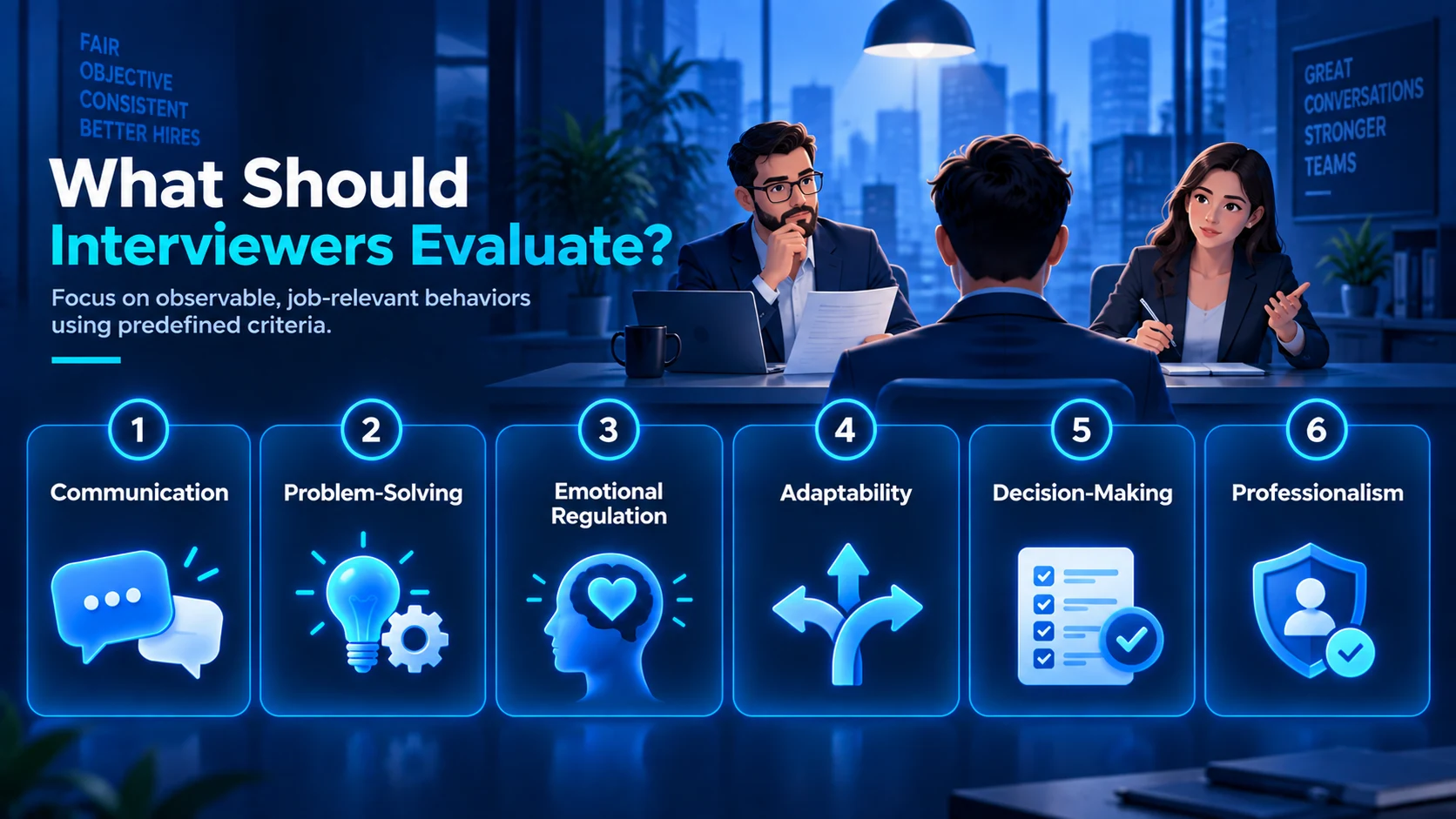
1. Communication
The interviewer should observe whether the candidate can explain their thoughts clearly when faced with challenging questions, disagreement, or unexpected situations.
Clear communication can be particularly important in roles where employees regularly interact with customers, colleagues, managers, or other stakeholders during difficult situations.
2. Problem-Solving
The interviewer should assess how the candidate approaches a difficult or unexpected problem rather than focusing only on whether they immediately provide the correct answer.
This can help the interviewer understand how the candidate approaches workplace problems when they have limited time, incomplete information, or changing circumstances.
3. Emotional Regulation
The interviewer should observe whether the candidate can maintain professional communication when faced with disagreement, criticism, or an uncomfortable situation.
The focus should be on observable behavior rather than simply assuming that visible nervousness means a candidate cannot handle pressure. The interviewer should consider how the candidate manages the situation and whether they continue responding professionally.
4. Adaptability
The interviewer should assess how well the candidate adjusts when information, priorities, or requirements change unexpectedly during the conversation.
Adaptability can be particularly relevant for roles where employees regularly deal with changing deadlines, customer requirements, priorities, or workplace situations.
5. Decision-Making
The interviewer should examine how the candidate makes decisions when there is limited information, competing priorities, or limited time available.
The interviewer does not necessarily need to look for one perfect answer. The reasoning behind the decision can provide useful information about how the candidate evaluates situations and chooses a course of action under pressure.
6. Professionalism
The interviewer should observe whether the candidate remains respectful and appropriate even when the conversation becomes challenging or involves disagreement.
Professionalism should be evaluated through specific behaviors rather than broad judgments about the candidate’s personality. This helps the interviewer focus on how the candidate actually responds during challenging interactions.
Benefits of Stress Interviews
Stress interviews can help interviewers understand how candidates respond when they face pressure, challenging questions, disagreement, or unexpected situations. When used appropriately, they can provide additional insight into skills that may be difficult to assess through standard interview questions alone.
1. More Insight Into Pressure-Related Behavior
Candidates may respond differently when faced with unexpected questions, disagreement, or difficult situations than they do during standard interview questions.
For example:
Unexpected challenges: The interviewer can observe how the candidate reacts when they are not fully prepared.
Difficult questions: The interviewer can assess whether the candidate remains focused when challenged.
2. Job-Relevant Simulations
Role-playing allows interviewers to recreate situations that candidates may encounter after joining the organization. This can make the assessment more practical than relying entirely on hypothetical questions.
For example:
Customer service: Handling an upset customer.
Management: Responding to an employee conflict.
3. Assessment of Multiple Skills
A single stress scenario can provide information about several competencies at the same time. Instead of assessing each skill through a separate question, an interviewer can observe how different abilities work together.
For example, a difficult customer scenario may reveal:
Communication: How clearly the candidate explains the situation.
Problem-solving: How they identify a solution.
4. Better Understanding of Emotion Regulation
Stress interviews can give interviewers additional insight into how candidates manage their reactions when faced with pressure, criticism, or difficult interactions. Instead of focusing only on whether a candidate appears calm, interviewers can observe how they regulate their responses and continue communicating professionally.
For example:
Managing reactions: Does the candidate avoid reacting impulsively?
Maintaining focus: Can they continue addressing the question despite pressure?
However, this benefit needs to be considered alongside the possible effect on the candidate experience, as the same study found a negative relationship between stress-interview use and applicants’ perceptions of interviewer friendliness and organizational attraction.
Risks and Limitations of Stress Interviews
Stress interviews can provide useful information about how candidates respond to challenging situations, but they also have certain risks and limitations. Pressure does not affect every candidate in the same way, and an interviewer’s interpretation of a candidate’s reaction may not always reflect their actual ability to perform the job.
1. Candidate Reactions Can Be Misinterpreted
Candidates may react differently when placed under pressure. A pause, nervous response, or difficulty answering immediately does not always mean that the candidate lacks the required skills.
Candidate reaction | Possible interpretation |
Pauses before answering | Taking time to organize thoughts |
Appears nervous | Feeling uncomfortable in an unfamiliar situation |
Asks for clarification | Trying to understand the question correctly |
Changes their response | Adjusting their answer after reconsidering the situation |
Interviewers should focus on the quality and relevance of the candidate’s response rather than assuming that a visible stress reaction automatically indicates poor performance.
2. Excessive Pressure Can Affect the Candidate Experience
Using too much pressure can change how candidates view the interview and the organization. If the approach becomes unnecessarily aggressive, the interview may feel unfair or uncomfortable.
Area | Possible effect |
Interview experience | Candidate may feel uncomfortable or intimidated |
View of the interviewer | Interviewer may be perceived as unnecessarily aggressive |
View of the organization | Candidate may develop a negative impression |
Interest in the position | Candidate may become less interested in continuing |
The pressure should therefore be controlled so that the interview remains challenging without becoming unnecessarily hostile.
3. The Technique May Not Suit Every Role
Stress interviews are more relevant to positions where employees regularly deal with pressure, conflict, uncertainty, or difficult situations. For roles that do not involve these conditions, creating artificial stress may provide limited useful information.
Role | Relevant pressure situation |
Customer service | Handling an angry or dissatisfied customer |
Sales | Responding to customer objections |
Leadership | Managing disagreement within a team |
Project management | Handling changing deadlines or priorities |
Interviewers should first consider the actual responsibilities of the position before deciding whether a stress interview is appropriate.
4. Subjectivity Can Affect Evaluation
Without clear evaluation criteria, interviewers may interpret the same candidate behavior differently. Personal expectations, communication preferences, and individual judgment can influence the assessment.
Candidate behavior | Different possible interpretations |
Long pause | Careful thinking or uncertainty |
Short answer | Lack of detail or clear communication |
Calm response | Emotional control or lack of engagement |
Disagreement | Confidence or difficulty accepting feedback |
Using predefined criteria and focusing on observable behavior can help make evaluations more consistent.
5. Poor Execution Can Create Unnecessary Intimidation
A stress interview should create job-related pressure rather than unnecessary discomfort. If interviewers use personal criticism, humiliation, or irrelevant pressure, the technique can move away from its purpose.
Appropriate approach | Inappropriate approach |
Challenge a realistic workplace decision | Personally insult the candidate |
Simulate a difficult customer interaction | Mock the candidate’s response |
Question a proposed solution | Deliberately humiliate the candidate |
Introduce a realistic time constraint | Use unrelated personal criticism |
The interviewer should ensure that every pressure technique has a clear connection to the skills or behaviors being assessed.
How to Conduct Stress Interviews Fairly
A well-designed stress interview should balance realistic pressure with a consistent and respectful evaluation process.
Employers can improve fairness by:
Using the same core competencies across candidates
Preparing standardized evaluation criteria
Connecting questions to actual job requirements
Training interviewers before conducting assessments
Recording observable behaviors rather than assumptions
Avoiding unnecessary personal attacks
Giving candidates reasonable opportunities to clarify their answers
Combining stress interviews with other relevant assessment methods
A structured and job-related approach can make stress interviews more consistent while helping interviewers distinguish between a candidate’s response to pressure and their overall ability to perform the role.
Example of a Stress Interview Scenario
Consider a candidate applying for a sales or customer-service position.
The interviewer creates a simulated situation in which an unhappy customer threatens to leave the company unless they receive a major discount.
Example 1:
Interviewer: “I have been using your service for two years, and I am extremely disappointed. If you cannot give me a 50% discount immediately, I am taking my business elsewhere.”
Candidate: “I understand your frustration, and I appreciate your loyalty to the company. While I may not be able to offer a 50% discount, I can explore alternative solutions that could provide value for you. Could you tell me more about the issue so I can understand what would resolve it?”
Example 2:
Interviewer: “I don’t have time for discussions. Either you offer the discount, or we end this call.”
Candidate: “I understand that you need a quick solution. What I can do immediately is explore the available options and see whether we can provide additional value instead of a direct 50% discount. Let me explain what I can offer.”
What can the interviewer evaluate?
The interviewer can observe:
Whether the candidate remains professional
How they respond to confrontation
Whether they listen before responding
How they handle pressure
Whether they focus on finding a solution
How clearly they communicate
The objective is not simply to determine whether the candidate “stayed calm.” It is to understand how they approached the situation and whether their response demonstrates competencies relevant to the role.
How to Make Stress Interviews More Effective
A stress interview becomes more useful when pressure is purposeful rather than excessive.
Employers should:
Define the competency being assessed before the interview.
Use pressure techniques that reflect genuine job situations.
Keep core questions and scoring criteria consistent.
Train interviewers to recognize observable behavior.
Avoid personal attacks or unnecessary humiliation.
Give candidates an opportunity to explain unusual responses.
Combine stress-interview findings with other relevant assessment information.
Use structured evaluation criteria to improve consistency.
Document the reasoning behind assessment decisions.
Review the overall candidate experience as well as the assessment results.
The objective is not to find out who can tolerate the most uncomfortable interview. It is to gather useful, job-relevant information about how a candidate responds to pressure.
Conclusion
Stress interviews can help employers assess how candidates communicate, solve problems, adapt, and regulate their responses under pressure. When designed around realistic workplace demands, they may provide useful insight into how applicants manage challenging situations.
However, stress interviews also carry potential risks. Excessive or poorly designed pressure can affect the candidate experience and may make it more difficult to interpret the candidate’s behavior accurately.
To balance these benefits and risks, stress interviews should reflect clear job requirements rather than simply make candidates uncomfortable. Employers should use standardized questions, defined evaluation criteria, trained interviewers, and consistent assessment practices to make the process more reliable and meaningful.
Ultimately, an effective stress interview should evaluate candidates’ responses to realistic workplace pressure while maintaining a professional, consistent, and evidence-based hiring process.