Back to all blogs
Learn what a structured interview is, how it works, its types, examples, pros and cons, and how to create an effective structured interview process.

Abhishek Kaushik

Hiring teams need a reliable way to compare candidates, especially when several people are applying for the same role. A structured interview provides a standardized approach by using predetermined questions, consistent interview procedures, and defined evaluation criteria. This allows interviewers to assess candidates against the same expectations rather than relying solely on the direction of an informal conversation.
Unlike an unstructured interview, where questions may change based on the candidate’s responses or the interviewer’s preferences, a structured interview follows a planned format. Each candidate is given a comparable opportunity to demonstrate their skills, experience, knowledge, problem-solving abilities, and approach to workplace situations. Interviewers can then evaluate responses using predefined criteria or scoring guidelines, making the overall assessment more consistent.
Research has also examined different structured interview question formats. A 2019 study that tested structured interview questions using real hiring data found that background, situational, and past-behavior question ratings significantly predicted job performance.
The structured format can be particularly useful when hiring teams need to evaluate multiple candidates for the same position while maintaining a consistent interview experience. It can also give interviewers a clear framework for focusing on job-related competencies rather than making decisions based primarily on an informal conversation.
But what exactly makes an interview structured? What are the different types, and when should hiring teams use them?
In this guide, we’ll explain what a structured interview is, how it works, the different types of structured interviews, practical examples, their pros and cons, how structured interviews differ from unstructured interviews, and how employers can create an effective structured interview process.
What Is a Structured Interview?
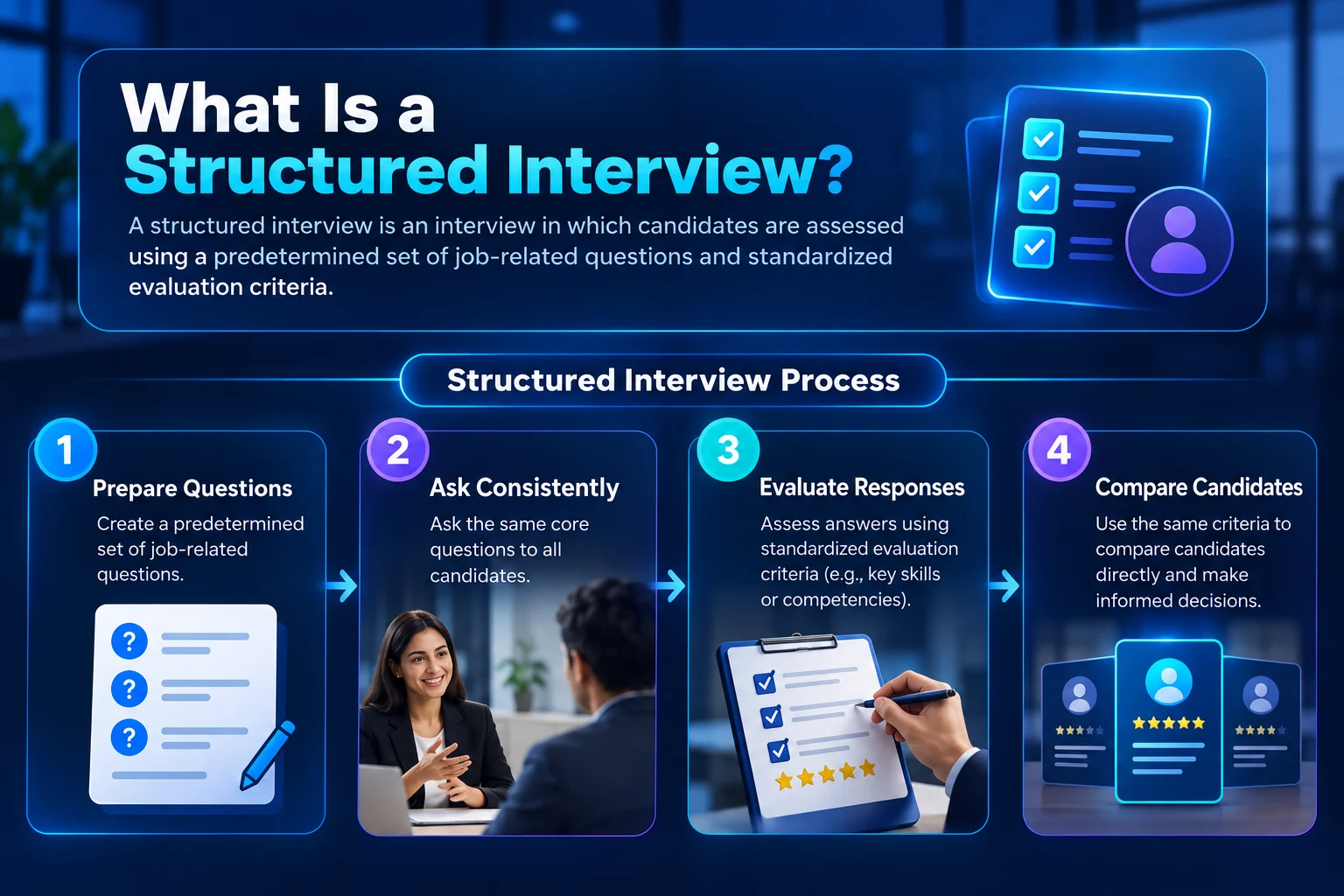
A structured interview is an interview in which candidates are assessed using a predetermined set of job-related questions and standardized evaluation criteria.
The interviewer typically asks the same core questions to candidates applying for the same role and evaluates their responses using a predefined scoring system. The questions are generally linked to competencies or requirements identified through job analysis.
For example, imagine a company is hiring a project manager. Instead of asking one candidate about leadership and another about communication, the organization could give every candidate the same questions:
Tell us about a project where you had to manage competing priorities.
Describe a time when a project was at risk of missing its deadline.
Tell us about a disagreement you had with a team member and how you handled it.
Describe a decision you made when you did not have all the information you wanted.
Each response can then be assessed against criteria such as leadership, communication, decision-making, planning, and problem-solving.
The purpose of a structured interview is not simply to make interviews more formal. It is to create a consistent method for collecting and evaluating information that is relevant to the job.
How to Conduct a Structured Interview
A structured interview works best when the hiring process is planned before candidates are interviewed. The questions, evaluation criteria, and overall process should be connected to the requirements of the position so that each candidate is assessed on the same core competencies.
1. Identify the Job Requirements
Start by identifying the skills, knowledge, behaviors, and competencies that are important for the position. These requirements should come directly from the responsibilities of the role rather than from what an interviewer personally considers important.
For example, a customer service position may require strong communication, problem-solving, conflict resolution, and customer management skills. These requirements can then be used to shape the questions and evaluation criteria used during the interview.
2. Develop Standardized Questions
Once the key requirements are clear, prepare a set of questions that can be asked consistently across candidates. The questions should encourage candidates to provide specific examples of their experience rather than simply make general claims about their abilities.
For instance, instead of asking whether someone is good at handling difficult customers, an interviewer could ask them to describe a time when they dealt with an angry customer, what action they took, and what the outcome was. This gives the interviewer more concrete evidence to evaluate.
3. Establish Evaluation Criteria
Before interviews begin, determine what a strong response should demonstrate. The criteria should reflect the competencies required for the position and give interviewers a clear basis for evaluating responses.
For a leadership question, for example, interviewers might look for evidence of problem identification, communication, decision-making, delegation, and the outcome of the situation. Defining these criteria in advance helps keep the evaluation focused on job-related evidence.
4. Create a Scoring System
A standardized scoring system can make the evaluation process easier to apply across candidates. Organizations may use a numerical scale, such as one to five, with each score representing a different level of evidence or competency.
The important part is not the specific scale but having a clear understanding of what each score represents. This gives interviewers a common framework for recording their assessments and makes interview results easier to discuss and compare.
5. Conduct the Interview Consistently
The same core questions, instructions, and evaluation standards should be used for candidates applying for the same position. Interviewers should also try to provide comparable conditions, including similar time limits and opportunities to respond.
For example, if software engineering candidates are asked to complete the same technical scenario, each candidate should receive the same instructions and a comparable amount of time. Consistency helps ensure that differences in interview results are more closely connected to the candidates' responses and performance.
6. Evaluate and Compare Responses
After the interview, interviewers should record specific evidence from the candidate's responses and assess it against the predefined criteria. Notes should describe what the candidate demonstrated rather than relying on broad impressions such as "good communicator" or "seems confident."
For example, an interviewer could note that a candidate explained a complex issue to a nontechnical client, confirmed the client's understanding, and successfully resolved the concern. Detailed observations like these provide a stronger basis for comparing candidates and making hiring decisions.
Types of Structured Interviews
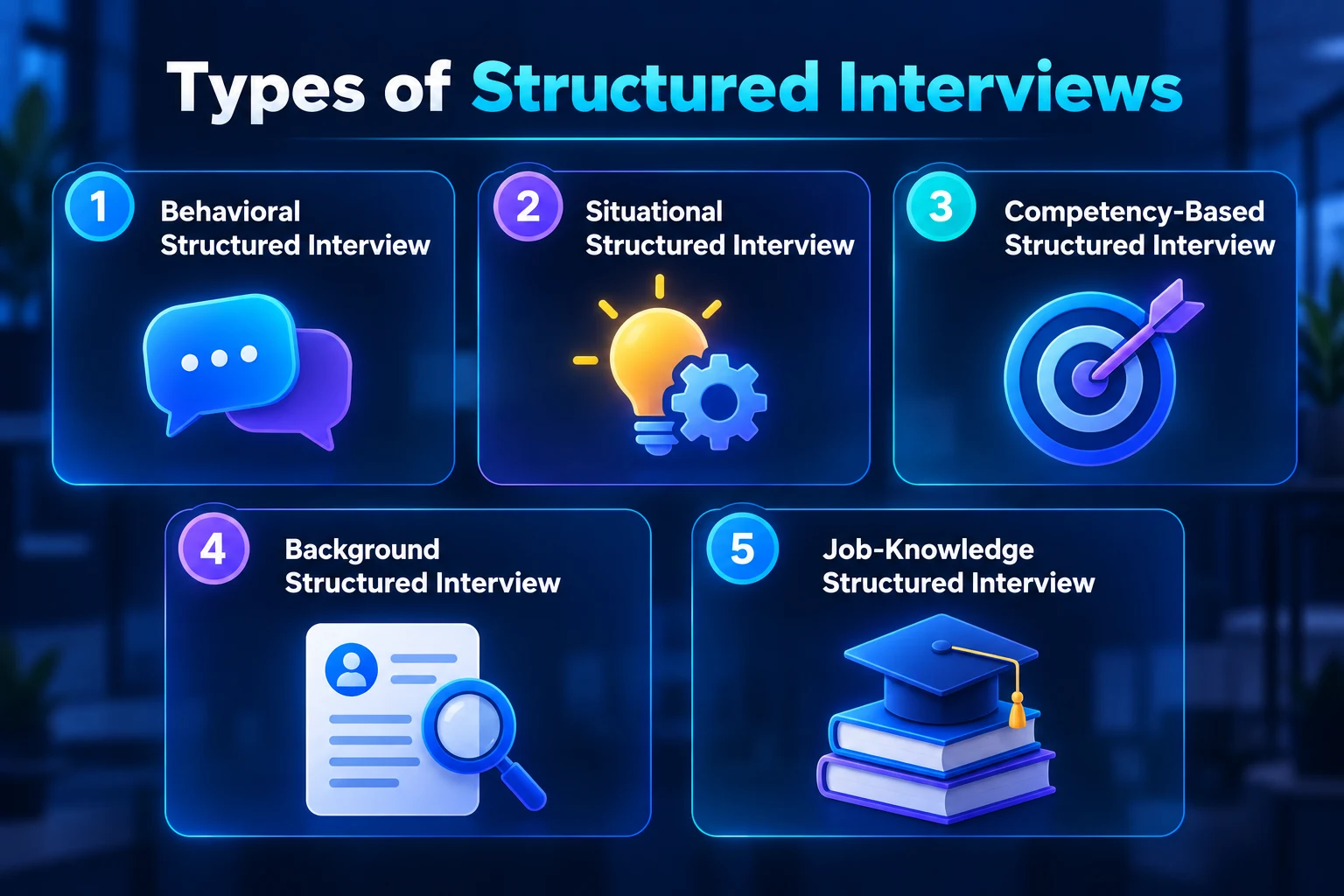
Structured interviews can use different types of questions depending on what the organization wants to assess. These question types include behavioral, situational, competency-based, background, and job-knowledge questions. These types can then be used across different interview formats, such as individual, panel, remote, or multi-stage interviews.
1. Behavioral Structured Interview
A behavioral structured interview asks candidates to describe how they handled situations they experienced in the past.
Example: "Tell us about a time when you had to resolve a conflict between two members of your team."
The interviewer may evaluate communication, conflict resolution, decision-making, leadership, and the candidate's specific actions.Behavioral questions are useful when previous experience can provide evidence of competencies relevant to the position.
2. Situational Structured Interview
A situational structured interview presents a hypothetical work-related situation and asks the candidate how they would respond.
Example: "You are managing a project when you discover that an important deliverable will be delayed. What would you do?"
The interviewer can evaluate decision-making, prioritization, communication, problem-solving, and judgment.Situational questions are useful when an employer wants to understand how candidates would approach situations they may encounter in the role.
3. Competency-Based Structured Interview
A competency-based structured interview is organized around specific competencies that the organization has identified as important for successful job performance.
Example: For a project manager, competencies could include leadership, planning, communication, stakeholder management, and risk management.
Each question is designed to provide evidence about one or more predefined competencies.This approach is useful when an organization has clearly defined competency requirements and wants to evaluate candidates consistently against those requirements.
4. Background Structured Interview
A background structured interview asks candidates standardized questions about their education, previous employment, training, experience, and career history.
Example: "Describe your previous experience managing projects involving multiple departments."
The interviewer can evaluate the relevance, depth, and quality of the candidate's previous experience.Background questions can be useful when previous experience is directly related to the responsibilities of the position.
5. Job-Knowledge Structured Interview
A job-knowledge structured interview uses standardized questions to assess knowledge that is directly relevant to the position.
Example: A cybersecurity candidate may be asked to explain how they would investigate a suspected credential compromise.
The interviewer evaluates technical or professional knowledge required for the role.Job-knowledge questions are particularly relevant for positions where specialized knowledge is essential to successful performance.
What Are the Most Common Structured Interview Questions?
A structured interview uses predefined, job-related questions that are asked consistently across candidates. The questions are usually designed to assess specific competencies such as problem-solving, teamwork, communication, adaptability, leadership, and technical knowledge. Common questions often ask candidates to describe previous situations, explain how they handled a challenge, or explain how they would respond to a situation relevant to the role.
1. Technical Skills Questions
What programming languages or technical tools have you used most extensively?
Can you explain how you would approach a technical problem you have not encountered before?
Describe a project where you had to apply your technical knowledge to solve a complex problem.
How do you ensure that your code or technical work is reliable and maintainable?
2. Problem-Solving Questions
Tell me about a difficult technical problem you faced and how you solved it.
How do you approach a problem when you do not immediately know the solution?
Describe a time when your first solution did not work. What did you do next?
How do you decide which solution is the most appropriate when there are multiple possible approaches?
3. Behavioral Questions
Tell me about a time when you disagreed with a teammate about a technical decision. How did you handle it?
Describe a situation where you made a mistake on a project. What did you learn from it?
Tell me about a time when you had to work under a tight deadline.
Describe a situation where you received critical feedback. How did you respond?
4. Situational Questions
What would you do if you discovered a serious bug shortly before a product release?
How would you handle a situation where a stakeholder asked you to implement something you believed would create technical problems?
What would you do if two important tasks had the same deadline?
How would you approach a project when the requirements were unclear?
Structured Interview Examples
Structured interviews can be adapted to different roles by connecting each question to the skills and competencies required for the position. The following examples show how employers can use role-specific questions and predefined evaluation criteria to assess candidates consistently.
1. Customer Service Representative
A customer service interview may include a question such as, “Tell us about a time when you dealt with an angry customer.” This question can help assess conflict resolution, communication, and customer service skills.
The interviewer can look for evidence of how the candidate listened to the customer, identified the problem, remained professional, and worked toward an appropriate solution. A strong response should describe a specific situation, the actions taken by the candidate, and the outcome. These factors can then be evaluated using predefined criteria rather than the interviewer's overall impression.
2. Software Developer
For a software developer, a structured interview could ask, “Describe a difficult technical problem you encountered and explain how you identified and resolved it.” This question focuses on technical problem-solving and gives the candidate an opportunity to explain their approach.
The interviewer can assess how the candidate diagnosed the problem, considered possible causes, selected a solution, tested the result, and communicated their reasoning. Candidates can then be evaluated against predefined technical problem-solving criteria, making the assessment more consistent across interviews.
3. Project Manager
A project manager may be asked, “Tell us about a project where you were at risk of missing an important deadline.” This question can assess planning, prioritization, communication, and project management skills.
The interviewer can examine how the candidate identified the risk, communicated with stakeholders, adjusted priorities, allocated resources, and managed the final outcome. Instead of simply judging whether the candidate gave a convincing answer, interviewers can evaluate the response against specific criteria related to planning, decision-making, communication, and results.
4. Sales Manager
For a sales manager position, an interviewer could ask, “Describe a situation where a member of your team was consistently missing their sales targets. How did you handle it?” This question can help assess leadership and performance-management abilities.
The response can reveal whether the candidate investigated the underlying issue, communicated expectations, provided coaching, established appropriate goals, and monitored progress. Interviewers can evaluate these elements using predefined leadership and performance-management criteria, helping ensure that candidates are assessed using the same standards.
Structured Interview vs. Unstructured Interview
The primary difference between structured and unstructured interviews is the degree of standardization.
A structured interview uses predetermined questions, consistent procedures, and predefined evaluation criteria. An unstructured interview gives the interviewer substantially more freedom to determine which questions to ask and how to conduct the conversation.
Feature | Structured Interview | Unstructured Interview |
Questions | Predetermined | Flexible |
Question order | Usually consistent | Can vary |
Evaluation | Predefined criteria | Primarily interviewer judgment |
Scoring | Standardized | May be informal |
Candidate comparison | More systematic | More difficult |
Interviewer flexibility | Lower | Higher |
Preparation | More extensive | Usually less formal |
Consistency | Higher | Can vary |
Job-related criteria | Defined in advance | May vary by interviewer |
The difference can also be seen in research findings. A large review of structured employment interview research examined areas including interview structure, bias reduction, rating scales, follow-up questions, and applicant reactions, showing that interview structure involves several design elements rather than simply asking candidates identical questions.
Pros of Structured Interviews
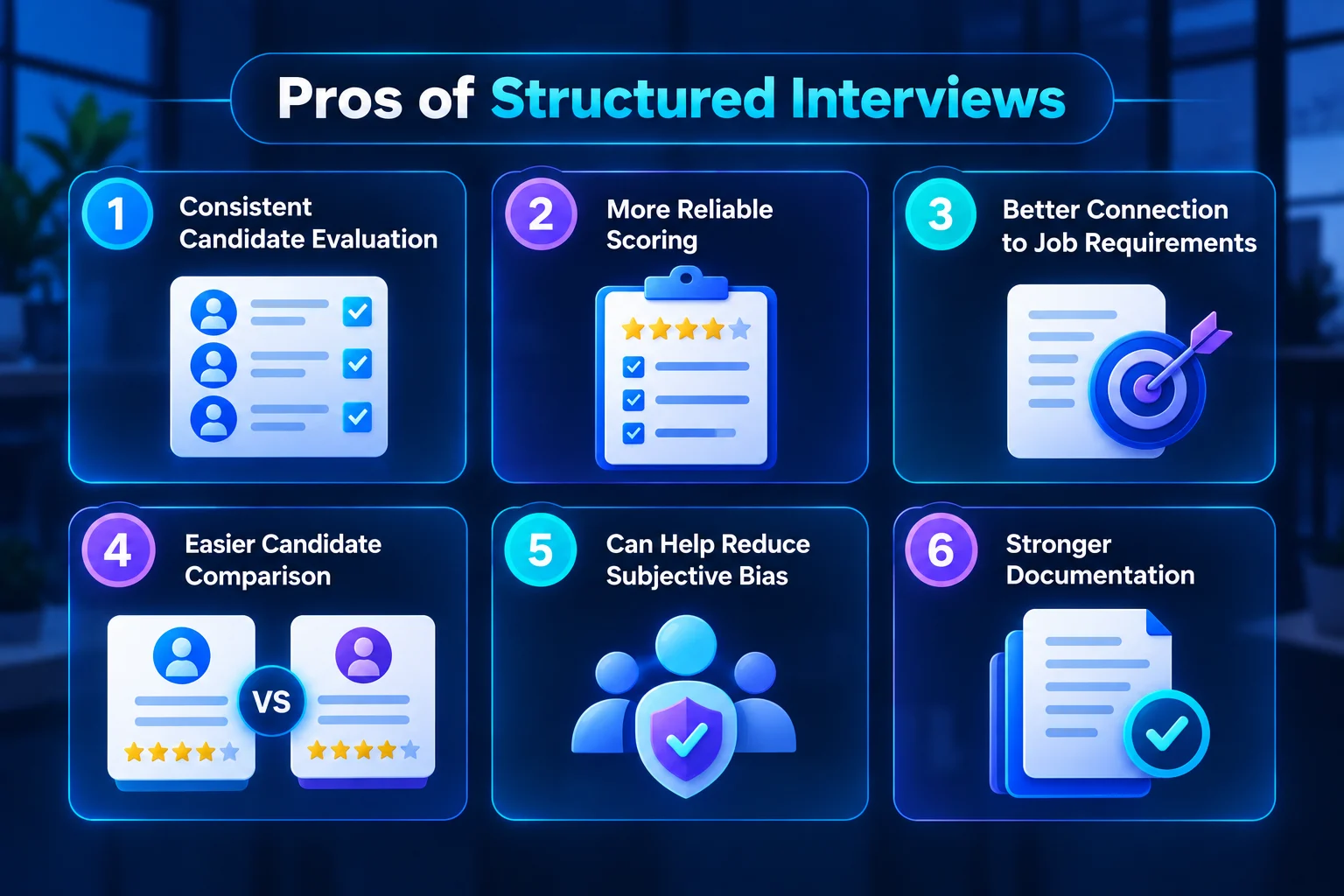
Structured interviews provide organizations with a consistent framework for assessing candidates against the requirements of a position. By using predefined questions, competencies, and evaluation criteria, hiring teams can focus the interview on job-related evidence and make the assessment process more consistent across candidates. This can also make interview results easier to review, document, and compare.
1. Consistent Candidate Evaluation
Structured interviews ensure that candidates applying for the same position are assessed using the same core questions and competencies. This creates a more consistent process and gives interviewers a common framework for evaluating responses. It also reduces the likelihood that one candidate will be assessed on completely different areas simply because a particular interviewer chose to change the direction of the conversation. Consistent evaluation makes it easier for hiring teams to review candidate performance against the same requirements.
2. More Reliable Scoring
A structured interview can use predefined rating scales and clear evaluation criteria to guide how candidate responses are scored. Instead of creating an individual standard for each candidate, interviewers can assess responses according to established expectations for the role. This creates greater consistency in scoring and gives interviewers a clearer basis for explaining why a particular rating was assigned. It can also make discussions between multiple interviewers more focused because they are working from the same scoring framework.
3. Better Connection to Job Requirements
Structured interviews are typically designed around the competencies and responsibilities that are important for successful performance in the position. This allows interviewers to focus their questions on the knowledge, skills, behaviors, and abilities that are actually relevant to the job. A well-designed interview therefore avoids spending too much time on unrelated topics and gives candidates an opportunity to demonstrate capabilities that they would be expected to use in the role. This can make the assessment more relevant and useful for the hiring team.
4. Easier Candidate Comparison
When candidates are asked similar questions and evaluated using the same criteria, hiring teams have a clearer basis for comparing their performance. Interviewers can review how candidates performed across individual competencies instead of relying only on an overall impression of who performed well. This is particularly useful when candidates have different backgrounds, experience levels, or areas of expertise. A structured process allows the hiring team to identify differences in technical knowledge, problem-solving, communication, leadership, or other job-related areas using a common framework.
5. Can Help Reduce Subjective Bias
Using standardized questions and predefined evaluation criteria can help reduce some of the subjective factors that may influence an interview. Interviewers have less flexibility to change the assessment based on personal preferences, similarities with a candidate, or unrelated characteristics. While structured interviews cannot eliminate bias completely, keeping the process focused on consistent, job-related criteria can reduce unnecessary variation between candidate assessments. This makes the evaluation more focused on the evidence provided during the interview.
6. Stronger Documentation
Structured interviews make it easier for organizations to maintain a clear record of how candidates were evaluated. Interviewers can document the questions asked, competencies assessed, observations made, and scores assigned during the process. These records provide the hiring team with specific information to refer back to when reviewing candidates or discussing interview results. Stronger documentation can also make it easier to understand the reasoning behind an assessment instead of relying on memory or broad comments made after the interview.
Cons of Structured Interviews
Although structured interviews provide consistency and make candidate evaluation more systematic, they also have some limitations. The preparation required, the formal nature of the process, and the need to follow predefined questions can sometimes reduce flexibility and make the interview feel less conversational. Organizations should consider these challenges when designing and implementing a structured interview process.
1. More Preparation Is Required
A structured interview requires more planning before candidates are interviewed. Hiring teams need to identify the competencies required for the position, develop relevant questions, establish evaluation criteria, create scoring guidelines, and prepare interviewers to follow the process correctly. This can require additional time and coordination, particularly for specialized positions where subject-matter experts and hiring managers may need to work together to develop an appropriate assessment framework.
2. Can Feel Less Conversational
Following a predefined set of questions can make a structured interview feel more formal than a traditional conversation. Interviewers may need to move through the planned questions even when a candidate provides an interesting response, which can sometimes make the interaction feel less natural. If the process is not managed carefully, candidates may feel that they are responding to a checklist rather than having a meaningful discussion about their experience and capabilities.
3. Can Limit Flexibility
A highly structured process can make it more difficult for interviewers to explore unexpected but relevant information that comes up during the conversation. Candidates may mention experiences, projects, or skills that were not included in the original questions but could provide useful evidence about their suitability for the role. While some follow-up questions can be incorporated into a structured process, excessive rigidity may prevent interviewers from exploring these areas in greater depth.
4. Poor Questions Can Still Produce Poor Assessments
Standardization does not automatically make an interview effective. If the questions are poorly designed, unrelated to important job requirements, or unable to provide meaningful evidence about candidate capability, asking the same questions consistently will not improve the quality of the assessment. Organizations therefore need to review their questions carefully and ensure that they are connected to the competencies
5. Interviewer Training Is Necessary
Interviewers need to understand how the structured process works and how to apply the evaluation criteria consistently. Without appropriate training, different interviewers may interpret the same scoring guidelines in different ways or place different levels of importance on particular parts of a candidate's response. Training can help interviewers understand the purpose of each question, recognize relevant evidence, use the scoring framework correctly, and maintain consistency throughout the interview.
6. Candidates May Prepare Rehearsed Responses
Because structured interviews use predefined questions, candidates may anticipate common questions and prepare their responses in advance. Rehearsed answers can sometimes make it more difficult for interviewers to determine how deeply a candidate understands the situation or whether the response accurately represents their experience. Interviewers can address this limitation by using standardized follow-up questions that ask candidates to provide specific details about their actions, decisions, reasoning, and outcomes.
How to Create a Structured Interview
Creating a structured interview involves several stages, starting with an understanding of the role and ending with a review of how well the interview process works. The questions, competencies, scoring system, and interview procedures should all be connected to the requirements of the position.
1. Conduct a Job Analysis
The first step is to understand what the candidate will actually be expected to do in the role. The hiring team should identify the responsibilities, knowledge, skills, and competencies that contribute to successful performance.
Key areas to consider include:
Main responsibilities of the position
Technical or professional knowledge required
Skills needed to perform the work
Behavioral competencies
Common challenges associated with the role
A clear job analysis gives the interview a foundation and helps ensure that candidates are assessed on capabilities that are genuinely relevant to the position.
2. Select the Competencies
After identifying the requirements of the position, determine which competencies the interview should measure. These competencies should represent the capabilities that are important for performing the role effectively.
Depending on the position, relevant competencies may include:
Communication
Problem-solving
Leadership
Decision-making
Technical knowledge
Teamwork
Adaptability
Customer management
Selecting the competencies in advance also makes it easier to connect individual interview questions to specific areas of assessment.
3. Develop Standardized Questions
Once the competencies are established, create questions that allow candidates to demonstrate those capabilities. The questions should be relevant to the position and structured so that candidates have a comparable opportunity to provide evidence of their skills and experience.
A structured interview may include:
Behavioral questions about previous experiences
Situational questions based on realistic workplace scenarios
Technical questions related to the position
Problem-solving questions
Role-specific questions
Preparing these questions before the interview helps prevent the assessment from becoming dependent on spontaneous questions or individual interviewer preferences.
4. Create Rating Scales
A scoring system should be established before candidates are interviewed so that interviewers know how responses will be evaluated. Each rating level should have clear criteria describing the quality and amount of evidence expected.
A rating scale may consider areas such as:
Relevance of the candidate's response
Quality of the reasoning provided
Evidence of the required competency
Effectiveness of the actions taken
Outcome or result achieved
Clear rating criteria give interviewers a common framework for assessing responses and make scores easier to interpret across candidates.
5. Establish Interview Procedures
The next step is to determine how the interview will be conducted. The organization should define the basic procedures before the first candidate is interviewed so that the process remains consistent throughout the hiring process.
This may include:
Interview duration
Order of questions
Number of interviewers
Interviewer responsibilities
Permitted follow-up questions
Note-taking process
Scoring procedure
Having these procedures in place gives interviewers a clear structure to follow and helps provide candidates with a more comparable assessment experience.
6. Train Interviewers
Interviewers should be prepared to use the structured interview correctly. Training should explain how questions should be asked, what type of evidence interviewers should record, and how the scoring criteria should be applied.
Training can cover:
Asking questions consistently
Using appropriate follow-up questions
Recording evidence rather than general impressions
Applying rating criteria correctly
Avoiding irrelevant judgments
Maintaining consistency between candidates
This preparation is important because even a well-designed structured interview can produce inconsistent results if different interviewers apply the process in different ways.
7. Review the Results
The final stage is to review whether the structured interview is actually producing useful information about candidates. Hiring teams can examine interview scores, interviewer feedback, and hiring outcomes to identify areas where the process may need improvement.
The review can focus on:
Whether questions are producing useful evidence
Whether competencies are being assessed effectively
Whether scoring is being applied consistently
Whether interviewers identify problems with the process
Whether any questions need to be revised
Regular review allows organizations to improve the interview over time rather than treating the original structure as permanent. As job responsibilities and required competencies change, the interview should also be updated to remain relevant.
Structured Interview Formats
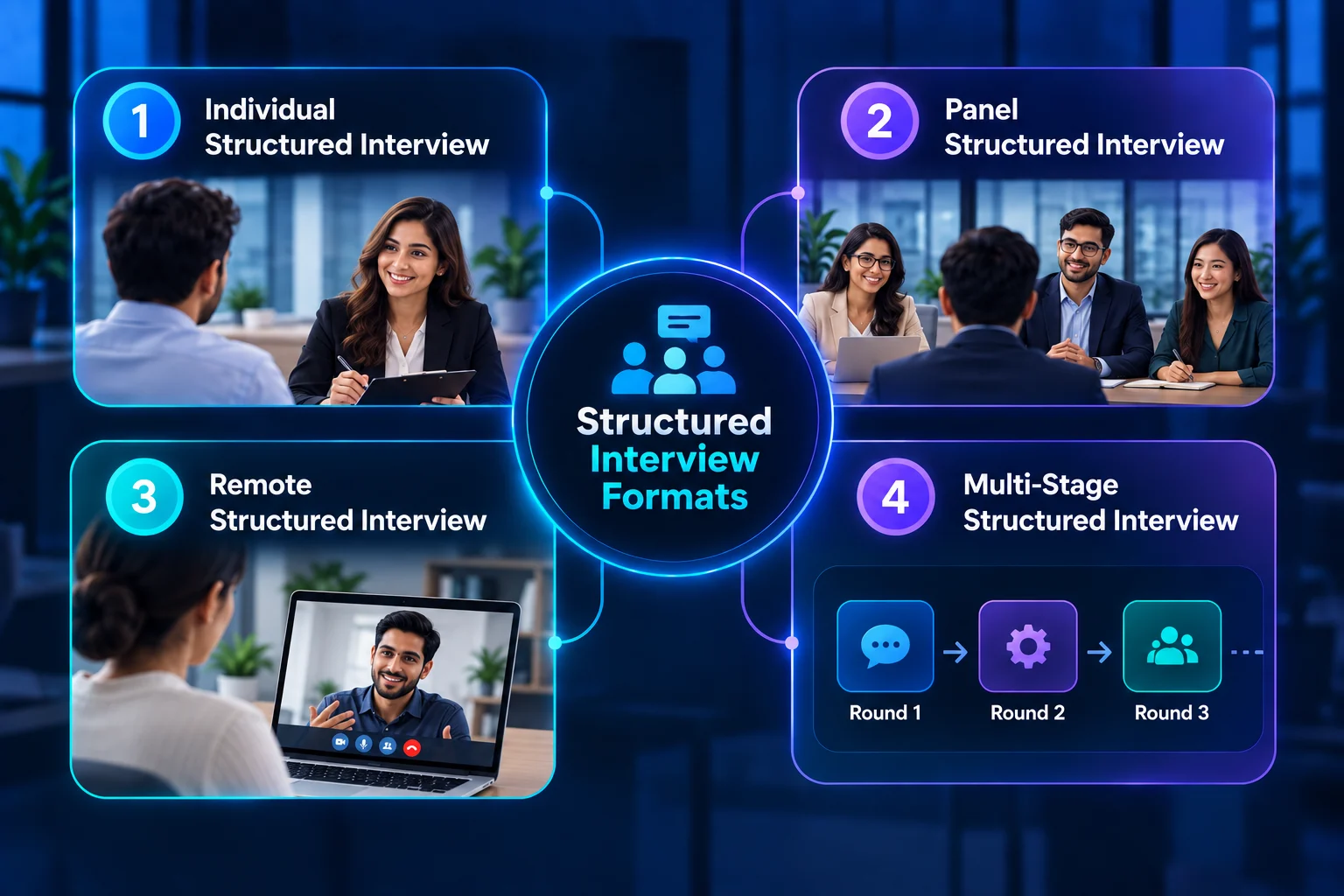
Organizations can adapt structured interviews to different recruitment situations while maintaining the core principles of standardization. The format may change depending on the number of interviewers, location, and complexity of the role, but candidates should still be assessed using consistent questions, procedures, and evaluation criteria.
1. Individual Structured Interview
An individual structured interview is conducted by one interviewer who follows a predetermined set of questions and uses established scoring criteria to evaluate the candidate. The interviewer typically follows the same sequence and timing for each candidate while recording evidence against the competencies required for the position. This format works well when one trained interviewer has sufficient knowledge to assess the role and can evaluate the required competencies without additional interviewers.
2. Panel Structured Interview
A panel structured interview involves multiple interviewers who assess a candidate using the same structured framework. The panel may include an HR representative, hiring manager, technical specialist, or subject-matter expert, depending on the requirements of the position. Each interviewer can evaluate the candidate's responses against predefined criteria before the panel discusses the results. The U.S. Office of Personnel Management notes that structured interviews can involve panels where interviewers independently rate responses and discuss significant differences in their ratings.
3. Remote Structured Interview
A remote structured interview follows the same principles as an in-person structured interview but is conducted through a video conferencing platform. Candidates receive the same questions, interview instructions, expected duration, and evaluation criteria, allowing the organization to maintain consistency even when candidates are located in different places. This format is particularly useful for remote, hybrid, and geographically distributed recruitment, where candidates and interviewers may not be able to meet in person.
4. Multi-Stage Structured Interview
A multi-stage structured interview divides the assessment into several interview rounds, with each stage designed to evaluate different competencies required for the position. For example, an organization may use an initial round to assess behavioral competencies, a second round to evaluate technical knowledge, and a later round to examine role-specific decision-making. Each stage can have its own questions and scoring criteria while following the same overall structured approach. This format is useful for complex positions where a single interview may not provide enough opportunity to assess all the capabilities required for successful performance.
Final Thoughts
A structured interview is a standardized approach to candidate assessment that uses predetermined questions, consistent procedures, and defined evaluation criteria. Its purpose is to create a more systematic way of measuring the skills, knowledge, behaviors, and competencies that matter for a particular role.
Structured interviews can make candidate comparisons easier, improve scoring consistency, support stronger documentation, and reduce opportunities for purely subjective evaluation. Research from organizations and academic researchers has also found meaningful evidence for their validity and reliability when they are designed and administered appropriately.
However, a structured interview is not automatically effective simply because every candidate receives the same questions. The questions need to be connected to the job, scoring standards need to be clearly defined, interviewers need appropriate training, and the process should be reviewed periodically.
The most effective structured interview combines job analysis, standardized questions, clear competencies, consistent administration, evidence-based scoring, and trained interviewers. When these elements are brought together, organizations can create a more consistent and transparent process for evaluating candidates and making informed hiring decisions.