Back to all blogs
Learn what a technical interview is, explore its types and benefits, and discover how to conduct, structure, evaluate, and improve technical interviews.

Abhishek Kaushik

A technical interview is one of the most important stages of the hiring process for technology and other specialized roles. It helps employers evaluate whether a candidate has the technical knowledge, practical skills, problem-solving ability, and communication required for a particular position.
Unlike a general interview, which may focus on experience, personality, behavioral situations, and career goals, a technical interview examines how candidates apply their knowledge to technical problems. Depending on the position, candidates may be asked to write code, solve technical problems, debug an application, review existing code, design a system, analyze data, or explain how they would approach a real-world technical situation. According to Deloitte India’s Campus Workforce Trends 2024 study, 93% of surveyed campuses identified technical interview performance as an important criterion for placement. The findings highlight the continued role of technical interviews in assessing candidates’ skills and suitability for technical roles.
The format of a technical interview should depend on the responsibilities of the role. A junior software developer does not need to be assessed in exactly the same way as a senior software architect. Similarly, a cybersecurity professional, data scientist, DevOps engineer, and frontend developer require different technical assessments. A well-designed technical interview should therefore focus on the skills and problem-solving abilities that candidates will actually use in the position.
Technical interviews are also changing as technology evolves. AI-assisted development has introduced new considerations for hiring teams because candidates may use AI tools to generate code, formulate answers, or provide real-time assistance during interviews. This has made interview integrity increasingly important and is encouraging employers to rethink how technical skills should be evaluated.
What Is a Technical Interview?
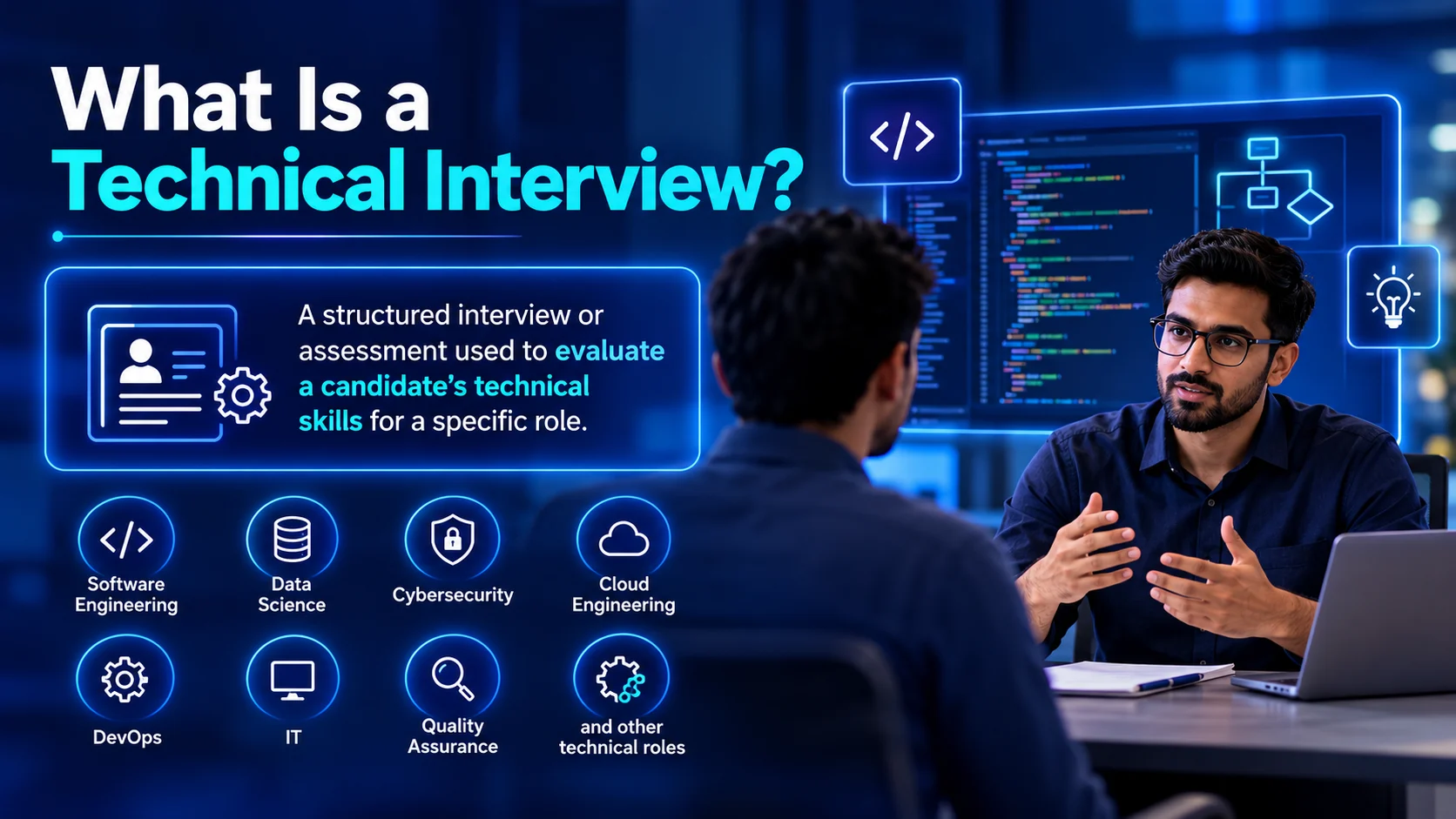
A technical interview is a structured interview or assessment used to evaluate the technical capabilities required for a particular job. It is commonly used for software engineering, IT, data science, cybersecurity, DevOps, cloud engineering, quality assurance, and other technical positions.
The content of the interview depends on the role. A software developer may be asked to solve a programming problem, while a senior engineer may be asked to design a scalable system. A data scientist may need to explain a modeling approach, while a cybersecurity candidate may be given a security incident to investigate.
The purpose is not simply to determine whether someone knows a programming language or can remember technical definitions. A strong technical interview examines whether the candidate can apply knowledge, reason through problems, make technical decisions, and explain those decisions clearly.
What Is the Purpose of a Technical Interview?
The main purpose of a technical interview is to collect evidence about whether a candidate can perform the technical responsibilities associated with a role.
A resume can show that someone has worked with Python, Java, JavaScript, SQL, AWS, React, Kubernetes, or another technology. However, listing a technology does not necessarily demonstrate how effectively the candidate can use it.
A technical interview allows hiring teams to explore this difference. Candidates can be given realistic technical situations that require them to apply their knowledge rather than simply recall information.
Technical Interview vs General Interview
Aspect | General Interview | Technical Interview |
|---|---|---|
Primary Focus | Communication, motivation, previous experience, teamwork, and behavioral situations | Technical knowledge and practical capabilities required for the position |
Depth of Assessment | Evaluates overall experience, communication, and interpersonal skills | Evaluates technical expertise and practical problem-solving abilities |
Example | Describing a difficult project the candidate worked on | Exploring how the project was designed, technologies used, problems faced, and solutions implemented |
Business Relevance | Helps assess overall candidate fit and workplace skills | Particularly useful when technical decision-making directly affects business outcomes |
Types of Technical Interviews
Technical interviews can take different forms depending on the role, seniority, and skills being assessed. Employers may use coding challenges, technical questions, system design exercises, take-home assignments, or code reviews to evaluate candidates. Each format focuses on different aspects of technical ability and problem-solving. Choosing the right type helps employers assess skills that are directly relevant to the position.
Technical Question Interviews
Technical question interviews focus on a candidate's understanding of technical concepts and their ability to explain how those concepts are applied.
Questions may cover programming, databases, operating systems, networking, cloud infrastructure, cybersecurity, data science, algorithms, or other role-specific subjects.
The strongest technical questions generally encourage candidates to explain their reasoning rather than simply provide definitions.
Live Coding Interviews
A live coding interview requires candidates to solve a programming problem while interacting with an interviewer.
The interviewer can observe how the candidate understands the problem, develops an approach, writes code, tests the solution, handles errors, and explains their decisions.
Live coding can provide useful information about practical programming ability, although interviewers should avoid treating speed as the primary measure of competence.
Online Coding Assessments
Online coding assessments allow candidates to complete technical questions in a standardized environment.
They can be particularly useful during early hiring stages because organizations can evaluate a larger number of applicants before moving candidates into live interviews.
However, coding assessments should be relevant to the position. A difficult algorithmic problem is not necessarily a useful assessment if candidates will never use that skill in their actual work.
Take-Home Technical Assignments
A take-home technical assignment gives candidates additional time to complete a technical task independently.
The assignment could involve building a small application, creating an API, analyzing data, fixing an existing problem, or designing a technical solution.
Take-home exercises can reveal code quality, documentation, testing, organization, and technical decision-making.
The assignment should also have a reasonable scope. Candidates should understand what is expected and how their work will be evaluated.
Code Review Interviews
Code review interviews ask candidates to examine existing code and explain what they would improve.
They can identify bugs, security problems, performance concerns, maintainability issues, and design weaknesses.
Code review is particularly useful because professional developers spend a significant amount of time understanding, modifying, and reviewing existing code rather than writing everything from scratch.
System Design Interviews
System design interviews focus on a candidate's ability to design larger technical systems.
The candidate may be asked to design a payment platform, messaging system, notification service, analytics platform, or another system relevant to the role.
The discussion may involve architecture, databases, APIs, caching, scalability, security, reliability, and failure handling.
The goal is not necessarily to find one perfect answer. Instead, interviewers are interested in how candidates clarify requirements, identify constraints, compare alternatives, and explain trade-offs.
Technical Presentations and Work Samples
Some technical roles benefit from presentations or work samples.
Candidates may be asked to explain a previous project, present an architecture decision, discuss a research project, or demonstrate a portfolio.
This format can be particularly valuable for positions where employees are expected to communicate technical information to other teams or stakeholders.
How to conduct a Technical Interview
Conducting a technical interview effectively requires more than asking candidates to solve a few technical questions. The interview should be designed around the skills and responsibilities of the role, with enough structure to evaluate candidates consistently. Interviewers should combine technical questions with problem-solving, practical exercises, and discussion of the candidate's approach. A clear process also gives candidates an opportunity to explain their reasoning and demonstrate how they would handle situations they may encounter in the actual job.
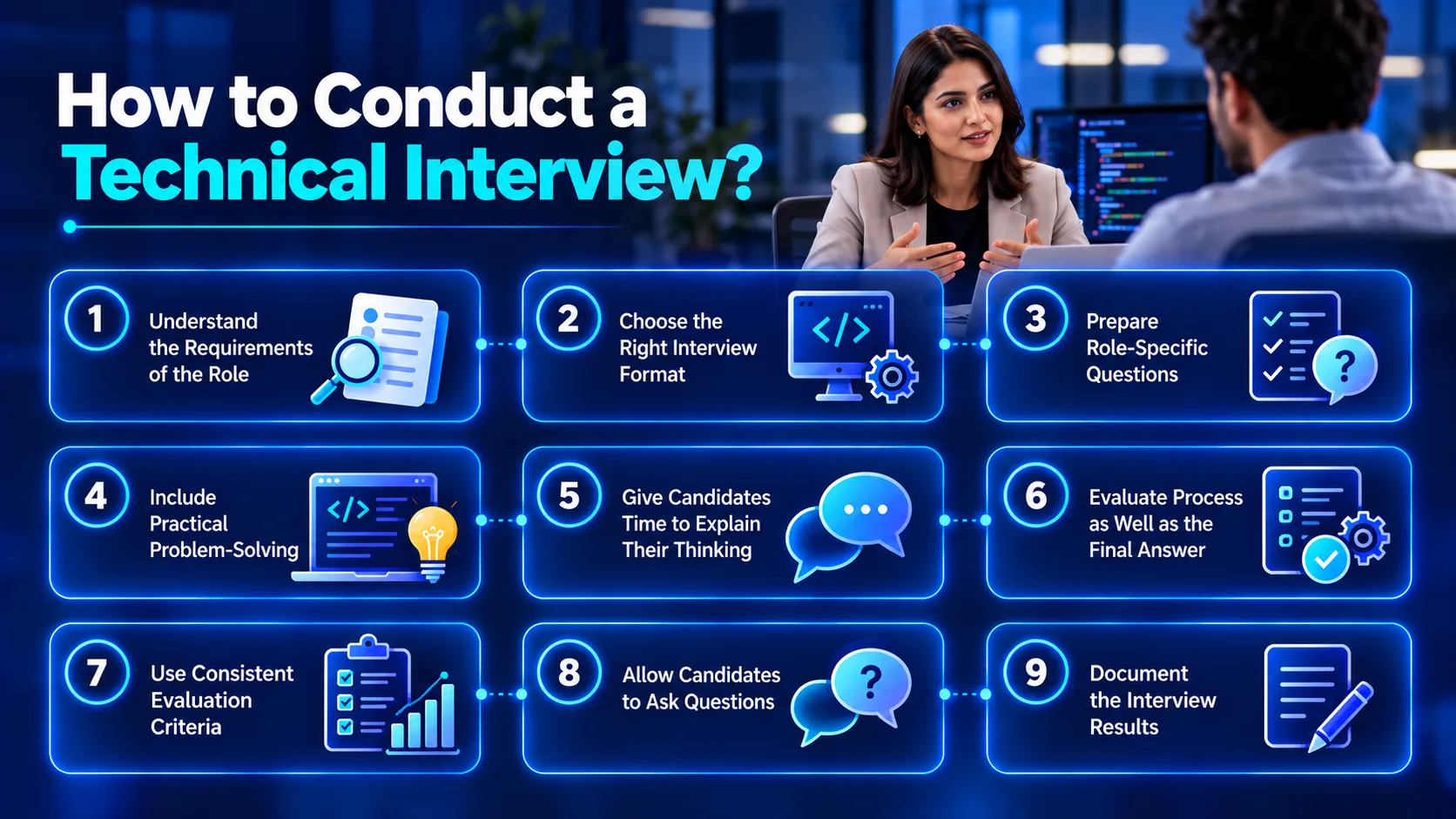
1. Understand the Requirements of the Role
Before creating the interview, identify the technical skills and competencies that the candidate will actually need in the position. The interview should reflect the responsibilities described in the job rather than testing a broad list of unrelated technical topics.
Consider areas such as:
Programming languages or technical tools required for the role
Problem-solving ability
System or technical design
Debugging and troubleshooting
Knowledge of relevant frameworks or technologies
Communication and technical reasoning
Ability to make appropriate technical trade-offs
This helps ensure that the interview measures capabilities that are relevant to the work the candidate will be expected to perform.
2. Choose the Right Interview Format
The format should depend on the role and the skills being assessed. A software engineering position may require coding and debugging, while a senior engineering role may place greater emphasis on system design, architecture, and technical decision-making.
Common formats include:
Live coding interviews
Technical discussion rounds
System design interviews
Debugging exercises
Take-home technical assessments
Case-based technical problems
Portfolio or project discussions
The goal is not to use every format in a single interview. Instead, select the format that gives candidates a meaningful opportunity to demonstrate the capabilities required for the position.
3. Prepare Role-Specific Questions
Prepare questions in advance and connect them to the competencies identified for the role. Avoid relying entirely on generic questions because they may not provide enough evidence about whether a candidate can perform the actual work.
Questions can cover areas such as:
Technical concepts
Problem-solving
Debugging
Architecture and design
Technical decision-making
Performance and scalability
Previous technical projects
Collaboration with technical and non-technical teams
For example, instead of only asking a candidate to define a technical concept, ask how they would apply it to a realistic situation. This gives the interviewer more insight into how the candidate uses technical knowledge rather than simply recalling information.
4. Include Practical Problem-Solving
Technical interviews should give candidates opportunities to demonstrate how they approach problems, not just whether they know the correct answer. A practical problem can reveal how a candidate breaks down a task, identifies assumptions, considers alternatives, and works toward a solution.
During the exercise, interviewers can ask candidates to explain:
How they would approach the problem
What assumptions they are making
Why they selected a particular solution
What edge cases they considered
How they would test the solution
What they would change if the requirements changed
This makes the interview more informative because the interviewer can evaluate both the solution and the reasoning behind it.
5. Give Candidates Time to Explain Their Thinking
A technical interview should not become a test of how quickly someone can produce an answer. Give candidates enough time to clarify the problem, explain their assumptions, and describe their reasoning as they work through the task.
Interviewers can use follow-up questions such as:
“Why did you choose this approach?”
“What alternatives did you consider?”
“What would happen if the requirements changed?”
“How would you test this?”
“What could cause this solution to fail?”
These questions help reveal how candidates reason through unfamiliar situations and respond when their initial approach needs to change.
6. Evaluate the Process as Well as the Final Answer
The final answer is important, but it should not always be the only factor considered. A candidate may reach a workable solution while taking a different approach from the interviewer, and that does not necessarily indicate poor technical ability.
Evaluation can consider:
Technical accuracy
Problem-solving approach
Understanding of requirements
Code quality or solution quality
Ability to identify edge cases
Technical judgment
Communication and explanation
Ability to respond to feedback or new information
Evaluating these areas gives interviewers a broader view of the candidate's technical capability and makes the assessment less dependent on whether the candidate followed one expected path.
7. Use Consistent Evaluation Criteria
Create an evaluation framework before interviewing candidates. Interviewers should know which competencies they are assessing and what different levels of performance look like.
For example, a technical interview scorecard could evaluate:
Technical knowledge
Problem-solving
Practical application
Communication
System or design thinking
Debugging ability
Overall role alignment
Using consistent criteria makes it easier to compare candidates and keeps the discussion focused on evidence from the interview. It can also reduce the influence of unrelated personal impressions during evaluation.
8. Allow Candidates to Ask Questions
Give candidates enough time at the end of the interview to ask questions about the technical environment, team, projects, responsibilities, and expectations of the role.
The interviewer can encourage questions related to:
Technology stack and development practices
Current technical projects and challenges
Team structure and collaboration
Architecture and engineering processes
Role expectations and technical responsibilities
Opportunities for learning and professional development
Allowing candidates to ask questions makes the interview more interactive and gives them a better understanding of the position beyond the technical assessment.
9. Document the Interview Results
Record relevant observations soon after the interview while the discussion is still fresh. Notes should focus on the competencies being evaluated rather than general impressions.
Interviewers can document:
Questions or exercises completed
Candidate's approach
Strengths demonstrated
Areas where additional evidence is needed
Technical concerns identified
Overall assessment against the predefined criteria
Clear documentation gives the hiring team a more reliable basis for discussing candidates and making decisions after multiple interviews have been completed.
Technical Interview Formats by Career Level
Technical interview formats should be adapted to the candidate’s experience level and the responsibilities of the role. Entry-level candidates may focus more on technical fundamentals and basic problem-solving, while mid-level candidates can be assessed on coding, debugging, and practical engineering decisions. Senior candidates typically require broader assessments involving system design, architecture, technical judgment, and past project experience.
Entry-Level Technical Interviews
Entry-level technical interviews generally focus on foundational knowledge, programming concepts, problem-solving, and the candidate's ability to learn.
Candidates may be asked to solve relatively straightforward programming problems, explain fundamental concepts, debug basic code, or discuss academic and personal projects.
The assessment should focus on technical foundations and potential rather than expecting the candidate to demonstrate years of professional experience.
Mid-Level Technical Interviews
Mid-level technical interviews can place greater emphasis on practical application.
Candidates may need to debug realistic problems, make technical decisions, explain previous projects, and demonstrate that they can work independently.
Interviewers can also explore how candidates handled technical challenges in previous roles and how they approached decisions involving performance, reliability, or maintainability.
Senior-Level Technical Interviews
Senior-level technical interviews generally require broader technical reasoning.
Candidates may be assessed on system design, architecture, scalability, reliability, security, technical decision-making, and leadership.
At this level, the interviewer should examine not only whether the candidate can solve a problem but also whether they understand why one solution may be preferable to another.
How Should Employers Prepare for a Technical Interview?
Preparing for a technical interview starts with identifying the skills and competencies required for the role. Hiring teams should then choose an assessment format, prepare relevant questions, create clear evaluation criteria, and ensure interviewers understand their responsibilities.
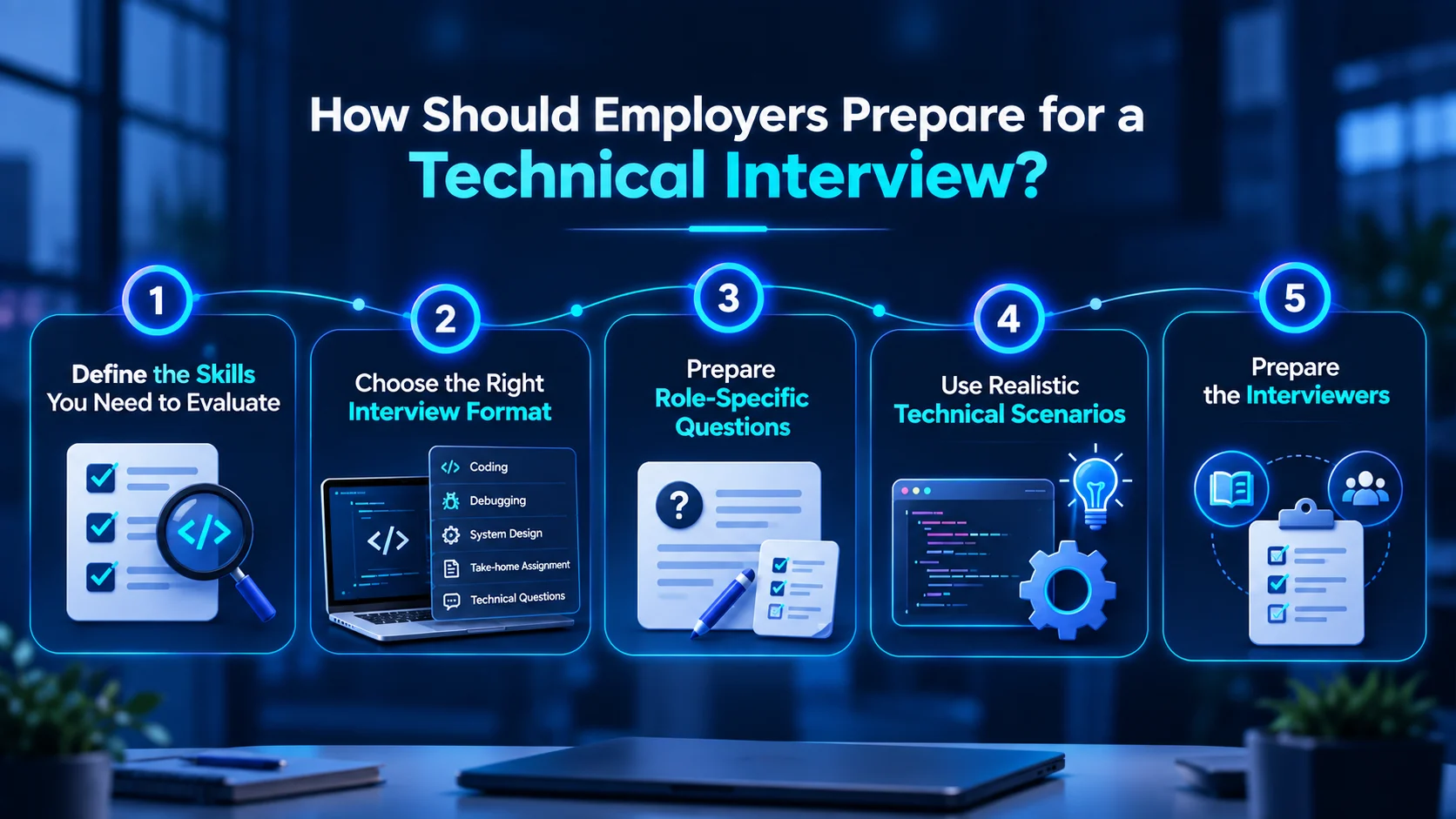
1. Define the Skills You Need to Evaluate
Start with the job requirements and identify the technical skills candidates need to perform the role successfully. For example, a backend developer may need strong knowledge of APIs, databases, and debugging, while a senior engineer may require system design and architecture skills.
2. Choose the Right Interview Format
Select an interview format that directly measures the required skills. Depending on the role, this could include coding, debugging, system design, technical questions, a take-home assignment, or a project discussion. Avoid using an assessment simply because it is commonly used.
3. Prepare Role-Specific Questions
Prepare questions before the interview and connect each question to a specific competency. Questions should reflect the candidate's experience level and focus on how they apply technical knowledge rather than simply recall definitions.
4. Use Realistic Technical Scenarios
Where appropriate, use scenarios that reflect problems candidates may encounter in the role. For example, a backend candidate could investigate a slow application, while a DevOps candidate could explain how they would approach a failed deployment.
5. Prepare the Interviewers
Make sure interviewers understand the role, assessment format, competencies being evaluated, and scoring criteria. Consistent interviewer preparation helps create a more structured assessment across candidates.
How Should You Structure a Technical Interview?
A well-structured technical interview should follow a clear sequence that gives candidates enough opportunity to demonstrate their technical knowledge and problem-solving approach. A typical interview can begin with a brief introduction and warm-up, followed by the main technical assessment, deeper follow-up questions, and time for candidate questions. Using a consistent structure and evaluation criteria can also make it easier for interviewers to compare candidates fairly.
Introduction and Warm-Up
The interview should begin with a short introduction.
The interviewer can introduce the participants, explain the structure of the session, and clarify whether the candidate will complete coding, system design, technical questions, or another assessment.
A short discussion about relevant previous technical work can then provide context before the main assessment.
Technical Assessment
The main technical assessment should focus on the competencies identified during preparation.
Depending on the role, this could involve coding, debugging, system design, code review, technical questions, or a realistic technical scenario.
The interviewer should give the candidate enough information to understand the problem while allowing them to demonstrate their own reasoning.
Technical Discussion and Follow-Up
Follow-up questions can reveal how deeply a candidate understands their solution.
The interviewer might ask how the approach would change if traffic increased, how the candidate would test the solution, what could cause it to fail, or what alternative approaches were considered.
This type of discussion is particularly useful in modern technical interviews where polished answers may not always reflect independent problem-solving.
Candidate Questions and Wrap-Up
The interview should conclude with time for the candidate to ask questions.
Candidates may want to understand the technology stack, development practices, team structure, technical challenges, or expectations of the position.
The interviewer can then explain the next stage of the hiring process.
How Should You Evaluate a Technical Interview?
Evaluating a technical interview should focus on more than whether a candidate arrives at the correct answer. Interviewers should assess technical knowledge, problem-solving approach, communication, code quality, and how the candidate handles feedback or ambiguity. Using a structured rubric with predefined criteria can make evaluations more consistent and reduce the influence of subjective impressions. HackerRank recommends scoring each technical competency separately and evaluating candidates against criteria that are directly relevant to the role.
A structured rubric helps interviewers evaluate candidates against predefined criteria rather than relying only on intuition or general impressions. It provides a consistent framework for assessing the technical skills required for the position and makes it easier to compare candidates fairly.
Evaluation Area | What to Evaluate |
Technical Knowledge | Understanding of technologies, tools, programming concepts, and technical principles relevant to the position |
Problem-Solving | Ability to break down complex technical problems, identify possible solutions, and explain the reasoning behind their approach |
Practical Application | Ability to apply technical knowledge to realistic, job-related situations and adapt concepts to solve practical problems |
Code Quality | Readability, maintainability, testing, documentation, organization, and overall structure of the code |
Technical Judgment | Understanding of trade-offs, limitations, performance, scalability, security, and potential risks when choosing a solution |
Communication | Ability to explain technical concepts, decisions, and solutions clearly and logically |
Adaptability | Ability to respond to feedback, learn unfamiliar concepts, and adjust an approach when requirements or circumstances change |
A clear rubric can also include a simple rating scale, such as 1–5, with defined expectations for each score. This ensures that interviewers are evaluating candidates against the same standards rather than making subjective assessments.
What Are the Common Technical Interview Mistakes to Avoid?
Technical interviews can become ineffective when they focus on the wrong skills or lack a clear evaluation process. Common mistakes include asking trivia-based questions, using inconsistent evaluation criteria, focusing too heavily on syntax instead of problem-solving, and failing to tailor assessments to the role. Interviewers should also avoid creating an unnecessarily stressful experience and should document observations using a structured scorecard. These practices can help make technical interviews more relevant, consistent, and useful for hiring decisions.
1. Testing Irrelevant Skills
Technical assessments should measure skills that are actually required by the role. Testing unrelated technical knowledge can produce misleading results and make it harder for candidates to demonstrate the abilities they would use in the position. The assessment should focus on the technologies, concepts, and competencies that are relevant to the job.
For example, a backend role may focus on APIs, databases, and debugging, while a data engineering role may require SQL, data pipelines, and data processing. Keeping the assessment role-specific makes the interview more relevant and gives employers stronger evidence about technical ability.
2. Relying Too Heavily on Coding Puzzles
Coding puzzles can be useful for assessing programming and problem-solving skills, but they should not become the entire technical assessment. Many technical roles also require debugging, system design, architecture, code review, communication, and technical decision-making.
Employers can combine coding questions with practical scenarios that reflect real responsibilities. Asking candidates to review code, identify a bug, explain a technical decision, or discuss different solutions can provide a broader view of how they apply their knowledge.
3. Ignoring AI-Assisted Interviewing
One of the newer challenges for technical hiring teams is undisclosed AI assistance. Candidates may use coding assistants, chat-based AI tools, browser-based tools, or secondary devices during remote interviews, making it harder to determine whether the observed performance represents their own technical ability.
Employers should clearly communicate which external tools are allowed during the assessment. Interviewers can also ask candidates to explain their reasoning, review a solution, or discuss technical trade-offs, providing additional evidence of their understanding rather than relying only on the final answer.
4. Failing to Use a Consistent Rubric
Without structured evaluation criteria, interviewers may place too much emphasis on confidence, communication style, familiarity, or personal preferences. A predefined rubric helps keep the assessment focused on competencies that are actually relevant to the role.
The rubric can cover areas such as technical knowledge, problem-solving, code quality, debugging, system design, and communication. Using consistent criteria across candidates also makes it easier for interviewers to compare evidence and discuss results after the interview.
5. Making the Interview Too Long
Longer interviews are not automatically better. Each interview round should have a clear purpose and provide useful information that has not already been established. Including too many unrelated questions or repeating the same assessment across multiple rounds can make the process unnecessarily lengthy.
Hiring teams should decide in advance what they need to assess and allocate enough time for those areas without adding unnecessary questions. A focused interview with relevant questions and clear evaluation criteria can provide more useful information while creating a better experience for both candidates and interviewers.
What Are the Benefits of a Well-Designed Technical Interview?
A well-designed technical interview helps employers assess the skills that are directly relevant to a role while giving candidates a clear opportunity to demonstrate their abilities. It can improve the quality and consistency of technical evaluations by using role-specific questions, practical assessments, and defined scoring criteria. A structured approach can also reduce interviewer bias, improve candidate experience, and provide stronger evidence for hiring decisions. Technical interviews are particularly useful when they assess both technical knowledge and how candidates apply that knowledge to problems relevant to the position.
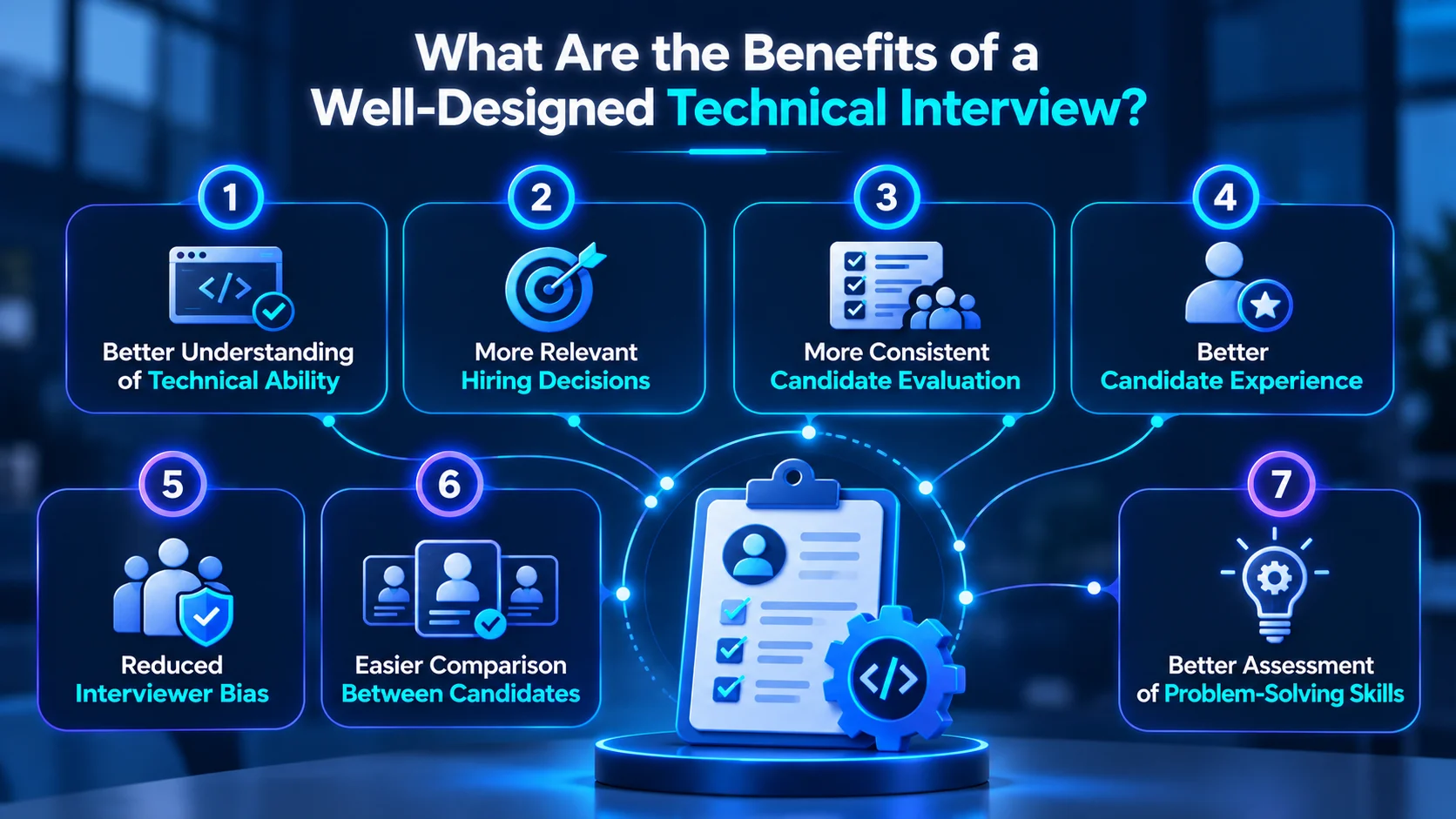
1. Better Understanding of Technical Ability
A technical interview provides employers with evidence about how candidates apply their technical knowledge. Instead of relying only on a resume or previous job titles, interviewers can ask candidates to explain concepts, solve problems, analyze technical situations, or describe how they approached previous projects.
This can reveal strengths and weaknesses that are not visible from resumes or general interviews. For example, a candidate may have experience with a particular programming language or technical tool, but a technical interview can provide more information about how they actually use that knowledge and approach technical problems.
2. More Relevant Hiring Decisions
When assessments are connected to actual job responsibilities, hiring teams can make decisions using evidence that is more relevant to the work candidates will perform. Questions and practical exercises can be designed around the knowledge, tools, systems, and problem-solving abilities required for the position.
This helps employers avoid relying too heavily on general interview performance or qualifications that may not directly indicate whether a candidate can handle the technical responsibilities of the role. A technical interview can therefore become a more focused part of the overall hiring process when its assessment criteria are clearly connected to the job.
3. More Consistent Candidate Evaluation
Structured questions and evaluation criteria can help interviewers evaluate candidates using comparable standards. When candidates are assessed against the same core competencies, interviewers have a clearer basis for comparing responses instead of relying primarily on personal impressions.
Consistency is particularly important when several interviewers are involved in the hiring process. A defined evaluation framework can help different interviewers focus on the same technical areas and record their observations in a more organized way. This can make the final discussion between hiring team members more focused and easier to document.
4. Better Candidate Experience
A clear and relevant technical interview also benefits candidates. When candidates know what will be assessed and receive meaningful opportunities to demonstrate their skills, the process becomes easier to understand and more representative of the actual role.
A well-designed process can also reduce unnecessary uncertainty. Candidates can prepare more effectively when the interview format, expectations, and assessment areas are communicated clearly. This allows them to focus on demonstrating their technical knowledge and problem-solving approach rather than trying to understand an unclear or unpredictable interview process.
5. Reduced Interviewer Bias
A technical interview that uses predefined questions and job-related evaluation criteria can reduce the influence of subjective impressions during assessment. Instead of allowing the conversation to focus heavily on personal similarities, communication style, or other unrelated factors, interviewers can concentrate on competencies that matter for the position.
This does not eliminate bias entirely, but a consistent process can help limit unnecessary variation between interviews. Using the same core questions and defined criteria also gives hiring teams a clearer framework for discussing candidate performance.
6. Easier Comparison Between Candidates
When candidates are assessed on similar technical competencies, hiring teams can compare the evidence collected during interviews more systematically. This is particularly useful when several candidates have similar educational backgrounds, certifications, or years of experience.
A scoring framework can help interviewers distinguish between different levels of technical proficiency. Rather than simply recording that one candidate performed “well,” the team can evaluate specific areas such as technical knowledge, problem-solving, system design, communication, or practical application.
7. Better Assessment of Problem-Solving Skills
Technical ability is not limited to knowing definitions, programming languages, tools, or processes. Many technical roles also require candidates to analyze unfamiliar problems, identify possible solutions, explain their reasoning, and make decisions when there is no single obvious answer.
A well-designed technical interview can include questions or scenarios that allow candidates to explain their thought process. This gives interviewers additional information about how candidates approach technical challenges rather than evaluating only whether they can recall specific information.
Technical Interview Questions
Technical interview questions vary depending on the role, seniority, and technical skills being assessed. Common questions cover areas such as programming, data structures and algorithms, debugging, databases, system design, and role-specific technical concepts. Candidates may also be asked to explain their approach to a problem, discuss past technical projects, or describe how they would handle a real-world engineering challenge. For senior roles, questions often focus more on architecture, scalability, technical trade-offs, and decision-making.
Software Engineering Questions
Software engineering technical interviews may cover programming languages, algorithms, databases, APIs, testing, debugging, and architecture.
The difficulty should depend on the experience level and responsibilities associated with the position.
Data Science Questions
Data science interviews may explore statistics, data preparation, machine learning, model selection, experimentation, evaluation, and communication of analytical findings.
DevOps and Cloud Questions
DevOps and cloud interviews may cover infrastructure, deployment, networking, monitoring, automation, security, scalability, and incident response.
Senior-Level Questions
Senior candidates may receive broader questions involving architecture, scalability, technical strategy, reliability, and trade-offs.
The objective is to understand how the candidate approaches complex technical decisions rather than simply whether they know a particular technology.
Conclusion
A technical interview is a structured way to evaluate whether a candidate has the technical knowledge, problem-solving ability, practical skills, communication, and judgment required for a specific position.
The most effective technical interviews are built around the actual responsibilities of the job. Technical questions, live coding, online assessments, take-home assignments, code reviews, system design interviews, and technical presentations can all be useful when they are matched to the skills being evaluated.
A strong process also requires preparation, relevant questions, clear instructions, structured evaluation, and consistent criteria. These elements help hiring teams collect more meaningful evidence while giving candidates a clearer opportunity to demonstrate their capabilities.
Technical hiring is also changing as AI-assisted development becomes more common. Organizations increasingly need to consider not only whether a candidate can produce a technically correct answer but also whether the interview accurately represents the candidate's own reasoning and capabilities.
By combining relevant technical assessments with a structured interview process and appropriate interview-integrity measures, organizations can create a technical interview process that is more closely aligned with the realities of modern technical work.