Back to all blogs
Learn what an unstructured interview is, including its types, examples, pros and cons, questions, and how to conduct an effective unstructured interview.

Abhishek Kaushik
An unstructured interview is a flexible approach where the conversation is not guided by a fixed set of questions or a strict sequence. Instead, interviewers can adapt questions and follow up based on a candidate’s responses, experience, skills, and areas they want to explore further.
Unlike structured interviews, where candidates are asked standardized questions and evaluated using consistent criteria, unstructured interviews allow for a more natural and conversational discussion. This flexibility can help interviewers explore a candidate’s background, communication style, experiences, and thought process in greater depth.
However, this flexibility can also make candidate comparisons more difficult and give interviewers greater influence over the direction of the conversation. A 2025 meta-analysis of 37 studies involving more than 30,000 participants found an overall interview validity estimate of ρ = .28. When comparing estimates based on comparable statistical corrections, the study reported a validity estimate of ρ = .19 for unstructured interviews and ρ = .42 for structured interviews.
Understanding the strengths and limitations of an unstructured interview is therefore important when deciding how it should be used in the hiring process. In this guide, we’ll explore the types, examples, pros and cons of unstructured interviews, along with how they compare with structured interviews.
What Is an Unstructured Interview?
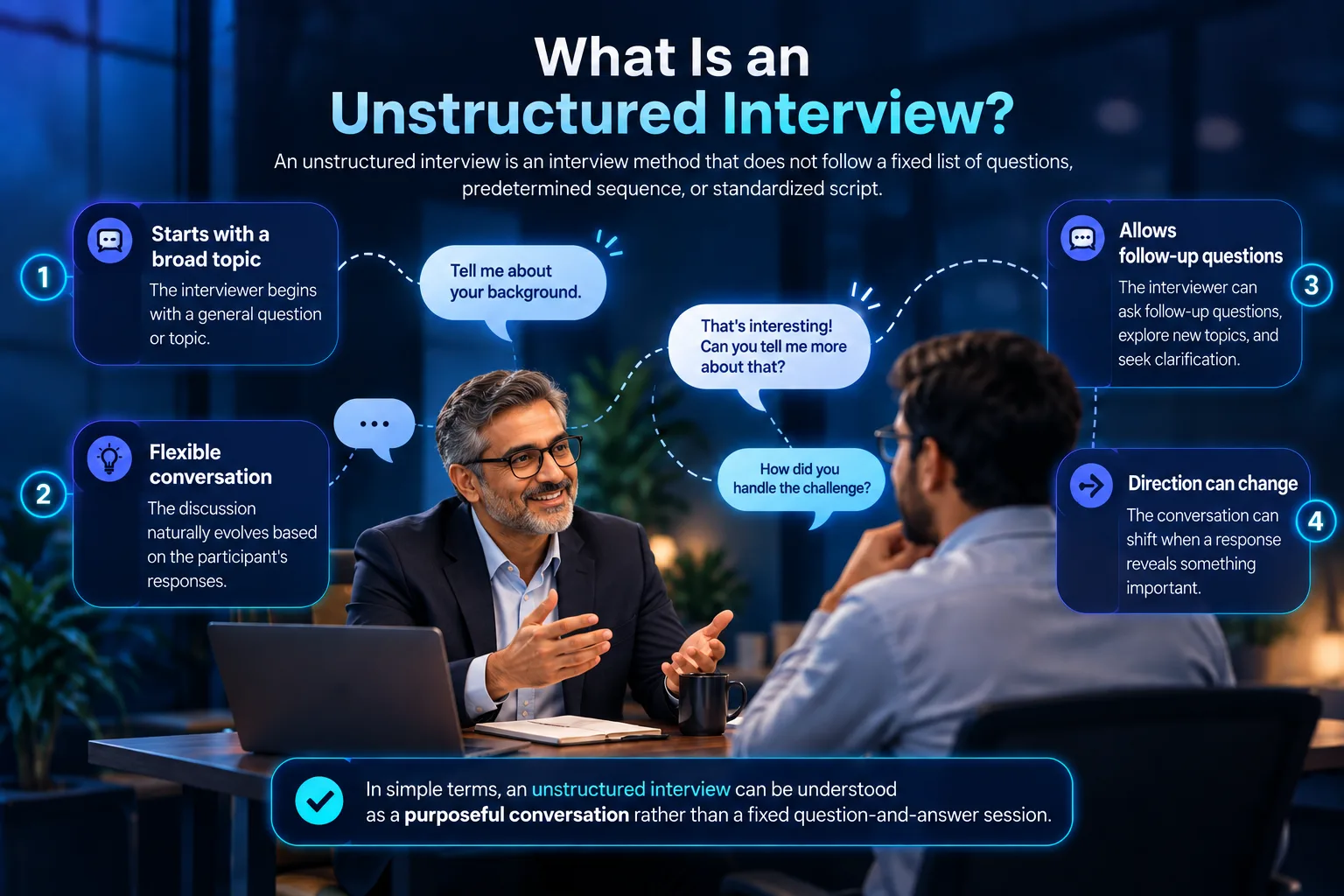
An unstructured interview is an interview method that does not follow a fixed list of questions, predetermined sequence, or standardized script. Instead, the interviewer begins with a broad topic or opening question and allows the conversation to develop based on the participant's responses.
Unlike a structured interview, where every participant is generally asked the same questions in the same order, an unstructured interview gives both the interviewer and participant more freedom. The interviewer can ask follow-up questions, explore unexpected topics, request clarification, and change the direction of the conversation when a response reveals something important.
In simple terms, an unstructured interview can be understood as a purposeful conversation rather than a fixed question-and-answer session.
How Does an Unstructured Interview Work?
An unstructured interview usually follows a general direction rather than a strict sequence. The interviewer may prepare a research objective and a few broad areas, but the actual questions asked during the conversation depend largely on what the participant says.
1. Start With a Broad Objective
The interviewer begins by establishing a clear purpose for the conversation. Although an unstructured interview does not rely on a fixed question list, it still needs an overall topic or research objective to provide direction.
The objective helps the interviewer understand what information they are trying to explore while leaving enough flexibility for the participant to determine which experiences or perspectives are most relevant. This prevents the conversation from becoming completely directionless while maintaining the open nature of the interview.
2. Begin With an Open-Ended Question
The conversation usually starts with a broad, open-ended question that encourages the participant to speak freely about the topic. Rather than limiting the response to a specific option or short answer, open-ended questions allow participants to explain their thoughts, experiences, and perspectives in their own words.
This opening creates the foundation for the rest of the unstructured interview. The participant's initial response can introduce areas that the interviewer may not have considered beforehand, giving the conversation a more natural direction.
3. Follow the Participant's Response
Once the participant begins responding, the interviewer allows their answers to influence what is discussed next. Instead of moving through a predetermined sequence, the interviewer listens for relevant details, themes, experiences, or concerns that can be explored further.
This participant-led approach is one of the defining characteristics of an unstructured interview. Questions can change according to the information already shared, allowing the interviewer to investigate topics in greater depth and respond to the direction of the conversation.
4. Probe for More Detail
Probing allows the interviewer to move beyond brief or general responses and understand the subject more completely. Follow-up questions can be used when an answer requires clarification, additional context, or deeper exploration.
Effective probing should remain neutral and focused on understanding the participant's perspective rather than directing them toward a particular answer. This can help uncover motivations, experiences, perceptions, and details that may not emerge from an initial response.
5. Allow the Conversation to Develop Naturally
An important part of an unstructured interview is allowing the discussion to develop according to the participant's responses. The interviewer does not need to immediately move from one predetermined topic to another. Instead, related ideas can be explored as they emerge during the conversation.
This flexibility can help uncover unexpected information and provide a deeper understanding of the participant's experiences. Unstructured interviews are particularly useful when the purpose is exploratory and the interviewer wants to remain open to perspectives that were not identified before the interview began.
Types of Unstructured Interviews
Unstructured interviews can take different forms depending on the purpose of the conversation, the people involved, and the level of flexibility required. Although these interviews share an open-ended approach, the level of candidate control, interviewer involvement, and depth of discussion can vary.
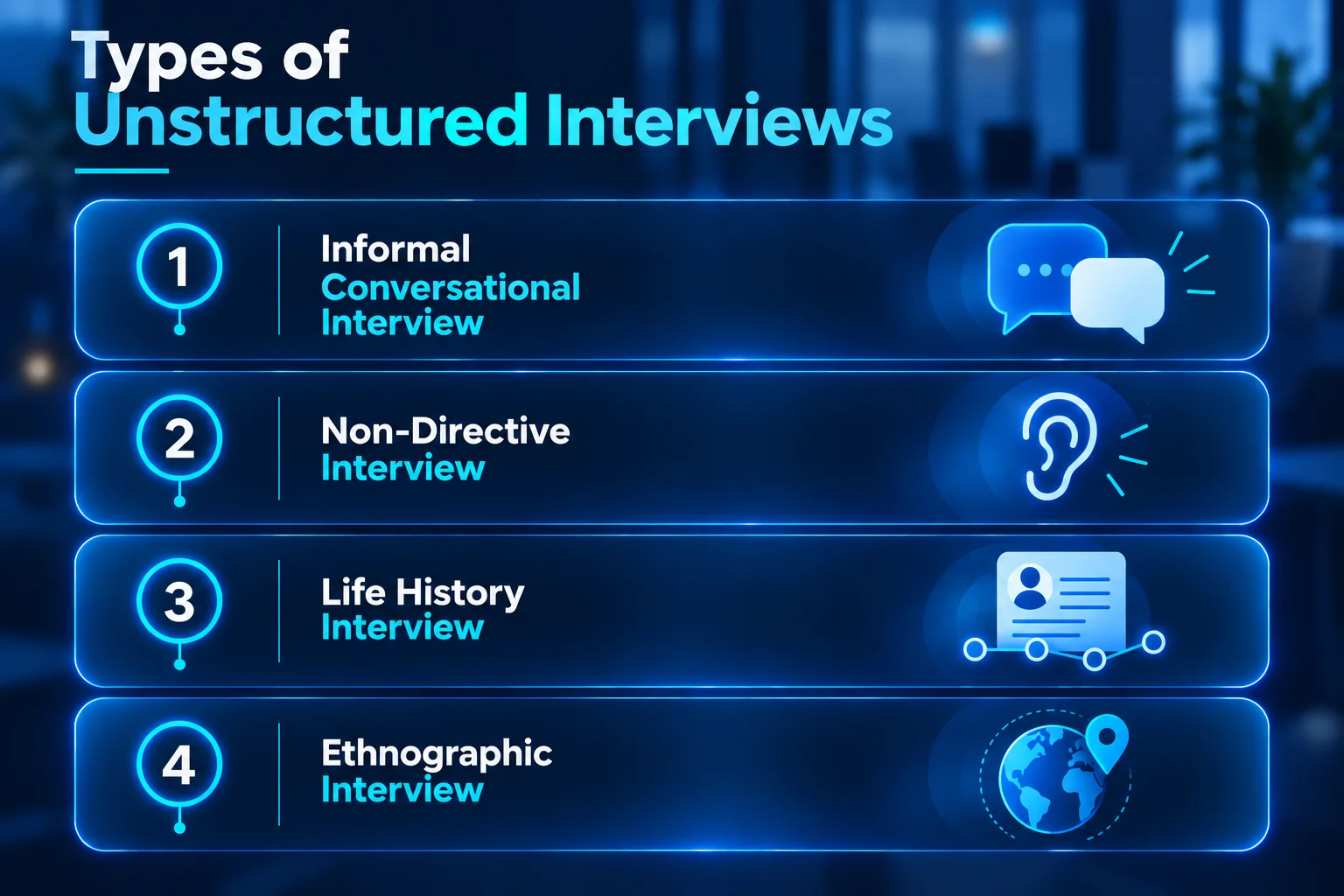
These forms are more commonly discussed in qualitative research, although the underlying principles of flexible and open-ended interviewing can also be applied in other contexts. Common forms include informal conversational interviews, non-directive interviews, life history interviews, and ethnographic interviews.
1. Informal Conversational Interview
An informal conversational interview develops naturally around a broad subject rather than following a fixed questionnaire or predetermined sequence of questions. The interviewer allows questions to emerge during the conversation based on what the candidate or participant shares.
This format can be useful when the interviewer wants to explore experiences, perspectives, or topics that may not have been identified beforehand. Because the conversation can develop differently with each person, the interviewer has greater flexibility to explore unexpected topics and ask spontaneous follow-up questions.
2. Non-Directive Interview
A non-directive interview gives the candidate considerable control over what they discuss and how they describe their experiences. The interviewer provides minimal direction and focuses primarily on listening, encouraging the candidate to develop their response in their own words.
Rather than guiding the candidate toward predetermined topics or answers, the interviewer uses open-ended prompts and carefully chosen follow-up questions when additional detail is needed. This approach can help interviewers gain deeper insight into a candidate's experiences, perspectives, and interpretations while reducing unnecessary direction during the conversation.
3. Life History Interview
A life history interview focuses on a person's experiences over an extended period, exploring important events, decisions, transitions, and experiences that have shaped their career or life. The candidate's personal narrative becomes the central source of information.
Instead of examining one isolated event or topic, the interviewer allows the candidate to connect different stages of their career and explain how earlier experiences relate to later decisions or changes. This type of interview can be useful when the goal is to understand career journeys, professional development, or significant transitions.
4. Ethnographic Interview
An ethnographic interview is used to understand people's experiences, perspectives, behaviors, and meanings within a particular social or cultural setting. It is commonly associated with qualitative research, where interviews are conducted alongside observation and engagement with the environment being studied.
The interviewer allows candidates or participants to explain their experiences using their own language and perspectives while exploring the practices, relationships, beliefs, and routines connected to their environment. Because the interview is closely connected to its wider context, it can provide deeper insight into how people understand and experience their surroundings.
Examples of Unstructured Interviews
Unstructured interviews can be used when an interviewer wants candidates or participants to explain their experiences in their own words. The conversation usually begins with a broad topic, and the direction of the interview depends on the responses that emerge. As a result, two interviews on the same subject may develop quite differently.
1. Employee Experience
An interviewer wants to understand how employees experience working from home. Rather than asking every employee the same series of questions, the conversation begins with a broad question about their experience.
One employee may focus mainly on communication with colleagues, while another may talk about workload, flexibility, management, or maintaining a boundary between work and personal life. The interviewer can then spend more time exploring whichever areas the employee considers important.
This approach allows the interviewer to move from a general discussion into specific experiences without requiring every participant to follow the same path.
2. Customer Research
A company wants to understand how customers experience a product. The interviewer begins by asking the customer to describe their overall experience rather than presenting a fixed questionnaire.
The conversation may develop around usability, pricing, customer support, onboarding, or another issue that the customer considers important. The interviewer can follow that particular topic and ask additional questions to understand why it matters to the customer.
This can reveal different aspects of the customer experience because participants are not limited to a predefined set of topics.
3. Candidate Career Journey
A recruiter wants to understand a candidate's career journey beyond what is covered in their resume. Instead of following a fixed sequence of questions, the recruiter asks the candidate to describe their professional journey and uses their responses to guide the conversation.
The discussion may move toward career decisions, significant projects, challenges, leadership experiences, or reasons for changing roles. The recruiter can then explore the experiences that are most relevant to the position.
This approach can give the interviewer a broader understanding of the candidate's experience while allowing the candidate to explain their career in their own words.
4. Workplace Culture
An interviewer wants to understand how employees perceive the culture within an organization. The conversation begins with a broad question about workplace culture and then develops according to the employee's response.
The discussion might move toward leadership, communication, teamwork, recognition, conflict, hierarchy, or informal practices within the organization. If the participant raises an important experience, the interviewer can explore it further instead of moving to the next predetermined question.
This makes it possible to uncover perspectives and workplace practices that may not appear when employees are asked only standardized questions.
What These Examples Show
Across these situations, the common feature is the flexibility of the conversation. The interviewer has a general objective, but the candidate's or participant's responses help determine what is discussed next.
This is what distinguishes an unstructured interview from a structured format, where questions and their order are predetermined. The approach can produce detailed and varied responses, but that flexibility also means the information collected may differ considerably between people. For this reason, interviewers need a clear objective and a consistent approach to documenting and evaluating the conversation.
Unstructured vs. Structured vs. Semi-Structured Interviews
Interviews can vary in how much structure the interviewer uses. Structured, semi-structured, and unstructured interviews differ mainly in how questions are prepared, how much flexibility the interviewer has, and how consistently candidates are evaluated.
A structured interview follows a predetermined set of questions and generally uses the same questions for every candidate. A semi-structured interview combines a set of planned questions with the flexibility to ask additional follow-up questions. An unstructured interview is more conversational, with questions developing naturally based on the candidate's responses.
Feature | Structured Interview | Semi-Structured Interview | Unstructured Interview |
|---|---|---|---|
Questions | Predetermined | Core questions are predetermined | Not predetermined |
Question order | Usually fixed | Some flexibility | Flexible |
Follow-up questions | Limited or standardized | Allowed when relevant | Frequently used |
Interviewer flexibility | Low | Moderate | High |
Candidate comparison | Easier because responses are more consistent | Relatively easy | More difficult |
Conversation style | Formal and consistent | Balanced and conversational | Informal and conversational |
Typical use | Consistent candidate evaluation | Consistency with room for follow-up | Exploratory and in-depth conversations |
Main strength | Standardization | Balance between structure and flexibility | Depth and spontaneity |
Main limitation | Can feel rigid | Requires careful interviewer judgment | Greater variation between interviews |
Pros of Unstructured Interviews
Unstructured interviews provide flexibility, allowing interviewers to adapt questions based on a candidate's responses and experience. They can create a more natural and conversational interview experience, giving candidates more freedom to explain their background and experiences. Interviewers can explore interesting points in greater depth and ask follow-up questions when needed.
This format can also help interviewers understand a candidate's communication style, experiences, thought process, and perspectives in greater detail. It is especially useful when the interviewer wants to explore experiences that may not be covered by a fixed set of questions.
1. Greater Flexibility
One of the main advantages of an unstructured interview is the flexibility it provides throughout the conversation. The interviewer can change the direction of the discussion based on what the candidate says and explore topics that become relevant during the interview.
This flexibility allows interviewers to spend more time exploring relevant experiences, ideas, or situations as they emerge rather than being restricted to a predetermined sequence.
2. More Detailed Responses
Unstructured interviews give candidates greater freedom to explain their experiences, opinions, and perspectives in their own words. Because responses are not restricted by predefined options or short questions, candidates can provide additional context and detail.
This can help interviewers understand not only what a candidate experienced but also how they approached the situation, why they made particular decisions, and what they learned from the experience.
3. Opportunity to Discover Unexpected Topics
Another advantage of an unstructured interview is the ability to uncover topics that were not identified during the initial interview planning. Candidates can introduce experiences, skills, challenges, or perspectives that the interviewer may not have anticipated.
These unexpected details can give interviewers additional areas to explore and may provide useful context that a fixed interview structure could overlook.
4. Candidate-Centered Conversation
Unstructured interviews give candidates greater control over which experiences they discuss and how much attention they give to different topics. Rather than following only the interviewer's assumptions, the conversation can reflect what the candidate considers meaningful or relevant.
This candidate-centered approach can provide a broader understanding of an individual's experiences and allow candidates to describe their work using their own language and examples.
5. Useful for Exploratory Hiring Conversations
Unstructured interviews can be useful when interviewers want to explore a candidate's background, career journey, motivations, or experiences before moving into more focused assessment.
The conversation can help interviewers identify areas that require further discussion and determine which experiences are most relevant to the role.
Cons of Unstructured Interviews
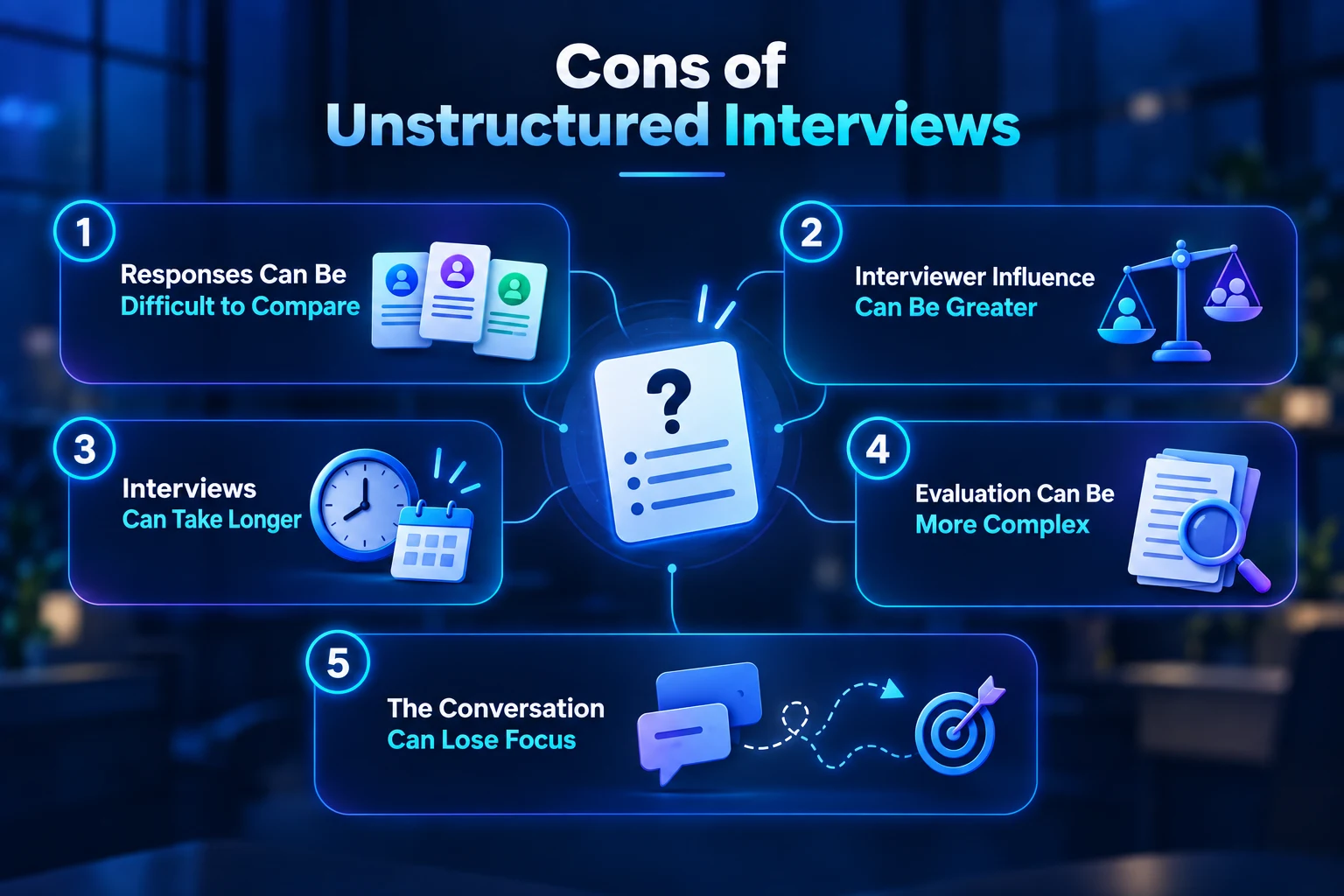
Unstructured interviews give interviewers more flexibility, but this flexibility can also make the hiring process less consistent. Because questions and discussion points can vary from one candidate to another, it can become difficult to compare candidates fairly and objectively.
Another potential drawback is greater interviewer influence. Decisions may be affected by personal impressions or the direction of the conversation rather than being based consistently on job-related qualifications. Candidates may also receive different opportunities to demonstrate particular skills, making evaluation more difficult.
1. Responses Can Be Difficult to Compare
Different candidates may discuss different subjects, even when they are interviewing for the same role. Because the conversation is not based on an identical set of questions, interviewers may not be able to compare responses directly from one candidate to another.
Hiring teams may therefore need to focus on broader job-related competencies and evidence rather than comparing individual answers word for word.
2. Interviewer Influence Can Be Greater
The interviewer can have a significant influence on which topics receive additional attention during an unstructured interview. Follow-up questions, reactions, and changes in conversation direction can affect the type and amount of information collected.
Different interviewers may therefore explore the same candidate response in different ways. This makes interviewer consistency, neutral questioning, and awareness of potential bias particularly important.
3. Interviews Can Take Longer
The flexible nature of an unstructured interview means that its length can vary considerably. Some candidates may provide brief responses, while others may discuss several related topics in considerable detail.
Longer interviews can increase scheduling demands and require more interviewer time. They can also make it more difficult to maintain consistency across candidates.
4. Evaluation Can Be More Complex
Unstructured interviews can produce a wide range of information about a candidate's experiences, skills, and perspectives. Interviewers must organize this information carefully and determine which details are relevant to the role.
Without clear evaluation criteria, the interviewer may rely too heavily on general impressions instead of job-related evidence.
5. The Conversation Can Lose Focus
The flexibility of an unstructured interview can sometimes cause the discussion to move into areas that are interesting but not directly related to the role. Without sufficient direction, the interviewer may spend time collecting information that does not contribute meaningfully to the hiring decision.
The interviewer therefore needs to balance candidate freedom with a clear understanding of the interview's purpose.
When Should You Use an Unstructured Interview?
The decision to use an unstructured interview should depend on the type of information you need and how much freedom participants require to describe their experiences. This approach is particularly useful when researchers want detailed, exploratory information rather than standardized responses. It can be valuable when the subject is complex, personal, emerging, or not well understood.
1. When the Topic Is Not Well Understood
An unstructured interview can be useful when there is limited existing knowledge about the subject being studied. In these situations, researchers may not know all the relevant issues, experiences, or perspectives before beginning the research.
The flexible nature of the interview allows participants to introduce topics that the researcher may not have considered. This can help researchers develop a broader understanding of the subject and identify areas that may require further investigation.
2. When Personal Experiences Are Central
Unstructured interviews are useful when the research focuses on individual experiences, perceptions, beliefs, or interpretations. Participants can explain events in their own words and decide which experiences they consider most important.
This approach allows the interviewer to explore the meaning participants attach to their experiences rather than limiting their responses to predefined categories. It can therefore provide richer information about how people understand and interpret events in their personal or professional lives.
3. When the Research Is Exploratory
Researchers can use an unstructured interview when they are exploring a topic before developing standardized research questions or other research instruments. The open-ended nature of the conversation can help reveal recurring themes, concerns, and perspectives.
The information collected during this early stage can then help researchers develop more focused questions, identify areas for further study, or design a structured questionnaire for later research.
4. When Depth Matters More Than Standardization
An unstructured interview is appropriate when understanding the detail and context behind people's experiences is more important than obtaining identical responses from every participant. The interviewer can spend more time exploring significant topics and asking follow-up questions.
This makes the approach particularly useful for complex subjects where experiences cannot easily be reduced to predefined categories. The resulting conversations can provide deeper qualitative information while giving participants greater freedom to explain their perspectives.
5. When Participants May Have Different Experiences
Unstructured interviews can also be useful when participants are likely to have substantially different backgrounds or experiences related to the research topic. A fixed questionnaire may not provide enough flexibility to explore those differences.
By allowing the conversation to develop according to each participant's responses, the interviewer can investigate individual experiences without forcing everyone into the same discussion path. This can help reveal differences as well as common themes across participants.
How to Conduct an Unstructured Interview
An unstructured interview may be flexible, but it still requires careful planning and a clear understanding of the research objective. The interviewer needs to know when to listen, when to ask follow-up questions, when to clarify a response, and when to redirect the discussion. Unlike a structured interview, the questions can develop according to the participant's responses, allowing the conversation to remain open while still producing relevant information.
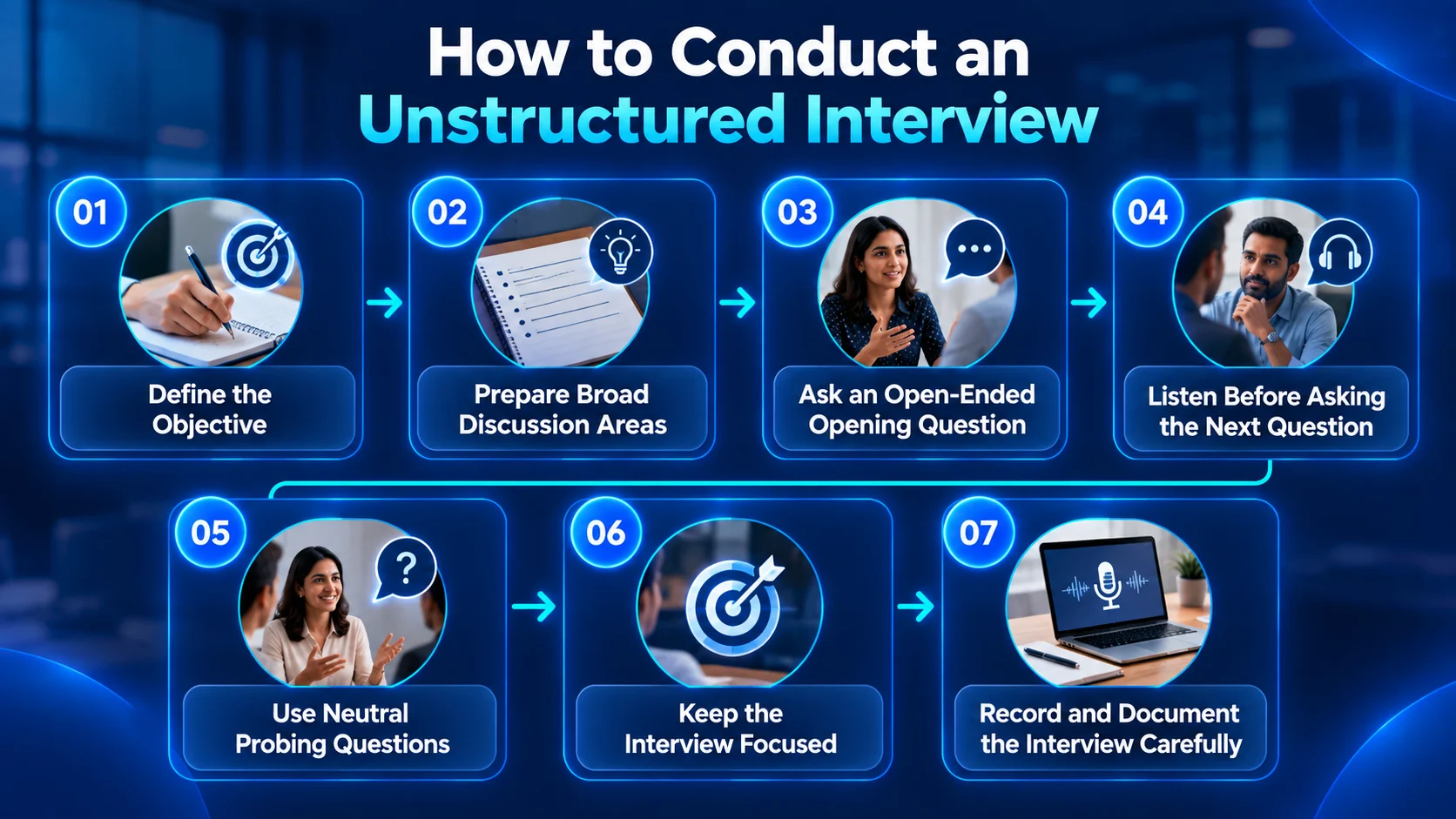
1. Define the Objective
The first step is to clearly identify what the interview is intended to understand. An unstructured interview does not require a fixed questionnaire, but having a defined objective gives the conversation an overall direction.
A clear objective helps the interviewer distinguish useful information from unrelated discussion and decide which areas require further exploration. It also provides a reference point for keeping the conversation focused while allowing participants enough freedom to influence its direction.
2. Prepare Broad Discussion Areas
Instead of preparing a strict list of questions, the interviewer can identify broad themes or areas that may need to be explored during the conversation. These themes act as a flexible framework rather than a predetermined interview script.
Preparing broad discussion areas allows the interviewer to remain organized without restricting the participant's responses. The order, depth, and relevance of each topic can change depending on what the participant shares during the interview.
3. Ask an Open-Ended Opening Question
An unstructured interview should generally begin with an open-ended question that gives the participant enough space to explain their experiences or perspectives in their own words. The opening question establishes the general subject without immediately limiting the conversation to specific responses.
Open-ended questions can also encourage participants to introduce issues that the interviewer may not have anticipated. The response to the opening question can then provide the foundation for the follow-up questions that come later in the conversation. Qualitative interviewing guidance emphasizes the value of open-ended questions for generating detailed discussion and allowing respondents to be expressive.
4. Listen Before Asking the Next Question
Active listening is particularly important in an unstructured interview because the participant's response often determines what the interviewer should ask next. The interviewer should pay attention to the information being shared, the areas the participant emphasizes, and topics that may require clarification or deeper exploration.
Rather than immediately moving to another prepared topic, the interviewer can use the participant's response to identify the next relevant question. This creates a more responsive conversation and allows important information to be explored while it is still relevant to the discussion.
5. Use Neutral Probing Questions
Follow-up or probing questions can help the interviewer obtain more detail without directing the participant toward a particular response. Neutral prompts can be used to clarify statements, explore experiences further, or understand the context behind an answer.
The interviewer should avoid wording that suggests a preferred answer or introduces assumptions into the conversation. Maintaining neutral language gives participants greater freedom to explain their experiences from their own perspective and can help reduce unnecessary interviewer influence.
6. Keep the Interview Focused
Flexibility should not mean allowing the conversation to become completely directionless. The interviewer should give participants enough freedom to explore relevant topics while gently redirecting the discussion when it moves too far away from the overall objective.
Maintaining this balance is one of the most important skills in an unstructured interview. The interviewer should remain responsive to new information while ensuring that the conversation continues to produce information that is relevant to the purpose of the research.
7. Record and Document the Interview Carefully
With appropriate participant consent, the interviewer can record the conversation and maintain notes about important observations, context, and emerging themes. Accurate documentation is especially useful because unstructured interviews can generate large amounts of detailed narrative information that may be difficult to reconstruct from memory.
Unstructured Interview Questions
Unlike structured interviews, unstructured interviews do not require the interviewer to follow a predetermined list of questions. Instead, the conversation develops naturally based on the candidate's responses, experiences, and areas that require further exploration.
However, having a few broad questions in mind can help interviewers maintain direction without making the conversation feel scripted. Open-ended questions are particularly useful because they encourage candidates to explain their experiences in their own words rather than giving short yes-or-no answers.
1. Opening Questions
Opening questions help establish a comfortable conversational tone and give candidates an opportunity to decide where to begin.
Examples include:
Can you tell me about your career journey so far?
What attracted you to this role?
What has been the most interesting part of your work so far?
Can you walk me through your current role and responsibilities?
What type of work do you enjoy doing the most?
The candidate's initial response can help the interviewer identify areas worth exploring through follow-up questions.
2. Follow-Up Questions
Follow-up questions allow interviewers to explore something the candidate has already mentioned. Rather than immediately moving to another topic, the interviewer can ask for more context or detail.
Examples include:
Can you tell me more about that?
What happened next?
What was your role in that situation?
How did you approach it?
What made that particularly challenging?
What did you learn from that experience?
These questions help the interviewer understand the candidate's experience without forcing the conversation into a predetermined sequence.
3. Experience-Based Questions
Experience-based questions encourage candidates to describe specific situations rather than provide general statements about their abilities.
Examples include:
Can you describe a project you're particularly proud of?
Tell me about a challenging situation you faced at work.
Can you walk me through how you handled that situation?
What was the most difficult part of that project?
How did you decide what to do?
What was the outcome?
The interviewer can then use the candidate's response to determine which aspects of the experience need further exploration.
4. Problem-Solving and Creativity Questions
Open-ended questions can also help interviewers explore how candidates approach problems, make decisions, and respond to unfamiliar situations.
Examples include:
Tell me about a time you had to solve a difficult problem.
How do you usually approach an unfamiliar challenge?
Can you describe a situation where your first approach did not work?
What would you do differently if you faced the same situation again?
Tell me about a time you had to find a creative solution.
The interviewer can follow the candidate's response with additional questions to understand their reasoning and decision-making process.
5. Career Goals and Motivation Questions
Unstructured interviews can also provide an opportunity to understand what motivates a candidate and how they view their career.
Examples include:
What are you looking for in your next role?
What type of work motivates you?
What would you like to learn or develop in your next position?
How does this role fit into your career goals?
Where would you like your career to develop over the next few years?
These questions can open a broader conversation about the candidate's expectations, interests, and professional goals.
6. Work Style and Collaboration Questions
Interviewers can use open-ended questions to understand how candidates approach teamwork, communication, and their day-to-day work.
Examples include:
How would you describe your working style?
What type of team environment helps you do your best work?
Tell me about a time you had to work with someone who had a different approach from yours.
How do you usually handle disagreements at work?
What do you value most in a manager or teammate?
The interviewer can use the candidate's answers to decide which experiences or examples deserve further discussion.
7. Reflective Questions
Reflective questions encourage candidates to think about what they learned from previous experiences and how those experiences influenced their approach to work.
Examples include:
What did you learn from that experience?
What would you do differently today?
How has that experience changed the way you work?
What was the most important takeaway for you?
Has your approach changed since then?
These questions can add context to the candidate's previous answers and encourage them to explain their reasoning and development.
8. Closing Questions
The interviewer can finish the conversation with broad questions that give the candidate an opportunity to raise topics that may not have been discussed.
Examples include:
Is there anything else about your experience you'd like to share?
Is there an achievement we haven't discussed that you'd like us to know about?
Is there anything you would like to clarify or add?
What questions do you have for us?
Because unstructured interviews are designed to remain flexible, these questions should be treated as prompts rather than a mandatory checklist. The interviewer can adapt them according to the candidate's responses and the overall purpose of the interview. Keeping a broad topic guide can help maintain focus while still allowing the conversation to develop naturally.
Conclusion
An unstructured interview is a flexible interview method designed to give participants greater freedom to explain their experiences, perspectives, and ideas. Instead of following a fixed questionnaire, the interviewer uses broad opening questions and develops the conversation through active listening, probing, clarification, and relevant follow-up questions.
The format is particularly useful when the subject is exploratory, when researchers want detailed personal narratives, or when they do not yet know which issues will be most important to participants. It can uncover unexpected themes that a structured questionnaire may miss.
At the same time, unstructured interviews require careful interviewing and analysis. Because participants may discuss different topics and interviewers may follow different paths, comparing responses can be more difficult. The conversations can also take longer and require more detailed analysis.
The choice between an unstructured, semi-structured, and structured interview should therefore depend on the purpose of the interview. Unstructured interviews provide depth and flexibility, while more standardized approaches provide greater consistency and comparability. Understanding this difference helps researchers select an interview format that matches the type of information they need.