Back to all blogs
Learn what virtual interview security is, how to identify candidate fraud, and ways to secure remote interviews with identity checks, assessments, and monitoring.


A candidate answers technical questions confidently, explains a work history, and performs well on a video call. Yet the hiring team still needs to establish whether the person on screen owns that experience and can do the work independently. Virtual interview security helps recruiters address this gap through identity verification, practical assessments, and checks for unauthorised assistance.
Candidate fraud can involve another person attending an interview, fabricated credentials, hidden coaching, or synthetic audio and video. These tactics can distort hiring decisions before a recruiter notices an inconsistency. For employers, the consequences may include wasted interview time, delayed projects, replacement costs, and inappropriate access to company information.
Security measures also need to earn candidate trust. In research published in July 2025, Gartner reported that only 26% of job candidates trusted AI to evaluate them fairly. This finding concerns candidate confidence in AI evaluation, rather than the prevalence of interview fraud. It highlights why employers should explain their checks and keep people involved in decisions that affect applicants.
Recruiters therefore face a challenge: verifying authenticity without turning every interview into an investigation. A delayed response, an unusual camera angle, or a brief glance away from the screen can have an innocent explanation. Reliable screening requires context, consistent procedures, and opportunities for candidates to clarify concerns.
The strongest starting point is the interview itself. Questions about specific decisions, short exercises, and relevant follow-up questions help reveal how candidates think. Identity and reference checks add evidence that a polished conversation alone cannot provide. Technology can support these steps by highlighting activity that deserves closer review.
This article explains the main types of candidate fraud, the warning signs worth investigating, and practical prevention methods. It also covers security tools and how hiring teams can respond to concerns while maintaining a respectful experience for legitimate applicants.
What Is Virtual Interview Security?
Virtual interview security is the use of identity checks, interview safeguards, and data protection measures to verify candidates and reduce fraud during remote hiring.
It helps hiring teams confirm that the person attending the interview is the actual applicant and that their responses follow the agreed rules on independent work and permitted assistance. It also includes securing interview rooms, recordings, and candidate information against unauthorised access.
Example: During a virtual coding interview, the hiring team verifies the candidate’s identity and asks them to solve a short problem while explaining their approach. A configured interview platform flags possible unauthorised activity for review, helping the recruiter investigate whether the task was completed independently.

What Are the Common Types of Candidate Fraud in Virtual Interviews?
Candidate fraud can involve concealing who is participating, receiving prohibited assistance, or presenting false qualifications. Some methods affect the application itself, while others misrepresent the candidate’s performance during a live interview.
1. Proxy Interviews and Identity Impersonation
Proxy interviewing happens when another person attends an interview or completes an assessment on the applicant’s behalf. Identity fraud may also involve applying with stolen or fabricated personal details. Both prevent employers from reliably connecting the person evaluated with the person they intend to hire.
For example, an applicant arranges for an experienced developer to attend a technical interview under their name. The hiring team evaluates the substitute’s knowledge while the applicant’s abilities remain untested.
2. Unauthorised AI Assistance
Candidates may use AI assistants to generate answers, suggest code, or display responses during an interview that requires independent work. The deception occurs when prohibited assistance is concealed and its output is presented as the candidate’s own reasoning.
For example, a candidate reads AI-generated answers from an undisclosed overlay during a scenario-based interview. AI use that the employer explicitly permits is not candidate fraud.
3. Hidden Human Assistance
The applicant remains the visible participant but secretly receives answers from another person. Assistance may arrive through messages, an earpiece, a second screen, or remote access to the assessment environment.
For example, an outside expert receives interview questions through a messaging application and sends solutions for the candidate to repeat. Unlike proxy interviewing, the applicant attends but does not answer independently.
4. Deepfake and Prerecorded Media Impersonation
Manipulated video, synthetic speech, or prerecorded footage may be used to conceal the identity of the person participating. These techniques can support an impersonation attempt by making the visible or audible participant appear different from the actual speaker.
For example, a substitute uses a face-swapping tool to resemble the applicant while answering questions on their behalf.
5. Fabricated Experience, Credentials, and Supporting Evidence
Applicants may invent employment history, submit altered certificates, arrange misleading references, or claim work completed by someone else. These claims misrepresent their suitability even when their personal identity is genuine.
For example, a candidate presents a former colleague’s project as their own and provides a friend’s contact details as a supposed supervisor who can confirm the claim.
How to Identify Candidate Fraud in Virtual Interviews?
Identifying candidate fraud requires checking consistency across applications, assessments, and interviews. These steps help recruiters recognise concerns that need further verification. A warning sign alone does not prove misconduct.
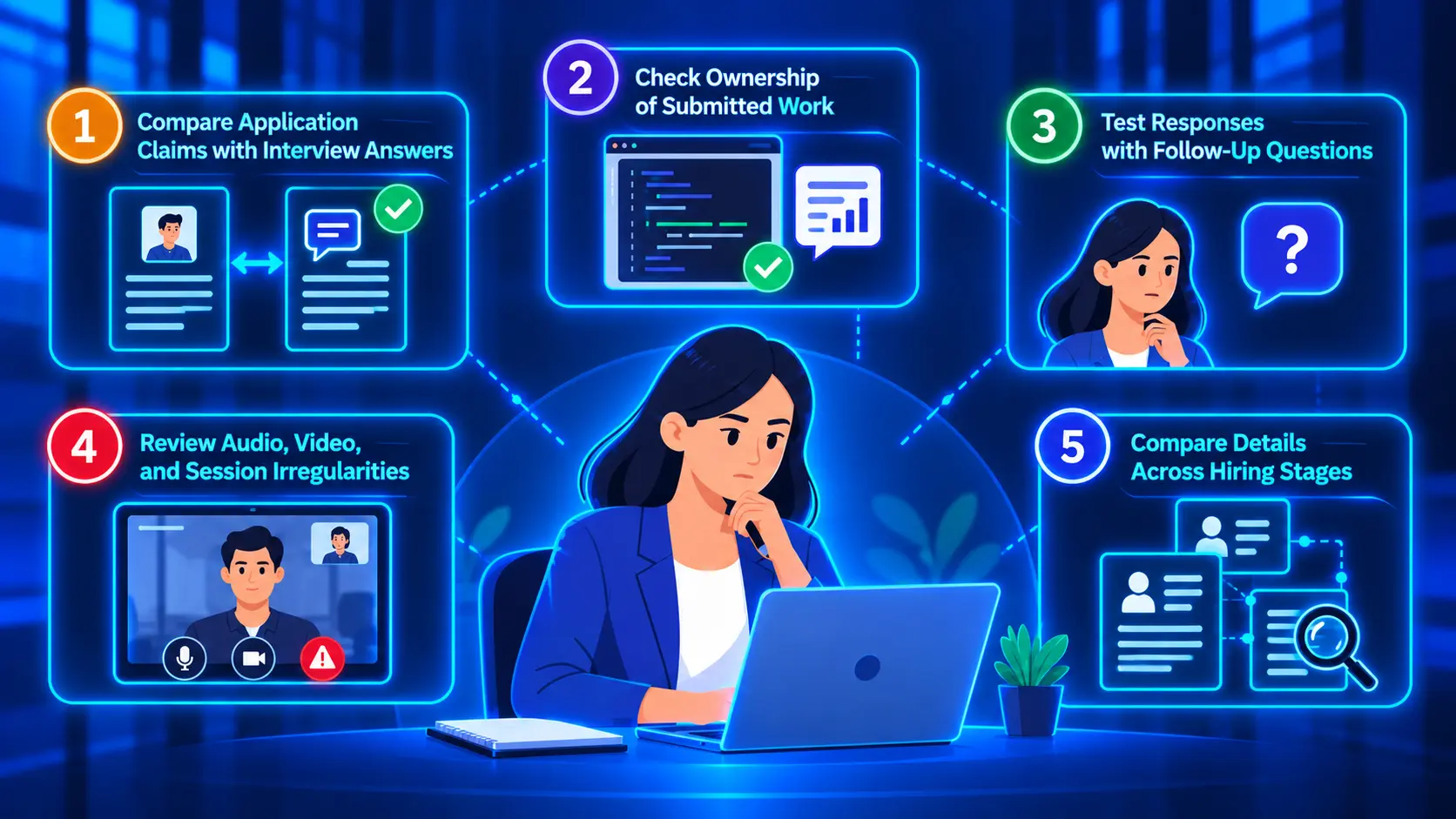
Step 1: Compare Application Claims with Interview Answers
Ask candidates to explain their responsibilities, decisions, and results from previous projects. Look for contradictions between their stated experience and the details they provide, particularly when they cannot distinguish their contribution from the team’s work.
Explore the challenges they encountered and how they handled them. Candidates should be able to discuss their involvement without revealing confidential information. Repeated gaps between claimed responsibilities and their explanations deserve clarification.
Step 2: Check Ownership of Submitted Work
Ask candidates to walk through a submitted assessment and explain how they developed the solution. Focus on whether they understand its structure, assumptions, and limitations rather than judging only the quality of the finished work.
Request a small modification and ask them to explain the change. Difficulty navigating their own work or connecting their explanation to the solution may warrant further assessment. Consider their explanation before drawing conclusions about authorship.
Step 3: Test Responses with Follow-Up Questions
Build questions around the candidate’s interview answers to explore their reasoning beyond a prepared response. Introduce a different requirement and ask how it would affect their proposed approach. Allow thinking time; a delayed response alone does not indicate cheating.
For instance, ask how they would handle the same situation with a shorter deadline or fewer resources. Listen for a connection between the new constraint and their revised answer. Repeatedly returning to generic explanations may justify further skill validation.
Step 4: Review Audio, Video, and Session Irregularities
Watch for persistent lip-sync mismatches, unexplained changes in the participant’s appearance, or audible assistance from another person. Where approved monitoring is enabled, review flagged activity against the interview’s rules.
Check whether audiovisual issues continue after reconnecting or adjusting equipment. Poor connectivity, video processing, and assistive technology can affect a session. Off-screen glances, pauses, and browser changes should not independently determine misconduct.
Step 5: Compare Details Across Hiring Stages
Review identity information, experience claims, and assessment explanations across screening and interview rounds. Focus on material contradictions rather than minor wording differences. Document unresolved concerns and give the candidate an opportunity to clarify them.
Use shared interview notes so reviewers can compare specific claims accurately. A change in claimed project ownership deserves more attention than a different communication style. Consider the explanation before deciding whether additional verification is necessary.
How to Prevent Candidate Fraud in Virtual Interviews?
Preventing candidate fraud requires clear expectations, identity verification, appropriate technical controls, and practical assessments. Apply safeguards according to the role and assessment requirements. Each measure should strengthen verification without creating unnecessary barriers for genuine candidates.
1. Set Clear Rules for AI and External Assistance
Explain what candidates can use during each interview or assessment. Distinguish permitted preparation from prohibited assistance during independent exercises. Share expectations beforehand so candidates understand the boundaries and interviewers apply them consistently.
Key actions:
Specify whether AI assistants, notes, and reference materials are allowed.
Explain rules for additional screens and outside assistance.
Disclose recording and monitoring arrangements.
Provide a contact for questions and accommodation requests.
Example: A team allows documentation during a coding task but prohibits generated solutions. A separate exercise permits AI use and assesses how well the candidate checks its output.
2. Verify Identity Before and Across Interview Stages
Confirm identity through an approved process before an interview stage where verification is required. Preserve continuity across later rounds so an initial check does not leave unexplained changes unnoticed. Use only the information necessary for the verification purpose.
Key actions:
Use secure identity verification where appropriate.
Confirm that verification records correspond to the scheduled applicant.
Review material identity discrepancies between stages.
Provide an alternative when standard verification cannot be completed.
Example: A final-round interviewer receives an unresolved identity mismatch from an earlier check. The designated reviewer clarifies it through the approved process before the interview proceeds.
3. Use Appropriate Browser and Assessment Controls
For exercises requiring independent work, a secure assessment environment can limit access to prohibited resources. Available restrictions depend on the software, device permissions, and configuration. These controls should support assessment integrity without blocking approved tools.
Key actions:
Configure restrictions around the specific assessment rules.
Check whether tab switching, copying, or application access can be controlled.
Test compatibility with required software and accessibility tools.
Explain setup requirements and offer a technical check beforehand.
Example: A closed-resource assessment restricts access to external websites while allowing the supplied reference sheet. Candidates complete a setup check before the scheduled exercise.
4. Consider Additional Camera Views for Higher-Risk Assessments
An additional camera view may help clarify the assessment setup when a single webcam does not provide sufficient visibility. It should be a justified measure, not a routine demand for every candidate. Consider privacy, equipment availability, and accessibility before introducing it.
Key actions:
Explain why an additional view is necessary.
Limit the requested view to the relevant workspace.
Give candidates setup instructions in advance.
Offer an appropriate alternative where the arrangement is unsuitable.
Example: A candidate completing a sensitive technical assessment uses an agreed side view of the workstation. The organisation provides another supervised assessment option for candidates unable to use that setup.
5. Use Structured Interviews and Live Skill Assessments
Combine consistent core questions with practical exercises and relevant follow-ups. Ask candidates to explain their decisions rather than judging only the final answer. This helps establish whether they understand the work they present.
Key actions:
Use role-relevant questions of comparable difficulty.
Ask about personal contributions and decision-making.
Include short fictional tasks or work-sample walkthroughs.
Introduce a changed requirement and assess the response consistently.
Example: A candidate proposes a solution to a scheduling problem. The interviewer then removes an available resource and asks them to explain how they would revise the plan.
6. Train Interviewers to Review Monitoring Signals Fairly
Interviewers need to understand both common fraud methods and the limitations of detection tools. Training should explain what to document, which follow-up questions to ask, and when specialist review is needed. Alerts should direct attention rather than determine the outcome.
Key actions:
Explain proxy interviewing, hidden assistance, and manipulated media.
Train reviewers to separate observations from assumptions.
Consider technical and accessibility explanations for unusual activity.
Define escalation responsibilities for recruitment, HR, and security.
Example: A platform flags repeated changes of window focus. The reviewer checks the task instructions and confirms that the candidate was accessing a permitted reference document.
7. Continue Verification After the Interview
Complete relevant checks before an offer or sensitive access is approved. Interview performance should be considered alongside verified credentials, references, and demonstrated work. Ensure recruitment, HR, and onboarding teams know who owns any unresolved issue.
Key actions:
Verify relevant qualifications through approved channels.
Contact references using independently established details.
Clarify ownership of submitted work where necessary.
Carry unresolved verification concerns into the onboarding review.
Example: A reference confirms employment but describes different responsibilities from those claimed. The recruiter asks the candidate to explain the discrepancy before completing the hiring decision.
Key Features to Look for in Virtual Interview Security Tools
Virtual interview security tools should help hiring teams verify candidates, identify suspicious activity, and investigate concerns using clear evidence. When comparing options, examine both detection capabilities and the practical requirements for candidates and reviewers.

1. Candidate Identity Verification
Look for secure identity checks and, where appropriate, liveness verification. Confirm how the tool connects the verified identity to the interview session and whether it supports identity consistency checks across hiring stages. A successful document check should not leave uncertainty about who actually attends the interview.
Review how the platform handles unsuccessful or inconclusive checks. Candidates should have access to an approved alternative when technical difficulties or accessibility needs prevent them from completing the standard process. Verification outcomes should be recorded securely for authorised reviewers.
2. Deepfake and Voice Analysis
Check whether the tool examines live sessions, recordings, or both. Ask for evidence of performance under conditions similar to your interviews, including different devices, lighting, and connection quality. Understand which forms of manipulation the tool is designed to flag and where its detection capabilities are limited.
The platform should explain uncertain results rather than presenting every alert as a confirmed deepfake. Reviewers need supporting evidence and a clear follow-up process. Detection findings should inform further verification, not automatically determine candidate rejection.
3. Browser and Application Controls
Establish which restrictions the software can enforce on supported devices. Distinguish between recording an activity, such as leaving the interview window, and actively preventing it. Confirm whether controls can be adjusted for different exercises so candidates retain access to approved documentation or software.
Check installation requirements, device permissions, and compatibility before introducing restrictions. Browser controls cannot guarantee that a separate phone or off-camera helper is absent. They should complement practical assessments and clear interview rules rather than serve as the only safeguard.
4. Session Monitoring and Additional Camera Support
Review what screen, audio, video, or device information the tool can capture with the required permissions. Establish whether screen monitoring covers the entire display or only a selected window, and whether reviewers can locate relevant events without watching the full session.
If additional cameras are supported, assess setup requirements, privacy implications, and alternative arrangements. Candidates should understand what will be observed and recorded before the interview. Additional views should address a specific assessment need rather than become an unnecessary requirement for every role.
5. Unauthorised Assistance Indicators
Examine how the tool identifies activity associated with prohibited AI assistance, hidden coaching, or external answer support. Ask what evidence accompanies an alert and whether reviewers can distinguish observed activity from the software’s interpretation of it.
The platform should accommodate the rules of each assessment. Accessing documentation may be permitted in one exercise and prohibited in another. Reviewers should be able to consider these differences, approved accommodations, and the candidate’s explanation before deciding whether a breach occurred.
6. ATS Integration and Record Continuity
Confirm which findings transfer to the applicant tracking system and how they map to the correct candidate, application, and interview stage. Check whether the integration transfers verification outcomes, evidence links, reviewer notes, or only a summary score. Understand which steps still require manual input.
Authorised reviewers should be able to find unresolved concerns without repeating completed checks. The integration should also preserve the distinction between an initial alert and its final review outcome. This helps prevent a dismissed concern from continuing to appear as an active risk.
7. Reviewable Evidence and Human Oversight
Prioritise timestamps, relevant session details, and clear explanations over an unexplained risk score. Reviewers need enough context to understand what happened, which rule may be involved, and whether the evidence supports further investigation.
The tool should allow authorised people to dismiss inaccurate alerts, request clarification, and document their reasoning. Look for a record of who reviewed the concern and how it was resolved. This supports consistent decision-making and helps distinguish confirmed misconduct from unresolved uncertainty.
8. Accessibility and Candidate Support
Assess device compatibility, installation requirements, and support for assistive technology. Candidates should receive clear setup instructions and have an opportunity to test their equipment before the interview. Check whether technical support is available when interviews are scheduled.
The platform should offer practical alternatives when its standard setup is inaccessible or incompatible with a candidate’s equipment. Review how interruptions, reconnections, and approved accommodations appear in session records so they are not automatically interpreted as suspicious activity.
9. Privacy and Data Controls
Examine how the platform collects, stores, and restricts access to recordings, identity documents, and other candidate information. Look for configurable retention periods, deletion options, and permissions that reflect different reviewer responsibilities. Not every interviewer needs access to every verification record.
Collection should be limited to what the interview process genuinely requires. Ask how candidates are informed about data use, whether external providers process the information, and what happens to stored records when the service is discontinued. These details should align with your organisation’s data-handling requirements.
What to Do When You Suspect Candidate Fraud in an Interview?
When candidate fraud is suspected, hiring teams should follow a consistent review process. The priority is to establish the facts, give the candidate an opportunity to explain, and resolve concerns before making a decision.
Document the Concern Clearly: Record the specific inconsistency, when it occurred, and who observed it. Preserve relevant interview notes, assessment results, and verification records. Keep descriptions factual and avoid assumptions about the candidate’s intent.
Seek Clarification from the Candidate: Raise the concern respectfully and ask questions that address the discrepancy directly. Allow the candidate to correct inaccurate information, explain their contribution, or resolve technical difficulties. Consider their explanation before requesting additional checks.
Conduct a Targeted Verification Check: Choose a follow-up that addresses the uncertainty. A live walkthrough can help establish assessment ownership, while independent reference or credential checks can clarify experience claims. Use an approved identity verification process when the participant’s identity is in question.
Review Evidence Across Hiring Stages: Compare the concern with application details, previous interview responses, and verification outcomes. Look for material contradictions that remain unexplained. Avoid treating several observations caused by the same technical issue as separate evidence of misconduct.
Pause and Escalate Unresolved Concerns: Hold the affected hiring or access decision when a significant discrepancy remains unresolved. Assign responsibility for the review and involve recruitment leadership or HR. Consult IT security when the concern could affect company systems or sensitive information.
Document and Communicate the Outcome: Record the checks completed, the candidate’s explanation, and the reasons for the decision. Distinguish resolved discrepancies from inconclusive concerns or confirmed misconduct. Communicate respectfully and keep sensitive records accessible only to authorised reviewers.
Conclusion
Virtual interview security helps hiring teams confirm candidate identity, assess genuine skills, and identify misleading information before it affects a hiring decision. Clear rules, practical assessments, appropriate technical controls, and independent verification work together to reduce opportunities for impersonation and unauthorised assistance.
Effective prevention also requires consistent judgement. Technical difficulties, nervousness, or an automated alert should prompt clarification rather than immediate rejection. Reviewing evidence in context and allowing candidates to explain discrepancies helps protect both the organisation and legitimate applicants.
Start by identifying gaps in your screening, interview, and onboarding processes. Assign responsibility for verification, establish a clear escalation procedure, and ensure unresolved concerns receive attention before sensitive access is granted. These steps make virtual hiring more reliable while maintaining a fair and respectful candidate experience.