Back to all blogs
Explore AI cheating statistics for 2026 covering exams, assessments, coding tests, interviews, recruitment fraud, deepfakes, and financial AI fraud.

Artificial intelligence has changed how people study, complete assessments, write assignments, prepare for interviews, and even apply for jobs. But the rapid adoption of tools such as ChatGPT and other generative AI systems has also created a growing challenge: AI cheating.
From students using AI to complete coursework to candidates using real-time AI assistance during technical interviews, cheating is no longer limited to traditional academic settings. Employers, universities, assessment providers, and certification bodies are increasingly dealing with AI-assisted misconduct across exams, skills tests, coding assessments, and hiring processes.
The scale of the problem is changing quickly. Research cited across recent education and hiring studies shows widespread AI usage among students and candidates, while assessment providers are reporting rising levels of suspicious or fraudulent behavior. For example, Aiseptor's 2026 research reports a 35% fraud-attempt rate on proctored assessments and identifies AI cheating as a growing issue across hiring assessments.
At the same time, AI use does not always equal cheating. Many students and candidates use AI for legitimate purposes such as brainstorming, research, learning, interview preparation, or improving their writing. The key distinction is whether AI use violates the rules of the particular assessment, assignment, examination, or hiring process.
In this guide, we've compiled 100 AI cheating statistics for 2026, covering academic cheating, exams, online assessments, coding tests, interviews, recruitment fraud, AI cheating detection, candidate behavior, and the broader impact of generative AI on assessment integrity.
TL;DR
AI cheating is no longer limited to students using ChatGPT to write assignments. Generative AI, real-time assistants, deepfakes, voice cloning, and other AI-enabled tools are creating new ways for individuals to manipulate tests, assessments, interviews, and hiring processes.
In this report, we've compiled 100+ AI cheating statistics and trends for 2026 to help you understand:
How common AI-assisted cheating is across education, assessments, and recruitment
How students and job candidates are using generative AI during evaluations
The growth of AI cheating in online exams and technical assessments
How AI is changing cheating during coding tests and job interviews
Why unproctored assessments face greater integrity risks
How candidates and students feel about using AI when detection is unlikely
The rise of impersonation, deepfakes, voice cloning, and real-time AI assistance
The financial and operational impact of fraudulent assessments and bad hires
How organizations are responding to AI-enabled cheating
What the future of AI cheating could look like as AI tools become more capable
Whether you're an educator, university administrator, assessment provider, recruiter, hiring manager, HR leader, or compliance professional, these statistics provide a data-driven view of how AI is changing the integrity of evaluations in 2026.
100+ AI Cheating Statistics & Trends in 2026
Let's dive into the numbers.
General AI Cheating Statistics
AI cheating has moved beyond simply using ChatGPT to write an essay. Students are using generative AI for assignments, research, coding, problem-solving and other assessed work, while educators and institutions are trying to distinguish legitimate AI assistance from unauthorized use.
The following statistics provide a broader picture of how AI is influencing cheating and academic integrity in 2026.
1. 9% of Students Who Use AI Admit to Using It to Cheat
According to a 2026 UC Berkeley study published in Science, at least 9% of undergraduate students who use generative AI reported using it to cheat. The study analyzed responses from more than 95,000 students across 20 research-intensive public universities. Researchers found that AI misuse varied by academic discipline, with non-STEM students reporting AI cheating more frequently than STEM students.
What This Means?
AI use and AI cheating should not be treated as the same thing. The study shows that while generative AI is becoming common among students, only a subset report using it specifically to cheat.
For educators, this makes it increasingly important to establish clear rules around acceptable AI use and design assessments that measure individual understanding. Assessment providers can also use controlled environments, identity verification, proctoring, and other integrity measures when AI use is prohibited.
Source: UC Berkeley study
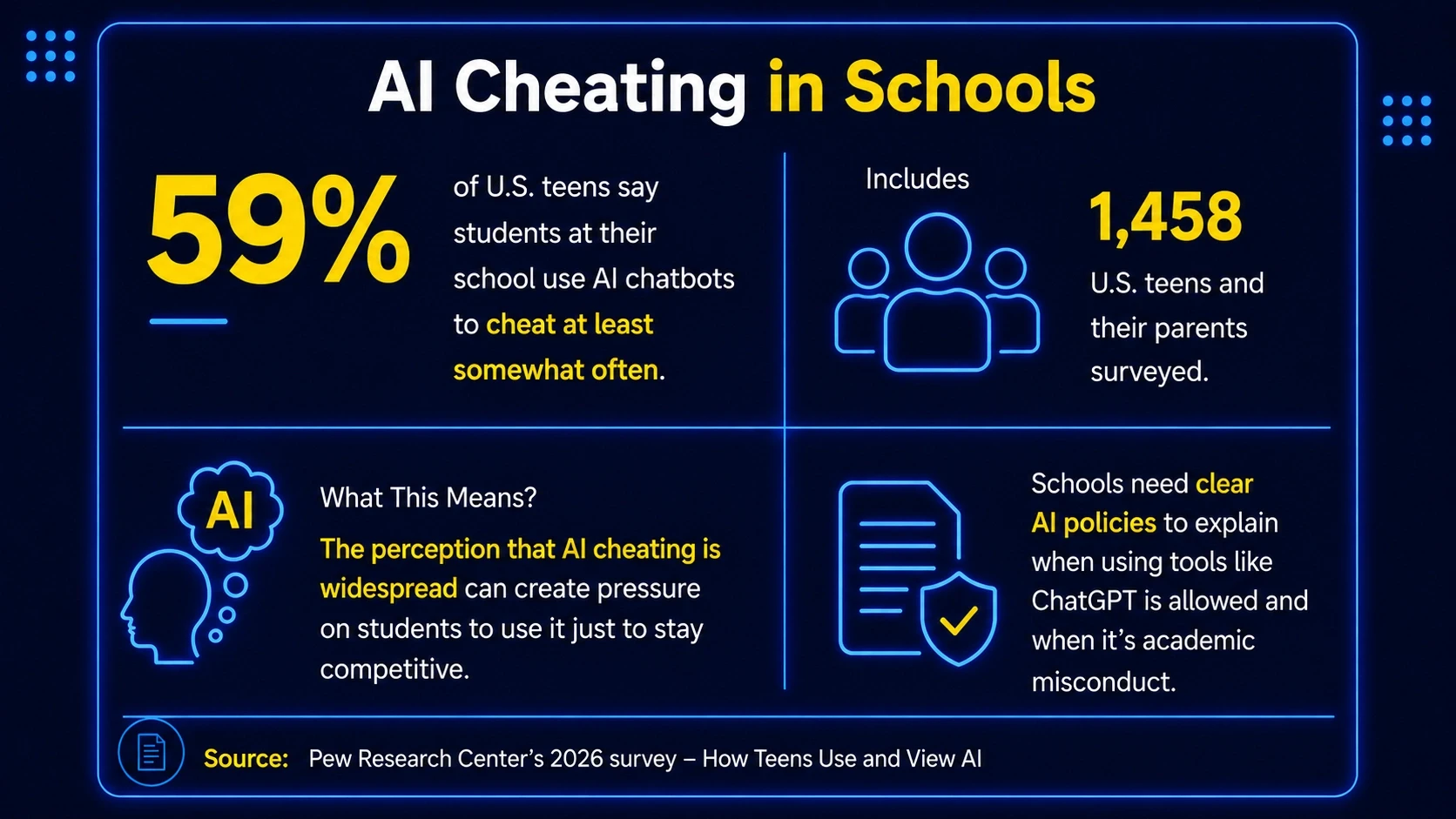
2. 59% of U.S. Teens Say Students at Their School Use AI to Cheat
According to Pew Research Center's 2026 survey, 59% of U.S. teenagers say students at their school use AI chatbots to cheat at least somewhat often. The survey included 1,458 U.S. teens and their parents and examined how teenagers use and perceive AI tools.
The figure includes students who believe AI cheating happens "extremely," "very," or "somewhat" often. This is a measure of students' perception of AI cheating at their school, rather than a direct measurement of how many students personally cheat.
What This Means?
The perception that AI cheating is widespread can itself create an academic-integrity problem. If students believe their peers are using AI to gain an unfair advantage, they may feel pressure to use it themselves simply to remain competitive.
Schools therefore need clear AI policies that explain when students can use tools such as ChatGPT and when doing so constitutes academic misconduct.
Source: Pew Research Center's 2026 survey
3. 94% of AI-Generated Exam Submissions Went Undetected
A real-world experiment conducted at the University of Reading found that 94% of AI-generated exam submissions were not detected by human markers.
Researchers secretly submitted 100% AI-generated answers across five undergraduate psychology modules and compared their results with genuine student work. The AI-generated submissions not only largely escaped detection but also received grades averaging around half a classification boundary higher than real student submissions. In 83.4% of cases, the AI submissions outperformed a randomly selected group of real student submissions.
What This Means?
The finding demonstrates why traditional take-home assessments can become vulnerable when students have unrestricted access to generative AI.
It also shows that simply relying on instructors to recognize AI-generated work may not be sufficient. Universities may need to combine assessment design, supervised evaluation, process evidence, and other integrity measures rather than relying solely on post-submission detection.
Source: PLOS ONE - A real-world test of artificial intelligence infiltration of a university examinations system
4. AI-Related Cheating Cases at UK Universities Rose From 1.6 to 5.1 per 1,000 Students
UK universities recorded an increase in confirmed AI-related academic misconduct from 1.6 cases per 1,000 students to 5.1 cases per 1,000 students between the 2022–23 and 2023–24 academic years.
A Guardian investigation based on university data found that nearly 7,000 AI-related cheating cases were recorded across UK universities in 2023–24. The investigation also reported that the number of cases could rise further as more universities improve how they identify and separately record AI-related misconduct.
What This Means?
The rapid increase suggests that AI-related academic misconduct is becoming a measurable part of university integrity cases rather than an isolated issue.
However, the numbers should not be interpreted as the percentage of students who cheat with AI. They represent recorded cases, meaning actual usage could be substantially different depending on institutional detection and reporting practices.
For universities, improving assessment integrity and consistently recording AI-related misconduct will become increasingly important as generative AI adoption grows.
Source: The Guardian - Thousands of UK university students caught cheating using AI
5. 38.5% of Candidates Showed Signs of Cheating in 19,368 AI-Powered Interviews
An analysis of 19,368 AI-powered interviews conducted between July 2025 and January 2026 found that 38.5% of candidates triggered cheating flags.
The analysis by Fabric found that the rate increased substantially during the period studied, rising from 9% in July 2025 to 45% by September 2025. Fabric also reported that technical roles experienced substantially higher cheating rates than sales roles.
What This Means?
AI cheating is no longer limited to academic environments. Hiring teams now face a similar integrity challenge when candidates use AI assistance during live interviews.
A candidate can potentially appear more capable than they actually are if an external AI system helps them formulate answers or solve technical problems in real time.
For employers, this makes it increasingly important to validate candidate skills through multiple signals rather than relying on a single AI-assisted interview.
Source: Fabric - State of AI Interview Cheating in 2026
6. 48% of Candidates in Technical Roles Showed Signs of Interview Cheating
Candidates interviewing for technical roles showed a 48% cheating rate, according to Fabric's analysis of 19,368 interviews. By comparison, Fabric reported a 12% cheating rate for sales roles.
The difference is particularly significant because technical interviews often involve coding, debugging, system design, or other tasks where generative AI can provide immediate assistance.
What This Means?
Technical hiring may be particularly vulnerable to AI-assisted cheating because candidates can use AI coding assistants and real-time answer-generation tools without necessarily displaying obvious signs of outside assistance.
Employers hiring engineers and other technical professionals should therefore consider combining coding assessments with follow-up technical discussions, live problem-solving, and verification of how candidates arrived at their solutions.
Source: SHRM - When Candidates Can Fake Skills in Real Time, Assessment Design Has to Catch Up
7. 21.9% of UK University Students Estimated to Have Used AI to Cheat
A 2025 study examining the vulnerability of UK universities to generative AI cheating estimated that 21.9% of students had used AI tools to cheat on at least one university assessment during the previous 12 months. Among students who had used generative AI, the estimate increased to 26.4%.
The researchers surveyed 1,484 students and used an anonymous list-experiment methodology designed to encourage more honest responses about sensitive behavior. The study also found that 81.4% of students had used at least one generative AI tool, while 91.1% had been assessed through written coursework such as essays.
What This Means?
The statistic shows that AI cheating can extend well beyond students simply experimenting with ChatGPT. A significant proportion of students in the study reported using AI specifically to cheat on university assessments.
For universities and assessment providers, the finding highlights the vulnerability of unsupervised essays and online assessments. Assessment design needs to account for the fact that students may have unrestricted access to increasingly capable AI tools outside controlled testing environments.
Source: Taylor & Francis - How vulnerable are UK universities to cheating with new GenAI tools?
8. 81.4% of UK University Students Have Used Generative AI
81.4% of students surveyed at UK universities reported using at least one generative AI tool, according to a study examining the risk of AI-assisted cheating in higher education.
Among the 1,484 students surveyed, 72.6% had used ChatGPT, making it by far the most commonly reported generative AI tool. Other tools included Google Gemini/Bard at 17.8%, Microsoft Copilot at 13.9%, and Claude at 5.1%.
While AI use itself is not equivalent to cheating, the high adoption rate provides important context for the 21.9% estimated cheating rate found in the same study.
What This Means?
When more than four in five students have access to and experience with generative AI, preventing AI-assisted cheating becomes much more difficult through simple restrictions or honor codes alone.
Universities need to clearly distinguish between permitted AI assistance and unauthorized AI use, while assessment providers need to consider how easily an assessment can be completed with external AI assistance.
Source: Taylor & Francis - How vulnerable are UK universities to cheating with new GenAI tools?
9. 54.6% of UK Students Take Unsupervised Online Exams
54.6% of students in a 2025 UK university study reported being assessed through unsupervised online examinations, and these exams accounted for an average of 27.5% of their degree assessment.
The same study found that 91.1% of students were assessed through written coursework such as essays, with written coursework accounting for an average of 52.2% of their assessment. Researchers identified both formats as particularly vulnerable to cheating with generative AI because students can potentially access AI tools without direct supervision.
What This Means?
The growth of generative AI changes the risk profile of assessments that were already designed around student work being completed outside a controlled environment.
For universities and online assessment providers, the challenge is not simply detecting AI after an assessment has been submitted. It is designing assessments where the student's identity, reasoning, and independent ability can be verified throughout the evaluation process.
This is particularly important for high-stakes exams, certifications, and assessments used to determine whether someone has acquired a particular skill.
Source: Taylor & Francis - How vulnerable are UK universities to cheating with new GenAI tools?
10. 83.4% of AI-Generated Exam Submissions Outperformed Random Student Submissions
In the University of Reading experiment, AI-generated exam submissions had an 83.4% probability of outperforming a randomly selected set of genuine student submissions.
The researchers placed fully AI-generated answers into five undergraduate psychology modules without informing the markers. The AI-generated work not only frequently escaped detection but also performed strongly against authentic student submissions.
What This Means?
AI cheating can undermine an assessment in two ways: it can make unauthorized work difficult to identify, and the AI-generated work may be good enough to receive competitive grades.
This makes assessment validity just as important as cheating detection. If an assessment can be completed successfully by AI without demonstrating the student's underlying knowledge, its ability to measure individual capability becomes questionable.
Source: PLOS ONE - University of Reading AI examination study
11. AI-Generated Work Scored Around Half a Grade Boundary Higher Than Real Student Work
In the same University of Reading experiment, AI-generated exam submissions received grades that were on average around half a classification boundary higher than genuine student submissions.
The study deliberately used AI-generated answers without human editing, meaning the result demonstrates how capable generative AI was even under relatively straightforward conditions.
What This Means?
The problem with AI cheating is not simply that students can generate answers faster. AI-generated work can potentially perform well enough to distort grades and rankings.
For educators, this reinforces the need to assess skills that require students to demonstrate their reasoning, application, and understanding rather than evaluating only a polished final submission.
Source: PLOS ONE - A real-world test of AI infiltration of university examinations
12. 26% of Daily AI Users Reported Cheating Compared With 7% of Monthly Users
The 95,513-student study found a substantial difference in cheating behavior based on how frequently students used generative AI. 26% of daily AI users reported using AI to cheat, compared with 7% of students who used AI monthly.
The finding does not establish that frequent AI use causes cheating. Instead, it shows a strong association between the intensity of AI use and the likelihood that students reported crossing academic-integrity boundaries.
What This Means?
Students who rely heavily on AI may have more opportunities to move from legitimate assistance into unauthorized use.
Rather than focusing exclusively on whether a student has used AI, institutions may need to pay greater attention to how AI is being used and whether the final assessment still represents the student's independent capabilities.
Source: Forbes - On Campus, More AI Use Means More Cheating. Across Majors, It Means Less
AI Cheating in Education Statistics
Generative AI has become deeply embedded in education, giving students new ways to research, write, solve problems, and complete assignments. While much of this use is legitimate, the same tools can also make it easier to bypass traditional academic work.
The following statistics examine how AI is affecting cheating and academic integrity across schools and universities.
13. 6.44% of High School Students Reported Using AI as an Unauthorized Aid
A 2024 study published in Computers & Education: Artificial Intelligence found that 6.44% of high school students reported using an AI tool or digital device, such as ChatGPT or a smartphone, as an unauthorized aid during an assessment, school assignment, or homework.
The study analyzed anonymous survey data from three high schools and compared cheating behaviors before and after the public release of ChatGPT. The researchers found that overall cheating levels remained relatively stable, but AI-specific cheating emerged as a distinct form of academic dishonesty after generative AI became widely available.
What This Means?
This statistic is important because it measures unauthorized AI use specifically, rather than general AI adoption. It also shows that AI-assisted cheating can be tracked separately from traditional forms of academic dishonesty such as copying homework or using unauthorized notes.
For schools and assessment providers, this highlights the need to define whether AI tools are permitted for each assessment. A student using AI for learning or brainstorming is fundamentally different from using it as an unauthorized aid during an assessment.
Source: Computers & Education: Artificial Intelligence - Cheating in the age of generative AI
14. 530 AI Misconduct Cases Were Recorded at UNSW in 2024
The University of New South Wales recorded 530 cases involving unauthorized use of generative AI in 2024, compared with 166 cases in 2023. That represents an increase of approximately 219% in a single year. UNSW said AI misuse was included as a separate student-conduct category for the second year in 2024.
The university also reported that almost one-third of all substantiated student misconduct cases involved AI misuse, although many were handled as lower-level plagiarism cases.
What This Means?
The rapid increase shows how quickly AI-related academic-integrity cases can become a significant part of a university's misconduct workload.
For universities, the challenge isn't only preventing students from using AI improperly. Institutions also need processes for investigating suspected misuse, determining whether AI use actually violated the assessment rules, and applying appropriate penalties.
Source: UNSW - 2024 Student Conduct and Complaints Report
15. Around 14% of Students Reported Copying AI-Generated Text Without Acknowledgment
A multi-university plagiarism study found that around 14% of students reported copying text generated by AI without acknowledging that AI was used in 2024.
The researchers surveyed students across multiple universities and specifically added AI-generated text as a new form of plagiarism to their long-running plagiarism research. Importantly, around 90% of students themselves considered this behavior to be plagiarism, showing that many students recognize the academic-integrity implications of submitting unacknowledged AI-generated material.
What This Means?
The statistic highlights a specific form of AI cheating: copying AI output directly without disclosure.
For educators, this suggests that AI policies need to go beyond simply saying whether ChatGPT is allowed. Students also need to understand whether they must disclose AI assistance and what level of AI-generated content is acceptable in submitted work.
Source: International Journal for Educational Integrity - Results from two decades of plagiarism surveys
16. 24.27% of High School Students Reported Using AI as an Unauthorized Aid
A 2026 follow-up study of high school cheating behavior found that 24.27% of students reported using AI or digital devices such as ChatGPT and smartphones as unauthorized aids during assessments, assignments, or homework.
The study examined 4,354 students across six U.S. high schools. Rates varied by school type, ranging from 22.24% in public schools to 27.12% in private schools.
This figure is particularly useful because it measures unauthorized AI/digital assistance, rather than simply asking whether students have used AI.
What This Means?
The statistic shows that AI-assisted academic dishonesty can occur across different types of schools and isn't limited to a particular educational environment.
For schools and assessment providers, it reinforces the need to distinguish ordinary AI use from unauthorized assistance during graded work. Controlled assessments, supervised testing, and clear AI-use rules can reduce ambiguity around what students are permitted to do.
Source: Springer Nature - Cheating in the second year of generative AI chatbots
17. 22% of UK University Students Estimated They Used AI to Cheat
A study of 1,484 UK university students estimated that 22% had used AI tools to cheat on at least one university assessment during the previous 12 months. The researchers used an anonymous list-experiment methodology designed to make students more comfortable reporting sensitive behavior.
The study also found that the estimated rate was higher among students who used generative AI, reaching 26.4%.
What This Means?
The finding suggests that AI-assisted cheating may be considerably more widespread than the number of officially reported misconduct cases indicates.
For universities, this makes assessment design increasingly important. Written assignments and unsupervised assessments can give students opportunities to use AI without direct oversight, making it harder to establish whether submitted work represents their own ability.
Source: Taylor & Francis - How vulnerable are UK universities to cheating with new GenAI tools?
18. 33% of Students in an Online-Exam Study Showed Suspicious Behavior
A 2025 pilot study analyzing 52 students during an online exam found that approximately 33% displayed suspicious behavioral patterns associated with potential AI-assisted cheating.
Researchers analyzed behaviors including selecting text within the question area, right-clicking, and repeatedly losing focus from the examination page. Students were grouped into six behavioral clusters, with four clusters showing suspicious behavior at varying levels.
What This Means?
The study suggests that cheating detection does not necessarily have to depend exclusively on analyzing the submitted answer. Behavior during an assessment can also provide useful signals.
For online assessment providers, behavioral analytics can potentially complement traditional proctoring and integrity controls by identifying unusual interaction patterns that warrant further review.
Source: arXiv - Detecting AI-Assisted Cheating in Online Exams through Behavior Analytics
19. ChatGPT Outperformed Students on 131 University Assessments
A 2026 study from Liverpool John Moores University compared ChatGPT-4's performance with student grades across 131 assessments from 40 university modules in Biological and Environmental Sciences.
The researchers found that ChatGPT performed particularly strongly on exam-like assessments, including tests and exams, especially multiple-choice assessments. Its performance was weaker on assessments involving in-class data collection, collaboration, reports, posters, and presentations.
What This Means?
The results show that the vulnerability of an assessment to AI cheating depends heavily on how the assessment is designed.
Assessments that can be answered from information contained in the question may be easier for AI to complete than tasks requiring students to collect data, collaborate, explain their process, or demonstrate practical skills.
For universities and assessment providers, this supports a shift toward assessments that measure application, reasoning, practical ability, and individual understanding, rather than relying solely on conventional question-and-answer formats.
Source: PubMed - ChatGPT and Academic Integrity: A Case Study of Assessment Vulnerability
AI Cheating in Online Assessment Statistics
Online assessments have become a common part of education, hiring, certification, and skills evaluation. However, the growing availability of generative AI, search engines, browser tools, and other digital resources has made it easier for test-takers to receive outside assistance while completing assessments. Recent research shows that AI use during pre-hire assessments is increasing, creating new challenges for assessment validity and fairness.
The following statistics examine AI-assisted cheating, unauthorized digital assistance, assessment fraud, and the growing impact of generative AI on online testing and evaluation.
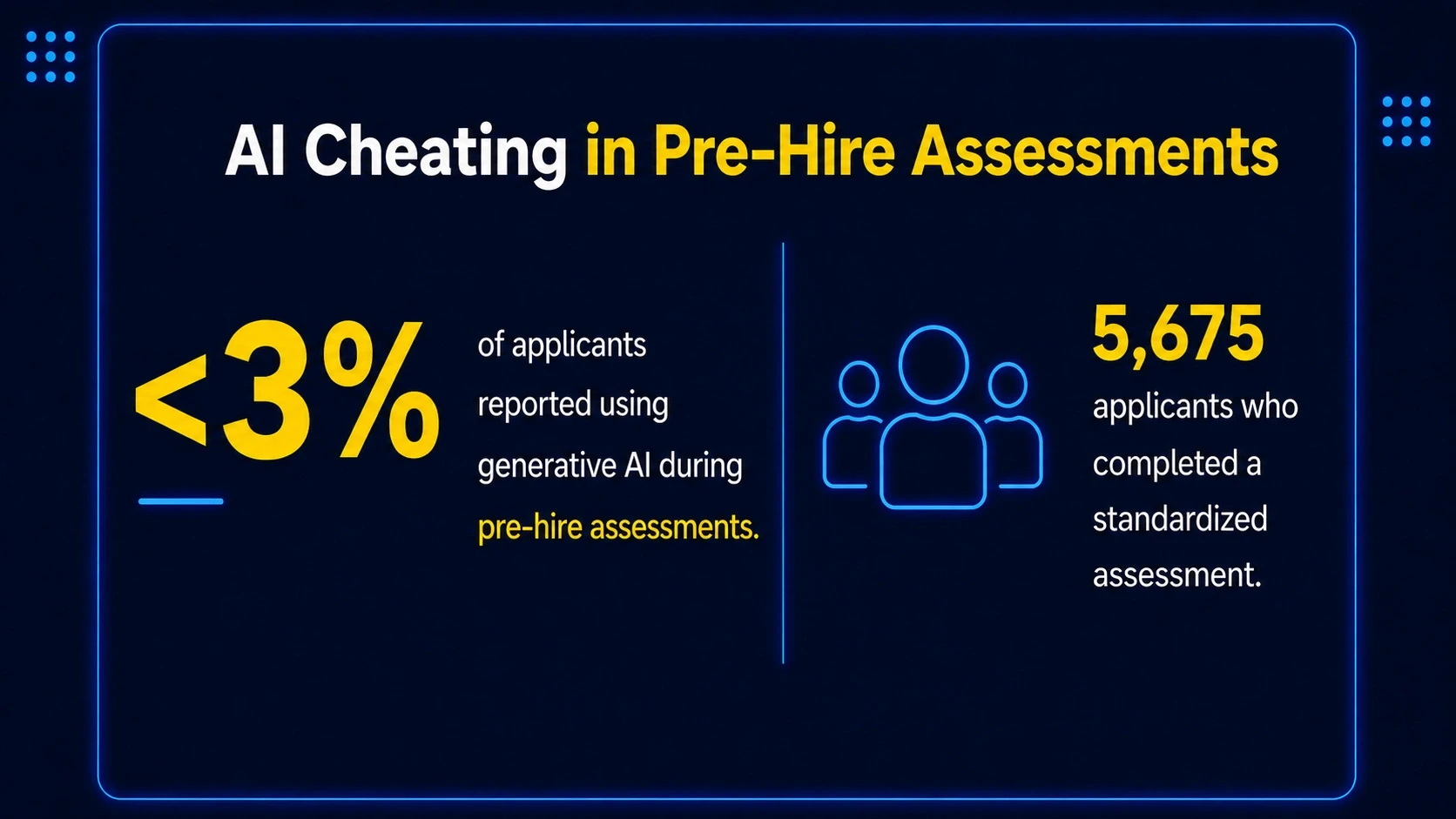
20. Fewer Than 3% of Applicants Reported Using Generative AI During Pre-Hire Assessments
A 2026 study published in the International Journal of Selection and Assessment examined 5,675 applicants completing a standardized pre-hire employment assessment in Q3 2024. The researchers found that fewer than 3% of applicants reported using generative AI while completing the assessment.
However, the study also examined broader use of AI alongside other online resources, such as search engines, because candidates may use multiple tools rather than relying on a chatbot alone.
What This Means?
The relatively low self-reported rate suggests that direct generative AI use was not yet widespread in this particular pre-hire assessment sample in 2024. However, self-reported behavior may not capture every instance of unauthorized assistance.
For employers, this highlights why assessment integrity cannot depend solely on asking candidates whether they used AI. Assessment design, monitoring, and follow-up validation can provide additional safeguards.
Source: Wiley - Candidate Generative AI Use in Pre-Hire Employment Assessments
21. 10% of Candidates Used an Unauthorized Tool in an Online Assessment
A 2026 Assessio report examining 500+ applicants found that 10% of candidates used a tool that was not permitted during an online assessment. The research examined faking, cheating, and AI use in assessment settings.
The study also reported that only 2.1% of participants said they would consider using AI in a real assessment.
What This Means?
Unauthorized assistance extends beyond generative AI. Candidates may use other tools or resources that are prohibited by the assessment rules.
This is why assessment integrity policies should define unauthorized assistance broadly rather than focusing exclusively on ChatGPT or other AI chatbots.
Source: Assessio - Integrity in Assessments
22. 12% of ChatGPT-Generated Hiring Assessment Responses Were Classified as High-Fit
Cangrade tested ChatGPT's ability to complete its hiring assessment across 50 different roles and found that only 6 of the 50 AI-generated response sets, or 12%, were classified as high-fit candidates based on the company's scoring threshold. Another 10% fell into a "wildcard" range, while 78% were classified as no fit.
What This Means?
Generative AI does not automatically guarantee that a candidate will perform well on every hiring assessment. In this particular experiment, AI-generated responses frequently failed to produce the profile the assessment was designed to identify.
However, the experiment also demonstrates why organizations need to evaluate the actual vulnerability of their assessments rather than assuming that AI assistance will either always succeed or always fail.
Source: Cangrade - AI-Enabled Candidates in Hiring Report
23. 85% of Employers Encountered Cheating During the Application and Assessment Process
The Institute of Student Employers' 2025 Student Recruitment Survey found that 85% of employers had encountered some form of cheating through the application and assessment process. The survey analyzed recruitment data from 155 ISE employer members, covering more than 31,000 student hires and 1.8 million applications.
The findings highlight the growing challenge employers face as candidates gain access to generative AI and other digital tools during recruitment and assessment.
What This Means?
Cheating is no longer an isolated problem in online recruitment. The fact that 85% of employers encountered some form of misconduct indicates that assessment integrity has become a significant concern for hiring teams.
For employers, maintaining reliable assessment results increasingly requires clear rules around AI use, stronger assessment design, and mechanisms for identifying suspicious candidate behavior.
Source: Institute of Student Employers - Student Recruitment Survey 2025 ISE - Student Recruitment Survey 2025 insights
24. 44.7% of Students Reported Cheating in Online Exams
A systematic review published in the Journal of Academic Ethics analyzed 25 samples from 19 studies involving 4,672 participants and found that 44.7% of students self-reported cheating in online exams. The review covered studies conducted from 2012 onward.
The rate was 29.9% before COVID-19, while studies conducted during the COVID-19 period reported a substantially higher rate of 54.7%. The researchers noted that the evidence varied in quality and that the samples were heterogeneous.
What This Means?
Online assessments can create additional opportunities for cheating because students may have access to external resources while completing an exam remotely. The substantial difference between pre-COVID and COVID-era self-reported cheating also highlights how assessment environments can influence cheating behavior.
For organizations using online assessments, secure testing environments, appropriate proctoring, and assessment designs that reduce opportunities for unauthorized assistance can help protect assessment integrity.
Source: Springer Nature - How Common is Cheating in Online Exams and did it Increase During the COVID-19 Pandemic?
25. 54.7% of Students Reported Cheating in Online Exams During COVID-19
A systematic review published in the Journal of Academic Ethics analyzed 25 samples from 19 studies involving 4,672 participants and found that 54.7% of students reported cheating in online exams during the COVID-19 period. Before COVID-19, the corresponding figure was 29.9%.
The review found that individual forms of cheating were more common than cheating involving other people. It also noted that the most commonly reported reason for cheating was simply having the opportunity to do so.
What This Means?
The sharp difference between pre-COVID and COVID-era results shows how moving assessments online can create additional opportunities for academic misconduct.
For organizations conducting remote assessments, reducing opportunities for unauthorized assistance can be just as important as detecting cheating after it occurs.
Source: Springer Nature - How Common is Cheating in Online Exams and did it Increase During the COVID-19 Pandemic?
26. 30% to 50% of Candidates Cheated During Entry-Level Online Job Assessments
HirePro analyzed 900,000 assessments conducted over a six-month period and found that approximately 30% to 50% of candidates cheated during entry-level job assessments. For lateral job assessments, the reported cheating rate was lower, at around 10% to 25%.
The study also found that cheating became less common as candidates gained more professional experience. Common methods included having someone sit with the candidate during the assessment and receiving verbal assistance from another person.
What This Means?
Entry-level assessments appear particularly vulnerable to cheating, potentially because candidates have less professional experience and may face greater pressure to secure their first opportunities.
The findings also show that assessment fraud isn't limited to AI. Human assistance, collaboration, and physical presence of another person can also compromise the validity of remote assessments.
Source: Indian Express - HirePro online assessment cheating survey
27. Up to 100% More Candidates Attempted to Cheat Without Effective Proctoring
A HirePro study analyzing 9 lakh online job assessments found that the number of candidates attempting to cheat increased by 80% to 100% when effective proctoring was absent. The study compared assessment environments with and without effective monitoring.
The research also found that cheating detection was significantly affected by the type of proctoring used. Video, audio, and image-based proctoring together detected cheating much more effectively than using only one or two of these methods.
What This Means?
Proctoring can have a major impact on online assessment integrity. When candidates know that an assessment is not effectively monitored, the likelihood of attempting to cheat can increase substantially.
For organizations conducting remote assessments, this suggests that simply moving a test online is not enough. Effective monitoring and multiple verification signals can help discourage cheating and improve the reliability of assessment results.
Source: The Indian Express - Over 50% candidates cheat in online assessment tests: Survey
28. Up to 19% of Applicants Reported Using AI or Algorithmic Resources During Pre-Hire Assessments
A 2026 study published in the International Journal of Selection and Assessment examined thousands of applicants completing a standardized pre-hire employment assessment. In its 2024 study, fewer than 3% of applicants reported using generative AI alone, but up to 19% reported using generative AI together with algorithmic resources such as search engines.
What This Means?
The finding suggests that measuring AI cheating solely by asking candidates whether they used ChatGPT or another chatbot may underestimate the true level of outside assistance. Candidates may combine generative AI with search engines and other digital resources while completing employment assessments.
Source: Wiley - Candidate Generative AI Use in Pre-Hire Employment Assessments
29. 4 of 6 Online-Exam Behavior Groups Showed Suspicious Activity
In the same study, researchers divided the 52 participants into six behavioral clusters based on their interactions during the online exam. Four of the six clusters, representing approximately one-third of participants, exhibited suspicious behavior at varying levels.
What This Means?
Rather than looking for one universal cheating signal, assessment platforms can potentially identify combinations of behaviors that indicate elevated risk. This is particularly relevant as AI browser extensions and real-time assistants become easier to use during online exams.
Source: arXiv - Detecting AI-Assisted Cheating in Online Exams through Behavior Analytics
30. 62% of Candidates Say In-Person Interviews Make Them More Likely to Apply
Gartner found that 62% of job candidates said they were more likely to apply for a position when the organization required an in-person interview. Gartner recommends in-person interviews as one potential safeguard against candidate fraud and AI-assisted deception.
What This Means?
In-person evaluation isn't only a fraud-prevention measure. It can also affect candidate willingness to apply. Organizations therefore need to balance stronger identity and assessment controls with candidate experience.
Source: Gartner - Candidate Fraud Research
AI Cheating in Coding Assessments & Technical Hiring Statistics
Coding assessments and technical interviews are particularly exposed to AI-assisted cheating because generative AI can produce, debug, and optimize code in seconds. The following statistics examine how candidates and developers are using AI and other unauthorized resources during technical hiring.
31. Students' Programming Exam Scores Increased From 48.33 to 74.47 With AI Assistance
A study examining an AI programming assistant found that students' average programming exam score increased from 48.33 without AI assistance to 74.47 when AI assistance was available.
The study used a pretest-posttest design in which students completed identical programming exams with and without access to the AI programming assistant. The improvement represented a large effect size of 1.56.
What This Means?
The result illustrates how substantially AI assistance can change performance on programming assessments.
A candidate who performs well with AI assistance may not necessarily have the same level of independent programming ability. This creates a challenge for assessments that prohibit AI use but are conducted in environments where AI access cannot be effectively controlled.
For educators and hiring teams, separating AI-assisted performance from independent technical ability is becoming increasingly important.
Source: Hacettepe University - AI chatbots in programming education
32. 38.3% of Higher-Grade Vietnamese Students Reported Using ChatGPT to Cheat
A study of Vietnamese undergraduates published in Education and Information Technologies found that 38.3% of higher-grade students in the majority ethnic group reported using ChatGPT to cheat. This was more than four times the prevalence reported among newly enrolled students.
What This Means?
The finding suggests that AI-assisted cheating may vary considerably according to students' academic experience and year of study.
For universities, this means AI-integrity policies and assessment safeguards may need to account for differences between early-stage and more advanced students rather than assuming that AI cheating is evenly distributed across cohorts.
Source: Springer Nature - Unmasking academic cheating behavior in the artificial intelligence era
33. 20% of U.S. Professionals Have Secretly Used AI During Job Interviews
A Blind survey conducted in April 2025 found that 20% of U.S. professionals said they had secretly used AI tools during a job interview. The survey collected 3,617 responses, with 2,510 respondents answering the question about their own behavior.
What This Means?
Secret AI use presents a particularly difficult challenge for employers because candidates may receive assistance without informing the interviewer.
The issue is especially relevant to remote interviews, where candidates may have access to another device, browser window, or AI overlay that is not visible to the interviewer.
Source: Indian Express - Is using AI for job interviews cheating?
34. 55% of Professionals Said AI-Assisted Interviews Have Become the New Norm
The same Blind survey found that 55% of professionals agreed that using AI during job interviews had become the new norm. Another 27% disagreed, while 18% were unsure.
What This Means?
The perception that AI assistance has become normal could make candidates more willing to use it, particularly if they believe other applicants are doing the same.
For employers, clearly communicating whether AI assistance is permitted can reduce ambiguity and establish a consistent standard for all candidates.
Source: Indian Express - Is using AI for job interviews cheating?
35. 11% of Assignments Had at Least 20% AI-Generated Writing
Turnitin reported that among more than 200 million writing assignments analyzed using its AI-detection technology, 11% had at least 20% of their text identified as likely AI-generated. About 3% of assignments were detected as having 80% or more AI-generated content.
What This Means?
The data indicates that AI involvement in student writing is not limited to assignments that are entirely generated by AI. A much larger group may contain substantial amounts of AI-generated material.
However, AI-detection results should not automatically be interpreted as proof of cheating because AI use may be permitted for some assignments and detection systems can produce false positives.
Source: Education Week - New Data Reveal How Many Students Are Using AI to Cheat
36. 72.06% of High School Students Reported Some Form of Academic Dishonesty
A 2026 study of 4,354 students across six U.S. high schools found that 72.06% reported engaging in at least one academically dishonest behavior during the previous month. The researchers noted that overall cheating levels remained broadly consistent with historical baselines despite the availability of generative AI.
What This Means?
The statistic provides important context for AI-cheating discussions: generative AI has created new mechanisms for cheating, but it does not necessarily mean that AI is responsible for all academic dishonesty.
For schools, effective academic-integrity strategies therefore need to address both traditional cheating and newer AI-enabled forms of misconduct.
Source: Springer Nature - Cheating in the second year of generative AI chatbots
37. 29.9% of Princeton Seniors Reported Cheating on an Assignment or Exam
A 2025 senior survey conducted by The Daily Princetonian found that 29.9% of more than 500 Princeton seniors reported cheating on at least one assignment or exam during their time at the university. The survey also found that 44.6% knew about an Honor Code violation but did not report it.
What This Means?
The finding shows that academic-integrity challenges can persist even at highly selective universities. The widespread availability of AI and other digital tools has also made some forms of cheating harder for peers to observe.
Source: The Daily Princetonian - Princeton Senior Survey and Proctoring Coverage
38. 27.7% of Princeton Students Used ChatGPT Despite It Being Prohibited
The 2025 Princeton senior survey found that 27.7% of students reported using ChatGPT for assignments even when its use was prohibited. The figure represented an increase of 12.5 percentage points compared with the 2024 graduating class.
What This Means?
The statistic demonstrates how difficult it can be for universities to enforce blanket restrictions on generative AI when students have easy access to these tools.
Source: The Daily Princetonian - Princeton AI and Academic Integrity Reporting
39. ChatGPT-Generated Interview Responses Started With “Certainly” 71.25% of the Time
In the same asynchronous interview experiment, 71.25% of ChatGPT-generated responses to behavioral questions began with the word “certainly.” Researchers identified this as one potential linguistic signal that could help reveal AI-generated responses.
What This Means?
Although this is not a cheating prevalence statistic, it demonstrates that AI-generated interview answers can contain recognizable linguistic patterns that may help employers identify potential AI assistance.
Source: International Journal of Selection and Assessment - AI Cheating in Asynchronous Video Interviews
40. 39% of UK Adults Worry AI English Tests Could Enable Cheating
A nationally representative YouGov survey of 2,221 UK adults, commissioned by Cambridge University Press & Assessment, found that 39% were concerned that AI-based English-language tests could enable cheating. The same percentage were concerned that AI tests might fail to measure the appropriate language skills.
What This Means?
Public concern about AI cheating extends beyond universities and hiring into language certification and proficiency testing, where assessment validity is particularly important.
Source: Cambridge University Press & Assessment - Public Concerns Over AI English Tests
AI Resume & Application Fraud
As generative AI becomes increasingly common in recruitment, candidates can use it for more than simply improving grammar or formatting. AI can generate entire resumes and cover letters, exaggerate qualifications, fabricate achievements, tailor applications to job descriptions, and even manipulate AI-powered screening systems. This creates a growing risk of AI-assisted resume and application fraud, where employers may struggle to determine whether a candidate's stated skills and experience are genuine.
41. 29% of Applicants Used AI During Remote Interviews
29% of applicants said they had used AI tools to assist with remote interviews, according to research commissioned by Hiscox and conducted by Attest in April 2025. The research surveyed 1,000 candidates who had applied for jobs during the previous 12 months. AI was also being used at other stages of recruitment, with 53% using it to help create their CVs and 45% using it for online tasks and assessments.
The research highlights that AI use is extending beyond application preparation into the actual interview and assessment process, where candidates are expected to demonstrate their own skills and knowledge.
What This Means?
AI assistance during remote interviews can make it difficult for employers to accurately evaluate a candidate's actual communication skills, knowledge, and ability to answer questions independently. It also creates a challenge for recruiters trying to distinguish legitimate interview preparation from unauthorized AI assistance during the interview itself.
Source: Onrec - Hiscox AI Job Application Research
42. 41% of Applicants Said Using AI Was Unfair to Other Candidates
41% of applicants said they believed using AI tools during the job application process was unfair to other candidates, according to research commissioned by Hiscox and conducted by Attest in April 2025. The survey included 1,000 people who had applied for jobs during the previous 12 months.
The finding is notable because AI use has become common across different stages of recruitment, including writing CVs, completing online assessments, and preparing or participating in interviews. This creates uncertainty around how much AI assistance candidates consider acceptable during the hiring process.
What This Means?
The statistic highlights the mixed attitudes toward AI-assisted job applications. While many candidates use AI to improve their applications, a substantial proportion still believe that doing so can create an unfair advantage over applicants who complete the process without AI assistance.
For employers, this reinforces the importance of clearly defining when AI is permitted and when candidates are expected to demonstrate their own abilities.
Source: Onrec - Hiscox AI Job Application Research
43. 24.2% of Employers Identify Inauthentic Applications and Resumes as an AI Hiring Concern
24.2% of employers said inauthentic candidate applications or resumes were a major concern associated with AI in hiring, according to iHire's 2025 State of Online Recruiting report. The report also found that 24.4% of employers were concerned about fake or fraudulent candidates, making candidate authenticity and fraud two closely related concerns for employers using AI in recruitment.
These concerns reflect the growing difficulty of determining whether information presented in a candidate's application accurately represents their real skills, experience, and identity, particularly as AI makes it easier to create highly polished application materials.
What This Means?
Employers are not only concerned about candidates using AI to improve the wording or presentation of their resumes. They are increasingly concerned that AI could contribute to inauthentic applications, exaggerated qualifications, and fraudulent candidate profiles.
For recruiters, this highlights the importance of verifying candidate information and using assessments or interviews that can validate whether applicants actually possess the skills and experience presented in their applications.
Source: iHire, State of Online Recruiting 2025
44. 73% of Companies Have Encountered AI-Generated Resumes, Cover Letters, or Assessments
According to Checkr's 2026 Recruitment Realities research, 73% of companies said they had encountered applicants using AI-generated content, including resumes, cover letters, or assessments. 29% said they encountered it frequently.
What This Means?
AI-generated application materials are becoming a mainstream part of recruitment rather than an unusual occurrence. While using AI to improve wording is not necessarily fraudulent, widespread AI-generated applications make it harder for recruiters to distinguish a candidate's genuine experience from highly polished or exaggerated content.
For employers, this increases the importance of validating the skills and experience presented in an application through structured assessments, interviews, and background verification.
Source: Checkr - Recruitment Realities 2026
45. 45% of Large Companies Found False Qualification Information in Job Applications
A 2025 YouGov survey commissioned by Hedd found that 45% of large companies had discovered that a job applicant provided false information about their qualifications. The research surveyed more than 500 HR decision-makers and found that employers were increasingly concerned about AI making it easier to embellish or fabricate credentials.
What This Means?
AI can make fabricated or exaggerated qualifications appear more convincing, increasing the importance of verifying degrees, grades, certifications, and previous experience.
For recruiters, resume screening should therefore be treated as the beginning of candidate verification rather than proof that the information provided is accurate.
Source: Prospects / Hedd - Employers report rise in AI-driven CV fraud
46. 67% of Large Companies Reported an Increase in Job Application Fraud
The same Hedd/YouGov research found that 67% of large companies had seen an increase in job application fraud, with employers attributing part of the rise to AI tools being used to enhance or fabricate experience and qualifications.
What This Means?
The growth of AI-assisted application fraud means recruiters may face more sophisticated forms of resume manipulation. Candidates can potentially create highly polished applications that obscure gaps in employment, exaggerate responsibilities, or present unsupported qualifications.
For employers, this makes credential verification and skills-based validation increasingly important when hiring for roles where inaccurate claims could lead to significant business or compliance risks.
Source: Prospects / Hedd - Employers report rise in AI-driven CV fraud
47. At Least 1% of Resumes Contained Hidden Instructions Designed to Manipulate AI Hiring Systems
A 2026 study involving 200,000 real resumes submitted through the hiring platform hireEZ found that at least 1% contained concealed instructions designed to manipulate the AI systems processing the resumes. The technique, known as prompt injection, attempts to influence an AI hiring system's behavior rather than simply presenting information to a human recruiter.
What This Means?
This represents a newer form of application fraud: instead of falsifying the resume itself, applicants can attempt to manipulate the AI evaluating the resume.
For organizations using AI-powered recruiting systems, resume security is therefore becoming an AI-security issue as well as a hiring-integrity issue. Hiring systems need to treat applicant-provided text as untrusted input and prevent hidden instructions from influencing screening decisions.
Source: Duke University / EurekAlert - Thwarting hidden resume hacks targeting AI hiring tools
AI Identity & Impersonation
AI identity and impersonation fraud occurs when candidates use deepfakes, face-swapping, voice cloning, synthetic identities, stolen identities, or proxy interviewees to misrepresent who they are during recruitment. Unlike ordinary AI-assisted cheating, the core issue here is whether the person being evaluated is actually the person who applied for the job.
This is becoming a major concern in remote hiring because video interviews and digital onboarding can provide fewer physical identity-verification checkpoints. AI-generated faces and cloned voices can make impersonation significantly harder to detect, potentially allowing fraudulent candidates to pass interviews and gain access to company systems.
48. 41% of Enterprises Have Hired and Onboarded a Fraudulent Candidate
A 2025 survey by GetReal Security of 668 IT, cybersecurity, fraud, and risk leaders found that 41% of enterprises said they had hired and onboarded a fraudulent candidate. The research also found that 88% of organizations encountered deepfake or impersonation attacks at least occasionally, while 45% said these attacks occurred frequently.
What This Means?
This goes beyond candidates exaggerating their skills on a resume. A fraudulent candidate can use a stolen identity, synthetic identity, deepfake, or proxy to get through recruitment and actually enter the organization.
For employers, identity verification should therefore continue beyond the application stage. Combining identity checks, live verification, background screening, and skills validation can reduce the risk of onboarding someone who is not who they claim to be.
Source: GetReal Security - Deepfake Readiness Benchmark Report
49. 17% of Hiring Managers Have Encountered Deepfake Video in an Interview
A 2025 survey cited in recruitment-fraud research found that 17% of hiring managers had encountered candidates using deepfake technology to alter their video during an interview.
What This Means?
Deepfake technology can allow a candidate to manipulate their face, appearance, or video feed while participating in a remote interview. This creates a new identity-verification problem because a hiring manager may be evaluating an artificially generated representation rather than the actual applicant.
For organizations conducting remote interviews, video alone should no longer automatically be treated as proof of identity.
Source: Fortune - Job applicants are using deepfake AI to trick recruiters
50. 88% of Organizations Encountered Deepfake or Impersonation Attacks
GetReal Security's research found that 88% of organizations encountered deepfake or impersonation attacks at least occasionally, with 45% reporting that these attacks occurred frequently. The research surveyed 668 IT, cybersecurity, fraud, and risk leaders at enterprises with 1,000 or more employees.
What This Means?
The statistic shows that deepfake and impersonation threats are not limited to a handful of unusual hiring incidents. Organizations are increasingly encountering synthetic or impersonated identities as part of a broader security threat.
For hiring teams, this means candidate identity verification is becoming closely connected to cybersecurity and access-control risk, particularly when remote employees will receive access to sensitive systems.
Source: GetReal Security - Deepfake Readiness Benchmark Report
51. 69% of UK Hiring Leaders Say AI Impersonation and Deepfakes Are a Sophisticated Recruitment Threat
Research from First Advantage found that 69% of UK hiring leaders considered AI-enabled impersonation and deepfake technologies among the most sophisticated emerging threats to recruitment integrity.
What This Means?
The concern is not simply that candidates may use AI to answer interview questions. Hiring leaders increasingly see identity deception itself as a recruitment-integrity problem.
As remote hiring continues, employers may need to treat identity verification as a core part of the recruitment process rather than relying solely on resumes, video calls, and traditional background checks.
Source: People Management - Deepfakes and AI-enabled impersonation rank among top recruitment threats
52. 50% of Job Applications Received by One Technology Company Were Estimated to Be Fake
A Citi Institute report on AI deepfakes and recruitment cited a technology company that reported that 50% of the job applications it receives are fake. The report connected this trend to AI-generated identities, manipulated credentials, and increasingly sophisticated recruitment fraud.
What This Means?
AI can make fraudulent applications much easier to create and scale. A single person or organized group can potentially submit large numbers of applications using synthetic identities and fabricated credentials.
This creates a major screening challenge for companies receiving large application volumes, because traditional resume screening may not reveal whether an applicant is a genuine person with genuine experience.
Source: Citi Institute - AI Deepfakes: When Seeing and Hearing Can't Be Trusted
53. 1 in 6 Companies Globally Reported Experiencing Identity Fraud During Hiring
HireRight's 2025 Global Benchmark Report found that 1 in 6 organizations globally reported that they had experienced identity fraud during the hiring process. Another 3 in 10 organizations were unsure whether identity fraud had occurred. The report surveyed employers across multiple regions and industries.
What This Means?
Identity fraud can occur when candidates misrepresent who they are or manipulate identifying information during recruitment. The fact that 30% of organizations were unsure whether they had experienced it also highlights how difficult candidate identity fraud can be to detect.
For employers, identity verification should be treated as a core part of pre-employment screening, particularly for remote and international hiring.
Source: HireRight - 2025 Global Benchmark Report
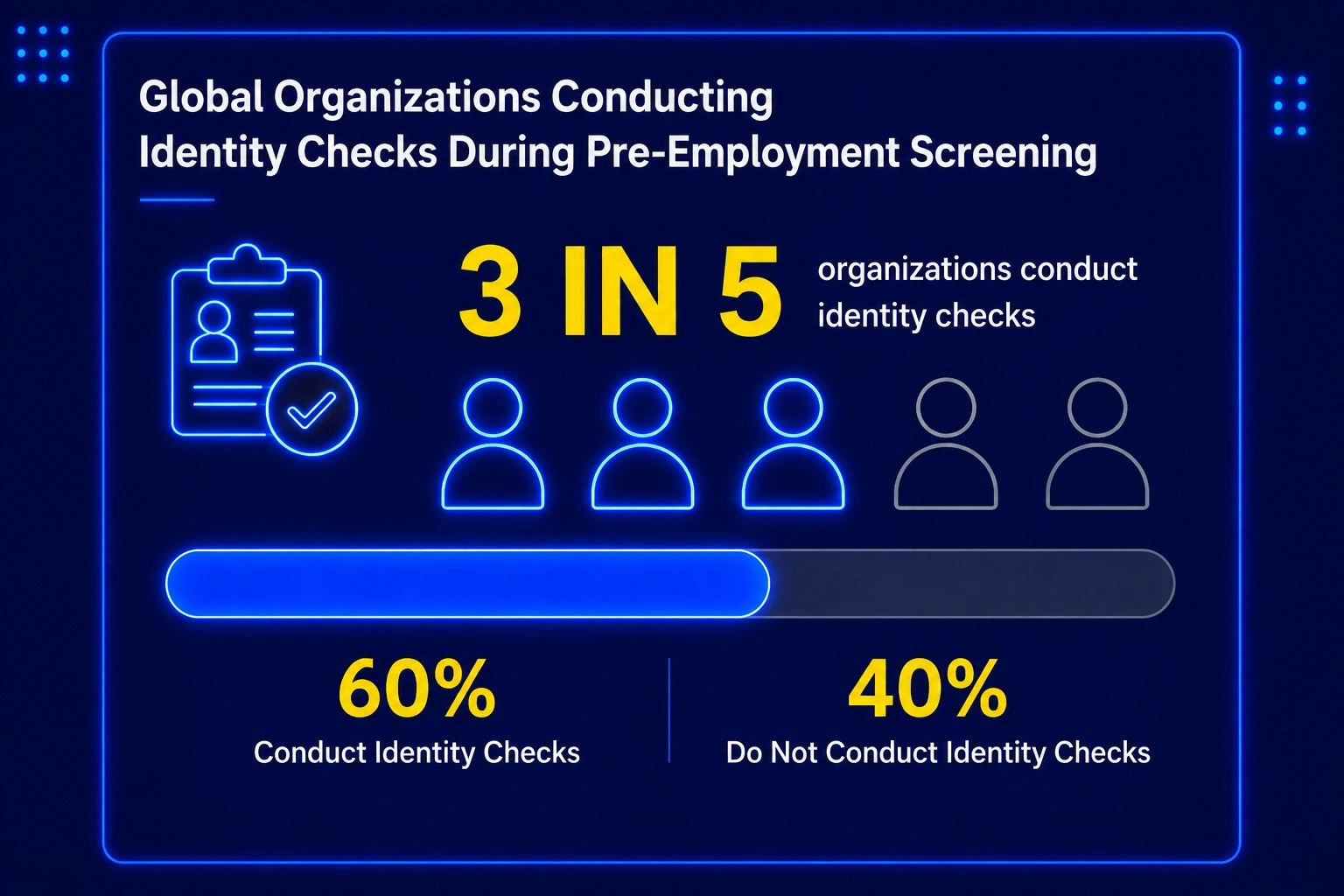
54. Only 3 in 5 Companies Globally Conduct Identity Checks During Pre-Employment Screening
HireRight's 2025 Global Benchmark Report found that only 3 in 5 organizations globally said they conduct identity checks as part of their pre-employment screening process. This means roughly 40% of organizations do not report routinely conducting identity checks as part of their screening program.
What This Means?
The growing availability of AI-generated identities, manipulated documents, and deepfakes makes identity verification increasingly important. Yet a significant proportion of employers may still be making hiring decisions without formally verifying that the candidate is who they claim to be.
For organizations hiring remotely, identity verification can help close a critical gap between evaluating a candidate and confirming the candidate's real-world identity.
Source: HireRight - 2025 Global Benchmark Report
55. 77% of HR Professionals Are Extremely Concerned About Deepfake-Driven Identity Fraud
A Genius HRTech report based on responses from 1,316 professionals in December 2025 found that 77% of respondents were extremely concerned about deepfake-driven identity fraud or AI-generated resumes and documents.
The report also found that 74% identified fake degrees or forged documents as their top concern, showing that identity and credential fraud remain major risks as recruitment becomes increasingly digital.
What This Means?
Deepfakes can make identity fraud substantially harder to detect because the deception can extend beyond written application materials to a candidate's face, voice, and digital presence.
For employers, the growing concern reinforces the need for stronger authentication mechanisms and verification throughout the hiring lifecycle rather than relying solely on traditional background checks.
Source: Economic Times - Fake degrees worry employers as remote hiring scales up
AI Cheating Costs & Business Impact
AI cheating can create costs that extend far beyond the assessment or interview itself. When an organization hires someone who misrepresented their skills or identity using AI, the consequences can include recruiting costs, lost productivity, delayed projects, re-hiring expenses, security incidents, compliance exposure, and damage to team performance.
The following statistics examine the broader business impact of AI-enabled cheating, candidate fraud, and inaccurate hiring decisions.
56. A Bad Hire Can Cost Up to One-Third of an Employee's First-Year Salary
AuthBridge's Workforce Fraud Files 2025, based on six months of background-verification data from October 2024 to March 2025, found that a bad hire can cost an organization up to one-third of the employee's first-year salary. The report also identified a 6% discrepancy rate among white-collar employees in India.
What This Means?
When AI-assisted applications or fraudulent credentials allow an unsuitable candidate to pass the hiring process, the financial impact isn't limited to the recruitment cost. Companies can also lose money through reduced productivity, replacement hiring, training, and management time.
For employers, validating candidate information before hiring can therefore have a measurable financial benefit.
Source: AuthBridge - Workforce Fraud Files 2025
57. 45% of IT Candidates in India Were Found to Be Moonlighting
EY India's 2025 employment-fraud study found that 45% of candidates in its IT-sector background-verification sample were identified as moonlighting through checks such as dual-employment verification or active GST registrations associated with their PAN. EY also found that 32% of IT candidates submitted fake documents from companies that did not exist or where the employer denied issuing the documents.
What This Means?
Remote and hybrid work can make it easier for employees to conceal multiple employment relationships. When fraudulent or misleading candidates enter an organization, the consequences can include confidentiality risks, reduced availability, conflicts of interest, and lost productivity.
Although moonlighting itself is not necessarily AI cheating, this statistic is relevant to the broader employment-fraud and business-impact category because remote hiring can make verification more difficult.
Source: EY India - The First Firewall: Background Checks as India Inc.'s Frontline Defense
58. 29% of Organizations Experienced Delayed Projects, Missed Revenue Targets, or Compliance Issues From Hiring Fraud
Research involving 3,000 hiring managers found that 29% said their organization had experienced delayed projects, missed revenue targets, or compliance issues as a direct result of fraudulent hires within the previous 12 months.
What This Means?
The impact of fraudulent hiring can extend well beyond HR. If someone is hired based on falsely demonstrated skills or qualifications, their lack of capability can affect project delivery, revenue targets, regulatory obligations, and other employees who depend on their work.
This is why AI-assisted hiring fraud should be viewed as a business-risk issue, rather than simply a recruitment problem.
Source: Checkr - The Hiring Hoax: What 3,000 Managers Revealed About Hiring Fraud in 2025
59. 64% of Employers Encounter Candidate Misrepresentation at Least Occasionally
The 2026 RPO Buyer Trends Report, produced by the RPO Association and Lighthouse Research & Advisory, found that 64% of employers encounter candidate misrepresentation at least occasionally. The report also found that 58% of employers want their RPO partner to help with fraud and risk mitigation.
What This Means?
Candidate misrepresentation is becoming an operational issue for a majority of employers rather than an isolated recruiting problem. As AI makes it easier to generate convincing resumes, credentials, and interview responses, employers increasingly need systems to validate candidate information.
The fact that 58% want external recruitment partners to help with fraud mitigation also shows that organizations are beginning to treat candidate fraud as a business-risk and process-management issue.
Source: RPO Association & Lighthouse Research & Advisory - 2026 RPO Buyer Trends Report
60. 61% of Staffing HR Leaders Encountered Hiring Fraud in the Past Year
The 2026 State of Screening Compliance Report for Staffing found that 61% of staffing HR leaders encountered hiring fraud during the previous year. The most common forms included resume or credential fabrication, document fraud, interview fraud, and identity fraud.
The report identified the leading organizational consequences as wasted recruiting time, increased sourcing costs from refilling roles, additional spending on fraud-detection technology, financial loss, and team burnout or morale issues.
What This Means?
Staffing organizations can be particularly exposed because they process large numbers of candidates and frequently place workers with client companies. Hiring fraud therefore creates costs not only for the staffing company but potentially for its clients as well.
For employers, this demonstrates that candidate fraud can directly increase the cost of recruiting and filling open positions.
Source: Checkr - 2026 State of Screening Compliance Report for Staffing
61. $600 Billion Is the Estimated Annual Cost of Candidate Fraud to U.S. Businesses
Jobvite reported an estimate that candidate fraud costs U.S. businesses more than $600 billion annually. The estimate was discussed in Jobvite's 2026 analysis of hiring in the AI era and includes the broader financial impact of candidate fraud rather than simply recruitment expenses.
What This Means?
The scale of the estimate illustrates why candidate fraud is increasingly being treated as a business and workforce risk, rather than solely an HR problem.
The impact can extend from wasted recruiting resources and replacement costs to investigations, productivity losses, and security exposure when fraudulent candidates gain access to organizational systems.
Source: Jobvite- Early Screening in the AI Era
AI Tools Used for Cheating
The rise of generative AI has given students, candidates, and test-takers access to a wide range of tools that can provide unauthorized assistance during assessments, assignments, interviews, and exams. While tools such as ChatGPT, Gemini, Claude, and AI coding assistants can have legitimate educational and professional uses, they can also be used to generate answers, solve problems, write code, complete assignments, or provide real-time responses when AI assistance is prohibited.
The following statistics examine which AI tools are being used, how frequently they are used, and the percentage of students or candidates relying on them for potentially unauthorized assistance.
62. 5% of Students Reported Turning in ChatGPT Output as Their Own
A WGU Labs survey of college students found that 5% of students reported turning in ChatGPT-generated output as their own response, up from 3% in the previous year's survey. Among students who were aware of ChatGPT, 7% reported using it to cheat.
What This Means?
The statistic shows that ChatGPT is not being used only for legitimate academic assistance. A measurable share of students reported directly submitting AI-generated material as their own work.
For educators and assessment providers, this distinction is important because AI adoption and AI cheating are not the same thing. The risk arises when students use AI-generated answers without disclosure or when AI use violates the rules of an assessment.
Source: WGU Labs - Student Perspectives on AI in Higher Education
63. 45% of AI Interview Cheating Cases Involved Dedicated Tools Like Cluely and Interview Coder
Fabric analyzed 19,368 AI-powered interviews conducted between July 2025 and January 2026. Among the interviews flagged for cheating, 45% involved dedicated AI interview assistants such as Cluely and Interview Coder.
For comparison, 34% involved voice mode on general-purpose LLMs such as ChatGPT, while 18% involved traditional methods such as tab switching or a second screen, and 3% involved live assistance from another person.
What This Means?
AI cheating during interviews is increasingly shifting away from obvious methods such as opening another browser tab or using a second screen. Candidates are increasingly using purpose-built AI interview copilots designed to listen to interview questions and provide answers in real time.
Tools such as Cluely and Interview Coder are particularly relevant because they are designed to operate alongside the interview while attempting to remain invisible to screen sharing and recording.
For employers, this creates a major limitation for traditional monitoring. Simply checking whether a candidate switched tabs or opened another application may not be enough to identify AI-assisted interview cheating.
Source: Fabric - State of AI Interview Cheating in 2026: Insights from 19,368 Interviews
64. Fabric Flagged a Cluely-Assisted Interview With an 85% Cheating Probability
Fabric conducted a controlled experiment using Cluely, an AI interview assistant designed to listen to interview questions and provide real-time answers through an invisible overlay. During the test interview, Fabric's detection system assigned the session an 85% probability of cheating. Fabric reported that Cluely successfully captured the interviewer's questions, generated answers within seconds, and displayed them through its overlay.
What This Means?
The experiment demonstrates that dedicated AI interview copilots can provide real-time assistance during an actual interview interaction, rather than simply helping candidates prepare beforehand.
Cluely was able to listen to questions and generate technically relevant responses quickly enough to support the candidate during the conversation. However, Fabric's detection system was still able to identify signals associated with the tool's use.
For employers, this shows why traditional controls such as screen sharing may not be sufficient to establish that a candidate is answering independently.
Source: Fabric, How Fabric Detects Cluely: Full Report Included Fabric: How Fabric Detects Cluely
65. 9% of Job Seekers Have Used an AI Interview Copilot During a Live Interview
A 2026 JobLeads survey found that 9% of job seekers said they had used an AI interview copilot to secretly help them perform better during a live online interview. These tools listen to the interview, transcribe the interviewer's question, and provide suggested answers in real time.
What This Means?
This is directly relevant to AI interview cheating because the statistic measures actual use of an AI copilot during a live interview, rather than general AI adoption or interview preparation.
The emergence of dedicated interview copilots means candidates can receive real-time assistance while still appearing to answer questions themselves. This can make it difficult for interviewers to determine whether a candidate's responses reflect their own knowledge and problem-solving ability.
For employers, this increases the importance of using follow-up questions, live problem-solving, and other methods that require candidates to demonstrate independent understanding.
Source: JobLeads, AI Interviews in 2026: How Recruiters Use AI & Why Candidates Hate It
66. 83% of Candidates Would Use AI Assistance During a Technical Interview If They Believed They Wouldn't Be Caught
A 2026 survey by CodePanion found that 83% of candidates said they would use AI assistance during a technical interview if they believed the employer would not detect it. The research specifically discusses real-time AI interview assistants and tools such as ChatGPT, Claude, Cluely, and Interview Coder.
What This Means?
The statistic highlights how the availability of real-time AI interview tools is changing candidate behavior. The main barrier for many candidates may not be whether AI assistance is technically possible, but whether they believe they can use it without being detected.
Tools such as AI interview copilots can listen to interview questions, process them through an LLM, and provide suggested answers while the interview is taking place.
For employers, this means simply telling candidates not to use AI may not be sufficient. Interview processes increasingly need mechanisms that can validate whether the candidate can independently explain their answers and demonstrate the underlying skills.
Source: CodePanion research, Why 83% of Candidates Would Cheat With AI (And How Companies Fight Back)
67. 45% of AI-Cheating Candidates Used Dedicated Interview Copilot Tools
An analysis of 19,368 interviews found that among candidates flagged for AI-assisted cheating, 45% used dedicated AI interview tools such as Cluely and Interview Coder. These tools provide real-time assistance during interviews through features such as screen overlays, transcription, and AI-generated answers.
What This Means?
This shows that AI interview cheating is increasingly moving from general-purpose tools such as ChatGPT to purpose-built interview copilots.
Tools such as Cluely and Interview Coder are specifically designed to assist candidates while an interview is happening. They can process interview questions and provide suggested responses without necessarily appearing in a conventional screen share.
For employers, this creates a different challenge from traditional ChatGPT use. Standard tab monitoring or screen sharing may not be sufficient when the AI assistance operates through an overlay or another device.
Source: Prepto, 38% of Candidates Are Cheating in Interviews. Here's What That Means for You
68. 26.9% of Candidates Reported Using AI During a Live Interview
A 2026 study by GCheck surveyed 1,500 respondents and found that 403 people, or 26.9%, reported using AI during a live interview. The study specifically defined this as using AI in real time while the interview was in progress, rather than using AI only for preparation.
What This Means?
This is directly relevant to AI interview cheating because the statistic measures real-time AI use during the interview itself, rather than general AI adoption or interview preparation.
The study also found that this live-AI group had additional forms of interview deception. For example, 51.1% of candidates who used AI during a live interview also reported using an AI avatar to impersonate themselves, while 57.1% used AI to overstate qualifications on their resumes.
For employers, this shows that AI-assisted interview fraud can involve multiple layers of deception, from generating answers in real time to manipulating the candidate's identity and qualifications.
Source: GCheck, AI Hiring Fraud: A Growing Concern in Recruitment
69. 51.1% of Live-AI Users Also Used an AI Avatar
Among the 403 candidates who reported using AI during a live interview in GCheck's 2026 survey, 51.1% also reported using an AI avatar to impersonate themselves during a virtual meeting.
What This Means?
This is particularly relevant to your AI Tools Used for Cheating section because it shows candidates combining real-time AI assistance with AI-generated identity manipulation.
Instead of simply receiving suggested answers, some candidates reported using an AI-generated avatar while participating in the interview. This can make it harder for recruiters to determine whether they are interacting with the actual candidate.
Source: GCheck, AI Hiring Fraud: A Growing Concern in Recruitment
70. 93.3% of Candidates Using AI Live During Interviews Used Another Remote-Cheating Method
GCheck found that 93.3% of candidates who reported using AI during a live interview also exploited remote-interview conditions in at least one additional way. These methods included reviewing off-camera notes, receiving real-time assistance from another person, or having someone else complete a technical assessment.
What This Means?
This suggests that AI interview cheating can be part of a broader cheating workflow rather than a standalone tool.
A candidate may simultaneously use an AI assistant, hidden notes, another person, or a proxy to improve their chances of passing a remote interview. For employers, this makes identity verification and independent skill validation increasingly important.
Source: GCheck, AI Hiring Fraud: A Growing Concern in Recruitment
71. 27% of Job Seekers Used AI to Generate Answers During Live Interviews
GCheck's 2026 Trust in Hiring Report, based on a survey of 1,500 respondents, found that 27% of job seekers reported using AI during a live interview to generate answers in real time. The same research separately measured AI use for interview preparation, take-home assignments, and AI avatars, so this figure specifically concerns active AI assistance during the interview.
What This Means?
This is different from simply using ChatGPT to prepare before an interview. The candidates in this group reported using AI while the interview was actually taking place, allowing the technology to help formulate responses in real time.
This type of assistance can include AI interview copilots that listen to questions, transcribe conversations, and surface suggested answers while the candidate is speaking with the interviewer.
For employers, this creates a growing challenge for remote interviews because a candidate can receive AI assistance without necessarily sharing the AI tool on screen.
Source: GCheck, 2026 Trust in Hiring Report
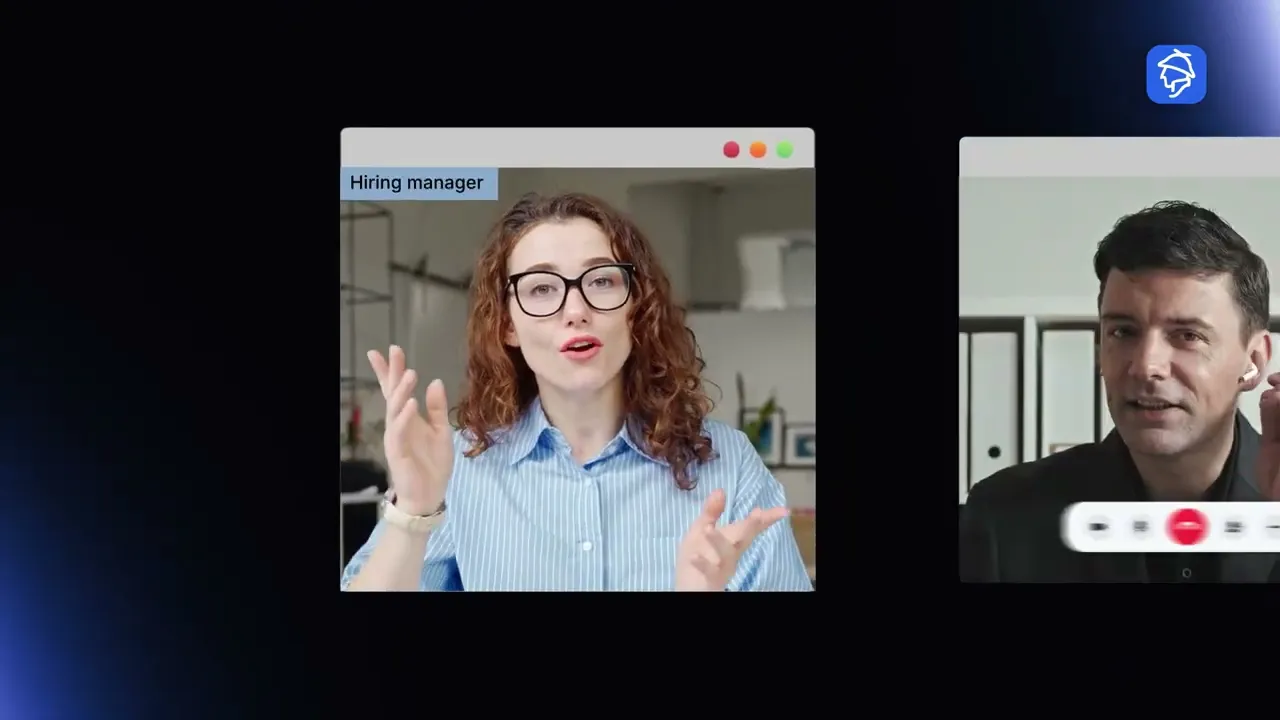
AI Cheating in Interviews
AI cheating in interviews occurs when candidates use artificial intelligence to gain unauthorized assistance while an interview is taking place. This can include real-time AI copilots that listen to interview questions and generate suggested answers, AI tools that transcribe conversations, coding assistants that solve technical problems, hidden AI overlays, voice-based assistants, and AI systems that help candidates respond without independently demonstrating their knowledge.
The issue has become especially relevant in remote interviews because candidates can potentially use AI assistance through another browser, device, overlay, or voice interface while continuing to appear engaged with the interviewer. Recent research also suggests that interview cheating is becoming more difficult to distinguish from genuine candidate performance.
The following statistics focus specifically on AI-assisted cheating during job interviews, including real-time AI assistance, AI-generated answers, interview copilots, and candidates using AI while being evaluated.
72. 20% of Job Seekers Have Used AI That Listens to Interview Questions and Feeds Them Answers
A 2026 LeanIn.Org survey found that 20% of male job seekers and 10% of female job seekers said they had used AI tools that listen to interview questions and feed them answers. The research describes this as real-time AI assistance during interviews rather than ordinary interview preparation.
What This Means?
This is exactly the type of AI-assisted interview cheating that creates an integrity problem. Instead of simply using AI to prepare beforehand, candidates can use a tool during the interview that listens to the interviewer's question and provides an answer in real time.
The finding also shows that this behavior is not limited to technical interviews. Any remote interview where candidates can access an AI listening and response tool can potentially be affected.
For employers, this makes it increasingly important to distinguish between AI-assisted preparation and AI assistance during the actual evaluation. Follow-up questions, live problem-solving, and verification of specific claims can make it harder for candidates to rely entirely on generated responses.
Source: LeanIn.Org, New research: Men are twice as likely to use AI in job interviews
73. 22% of Candidates Reported Using AI During Live Job Interviews
A 2026 Resume Genius Job Seeker Insights Report found that 22% of candidates said they were already using AI during live job interviews. The finding specifically concerns AI use while the interview is taking place, rather than using AI beforehand for interview preparation.
What This Means?
This is directly relevant to AI cheating in interviews because it measures AI assistance during the live evaluation.
Real-time AI tools can listen to interview questions, generate suggested responses, and help candidates formulate answers while they are speaking with the interviewer. This creates a risk that the interview score reflects the candidate's access to AI assistance rather than their independent knowledge or communication ability.
For employers, the distinction between AI-assisted preparation and AI-assisted interviewing is becoming increasingly important. Clear AI-use policies and follow-up questions that require candidates to demonstrate genuine experience can help reduce this risk.
Source: Meeting Copilot
74. Employers Have Reported Candidates Bringing Their Own AI Bot Into Interviews
LinkedIn Talent Solutions reported that one of its clients encountered a candidate who invited their own personal AI bot to join a Zoom interview. The bot appeared to be taking notes, but was actually listening to the interviewer's questions and providing the candidate with answers in real time.
What This Means?
This is a concrete example of a new form of interview cheating: candidates can use an AI assistant that participates in the interview environment and provides real-time prompting rather than simply using ChatGPT before the interview.
It also shows why AI cheating can be difficult to detect. The candidate does not necessarily need to open another visible browser tab or constantly look away from the camera. An AI bot can operate alongside the interview and provide assistance while the candidate continues interacting normally.
For employers, this makes it important to establish clear rules about whether external AI participants, transcription bots, copilots, or other real-time AI assistance are permitted during interviews.
Source: LinkedIn Talent Solutions, What Talent Leaders Need to Know and Do About the Upsurge in Candidate Cheating
75. A Candidate Was Caught Using an AI Chatbot During a Machine-Learning Interview
In July 2026, a Bay Area recruiter reported catching a candidate using an AI chatbot during a machine-learning system-design interview. When the recruiter asked the candidate to share their screen, the candidate froze and an AI chatbot window was briefly visible. The recruiter then terminated the interview for using unauthorized AI assistance.
What This Means?
This demonstrates how candidates can use AI assistance during highly technical interviews without necessarily making the AI visible to the interviewer.
The incident is particularly relevant to remote technical hiring because AI can potentially generate explanations, architecture suggestions, code, or answers while the candidate presents them as their own.
For employers, screen sharing, follow-up questions, and asking candidates to explain their reasoning step by step can make this type of assistance easier to identify.
Source: NDTV, Candidate Using AI Freezes During Interview After Recruiter Asks Him To Share Screen
76. 52% of Job Seekers Would Use AI to Feed Them Answers During an Interview
A 2025 Resume.io survey of 3,018 job seekers found that 52% said they would use AI to feed them answers during a live job interview. The survey specifically examined candidates' willingness to use AI assistance while answering interview questions, rather than simply using AI for preparation beforehand.
What This Means?
The finding shows how real-time AI assistance can become a form of interview cheating when candidates use it to generate or suggest answers during the actual evaluation.
More than half of the surveyed job seekers indicated they would be willing to use this type of assistance, suggesting that access to real-time AI could significantly change how candidates approach remote interviews.
For employers, this makes it increasingly important to clearly define whether AI assistance is permitted during interviews and to use follow-up questions or live problem-solving exercises that require candidates to demonstrate their own knowledge.
Source: Resume.io - 1-in-3 Job Seekers Use AI to Scrape Interview Questions
77. 47% of Job Seekers Consider AI Interview Preparation Cheating
A 2025 Resume.io survey of 3,018 job seekers found that 47% considered using AI to prepare for job interviews to be cheating, while 53% viewed it as smart preparation. The survey examined how candidates were using AI to scrape likely interview questions and rehearse answers before interviews.
What This Means?
Nearly half of job seekers already view AI-assisted interview preparation as crossing an ethical line. The finding highlights how AI is blurring the distinction between legitimate interview preparation and unfair assistance.
As AI tools become more capable of generating personalized interview questions and answers, candidates and employers may increasingly need clearer rules around what types of AI assistance are acceptable during the hiring process.
Source: Resume.io - 1-in-3 Job Seekers Use AI to Scrape Interview Questions
78. 6% of Candidates Admitted to Participating in Interview Fraud
A 2025 Gartner survey of 3,000 job candidates found that 6% admitted to participating in interview fraud, either by posing as someone else during an interview or having another person pose as them. Gartner defined this as part of the broader rise in candidate fraud associated with AI-enabled hiring.
What This Means?
Interview cheating is extending beyond candidates using AI to generate answers. Identity-based fraud can allow someone other than the actual candidate to participate in the interview, making it harder for employers to verify whether the person being evaluated is genuinely the person who applied.
As AI makes identity manipulation and remote impersonation easier, employers may need stronger identity-verification measures alongside traditional interview methods.
Source: Gartner - Just 26% of Job Applicants Trust AI Will Fairly Evaluate Them
79. 13% of Candidates Reported Using Generative AI in Real Time During Interviews
A 2025 Gartner survey found that 13% of candidates reported using generative AI in real time during an interview. The figure was even higher in the Asia-Pacific region, where 18% of candidates reported using generative AI while being interviewed.
What This Means?
Real-time AI assistance is becoming part of the interview process itself, rather than being limited to preparation before the interview. Candidates can use generative AI to help formulate answers while the evaluation is taking place.
The higher rate reported in Asia-Pacific also shows that the use of AI during live interviews can vary by region, making it an increasingly important consideration for employers conducting remote and international hiring.
Source: HR Dive - Human Touch vs. AI: Navigating the New Hiring Landscape
80. 19% of Job Seekers Consider Using AI During a Live Interview to Be Cheating
A 2025 survey of U.S. job seekers found that 19% considered using AI during a live interview to be cheating. The research also found that candidates' views on acceptable AI use varied considerably, with some job seekers treating AI assistance as a normal part of the modern hiring process.
What This Means?
The finding shows that candidates do not have a universal definition of what constitutes AI cheating during interviews. While some candidates see real-time AI assistance as unacceptable, others may view it as another form of technology-assisted preparation.
This growing difference in attitudes can make it harder for employers to establish clear expectations around AI use during interviews.
Source: PR Newswire - Only 7% of Candidates Say the Job Market Favors Them
81. 45% of Job Seekers Use AI for Interview Preparation
A 2025 survey of U.S. job seekers found that 45% use AI tools to prepare for job interviews. The same research found that 28% use AI to generate fake work samples, showing that AI use is extending beyond conventional interview preparation into areas that can directly affect how candidates are evaluated.
What This Means?
AI is becoming a routine part of the interview preparation process, but its use is also expanding into activities that can misrepresent a candidate's actual skills and experience.
The distinction between legitimate preparation and AI-assisted misrepresentation is therefore becoming increasingly important as candidates gain access to more sophisticated AI tools.
Source: PR Newswire - Only 7% of Candidates Say the Job Market Favors Them
AI Cheating Trends Over Time
The rise of generative AI has changed candidate cheating from a relatively limited concern into a growing issue across recruitment and pre-hire assessments. As AI tools have become more accessible and capable, candidates have gained easier access to real-time assistance, while employers have increasingly reported concerns about the authenticity of candidate responses. The following statistics highlight how AI-assisted cheating and candidate AI use have changed over time, including changes in usage, employer detection, and the effectiveness of measures designed to discourage cheating.
82. Self-Reported Generative AI Use in Pre-Hire Assessments Increased From 2024 to 2025
A 2026 study published in the International Journal of Selection and Assessment examined 9,031 applicants across two studies conducted in Q3 2024 and Q3 2025. In 2024, fewer than 3% of applicants in the control group reported using generative AI during the assessment. By 2025, more than 23% of control participants reported using GenAI at least to some extent, showing a substantial increase in self-reported AI use over the one-year period.
What This Means?
The increase shows how quickly generative AI use has become more common in recruitment assessments. The researchers kept the assessment structure and applicant demographics largely consistent across both years, making the increase particularly relevant as evidence of changing candidate behavior rather than simply a change in the assessment itself.
As AI tools become more widely integrated into everyday activities, candidates may increasingly view them as legitimate assistance or as an effective shortcut during recruitment assessments.
Source: International Journal of Selection and Assessment - Candidate Generative AI Use in Pre-Hire Employment Assessments
83. Frequent Recruitment Cheating More Than Doubled From 7% to 15% in One Year
The Institute of Student Employers (ISE) reported that the proportion of employers who frequently encountered cheating during recruitment more than doubled, rising from 7% in 2024 to 15% in 2025. During the same period, the share of employers who had never suspected or identified cheating fell from 22% to 15%.
What This Means?
The sharp year-over-year increase suggests that cheating is becoming a more visible and frequent problem in recruitment rather than remaining an occasional issue.
The decline in employers reporting that they had never encountered suspected cheating further indicates that recruitment teams are increasingly coming across candidates using unauthorized assistance during assessments and interviews.
Source: Institute of Student Employers - How are employers using AI in early careers recruitment?
84. 65% of Hiring Managers Were Concerned About Candidates Using GenAI to Cheat
A 2025 Talogy study surveyed 560 hiring managers, 564 early-career professionals, and 138 job seekers about AI use in recruitment. It found that 65% of hiring managers were somewhat or very concerned about candidates using generative AI such as ChatGPT to cheat on recruitment assessments.
What This Means?
Employer concern about AI-assisted cheating is already substantially higher than the proportion of candidates who say they are willing to use AI for this purpose. This gap suggests that hiring teams may perceive AI cheating as a larger emerging threat than current self-reported candidate behavior indicates.
The finding also shows how employer concerns are evolving as AI becomes increasingly accessible during recruitment.
Source: Talogy - Navigating AI Cheating in Early Talent Hiring
85. 59% of Students and Graduates Have Used or Would Use GenAI in Selection and Assessment
A 2024 Arctic Shores study found that 59% of students and graduates had used or would use generative AI during the selection and assessment process. The research also found that 88% were using GenAI tools every week, showing how quickly AI had become embedded in the daily habits of early-career candidates.
What This Means?
GenAI use is becoming increasingly normalized among students and graduates entering the workforce. With nearly six in ten saying they have used or would use AI during selection and assessment, employers are facing a growing challenge in distinguishing legitimate AI-assisted work from unauthorized assistance.
The finding also highlights how the rapid growth of everyday GenAI use can influence candidate behavior during hiring, particularly among younger applicants who are already highly familiar with these tools.
Source: Arctic Shores - New data reveals candidate use of GenAI is growing faster than we could have possibly predicted
86. 29% of Job Seekers Used AI to Generate Answers to Interview Questions
Capterra's 2024 survey of 2,997 active job seekers across 12 countries found that 29% had used AI to generate answers to interview questions. The research also found that 27% had used AI to complete a test assignment or skills assessment.
What This Means?
AI use is moving directly into the interview stage, rather than remaining limited to résumé and cover-letter preparation.
Nearly three in ten job seekers using AI reported using it specifically for interview answers, demonstrating how generative AI can influence the actual content candidates present during evaluation.
Source: Capterra - How Recruiters Can Get Ahead of Applicant AI Cheating
87. 73% of Recruiters Had Encountered AI-Enhanced Resumes
A 2025 SocialTalent survey found that 73% of recruiters had encountered AI-enhanced resumes. However, only 3% said they felt very confident in identifying AI-generated applications. SocialTalent conducted live polls during its Tackling AI-Driven Candidate Cheating event with recruitment professionals.
What This Means?
AI-generated or AI-enhanced applications are becoming increasingly common, while recruiter confidence in identifying them remains low.
The gap suggests that candidate use of AI is developing faster than many traditional recruitment processes can adapt, making it harder for employers to distinguish genuine candidate work from AI-assisted content.
Source: SocialTalent - AI, Cheating, and Hiring: How Talent Teams Can Stay Ahead
88. Only 2.1% of Candidates Said They Would Consider Using AI in a Real Assessment
A 2025–2026 Assessio research program involving 500+ applicants found that only 2.1% said they would consider using AI in a real assessment, while fewer than 10% used an unauthorized tool during the study. Assessio's research drew on multiple studies conducted during 2025–2026.
What This Means?
Not every candidate is willing to use AI to cheat when the assessment is an actual hiring evaluation. The relatively low willingness reported by Assessio contrasts with some much higher figures from candidate surveys, highlighting how cheating estimates can vary depending on whether researchers measure hypothetical willingness, self-reported behavior, or observed behavior.
The finding is useful for understanding the evolving gap between perceptions of AI cheating and what candidates actually do under controlled assessment conditions.
Source: Assessio - Integrity in Assessments: Faking, Cheating & AI in Hiring
89. 37% of Job Seekers Used ChatGPT for Help on Skills Assessments When It Was Not Allowed
A 2024 survey of 1,250 professionals who had searched for a job within the previous two years found that 37% had used ChatGPT for help with a pre-hiring skills assessment when such assistance was not allowed. The survey also found that 17% searched online for answers when prohibited.
What This Means?
AI-assisted cheating is becoming a significant part of how candidates circumvent traditional skills assessments. More than one-third of respondents reported using ChatGPT despite it being prohibited, showing how easily candidates can turn generative AI into an unauthorized source of assistance.
The finding also provides an early benchmark for AI-assisted cheating as generative AI became widely available, making it useful for understanding how candidate behavior has evolved during the AI era.
Source: WTOP - How Job Seekers Are ‘Cheating’ in the Hiring Process
90. 53% of Students Said Fear of Being Accused of Cheating Discourages AI Use
The 2025 HEPI/Kortext Student Generative AI Survey found that 53% of students said the possibility of being accused of cheating was a factor discouraging them from using AI. This was the most commonly cited deterrent, ahead of concerns about AI producing false or inaccurate information, cited by 51%.
What This Means?
The statistic shows that academic-integrity concerns can directly influence how students use generative AI. Students may avoid AI not because they lack access to it, but because they are uncertain whether using it could be considered cheating.
For universities, this reinforces the importance of clear AI-use policies that explain exactly what forms of AI assistance are permitted in assignments and assessments.
Source: HEPI - Student Generative AI Survey 2025
91. Two-Thirds of AI Cheating Cases at UNSW Were Treated as Low-Level Plagiarism
In 2024, UNSW recorded 530 cases involving unauthorised use of generative AI, up from 166 in 2023. Of the substantiated AI-related cases, two-thirds were detected and managed by individual schools as low-level plagiarism rather than being escalated as more serious misconduct.
What This Means?
AI cheating isn't always treated as a major disciplinary offense. At UNSW, most substantiated cases involving unauthorised generative AI use were handled as low-level plagiarism, suggesting that many incidents involved inappropriate AI assistance within otherwise ordinary academic work.
This is useful for your AI Cheating Trends Over Time section because it shows how universities are not only seeing more AI misuse, but are also classifying and managing a large share of these cases as plagiarism.
Source: UNSW - 2024 Student Conduct and Complaints Report
AI Fraud in Banking & Financial Sectors
The financial sector is becoming a major target for AI-enabled fraud as criminals use generative AI to create convincing deepfakes, synthetic identities, cloned voices, AI-generated phishing messages, and other forms of impersonation. These techniques can be used to deceive customers, employees, and financial institutions, making traditional identity and fraud controls harder to rely on. In 2025, financial-sector participants identified AI-enhanced social engineering and deepfake identity fraud among their most significant AI-related cybersecurity concerns.
92. 71% of Financial-Sector Participants Identified AI-Enhanced Social Engineering as Their Most Acute AI-Related Challenge
71% of participants in a 2025 financial-sector workshop identified AI-enhanced social engineering as the financial sector's most acute AI-related cybersecurity challenge. Deepfake identity fraud followed, with 40% of participants identifying it as a major concern.
What This Means?
AI is making social-engineering attacks more convincing by helping fraudsters create realistic messages, impersonate trusted individuals, and manipulate victims into revealing information or authorizing transactions. For banks and financial institutions, this means AI-enabled deception is becoming a significant fraud risk rather than simply a cybersecurity concern.
Source: Office of the Superintendent of Financial Institutions (OSFI) – FIFAI II Workshop
93. 42.5% of Fraud Attempts in the Financial Sector Now Involve AI
42.5% of fraud attempts detected in the financial and payments sector now involve AI, according to Signicat's Battle Against AI-Driven Identity Fraud report. The research also found that 29% of these AI-driven fraud attempts were considered successful. The study surveyed more than 1,200 fraud decision-makers across banks, fintechs, payment providers, and insurers in seven European countries.
What This Means?
AI is no longer being used only to improve legitimate financial services. Fraudsters are using AI to make deepfakes, synthetic identities, phishing campaigns, and other deceptive attacks more convincing and scalable. With almost half of detected financial-sector fraud attempts estimated to involve AI, financial institutions face a growing challenge in distinguishing legitimate customers from AI-assisted fraudsters.
Source: Signicat – 42.5% of Fraud Attempts Are Now AI-Driven
94. Deepfake Fraud Attempts Against Financial Institutions Increased 2,137% in Three Years
Financial institutions experienced a 2,137% increase in attempted deepfake fraud over a three-year period, according to Signicat's Battle Against AI-Driven Identity Fraud report. The research surveyed more than 1,200 fraud decision-makers across the financial and payments sectors in seven European countries and identified deepfakes as one of the three most common forms of identity fraud affecting the sector.
What This Means?
The dramatic increase shows how quickly generative AI has changed financial fraud. Criminals can use AI-generated faces, voices, and other synthetic media to impersonate legitimate customers or other trusted individuals, making identity verification significantly more difficult for banks and financial institutions.
As deepfake technology becomes more accessible, financial organizations need stronger identity-verification and fraud-detection systems that can identify AI-generated manipulation rather than relying solely on traditional authentication methods.
Source: Signicat – Fraud Attempts With Deepfakes Have Increased by 2,137%
95. 47.5% of Confirmed Financial Fraud Cases Involved Synthetic-Pattern Attacks
AU10TIX's Q1 2026 Financial Services Identity Fraud Intelligence Report found that 47.5% of confirmed fraud cases involved synthetic-pattern attacks, making them the most common fraud method detected across payments, banking, and trading platforms. The report analyzed verified identity transactions across the financial-services sector.
What This Means?
AI-generated and synthetic identities are becoming a major tool for financial fraud. Instead of simply modifying legitimate documents, fraudsters can increasingly construct identities and credentials from scratch, making traditional identity-verification methods harder to rely on.
Source: AU10TIX – Financial Services Identity Fraud Intelligence Report
96. 34.3% of Confirmed Financial Fraud Cases Involved Text Deepfakes
AU10TIX's Q1 2026 analysis found that text deepfakes accounted for 34.3% of confirmed fraud cases across payments, banking, and trading platforms. The company identified AI-generated identity manipulation as a dominant method in financial-services fraud.
What This Means?
AI-generated text can be used to create convincing identity documents, applications, communications, and other materials used during fraudulent onboarding or financial transactions. This makes it increasingly difficult for institutions to distinguish genuine information from AI-generated fraudulent content.
Source: AU10TIX – Financial Services Identity Fraud Intelligence Report
97. Deepfake Attacks Increased Twentyfold in Three Years
Federal Reserve Governor Michael Barr reported that deepfake attacks had increased twentyfold over the previous three years. He specifically highlighted their use in financial cybercrime, including impersonating bank customers and executives to facilitate fraudulent transactions.
What This Means?
The rapid growth of deepfake attacks creates a direct challenge for financial institutions that rely on visual or voice-based identity signals. AI can now generate convincing representations of real people, making traditional assumptions such as "I recognize this person's voice" increasingly unreliable.
Source: Federal Reserve – Speech by Governor Barr on Cybersecurity in the Banking System
98. More Than 50% of Fraud Involves AI
Feedzai's 2025 AI Trends in Fraud and Financial Crime Prevention report found that more than 50% of fraud involves artificial intelligence, including deepfakes, synthetic identities, and AI-powered phishing. The report also found that nine in ten banks were already using AI to detect fraud.
What This Means?
AI has become a tool for both sides of the fraud battle. Criminals can use generative AI to create more convincing fraudulent identities and scams, while financial institutions are increasingly deploying AI to detect those attacks.
Source: Feedzai – AI Trends in Fraud and Financial Crime Prevention
99. 83% of Indian AI-Voice-Scam Victims Suffered Financial Losses
A 2025 analysis cited by the Observer Research Foundation found that 83% of Indian victims of AI voice scams suffered monetary losses, while almost half of those victims lost more than ₹50,000. The same research found that 47% of Indian adults had either experienced or knew someone who had experienced an AI voice-cloning or deepfake scam.
What This Means?
AI voice cloning can turn familiar voices into powerful tools for financial deception. When scammers imitate relatives, bank representatives, executives, or other trusted individuals, victims may be more likely to disclose information or authorize financial transactions.
Source: Observer Research Foundation – Deepfakes and Financial Cybercrime in India
100. 35% of UK Businesses Were Targeted by AI-Related Fraud in Early 2025
Experian found that 35% of UK businesses reported being targeted by AI-related fraud in Q1 2025, up from 23% in the previous year. The AI-related techniques included deepfakes, identity theft, voice cloning, and synthetic identities. Retail banks were among the most affected sectors, with 48% reporting that they had been targeted.
What This Means?
AI fraud is no longer limited to isolated deepfake incidents. Businesses are increasingly encountering AI-enabled fraud attempts across identity verification, payments, account access, and impersonation. The increase from 23% to 35% in just one year indicates how quickly AI-assisted fraud is spreading.
Source: Experian – Surge in AI-Driven Fraud
Conclusion
AI cheating has evolved far beyond students using ChatGPT to complete assignments. As these 100 statistics show, generative AI is changing how people can cheat across academic assessments, online exams, coding tests, job interviews, recruitment, remote employment, and even financial services.
The biggest challenge is that AI itself is not inherently fraudulent. Students and professionals can use AI legitimately for learning, research, preparation, productivity, and communication. The problem begins when AI is used without authorization to misrepresent someone's knowledge, skills, identity, or qualifications.
The statistics also show that cheating is becoming more sophisticated. Real-time AI interview assistants, AI-generated resumes, deepfakes, voice cloning, synthetic identities, and other AI-enabled techniques can make it increasingly difficult for universities, employers, assessment providers, and financial institutions to determine whether they are evaluating a genuine person or an AI-assisted representation.
For organizations, the answer is not simply to ban AI or rely entirely on AI detectors. Stronger assessment design, identity verification, supervised evaluation, behavioral analysis, skills validation, human review, and clear AI-use policies will become increasingly important.
As AI capabilities continue to improve, the definition of cheating will also continue to evolve. Organizations that adapt their assessment and verification processes now will be better positioned to protect fairness, trust, and the integrity of their evaluations.
Stop AI Cheating Before It Becomes a Hiring Problem. Protect the integrity of your hiring process with Sherlock AI. |
|---|