Back to all blogs
Compare 15 recruitment analytics tools for 2026, including key features, reporting capabilities, hiring metrics, integrations, and ideal use cases.


Recruitment teams generate large amounts of data throughout the hiring process, from candidate sources and application volumes to interview activity, conversion rates, hiring speed, and recruitment costs. However, collecting this data is only the first step. Without effective analytics tools, hiring teams may struggle to understand what the data reveals about recruitment performance and where improvements are needed.
The need for better visibility is significant. According to Symphony Talent’s 2025 Talent Acquisition Outlook Report, 85% of talent acquisition professionals reported poor access to data across the recruitment funnel. Limited visibility can make it harder to identify candidate drop-off points, evaluate sourcing effectiveness, measure recruiter performance, and uncover bottlenecks in the hiring process.
Recruitment analytics tools help organizations turn hiring data into practical insights through dashboards, reports, and performance metrics. Depending on the platform, teams can track metrics such as time-to-hire, source of hire, pipeline conversion, cost-per-hire, offer acceptance, candidate experience, recruiter performance, and quality of hire. Some tools also provide more specialized analytics for areas such as skills assessment, talent intelligence, staffing operations, and interview integrity.
In this guide, we compare 15 recruitment analytics tools to consider in 2026, including their key features, analytics capabilities, and ideal use cases. We also cover the recruitment metrics worth tracking and the factors to consider when choosing an analytics platform for your hiring needs.
15 Recruitment Analytics Tools in 2026
Recruitment analytics tools vary widely in their focus. Some platforms provide analytics directly within an applicant tracking system (ATS), while others specialize in talent intelligence, skills assessment, staffing operations, or interview analytics. The right tool depends on the recruitment data your organization needs to measure and the stage of the hiring process where you need greater visibility.
The tools below cover different recruitment analytics use cases, from tracking candidate pipelines and hiring performance to analyzing assessment results, recruiter productivity, workforce outcomes, and interview integrity.
Here are 15 recruitment analytics tools to consider in 2026.
1. Sherlock AI - Interview Integrity Analytics
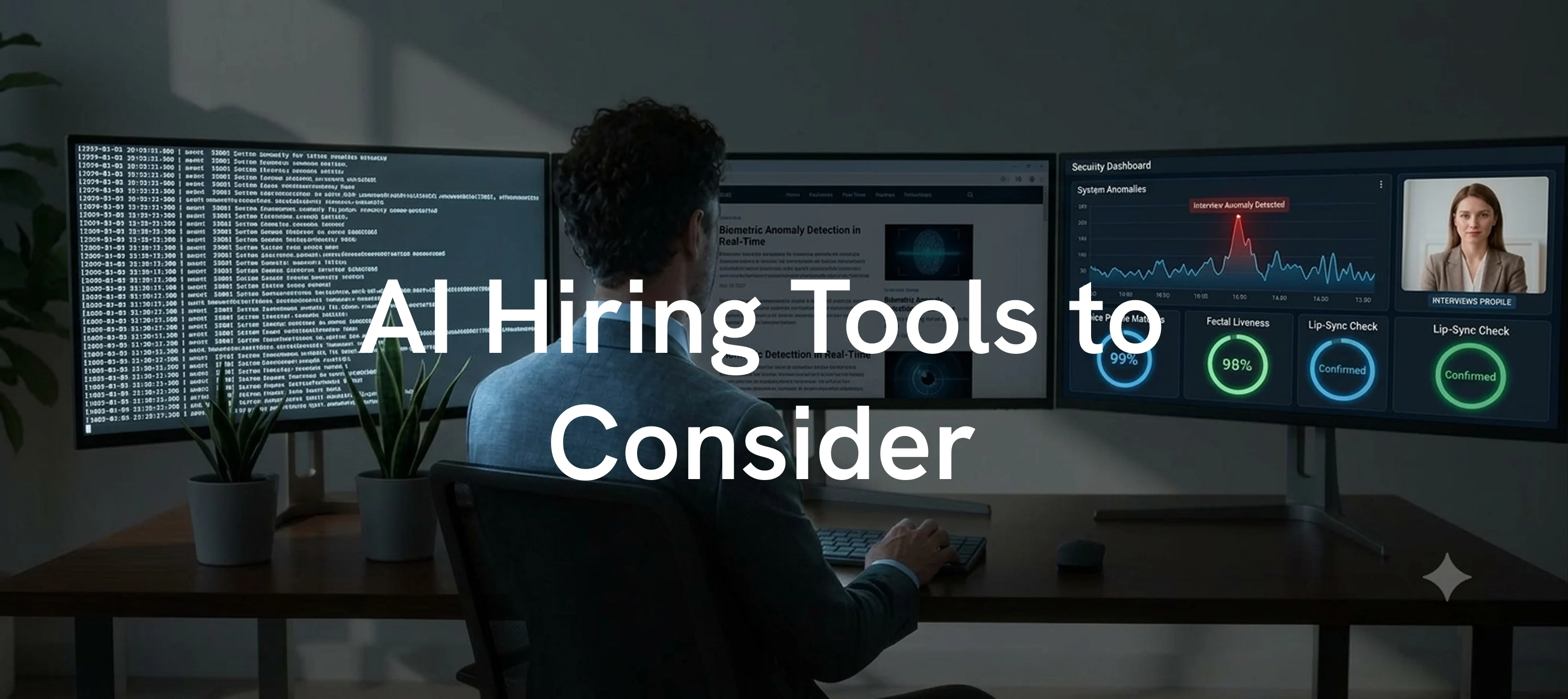
Sherlock AI is an interview integrity and candidate fraud detection platform designed for remote hiring teams. It analyzes interview behavior, identity signals, audio and video context, response patterns, and attention shifts to help hiring teams identify potential interview fraud and investigate suspicious activity.
The platform can surface signals associated with AI-assisted answering, proxy interviews, deepfakes, voice cloning, hidden external assistance, and identity inconsistencies. Rather than relying only on an automated risk score, Sherlock provides contextual and timestamped evidence that hiring teams can review before making a hiring decision.

Key Features
Real-Time Interview Integrity Analytics: Analyzes interview activity as it happens and highlights potentially suspicious moments that may require recruiter review.
Candidate Identity Verification: Evaluates identity-related signals during interviews to help detect inconsistencies and possible impersonation.
AI-Assisted Answering Detection: Examines response timing, answer patterns, attention shifts, and contextual signals that may indicate the use of external AI tools.
Proxy Interview Detection: Identifies behavioral and identity signals that may suggest someone other than the intended candidate is participating in the interview.
Deepfake Detection: Analyzes video for inconsistencies associated with synthetic faces, facial manipulation, or other forms of altered visual media.
Voice Cloning and Audio Analysis: Reviews audio signals for anomalies that may indicate cloned, altered, or manipulated voices.
Behavior and Response Pattern Analysis: Examines candidate behavior, response timing, attention patterns, and other contextual indicators to surface unusual interview activity.
Timestamped Evidence: Shows the exact moments when suspicious activity is detected, helping recruiters quickly review what happened during the interview.

Best For
Sherlock AI is best suited for organizations that conduct remote, high-volume, or high-stakes interviews and need greater visibility into candidate authenticity and interview integrity. It is particularly useful for hiring teams concerned about AI-assisted answering, proxy interviews, deepfakes, voice cloning, hidden external assistance, and identity inconsistencies.
Read more about: Sherlock AI (Anti-Interview-Fraud) Security Overview |
|---|
2. iMocha
iMocha is a skills and work intelligence platform that helps organizations make data-driven hiring and talent decisions. Its recruitment analytics capabilities provide insights into candidate performance, recruiter effectiveness, assessment results, and candidate engagement. The platform also supports custom reporting and integrations with ATS platforms, allowing recruitment teams to connect assessment and hiring data. It is particularly useful for organizations that want to combine skills assessment with recruitment analytics.
Key Features
Recruitment Analytics: Provides dashboards and reports for analyzing candidate performance, recruiter performance, candidate pipelines, assessment results, and engagement.
Skills-Based Assessment: Offers skills assessments that help recruiters evaluate candidates based on role-specific technical and functional capabilities.
Custom Reporting and Integrations: Allows organizations to create custom reports and connect iMocha with ATS platforms to maintain recruitment data in a more centralized workflow.
Overall, iMocha is well suited for organizations that want to combine recruitment analytics with skills-based assessments to make candidate evaluation more structured and data-driven.
3. Greenhouse
Greenhouse is an applicant tracking and hiring platform with extensive recruitment reporting and analytics capabilities. It provides more than 40 pre-built reports covering areas such as candidates, sources, jobs, offers, departments, and pipeline performance. Greenhouse also offers self-service analytics that allow teams to create custom reports, apply filters, and analyze recruitment data directly within the platform. Its analytics capabilities are designed to help recruiters and hiring leaders identify bottlenecks and make more data-informed hiring decisions.
Key Features
Pre-Built Recruitment Reports: Provides 40+ reports for analyzing hiring activity, sourcing, pipeline health, offers, departments, and other recruitment data.
Custom Analytics: Greenhouse Analytics allows users to select datasets such as applications, interviews, and offers, then apply filters, metrics, and groupings to build customized analyses.
BI Integrations: Recruitment data can be exported or connected with business intelligence platforms such as Tableau, Power BI, and Looker for deeper analysis.
Overall, Greenhouse is a suitable choice for teams that need detailed recruitment reporting, customizable analytics, and clear visibility into hiring performance within an established applicant tracking system.
4. Ashby
Ashby is a recruiting platform known for its real-time analytics and reporting capabilities. It brings recruiting data into a unified system so teams can analyze activities across the hiring lifecycle. Recruiters can use ready-made dashboards or create custom reports using filters, calculated fields, and different data views. Ashby also supports hiring-plan tracking, alerts, scheduled dashboard delivery, and detailed funnel analysis.
Key Features
Real-Time Recruiting Analytics: Provides real-time reports and dashboards covering recruiting activities and key hiring metrics.
Custom Report Builder: Allows teams to create reports using filters, calculated fields, groupings, and customizable visualizations.
Hiring Planning and Alerts: Supports recruiting plans, hiring progress tracking, data alerts, and scheduled dashboard deliveries.
Overall, Ashby is a strong fit for recruiting teams that want real-time analytics, flexible reporting, and deeper visibility into recruiting funnels, hiring plans, and overall talent acquisition performance.
5. Visier
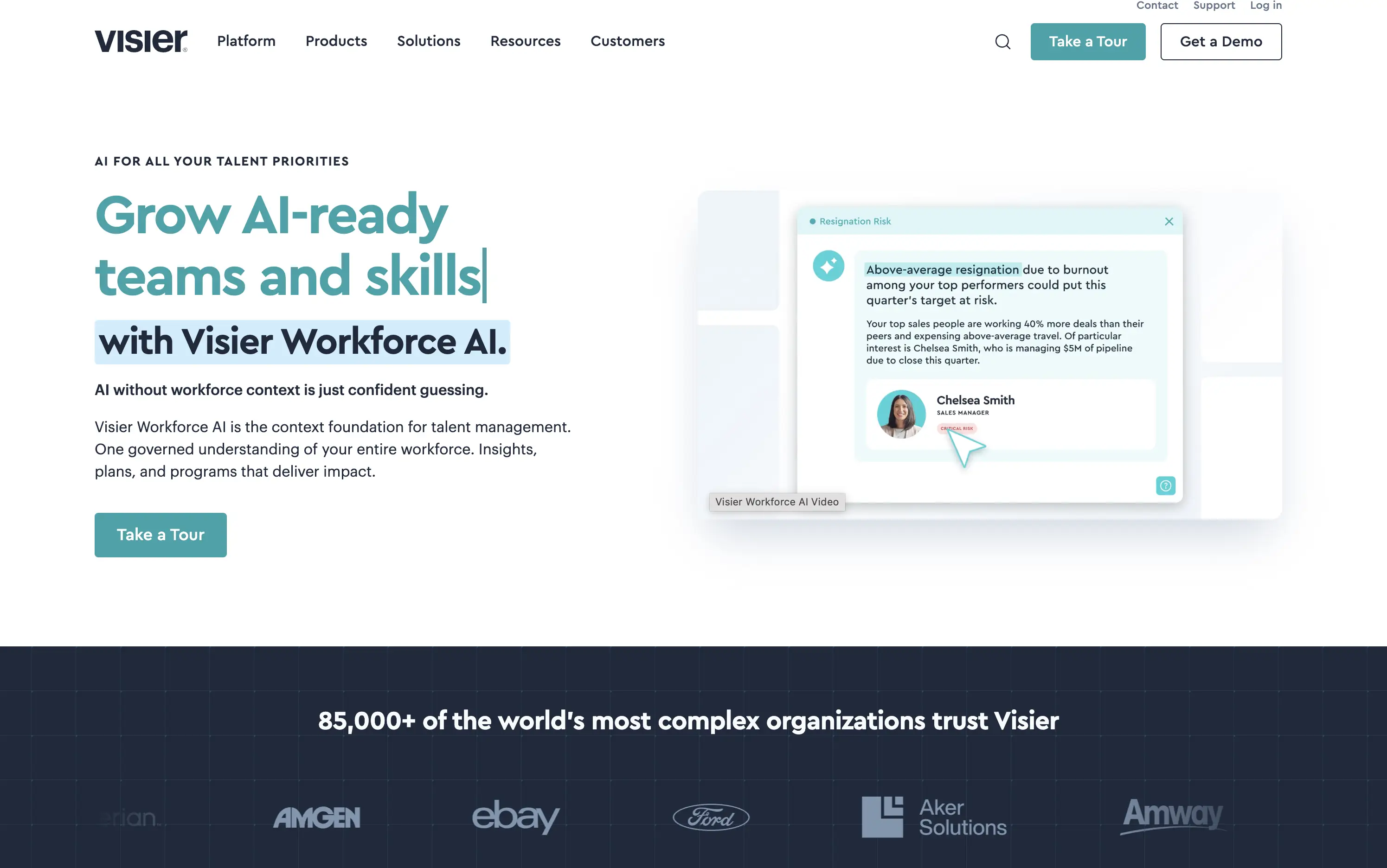
Visier is a people analytics platform with dedicated talent acquisition analytics capabilities. Unlike tools that focus primarily on ATS reporting, Visier can connect applicant data with employee data to examine outcomes beyond the initial hire. It provides visibility into recruiter workload, hiring costs, candidate sources, pipeline bottlenecks, and quality of hire. This makes it useful for organizations that want to connect recruitment performance with longer-term workforce outcomes.
Key Features
Talent Acquisition Analytics: Analyzes recruitment data across sourcing, candidate pipelines, hiring activity, costs, and recruiter performance.
Quality-of-Hire Insights: Connects applicant and employee data to help organizations examine the longer-term outcomes of their hiring decisions.
End-to-End Pipeline Analysis: Provides visibility into candidate sources, bottlenecks, abandoned applications, candidate experience, and other recruitment funnel signals.
Overall, Visier is particularly useful for organizations that want to go beyond basic recruitment reporting and connect hiring data with broader workforce insights and quality-of-hire outcomes.
6. Workable
Workable is an all-in-one hiring and HR platform with built-in recruitment reporting and analytics. Its Report Center provides recruiters with pre-built reports for monitoring candidate sources, hiring funnels, hiring velocity, time-to-hire, and other recruitment metrics. Teams can also create customized reports and dashboards using different recruitment data fields and filters. Workable is useful for organizations that want recruitment analytics integrated directly into their hiring workflow.
Key Features
Recruitment Reports: Provides reports for candidate sources, hiring funnels, hiring velocity, assessments, interviews, and other recruitment activities.
Custom Reports and Dashboards: Allows teams to create customized reports using different data fields, metrics, filters, charts, and KPIs.
Data Export and BI Integration: Recruitment data can be exported and connected with external business intelligence tools for deeper analysis.
Overall, Workable is a practical option for organizations looking for recruitment analytics alongside applicant tracking and hiring workflows, with reporting capabilities that cover core recruitment performance metrics.
7. iCIMS
iCIMS is an enterprise talent acquisition platform with recruitment analytics and reporting capabilities designed for organizations managing complex or high-volume hiring. Its analytics can help teams evaluate hiring sources, recruitment activity, candidate pipelines, and hiring performance. The platform also provides embedded analytics for high-volume hiring, giving organizations greater visibility into application volume, conversion rates, time spent in stages, and hiring velocity.
Key Features
Recruitment Analytics: Provides insights into metrics such as source effectiveness, candidate activity, hiring performance, and recruitment funnel data.
High-Volume Hiring Analytics: Provides embedded analytics for application volume, conversion rates, time-in-stage, hiring velocity, and other high-volume recruitment metrics.
Configurable Dashboards: Allows organizations to analyze recruitment data through dashboards and metrics tailored to their hiring operations.
Overall, iCIMS is designed for organizations with complex or high-volume hiring needs that require detailed recruitment analytics, configurable reporting, and visibility across different stages of the hiring process.
8. SmartRecruiters
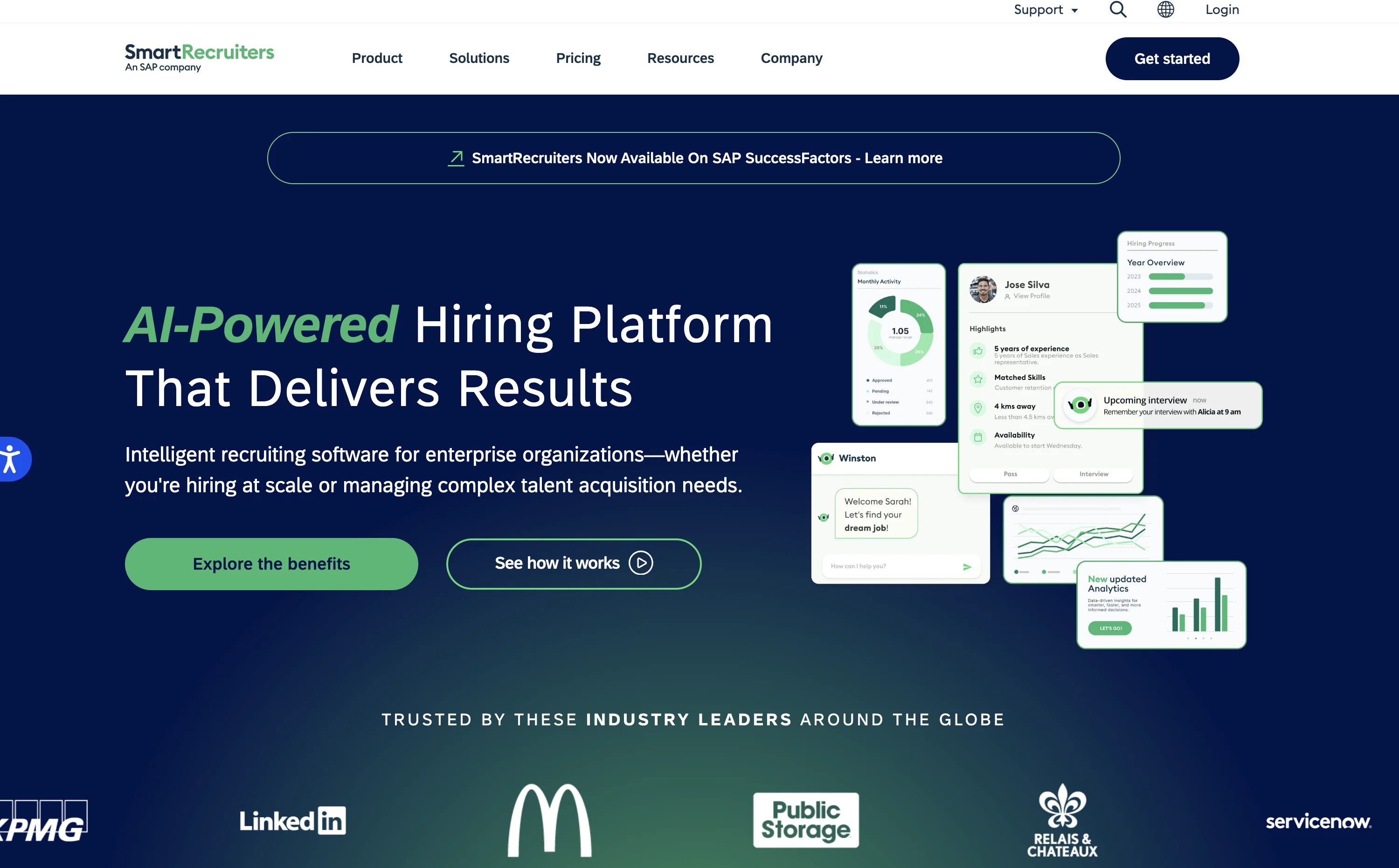
SmartRecruiters is an enterprise talent acquisition platform with SmartAnalytics for monitoring recruitment performance. Its analytics capabilities provide centralized access to recruiting metrics and allow teams to create customized dashboards and visualizations. Recruiters can analyze areas such as time-to-hire, candidate sources, candidate drop-off, and offer acceptance. The platform is designed to connect recruitment analytics directly with the broader hiring workflow.
Key Features
Real-Time Recruitment Analytics: Provides centralized access to recruitment metrics and reporting for monitoring hiring performance.
Custom Dashboards: Allows teams to create dashboards focused on specific KPIs, jobs, hiring trends, or organizational goals.
Data Visualization: Uses charts, comparisons, and visualizations to help recruitment teams identify trends, bottlenecks, and changes in hiring performance.
Overall, SmartRecruiters is a suitable option for enterprise hiring teams that want centralized recruitment analytics, customizable dashboards, and visual insights integrated into their broader talent acquisition workflow.
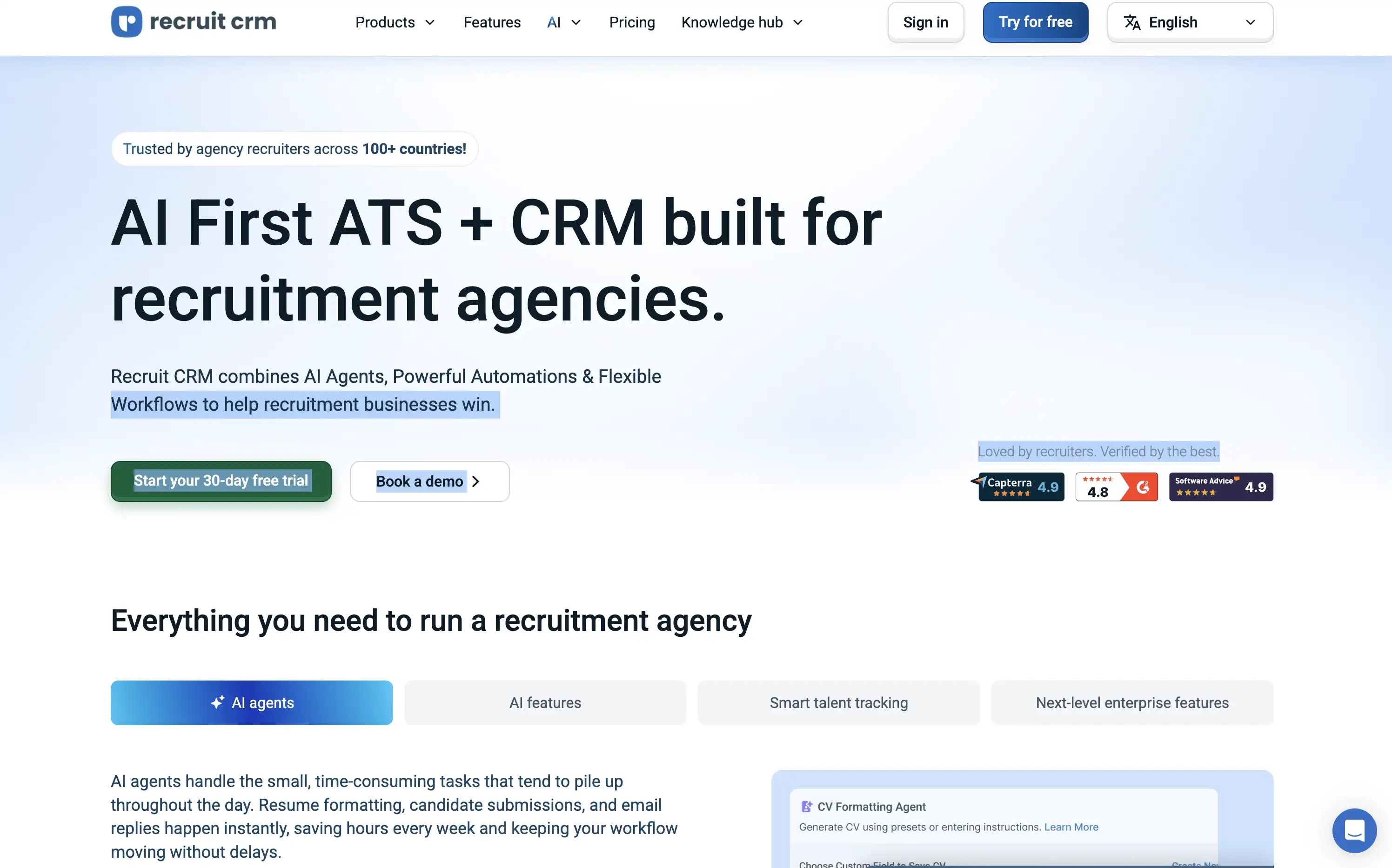
9. Recruit CRM
Recruit CRM is a recruitment CRM and applicant tracking platform with built-in reporting and analytics for recruitment agencies and staffing teams. It provides reports covering candidates, jobs, clients, deals, recruiters, and overall account activity. Recruiters can use its dashboards to monitor candidate pipelines, job performance, team activity, and time-to-hire. The platform also supports customizable and scheduled reports, making it useful for teams that want recruitment analytics connected directly to their daily operations.
Key Features
Candidate and Pipeline Analytics: Tracks candidate progression, lifecycle activity, and pipeline performance.
Team Performance Reporting: Measures recruiter and team activity using recruitment KPIs and interactive reports.
Custom and Scheduled Reports: Allows users to customize reports, save them, and automate their delivery.
Overall, Recruit CRM is particularly relevant for recruitment agencies and staffing teams that need to track candidate pipelines, recruiter activity, job performance, and client-related recruitment data in one platform.
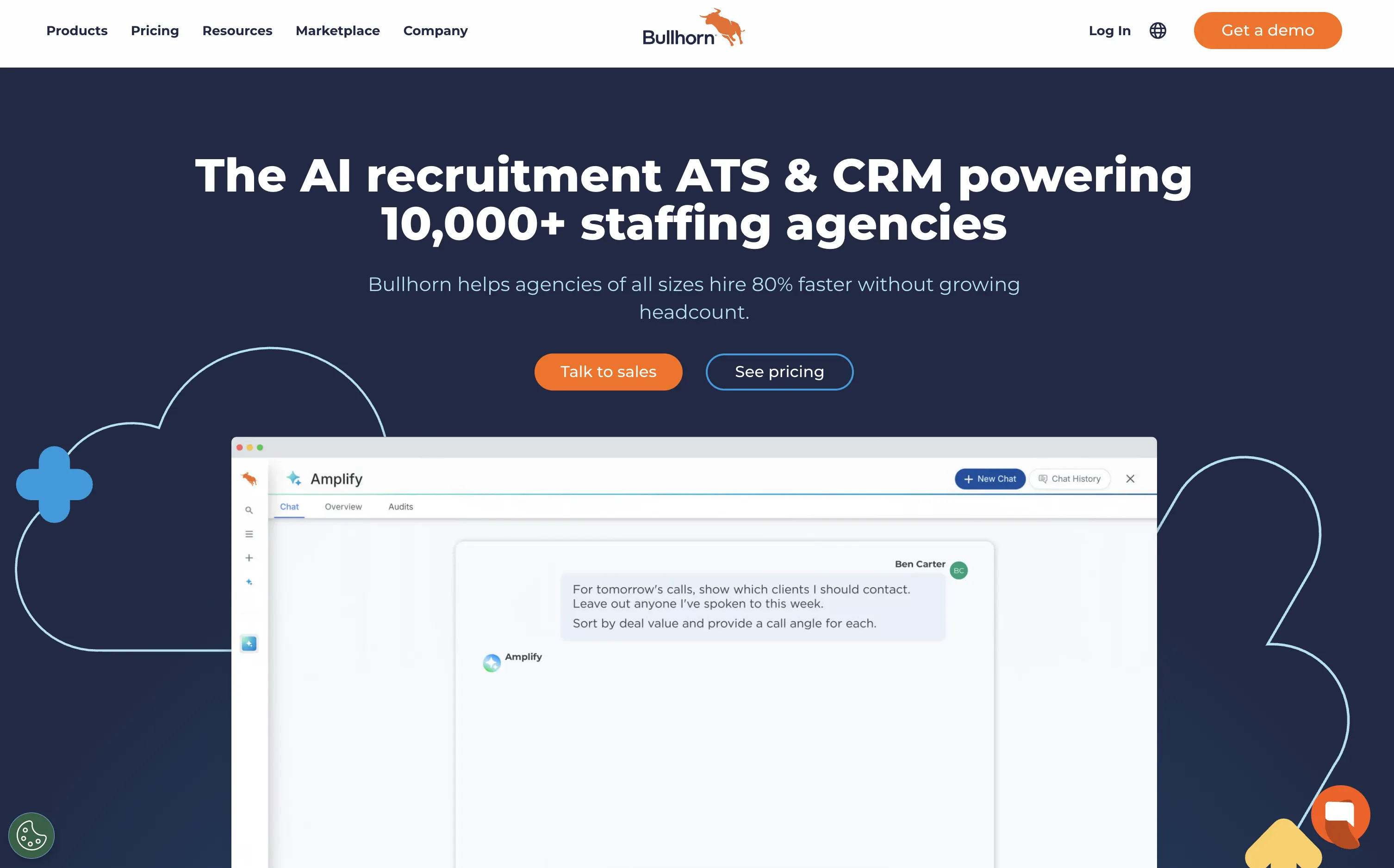
10. Bullhorn
Bullhorn is a staffing and recruitment platform that combines an ATS with analytics and reporting capabilities. Its analytics tools provide real-time visibility into recruiter activity, candidate pipelines, job performance, placements, and business performance. Recruiters and managers can use dashboards to monitor productivity and identify areas requiring attention. Bullhorn is particularly focused on staffing and recruiting agencies that need to connect recruitment activity with operational and financial performance.
Key Features
Real-Time Recruiter Dashboards: Provides live visibility into recruiter activity, individual performance, candidate progress, and job activity.
Staffing Business Intelligence: Combines recruitment and financial data to help staffing organizations analyze trends and business performance.
Pipeline Forecasting: Uses recruitment pipeline data to help teams monitor pipeline health and forecast future placements and revenue.
Overall, Bullhorn is well suited to staffing and recruitment agencies that want to connect recruiter productivity, candidate pipelines, placements, and business performance through integrated analytics.
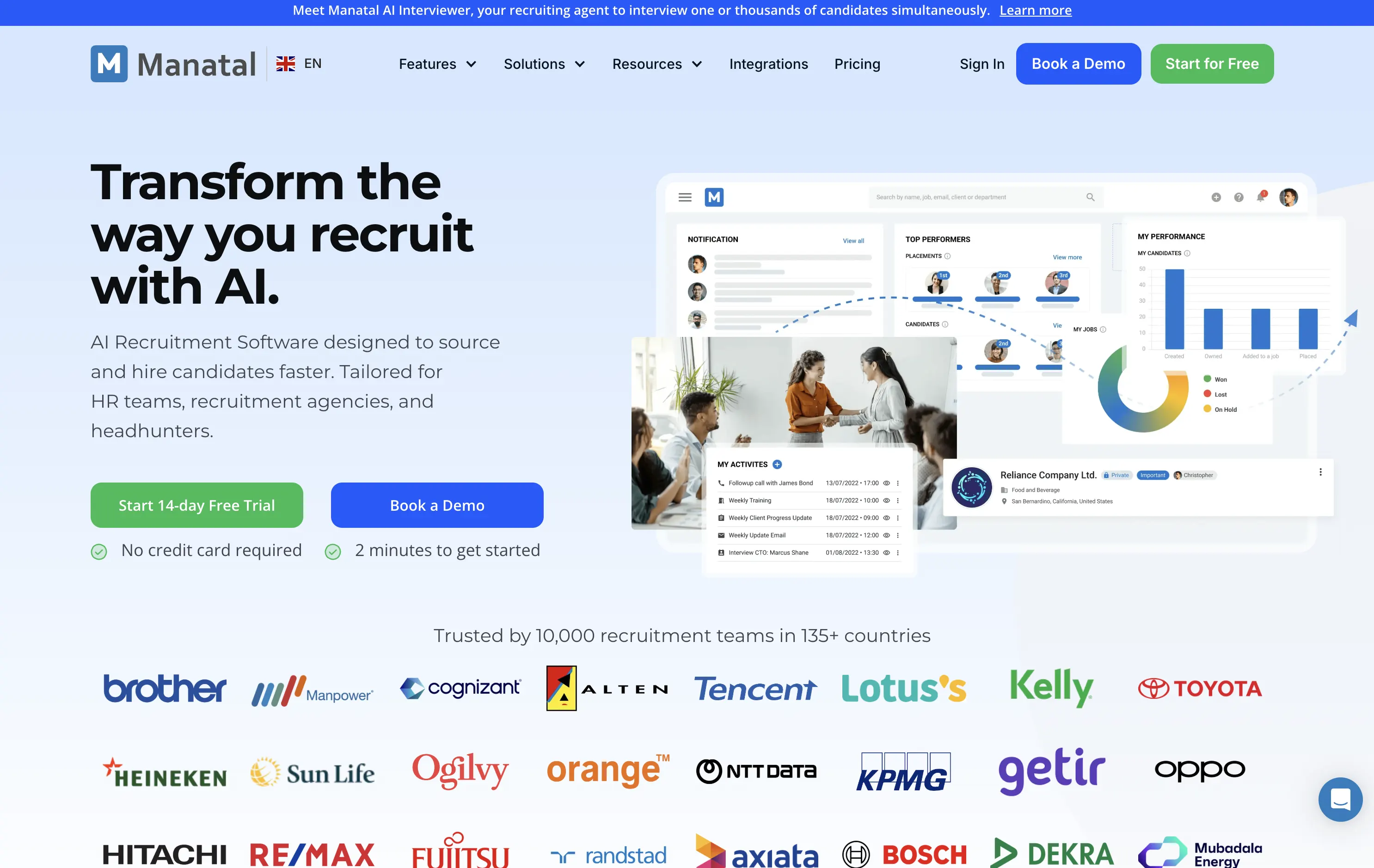
11. Manatal
Manatal is a recruitment software platform with a built-in reporting and analytics suite for tracking recruitment performance. It provides dashboards covering candidates, jobs, recruiters, placements, and other recruitment activities. Its reporting capabilities include source analysis, pipeline performance, time-to-hire, cost-per-hire, and recruiter performance metrics. Manatal also provides a custom report builder that allows users to create reports using data from across their recruitment operations.
Key Features
Recruitment Performance Reports: Tracks important metrics such as time-to-hire, cost-per-hire, recruitment performance ratios, and pipeline bottlenecks.
Source and Candidate Analytics: Helps teams analyze candidate sources, application channels, job boards, referrals, and sourcing performance.
Custom Report Builder: Allows recruiters to create customized reports using account data, filters, and different visualization options.
Overall, Manatal provides a practical recruitment analytics option for teams that want built-in reporting across candidate sources, recruitment pipelines, hiring speed, costs, and recruiter performance.
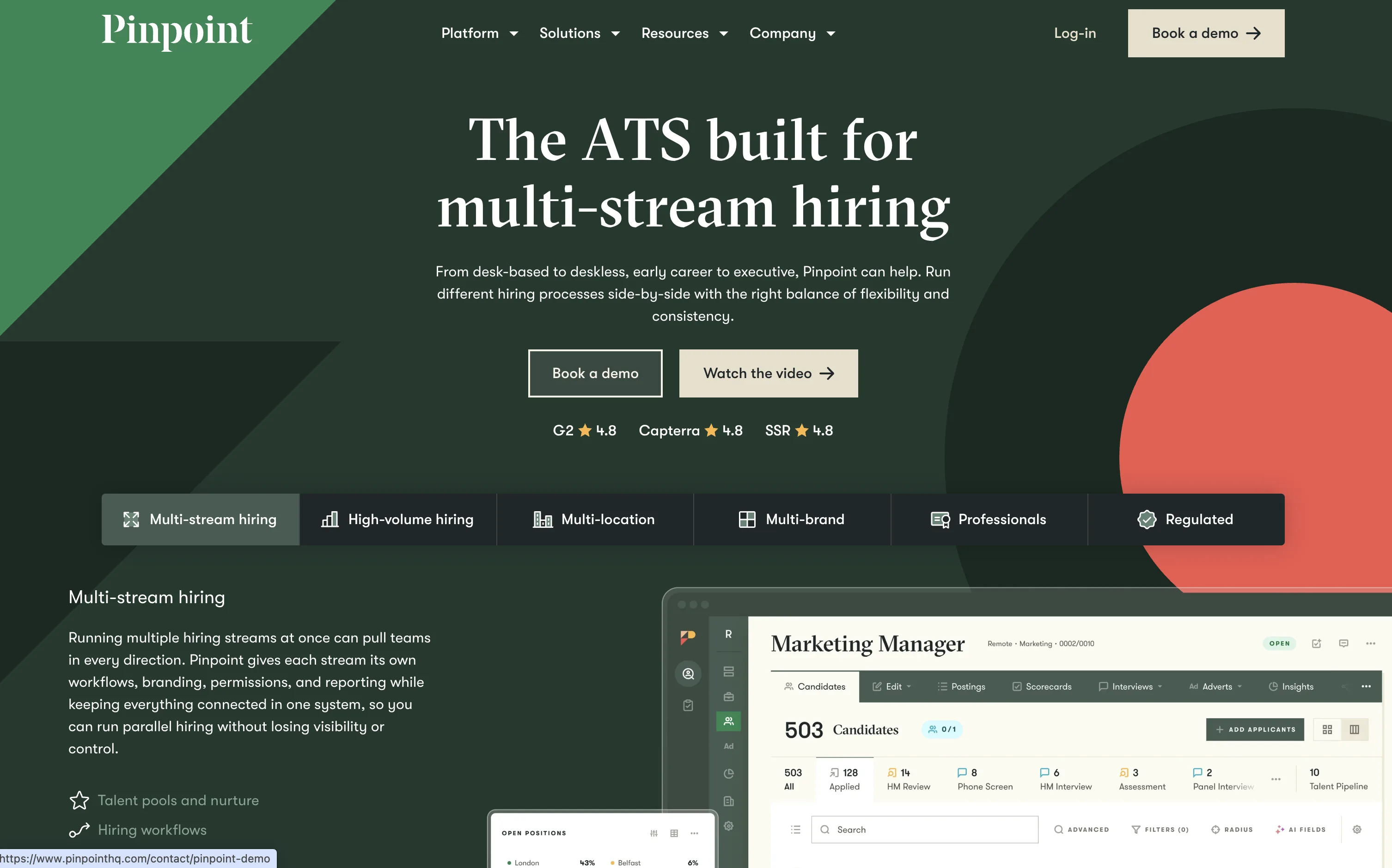
12. Pinpoint
Pinpoint is an applicant tracking and recruitment analytics platform designed to give hiring teams visibility across the recruitment funnel. Its reporting tools help teams monitor hiring performance across roles, teams, and time periods. Recruiters can track metrics such as time-to-hire, source of hire, and candidate pass-through rates while identifying stages where candidates slow down or drop out. Pinpoint also supports custom dashboards, report sharing, data exports, and integrations with BI tools.
Key Features
Recruitment Funnel Analytics: Tracks time-to-hire, source of hire, pass-through rates, and candidate movement through different hiring stages.
Custom Dashboards: Allows teams to create dashboards around the recruitment metrics and KPIs most relevant to their hiring process.
Bottleneck Detection: Helps identify stages where candidates are taking longer to progress or dropping out of the recruitment funnel.
Overall, Pinpoint is a useful choice for internal recruitment teams that want to monitor their entire hiring funnel, identify recruitment bottlenecks, and build customized dashboards around their most important hiring metrics.
13. BambooHR
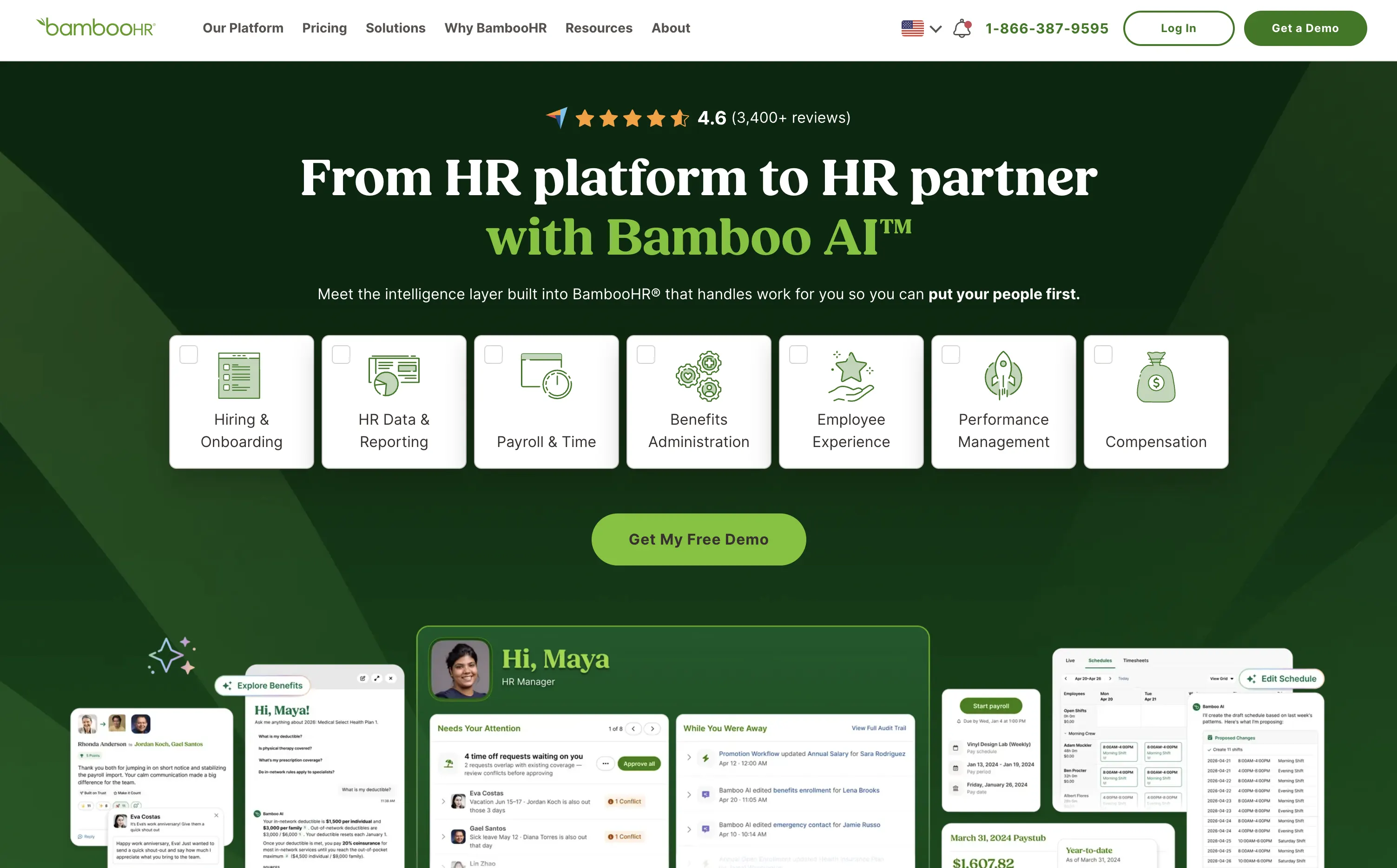
BambooHR is an HR platform that combines applicant tracking with HR reporting and analytics. Its recruiting functionality provides hiring reports and analytics, while its broader reporting system allows organizations to analyze applicant tracking and employee data together. The platform supports built-in and customizable reports, dashboards, and data visualizations. Its recent reporting updates have also expanded the datasets available for custom reporting, including applicant tracking data.
Key Features
Applicant Tracking Analytics: Provides hiring reports and analytics covering candidates, job openings, applications, and recruitment activity.
Custom Reports and Dashboards: Allows organizations to build customized reports and dashboards using different HR and recruitment datasets.
Integrated HR Data: Connects recruitment data with broader HR information, allowing teams to analyze hiring alongside employee and workforce data.
Overall, BambooHR is a good option for organizations that want recruitment reporting connected with broader HR data, allowing hiring teams to view recruitment activity alongside employee and workforce information.
14. Eightfold AI
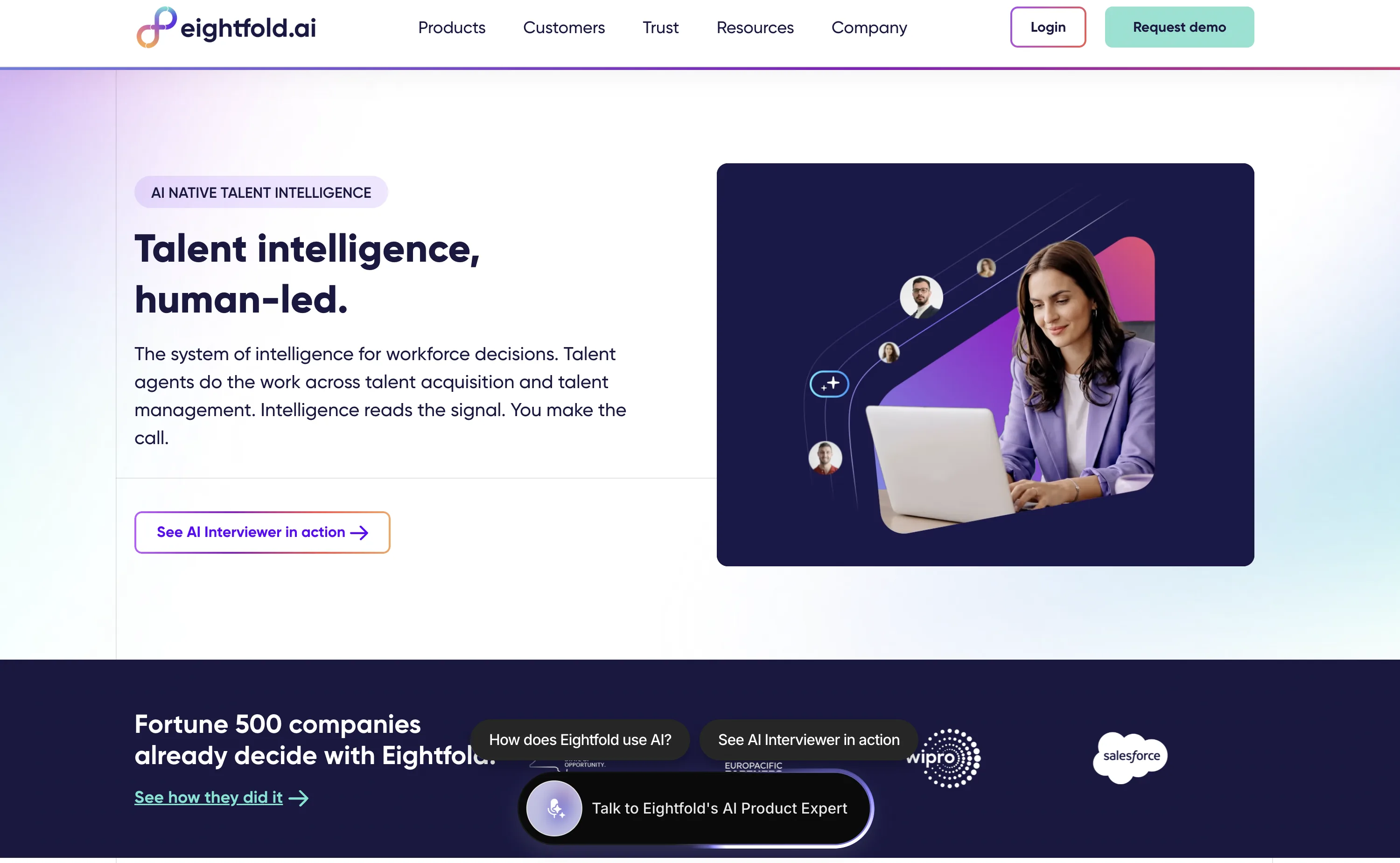
Eightfold AI is an AI-powered talent intelligence platform that uses skills, talent, and workforce data to support recruitment and talent decisions. Its Talent Acquisition solution provides analytics and insights across sourcing, screening, interviewing, and hiring. The platform includes built-in talent analytics dashboards that are updated daily for recruiters, managers, and leaders. Eightfold also uses skills-based matching and AI to help organizations understand candidate potential beyond traditional résumé information.
Key Features
Talent Analytics: Provides built-in dashboards for recruiters, hiring managers, and leaders to monitor talent acquisition data.
Skills-Based Talent Intelligence: Uses skills, capabilities, and candidate data to identify potential matches beyond traditional résumé-based screening.
AI-Powered Recruitment Insights: Uses AI to support sourcing, candidate matching, screening, interviewing, and broader recruitment decision-making.
Overall, Eightfold is suited to organizations looking for AI-powered recruitment analytics combined with skills-based talent intelligence, helping teams analyze and understand talent beyond traditional résumé data.
15. SAP SuccessFactors Recruiting
SAP SuccessFactors is an enterprise recruiting and talent acquisition platform with advanced analytics and reporting capabilities. Its recruitment analytics can provide visibility into candidate activity from the first interaction through applications, interviews, offers, and hires. Teams can analyze sourcing performance, recruitment funnel conversion, application activity, and hiring outcomes. The platform is particularly suited to organizations that need recruitment analytics integrated with a broader human capital management environment.

Key Features
Recruitment Funnel Analytics: Tracks candidate activity across applications, qualifications, interviews, offers, and hires to provide visibility into recruitment performance.
Source and Campaign Analytics: Helps teams evaluate candidate sources and recruitment campaigns using metrics such as applications, qualified candidates, interviews, and hires.
Advanced Reporting: Provides configurable analytics and reporting capabilities that allow organizations to filter, analyze, and export recruitment data.
Overall, SAP SuccessFactors Recruiting is a strong enterprise-oriented option for organizations that need advanced recruitment analytics integrated with their broader human capital management and workforce processes.
How We Evaluated the Best Recruitment Analytics Tools
To identify the best recruitment analytics tools, we focused on the capabilities that help hiring teams understand performance, identify bottlenecks, and make better use of recruitment data. The evaluation considered not only the range of reports and dashboards available, but also how effectively each platform helps teams access, analyze, and act on hiring insights.
1. Reporting and Dashboard Capabilities
We considered whether each platform provides clear, ready-to-use reports as well as flexible dashboards for deeper analysis. Strong tools should make it easy to track important recruitment metrics, customize reporting views, apply filters, and present data in a format that recruiters and hiring managers can understand without extensive manual analysis.
2. Recruitment Metrics and Funnel Visibility
We looked at how well each platform tracks candidate movement across the recruitment funnel, from sourcing and applications to screening, interviews, offers, and hires. Tools that provide visibility into conversion rates, hiring speed, candidate sources, stage-level bottlenecks, and drop-off points can help teams identify where the hiring process needs improvement.
3. Customization and Data Analysis
Recruitment teams often have different reporting needs based on hiring volume, organizational structure, and business goals. We therefore considered features such as custom reports, calculated metrics, filters, drill-down analysis, scheduled reporting, and the ability to compare data across roles, departments, recruiters, locations, or time periods.
4. Integration and Data Accessibility
Recruitment analytics are more valuable when data from different hiring systems can be connected. We considered how well each platform integrates with ATS platforms, HR systems, job boards, sourcing tools, assessment platforms, and other recruitment technologies. We also looked at options for exporting, sharing, or connecting recruitment data with external business intelligence tools.
5. AI and Advanced Analytics
We also considered whether each platform goes beyond traditional reporting with capabilities such as AI-powered insights, predictive analytics, talent intelligence, skills analysis, or other advanced features. These capabilities can help teams identify patterns, uncover risks, and gain deeper insights from the data they already collect.
6. Ease of Use and Scalability
Finally, we considered how practical each platform is for different types of recruitment teams. Analytics tools are most useful when recruiters and hiring managers can access and understand the data without unnecessary complexity. We therefore looked at usability, reporting accessibility, flexibility, and the platform’s ability to support growing or more complex hiring operations.
Conclusion
Recruitment analytics tools give hiring teams greater visibility into how their recruitment processes are performing. By tracking metrics such as candidate sources, funnel conversion, hiring speed, recruiter activity, and quality of hire, organizations can identify inefficiencies and make more informed hiring decisions.
The tools in this guide serve different recruitment needs. Sherlock AI focuses on interview integrity and candidate verification, while iMocha combines skills assessment with recruitment analytics. Platforms such as Greenhouse, Ashby, Workable, iCIMS, and SmartRecruiters provide analytics within broader recruiting systems, while Visier and Eightfold extend recruitment data into talent intelligence and workforce insights. Recruit CRM, Bullhorn, Manatal, and Pinpoint offer reporting capabilities suited to specific recruitment and staffing workflows.
When choosing a recruitment analytics platform, organizations should focus on the problems they need to solve rather than simply comparing the number of dashboards or reports available. The right tool should provide the metrics, integrations, customization, and level of analysis required for the organization’s hiring model and growth plans.
Ultimately, effective recruitment analytics should make hiring data easier to understand and more useful in practice. The best platform is one that helps teams turn recruitment data into clearer decisions, stronger processes, and better hiring outcomes.