Back to all blogs
Explore recruitment automation, including benefits, types, tools, implementation steps, challenges, and advanced strategies for improving hiring workflows.


Recruitment automation is changing how companies manage repetitive hiring activities, from sourcing and screening candidates to scheduling interviews and communicating with applicants. By automating routine tasks, recruitment teams can spend more time evaluating candidates, collaborating with hiring managers, and building stronger candidate relationships.
Adoption is already growing across talent acquisition. LinkedIn’s 2025 Future of Recruiting research found that 37% of organizations were actively integrating or experimenting with generative AI in recruitment, up from 27% the previous year. Among professionals already using or testing GenAI, the average reported time saved was around 20% of their workweek.
The value of recruitment automation goes beyond replacing individual manual tasks. Its real strength comes from connecting different stages of the hiring process so routine actions happen faster and more consistently. For example, when a candidate applies, an automated workflow can organize their information, support initial screening, trigger communication, and help schedule the next stage without requiring recruiters to coordinate every step manually.
In this guide, we’ll explain what recruitment automation is, why organizations are adopting it, which recruitment tasks can be automated, the key benefits and challenges, and five practical steps for implementing it effectively.
TL;DR
Recruitment automation uses software, AI, and connected workflows to reduce repetitive hiring work across sourcing, screening, communication, scheduling, reporting, and onboarding.
The biggest value comes from automating high-volume, rules-based tasks while keeping recruiters involved in candidate evaluation and important hiring decisions.
Common starting points include application confirmations, interview scheduling, candidate updates, resume parsing, routine follow-ups, and recruitment reporting.
Successful implementation starts with identifying workflow bottlenecks, choosing the right tasks to automate, testing the technology in a limited pilot, and measuring the results.
Key risks include bias, poor candidate experience, privacy concerns, inaccurate screening, and weak system integrations.
Recruitment automation works best when it improves efficiency without removing the human judgment and interaction that effective hiring still requires.
What Is Recruitment Automation?
Recruitment automation is the use of software, AI, machine learning, and automated workflows to reduce repetitive tasks across the hiring process.
It can support activities such as job posting, candidate sourcing, resume screening, interview scheduling, candidate communication, offer management, onboarding, and recruitment reporting.
What makes recruitment automation different from simply using individual recruitment tools is the way these activities can be connected. One action can automatically trigger another, allowing candidate information and tasks to move through the hiring process with fewer manual handoffs.
For example, when a candidate submits an application, an automated workflow might update their record in the applicant tracking system, send an acknowledgement, support initial screening, and trigger the next recruitment step.
Recruitment automation is designed to support recruiters rather than remove them from the process. Human involvement remains important for candidate evaluation, complex conversations, exceptions, and final hiring decisions.
What Are the Benefits of Recruitment Automation?
Recruitment automation can improve more than just hiring speed. When repetitive activities are handled through automated workflows, recruiters can spend more time on candidate evaluation, relationship building, and collaboration with hiring managers. Automation can also make recruitment processes more consistent by applying predefined workflows across candidates and reducing unnecessary manual handoffs.
The shift toward automation extends beyond recruitment teams. According to the World Economic Forum’s Future of Jobs Report 2025, 73% of employers expect to accelerate process and task automation, while 63% plan to complement and augment their workforce with new technologies.
1. Speeds Up the Hiring Process
Recruitment automation can reduce delays between different stages of hiring. Tasks such as resume screening, candidate communication, interview scheduling, and status updates can happen automatically based on predefined workflows.
This means recruiters do not have to manually initiate every step. Candidates can move through the recruitment process more quickly, while recruiters can focus their attention on applications and conversations that require human involvement.
2. Reduces Repetitive Recruiter Work
Recruiters often spend considerable time on administrative activities such as entering candidate information, sending similar emails, coordinating calendars, and updating recruitment records.
Automating these tasks reduces repetitive work and gives recruiters more time for activities that require judgment and interaction. The goal is not simply to make recruiters work faster, but to allow them to spend more of their working time on higher-value recruitment activities.
3. Improves Candidate Experience
Candidates expect recruitment processes to be clear and responsive. Long periods without updates, delayed interview scheduling, or repeated requests for the same information can create unnecessary friction.
Automated confirmations, reminders, scheduling, and status notifications can keep candidates informed throughout the process. However, automation should be balanced with human communication at important stages where candidates need personalized answers or meaningful interaction.
4. Creates More Consistent Recruitment Workflows
Manual processes can vary depending on the recruiter, hiring manager, or department involved. One team may follow up quickly, while another may use a completely different process.
Automation can establish standardized workflows for recurring activities. For example, every candidate who reaches a particular interview stage can automatically receive the same scheduling instructions, reminders, or documentation requirements.
5. Supports Data-Driven Recruitment Decisions
Automated recruitment systems can capture data throughout the hiring funnel, including application volumes, candidate sources, screening outcomes, interview progression, and time spent at different stages.
Recruiters and hiring leaders can use this information to identify bottlenecks and understand which parts of the recruitment process need improvement. Over time, this can help organizations make technology and process decisions based on actual recruitment data rather than assumptions.
6. Makes Recruitment Easier to Scale
As hiring volumes increase, manually managing every recruitment activity becomes more difficult. Automation allows organizations to handle a larger number of candidates and vacancies without increasing administrative work at the same rate.
This can be particularly useful for organizations running high-volume recruitment campaigns, hiring across multiple locations, or managing recurring recruitment for similar roles. Automation provides the underlying workflow structure while recruiters remain involved in decisions that require human judgment.
Types of Recruitment Automation
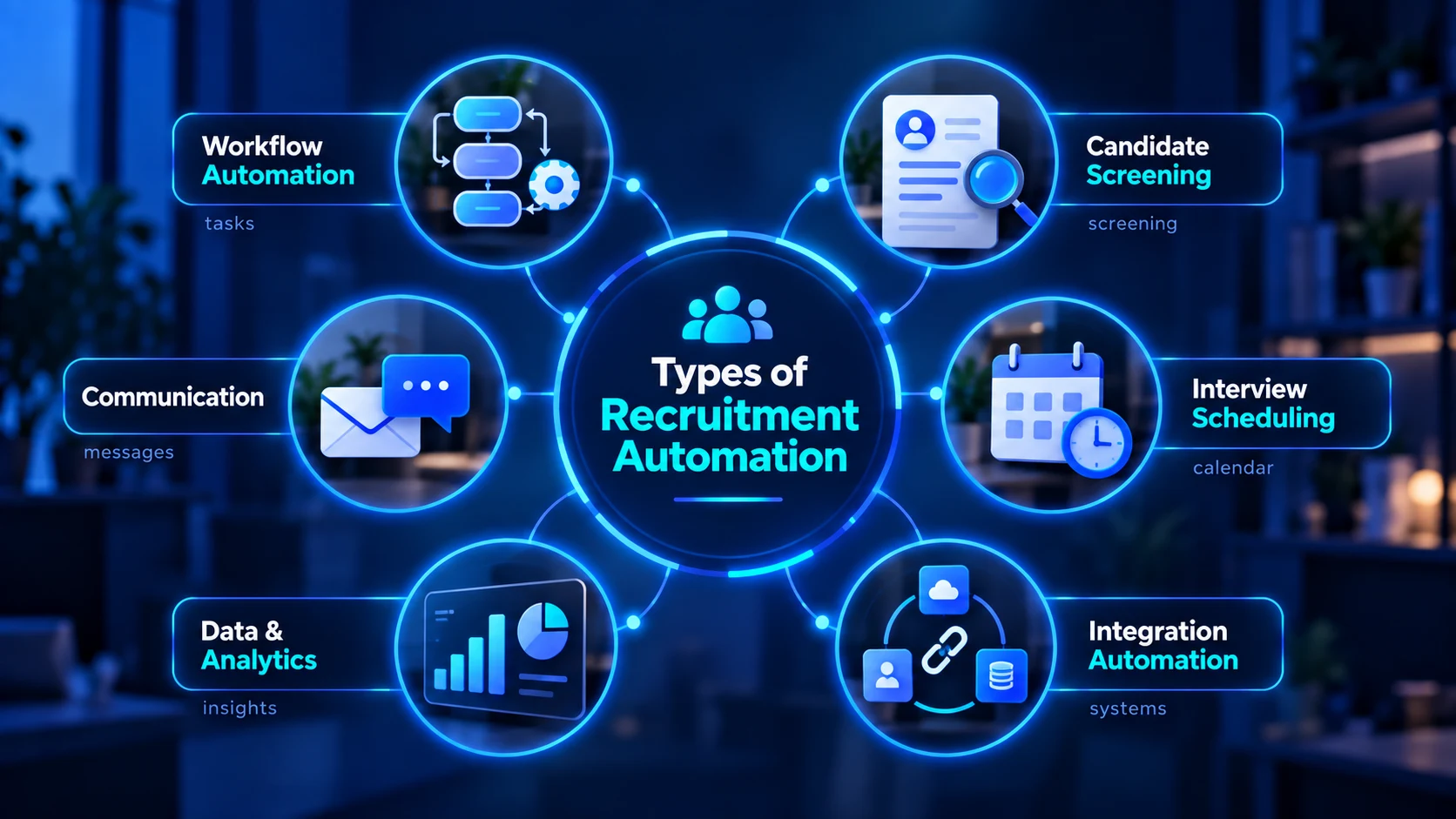
Recruitment automation can be applied to different stages of the hiring process. Some forms handle repetitive administrative work, while others support screening, communication, interviews, and recruitment data.
1. Workflow Automation
Workflow automation connects different recruitment tasks and moves candidates through predefined stages automatically. For example, when a candidate submits an application, the system can update the candidate record, send an acknowledgement, assign a screening task, and trigger the next step in the process.
This helps recruiters maintain a consistent hiring workflow without manually tracking every candidate or remembering when an action needs to happen. It is particularly useful when multiple recruiters or hiring managers are involved in the same recruitment process.
2. Candidate Screening Automation
Screening automation helps recruiters process large numbers of applications by organizing and comparing candidate information against predefined job-related criteria. Recruitment systems can extract information from resumes, identify relevant skills and experience, and help prioritize applications for recruiter review.
These tools can reduce the amount of manual screening required, but they should not be treated as a substitute for recruiter judgment. Automated screening may overlook candidates with transferable skills, unconventional career paths, or experience that is described differently from the language used in the job description.
Recruiters should therefore use screening automation as a decision-support tool, with human review remaining part of important candidate evaluation and hiring decisions.
3. Candidate Communication Automation
Recruitment teams regularly send similar messages to candidates, including application confirmations, interview instructions, reminders, status updates, and requests for additional information. Communication automation can handle these routine interactions through email, chatbots, and other messaging systems.
Automated communication can also help candidates receive information more quickly instead of waiting for a recruiter to respond to every routine question. Recruiters can remain involved when a candidate has a complex question or when a conversation requires personal judgment.
4. Interview Scheduling Automation
Coordinating interviews can involve several calendars, recruiters, hiring managers, interviewers, and candidates. Scheduling automation can identify available time slots, allow candidates to select an appropriate option, send calendar invitations, and issue reminders automatically.
This reduces the back-and-forth communication involved in arranging interviews and helps prevent scheduling delays. It can also support rescheduling when an interviewer or candidate becomes unavailable.
5. Recruitment Data and Analytics Automation
Recruitment generates data at almost every stage, including application numbers, candidate sources, screening outcomes, interview progress, offers, and hiring timelines. Analytics automation brings this information together so recruiters can monitor recruitment performance without manually creating every report.
Automated recruitment dashboards can help teams examine metrics such as candidate-to-hire conversion, source performance, and time spent at different stages. This makes it easier to identify bottlenecks and understand where improvements may be needed in the hiring process.
6. Recruitment Integration Automation
Integration automation connects recruitment technologies such as applicant tracking systems, recruitment CRMs, assessment platforms, calendars, communication tools, and HR systems.
When these systems exchange information automatically, recruitment teams can reduce duplicate data entry, minimize manual transfers, and maintain more consistent candidate records across the hiring process.
How Does the Recruitment Automation Process Work?
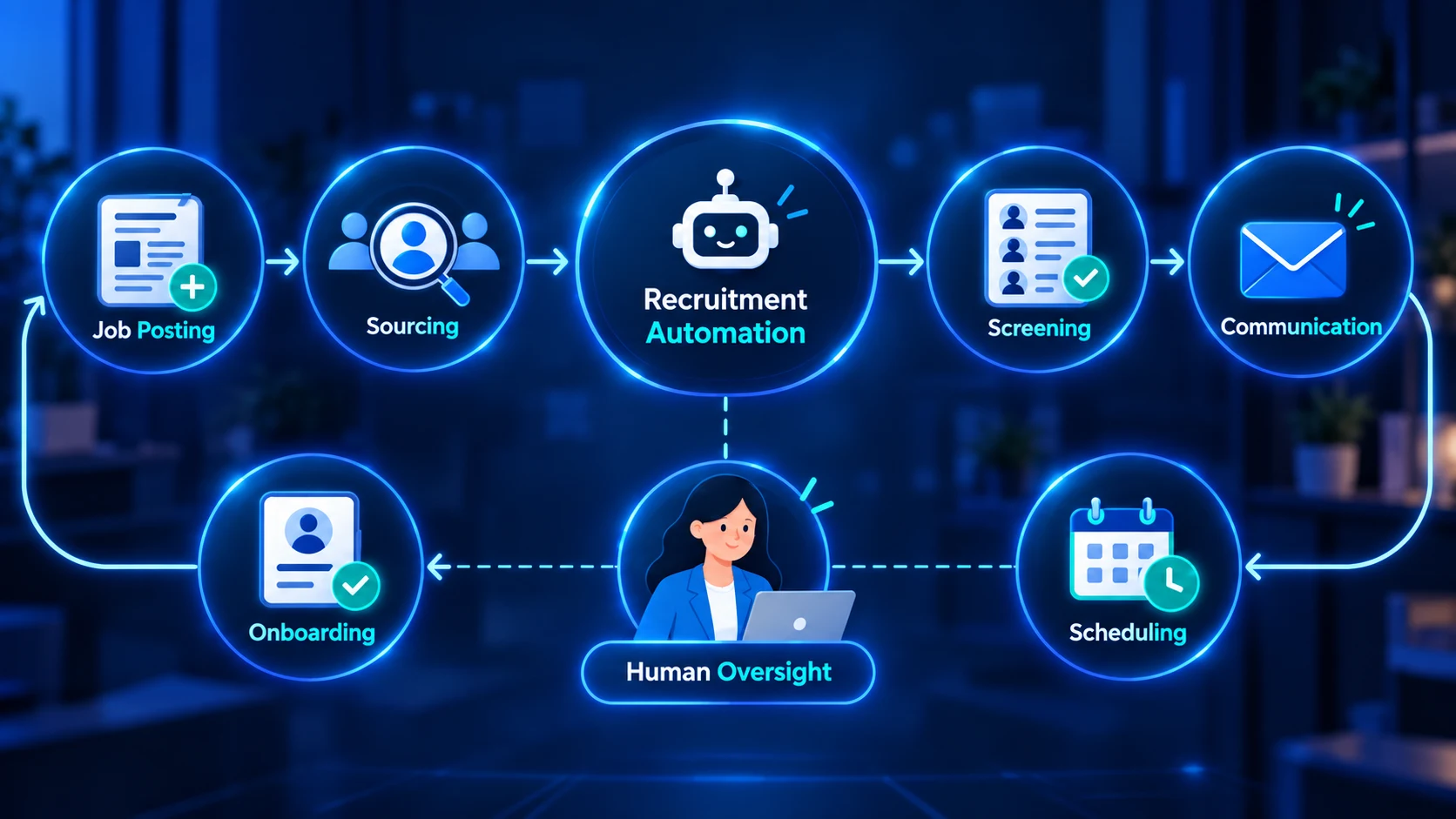
Recruitment automation works by connecting repetitive hiring activities into a structured workflow, allowing technology to handle tasks such as sourcing, screening, communication, scheduling, and data management. Instead of recruiters manually moving candidates from one stage to another, automated workflows can transfer candidate information, trigger communications, update recruitment systems, and generate insights as candidates progress through the hiring process.
Each stage can use automation differently, while recruiters continue to oversee important evaluation and hiring decisions.
1. Job Posting
The process begins when a company creates and publishes a job description for an open position. Recruitment automation can help standardize job descriptions, distribute vacancies across relevant channels, and ensure that information is consistently presented to potential candidates.
2. Candidate Sourcing
Once the position is published, automated sourcing tools can search multiple candidate databases and recruitment platforms based on predefined job requirements. Instead of manually searching different sources, recruiters can use automation to identify relevant candidates and continuously build the talent pipeline.
3. Application Collection
Automation can collect applications from different recruitment channels and centralize candidate information in the hiring system. This reduces manual data entry and gives recruiters a consistent candidate record that can include resumes, skills, experience, contact details, and source information.
4. Resume Screening
AI-powered screening tools can parse resumes, compare candidate skills and experience against job requirements, and identify relevant applicants. This helps recruiters reduce the amount of time spent manually reviewing large numbers of resumes.
5. Candidate Shortlisting
After screening, candidates can be ranked or filtered according to predefined requirements. Recruitment automation can help recruiters create a prioritized shortlist, while human reviewers can still evaluate whether candidates meet the broader requirements of the role.
6. Candidate Communication
Automated communication can be used to acknowledge applications, send personalized outreach, provide status updates, and manage follow-ups. Automated workflows can also track candidate engagement and help prevent qualified candidates from being lost because of delayed communication.
7. Interview Scheduling
Once candidates move forward, scheduling automation can connect recruiter calendars with candidate availability. Candidates can select available time slots, while automated reminders and calendar updates reduce the back-and-forth communication normally required to arrange interviews.
8. Interview or Assessment
The next stage involves evaluating the candidate through interviews, assessments, or both. Technology can support this stage by organizing assessment results, recording candidate information, and maintaining recruitment records, while recruiters and hiring managers remain responsible for evaluating candidates.
9. Background Verification
For candidates who progress further, background verification can be incorporated into the recruitment workflow. Automated processes can initiate verification requests, track completion status, and update candidate records, reducing the need for recruiters to manually monitor every verification step.
10. Offer
Once the candidate is selected, automation can support offer generation, communication, approval workflows, and status tracking. This helps reduce administrative delays between the final hiring decision and the candidate receiving an offer.
11. Onboarding
After the candidate accepts the offer, recruitment information can be transferred into the onboarding or HR system. Automating this handoff reduces duplicate data entry and helps ensure that important candidate information is available to the relevant HR and onboarding teams.
How to Implement Recruitment Automation in 5 Steps?
Recruitment automation is most effective when introduced gradually rather than applied across the entire hiring process at once. Organizations should first understand their existing workflow, identify suitable tasks, choose technology that fits their systems, test the automation, and measure the results before expanding it.
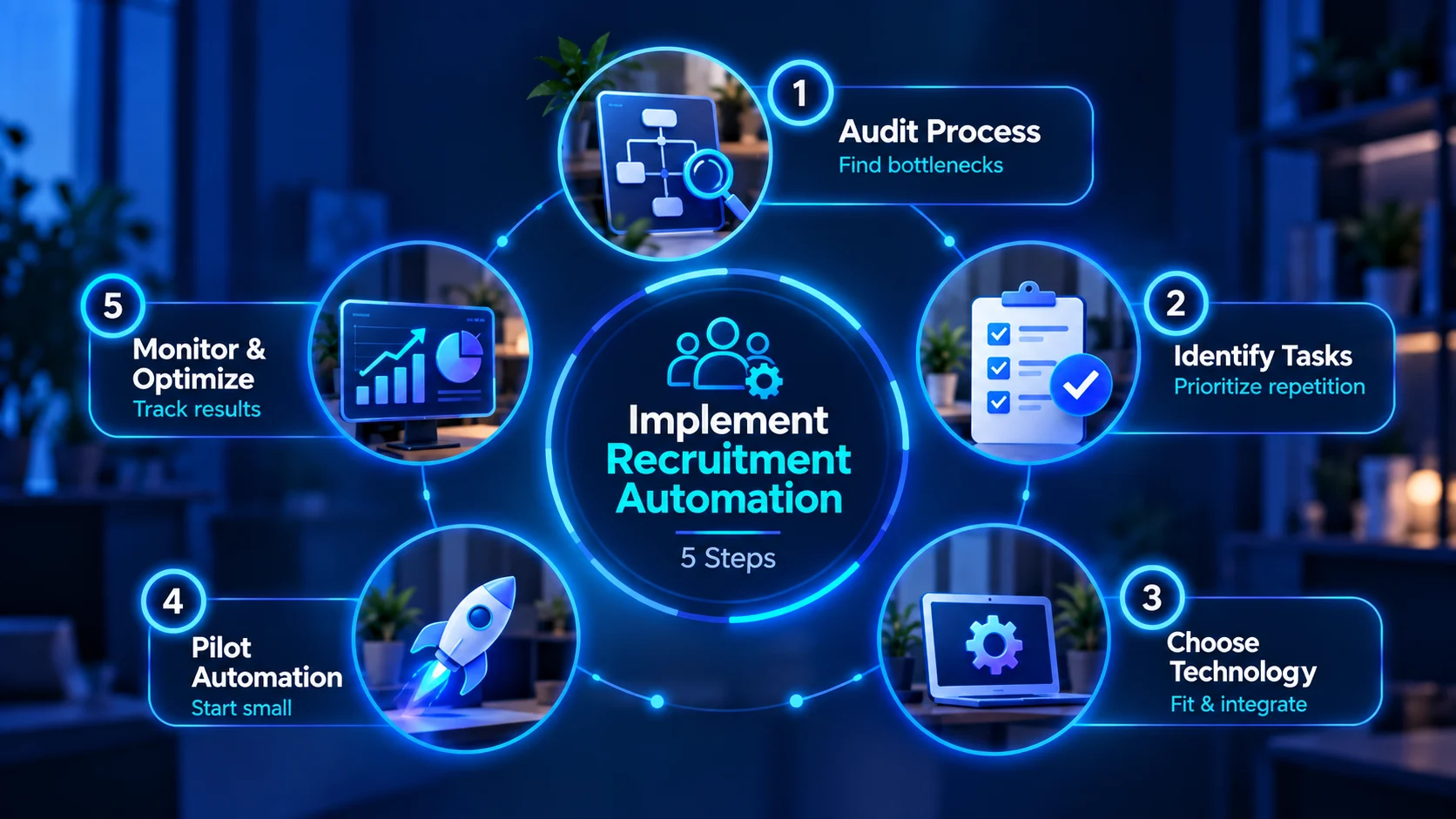
Step 1: Audit Your Current Recruitment Process
Start by mapping the recruitment process from job creation and candidate sourcing through screening, interviews, offers, and onboarding.
Identify where recruiters spend the most time, where candidates experience delays, and where manual handoffs or duplicate data entry occur. Review the systems already being used, including the ATS, recruitment CRM, communication tools, calendars, assessment platforms, and HR systems.
The goal is to identify specific bottlenecks rather than automate processes simply because automation is available.
Questions to consider include:
Which tasks take the most recruiter time?
Where do candidates commonly experience delays?
Which activities involve repeated data entry or follow-ups?
Which steps frequently create errors or missed actions?
Which tasks genuinely require human judgment?
Step 2: Identify the Right Tasks to Automate
Prioritize activities that are repetitive, high-volume, rules-based, and relatively easy to standardize.
Common starting points include:
Application confirmations
Interview scheduling and reminders
Candidate status updates
Routine follow-up messages
Resume parsing and application organization
Recruitment reporting
Data transfers between connected systems
Avoid automating a task simply because the technology can perform it. Candidate evaluation, sensitive conversations, exceptions, and important employment decisions may still require direct recruiter involvement.
A useful approach is to evaluate each task based on its volume, repetition, complexity, risk, and need for human judgment.
Step 3: Choose the Right Recruitment Technology
Select technology based on the workflow problem identified in the previous steps.
Depending on the requirement, organizations may consider an applicant tracking system, recruitment CRM, screening platform, scheduling software, recruitment chatbot, analytics platform, or integrated recruitment automation solution.
When evaluating technology, consider:
Integration with existing recruitment and HR systems
Ease of use for recruiters and candidates
Data privacy and security
Transparency of automated decisions or recommendations
Customization of workflows and rules
Reporting and analytics capabilities
Scalability as hiring volume increases
Availability of human review and intervention
The best technology is not necessarily the platform with the most features. It is the one that solves the identified workflow problem without adding unnecessary complexity.
Step 4: Pilot the Automation Before Scaling
Test the automation within a limited recruitment process, department, location, or job category before rolling it out more broadly.
Define what success should look like before the pilot begins. For example, the team might aim to reduce interview scheduling time, improve candidate response rates, decrease manual data entry, or shorten a particular stage of the hiring process.
During the pilot, monitor:
Time saved by recruiters
Candidate completion and response rates
Screening or workflow accuracy
Scheduling efficiency
Candidate and recruiter feedback
Errors or situations requiring manual intervention
Use these findings to adjust rules, communication, integrations, and workflows before expanding the automation.
Step 5: Monitor Results and Optimize the Process
Recruitment automation should be reviewed continuously after implementation.
Track metrics that reflect the problem the automation was intended to solve. These may include:
Time-to-hire
Time-to-screen
Time spent at each recruitment stage
Recruiter administrative workload
Candidate drop-off rates
Candidate response rates
Cost-per-hire
Offer acceptance rates
Workflow completion rates
Compare results with the baseline established during the initial audit. If automation creates new delays, poor candidate experiences, inaccurate outputs, or additional manual work, adjust the workflow rather than simply expanding it.
Successful automation can then be introduced gradually into other parts of the recruitment process while maintaining appropriate human oversight.
Recruitment Automation Tools and Technologies
Different recruitment automation tools address different stages of hiring. Some manage candidate information, while others automate screening, communication, scheduling, interviews, or recruitment analytics. Organizations can use individual tools or combine several capabilities within a broader recruitment platform.
Applicant Tracking Systems (ATS)
An ATS acts as the central system for managing candidates throughout the recruitment process. Modern ATS platforms can go beyond storing resumes by supporting job posting, candidate tracking, screening, interview scheduling, offer management, and reporting. This makes an ATS an important foundation for connecting different recruitment automation workflows and keeping candidate information organized in one place.
Best suited for: Organizations that need a central system for managing applications, recruitment stages, and candidate records.
AI Screening and Matching Tools
AI-powered screening tools help recruiters process applications by analyzing candidate information against job-related criteria. These systems can assist with resume parsing, skills matching, candidate search, and application prioritization. When used appropriately, they can reduce the amount of manual screening required, while recruiters remain responsible for reviewing candidates and making employment decisions.
Best suited for: High-volume recruitment or roles that attract large applicant pools.
Recruitment Chatbots and Conversational AI
Recruitment chatbots can interact with candidates through websites, messaging platforms, or other communication channels. They can answer frequently asked questions, collect basic candidate information, provide job details, and support parts of the application process. Conversational AI can also help with candidate qualification and interview scheduling, particularly in high-volume recruitment environments.
Best suited for: High-volume hiring environments or organizations receiving frequent candidate questions.
Automated Interview Scheduling Platforms
Interview scheduling tools connect candidate availability with recruiter and interviewer calendars. They can automatically suggest available slots, send invitations, manage rescheduling, and issue reminders. These tools are especially useful when hiring teams conduct multiple interviews or panel interviews because they reduce the administrative coordination required from recruiters.
Best suited for: Recruitment teams spending significant time coordinating calendars and interview availability.
Recruitment Analytics and Reporting Tools
Recruitment analytics tools turn hiring data into reports and dashboards that recruiters can use to monitor performance. They can track metrics such as application volume, sourcing channels, time-to-hire, candidate movement between stages, and recruitment costs. By connecting these insights with automated workflows, recruitment teams can identify bottlenecks and determine which parts of the hiring process need improvement.
Best suited for: Organizations that want to measure recruitment performance and make process decisions using hiring data.
Integrated Recruitment Platforms
Organizations can also use platforms that combine several automation capabilities rather than relying on separate tools for every recruitment stage. These platforms may connect sourcing, screening, candidate communication, interview scheduling, offers, onboarding, and analytics within a single environment. An integrated approach can reduce data duplication and make it easier to maintain a consistent workflow across the recruitment process.
Best suited for: Organizations looking to automate several stages of recruitment within a connected environment.
Choosing the Right Recruitment Automation Tools
Organizations do not necessarily need a separate tool for every recruitment task. In many cases, existing ATS or HR platforms already include automation capabilities that are not being fully used.
Before purchasing additional technology, recruitment teams should identify the specific workflow problem they want to solve, review what their current systems can already automate, and then evaluate whether a new tool provides enough additional value to justify the complexity and cost.
Challenges and Concerns of Recruitment Automation
Recruitment automation can improve efficiency, but introducing technology into hiring also creates challenges that organizations need to manage carefully. Issues can arise around automated decision-making, candidate experience, data protection, and system accuracy. Understanding these limitations helps recruitment teams use automation responsibly while maintaining appropriate human oversight.

Risk of Bias in Automated Decisions
Automated recruitment systems can produce biased outcomes when the data, criteria, or processes behind them contain existing patterns of bias. A system may also give greater importance to certain qualifications or characteristics that do not accurately reflect job performance. Regular monitoring is therefore important when automated tools are used in screening or candidate assessment.
Key considerations include:
Job-related criteria: Use requirements that are directly relevant to the role and its responsibilities.
Regular monitoring: Review automated outputs to identify unexpected or inconsistent patterns.
Human oversight: Keep recruiters involved in important candidate evaluation and hiring decisions.
Over-Automation Can Affect Candidate Experience
Automation can make recruitment faster, but excessive automation may make the process feel impersonal or difficult to navigate. Candidates may become frustrated when they cannot communicate with a recruiter or receive only generic responses. Recruitment teams should therefore determine which interactions can be automated and where direct human communication adds value.
Key considerations include:
Human interaction: Provide access to recruiters when candidates need individual assistance.
Personalized communication: Use candidate information to make automated messages relevant rather than generic.
Candidate feedback: Monitor candidate responses and drop-off rates to identify problems in the automated journey.
Automated Systems May Miss Qualified Candidates
Automated screening depends heavily on the criteria and information used by the system. Candidates with transferable skills, unconventional career paths, or relevant experience that is presented differently from the job description may not always be identified accurately. Recruiters should therefore use automated screening to support candidate review rather than treating its output as a final decision.
Key considerations include:
Flexible criteria: Avoid relying too heavily on narrow keywords or rigid requirements.
Broader evaluation: Consider transferable skills and relevant experience beyond standard resume patterns.
Manual review: Give recruiters the opportunity to review candidates who may have been overlooked by automation.
Data Privacy and Security
Recruitment automation requires organizations to process significant amounts of candidate information, including resumes, contact details, employment history, assessments, and verification data. Poorly managed systems can create privacy and security risks. Organizations should understand how recruitment platforms collect, store, process, and share candidate information before introducing them into the hiring workflow.
Key considerations include:
Data protection: Establish appropriate controls for collecting and storing candidate information.
Access management: Limit sensitive recruitment data to authorized users.
Vendor security: Review the privacy and security practices of third-party recruitment technology providers.
Integration and Data Quality Challenges
Automation depends on accurate data and effective connections between recruitment systems. When an ATS, scheduling platform, assessment tool, and HR system do not integrate properly, recruiters may still need to transfer information manually. Inconsistent or incomplete candidate data can also reduce the effectiveness of automated workflows.
Key considerations include:
System integration: Check whether recruitment tools can exchange information effectively.
Data accuracy: Keep candidate records complete, current, and consistent across systems.
Workflow testing: Test automated processes regularly to identify errors, duplicate records, or broken integrations.
Advanced Recruitment Automation Strategies
Once basic recruitment tasks are automated, organizations can use more advanced technologies to improve how they identify, evaluate, and manage candidates. These approaches can connect recruitment data across different stages and provide recruiters with deeper insights. However, advanced automation should still operate within clearly defined processes and appropriate human oversight.
Predictive Recruitment Analytics
Predictive analytics uses recruitment and workforce data to identify patterns that can help teams understand future hiring needs and recruitment outcomes. Instead of only reporting what has already happened, these systems can analyze historical information to identify trends in candidate movement, hiring demand, recruitment timelines, and workforce requirements.
For example, recruitment teams can use historical data to identify roles that consistently take longer to fill or periods when hiring demand tends to increase. These insights can help teams plan sourcing earlier, allocate recruiter capacity more effectively, and reduce potential hiring delays.
Research from the OECD on AI and labour-market matching also explores how AI is being used across recruitment activities, along with the potential benefits and challenges of these systems.
Intelligent Candidate Routing
Intelligent candidate routing automatically directs applications, candidates, or recruitment tasks to the appropriate recruiter or hiring workflow. Routing rules can consider factors such as job role, department, location, skills, or recruiter specialization, reducing the need for recruiters to manually assign every application.
This can be particularly useful for organizations handling large recruitment volumes across multiple teams. Instead of applications sitting in a general queue, automation can direct them to the relevant recruitment team and trigger the appropriate next step based on predefined workflow rules.
Automated Bias Monitoring
Advanced recruitment systems can help organizations monitor automated hiring workflows for potential inconsistencies. Rather than assuming that an automated process is automatically neutral, recruitment teams can examine outcomes across different stages and identify patterns that may require further investigation.
Regular monitoring can also help organizations review whether screening criteria are unnecessarily excluding relevant candidates or whether certain automated rules are producing unexpected outcomes. Human review remains important because identifying a statistical difference does not by itself establish why that difference occurred.
AI-Powered Recruitment Assistants
AI-powered recruitment assistants can support recruiters with routine activities such as drafting job descriptions, summarizing candidate information, preparing communication, organizing recruitment data, and answering common questions. These tools are designed to reduce administrative workload and give recruiters more time for activities that require human interaction and judgment.
For example, an AI assistant can help prepare a candidate summary from information already available in the recruitment system or draft a follow-up message for recruiter review. The recruiter can then verify the information, make necessary changes, and decide whether the communication or recommendation is appropriate before it is used.
Conclusion
Recruitment automation can make hiring faster, more consistent, and easier to scale by reducing repetitive administrative work across sourcing, screening, communication, scheduling, and reporting.
The most effective approach is not to automate every part of recruitment, but to focus on high-volume, repeatable tasks where automation can remove friction without replacing necessary human judgment. Organizations that start with clear workflow problems, test automation carefully, monitor results, and keep recruiters involved in important decisions are more likely to see meaningful improvements in both efficiency and candidate experience.
As recruitment technology continues to evolve, the goal should remain the same: use automation to make the hiring process more efficient while preserving the human judgment and interaction that effective recruitment still requires.