Back to all blogs
Learn what AI impersonation is, how attacks work, common types, real-world examples, detection methods, and ways to prevent AI impersonation fraud.


Artificial intelligence can now generate convincing text, voices, images, videos, and other digital content with minimal time or technical effort. While these capabilities have legitimate uses, attackers can also exploit them to impersonate trusted individuals, organizations, or roles.
AI impersonation can occur through cloned voices, manipulated video calls, fraudulent messages, or synthetic identity documents. These attacks can target financial transactions, customer support, account recovery, and identity verification processes. Attackers often combine realistic AI-generated content with urgency, familiarity, or authority to deceive their targets.
In 2024, consumers reported $2.95 billion in losses from imposter scams to the Federal Trade Commission (FTC). Although this figure represents imposter scams broadly rather than AI impersonation specifically, it highlights the financial risks associated with fraudulent identity claims.
Detecting AI impersonation requires more than recognizing unnatural voices or visual inconsistencies. Understanding how these attacks work and independently verifying identities are essential to preventing fraud.
This guide explains what AI impersonation is, its common types, real-world examples, detection methods, and security measures organizations can use to reduce the risk.
What Is AI Impersonation?
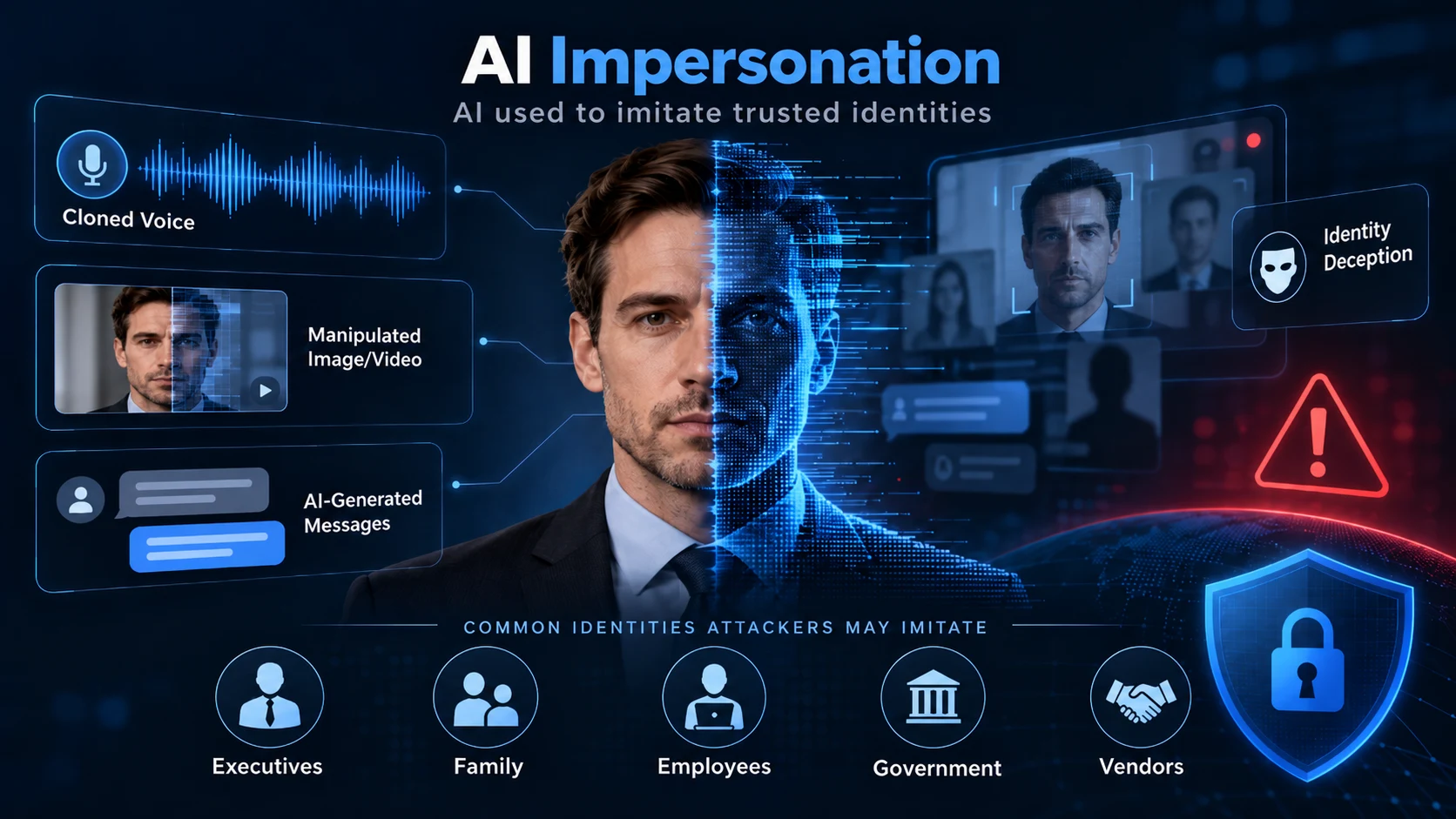
AI impersonation is the use of artificial intelligence to imitate the identity, appearance, voice, communication style, or behavior of a real person, organization, or trusted role. Attackers may use AI-generated text, cloned voices, manipulated images, or videos to make fraudulent interactions appear legitimate.
For example, an attacker might clone a company executive's voice and call an employee requesting an urgent payment. Because the voice sounds familiar, the employee may believe the request is genuine and transfer money without independently verifying it. This illustrates how AI impersonation can exploit trust to obtain money, credentials, sensitive information, or unauthorized access.
Common identities attackers may imitate include:
Executives or finance leaders: Attackers may impersonate senior employees to request urgent payments, invoice changes, or confidential business information.
Family members or close contacts: A cloned voice or familiar communication style may be used to create emotional pressure and request emergency financial assistance.
Employees or account holders: Attackers may pose as legitimate users to persuade support teams to reset credentials, change account information, or grant access.
Government or business representatives: Fraudsters may claim to represent trusted institutions to request payments, personal information, or account verification.
Vendors, customers, or known contacts: Attackers may exploit existing business relationships to introduce fraudulent payment instructions, suspicious documents, or malicious links.
How Does AI Impersonation Work?
AI impersonation attacks typically combine information gathering, AI-generated content, and social engineering to deceive a person or an identity verification process. These attacks may involve a single fraudulent message or a longer interaction across multiple communication channels.
1. Selecting the Identity
The attacker begins by choosing a person or organization whose identity could help achieve a specific objective.
Common identities targeted for impersonation include company executives, employees, vendors, customer support representatives, public officials, and family members.
The chosen identity depends on the intended outcome. For example, an attacker seeking a fraudulent payment may impersonate a finance executive, while someone attempting account takeover may pose as the account holder.
2. Gathering Information
The attacker collects information to reproduce identifying details or personalize the fraudulent interaction.
Public sources, including company websites, professional profiles, social media, and recorded interviews, may provide photographs, voice samples, job titles, and communication patterns.
Leaked data or compromised accounts may reveal private details, such as business relationships, account information, or previous conversations, that can be used in the attack.
3. Generating the Impersonation
AI tools are used to create content that imitates the selected person or organization.
Text generation tools can produce personalized emails, messages, and conversational responses that imitate a person's writing style or professional role.
Voice cloning and synthetic media tools can generate speech, images, or videos. Attackers may also create fake profiles or manipulate identity documents to support the claimed identity.
4. Delivering and Maintaining the Interaction
The attacker introduces the impersonation through a communication channel or verification process.
Fraudulent content may be delivered through emails, phone calls, messaging applications, video meetings, social media, or customer support portals.
During an ongoing interaction, AI-generated replies may help the attacker respond to questions, provide additional details, or reinforce a fabricated emergency or business request.
5. Requesting an Unauthorized Action
The attacker uses the impersonated identity to obtain something the recipient would not otherwise provide or approve.
Common requests include transferring money, disclosing credentials, sharing sensitive documents, approving authentication requests, or resetting account access.
The attack succeeds when the recipient or verification system accepts the false identity and permits an unauthorized action. Independent verification or additional security controls may prevent the attack from succeeding.
Common Types of AI Impersonation
AI impersonation can take different forms depending on the technology used and the identity being copied. Attackers may use AI-generated voices, videos, messages, or identity documents to make fraudulent interactions appear legitimate. Some attacks combine multiple techniques to make the impersonation more convincing.

1. AI Voice Cloning
AI voice cloning uses artificial intelligence to generate speech that resembles a real person's voice. Attackers can use cloned voices in phone calls, voice messages, or other audio communications to impersonate someone the recipient knows or trusts.
For example, a scammer might imitate a family member's voice and claim to need money urgently because of an emergency. The familiar voice may make the request appear genuine, even when the call comes from an unfamiliar number.
The FTC has warned that scammers can use short audio samples to imitate family members in emergency scams. It recommends contacting the person through a known phone number rather than relying on voice recognition alone.
2. Deepfake Video Impersonation
Deepfake video impersonation involves using AI to generate or manipulate video so that someone appears to say or do something they never actually said or did. This technique can be used in video calls, recorded messages, social media content, and remote identity verification.
For example, an attacker might use a manipulated video to appear as a company executive during an online meeting and request approval for an unauthorized financial transaction. The familiar appearance of the executive could make participants less likely to question the request.
The primary risk is that realistic facial expressions, movements, and speech may create a false sense of authenticity. A convincing video should not be treated as sufficient proof of someone's identity.
3. AI-Generated Written Impersonation
AI-generated written impersonation involves using generative AI to create emails, text messages, social media conversations, or chat responses that imitate another person's communication style or professional role.
For example, an attacker might send an AI-generated email that appears to come from a company's finance manager, requesting an employee to update a vendor's payment details. The message may use familiar business terminology and a professional tone to make the instruction seem routine.
Because generative AI can produce natural and grammatically accurate messages, spelling mistakes and awkward language are no longer dependable indicators of fraud. Verifying the sender and the requested action is more important than judging the quality of the writing.
4. Synthetic Identity and Document Impersonation
Synthetic identity and document impersonation involves using AI-generated or manipulated identity information to misrepresent a person's identity during processes such as customer onboarding, account registration, or account recovery.
Attackers may create altered identification documents, synthetic facial images, or other misleading identity evidence to convince an organization that an identity is genuine.
For example, someone attempting to open an account fraudulently might submit a manipulated identity document along with an AI-generated facial image. If the verification process relies on insufficient checks, the false identity evidence may go undetected.
In November 2024, FinCEN reported increased suspicious activity involving suspected deepfake media, including fraudulent identity documents used in attempts to bypass identity verification and authentication controls.
This type of impersonation is particularly concerning because it targets the systems responsible for establishing identity rather than relying only on persuading another person.
5. Executive and Employee Impersonation
Executive and employee impersonation occurs when attackers use AI-assisted content to pose as someone within an organization. Unlike voice cloning or deepfake video impersonation, which describe specific techniques, this category focuses on the organizational identity and authority being exploited.
For example, an attacker might impersonate a senior executive through an AI-generated voice message and instruct a finance employee to process an urgent payment. In another situation, an attacker may imitate an employee's communication style when contacting an IT help desk to request an account reset.
The risk comes from the trust associated with internal roles. Employees may assume that a request is legitimate because it appears to come from a familiar colleague or senior leader.
These attacks can involve voice cloning, deepfake videos, AI-generated messages, or a combination of techniques.
6. Government and Business Impersonation
Government and business impersonation involves attackers presenting themselves as representatives of recognized institutions, such as government agencies, banks, technology companies, or service providers. This category focuses on the institutional identity being misrepresented rather than a particular AI technique.
AI can help generate convincing messages, automated conversations, or synthetic audio that supports these false claims.
For example, a scammer might use an AI-generated customer support message claiming to represent a bank and warning that an account has been compromised. The message may direct the recipient to disclose sensitive information or approve an unauthorized transaction.
These attacks exploit trust in established organizations rather than familiarity with a particular individual.
Real-World Examples of AI Impersonation
AI impersonation has been documented in fraudulent payment schemes, government impersonation campaigns, and attempts to bypass identity verification. The following cases illustrate how attackers have used AI-generated voices, deepfake videos, and AI-assisted messages in different situations.
1. Government Official Impersonation
In May 2025, the FBI warned about a campaign that began in April 2025, in which attackers impersonated senior U.S. officials through text messages and AI-generated voice messages. The campaign targeted individuals connected to current or former government officials, with attackers attempting to gain access to personal accounts.
2. Executive Impersonation Through Deepfake Video
In January 2024, an employee at engineering firm Arup's Hong Kong office was deceived by a pre-recorded video conference featuring deepfake impersonations of senior colleagues. The employee subsequently authorized transfers totaling approximately HK$200 million to fraudulent accounts.
The Hong Kong government documented the incident as an example of deepfake technology being used in financial fraud.
3. Ferrari CEO Voice Impersonation Attempt
In July 2024, fraudsters attempted to impersonate Ferrari CEO Benedetto Vigna using WhatsApp messages and an AI-generated voice during a phone call. The impersonator discussed a confidential business deal involving a currency transaction.
However, the targeted executive became suspicious and asked about a book Vigna had recently recommended. The caller abruptly ended the conversation without answering the question, and the attempt failed. According to Bloomberg's reporting, Ferrari avoided financial loss after the executive questioned the caller's identity.
4. AI-Assisted Brand and Executive Impersonation
In September 2026, Microsoft reported a financial fraud campaign involving emails that impersonated company executives and the business software provider ServiceNow.
Attackers used fabricated invoices and email conversations to request payments of nearly $50,000 from finance departments. The campaign involved more than one million fraudulent emails and showed indicators consistent with AI-assisted content creation.
According to Microsoft's investigation, the attackers combined executive impersonation with recognizable business branding to make fraudulent payment requests appear legitimate. Microsoft noted that the evidence suggested generative AI involvement but did not establish the full extent of its use.
Why AI Impersonation Can Be Difficult to Detect?
The challenge is not that every synthetic voice, image, or video is impossible to detect. The greater risk is that relying on a single visual, verbal, or behavioral clue can create false confidence.
Familiarity creates trust: People naturally place more confidence in recognizable voices, faces, organizations, and communication patterns. A convincing imitation can therefore reduce initial suspicion.
Context may matter more than technical quality: A hurried call, short voice note, low-resolution video, or brief chat may provide too little information for the recipient to notice inconsistencies.
Urgency reduces verification: Requests involving emergencies, confidential transactions, account problems, or time-sensitive decisions can pressure people to act before independently verifying the identity.
Attackers can combine signals: A plausible email, familiar voice, matching profile image, and knowledge of internal context may reinforce one another, even if no single element is perfect.
The practical lesson is that detection is stronger when media analysis is combined with identity, device, account, behavioral, and procedural signals rather than treated as a simple yes-or-no test.
How to Detect AI Impersonation?
Detecting AI impersonation requires more than identifying suspicious voices, images, or videos. AI-generated content can appear convincing, making it important to verify the claimed identity, examine unusual requests, and consider multiple security signals before taking action.

1. Look for Inconsistencies in the Request
Suspicious requests can indicate potential impersonation even when the communication appears genuine. Watch for warning signs such as:
Unexpected financial requests: Urgent payments, changes to banking details, or unfamiliar payment methods.
Unusual account activity: Requests to reset passwords, change recovery information, or share authentication codes.
Unfamiliar communication channels: Messages or calls from unexpected phone numbers, email addresses, or platforms.
Pressure to act quickly: Instructions to bypass standard procedures, maintain secrecy, or avoid additional verification.
These warning signs do not automatically confirm impersonation, but they indicate when further verification is necessary.
2. Verify Through Another Channel
Independent verification helps establish whether a request genuinely comes from the person or organization claiming to be the sender.
Contact the person directly: Use a previously verified phone number or trusted communication platform.
Confirm financial requests: Verify payment instructions or banking changes through established approval procedures.
Check organizational claims: Contact the organization using independently obtained official contact information.
Avoid suspicious contact details: Do not rely on phone numbers, links, or email addresses provided in the questionable message.
For example, if an employee receives an unexpected payment request appearing to come from a manager, they should confirm it through an approved internal channel before proceeding.
3. Check the Identity, Not Just the Content
A familiar voice, recognizable face, or professionally written message does not guarantee that the sender is genuine. AI-generated audio and video may lack obvious signs of manipulation.
Organizations can strengthen identity verification by checking:
Authentication records: Confirm whether the request is associated with legitimate authentication activity.
Device and account information: Identify unfamiliar devices, unusual account activity, or unexpected changes.
Previously verified details: Compare the request with trusted identity information and established account history.
Established procedures: Require appropriate identity checks before approving sensitive actions.
Conflicting information should trigger additional verification rather than immediate approval.
4. Use Media Analysis as One Signal
Deepfake detection tools can help identify possible manipulation in images, audio, videos, and digital identity evidence. However, these tools are not always accurate and should not be treated as definitive proof of authenticity or fraud.
For more reliable assessments, organizations should:
Analyze suspicious media: Examine images, audio, videos, or identity evidence for possible manipulation.
Compare multiple security signals: Evaluate media detection results alongside identity, device, and authentication information.
Use additional verification or human review: Investigate uncertain or conflicting evidence before approving sensitive requests.
A reliable approach combines media analysis with independent identity verification and established security procedures rather than relying on a single detection method.
How Organizations Can Reduce AI Impersonation Risk?
Organizations can reduce AI impersonation risk by strengthening controls around financial transactions, account access, identity verification, and employee communications. An effective approach combines technical safeguards, established procedures, and employee awareness rather than relying solely on detecting AI-generated content.
1. Protect High-Risk Transactions
Financial transactions and sensitive business operations should have approval controls to prevent unauthorized requests from being executed.
Establish authorization procedures for wire transfers, vendor banking changes, large payments, and disclosures of confidential information. These procedures should apply regardless of the requester's seniority or communication method.
Require separation of duties for critical transactions, such as having a second authorized employee approve payments above defined thresholds. Restrict payment initiation and approval permissions based on employee responsibilities.
2. Establish Trusted Communication Channels
Organizations should provide reliable methods for confirming the identity of individuals making unusual or sensitive requests.
Maintain verified contact information for executives, employees, vendors, and other relevant parties. Confirm unexpected instructions using independently verified contact details rather than information supplied in the request.
Establish approved channels for sensitive business communications. When a request arrives through an unfamiliar channel, employees should verify it separately using an established contact method.
3. Strengthen Account Authentication
Strong authentication reduces the likelihood that stolen credentials or impersonation attempts will lead to unauthorized access.
Implement phishing-resistant multifactor authentication, such as FIDO2 security keys or passkeys, for privileged accounts and sensitive applications where supported. These methods provide stronger protection against credential phishing than passwords or manually entered one-time codes.
Monitor sensitive account events, including enrollment of new authentication factors, registration of unfamiliar devices, and changes to recovery information. Apply additional checks or restrictions when suspicious activity is detected.
4. Secure Help Desk and Account Recovery Processes
Attackers may target IT support and account recovery procedures when they cannot access an account through normal authentication methods.
Establish documented identity verification procedures for password resets, account recovery, and access restoration. Support teams should not rely solely on personal information, employee details, or voice recognition to confirm account ownership.
Restrict privileged recovery permissions to authorized personnel and maintain audit logs of sensitive support actions. Review repeated recovery attempts, unusual reset requests, and changes involving privileged accounts.
5. Apply Risk-Based Identity Verification
Organizations that verify customers, employees, or contractors remotely should select identity verification controls based on the sensitivity of the service and the risks associated with accepting a false identity.
Combine appropriate controls such as document authenticity checks, biometric comparison, and liveness detection. Document checks assess identity evidence, biometric comparison evaluates whether biometric samples match, and liveness detection helps assess whether a biometric presentation is genuine rather than a presentation attack. These controls should be evaluated together because none is completely reliable on its own.
Consider additional signals such as device characteristics, account history, and application activity when assessing identity risk. Conflicting evidence or elevated risk may require further verification or specialist review before access is granted.
6. Train Employees to Recognize Fraudulent Requests
Employee awareness programs should focus on identifying suspicious requests and responding appropriately rather than relying only on visual or audio imperfections in AI-generated content.
Conduct practical exercises involving executive impersonation, fraudulent invoices, cloned voice calls, and requests for confidential information. Explain how attackers exploit authority, urgency, and familiar communication patterns.
Teach employees how to report suspicious communications, preserve relevant evidence, and avoid sharing additional information during a suspected attack. Provide accessible reporting channels so concerns can reach the appropriate team promptly.
7. Establish an Incident Response Process
Organizations should prepare for situations where an impersonation attempt has already resulted in a fraudulent payment, account compromise, or disclosure of sensitive information.
Define responsibilities for security, IT, finance, legal, and other relevant teams. Response procedures may include contacting financial institutions about fraudulent transfers, revoking compromised sessions, resetting affected credentials, and restricting unauthorized account access.
Preserve relevant evidence, including messages, call records, transaction details, authentication logs, and account activity. Investigate how the impersonation occurred, identify affected systems or individuals, and use the findings to strengthen security controls.
Understanding the Different Forms of Identity Deception
These terms can overlap, but they describe different concepts. Understanding their differences helps clarify how AI impersonation relates to other forms of identity fraud and deception.
Term | Meaning |
|---|---|
AI Impersonation | Using AI-generated or AI-assisted content to falsely represent another person, organization, or trusted identity. |
Deepfake | AI-generated or manipulated audio, video, or images that realistically imitate or alter a person's appearance, voice, or actions, or depict events that did not occur. |
Identity Theft | The unauthorized acquisition or use of another person's identifying information, often for fraud or financial gain. |
Synthetic Identity | An identity created using fabricated information, real information, or a combination of both. |
Phishing | Fraudulent communication designed to trick someone into revealing sensitive information, interacting with malicious content, or performing an unsafe action. |
A deepfake can be used in an AI impersonation attack, but AI impersonation does not always involve deepfake video or audio. It may instead use AI-generated messages, manipulated identity documents, or multiple techniques to misrepresent a trusted identity.
Similarly, AI impersonation may involve identity theft, synthetic identity fraud, phishing, or account takeover. However, these terms describe different techniques, forms of deception, or outcomes associated with fraudulent activities.
What to Do If You Suspect AI Impersonation?
If an interaction appears inconsistent, unusual, or unexpectedly urgent, avoid acting solely because the person seems familiar. The immediate priority is to prevent financial loss, data disclosure, account compromise, or other unauthorized actions.
1. Stop Before Taking Action
Do not send money, share credentials, disclose sensitive information, approve authentication requests, or change account settings until the request has been independently verified.
2. Verify the Identity Through a Trusted Channel
Contact the person or organization independently using a known phone number, verified account, corporate directory, or approved internal communication channel.
Confirm the suspicious request separately, especially when it involves payments, account access, confidential information, credentials, or account recovery. Avoid using contact details provided in the suspicious interaction.
3. Escalate the Incident
In a workplace, notify the appropriate security, fraud, finance, IT, management, or identity verification team so that related accounts, communications, transactions, or access attempts can be reviewed.
4. Secure Potentially Exposed Accounts
If credentials, authentication codes, recovery information, or account details may have been disclosed, follow the appropriate incident response procedures. Review affected accounts, revoke compromised sessions where necessary, and update credentials through trusted channels.
5. Preserve Relevant Evidence
Keep suspicious messages, recordings, screenshots, sender information, account details, and transaction records that may support an investigation or fraud report.
6. Report the Incident
Report the suspected impersonation through the appropriate channels. Depending on the situation, this may include an employer, financial institution, online platform, consumer protection authority, regulator, or law enforcement agency.
Conclusion
AI impersonation allows attackers to use AI-generated text, voices, images, videos, and identity evidence to make fraudulent interactions appear legitimate. These attacks can lead to financial losses, data exposure, account compromise, and unauthorized access when false identities are trusted without proper verification.
Reducing these risks requires a combination of independent identity verification, strong authentication, secure account recovery procedures, transaction approval controls, and employee awareness. Organizations should focus on verifying identities and sensitive requests rather than relying solely on identifying deepfake content.
As AI-generated impersonations become increasingly convincing, a familiar voice, recognizable face, or professional message should never be treated as sufficient proof of identity. Independent verification remains essential to preventing AI impersonation fraud.