Back to all blogs
Learn what deepfake fraud is, how it works, real-world cases, key risks, detection methods, and effective strategies to prevent AI-powered impersonation.

Deepfake fraud is changing how criminals impersonate trusted individuals and deceive businesses. AI-generated voices, manipulated videos, and realistic facial impersonations can make fraudulent communications appear legitimate. A familiar voice or a video call with a recognizable colleague is no longer sufficient proof of someone's identity.
The financial consequences are not hypothetical. In January 2024, Hong Kong police received a report involving a fabricated, prerecorded video conference in which a fraudster impersonated a company’s UK-based chief financial officer. The employee who attended authorized transfers to five local bank accounts, resulting in a reported loss of approximately HK$200 million, according to the Hong Kong government. Investigators believed publicly available recordings had been used to construct the impersonation.
The case shows why deepfake fraud is more than a question of whether a video looks realistic. Attackers exploit authority, familiarity, timing, and established business relationships. A request that appears to come from a manager can be persuasive even when it contradicts normal payment procedures. Similar tactics can target remote hiring, customer onboarding, account recovery, investment decisions, and personal communications.
Deepfakes themselves are not inherently fraudulent. Synthetic media can serve legitimate purposes, including accessibility and creative production. Fraud begins when manipulated or generated content is used deliberately to misrepresent identity or obtain something through deception. That distinction matters when evaluating both the technology and the risk.
Identifying visual glitches or unusual speech can help, but these clues are not dependable proof. Organizations need to examine the request, verify the person through independent channels, and protect high-risk actions with controls that do not depend on a familiar face or voice. Understanding where the deception enters the process is the starting point for preventing it.
What Is Deepfake Fraud?
Deepfake fraud is the deliberate use of AI-generated or AI-manipulated audio, images, or video to deceive someone about a person’s identity, statements, or actions. The objective may be to steal money, obtain confidential information, gain access to a service, or secure an advantage through impersonation.
A deepfake may replace a face in existing footage, recreate a person’s voice, animate a still image, or synthesize a new likeness. Fraudsters typically pair that media with a believable story: an executive needs an urgent transfer, a relative needs emergency funds, or an applicant must complete a remote verification step. The media supplies apparent credibility; the story prompts action.
Deepfake fraud overlaps with phishing, business email compromise, identity theft, and account takeover, but is not identical to any of them. A conventional impersonation scam may use only text. A deepfake-enabled scam adds fabricated audiovisual evidence that appears to confirm the attacker’s claimed identity.

How Does Deepfake Fraud Work?
The exact sequence differs by attack, but many incidents follow a recognizable progression from gathering identity material to securing the victim’s cooperation.
Step 1: Research the Target
An attacker may collect public photographs, recorded presentations, interviews, social posts, and information about a person’s role or relationships. Details about an organization’s reporting lines, vendors, or upcoming transactions can help make a fraudulent request sound routine. Not every attack requires extensive recordings, and the amount of source material needed varies by technique.
Step 2: Generate or Manipulate the Media
AI tools are used to imitate a voice, alter a face, or create synthetic video. Some attacks use prerecorded clips; others attempt to change what appears or sounds during a live call. The distinction matters because a prerecorded sequence may be unable to respond naturally to unexpected questions, while an interactive impersonation may adapt during the conversation.
Step 3: Establish Trust
The fraudster presents the content through a call, video meeting, messaging service, advertisement, or remote identity-checking workflow. A familiar face or voice can reinforce an email, a forged account, or a convincing explanation. Urgency, confidentiality, and claimed seniority may discourage the recipient from checking independently.
Step 4: Request an Action
The attacker seeks a transfer, credentials, sensitive documents, employment access, or approval of an identity claim. The decisive failure is often not the existence of a deepfake but the decision to authorize an action based on an unverified communication. Effective defenses interrupt that final step.
Common Types of Deepfake Fraud
Deepfake fraud can take different forms depending on how attackers use AI-generated audio, video, or images to deceive their targets. Some techniques involve impersonating trusted individuals to authorise fraudulent payments, while others target identity verification systems, recruitment processes, or online investments. Understanding these common types helps organisations recognise potential threats and implement appropriate safeguards against identity-based fraud.
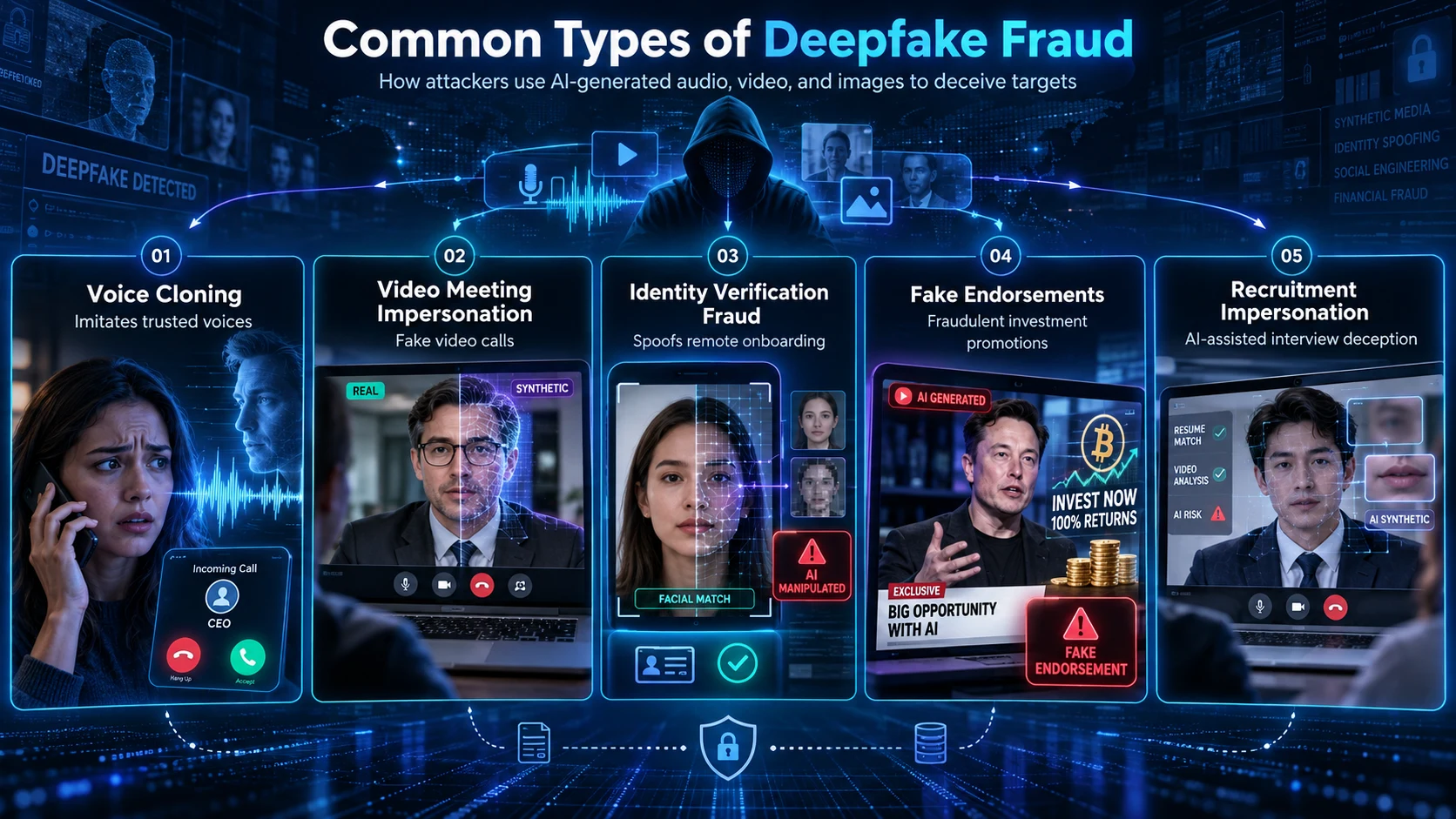
1. Voice Cloning and Phone Impersonation
Voice cloning produces speech that resembles a particular person. A scammer might imitate a family member asking for emergency funds or a finance executive instructing a payment. Calls are especially challenging because the recipient cannot inspect the caller’s face, and ordinary audio quality can conceal inconsistencies. The US Federal Trade Commission has described impersonation of relatives and executives as a risk associated with malicious voice cloning.
The correct response is to verify the request through a known contact method, not to rely on the voice alone. A callback to a previously saved number can be more valuable than attempting to judge whether every syllable sounds natural.
2. Video Meeting Impersonation
A fabricated video call can make an instruction appear to come from a manager or colleague. It may use manipulated recordings, face replacement, or synthetic participants. The presence of multiple seemingly familiar people can create false confidence, especially when the meeting resembles a normal business discussion.
The main safeguard is procedural: an apparent video confirmation should not replace the organization’s payment or approval workflow. Requests for secrecy or unusual account changes deserve independent confirmation regardless of how convincing the meeting appears.
3. Synthetic Media in Identity Verification
During remote onboarding or account recovery, an attacker may attempt to submit altered facial imagery or a synthetic video instead of an authentic camera capture. Some attacks display a photo or replay a video to the camera; others inject manipulated media into the digital capture path. These are different technical problems and may require different defenses.
The NIST guidance distinguishes presentation attacks from digital injection and forged-media attacks. It also explains why matching a face to an identity document is not, by itself, enough to prove that the submitted media came from a genuine live capture.
4. Fake Endorsements and Investment Scams
Manipulated videos can depict celebrities, public officials, or financial commentators endorsing an investment they never supported. The attacker then directs viewers toward a fraudulent website, payment channel, or messaging conversation. The apparent endorsement is the lure; the loss occurs when the victim trusts the fabricated recommendation and acts on it.
A recognizable spokesperson is not evidence that an offer is legitimate. Viewers should check the original publisher, the business behind the offer, and any regulatory information through independent sources.
5. Remote Recruitment Impersonation
Deepfake-enabled hiring fraud can involve an applicant using AI-generated or manipulated audio and video to impersonate another individual during an online interview. The immediate objective may be employment or access to company systems rather than a direct payment. Employers may be particularly exposed when interviews, identity checks, and equipment provisioning happen remotely.
The FBI advisory issued in June 2022 reported complaints involving deepfakes, possible voice spoofing, and stolen personal information in applications for remote technology positions. The warning specifically described occasions when observed lip movements did not match the audio.
Real-World Deepfake Fraud Cases
Deepfake fraud has moved beyond experimental technology into documented financial crimes involving corporate impersonation, identity theft, and fraudulent investment schemes. Investigations by law enforcement agencies show how criminals use AI-generated faces, manipulated videos, and synthetic identities to deceive victims and bypass security checks. The following four cases illustrate different ways deepfake technology has been used in real-world fraud.
1. Deepfake Romance and Cryptocurrency Investment Scam
In October 2024, Hong Kong police dismantled a criminal syndicate that used deepfake technology during online dating interactions to persuade victims to invest in fraudulent cryptocurrency platforms. The operation targeted individuals in Hong Kong, mainland China, and other parts of Asia.
According to a December 2024 Hong Kong government report to the Legislative Council, police dismantled a criminal syndicate that used deepfake technology in online romance scams to lure victims into fraudulent cryptocurrency investments. The case involved more than HK$360 million, and authorities arrested 27 individuals, including suspected organizers and key members of the syndicate.
The incident demonstrates how AI-generated identities can help fraudsters build personal relationships and establish trust before directing victims toward fraudulent investment opportunities.
2. Deepfake Executive Impersonation in a Singapore Corporate Scam
In March 2025, a finance director at a multinational corporation in Singapore was contacted through WhatsApp by a scammer impersonating the company's chief financial officer. The victim was subsequently invited to a Zoom meeting where attackers used deepfake technology to impersonate the company's chief executive officer and other participants.
The Singapore Police Force reported that the victim transferred more than USD499,000 to a fraudulent account. Through cooperation between Singapore and Hong Kong authorities, the funds were traced, with more than USD494,000 withheld in Hong Kong bank accounts and the remaining amount seized in Singapore.
This case highlights how synthetic video impersonation, combined with confidential business instructions, can persuade employees to authorize payments without independently verifying the request.
3. Deepfake Identity Fraud in Online Banking
In October 2025, Hong Kong police launched Operation SILVERHALL against a syndicate suspected of using deepfake technology to manipulate photographs on lost identity cards. The altered images reportedly passed facial recognition checks used by online banking systems.
According to the Hong Kong government's June 2026 report, the syndicate opened 19 bank accounts and used the identities to apply for loans and credit cards involving approximately HK$220,000. Police arrested 23 individuals during the operation.
The investigation demonstrates how manipulated identity documents and synthetic facial content can undermine remote banking verification. It also highlights the need to verify the authenticity of biometric information rather than relying solely on facial matching.
4. Deepfake Impersonation of Singapore Government Officials
In May 2026, scammers impersonated Singapore Prime Minister Lawrence Wong and other senior government officials to deceive a victim into transferring money. The victim received messages requesting urgent financial assistance relating to the situation in the Straits of Hormuz, along with a purported government letter of guarantee.
The victim was subsequently invited to a Zoom meeting featuring participants fabricated using deepfake technology. According to the Singapore Police Force, the victim transferred at least SGD 4.9 million before contacting the actual Secretary to the Cabinet and discovering the fraud.
The case illustrates how criminals can combine deepfake video, forged official communications, and impersonation of public authorities to create convincing financial requests.
What Are the Risks and Consequences of Deepfake Fraud?
Deepfake fraud can cause financial losses, identity theft, reputational damage, and operational disruption. By using AI-generated voices, videos, and facial images to impersonate trusted individuals, criminals can manipulate decisions and exploit weaknesses in digital verification processes. The consequences depend on the type of attack, the information compromised, and how quickly the incident is identified.
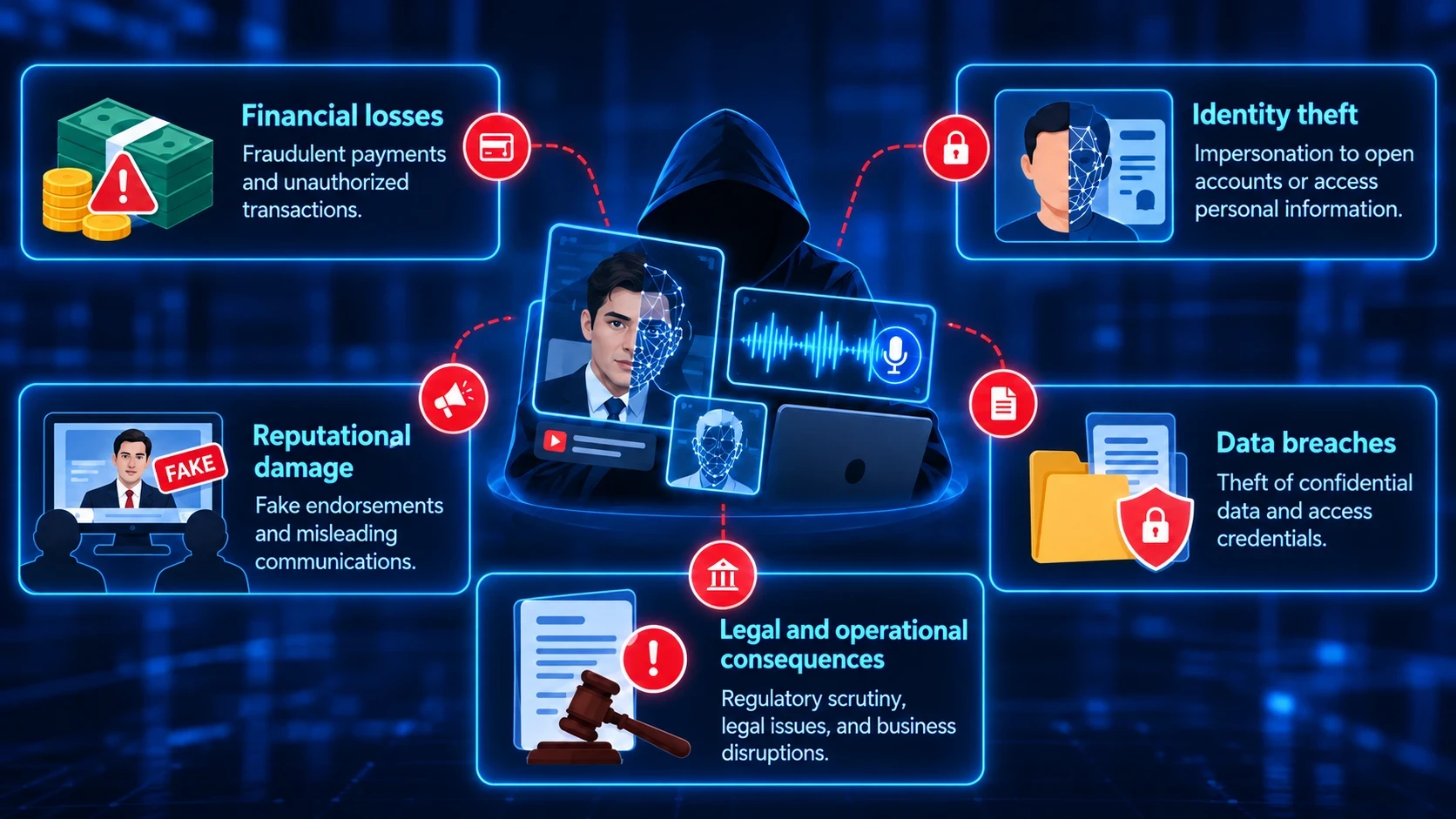
1. Financial Losses and Unauthorized Transactions
Deepfake fraud can lead to substantial financial losses when criminals impersonate executives, employees, or business partners to initiate fraudulent transactions. Attackers may create a sense of urgency or confidentiality to persuade employees to act without following established approval procedures.
Key risks:
Unauthorized transfers to fraudulent accounts
Diversion of legitimate business payments
Losses from fraudulent investments or loan applications
Additional expenses for fraud investigations and recovery
Financial damage can extend beyond the original transaction. Organizations may experience cash flow disruptions, delayed supplier payments, and difficulties recovering funds transferred through multiple accounts.
Example: A finance employee receives a video call appearing to come from the company's CFO, requesting an urgent payment. The employee transfers the funds without independently confirming the instruction. The fraud is discovered during financial reconciliation, requiring the organization to investigate the transaction and initiate recovery procedures.
2. Identity Theft and Account Compromise
Fraudsters can combine stolen personal information with AI-generated facial images or cloned voices to impersonate legitimate individuals. These techniques may help attackers target remote identity verification systems, access accounts, or submit fraudulent financial applications.
Key risks:
Opening bank accounts using stolen identities
Submitting unauthorized loan or credit applications
Gaining access to personal or business accounts
Reusing compromised identity information for further fraud
Victims may face difficulties restoring account access, disputing unauthorized financial activity, and correcting inaccurate records. Because stolen identity information can remain usable, the consequences may continue after the initial incident.
Example: A criminal uses a stolen identity document and manipulated facial imagery to pass an online verification process. The victim later discovers an unfamiliar loan application associated with their identity and must contact the financial institution to dispute it.
3. Reputational Damage and Loss of Trust
Deepfake fraud can undermine an organization's credibility when criminals impersonate executives, employees, or public representatives. Fabricated communications may appear authentic to customers and business partners, making it difficult to distinguish legitimate messages from fraudulent content.
Key risks:
Reduced confidence in official business communications
Misuse of company identities in fraudulent promotions
Damage to executive and organizational credibility
Deterioration of customer and partner relationships
Rebuilding trust may require organizations to clarify fraudulent claims, communicate with affected stakeholders, and demonstrate that their official communication channels remain secure.
Example: Scammers circulate an AI-generated video showing a company's CEO endorsing a fraudulent investment platform. Customers who believe the endorsement may associate the resulting financial losses with the company, even though it had no involvement in the scheme.
4. Data Breaches and Exposure of Sensitive Information
Deepfake impersonation can support social engineering attacks designed to obtain confidential information. Criminals may imitate trusted colleagues or authorized personnel to persuade employees to disclose credentials, internal documents, or sensitive customer records.
Key risks:
Exposure of confidential business information
Theft of login credentials and authentication codes
Unauthorized access to customer or employee records
Further phishing attempts using compromised information
The consequences can escalate when stolen information provides access to additional systems. A single successful impersonation attempt may enable broader unauthorized activity across an organization's digital environment.
Example: An employee receives a call that sounds like the company's IT administrator, requesting a one-time authentication code to resolve an urgent account issue. After receiving the code, the attacker attempts to access the employee's account and retrieve confidential company files.
5. Legal, Regulatory, and Operational Consequences
Deepfake fraud can create legal and compliance challenges when incidents involve unauthorized transactions, compromised personal information, or failures in required security controls. Organizations may need to determine their responsibilities under applicable financial, privacy, and data protection regulations.
Key risks:
Regulatory scrutiny following security or compliance failures
Legal disputes involving fraudulent financial activity
Breach notification and reporting obligations, where applicable
Business interruptions during incident investigations
Responding to these incidents can require coordination between security, legal, compliance, and financial teams. Organizations may also need to preserve evidence, review affected systems, and address weaknesses identified during the investigation.
Example: A financial institution discovers that fraudulent applicants used manipulated facial images to bypass its identity verification process. The institution temporarily suspends affected onboarding workflows while investigating the accounts and assessing whether regulatory reporting is required.
How to Detect Deepfake Fraud?
Detection should examine both the media and the request. A technical anomaly can raise suspicion, but a convincing clip is not proof that the person shown is genuine or authorized.
1. Check for Visual or Audio Irregularities
Potential warning signs include mismatched lip movements, unnatural pauses, inconsistent lighting, distorted facial boundaries, or changes in voice quality. These clues are imperfect: network lag, compression, and poor microphones can produce similar effects, while high-quality synthetic content may display none of them. Treat anomalies as reasons to investigate, not as definitive tests.
2. Look for Behavioral Red Flags
An unusual demand is often easier to assess than the authenticity of the media. Pay attention to requests for secrecy, urgent payments, credential disclosure, new beneficiary accounts, or exceptions to ordinary approval procedures. A request that bypasses established controls is suspicious even when it seems to come from a familiar executive.
3. Confirm Identity Outside the Conversation
End the suspicious interaction and use a previously verified phone number, internal directory, or established communication channel to reach the person directly. Do not use a number or link supplied in the questionable message. For a high-risk transaction, confirm both who initiated it and whether the proposed action was authorized.
4. Use Technical Analysis Where Appropriate
Deepfake detection software may analyze speech features, facial artifacts, synchronization, provenance information, or characteristics of the capture process. Different systems are designed for different threats; a detector for uploaded videos may not protect a live identity-verification workflow. The FTC guidance describes prevention, real-time detection, and post-use evaluation as distinct intervention points for voice-cloning harms. No single technique should be assumed to work against every generated voice or manipulated video.
How to Prevent Deepfake Fraud?
Prevention is strongest when sensitive actions remain protected even if an attacker successfully imitates a person. The following controls address different points in the fraud chain.
Step 1: Verify High-Risk Instructions Independently
Require a callback or separate confirmation for unusual payment requests, beneficiary changes, sensitive data disclosures, and exceptions to policy. Use known contact information and avoid approving an action within the same conversation that introduced it. This protects against both deepfake enabled and conventional impersonation.
Step 2: Use Segregated Payment Approvals
For significant transfers, separate the person requesting a payment from those verifying beneficiary details and releasing funds. Establish thresholds, dual authorization, and documented change-control procedures. Seniority or apparent urgency should not create an informal exemption. The goal is to make a convincing impersonation insufficient to move money.
Step 3: Secure Remote Identity Proofing
Remote verification may combine document checks, biometric comparison, presentation attack detection, and controls designed to identify suspicious camera or media inputs. Liveness detection helps assess whether biometric material comes from a living person at capture, but it is not a universal defense against digitally injected content. The NIST guidance specifically addresses both presentation and injection threats.
Organizations should test their selected approach against the attack methods relevant to their workflow and provide a safe path for legitimate users who cannot complete a particular biometric step.
Step 4: Protect Accounts and Access
Phishing resistant multi factor authentication, least-privilege access, and careful account recovery processes reduce the damage an impersonator can cause. These measures do not determine whether a video is authentic; instead, they make stolen credentials or a persuasive conversation less likely to translate into unauthorized system access.
Step 5: Train Teams and Prepare a Response
Finance, human resources, customer support, and executives encounter different impersonation scenarios. Training should emphasize independent verification and reporting procedures rather than teaching employees to spot only facial glitches. Staff need clear permission to delay a suspicious request, including one apparently made by a senior colleague.
Incident procedures should cover preserving messages and meeting details, notifying security teams, contacting banks promptly when funds are at risk, and reviewing how the attacker bypassed controls. Rehearsing these actions reduces uncertainty during a real event.
Deepfake Detection vs. Prevention
Deepfake detection and prevention work together to reduce the risks of AI-driven impersonation fraud. Detection focuses on identifying manipulated audio, video, or images, while prevention focuses on stopping fraudulent activity before it leads to financial losses, unauthorized access, or data exposure.
Although detection can identify suspicious content, it cannot guarantee that every deepfake will be recognized. Prevention adds security controls that help protect sensitive transactions and identity verification processes, even when manipulation goes undetected.
Aspect | Deepfake Detection | Deepfake Prevention |
Primary goal | Identify potentially manipulated content | Stop fraudulent actions and unauthorized access |
Main focus | Authenticity of audio, video, and images | Security of identities, transactions, and accounts |
Techniques | Media analysis, deepfake detection algorithms, and provenance checks | Identity verification, liveness checks, independent callbacks, and transaction approvals |
Timing | During content analysis or verification | Before sensitive actions are authorized |
Human involvement | Review suspicious content and alerts | Verify requests and approve critical actions |
Limitations | May miss sophisticated deepfakes or produce false alerts | May fail if security procedures are bypassed |
Outcome | Identifies potential impersonation attempts | Reduces the likelihood of successful fraud |
Challenges and Limitations of Deepfake Fraud Detection
Deepfake detection technologies help organizations identify potentially manipulated audio, video, and images. However, their effectiveness can vary depending on the quality of the content, the methods used to create it, and the environment in which detection takes place. Organizations must also consider operational requirements, privacy concerns, and the limitations of relying on content authenticity alone.
1. Detection Accuracy and False Results
Deepfake detection systems analyze visual and audio signals to identify potential manipulation. Their performance can vary depending on video resolution, audio compression, lighting conditions, language, and the techniques used to generate synthetic content.
Key challenges:
False positives: Legitimate content may be incorrectly flagged as manipulated, delaying genuine users or transactions.
False negatives: Synthetic content may go undetected, allowing fraudulent interactions to proceed.
Variable performance: Detection accuracy may differ across content quality, demographic groups, and unfamiliar generation techniques.
Organizations should evaluate detection tools under realistic conditions and assess both false positive and false-negative rates rather than relying on a single accuracy figure.
2. Rapidly Evolving Deepfake Techniques
Advances in generative AI allow attackers to create increasingly convincing synthetic voices, facial movements, and video impersonations. Detection models trained on existing manipulation techniques may struggle to recognize content produced using newer or unfamiliar methods.
Key challenges:
Emerging attack methods: New generation techniques may produce manipulation patterns that existing detectors do not recognize.
Real-time manipulation: Live face-swapping and voice-cloning techniques can complicate verification during digital interactions.
Continuous adaptation: Detection systems require ongoing testing and updates to remain effective against changing threats.
Even regularly updated detection systems cannot guarantee that every emerging deepfake technique will be identified.
3. Operational Complexity and User Experience
Implementing deepfake detection can introduce additional steps into onboarding, authentication, and transaction verification workflows. Organizations must integrate detection capabilities with existing systems while ensuring that suspicious results receive appropriate attention.
Key challenges:
Verification delays: Additional checks may increase onboarding time or delay sensitive transactions.
Manual review requirements: Uncertain detection results can increase workloads for fraud and security teams.
Accessibility concerns: Some biometric verification methods may be difficult for users with disabilities or limited access to suitable devices.
Organizations need to balance fraud detection requirements with efficient, accessible experiences for legitimate users.
4. Privacy and Biometric Data Protection
Some deepfake detection systems process facial images, voice recordings, or other biometric information. Depending on the technology and jurisdiction, this information may be subject to specific privacy and data protection requirements.
Key challenges:
Sensitive data collection: Biometric processing can create privacy risks when unnecessary information is collected.
Data storage and retention: Inadequate retention policies may increase exposure if sensitive records are compromised.
Third-party data handling: External detection providers may process personal information, requiring appropriate contractual and security safeguards.
Organizations should assess data collection practices, access restrictions, retention periods, and applicable legal requirements before deploying detection solutions.
5. Limitations of Content Authenticity Verification
Determining whether audio or video has been manipulated does not necessarily establish whether the person presenting it is authorized to perform a requested action. Fraudsters may also use genuine recordings, stolen credentials, or misleading communication contexts to support fraudulent requests.
Key challenges:
Authentic but misleading content: Genuine recordings may be reused to create false impressions or support unauthorized requests.
Identity uncertainty: A lack of detected manipulation does not independently confirm the identity of the person communicating.
Authorization gaps: Authentic media does not establish whether a payment, account change, or information request is legitimate.
For example, a genuine recording of an executive could be presented alongside fraudulent payment instructions. Even if the recording passes an authenticity check, the transaction may still be unauthorized.
These limitations show why deepfake detection should support, rather than replace, independent identity verification and established authorization procedures.
What to Look for in a Deepfake Fraud Prevention Solution?
A useful evaluation starts with the threat model. Decide whether the main risk is fraudulent calls, video meetings, customer onboarding, or digital identity proofing. Then assess whether a proposed product or workflow addresses that specific attack surface.
Attack coverage: Ask which presentation, replay, synthetic-media, and injection attacks are in scope, and which are not.
Evidence of performance: Review testing methods, error rates, and performance under realistic operating conditions rather than accepting broad accuracy claims.
Workflow fit: Confirm that identity checks, human review, and approvals can be integrated without encouraging shortcuts.
Privacy and accessibility: Examine biometric data handling, retention, user consent where applicable, and alternative verification routes.
Monitoring and escalation: Ensure suspicious activity can be investigated, documented, and handled without assuming automated output is infallible.
The right solution is not necessarily the one that promises to recognize every deepfake. It is the combination of technology and process that makes impersonation less likely to succeed in the organization’s highest-risk workflows.
For organizations concerned about deepfake fraud during remote recruitment, Sherlock AI provides an additional layer of interview security. It analyzes video, audio, and behavioral signals to identify potential deepfake impersonation, voice cloning, proxy candidates, and AI-assisted cheating. By providing real-time alerts and reviewable evidence, Sherlock AI helps hiring teams investigate suspicious activity and make more informed decisions without relying solely on visual or audio inconsistencies.
Conclusion
Deepfake fraud has introduced new challenges for businesses and individuals by making fraudulent identities and communications increasingly convincing. AI-generated voices, manipulated videos, and synthetic identities can exploit the trust people place in familiar faces, voices, and established relationships. As these techniques become more sophisticated, relying solely on visual or audio clues is no longer sufficient to identify potential fraud.
Effective deepfake fraud prevention requires a combination of technical safeguards, independent identity verification, secure approval workflows, and employee awareness. Organizations should also establish clear procedures for handling suspicious requests, particularly those involving financial transactions, sensitive information, or access to critical systems.
Ultimately, protecting against deepfake fraud is not just about identifying manipulated content. It is about ensuring that sensitive requests are independently verified and properly authorized. By strengthening verification processes and maintaining consistent security practices, organizations can reduce their exposure to deepfake-enabled attacks without relying on any single detection method.