Back to all blogs
Explore 52 AI interview cheating statistics for 2026, covering AI-assisted cheating, deepfakes, candidate fraud, identity theft, and interview detection trends.


Artificial intelligence is changing how candidates prepare for and participate in job interviews. Tools that can generate answers, provide real-time assistance, write code, transcribe conversations, and even imitate human voices are making it harder for employers to determine whether a candidate is demonstrating their own skills.
AI use during hiring is not always cheating. Candidates may legitimately use AI to prepare for interviews, improve their resumes, or research a company. The concern begins when AI is used secretly during a live interview or assessment to generate answers, solve coding problems, impersonate a candidate, or provide assistance that would not otherwise be available.
The scale of this problem is becoming clearer as more employers and candidates report AI use throughout the hiring process. At the same time, interview fraud is expanding beyond traditional forms of cheating to include AI copilots, deepfakes, voice cloning, proxy interviews, and other forms of identity manipulation.
This guide brings together 52 AI interview cheating statistics for 2026, covering AI use during interviews, candidate cheating, technical interview fraud, impersonation, deepfakes, detection methods, and the impact on hiring. Each statistic is supported by its original source wherever possible, giving recruiters, talent leaders, and employers a clearer view of how AI is changing interview integrity.
52 AI Interview Cheating Statistics 2026
These statistics reveal how AI is reshaping interview integrity, from real-time cheating and hidden AI assistance to deepfakes, impersonation, and candidate fraud.
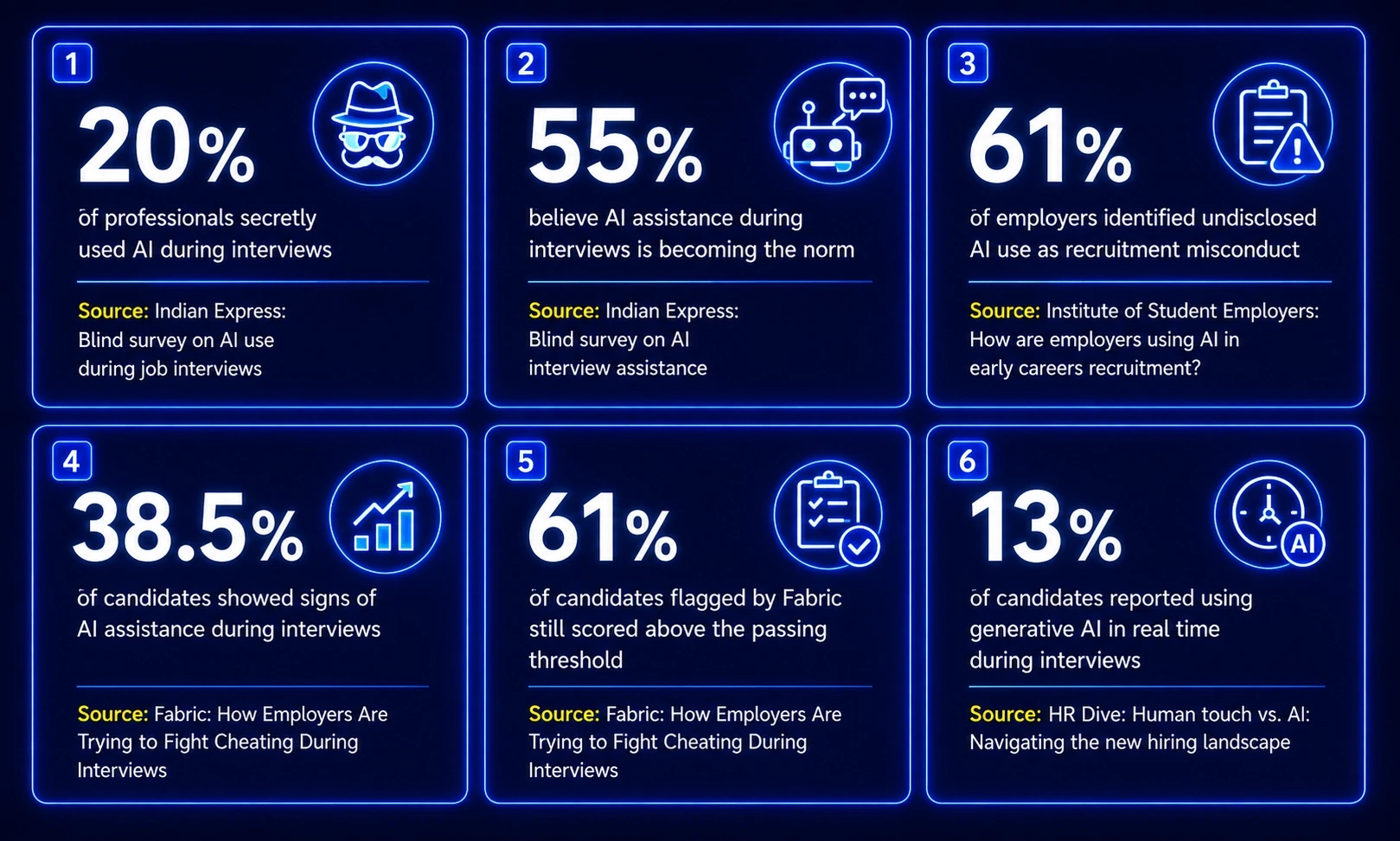
1. 20% of professionals secretly used AI during interviews
20% of U.S. professionals surveyed said they had secretly used AI during a job interview.
Blind surveyed 3,617 verified professionals in April 2025. Among the 2,510 respondents who answered this particular question, 503 said they had secretly used AI during an interview, representing 20%.
Source: Indian Express: Blind survey on AI use during job interviews
What This Means for Recruiters?
One in five respondents admitting to undisclosed AI use suggests that remote interviewers cannot always assume a candidate is answering independently. Recruiters may need to establish clear AI-use policies and consider interview processes that make it easier to evaluate a candidate's unaided knowledge and reasoning.
2. 55% believe AI assistance during interviews is becoming the norm
55% of professionals surveyed said AI assistance during interviews had become the new norm.
The same Blind survey found that 1,989 of 3,617 verified professionals agreed that AI assistance during interviews had become commonplace.
Source: Indian Express: Blind survey on AI interview assistance
What This Means for Recruiters?
AI assistance is increasingly viewed as a normal part of the interview landscape rather than an isolated behavior. Recruiters should therefore define what constitutes acceptable AI use before interviews begin and communicate those expectations clearly to candidates.
3. 61% of employers identified undisclosed AI use as recruitment misconduct
61% of employers who encountered recruitment misconduct identified undisclosed AI use during interviews as a form of cheating.
The Institute of Student Employers reported that candidates using AI during interviews without disclosure or permission was the most commonly reported form of recruitment misconduct among employers that had encountered cheating.
Source: Institute of Student Employers: How are employers using AI in early careers recruitment?
What This Means for Recruiters?
The finding shows why organizations need explicit guidelines around AI during interviews. Recruiters should tell candidates whether AI tools are permitted, restricted, or prohibited and ensure interviewers know how to handle suspected violations consistently.
4. 38.5% of Candidates Showed Signs of AI Assistance During Interviews
A 2026 analysis by Fabric of 19,368 AI-powered interviews conducted between July 2025 and January 2026 found that 38.5% of candidates showed signs of using AI assistance during interviews. Fabric also reported that the rate increased from 9% in July 2025 to 45% by September 2025. Because this is a company analysis rather than an independent academic study, it should be presented as Fabric's analysis, not as a universal industry-wide rate.
Source: Fabric: How Employers Are Trying to Fight Cheating During Interviews
What This Means for Recruiters?
AI assistance during interviews may be considerably more common than traditional interview monitoring can reveal. Recruiters conducting remote interviews should consider whether their existing process can identify hidden AI assistance, particularly when evaluating technical or high-value roles.
5. 61% of Candidates Flagged by Fabric Still Scored Above the Passing Threshold
Fabric's analysis of 19,368 interviews found that 61% of candidates identified as using AI assistance still scored high enough to pass the interview when conventional evaluation was used.
Source: Fabric: How Employers Are Trying to Fight Cheating During Interviews
What This Means for Recruiters?
A strong interview score does not necessarily prove that a candidate completed the interview independently. If AI-assisted candidates can still meet traditional interview thresholds, recruiters may need additional signals and verification methods alongside standard interviewer evaluations.
6. 13% of Candidates Reported Using Generative AI in Real Time During Interviews
13% of candidates reported using generative AI in real time during an interview, according to Gartner's 3Q25 candidate survey. The rate was even higher in the Asia-Pacific region, where 18% of candidates reported using generative AI during interviews. This statistic specifically measures real-time AI use, making it more directly relevant to AI-assisted interview cheating than general AI use during the job search.
Source: HR Dive: Human touch vs. AI: Navigating the new hiring landscape
What This Means for Recruiters?
Real-time AI assistance is not limited to a small number of isolated cases. Recruiters conducting remote interviews should establish clear rules around AI use and consider additional interview controls when they need to evaluate a candidate's independent knowledge, reasoning, and communication skills.
7. 80% of Candidates Use LLMs During Coding Tests Despite Restrictions
80% of candidates reportedly use large language models (LLMs) during coding tests even when AI assistance is explicitly prohibited, according to Karat, as cited by Connecting People. The finding highlights how difficult it can be for employers to prevent AI-assisted cheating when candidates are completing technical assessments.
The statistic is particularly relevant to AI-assisted interview cheating because it focuses on candidates using AI despite explicit restrictions, rather than simply measuring general AI adoption.
Source: Connecting People
What This Means for Recruiters?
Simply prohibiting AI does not necessarily prevent candidates from using it during technical assessments. Employers may need to combine clear AI-use policies with live follow-up discussions, code reviews, and questions that require candidates to explain and defend their solutions.
8. 45% of AI-Assisted Interview Cheating Cases Involved Dedicated AI Assistants
According to Fabric's analysis of 19,368 interviews conducted between July 2025 and January 2026, dedicated AI assistants such as Cluely, Interview Coder, and LeetCode Wizard accounted for 45% of the identified AI-assisted cheating cases. Connecting People reported this breakdown based on Fabric's research.
The same analysis identified other methods, including voice-mode LLMs at 34%, tab switching or second-screen use at 18%, and live human assistance at 3%.
Source: Connecting People, citing Fabric's analysis of 19,368 interviews.
What This Means for Recruiters?
Dedicated AI interview assistants represent a significant form of AI-assisted cheating because they can provide candidates with real-time answers while remaining difficult to identify through conventional screen sharing. Recruiters evaluating candidates remotely may need to look beyond what is visible on the shared screen when interview integrity is critical.
9. More Than Half of Candidates Use AI Despite Being Told Not To
More than half of candidates reportedly use AI during technical interviews despite being explicitly instructed not to, according to Karat's 2026 engineering interview research. Karat found that tech leaders estimate that over half of candidates use AI despite instructions prohibiting it.
This is different from simply measuring whether candidates use AI. It specifically addresses unauthorized AI assistance, making it directly relevant to interview cheating.
Source: Karat: Engineering Interview Trends in 2026
What This Means for Recruiters?
A prohibition alone may not be enough to prevent AI-assisted cheating. If a substantial share of candidates continue using AI despite explicit restrictions, employers may need interview processes that verify independent reasoning through follow-up questions, live problem-solving, and appropriate monitoring or assessment controls.
10. 62% of Organizations Still Prohibit AI Use in Technical Interviews
62% of organizations still prohibit candidates from using AI during technical interviews, according to Karat's 2026 Engineering Interview Trends report. Despite these restrictions, tech leaders estimated that more than half of candidates use AI anyway.
The finding highlights a growing mismatch between interview policies and candidate behavior. Many organizations continue to evaluate candidates under traditional conditions even as AI tools become part of everyday software development.
Source: Karat: Engineering Interview Trends in 2026
What This Means for Recruiters?
Prohibiting AI does not necessarily eliminate AI-assisted cheating. Employers may need to decide whether AI should be prohibited, permitted, or deliberately incorporated into technical interviews, and then design the assessment around that choice.
11. 30% of Repeat Candidates Cheated in Every Interview
Among candidates who interviewed multiple times through Fabric, 30% cheated in every interview they took, according to Fabric's analysis of 19,368 AI-powered interviews. Another 23% were classified as situational cheaters, meaning they cheated in some interviews but not others, while 47% never showed cheating behavior across their interviews.
The finding suggests that AI-assisted cheating is not always an isolated decision made during a single difficult interview. For some candidates, using AI assistance appears to be a repeated behavior across multiple interview opportunities.
Source: Fabric: State of AI Interview Cheating in 2026: Insights from 19,368 Interviews
What This Means for Recruiters?
Repeated cheating behavior makes interview integrity more difficult to address through candidate instructions alone. Organizations hiring at scale may benefit from consistent interview controls and verification methods across multiple stages rather than relying on a single interview to establish whether a candidate is performing independently.
12. 15% of Employers Frequently Encountered Cheating in Assessments
15% of employers reported frequently encountering cheating in assessments in 2025, according to the Institute of Student Employers (ISE). This was more than double the 7% reported in 2024.
ISE's survey also found that only 15% of employers said they had never suspected or identified cheating in assessments, down from 22% the previous year. The most commonly reported form of misconduct was candidates using AI during interviews without disclosure or permission, cited by 61% of employers.
Source: Institute of Student Employers (ISE), How are employers using AI in early careers recruitment?
What This Means for Recruiters?
The increase from 7% to 15% suggests that assessment cheating is becoming a more visible issue for employers. As candidates gain easier access to generative AI and other digital assistance tools, organizations may need stronger processes for identifying unauthorized assistance and verifying that candidates can demonstrate the skills they were evaluated for.
13. 48% of Candidates in Technical Roles Showed Signs of AI Cheating
48% of candidates in purely technical roles showed signs of AI-assisted cheating during interviews, according to Fabric's analysis of 19,368 interviews conducted between July 2025 and January 2026.
The rate was substantially higher than the 12% reported for sales roles, indicating that AI-assisted interview cheating varied considerably by job function. Fabric attributed the higher rate in technical roles partly to candidates' greater familiarity with technology and the fact that technical interviews often contain more objective questions that can be answered with AI assistance.
Source: Fabric, State of AI Interview Cheating in 2026: Insights from 19,368 Interviews
What This Means for Recruiters?
Technical hiring teams may face a greater risk of unauthorized AI assistance than teams hiring for roles that rely more heavily on open-ended communication. Employers hiring engineers and other technical professionals should consider interview formats that require candidates to explain their reasoning, modify solutions in real time, and demonstrate that they understand the work they submit.
14. 6% of Candidates Admitted to Interview Fraud
6% of candidates admitted to participating in interview fraud, according to a Gartner survey of 3,000 job candidates conducted in the second quarter of 2025.
Gartner defined interview fraud as either posing as someone else during an interview or having someone else pose as them. This makes the statistic broader than AI-assisted cheating alone, but it is highly relevant to the growing problem of AI-enabled candidate impersonation and identity fraud in remote hiring.
Gartner also predicts that one in four candidate profiles worldwide could be fake by 2028, highlighting the potential scale of identity-related fraud as AI-generated identities, deepfakes, and other impersonation technologies become more sophisticated.
Source: Gartner, Gartner Survey Shows Just 26% of Job Applicants Trust AI Will Fairly Evaluate Them
What This Means for Recruiters?
Interview integrity is not limited to detecting unauthorized AI assistance. Employers also need to verify that the person participating in a remote interview is the actual candidate who applied for the role. Identity verification, consistent candidate checks, and additional validation during later hiring stages can help reduce the risk of impersonation.
15. 65% of Hiring Managers Have Caught Candidates Using AI Deceptively
65% of hiring managers said they have caught candidates using AI deceptively during the hiring process, according to Greenhouse's 2026 AI in Hiring Report.
Greenhouse found that hiring managers had identified several forms of deceptive AI use. These included candidates reading from AI-generated scripts (32%), hiding prompt injections in resumes (22%), and appearing as deepfakes during interviews (18%). The findings show that AI-assisted candidate deception extends beyond simply using ChatGPT to generate an interview answer.
The research also found that 91% of recruiters had encountered some form of candidate deception during hiring, making AI-assisted interview fraud part of a broader candidate-authenticity problem.
Source: Greenhouse, 2026 AI in Hiring Report
What This Means for Recruiters?
AI-assisted deception can take several forms, from reading AI-generated responses to using deepfake technology during an interview. Recruiters therefore need to look beyond obvious screen-based cheating and consider whether the candidate's identity, responses, and behavior are consistent throughout the hiring process.
16. Deepfake Fraud Attempts Increased by More Than 1,300%
Deepfake fraud attempts increased by more than 1,300% in 2024, according to Pindrop's 2025 Voice Intelligence and Security Report. Pindrop's analysis found that deepfake attacks increased from an average of about one incident every two days to seven incidents per day.
The research analyzed more than 1.2 billion calls and found that AI-generated voice attacks were increasing across multiple industries. While the statistic is not limited to job interviews, it is relevant to interview fraud because voice cloning and synthetic speech can be used to impersonate candidates during remote hiring.
Pindrop's findings illustrate how quickly synthetic voice technology is moving from an emerging threat to a practical fraud technique. In a hiring environment where candidates may be evaluated entirely through video or audio calls, increasingly convincing voice manipulation can make identity verification more difficult.
Source: Pindrop's 2025 Voice Intelligence & Security Report Reveals +1,300% Surge in Deepfake Fraud
What This Means for Recruiters?
Voice cloning adds another layer to interview fraud. A candidate's voice alone may no longer be sufficient evidence of identity, particularly in remote interviews. Employers hiring for sensitive or high-value roles may need to combine voice analysis with video, behavioral signals, identity verification, and additional checks throughout the hiring process.
17. Cheating Detection Rates Increased Fivefold in Two Years
Cheating detection rates during technical interviews increased fivefold over a two-year period, according to Karat's research on the changing role of AI in technical interviewing.
Karat reported that candidate behavior has shifted as AI has become more integrated into software development. The increase in detected cheating includes unauthorized assistance and other methods candidates use to gain an advantage during technical interviews.
The finding does not mean that the overall number of candidates cheating increased exactly fivefold. Instead, it refers specifically to the rate at which cheating was detected through Karat's interview processes.
Source: Karat, AI and the Future of Interviewing
What This Means for Recruiters?
The sharp increase in detected cheating suggests that traditional technical interview processes are encountering new forms of unauthorized assistance as AI tools become easier to access. Employers may need to continually adapt their interview methods rather than relying on controls designed before real-time AI assistance became widely available.
18. 60% of Hiring Managers Have Uncovered Candidates Misrepresenting Their Experience
60% of hiring managers said they had uncovered a candidate who misrepresented their experience or qualifications, according to Checkr's survey of 3,000 American managers.
The finding comes from Checkr's research into hiring and identity fraud. Another 13% of managers said they had suspected a candidate of misrepresenting their experience or qualifications but could not prove it.
The research highlights that candidate deception can extend beyond using AI to generate interview answers. AI tools can also make it easier for applicants to exaggerate skills, qualifications, employment history, or other credentials during the hiring process.
Source: Checkr, The Hiring Hoax: What 3,000 Managers Revealed About Hiring Fraud in 2025
What This Means for Recruiters?
AI-assisted deception can affect more than the interview itself. Recruiters may need to verify important claims made by candidates instead of relying entirely on resumes, interviews, or self-reported qualifications. Skills-based assessments, employment verification, identity checks, and structured interviews can provide additional evidence that a candidate's stated experience matches reality.
19. 71% of Recent Job Seekers Admitted to Cheating During the Hiring Process
71% of recent job seekers admitted to cheating or being dishonest during the hiring process, according to a 2024 survey by ResumeTemplates.com.
The survey of 1,759 U.S. job seekers found that 15% said they always or often cheated, 20% said they cheated occasionally, and 35% said they rarely cheated. Only 29% said they had never cheated during the hiring process.
The cheating was not limited to interviews. Candidates reported using unauthorized assistance on assessments, providing false references, and misrepresenting information on resumes and cover letters.
Source: ResumeTemplates.com
What This Means for Recruiters?
Candidate dishonesty can occur across multiple stages of hiring, not just during live interviews. Employers should therefore consider interview integrity as part of a broader candidate-verification strategy that covers applications, assessments, interviews, and references.
20. 31% of Managers Have Interviewed a Candidate Who Later Turned Out to Have a Fake Identity
31% of hiring managers said they had interviewed a candidate who was later revealed to be using a fake identity, according to Checkr's 2025 survey of 3,000 American managers involved in hiring.
Checkr's research examined the growing use of AI in candidate deception and identity fraud. The survey also found that 35% of managers said someone other than the listed applicant had participated in a virtual interview.
These findings highlight a shift from traditional interview cheating toward identity-based fraud, where the person appearing on screen may not actually be the person who applied for the position.
Source: Checkr, The Hiring Hoax: What 3,000 Managers Revealed About Hiring Fraud in 2025
What This Means for Recruiters?
Remote interviews can create opportunities for proxy candidates and identity manipulation. For sensitive or high-value positions, employers may need to incorporate identity verification and additional candidate validation rather than relying solely on a video interview.

21. AI-Assisted Candidates Scored Significantly Higher in Video Interviews
A 2025 peer-reviewed study found that candidates who used ChatGPT during asynchronous video interviews received significantly higher overall interview performance scores than candidates who did not use ChatGPT.
The study involved 245 participants who were randomly assigned to one of three conditions: no ChatGPT, reading ChatGPT-generated answers verbatim, or using ChatGPT to generate and personalize responses.
Candidates in the ChatGPT-verbatim group received an average overall performance score of 3.78 out of 5, while the personalized ChatGPT group scored 3.62. Candidates who did not use ChatGPT scored 2.52. The difference was statistically significant and represented a very large effect size (η² = 0.41).
The researchers concluded that AI assistance can substantially improve interview performance ratings, raising concerns about whether asynchronous video interviews accurately measure a candidate's unaided abilities.
Source: Canagasuriam & Lukacik, International Journal of Selection and Assessment
What This Means for Recruiters?
AI assistance can materially change how a candidate performs in an interview, even when the candidate's underlying ability has not changed. Employers using asynchronous video interviews should therefore consider whether candidates have access to unauthorized AI assistance and whether additional live or skills-based evaluation is needed to validate interview results.
22. 17% of HR Managers Encountered Deepfakes in Video Interviews
17% of HR managers reported encountering deepfake technology during a video interview, according to a 2025 survey examining the growing use of deepfakes in recruitment.
The finding highlights a shift in interview fraud from candidates simply receiving hidden AI assistance to manipulating their identity or appearance during the interview itself. Deepfake technology can alter a person's face, voice, or other visual characteristics in real time, potentially allowing someone to appear as a different person during a remote interview.
This creates a separate interview-integrity challenge because traditional video interviews generally assume that the person on camera is the actual candidate.
Source: InterviewMan – AI Interview Cheating Statistics 2026
What This Means for Recruiters?
Deepfake technology can undermine the basic assumption that a video interview verifies a candidate's identity. For roles where identity and qualifications are particularly important, employers may need to combine video interviews with identity verification, live follow-up questions, and additional skills validation.
23. Only 0.15% of 20,000 Interviews Involved Deepfake Technology
Deepfake technology was detected in approximately 0.15% of 20,000 online interviews conducted for UK university admissions during the January 2025 intake, according to reporting by The Guardian.
The interviews were handled through automated processes used to assess international student applicants. Enroly, the company supporting the interviews, identified around 30 cases involving deceptive behavior, with deepfake technology accounting for approximately 0.15% of the interviews.
The broader 20,000-interview sample also revealed other forms of deception, including impersonation, lip-syncing, and third-party assistance. This distinction is important because deepfakes represented only a small portion of the detected fraud, while traditional forms of impersonation and outside assistance remained more common.
Source: The Guardian – UK universities face deepfake applicants
What This Means for Recruiters?
Deepfake interview fraud may still represent a relatively small proportion of detected cases, but it introduces a fundamentally different integrity risk because it can manipulate a candidate's identity, appearance, or voice. Employers should therefore consider identity verification alongside measures designed to detect conventional AI assistance.
24. 17% of U.S. Hiring Managers Have Encountered Deepfake Candidates
17% of U.S. hiring managers said they had encountered a job candidate using a deepfake during the hiring process, according to research reported by The Week.
The problem was particularly pronounced in technology-related hiring, where remote interviews and digitally submitted credentials can make it easier for fraudulent candidates to manipulate their identity. Deepfake technology can alter a candidate's face or voice during a video interview, allowing someone to appear as another person.
The finding highlights that AI interview fraud is not limited to candidates using AI to generate answers. It can also involve identity manipulation, where the person appearing in the interview may not be the genuine applicant.
Source: The Week – Deepfakes and impostors: the brave new world of AI jobseeking
What This Means for Recruiters?
Remote interviews can no longer be treated as automatic proof of candidate identity. For roles where candidate authenticity is critical, employers may need to combine video interviews with identity verification, behavioral checks, and additional live assessments.
25. AI-Assisted Candidates Received Much Higher Interview Ratings
A peer-reviewed experiment involving 245 participants found that candidates who used ChatGPT during asynchronous video interviews received considerably higher interview performance ratings than candidates who did not use ChatGPT.
Participants were randomly assigned to either a non-ChatGPT condition, a condition where they read ChatGPT-generated answers verbatim, or a condition where they personalized ChatGPT-generated answers. Both ChatGPT groups received higher overall performance and content ratings than the control group.
The study found that AI assistance improved the candidates' apparent interview performance even though the candidates were not necessarily demonstrating their unaided abilities.
Source: Wiley – ChatGPT, Can You Take My Job Interview?
What This Means for Recruiters?
AI assistance can distort interview scores by making candidates appear more capable than they would without assistance. Employers should consider whether asynchronous interviews adequately measure independent skills when candidates have access to generative AI.
26. AI Interview Ratings Can Be Vulnerable to Candidate Faking
A 2025 peer-reviewed study from researchers at Virginia Tech found that AI-based interview ratings can be particularly susceptible to candidates' attempts to fake or manage their impressions.
The researchers compared faking behavior across self-reports, human interview ratings, and AI interview ratings. Their findings showed that candidates could use impression-management strategies during interviews and that AI-based evaluation did not automatically eliminate the problem of candidate faking.
The study is important because replacing a human interviewer with an AI system does not necessarily solve interview-integrity problems. In some situations, candidates may adapt their behavior specifically to what they believe the AI system is measuring.
Source: Wiley – Can Interviewees Fake Out AI?
What This Means for Recruiters?
AI-based interviewing should not automatically be treated as a fraud-proof alternative to human interviews. Employers should validate important candidate claims through multiple stages and avoid relying on a single automated interview score.
27. AI Models Explained 91% of the Variance in Honest Impression-Management Behavior
A 2026 study published on arXiv found that computer-vision models analyzing facial expressions and head movements in job-interview videos could explain 91% of the variance in honest impression-management behavior reported by applicants.
The researchers analyzed videos from 121 job applicants completing structured asynchronous video interviews. Their models also explained 84% of the variance in deceptive impression-management behavior.
The study compared the AI models with human interviewers and found that the models showed stronger correlations with applicants' self-reported impression-management behavior.
Source: arXiv – AI Recognition of Honest and Deceptive Job-Interview Behavior
What This Means for Recruiters?
Behavioral signals may provide additional information beyond a candidate's spoken answers. However, the findings are still research-stage evidence and should not be interpreted as proof that AI can reliably determine whether an individual candidate is lying.
28. 0% of Interviewers Suspected the Candidates Were Cheating
In a controlled study conducted by interviewing.io, none of the interviewers suspected that candidates were using ChatGPT during the technical interviews.
The study secretly instructed some candidates to use ChatGPT during live technical interviews while experienced engineers from major technology companies conducted the interviews without knowing that cheating was taking place. Despite multiple opportunities to raise concerns about suspicious behavior, 0% of the interviewers identified the candidates as cheating.
Instead, interviewers attributed weaker performances to factors such as lack of preparation. The study also found that 81% of candidates who cheated believed they had not been caught.
Source: Medium – They Didn’t Get Caught: What 19,000 Interviews Reveal About AI Cheating
What This Means for Recruiters?
Traditional interviewer judgment may not be enough to identify AI-assisted cheating. When candidates can receive real-time assistance without triggering suspicion, employers may need additional signals such as behavioral analysis, follow-up questions, live problem-solving, or technical verification.
29. 29% of Candidates Used AI to Answer Assessment Questions
According to a Gartner survey of 3,000 job candidates conducted in Q2 2025, 29% of candidates who used AI during the hiring process said they used it to generate answers to questions on an assessment.
This is more specific than general AI use because it concerns candidates using AI to produce answers during an employer's assessment. It is therefore relevant to AI-assisted cheating, particularly when the employer has not permitted AI assistance.
Source: Gartner – AI and job applicants survey
What This Means for Recruiters?
AI use during assessments can directly affect whether an employer is measuring a candidate's own knowledge and problem-solving ability. Recruiters should clearly state whether AI is permitted and use additional verification when independent performance is required.
30. 61% of Companies Now Run Software to Detect AI Use During Interviews
61% of companies use dedicated software to detect AI use during interviews, according to Greenhouse's 2026 AI Hiring Report. The same report found the figure varies by region, with 61% of US hiring managers and 59% across the UK, Ireland, and Germany running detection software.
Source: Greenhouse, 2026 AI Hiring Report (via The Interview Guys and Gethyn Ellis)
What This Means for Recruiters?
Detection software has moved from an experimental add-on to a near-standard part of the hiring stack in a single year. Recruiters not yet using any detection tooling are increasingly the exception rather than the norm, which is worth knowing when benchmarking a process against competitors.
31. 41% of Organizations Reported Hiring a Fraudulent Candidate
41% of IT, cybersecurity, risk, and fraud leaders said their organization had hired and onboarded a fraudulent candidate, according to a survey of 668 enterprise leaders.
The same survey found that 88% of organizations encountered deepfake or impersonation attacks at least occasionally, while 45% said these attacks were frequent.
This is one of the strongest statistics for your deepfake and candidate-impersonation section.
Source: Security Magazine – 41% of Organizations Have Hired a Fake Candidate
What This Means for Recruiters?
Interview fraud can result in an organization actually onboarding someone who is not the person they believed they hired. Identity verification therefore needs to extend beyond the video interview.
32. 88% of Organizations Encountered Deepfake or Impersonation Attacks
88% of organizations surveyed said they encountered deepfake or impersonation attacks at least occasionally, according to the same 668-leader survey.
45% described these attacks as frequent occurrences.
Although this is broader than employment interviews, the research specifically identifies fraudulent candidates as one of the identity-attack risks affecting enterprises.
Source: Security Magazine – Deepfake and impersonation attack findings
What This Means for Recruiters?
Deepfake risk is not limited to isolated interview incidents. Organizations should consider synthetic identity and impersonation threats as part of their broader hiring-security strategy.
33. Only 28% Prioritized Deepfake-Resistant Verification
Only 28% of surveyed leaders said deepfake-resistant verification tools were a priority for identity-and-access-management modernization.
This creates an interesting mismatch: fraudulent candidates are already being reported, but relatively few organizations identify deepfake-resistant verification as a modernization priority.
Source: Security Magazine – Deepfake verification priorities
What This Means for Recruiters?
Organizations may recognize candidate impersonation as a risk without yet investing sufficiently in tools designed to address it.
34. 52% of Leaders Were Definitely Rethinking Identity Strategies
52% of surveyed leaders said they were definitely rethinking identity and access-management strategies because of AI-driven identity threats.
This includes risks such as synthetic identities, impersonation, and deepfakes that can affect recruitment and onboarding.
Source: Security Magazine – AI identity-threat research
What This Means for Recruiters?
Candidate identity verification is increasingly becoming an enterprise-security concern rather than only an HR concern.
35. 63% of U.S. Job Seekers Have Experienced an AI Interview
63% of U.S. job seekers said they had already experienced an AI interview, according to Greenhouse's 2026 Candidate AI Interview Report, based on 2,950 job seekers across the U.S., UK, Ireland, Germany and Australia.
This shows how quickly AI interviewing has moved from an experimental recruiting technology to a mainstream candidate experience.
Source: Greenhouse, 2026 Candidate AI Interview Report
What This Means for Recruiters?
As AI interviews become common, recruiters need to distinguish between AI-assisted interviewing and AI-assisted cheating. Clear rules about whether candidates can use AI themselves are becoming increasingly important.
36. 62% of Hiring Professionals Say AI Makes Identity Fraud Harder to Detect
62% of hiring professionals said job seekers are now better at faking their identities with AI than HR teams are at detecting those deceptions, according to Checkr's survey of 3,000 U.S. managers.
The finding highlights a growing gap between the sophistication of AI-enabled identity fraud and the ability of traditional hiring processes to detect it.
Source: Checkr, The Hiring Hoax: What 3,000 Managers Revealed About Hiring Fraud in 2025
What This Means for Recruiters?
Recruiters cannot rely solely on experience or intuition to identify sophisticated impersonation. Identity verification may need to become a formal part of the hiring process rather than an occasional fraud-prevention measure.
37. Only 19% of Hiring Managers Are Extremely Confident They Can Detect Fraudulent Applicants
Only 19% of hiring managers said they were extremely confident that their current hiring process could catch a fraudulent applicant, according to Checkr's survey of 3,000 American managers.
Another 36% described themselves as very confident, while 37% were only somewhat confident.
Source: Checkr, The Hiring Hoax: What 3,000 Managers Revealed About Hiring Fraud in 2025
What This Means for Recruiters?
Even though many companies have fraud-prevention measures, relatively few hiring managers have very high confidence that those systems can identify fraudulent candidates. This suggests that detection remains an important weakness in remote hiring.
38. 59% of Hiring Managers Suspected AI-Enabled Candidate Misrepresentation
59% of hiring managers said they had suspected candidates of using AI tools to misrepresent themselves during the hiring process, according to Checkr's survey of 3,000 U.S. managers.
The suspected deception can involve fabricated qualifications, identities, documents or other AI-generated information.
Source: Checkr, The Hiring Hoax: What 3,000 Managers Revealed About Hiring Fraud in 2025
What This Means for Recruiters?
AI-enabled candidate fraud extends beyond the interview itself. Recruiters may need to validate important claims made throughout the application and interview process rather than assuming that polished candidate materials are authentic.
39. 23% of Managers Reported More Than $50,000 in Hiring-Fraud Losses
23% of hiring managers surveyed by Checkr said their organizations experienced more than $50,000 in losses from hiring fraud during the previous year.
Around 10% reported losses exceeding $100,000.
Source: Checkr, The Hiring Hoax: What 3,000 Managers Revealed About Hiring Fraud in 2025
What This Means for Recruiters?
Candidate impersonation can create a measurable financial impact beyond the cost of a failed hire. Fraudulent employees can consume recruiting resources, salaries and onboarding costs before the deception is discovered.
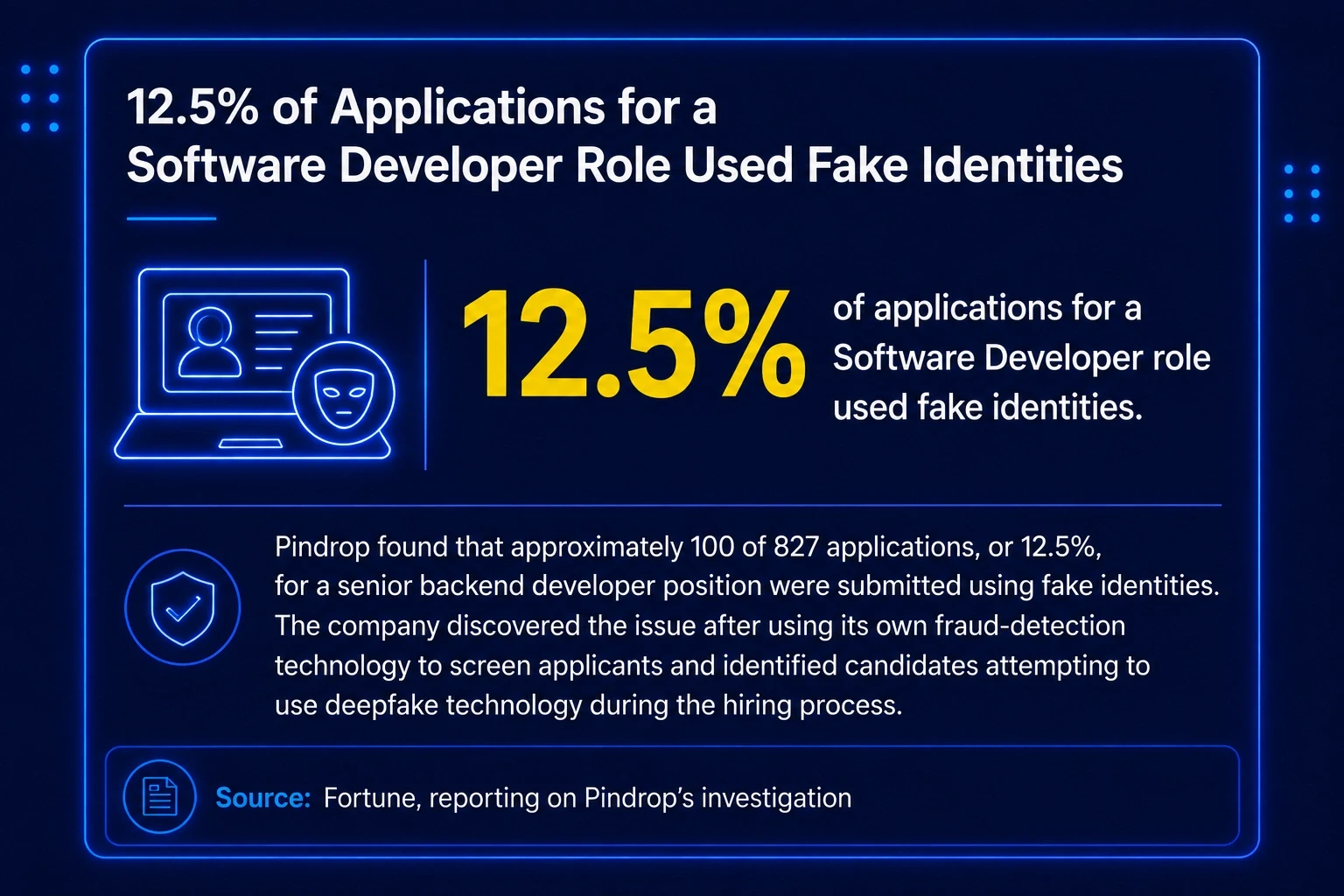
40. 12.5% of Applications for a Software Developer Role Used Fake Identities
Pindrop found that approximately 100 of 827 applications, or 12.5%, for a senior backend developer position were submitted using fake identities.
The company discovered the issue after using its own fraud-detection technology to screen applicants and identified candidates attempting to use deepfake technology during the hiring process.
Source: Fortune, reporting on Pindrop's investigation
What This Means for Recruiters?
Fake identities can appear well before the interview begins. Recruiters hiring for remote technical positions may need to verify candidate identity early in the hiring funnel rather than waiting until the final interview stage.
41. 20% of Hiring Fraud Detected by HR Teams Is Interview Fraud
20% of hiring fraud detected by HR teams is interview fraud, including proxy interviews and AI-assisted impersonation, according to Checkr's 2026 State of Screening Compliance Report.
The report surveyed HR teams about the types of hiring fraud they encounter when hiring at scale. Interview fraud ranked behind resume or credential fabrication at 34% and document fraud at 29%.
Source: Checkr, 2026 State of Screening Compliance Report
What This Means for Recruiters?
Interview fraud is not limited to candidates secretly using AI to answer questions. Proxy interviews and AI-assisted impersonation represent a distinct category of hiring fraud that requires identity verification as well as conventional interview monitoring.
42. 15% of Hiring Fraud Involves Identity Fraud
15% of hiring fraud detected by HR teams involves identity fraud, including stolen identities or fabricated personal details, according to Checkr's 2026 State of Screening Compliance Report.
The finding separates identity fraud from interview fraud, showing that fraudulent candidates can manipulate their identity independently of the interview itself.
Source: Checkr, 2026 State of Screening Compliance Report
What This Means for Recruiters?
Identity verification should be treated as a separate layer of candidate screening. A candidate can potentially pass an interview while still being someone other than the person represented in the application.
43. 58% of HR Teams Detected Hiring Fraud in the Past Year
58% of HR teams reported detecting hiring fraud during the previous year, according to Checkr's 2026 State of Screening Compliance Report.
The report describes hiring fraud as evolving from an occasional problem into an issue that organizations encounter at scale.
Source: Checkr, 2026 State of Screening Compliance Report
What This Means for Recruiters?
Hiring fraud is becoming a broader operational issue rather than a handful of isolated incidents. Organizations hiring large numbers of remote workers may need standardized fraud detection and identity-verification processes.
44. 34% of Hiring Fraud Involves Resume or Credential Fabrication
34% of hiring fraud detected by HR teams involves resume or credential fabrication, making it the most common category identified in Checkr's 2026 screening research.
This includes candidates falsifying their professional qualifications or credentials before they even reach the interview stage.
Source: Checkr, 2026 State of Screening Compliance Report
What This Means for Recruiters?
The fake-candidate problem can begin before a candidate joins a video call. Resume verification and credential checks can therefore be important defenses against candidates who combine fabricated backgrounds with proxy or deepfake interviews.
45. 29% of Hiring Fraud Involves Document Fraud
29% of hiring fraud detected by HR teams involves document fraud, including falsified degrees, certifications, licenses or work history.
This makes document manipulation another major component of fraudulent candidate profiles, alongside interview and identity fraud.
Source: Checkr, 2026 State of Screening Compliance Report
What This Means for Recruiters?
Deepfake interviews are only one part of the problem. Fraudulent candidates can create an entire synthetic professional identity using fake credentials and documents before impersonating that identity during an interview.
46. 72.4% of Recruiting Leaders Now Conduct In-Person Interviews to Combat Fraud
According to a Gartner survey reported by Computerworld, 72.4% of recruiting leaders said they are currently conducting interviews in person specifically to combat candidate fraud. Gartner defines candidate fraud as a would-be hire who pretends to be someone else or has someone else complete the interview on their behalf. Google, Cisco, and McKinsey have all reinstated in-person interview rounds over the past year in response.
Source: Computerworld, citing Gartner
What This Means for Recruiters?
The scale of the shift back to in-person interviewing shows how limited employers feel remote screening has become for verifying identity. Organizations relying solely on video interviews for sensitive roles may want to weigh whether an in-person or live-proctored round is worth reintroducing.
47. Share of Companies Requiring In-Person Interviews Rose from 24% to 72%
Reporting cited by The Interview Guys put the share of companies requiring at least one in-person interview round to catch AI-assisted candidates at 72%, up from 24% in 2022 a threefold increase in four years.
Source: The Interview Guys
What This Means for Recruiters?
This is one of the clearest before-and-after signals in the space: it shows the pace at which in-person verification moved from a niche practice to a near-majority standard as AI tools became more capable.
48. 81% of Big Tech Interviewers Believed Candidates Were Cheating with AI
By the end of 2025, 81% of Big Tech interviewers said they believed candidates were using AI to cheat during remote interviews, according to The Interview Guys' 2026 report on AI in job interviews.
Source: The Interview Guys, The State of AI in Job Interviews 2026
What This Means for Recruiters?
Suspicion has become the default assumption among experienced interviewers at leading tech companies, even without formal detection tools. That gap between suspicion and confirmed detection is exactly where clearer AI-use policies and follow-up questioning can help.
49. Fabric's Broader Dataset Shows Cheating Flags More Than Doubled in Six Months
Across a larger tracked sample of more than 50,000 candidates, Fabric found the share flagged for AI-assisted cheating behavior more than doubled, from 15% in June 2025 to 35% by December 2025.
Source: Truffle, citing Fabric
What This Means for Recruiters?
This is a separate, larger Fabric dataset from the 19,368-interview analysis already cited elsewhere, and it points the same direction: rapid, sustained growth in detected AI assistance over just six months, not a one-time spike.
50. Humans Detect Deepfakes with Only 55.54% Accuracy
Human reviewers identify deepfake video with only 55.54% accuracy, barely better than a coin flip, according to research cited by The Interview Guys.
Source: The Interview Guys, The State of Hiring Fraud 2026
What This Means for Recruiters?
Manual visual review is not a reliable defense against deepfake candidates. This strengthens the case for combining video interviews with identity verification tools rather than relying on interviewer judgment alone.
51. 91% of Hiring Professionals Encountered or Suspected AI-Generated Answers in Online Meetings
In a Greenhouse survey of 4,136 people, 91% of hiring professionals said they had encountered or suspected AI-generated answers during online interview meetings.
Source: Greenhouse, via People Management
What This Means for Recruiters?
Suspicion of AI-generated answers is now close to universal among hiring professionals conducting virtual interviews, reinforcing the need for structured follow-up questions that are harder to answer with pre-generated responses.
52. Only 14% of Candidates Openly Admit to Using AI in an Assessment
Only 14% of candidates openly admit to having already used generative AI in an assessment context, a gap researchers refer to as the "dark figure" between self-reported and actual use.
Source: TestPartnership survey, reported by HackerRank
What This Means for Recruiters?
Self-reported AI use significantly undercounts actual behavior. Recruiters should treat candidate honesty on this topic as unreliable and rely on behavioral or technical detection signals instead of disclosure alone.
Conclusion
AI is changing interview integrity faster than traditional hiring processes can adapt. The statistics in this report show that the challenge extends beyond candidates using AI to generate answers. Employers are increasingly dealing with real-time AI assistance, technical interview cheating, deepfakes, proxy interviews, fake identities, and other forms of candidate fraud.
The data also highlights a growing gap between candidate behavior and employers' ability to detect it. From candidates using AI despite restrictions to hiring managers struggling to identify sophisticated deception, traditional interviews and candidate self-disclosure are no longer enough to establish authenticity in every case.
For recruiters and hiring teams, the goal should not simply be to prohibit AI. Organizations need clear AI-use policies, structured interviews, identity verification, skills validation, and appropriate detection methods that match the risks of each role.
As AI-assisted hiring fraud continues to evolve, interview integrity will become an increasingly important part of building a reliable hiring process. Employers that combine better verification with thoughtful interview design will be better positioned to distinguish genuine skills and experience from AI-assisted or fraudulent performance.
Stop AI-Assisted Interview Cheating |
|---|