Back to all blogs
Discover how AI is reshaping fraud in financial services through deepfakes, voice cloning, and identity impersonation, and what to do about it.

Abhishek Kaushik

AI-enabled fraud surged 1,210% in 2025, and losses are expected to top $40 billion by 2027. This is a major issue for financial institutions, but AI can also be part of the solution.
In January 2024, an Arup employee was tricked into authorizing 15 wire transfers totaling $25.6 million on a video call with a deepfake of the company's chief financial officer and several colleagues.
The Arup incident is a wake-up call for the financial services industry. AI is the most powerful tool available to fight fraud, but it's also the most dangerous weapon in the hands of fraudsters. This duality is creating a trust crisis for banks, insurers, fintech companies, and their customers, and it needs to be addressed now.
According to a YouGov survey, just 20% of Americans trust AI in financial services, the lowest of any industry. But a Harris Poll survey conducted for Alloy found that 66% of consumers are more likely to choose a financial institution that uses AI security measures to protect them.
This is a critical moment for financial institutions to demonstrate the value they can create for their customers by using AI to improve the customer experience and protect them from fraud.
The Scale of AI Fraud in Financial Services
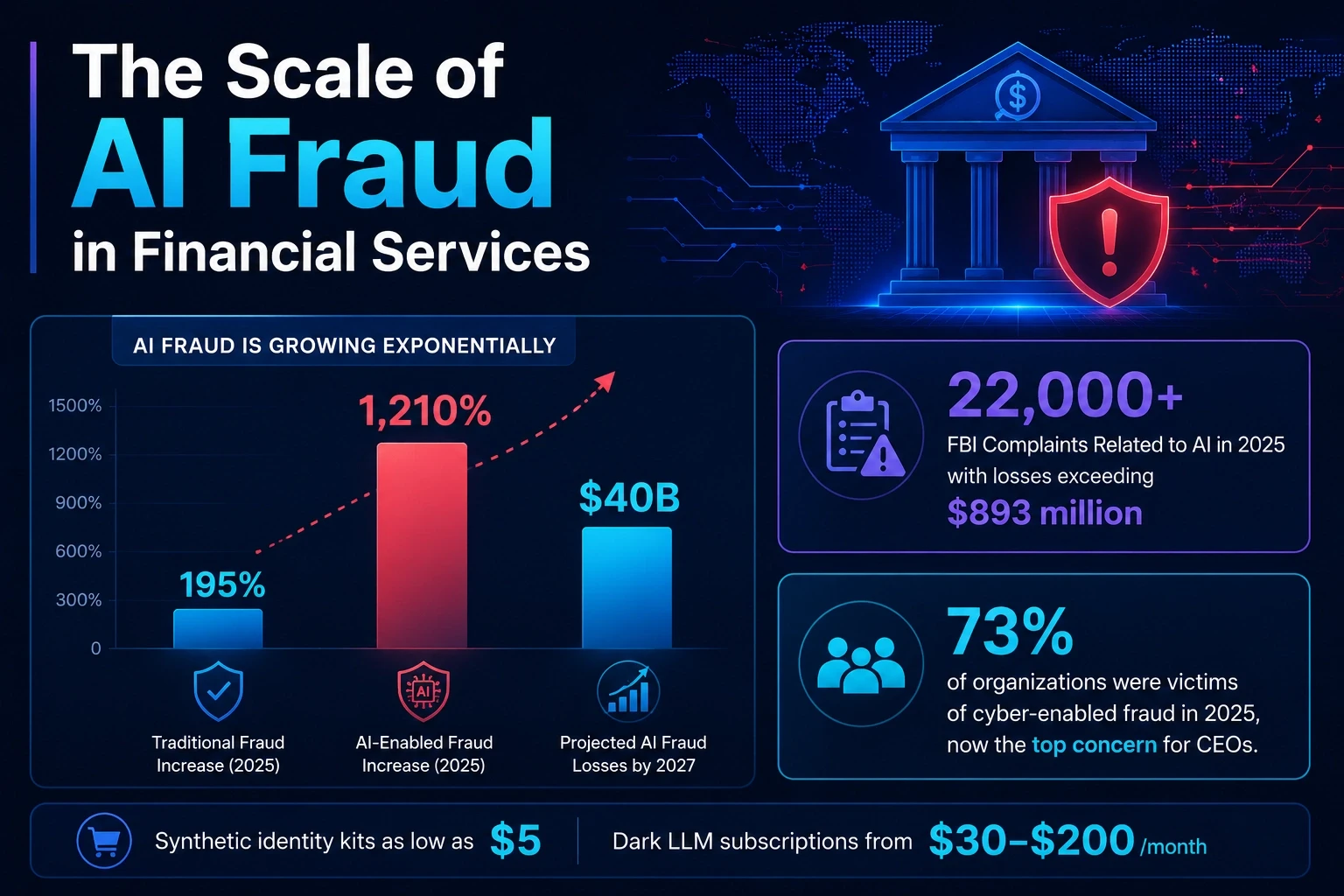
Pindrop's analysis of attacks against its major U.S. customers saw a 1,210% increase in AI-enabled fraud between January and December 2025, compared to a 195% increase in traditional fraud over the same period. The FBI's Internet Crime Complaint Center received more than 22,000 complaints related to AI in 2025, with adjusted losses exceeding $893 million. This represents a significant portion of the $16.6 billion in cybercrime losses reported to IC3 in 2024, which was a 33% year-over-year increase.
These are just the reported figures, and the real numbers are likely higher.
Deloitte's Center for Financial Services estimates that generative AI will drive $40 billion in fraud losses in the U.S. by 2027, up from $12.3 billion in 2023, a 32% compound annual growth rate. The World Economic Forum's Global Cybersecurity Outlook 2026 found that in 2025, 73% of organizations were victims of cyber-enabled fraud, which has become the top concern for CEOs, surpassing ransomware.
Group-IB has found that synthetic identity kits are available for as little as $5, while dark LLM subscriptions can cost anywhere from $30 to $200 a month.
How AI Is Being Leveraged to Target Financial Services
AI fraud takes many forms in financial services, taking advantage of weaknesses in how banks and other financial institutions verify identity and authorize transactions.
Deepfakes and Video Fraud
By 2025, the number of deepfakes online had grown from 500,000 in 2023 to 8 million, with Gen Threat Labs identifying 159,378 deepfake scams in the fourth quarter of 2025 alone. The Arup case was not an isolated incident. The technology has advanced to the point where real-time interactive video avatars can be created that maintain temporal consistency without the flicker, warping, or uncanny valley artifacts that earlier detection methods relied on.
The FBI has documented North Korean IT worker schemes using deepfake technology to pass video job interviews at more than 136 U.S. companies, with operatives earning over $300,000 per year while funneling revenue to weapons programs. Gartner projects that one in four candidate profiles could be fake by 2028.
Voice Cloning: The Emerging Risk to Financial Institutions
Voice cloning is the most dangerous of all AI fraud vectors. For years, phone-based banking has relied on the assumption that a customer's voice provides a layer of identity verification, but this is no longer the case.
McAfee has demonstrated that it's possible to produce a voice clone with 85% accuracy using just three seconds of audio. Fortune reported in late 2025 that voice cloning had crossed what researchers call the "indistinguishable threshold" — the point at which human listeners can no longer reliably distinguish cloned voices from authentic ones. AI voice cloning is now being used to bypass bank voice authentication systems and authorize fraudulent transactions.
The number of AI-generated scam calls is growing, with some major retailers reporting more than 1,000 a day. In New Hampshire, families have been scammed by AI-generated imitations of relatives' voices in so-called grandparent scams. The FBI's 2025 Internet Crime Report also noted an increase in "family in distress" calls using AI voice cloning among its documented AI-related losses.
In 2025, Consumer Reports tested six of the leading AI voice cloning products and found that most of them did not have sufficient security measures in place to prevent abuse. In April 2026, U.S. Senator Maggie Hassan wrote to ElevenLabs, LOVO, Speechify, and VEED to ask what they are doing to stop scammers from using their products, and to go beyond terms-of-service promises and provide details on actual technical enforcement.
AI-Powered Phishing and Business Email Compromise
Brightside AI's research shows that AI-generated phishing emails have a 54% click-through rate, 4.5x higher than the 12% for traditional phishing. IBM X-Force research found that AI can generate a convincing phishing email in five minutes, a task that takes a human researcher 16 hours, representing a 192x speed increase with equivalent or better quality.
The FBI’s IC3 recorded $2.77 billion in losses from 21,442 business email compromise (BEC) incidents in 2024, and generative AI is making these attacks even more dangerous. According to KnowBe4 and SlashNext, 82.6% of phishing emails now contain some AI-generated content, while Hoxhunt reports that 40% of BEC emails are primarily AI-generated. This lets attackers launch multimodal campaigns that combine email, voice, and video impersonation.
The Trust Deficit: Why Consumer Confidence Is Eroding
According to a YouGov survey, financial services is the least trusted when it comes to AI, with just 20% of Americans expressing consumer trust in AI in finance, and only 5% saying they trust it "a lot."
Gen Z is the most likely to trust AI in general, with 29% saying they do, while Gen X is the most skeptical at 13%. But Gen Z is the least likely to trust AI for fraud detection, at 44%. By contrast, 64% of Baby Boomers and 59% of Gen X trust AI for fraud detection.
According to Alloy's 2025 State of Scams Report, based on a Harris Poll survey of 2,000 American consumers, 85% of consumers are concerned that AI technology will make it easier for scammers to trick them. Their top three concerns are AI-driven bank impersonations (28%), voice cloning phone calls (21%), and synthetic identity fraud (18%). In fact, 62% of consumers say they or someone they know has been a victim of a scam, and one in five of those who lost money lost $5,000 or more. While the financial loss is significant, consumers say the emotional distress is even worse.
Eighty-seven percent of consumers in the Alloy survey said they would lose trust in their financial institution if it failed to notify them about attempted scams. As Trace Fooshée of Datos Insights says, "Authorized payment scams edge closer to a tipping point that threatens to upend the trust relationship across the whole financial system."
AI as a Strategic Shield: How Financial Institutions Are Countering the Threat
According to a recent survey by Alloy, 66% of consumers are more likely to choose a bank that uses AI for security, and 97% said fraud prevention is the most important factor when selecting a financial institution. In fact, a YouGov survey found that 56% of Americans trust AI to flag unusual transactions, the highest level of trust for any AI application in finance.
Banks need to make sure their AI fraud detection is working behind the scenes, but also let customers know it's there.
At a high level, AI fraud detection systems operate in a number of ways. They can be used to analyze billions of transactions in real time and identify anomalies. They can also use supervised learning trained on known fraud patterns to catch recognized attack types, and unsupervised learning to detect previously unknown anomalies. At a lower level, Behavioral analytics track patterns across networks, identity signals, and data flows to flag deviations that rules-based systems would miss. For phone-based fraud, voice biometric anomaly detection can be used to counter the voice cloning threat.
American Express has improved its fraud detection by 6% through AI, while PayPal has improved real-time fraud detection by 10%. According to a survey reported by Customer Experience Dive, 70% of consumers are comfortable with AI being used for fraud detection.
These capabilities are now table stakes for any institution serious about fraud prevention.
The Regulatory Landscape
Senators Tim Sheehy and Lisa Blunt Rochester have introduced the AI Fraud Accountability Act of 2026 (S.3982), which would create a federal criminal prohibition on the use of digital impersonation with intent to defraud. The bill would provide for up to three years in prison and forfeiture provisions. The bill would also allow the FTC to pursue civil penalties for such conduct. In addition, the bill would direct the Secretary of Commerce to establish a committee through NIST to develop standards for identifying, preventing, and tracing digital impersonations.
In April 2026, Senator Hassan sent letters to voice cloning companies, calling for greater transparency and accountability. In December 2025, NIST published the NIST Cyber AI Profile (IR 8596) that provides guidance on AI-enabled cyber defense and thwarting AI-enabled cyberattacks. In Europe, the EU AI Act classifies AI systems by risk level and imposes specific obligations on high-risk AI systems, including documentation of decision-making processes and regular bias assessments.
The regulatory writing is on the wall: AI will be part of the financial services landscape, and firms that don’t prepare now will be left behind.
Strategic Actions for Financial Services Leaders Today
To rebuild trust, financial services leaders need to focus on providing a better customer experience through improved technology, while also prioritizing security and fraud prevention.
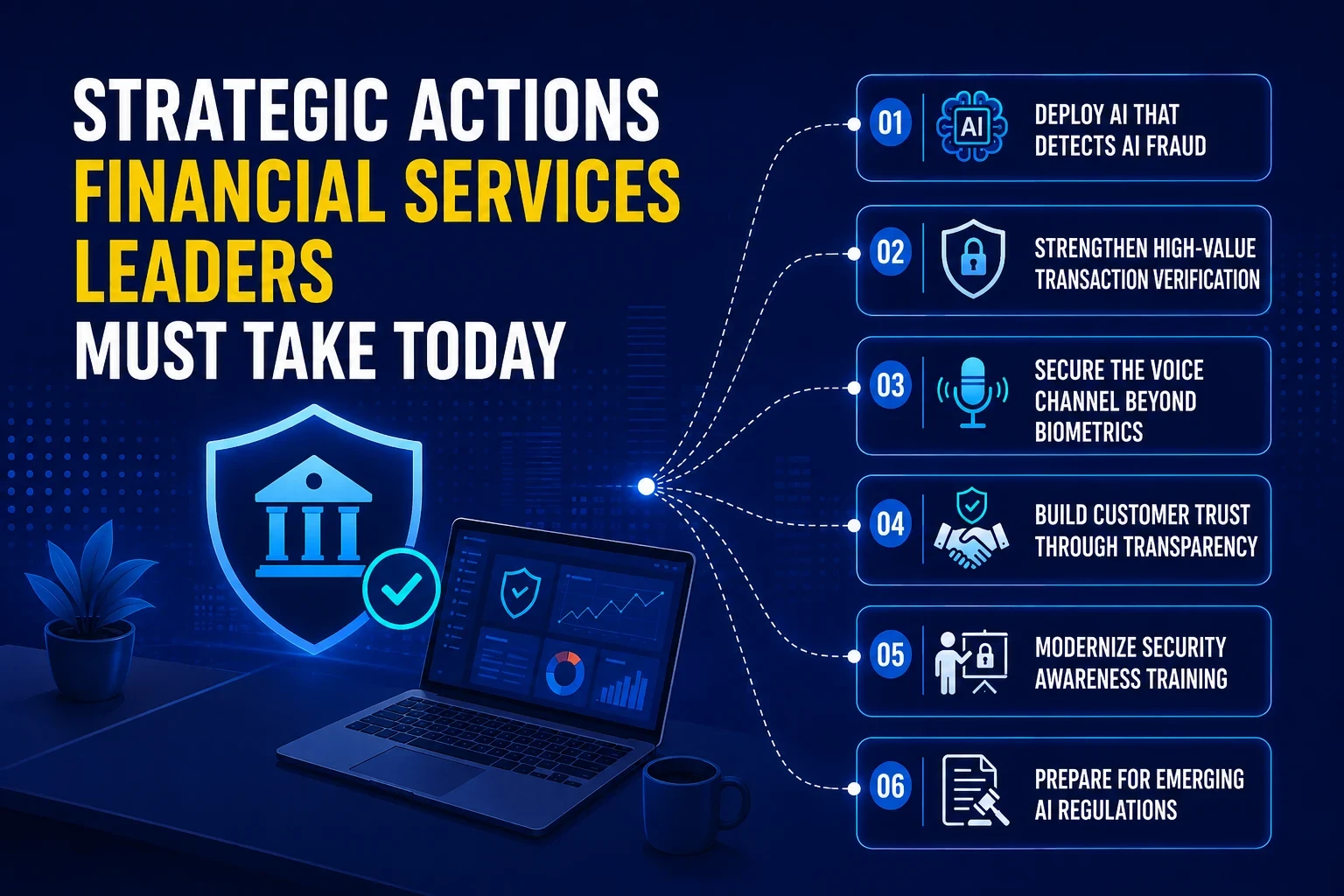
Deploy AI fraud detection that matches the threat. To keep up with the threat, you need AI that can detect AI. This means using behavioral analytics, real-time anomaly detection, and machine learning models that can adapt as fraud tactics evolve.
Implement layered verification for high-value transactions. In an era of deepfakes, it's critical to have multiple layers of security. This includes dual-approval financial controls, out-of-band verification, and pre-shared code phrases that can be used to confirm the identity of the person on the other end of the line.
Address the voice channel vulnerability directly. Voice biometric anomaly detection is a useful part of a layered approach to identity confirmation, but voice recognition should not be the only factor in high-value transactions.
Be transparent with customers about both threats and defenses. If your bank knows about a scam, it should let you know—eighty-seven percent of consumers would lose trust if not notified about attempted scams. By being transparent about how it's protecting you, your bank can build trust and demonstrate that it's looking out for you.
Upgrade security awareness training. Your employees and customers can identify phishing emails that contain grammatical errors, but AI-generated phishing is grammatically flawless. Train them to identify the psychological manipulation tactics, such as urgency framing or an unusual request, that are more likely to trick them into falling for a phishing scam.
Prepare for tightening regulation. The AI Fraud Accountability Act, NIST working group guidelines, and EU AI Act requirements are critical for financial services organizations to understand and be prepared to achieve compliance with.
This is an area where consumers are ahead of the curve. In fact, 69% of Americans are willing to trade some privacy for AI-powered scam protection, according to an Alloy survey.
Restoring Consumer Confidence in the Era of AI
The technology that is eroding trust in financial services is also the technology that will be needed to restore it. As such, it’s critical to get ahead of the curve and develop AI that can be trusted. Fraudsters are already using AI at scale, and consumers are increasingly demanding AI-powered solutions that can protect them.
The organizations that will come out of this ahead will be those that are using AI fraud detection, not just as a back-office function, but also in ways that are visible to customers and that demonstrate a commitment to security. They will be organizations that are talking about the threats they are seeing and the steps they are taking to protect their customers. And they will be organizations that are helping to shape the regulatory frameworks for how AI is used, both offensively and defensively, in financial services.
The race is on, and the time to get ahead of the competition is now.
Citations
Deloitte Center for Financial Services — "Generative AI is expected to magnify the risk of deepfakes and other fraud in banking" (2024). Projected $40B in AI-enabled fraud losses by 2027, up from $12.3B in 2023. https://www.deloitte.com/us/en/insights/industry/financial-services/deepfake-banking-fraud-risk-on-the-rise.html
FBI Internet Crime Complaint Center (IC3) 2025 Annual Report — Over 22,000 AI-related complaints with $893M in adjusted losses in 2025. https://www.ic3.gov/AnnualReport/Reports/2025_IC3Report.pdf
FBI IC3 2024 Annual Report — $16.6B in total cybercrime losses (33% YoY increase); $2.77B in BEC losses across 21,442 incidents. https://www.ic3.gov/AnnualReport/Reports/2024_IC3Report.pdf
Pindrop — "Inside the 2025 AI Fraud Spike" — AI-enabled fraud increased 1,210% between January and December 2025, compared to 195% for traditional fraud. https://www.pindrop.com/ai-fraud-spike/
World Economic Forum — Global Cybersecurity Outlook 2026 — In 2025, 73% of organizations were victims of cyber-enabled fraud, which became the top CEO concern, surpassing ransomware. https://reports.weforum.org/docs/WEF_Global_Cybersecurity_Outlook_2026.pdf
Alloy / Harris Poll — 2025 State of Scams Report — 85% of consumers fear AI scams, but 66% are more likely to bank with an institution that uses AI protection; 97% say fraud prevention is the most important factor in choosing a bank; 87% would lose trust if not notified of a scam attempt. https://www.prnewswire.com/news-releases/85-of-americans-fear-ai-powered-scams-and-66-opt-for-banks-using-ai-protection-302589192.html
YouGov — "Americans still don't trust banking sector AI use" — Just 20% of Americans trust AI in financial services, the lowest of any industry. https://yougov.com/en-us/articles/53809-americans-still-dont-trust-banking-sector-ai-use
McAfee — "Artificial Imposters: Cybercriminals Turn to AI Voice Cloning" — Using just three seconds of audio, cybercriminals can create a voice clone that is 85% accurate; 1 in 4 adults has encountered an AI voice scam. https://www.mcafee.com/blogs/privacy-identity-protection/artificial-imposters-cybercriminals-turn-to-ai-voice-cloning-for-a-new-breed-of-scam/
Biometric Update — "AI voice fraud draws new congressional scrutiny" (April 2026) — Sen. Hassan's letters to voice cloning companies; AI Fraud Accountability Act of 2026 (S.3982) details; Consumer Reports assessment of voice cloning product safeguards. https://www.biometricupdate.com/202604/ai-voice-fraud-draws-new-congressional-scrutiny
CNN — "Finance worker pays out $25 million after video call with deepfake 'chief financial officer'" — Arup deepfake case details. https://www.cnn.com/2024/05/16/tech/arup-deepfake-scam-loss-hong-kong-intl-hnk
Gen Threat Labs — Q4 2025 Threat Report — 159,378 deepfake scam instances detected in Q4 2025. https://www.gendigital.com/blog/insights/reports/threat-report-q4-2025
Group-IB — "AI Cybercrime Use Cases" (2026) — Synthetic identity kits available for ~$5; dark LLM subscriptions $30-$200/month. https://www.group-ib.com/blog/ai-cybercrime-usecases/
Brightside AI — AI-generated phishing emails have a 54% click-through rate, compared to 12% for human phishing emails. https://www.brside.com/blog/ai-generated-phishing-vs-human-attacks-2025-risk-analysis
IBM X-Force — AI can produce a phishing email in 5 minutes, while it takes a human 16 hours to do the same. https://www.ibm.com/think/insights/generative-ai-social-engineering
Customer Experience Dive — 70% of consumers comfortable with AI used for fraud detection behind the scenes. https://www.customerexperiencedive.com/news/customers-trust-ai-use-financial-institutions/751120/