Back to all blogs
Learn about remote hiring compliance in the USA, including federal and state laws, Form I-9, AI hiring, background checks, and best practices.

Abhishek Kaushik
Remote hiring allows companies to recruit, interview, evaluate, and onboard employees without requiring candidates to visit a physical workplace. But hiring candidates remotely does not remove an employer's legal responsibilities. It introduces additional compliance considerations across recruitment, interviews, background checks, employment eligibility verification, and onboarding.
Remote hiring compliance in the USA requires employers to follow applicable federal, state, and local requirements while also considering how hiring technology affects the candidate experience. AI-powered resume screening, automated assessments, video interviews, background screening platforms, and remote identity verification can all influence how candidates are evaluated and selected. SHRM reported that 69% of organizations experienced difficulty recruiting for full-time positions in 2025, while AI adoption in HR tasks increased to 43%.
A compliant remote hiring process therefore needs to address more than traditional employment requirements. Employers should consider discrimination and accessibility, AI and automated decision-making, background checks, Form I-9 procedures, candidate identity verification, privacy, and interview integrity.
This guide explains the key remote hiring compliance requirements employers should understand in the USA, how AI and hiring technology can affect compliance, what employers need to know about remote Form I-9 procedures, and how to build a fair, consistent, and reliable remote hiring process.
Disclaimer: This article provides general information about U.S. employment compliance and is not legal advice. Requirements can vary based on the employer, employee location, industry, and state or local law.
What Is Remote Hiring Compliance in the USA?
Remote hiring compliance refers to the laws, regulations, policies, and procedures employers need to follow when recruiting, evaluating, selecting, and onboarding employees through remote or online hiring processes.
These requirements can apply throughout the entire hiring journey, including job advertising, applications, candidate screening, remote interviews, assessments, background checks, employment eligibility verification, offer management, and onboarding.
In the USA, remote hiring compliance can involve federal, state, and local requirements. Employers may need to consider rules related to equal employment opportunity, disability accommodations, background checks, employment eligibility, candidate data, privacy, and the use of AI or automated hiring technologies.
Remote hiring can also create risks that are less common in traditional in-person recruitment. For example, employers may need to verify that the person participating in an interview or assessment is the same person who applied for the position, while also ensuring that identity verification and hiring technologies do not create unnecessary barriers or discriminatory outcomes.
A compliant remote hiring process therefore combines legal requirements with consistent hiring procedures, appropriate technology controls, accessibility measures, and safeguards for candidate information and identity.
Why Is Remote Hiring Compliance Important?
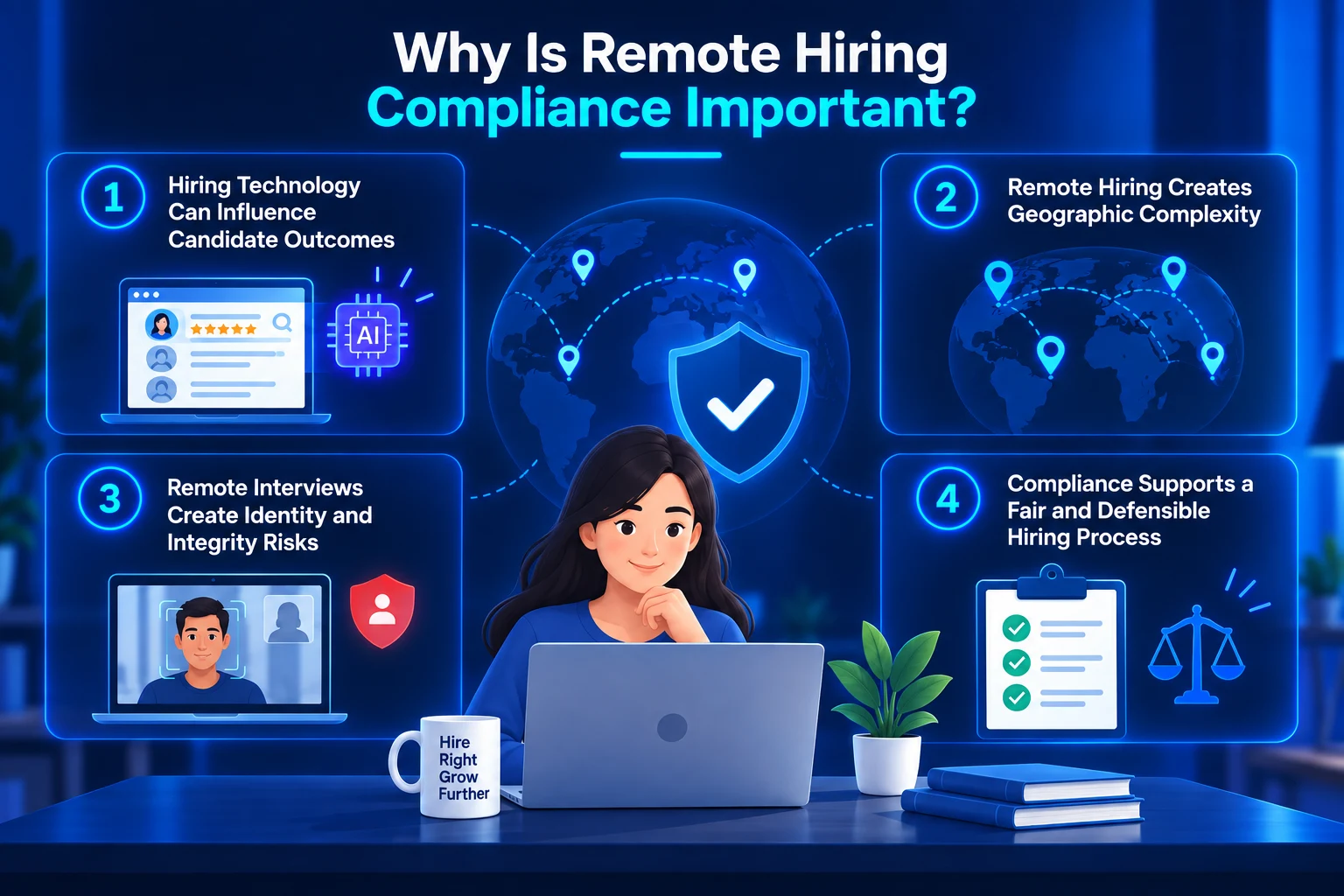
Remote hiring can help employers reach a wider talent pool and streamline recruitment, but it also creates compliance risks that may be harder to identify when the hiring process is spread across multiple technologies, vendors, and jurisdictions.
A single remote hiring process may involve an applicant tracking system, AI-powered screening, online assessments, video interviewing software, background screening services, identity verification tools, and digital onboarding platforms. Each system may collect candidate information or influence the hiring experience, creating additional areas for employers to review.
1. Hiring Technology Can Influence Candidate Outcomes
Automated systems can screen resumes, rank candidates, evaluate assessments, or recommend which applicants move forward. If the criteria used by these systems are inappropriate, inaccessible, or discriminatory, technology can contribute to unfair hiring outcomes.
Employers should therefore understand how their hiring technologies are used, what information they process, and how automated outputs influence human hiring decisions. The EEOC recognizes that AI and other automated technologies can be used in recruiting, screening, and hiring and that existing federal employment discrimination laws continue to apply.
2. Remote Hiring Creates Geographic Complexity
Remote employers may recruit candidates who live in different states or local jurisdictions. Employment requirements can vary depending on where the employer operates and where the candidate or employee is located.
Organizations should identify the federal, state, and local requirements that apply to their hiring process rather than assuming that a single nationwide policy covers every situation.
3. Remote Interviews Create Identity and Integrity Risks
Unlike traditional in-person interviews, remote interviews may make it harder to confirm that the person participating is the same person who applied for the position. Proxy candidates, identity inconsistencies, deepfakes, and other forms of interview fraud can create additional risks, particularly for roles involving sensitive information or privileged access.
Candidate identity verification should therefore be considered separately from employment eligibility verification and incorporated into the overall hiring process where appropriate.
4. Compliance Supports a Fair and Defensible Hiring Process
A structured remote hiring process can help employers apply consistent evaluation criteria, provide reasonable accommodations, follow applicable background-check and employment-eligibility requirements, protect candidate information, and identify potential integrity concerns.
The goal is not simply to make remote hiring compliant on paper. It is to create a hiring process that is fair, accessible, consistent, documented, and secure from the initial application through onboarding.
What Federal Laws Affect Remote Hiring in the USA?
There is no single federal law that governs every aspect of remote hiring in the United States. Instead, employers may need to comply with multiple federal employment laws depending on the employer, position, hiring process, and information collected from candidates.
These requirements can apply whether hiring takes place in person, remotely, or through a combination of both. Employers should also consider state and local requirements, which may provide additional protections or impose additional obligations.
1. Title VII and Federal Anti-Discrimination Requirements
Title VII of the Civil Rights Act prohibits covered employers from discriminating against applicants and employees based on protected characteristics, including race, color, religion, sex, and national origin.
These protections apply to recruitment and hiring as well as other employment decisions. Employers should therefore review job advertisements, screening criteria, interview practices, assessments, and AI-powered hiring tools to identify practices that could result in unlawful discrimination.
2. Americans with Disabilities Act
The Americans with Disabilities Act (ADA) prohibits covered employers from discriminating against qualified individuals with disabilities and requires reasonable accommodation in applicable circumstances.
The ADA is particularly relevant to remote hiring when employers use online assessments, video interviews, automated screening systems, or other digital recruitment technologies. Employers should ensure that hiring technology is accessible and provide reasonable accommodations when a disability creates a barrier during the recruitment process.
3. Age Discrimination in Employment Act
The Age Discrimination in Employment Act (ADEA) protects individuals who are 40 or older from age discrimination in employment.
Remote recruitment systems should be reviewed to ensure that job advertisements, screening criteria, assessments, and selection processes do not create unlawful age-based barriers. This is particularly relevant when automated systems consider factors such as career history, years of experience, or other criteria that could unintentionally disadvantage older applicants.
4. Genetic Information Nondiscrimination Act
The Genetic Information Nondiscrimination Act (GINA) restricts covered employers from requesting, requiring, or using genetic information in employment decisions, subject to limited exceptions.
Employers should ensure that remote application forms and recruitment systems do not unnecessarily collect genetic information or family medical history that could create compliance concerns.
Other Federal Requirements May Apply
These laws represent several major federal requirements relevant to remote hiring, but they are not an exhaustive list. Depending on the employer and hiring process, other federal requirements may also apply.
Employers should evaluate their specific recruitment practices and determine which federal, state, and local requirements apply to their organization and the locations where they recruit and employ workers.
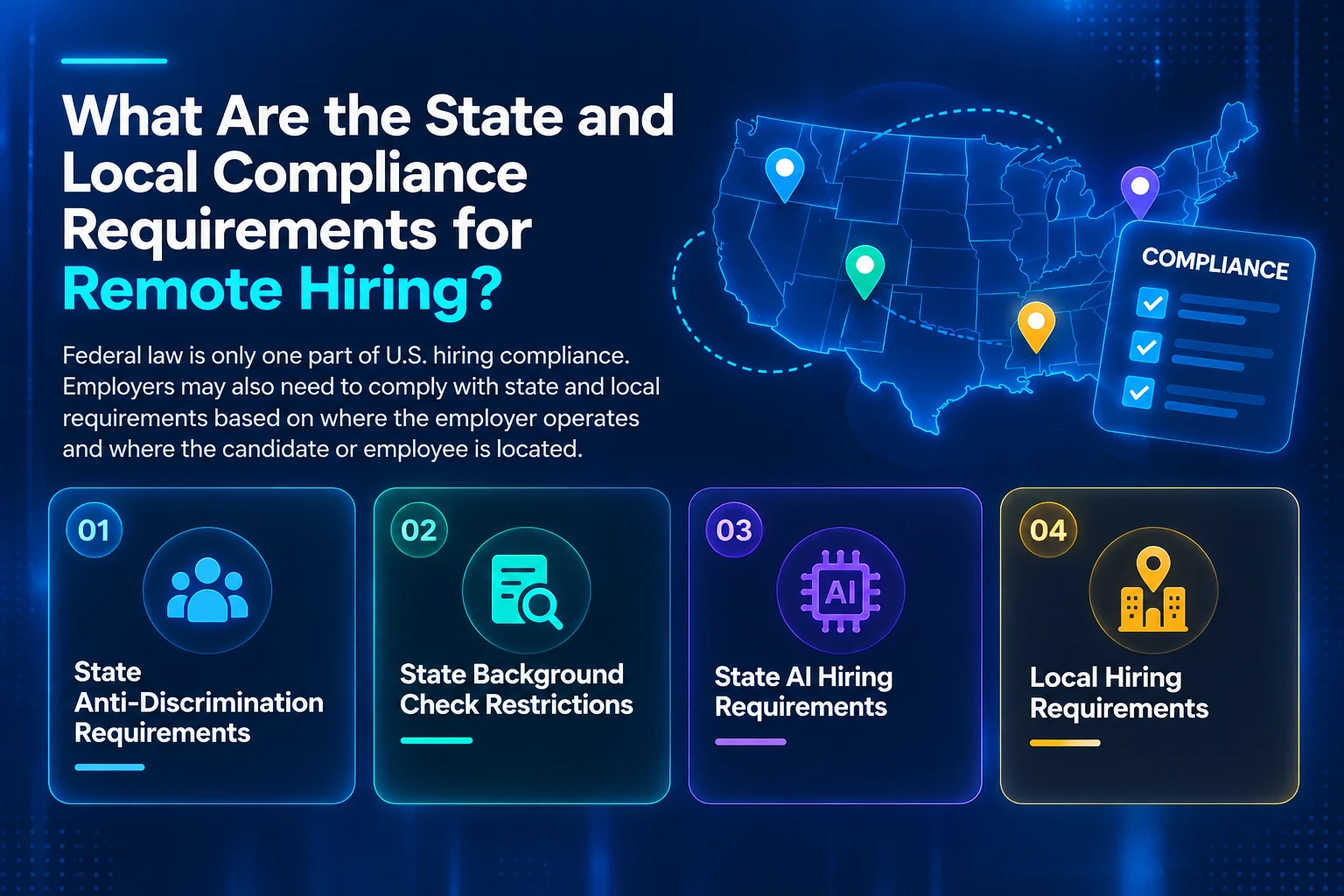
What Are the State and Local Compliance Requirements for Remote Hiring?
Federal law is only one part of U.S. hiring compliance.
Employers may also need to comply with state and local requirements based on where the employer operates and where the candidate or employee is located.
State Anti-Discrimination Requirements
States and local jurisdictions may provide additional protections beyond federal law.
Employers should therefore review the requirements that apply to the jurisdictions in which they recruit and employ workers.
State Background Check Restrictions
Some states and municipalities regulate when and how employers can ask about criminal history or use certain background information.
The FTC specifically advises employers to review applicable state and municipal requirements when using background information for employment purposes.
State AI Hiring Requirements
State-level regulation of automated employment decision systems is also developing.
For example, California's Civil Rights Council approved employment regulations regarding automated decision systems, with the regulations taking effect April 1, 2026.
Employers using AI hiring technologies should therefore monitor the jurisdictions where candidates and employees are located rather than assuming that one nationwide policy will cover every requirement.
Local Hiring Requirements
Cities and local governments may impose additional employment requirements.
Remote employers should identify applicable local rules based on the location of the worker and the company's recruitment practices.
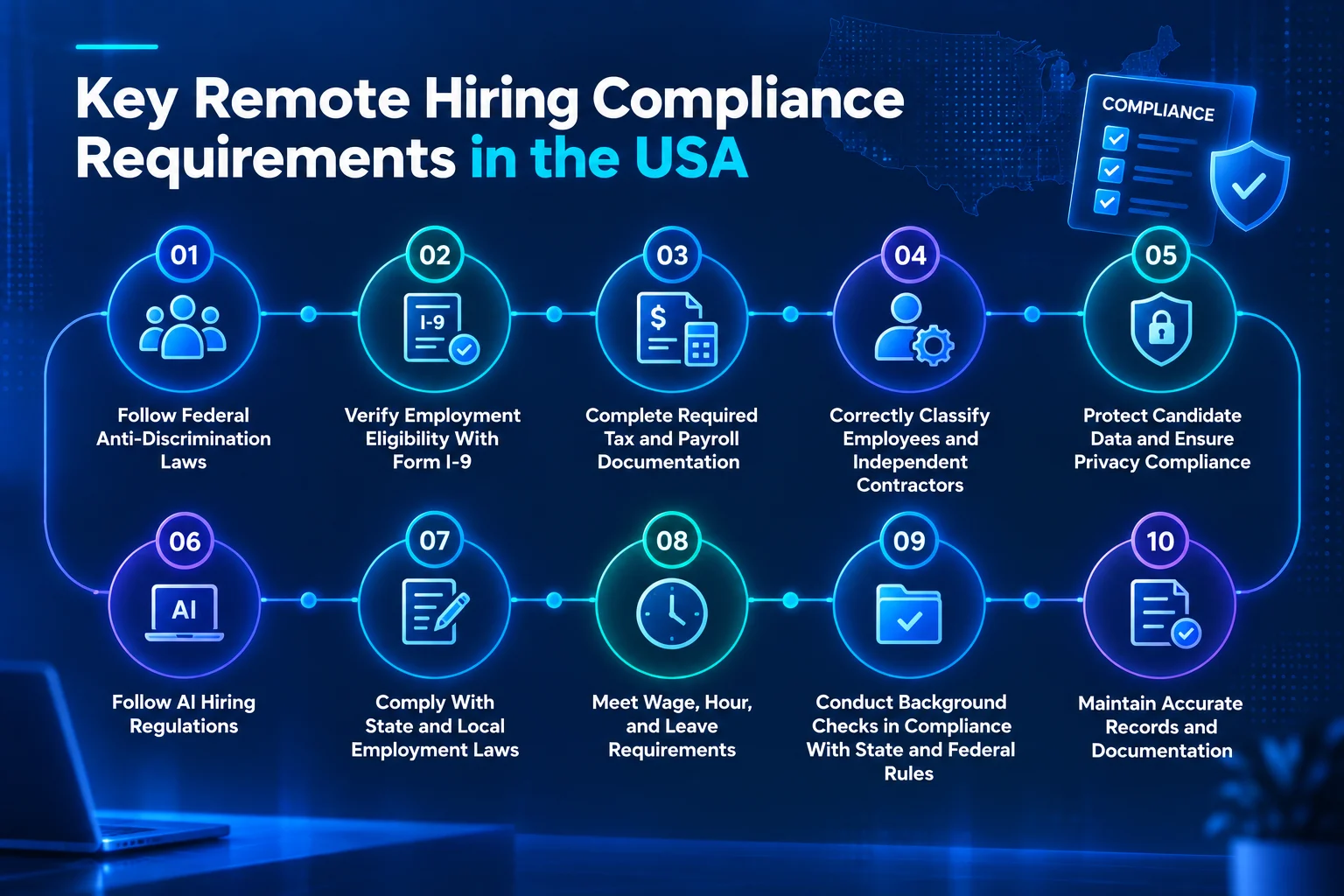
Key Remote Hiring Compliance Requirements in the USA
Employers must address key compliance areas throughout the remote hiring process, from anti-discrimination and employment eligibility to background checks, data protection, AI hiring, and state-specific requirements.
1. Follow Federal Anti-Discrimination Laws
One of the most important areas of remote hiring compliance is preventing discrimination during recruitment and selection.
The EEOC states that covered employers cannot discriminate against applicants or employees based on protected characteristics including:
Race
Color
Religion
Sex, including pregnancy, sexual orientation, and transgender status
National origin
Age 40 or older
Disability
Genetic information
These protections apply to employment decisions, including recruitment and hiring.
For private employers, federal EEOC coverage can depend on the type of discrimination and number of employees. For example, many Title VII protections generally apply to private employers with 15 or more employees, while age discrimination protections generally apply at 20 or more employees.
What should remote employers do?
Companies should make sure their:
Job descriptions use neutral, job-related criteria.
Interview questions focus on qualifications.
Candidate evaluation criteria are consistent.
Interviewers receive appropriate training.
Automated hiring tools are monitored for discriminatory outcomes.
Candidates are assessed using the same standards.
Remote hiring can actually make consistency more important because candidates may be interviewed by different recruiters, managers, or interview panels across locations.
2. Verify Employment Eligibility With Form I-9
Employers must verify the identity and employment authorization of employees hired to work in the United States.
This is done using Form I-9, Employment Eligibility Verification. The requirement applies to both U.S. citizens and noncitizens.
Remote employers need to pay particular attention to how employment eligibility documents are examined.
Can Form I-9 be completed remotely?
Yes, under certain conditions.
DHS authorized an alternative procedure allowing eligible employers enrolled in E-Verify to remotely examine Form I-9 documents instead of physically examining them, subject to the requirements of the authorized procedure. USCIS's Form I-9 instructions specifically provide for an employer to indicate when an authorized alternative procedure was used.
Employers should therefore avoid assuming that a video call alone satisfies I-9 requirements. The remote verification process needs to follow the applicable DHS requirements.
Employers must also apply verification procedures consistently. Federal law prohibits employers from requesting specific or additional documents based on an employee's citizenship status or national origin.
3. Complete Required Tax and Payroll Documentation
Hiring an employee means more than sending an offer letter and setting up payroll.
Employers generally need to collect information and complete the appropriate federal employment tax processes.
For example, new employees generally provide a Form W-4, which employers use to determine federal income tax withholding.
Employers are also responsible for federal employment taxes, including applicable:
Federal income tax withholding
Social Security taxes
Medicare taxes
Federal unemployment taxes
Employers must report and deposit employment taxes according to applicable IRS requirements.
Why does the employee's location matter?
With remote employees, payroll teams need to identify the employee's actual work location and determine which state and local requirements apply.
A company should not assume that because its headquarters are in one state, every remote employee can simply be processed under that state's employment rules.
State requirements can include:
Income-tax withholding
Unemployment insurance
Payroll registration
Wage statements
Paid leave
Workers' compensation
State-specific wage requirements
Because these requirements vary considerably, employers should review the rules applicable to each employee's work location.
4. Correctly Classify Employees and Independent Contractors
Another major compliance issue is determining whether a remote worker is an employee or an independent contractor.
Simply calling someone a "contractor" in an agreement does not necessarily determine their legal classification.
The IRS explains that a remote worker can still be an employee when the employer has the right to control what the worker does and how the work is performed.
The Department of Labor also uses an economic-realities analysis under the FLSA when determining whether a worker is an employee or independent contractor.
Misclassification can affect:
Minimum wage obligations
Overtime
Payroll taxes
Benefits
Unemployment insurance
Workers' compensation
Recordkeeping
Other employee protections
Before hiring a remote worker as a contractor, employers should evaluate the actual working relationship rather than relying solely on the contract's label.
5. Comply With Wage and Hour Requirements
Remote employees are still employees.
Working from home does not automatically remove federal wage and hour protections.
Under the FLSA, covered nonexempt employees generally must receive overtime pay at a rate of at least one and one-half times their regular rate for hours worked over 40 in a workweek.
This creates an important compliance challenge for remote employers: tracking working time.
Employees may respond to emails, join meetings, complete tasks, or work outside their scheduled hours.
Employers should therefore establish clear policies covering:
Working hours
Time tracking
Overtime approval
Breaks
After-hours communication
Unauthorized overtime
Reporting of hours worked
Managers should also understand that simply telling employees not to work overtime does not necessarily eliminate the employer's obligations when employees actually perform compensable work.
6. Conduct Background Checks Properly
Many employers conduct background checks before hiring remote employees.
These may include checks involving:
Criminal history
Employment history
Education
Credit information
Public records
However, employers need to follow applicable federal, state, and local requirements.
When an employer obtains a consumer report from a background-reporting company for employment purposes, the Fair Credit Reporting Act (FCRA) imposes specific obligations.
Before obtaining the report, employers generally must provide the required disclosure and obtain the applicant's written permission. Additional requirements apply before and after taking adverse action based on the report.
State and local laws may impose additional restrictions on when and how criminal or credit information can be considered.
A compliant remote hiring process should therefore separate background-check procedures from informal searches of candidate information.
7. Protect Candidate and Employee Data
Remote recruitment involves significant amounts of personal information.
A hiring process may collect:
Names and contact information
Resumes
Employment history
Education records
Identification documents
Background-check information
Interview recordings
Assessment results
Compensation information
Because much of remote recruitment occurs through cloud-based platforms, employers should have appropriate controls for protecting this information.
Companies should consider:
Who can access candidate information
How long information is retained
Where information is stored
How information is transmitted
Whether vendors have access
How sensitive documents are protected
How information is securely deleted
Privacy requirements can vary by state, so organizations hiring remotely across multiple states should evaluate applicable state privacy and employment laws rather than relying on a single nationwide policy.
8. Be Careful With AI-Powered Hiring Tools
AI is increasingly being used throughout recruitment.
Companies may use AI for:
Resume screening
Candidate ranking
Interview analysis
Skills assessments
Identity verification
Fraud detection
Interview monitoring
However, using AI does not transfer responsibility for the hiring decision to the technology provider.
If an automated system creates discriminatory outcomes or disproportionately excludes protected groups, the employer can still face compliance risks.
The EEOC states that employment policies and practices can violate federal discrimination laws when they disproportionately affect protected groups and are not sufficiently job-related and necessary.
For remote hiring, employers should therefore document:
Why an AI tool is being used.
What information it evaluates.
How candidates are assessed.
How results are reviewed.
What human oversight exists.
How candidates can raise concerns where applicable.
For roles where interview integrity and candidate identity are important, employers can also use AI-powered proctoring and verification tools to add another layer of oversight to remote interviews and assessments. Sherlock AI, for example, helps organizations monitor remote hiring processes for potential identity and interview-integrity concerns while keeping human reviewers involved in the evaluation process.
AI should support a structured hiring process and not become an unexplained black box.
9. Provide Reasonable Accommodations During Remote Hiring
Remote interviews and assessments should also account for applicants who may need reasonable accommodations.
Federal disability discrimination laws can apply to covered employers, and the EEOC identifies denial of reasonable accommodation as a prohibited practice in applicable circumstances.
For example, an applicant may need an accommodation to participate in:
A video interview
An online assessment
A technical test
A timed evaluation
A remote onboarding session
Recruiters should have a process for receiving and responding to accommodation requests instead of assuming every candidate can use the same technology in the same way.
10. Follow State and Local Hiring Laws
Federal compliance is only one part of remote hiring compliance.
The employee's location can determine which state and local employment requirements apply.
Depending on the jurisdiction, employers may encounter rules concerning:
Pay transparency
Salary history
Criminal background checks
Paid sick leave
Family and medical leave
Final pay
Wage statements
Meal and rest breaks
Expense reimbursement
Personnel records
Privacy
Non-compete agreements
Workers' compensation
This is one of the biggest challenges of hiring remotely across the United States.
A company with employees in 10 states may need to manage different requirements across those jurisdictions.
Remote hiring compliance should therefore be location-aware from the beginning of the hiring process.
Remote Hiring Compliance Checklist
Before hiring a remote employee in the United States, HR and recruiting teams can use the following checklist.
Before the interview
Confirm the candidate's work location.
Review applicable state and local hiring requirements.
Ensure the job description uses lawful, job-related criteria.
Standardize interview questions.
Train interviewers on prohibited questions.
Review any AI-powered screening tools.
During candidate evaluation
Apply consistent evaluation criteria.
Avoid discriminatory screening practices.
Provide required accommodations.
Document hiring decisions.
Follow applicable rules for assessments and automated decision-making.
Before making the hire
Determine employee vs. contractor classification.
Conduct required background checks properly.
Provide required FCRA disclosures and obtain authorization where applicable.
Confirm the employee's work location.
Determine applicable payroll and state requirements.
During onboarding
Complete Form I-9.
Follow applicable remote document examination procedures.
Complete Form W-4 and other required payroll documentation.
Register for applicable state employment requirements.
Set up appropriate payroll withholding.
Provide required employment notices.
Provide remote-work and information-security policies.
After hiring
Maintain required employment records.
Track working time where applicable.
Monitor overtime.
Update compliance requirements when employees change locations.
Secure employee and candidate data.
Review state and federal requirements periodically.
Best Practices for Remote Hiring Compliance
Building a compliant remote hiring process requires more than following a checklist. Employers need consistent hiring standards, location-specific compliance reviews, secure documentation practices, and regular policy updates to reduce legal and operational risks.
The following best practices can help organizations create a more reliable and scalable remote hiring workflow.
1. Standardize the Hiring Process
A standardized hiring process helps ensure every candidate is evaluated using the same job-related criteria, regardless of where they live or who conducts the interview.
Without a consistent process, recruiters and hiring managers may unintentionally use different interview questions, assessment methods, or evaluation standards, creating fairness and compliance concerns.
Best practices include:
Using structured interview questions.
Creating standardized candidate scorecards.
Defining job-related evaluation criteria.
Documenting hiring decisions consistently.
Applying the same assessment process for similar roles.
A documented hiring framework also makes it easier to demonstrate consistency during audits or employment-related disputes.
2. Make Employee Location Part of the Hiring Workflow
A remote employee's work location should be verified before an offer is finalized because employment obligations often depend on where the employee physically performs their work.
For example, different states may have different requirements relating to payroll, wage laws, paid leave, workers' compensation, and required employment notices.
Best practices include:
Asking candidates to confirm their primary work location.
Recording location information before onboarding.
Reviewing applicable state or local employment requirements.
Updating records if an employee later relocates.
Treating location verification as a required hiring step helps prevent compliance gaps later.
3. Maintain a State-Specific Compliance Checklist
Remote hiring often means managing employees across multiple states, each with its own employment requirements.
Instead of reviewing every requirement from scratch for each new hire, employers can maintain a reusable compliance checklist for every jurisdiction where they employ people.
A checklist can include:
Payroll registration requirements
Wage and overtime rules
Paid leave obligations
Required workplace notices
Pay transparency requirements
Background-check restrictions
Workers' compensation requirements
Keeping this information organized helps HR teams onboard employees more efficiently while reducing the risk of overlooking location-specific obligations.
4. Train Recruiters and Interviewers
Recruiters and hiring managers play a critical role in compliance because they make many of the decisions that affect candidates throughout the hiring process.
Even well-written company policies become less effective if interviewers are unfamiliar with them.
Training should cover topics such as:
Appropriate interview questions
Anti-discrimination requirements
Reasonable accommodations
Employment eligibility procedures
Background-check requirements
Consistent candidate evaluation
Responsible use of AI-powered hiring tools
Regular refresher training helps keep hiring teams aligned as laws and company policies evolve.
5. Review AI-Powered Hiring Tools Regularly
Many organizations now use AI to screen resumes, rank candidates, analyze interviews, or support hiring decisions.
While these tools can improve efficiency, employers remain responsible for how they are used during recruitment.
Companies should periodically review AI systems to ensure they:
Produce consistent results.
Support job-related decision-making.
Include appropriate human oversight.
Do not create unintended discriminatory outcomes.
Documenting how AI tools are evaluated can also strengthen compliance processes.
6. Keep Accurate Hiring Records
Remote hiring generates numerous employment records, many of which may need to be retained under applicable laws or company policies.
Important records may include:
Job applications
Resumes
Interview notes
Candidate assessments
Hiring decisions
Form I-9 documentation
Payroll records
Background-check records
Accommodation documentation
Employers should also restrict access to sensitive records and establish secure retention and disposal procedures.
7. Review Compliance Policies Regularly
Remote employment laws continue to change at the federal, state, and local levels. A hiring process that worked last year may require updates as new requirements are introduced.
Companies should periodically review:
Hiring policies
Remote work policies
Payroll procedures
Privacy practices
Background-check processes
Employment documentation
Regular compliance reviews help organizations identify gaps before they become larger legal or operational issues.
Remote vs. Offshore Hiring: What Are the Compliance Differences?
Remote and offshore hiring can both help companies access talent beyond their local office, but the compliance requirements can be very different.
Remote hiring generally refers to employing someone who works remotely within the same country as the employer, although the employee may be located in a different state. Offshore hiring involves engaging talent who works from another country, which can introduce additional requirements involving employment law, taxation, intellectual property, data protection, and cross-border operations.
The key difference is the number and type of jurisdictions involved. A U.S. company hiring a remote employee in another U.S. state may need to comply with that state's employment and payroll requirements. Hiring someone who works from another country can require the company to consider the laws of both the U.S. and the worker's country.
Compliance Area | Remote Hiring Within the U.S. | Offshore Hiring |
|---|---|---|
Employment Law | Must account for federal, state, and sometimes local employment laws. | May involve the employment laws of the worker's country in addition to U.S. requirements that apply to the arrangement. |
IP Assignment | Intellectual property and confidentiality terms need to comply with applicable U.S. and state laws. | IP ownership and assignment can become more complex because local laws may affect how rights are transferred or enforced. |
Tax & Payroll | Requires appropriate federal, state, and potentially local payroll and tax compliance. | Can involve cross-border tax, withholding, payroll, permanent-establishment, or contractor-related considerations. |
Data Protection | Must protect employee and candidate information under applicable U.S. privacy and security requirements. | May involve additional privacy and cross-border data-transfer requirements depending on the countries involved. |
Audit Readiness | Requires consistent documentation across different U.S. employee locations. | May require documentation covering multiple legal entities, countries, contracts, vendors, and compliance frameworks. |
Risk Control | Compliance can be managed through standardized U.S. hiring policies with state-specific adjustments. | Risk management may require country-specific policies, local expertise, and additional contractual controls. |
Governance | Centralized policies can be adapted for individual states. | Governance can become more complex when multiple countries, vendors, and legal frameworks are involved. |
Scalability | Scaling across states requires keeping track of changing state and local requirements. | Scaling across countries requires managing different employment, tax, privacy, and regulatory environments. |
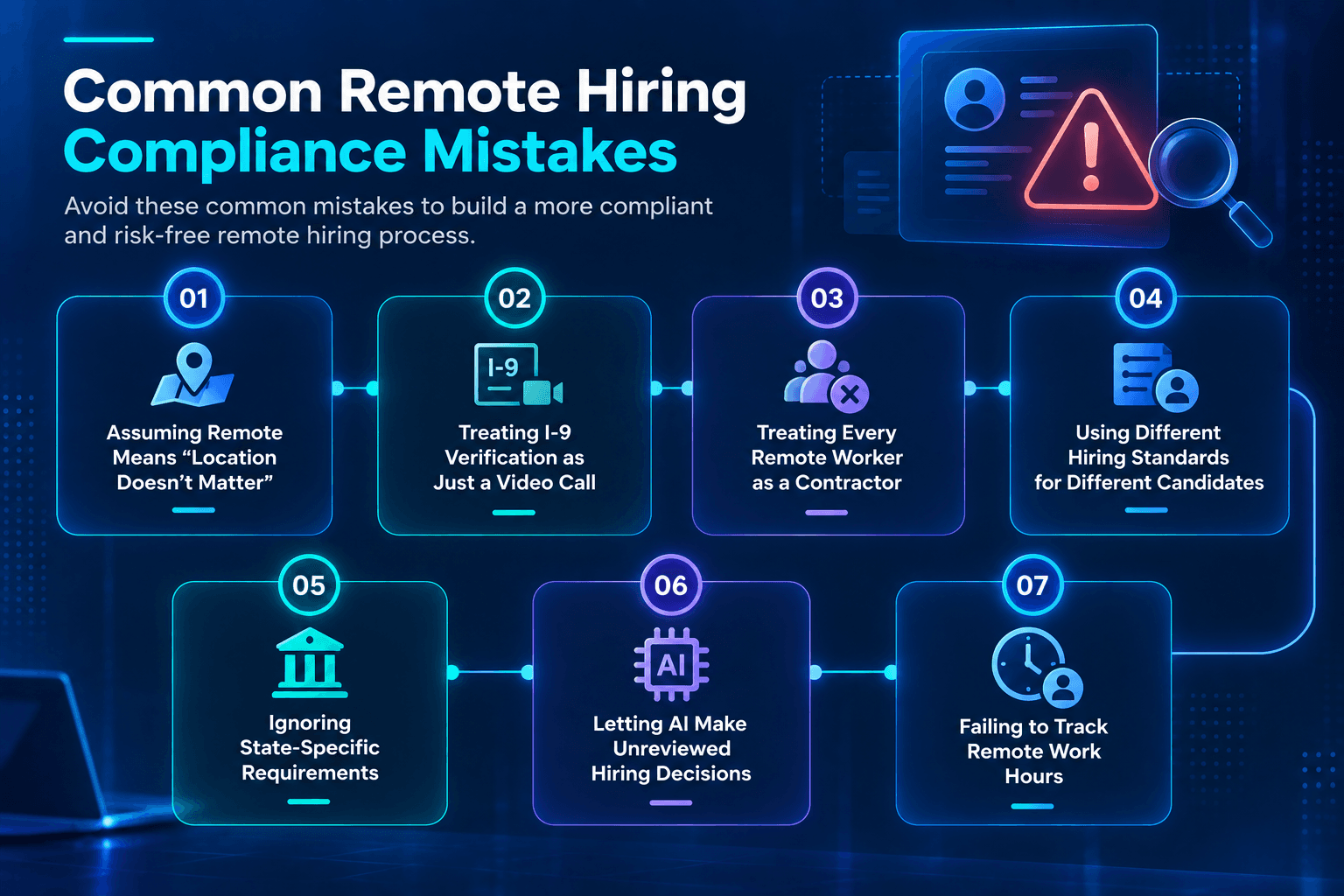
Common Remote Hiring Compliance Mistakes
Remote hiring introduces additional compliance considerations that many employers do not encounter during traditional office-based hiring. Small mistakes during recruitment or onboarding can create payroll issues, worker classification disputes, documentation problems, or violations of employment laws.
Understanding these common mistakes can help employers build a more compliant hiring process.
1. Assuming Remote Means "Location Doesn't Matter"
One of the most common mistakes is assuming that remote employees follow the same employment requirements regardless of where they work.
In reality, an employee's physical work location can affect payroll, taxation, wage-and-hour rules, paid leave, workers' compensation, and other employment obligations.
For example, two employees performing identical jobs may still be subject to different state employment requirements.
How to avoid it:
Verify where employees will physically work.
Review applicable state and local requirements before onboarding.
Update compliance records if employees relocate.
2. Treating I-9 Verification as Just a Video Call
Some employers mistakenly believe that viewing identification documents over a video call automatically satisfies Form I-9 requirements.
However, employers using remote document examination must follow the applicable DHS-authorized procedures rather than relying on an informal verification process.
How to avoid it:
Use the current Form I-9.
Follow applicable USCIS and DHS guidance.
Maintain proper employment eligibility records.
3. Treating Every Remote Worker as a Contractor
Remote work does not automatically make someone an independent contractor.
Worker classification depends on the actual working relationship, including factors relating to control, independence, and the nature of the work.
Misclassification can create issues involving:
Payroll taxes
Overtime
Benefits
Workers' compensation
Unemployment insurance
How to avoid it:
Evaluate worker classification before onboarding rather than relying solely on the contract's title.
4. Using Different Hiring Standards for Different Candidates
When multiple recruiters or hiring managers conduct interviews independently, candidates may receive different questions, assessments, or evaluation criteria.
This inconsistency can increase compliance risks and make hiring decisions more difficult to justify.
How to avoid it:
Use structured interviews.
Apply standardized scorecards.
Document hiring decisions consistently.
5. Ignoring State-Specific Requirements
Federal compliance alone is not always enough.
Many states have additional employment requirements covering areas such as pay transparency, leave policies, wage statements, salary history restrictions, and meal or rest breaks.
A company can comply with federal law while still violating a state requirement.
How to avoid it:
Maintain a state-specific compliance checklist and review requirements before hiring employees in new jurisdictions.
6. Letting AI Make Unreviewed Hiring Decisions
AI-powered recruiting tools can help automate parts of the hiring process, but employers should not rely on automated recommendations without oversight.
Poorly monitored systems can produce inconsistent or potentially discriminatory outcomes.
How to avoid it:
Define how AI is used.
Require human review for important hiring decisions.
Periodically audit automated systems.
7. Failing to Track Remote Work Hours
Working from home does not eliminate wage-and-hour obligations.
Remote employees may perform work outside scheduled hours by responding to emails, joining meetings, or completing tasks from home. For covered nonexempt employees, this time may still count as compensable work.
How to avoid it:
Establish clear timekeeping policies.
Require employees to record all hours worked.
Train managers to monitor overtime appropriately.
Clarify expectations around after-hours work.
This helps employers remain compliant while giving employees a clear understanding of how working time should be recorded.
Conclusion
Remote hiring compliance in the USA requires employers to look beyond the traditional hiring process. Employers need to consider federal employment laws, state and local requirements, employment eligibility verification, worker classification, wage and hour rules, background checks, candidate data protection, reasonable accommodations, and the use of AI-powered hiring technologies.
A compliant remote hiring process should also be consistent and location-aware. Verifying where employees work, applying standardized hiring criteria, maintaining accurate records, reviewing hiring technology, and keeping state-specific compliance requirements up to date can help organizations reduce compliance risks as they scale remote hiring.
Because employment requirements can vary by employer, role, worker location, and jurisdiction, organizations should review their processes regularly and seek qualified legal advice when necessary. A structured approach can help employers build a remote hiring process that is fair, secure, consistent, and aligned with applicable requirements.