

Back to all blogs
Learn the top advantages and disadvantages of remote hiring, from global talent access to hiring challenges and recruitment risks.

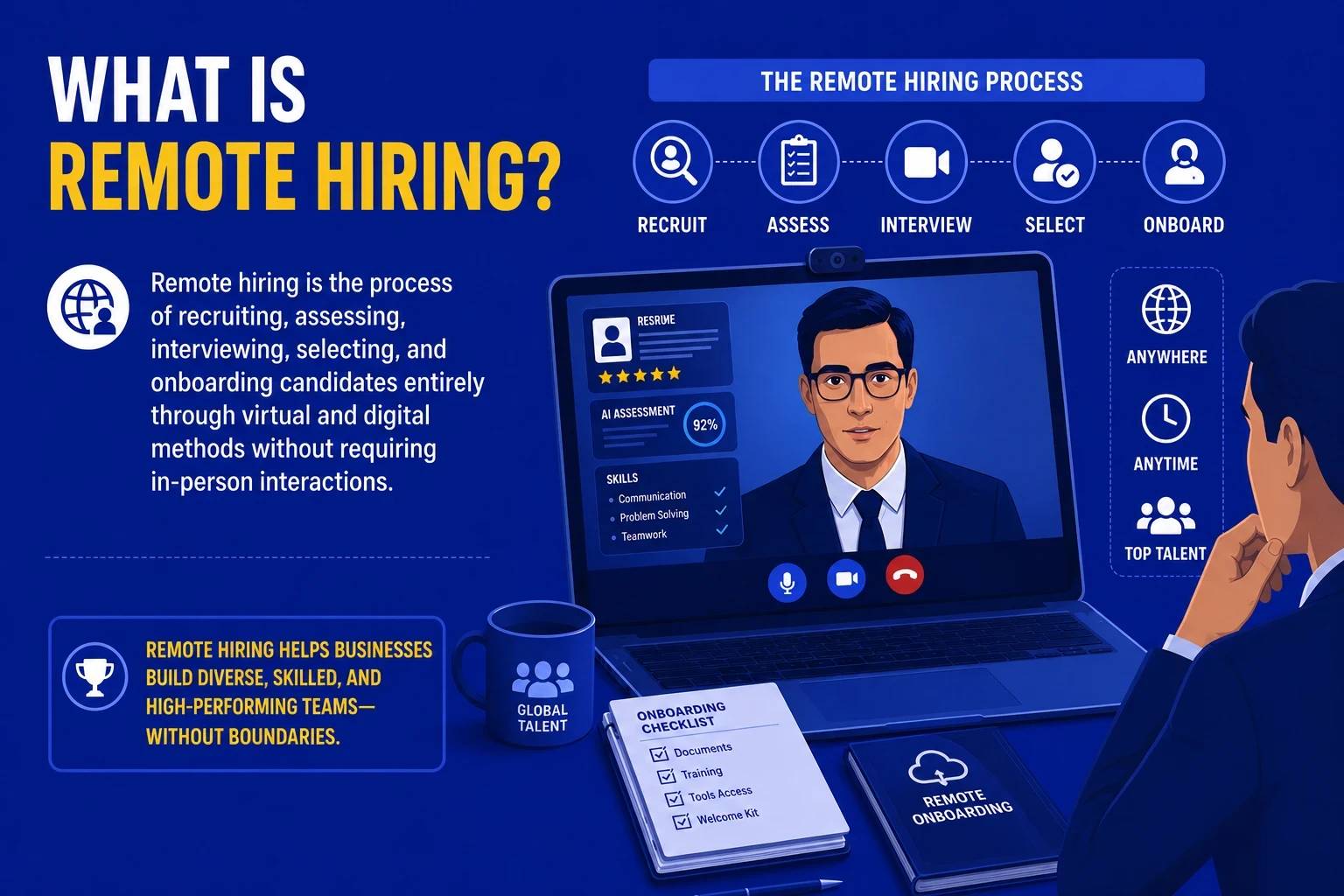
Remote hiring has fundamentally changed how businesses recruit talent, making it possible to hire skilled professionals from anywhere in the world without geographic limitations. As companies increasingly adopt flexible work models, virtual recruitment has become a strategic approach for improving hiring speed, reducing recruitment costs, and accessing broader talent pools.
RemotePass analyzed 35,000+ remote employment contracts across 143 countries, showing rapid growth in cross-border hiring and increasing employer adoption of remote recruitment.
However, remote hiring is not without challenges. Studies show that hiring fraud and candidate impersonation risks are increasing in virtual recruitment environments. As online interviews become standard, organizations are dealing with concerns such as proxy interviews, fake identities, AI-assisted cheating, and deepfake candidates, making hiring accuracy and candidate verification more difficult. 17% of hiring managers reported encountering candidates using deepfake technology during video interviews, highlighting growing risks in remote hiring and virtual recruitment fraud.
Despite these challenges, businesses continue to embrace remote hiring due to its efficiency and scalability. Companies can streamline hiring processes, reduce operational expenses, and improve recruitment flexibility while candidates gain access to wider job opportunities.
In this guide, we explore the 24 major advantages and disadvantages of remote hiring, helping employers understand both the benefits and risks involved.
Advantages of Remote Hiring
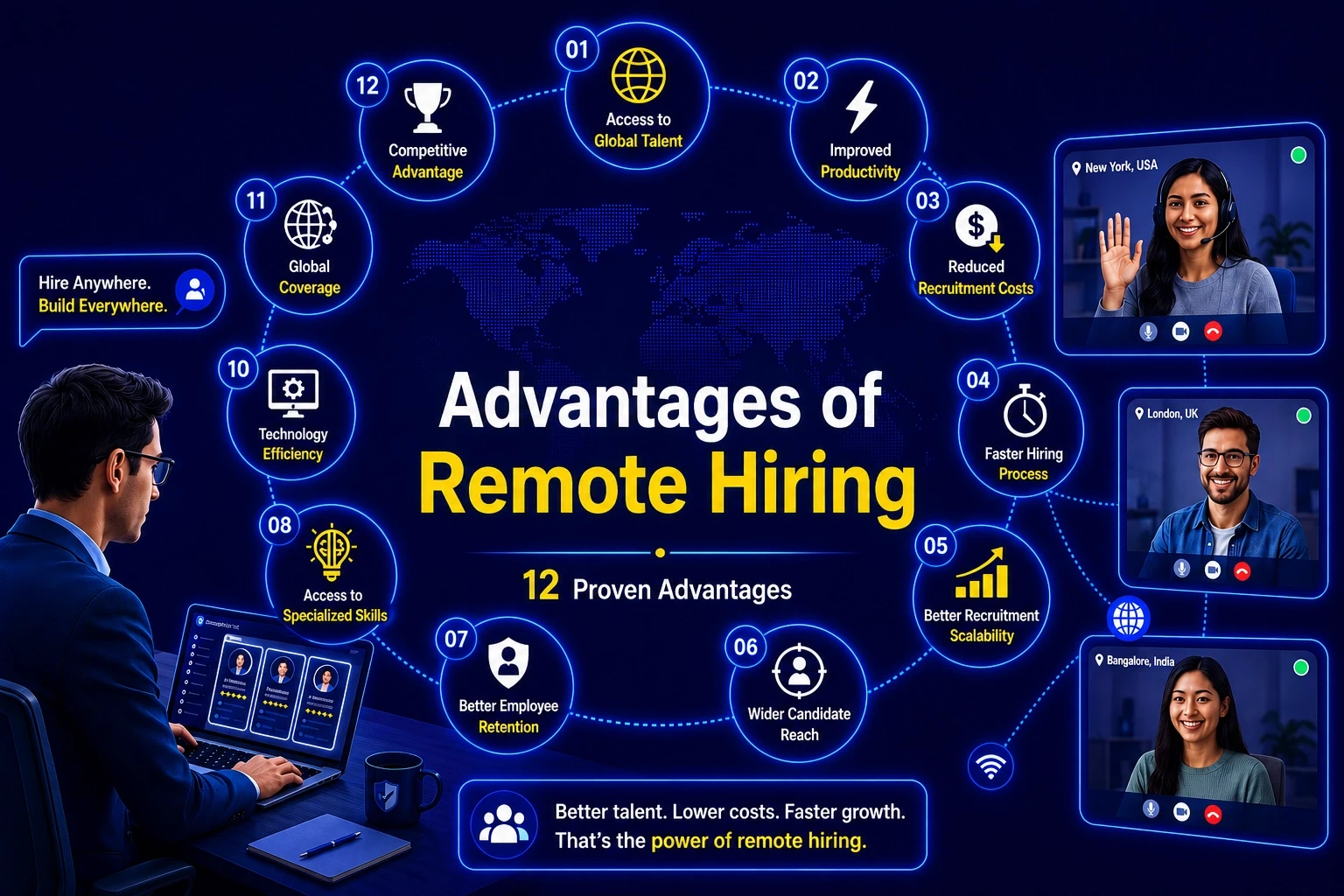
Remote hiring has become an essential recruitment strategy for businesses looking to improve hiring efficiency, reduce operational limitations, and access skilled talent without geographic restrictions. As organizations continue adopting digital recruitment processes, remote hiring offers several advantages that help employers build stronger and more flexible teams.
Below are some of the biggest advantages of remote hiring for employers.
1. Access to Global Talent: Hire Beyond Geographic Boundaries
One of the biggest advantages of remote hiring is the ability to access talent without geographic limitations. Traditional hiring often restricts companies to candidates within commuting distance, making it harder to find professionals with specialized skills. Remote hiring removes this barrier, enabling businesses to recruit the best candidates regardless of location.
Here is how access to global talent benefits employers:
Larger Candidate Pool: Remote hiring gives companies access to candidates from different locations, increasing the chances of finding the right talent.
Faster Hiring for Specialized Roles: Businesses can hire niche talent globally, making it easier to fill hard-to-recruit positions quickly.
Reduced Talent Shortages: Companies can overcome local skill gaps by sourcing qualified professionals from other regions.
More Diverse Teams: Hiring remotely helps build teams with diverse backgrounds, perspectives, and experiences.
Improved Hiring Flexibility: Organizations can recruit across locations and time zones to support changing business needs more effectively.
By removing location barriers, remote hiring helps businesses find skilled professionals faster, improve hiring quality, and build stronger teams without geographic restrictions. Remote hiring has democratized access to opportunities. 73% of professionals from smaller cities now compete for roles at major metropolitan companies.
2. Improved Productivity During Recruitment: Save Time for Hiring Teams
Managing traditional hiring often involves travel coordination, scheduling issues, manual administrative work, and lengthy candidate evaluations. Remote hiring simplifies many of these tasks, helping recruiters save time and improve overall hiring efficiency.
Here is how remote hiring improves recruiter productivity:
Less Administrative Work: Digital hiring tools simplify interview scheduling, candidate tracking, and communication.
Reduced Meeting Delays: Virtual interviews are easier to organize, reducing back-and-forth coordination.
Faster Team Collaboration: Hiring managers can review interview feedback and candidate performance digitally.
More Efficient Candidate Evaluation: Online assessments and virtual interviews help recruiters screen applicants faster.
Better Time Management: Recruiters can manage multiple hiring stages and candidates more efficiently.
Advanced hiring platforms like Sherlock AI further improve recruitment productivity by helping teams detect suspicious interview behavior, identify impersonation risks, and maintain hiring accuracy without adding manual verification effort. This allows recruiters to focus more on selecting qualified candidates rather than investigating hiring fraud.
By improving recruiter efficiency and streamlining candidate evaluation, remote hiring helps organizations save time, optimize workflows, and make smarter hiring decisions.
Hire with Confidence Using Sherlock AI |
3. Reduced Recruitment Costs: Lower Hiring Expenses
Traditional hiring can be expensive, with costs related to office visits, travel reimbursements, venue arrangements, relocation support, and administrative processes. Remote hiring helps businesses reduce many of these expenses by moving recruitment activities online.
Here is how remote hiring helps reduce recruitment costs:
Lower Interview Costs: Virtual interviews eliminate travel, accommodation, and venue-related expenses for both employers and candidates.
Reduced Administrative Expenses: Digital hiring tools help automate scheduling, screening, and communication, reducing manual recruitment efforts.
Less Spending on Office Resources: Companies hiring remote employees may reduce costs associated with workspace setup and onsite recruitment infrastructure.
Lower Relocation Costs: Businesses can hire qualified candidates remotely without needing to offer relocation packages.
Cost-Effective Hiring at Scale: Organizations can manage large hiring volumes more efficiently through virtual recruitment processes.
By reducing unnecessary recruitment expenses, remote hiring helps businesses optimize budgets while maintaining hiring efficiency and access to skilled talent.
4. Faster Hiring Process: Speed Up Recruitment
Lengthy recruitment cycles can slow business growth and delay important projects. Traditional hiring often involves multiple in-person meetings, travel coordination, and scheduling delays. Remote hiring helps companies streamline recruitment by making the entire process faster and more efficient.
Here is how remote hiring speeds up the hiring process:
Quicker Interview Scheduling: Virtual interviews are easier to coordinate, helping recruiters connect with candidates faster.
Faster Candidate Screening: Online assessments and digital tools allow recruiters to evaluate applicants more efficiently.
Reduced Time-to-Hire: Companies can move candidates through different hiring stages quickly without location-related delays.
Faster Decision-Making: Hiring teams can collaborate remotely and provide feedback more efficiently during recruitment.
Immediate Onboarding Opportunities: New hires can start onboarding digitally without waiting for relocation or office arrangements.
By reducing delays and simplifying recruitment workflows, remote hiring helps organizations fill roles faster and maintain business productivity.
5. Better Recruitment Scalability: Hire Efficiently at Scale
Growing companies often need to hire multiple employees quickly. Traditional hiring can become difficult to manage when recruitment demand increases. Remote hiring makes it easier for organizations to scale recruitment efforts efficiently.
Here is how remote hiring improves recruitment scalability:
Manage High Hiring Volumes: Recruiters can screen and interview multiple candidates simultaneously.
Standardized Hiring Process: Digital workflows help maintain consistency across recruitment stages.
Faster Multi-Location Hiring: Companies can recruit talent across different regions without physical limitations.
Improved Recruitment Efficiency: Hiring teams can streamline evaluations using digital tools.
Supports Business Growth: Organizations can expand teams quickly during scaling periods.
By improving recruitment scalability, remote hiring helps businesses grow faster while maintaining hiring efficiency. Remote hiring delivers 340% larger candidate pools, 16% faster time-to-hire, and 13% higher offer acceptance rates.
6. Increased Candidate Reach: Attract More Qualified Applicants
Finding skilled candidates locally can sometimes limit hiring opportunities. Remote hiring helps organizations reach professionals from different regions and attract a wider range of applicants.
Here is how remote hiring increases candidate reach:
Broader Applicant Pool: Companies can attract candidates beyond their local market.
Appeals to Remote Workers: Flexible opportunities attract professionals who prefer remote work.
Improved Employer Visibility: Businesses can expand hiring efforts across wider talent markets.
Access to Passive Candidates: Organizations may attract professionals not actively seeking local jobs.
Higher Application Rates: Remote jobs often receive more interest than office-based roles.
By expanding candidate reach, remote hiring increases access to qualified professionals and improves hiring opportunities.
7. Enhanced Workforce Diversity: Build More Inclusive Teams
Workforce diversity plays an important role in innovation and business performance. Hiring only within one location may limit exposure to different perspectives and experiences.
Here is how remote hiring supports workforce diversity:
Geographic Diversity: Companies can hire employees from different regions and countries.
Varied Perspectives: Diverse backgrounds can improve creativity and problem-solving.
Broader Skill Sets: Teams benefit from different professional experiences and expertise.
Inclusive Hiring Opportunities: Remote hiring creates opportunities for candidates with location limitations.
Stronger Collaboration: Diverse teams often bring fresh ideas and better decision-making.
By enabling broader access to talent, remote hiring helps organizations create stronger and more inclusive teams.
8. Better Employee Retention: Improve Workforce Satisfaction
Employee retention remains a major challenge for many organizations. Flexible work arrangements can improve employee satisfaction and reduce turnover.
Here is how remote hiring can improve employee retention:
Better Work-Life Balance: Employees often value flexibility and reduced commuting time.
Increased Job Satisfaction: Flexible work options may improve overall employee experience.
Lower Burnout Levels: Remote work can help reduce workplace stress for some employees.
Improved Employee Loyalty: Flexible employers may retain talent for longer periods.
Competitive Employer Advantage: Offering remote opportunities can help attract and retain skilled professionals.
By supporting flexibility and employee satisfaction, remote hiring can contribute to stronger long-term retention.
9. Access to Specialized Skills: Find Niche Expertise Faster
Some roles require highly specific skills that may be difficult to find locally. Remote hiring helps businesses search beyond regional talent limitations.
Here is how remote hiring improves access to specialized skills:
Global Skill Access: Companies can recruit experts from different regions.
Faster Hiring for Niche Roles: Hard-to-fill positions become easier to recruit for.
Reduced Skill Gaps: Organizations can access professionals with specialized expertise.
Industry-Specific Talent: Businesses can hire experts in fields such as AI, cybersecurity, healthcare, and engineering.
Improved Hiring Precision: Employers can focus on skills rather than geographic availability.
By expanding access to specialized professionals, remote hiring helps organizations fill critical positions more effectively.
10. Improved Hiring Efficiency Through Technology: Streamline Recruitment
Remote hiring often encourages organizations to adopt digital tools that improve recruitment speed and efficiency. Virtual hiring platforms, automation, and AI-powered assessments help simplify the hiring process.
Here is how technology improves remote hiring efficiency:
Automated Candidate Screening: Recruiters can filter applicants faster using digital tools.
Virtual Interview Management: Video interviews make scheduling and evaluations easier.
Digital Skills Assessments: Online testing helps evaluate candidates efficiently.
Centralized Recruitment Processes: Hiring teams can manage applications in one place.
Improved Hiring Transparency: Advanced hiring tools help improve recruitment accuracy and consistency.
By using technology-driven hiring processes, organizations can streamline recruitment, improve efficiency, and make better hiring decisions. 62% of interviewers conduct entire hiring processes remotely.
11. Wider Business Coverage: Support Global Operations
Businesses operating across multiple regions often need employees available in different time zones. Remote hiring helps organizations build distributed teams that can support customers, projects, and operations more effectively.
Here is how remote hiring improves business coverage:
Extended Working Hours: Teams across time zones can support operations beyond standard business hours.
Better Customer Support: Companies can provide faster assistance to global customers.
Improved Market Reach: Businesses can hire local talent to support regional expansion.
Greater Operational Continuity: Distributed teams reduce dependency on a single office location.
Enhanced Global Presence: Organizations can strengthen operations in multiple regions.
By expanding workforce coverage, remote hiring helps businesses improve productivity and global support.
12. Competitive Hiring Advantage: Stay Ahead in Talent Acquisition
Competition for skilled talent continues to increase across industries. Companies that limit hiring to local markets may struggle to compete for top professionals.
Here is how remote hiring creates a competitive advantage:
Faster Access to Talent: Organizations can recruit skilled professionals more quickly.
Improved Hiring Flexibility: Businesses can adjust recruitment strategies based on demand.
Stronger Talent Acquisition: Wider reach improves candidate availability.
Better Workforce Planning: Companies can hire strategically across regions.
Higher Recruitment Agility: Employers can respond faster to hiring challenges.
By expanding hiring possibilities and improving recruitment flexibility, remote hiring helps businesses stay competitive in changing talent markets.
Disadvantages of Remote Hiring
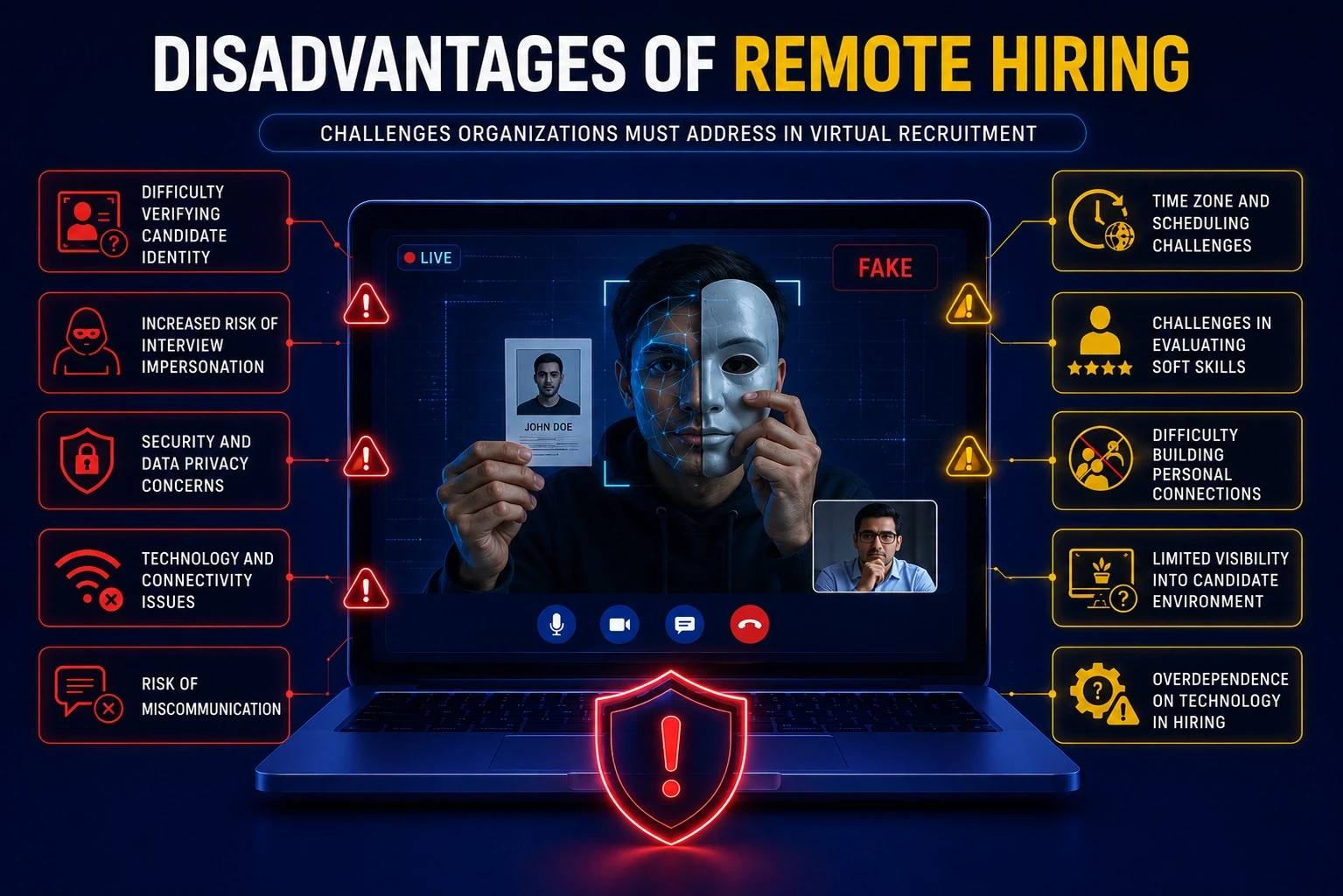
While remote hiring offers several advantages, it also introduces challenges that organizations must carefully manage. From candidate verification issues to communication barriers, virtual recruitment can create risks that affect hiring accuracy, collaboration, and overall recruitment efficiency.
Below are some of the biggest disadvantages of remote hiring for employers.
13. Difficulty Verifying Candidate Identity: Increased Risk of Hiring Fraud
One major challenge of remote hiring is verifying whether candidates are genuinely who they claim to be. In traditional hiring, recruiters can validate identity through face-to-face interactions, office visits, and physical documentation. Remote hiring removes these in-person checkpoints, making candidate verification more difficult.
Why This Happens in Remote Hiring
Since interviews and technical assessments happen virtually, recruiters have limited visibility into a candidate’s actual environment and behavior. This creates opportunities for fraudulent activities that may be difficult to detect through standard video interviews alone.
Recruiters may encounter challenges such as interview impersonation, fake credentials, AI-assisted cheating, or candidates receiving hidden assistance during assessments. As deepfake technology and voice cloning continue to evolve, maintaining hiring authenticity becomes even more challenging.
Business Impact
Poor candidate verification can create serious hiring risks for organizations, including:
Hiring underqualified or fraudulent candidates
Increased employee turnover and rehiring costs
Security and compliance concerns
Reduced team productivity
Loss of trust in recruitment processes
How Sherlock AI Helps
Sherlock AI helps organizations improve hiring transparency by detecting suspicious interview behavior, identifying impersonation risks, and strengthening candidate verification throughout remote recruitment.
While remote hiring creates new verification challenges, businesses using intelligent hiring safeguards can significantly reduce fraud risks and improve recruitment confidence.
14. Communication and Collaboration Challenges: Reduced Hiring Clarity
Effective communication plays an important role in recruitment, helping employers assess candidate skills, personality, and cultural fit. However, remote hiring can sometimes make communication and collaboration more difficult due to the absence of in-person interactions.
Why This Happens in Remote Hiring
Virtual interviews rely heavily on digital communication tools, internet connectivity, and scheduling coordination. Without face-to-face interaction, recruiters may find it harder to observe body language, assess interpersonal skills, or build natural conversations during interviews.
Communication challenges may also arise from time zone differences, delayed responses, language barriers, or technical disruptions, affecting collaboration between recruiters and hiring managers.
Business Impact
Communication gaps during remote hiring can create several challenges, including:
Difficulty evaluating soft skills and cultural fit
Misunderstanding job expectations or responsibilities
Delays in hiring team feedback and decision-making
Reduced candidate engagement during interviews
Slower recruitment timelines
Although remote hiring improves flexibility, organizations must establish clear communication processes to maintain hiring quality and create a better candidate experience.
15. Technology and Connectivity Issues: Disruptions in the Hiring Process
Remote hiring depends heavily on digital platforms for interviews, assessments, and recruiter collaboration. While virtual recruitment improves flexibility and speed, technical disruptions can negatively affect candidate evaluations and delay hiring decisions.
Why This Happens in Remote Hiring
Since interviews and hiring assessments happen online, recruiters and candidates rely on stable internet, video conferencing platforms, and recruitment tools. Even minor technical issues can interrupt conversations, reduce interview quality, or create delays in the hiring process.
Common challenges include unstable internet connections, poor video or audio quality, software glitches, platform compatibility issues, and unexpected disruptions during virtual interviews. These issues may impact how candidates perform and how recruiters assess them.
Business Impact
Technology and connectivity issues during remote hiring can lead to:
Interrupted interviews and incomplete evaluations
Difficulty assessing candidate communication and technical skills
Delays in scheduling and recruitment timelines
Poor candidate experience during the hiring process
Reduced consistency in interview assessments
Although remote hiring improves recruitment flexibility, organizations need reliable hiring platforms, backup interview plans, and structured evaluation methods to reduce disruptions and maintain hiring quality.
16. Time Zone and Scheduling Challenges: Delays in Recruitment Coordination
Remote hiring allows organizations to recruit talent from different regions and countries. While this expands access to skilled professionals, it can also create scheduling difficulties when candidates and hiring teams operate across multiple time zones.
Why This Happens in Remote Hiring
Coordinating interviews across different locations can become challenging, especially when recruiters, hiring managers, and candidates have limited overlapping work hours. Scheduling conflicts, delayed communication, and last-minute rescheduling may slow down the recruitment process.
Time zone differences can also make it harder for hiring teams to collaborate quickly, review feedback, and move candidates through recruitment stages efficiently.
Business Impact
Time zone and scheduling challenges during remote hiring can lead to:
Delays in interview coordination and candidate communication
Slower feedback from recruiters and hiring managers
Longer hiring timelines for critical roles
Reduced candidate engagement due to scheduling inconvenience
Difficulty coordinating multiple interview rounds efficiently
Although remote hiring expands access to global talent, organizations need structured scheduling systems and clear communication processes to maintain recruitment efficiency across different time zones.
17. Increased Risk of Interview Impersonation: Challenges in Hiring Authentic Candidates
One growing concern in remote hiring is interview impersonation, where someone other than the actual candidate attends interviews or completes assessments on their behalf. Since the hiring process happens virtually, recruiters may find it more difficult to confirm whether candidates are genuinely demonstrating their own skills and knowledge.
Why This Happens in Remote Hiring
Remote interviews limit direct supervision, making it easier for candidates to receive hidden assistance or involve third parties during assessments. In some cases, organizations may encounter proxy candidates, screen sharing support, hidden communication tools, or even AI-assisted responses during technical interviews.
Without proper verification methods, these activities can become difficult to identify through standard video interviews alone.
Business Impact
Interview impersonation during remote hiring can lead to:
Hiring candidates who do not possess the demonstrated skills
Increased onboarding and training challenges
Reduced team productivity due to poor performance
Additional rehiring costs and recruitment delays
Higher security and operational risks
As virtual recruitment evolves, organizations need stronger candidate verification processes to maintain hiring accuracy and reduce impersonation risks. Advanced hiring platforms like Sherlock AI can help improve interview transparency by detecting suspicious behavior and strengthening candidate authenticity during remote hiring.
Although remote hiring offers flexibility, maintaining trust and authenticity remains essential for making confident hiring decisions.
18. Security and Data Privacy Concerns: Risks in Virtual Recruitment
Remote hiring often requires organizations to collect, share, and store sensitive candidate information through digital platforms. While virtual recruitment improves efficiency, it can also create security and data privacy concerns if hiring systems are not properly managed.
Why This Happens in Remote Hiring
During remote hiring, recruiters frequently exchange resumes, identity documents, interview recordings, technical assessments, and personal information through online tools. Using multiple platforms or unsecured systems may increase the risk of unauthorized access or data exposure.
Organizations may also face challenges related to platform security, document sharing, access permissions, and compliance with data privacy regulations during virtual recruitment.
Business Impact
Security and data privacy concerns during remote hiring can lead to:
Exposure of sensitive candidate information
Increased cybersecurity and compliance risks
Loss of candidate trust in the hiring process
Legal or reputational challenges for employers
Greater operational risks related to data management
Although remote hiring improves recruitment flexibility, organizations need secure hiring platforms, clear data handling policies, and stronger privacy measures to protect candidate information throughout the hiring process.
19. Limited Visibility Into Candidate Environment: Reduced Context During Evaluation
In traditional hiring, recruiters can observe how candidates interact in professional settings, communicate with others, and respond to workplace environments. Remote hiring limits this visibility, making it harder to fully understand a candidate’s working style and overall professionalism.
Why This Happens in Remote Hiring
Since interviews happen virtually, recruiters only see a limited part of a candidate’s environment through a screen. Distractions, hidden assistance, or external support during interviews may not always be visible.
Hiring managers may also find it harder to assess non-verbal communication, problem-solving behavior, workplace readiness, or how candidates naturally engage in professional settings.
Business Impact
Limited visibility during remote hiring can lead to:
Reduced confidence in candidate evaluation
Difficulty assessing professionalism and work readiness
Greater chances of missing behavioral concerns
Challenges in validating interview authenticity
Increased risk of hiring mismatches
Although remote hiring improves convenience and access to talent, organizations need structured interview frameworks and stronger evaluation methods to make more informed hiring decisions.
20. Overdependence on Technology in Hiring: Reduced Flexibility During Recruitment
Remote hiring relies heavily on digital tools for communication, interviews, assessments, scheduling, and candidate management. While technology helps streamline recruitment, depending too much on digital systems can sometimes create challenges when platforms fail or processes become overly automated.
Why This Happens in Remote Hiring
Since most hiring activities happen online, recruiters often depend on video conferencing software, applicant tracking systems, assessment platforms, and automated communication tools. Technical failures, software limitations, or system downtime can disrupt recruitment and delay decision-making.
In some cases, excessive reliance on automation may also reduce human interaction during hiring, making the process feel less personal for candidates.
Business Impact
Overdependence on technology during remote hiring can lead to:
Delays caused by platform or system failures
Reduced flexibility when technical issues arise
Poor candidate experience due to overly automated communication
Challenges in maintaining personalized recruitment interactions
Increased dependency on multiple hiring tools and platforms
Although technology improves hiring efficiency, organizations should balance automation with human interaction to maintain recruitment quality and create a better candidate experience.
21. Increased Competition for Top Talent: Harder to Secure Skilled Candidates
Remote hiring allows companies to access global talent, but it also increases competition. Since businesses can hire from anywhere, candidates also have access to more job opportunities, making it harder for employers to attract and retain highly skilled professionals.
Why This Happens in Remote Hiring
Top candidates often receive multiple offers from organizations across different regions and industries. Companies are no longer competing only with local employers but with global businesses offering flexible work options, higher salaries, or stronger benefits.
As a result, recruiters may face challenges in engaging qualified candidates and closing positions quickly.
Business Impact
Increased competition for talent during remote hiring can lead to:
Longer hiring timelines for specialized roles
Higher salary expectations from candidates
Difficulty securing top-performing professionals
Increased offer drop-offs during recruitment
Greater pressure on employer branding and candidate experience
Although remote hiring expands access to talent, organizations need competitive hiring strategies and strong employer branding to attract the best candidates.
22. Difficulty Building Personal Connections: Reduced Human Interaction
Building trust and rapport with candidates is an important part of the hiring process. Remote hiring can sometimes make interactions feel less personal, affecting relationship building between recruiters and candidates.
Why This Happens in Remote Hiring
Virtual communication often limits informal conversations and natural engagement that happen during in-person interviews or office visits. Recruiters may find it harder to build strong connections or create a memorable candidate experience.
Candidates may also struggle to understand team culture, workplace dynamics, or organizational values through virtual interactions alone.
Business Impact
Reduced personal interaction during remote hiring can lead to:
Lower candidate engagement during interviews
Difficulty building trust with applicants
Reduced understanding of company culture
Weaker recruiter-candidate relationships
Increased uncertainty during hiring decisions
Although remote hiring improves flexibility, organizations should prioritize personalized communication and meaningful candidate interactions.
23. Risk of Miscommunication: Challenges in Virtual Communication
Clear communication is essential during recruitment to ensure expectations, responsibilities, and hiring processes are understood correctly. Remote hiring can sometimes increase the risk of misunderstandings.
Why This Happens in Remote Hiring
Since communication often happens through emails, messages, or video calls, there may be fewer opportunities for instant clarification. Technical disruptions, delayed responses, or lack of face-to-face interaction can sometimes create confusion.
Miscommunication may occur around job expectations, interview schedules, feedback, or role responsibilities.
Business Impact
Miscommunication during remote hiring can lead to:
Candidate confusion about role expectations
Delays in recruitment timelines
Missed interview schedules or follow-ups
Poor candidate experience during hiring
Increased hiring inefficiencies
Although remote hiring depends on digital communication, organizations should maintain clear messaging and structured communication processes to reduce misunderstandings.
24. Challenges in Evaluating Soft Skills: Limited Behavioral Assessment
Technical skills are important, but communication, adaptability, teamwork, and problem-solving are equally valuable during hiring. In remote hiring, evaluating soft skills can become more difficult.
Why This Happens in Remote Hiring
Virtual interviews may focus more heavily on technical assessments and structured questioning, leaving fewer opportunities to observe natural workplace behavior. Recruiters may also miss subtle non-verbal communication and interpersonal cues.
This can make it harder to fully assess how candidates collaborate, communicate, or handle workplace situations.
Business Impact
Difficulty evaluating soft skills during remote hiring can lead to:
Hiring candidates with poor team compatibility
Reduced collaboration within teams
Communication challenges after onboarding
Higher risk of hiring mismatches
Lower long-term employee performance
Although remote hiring increases access to talent, organizations need structured behavioral interviews and situational assessments to evaluate soft skills more effectively.
How Sherlock AI Helps Improve Remote Hiring
Remote hiring offers flexibility and access to global talent, but it also introduces challenges related to candidate verification, interview authenticity, hiring transparency, and recruitment accuracy. As organizations continue adopting virtual recruitment, reducing hiring risks has become increasingly important.
Sherlock AI helps organizations strengthen remote hiring by improving visibility throughout the interview process and helping recruiters make more confident hiring decisions.
Here is how Sherlock AI supports secure and transparent remote hiring:
Detects Interview Impersonation Risks
Remote hiring can increase the risk of proxy interviews, where another person attends interviews or completes assessments on behalf of the candidate. Sherlock AI helps identify suspicious interview behavior and potential impersonation risks during virtual hiring.
Strengthens Candidate Verification
Verifying whether candidates are genuinely demonstrating their own skills can be difficult in virtual interviews. Sherlock AI improves hiring transparency by helping recruiters validate candidate authenticity throughout the recruitment process.
Identifies Suspicious Interview Behavior
Remote candidates may sometimes receive hidden assistance, external support, or AI-generated help during interviews. Sherlock AI helps organizations detect unusual patterns and suspicious activities that may affect hiring accuracy.
Helps Reduce Hiring Fraud
Fraudulent hiring can lead to poor performance, security concerns, and costly rehiring. Sherlock AI helps organizations reduce hiring fraud risks and improve trust in remote recruitment.
Supports Fair and Consistent Evaluations
Maintaining consistency across remote interviews can be challenging. Sherlock AI helps hiring teams improve evaluation transparency, making it easier to maintain structured and reliable hiring processes.
Improves Recruitment Efficiency
Manual verification during remote hiring can be time-consuming. Sherlock AI helps recruiters focus more on selecting qualified candidates while reducing time spent investigating suspicious interview behavior.
As remote hiring continues to evolve, organizations need smarter ways to maintain hiring quality and reduce fraud risks. Sherlock AI helps businesses build more secure, transparent, and trustworthy remote hiring processes.
Conclusion
Remote hiring has transformed how organizations attract, evaluate, and recruit talent. By removing geographic limitations, businesses can access global talent, reduce recruitment costs, improve hiring flexibility, and scale recruitment more efficiently. For many organizations, remote hiring has become an effective way to build stronger and more distributed teams.
However, remote hiring also comes with challenges. Difficulties in verifying candidate identity, communication barriers, interview impersonation, technology issues, and onboarding challenges can affect hiring accuracy and recruitment efficiency if not managed properly.
The key to successful remote hiring is creating a balanced approach. Organizations need structured interview processes, reliable hiring technologies, clear communication practices, and strong candidate verification systems to reduce risks while maintaining recruitment quality.
As virtual recruitment continues to evolve, businesses that invest in secure, transparent, and efficient hiring practices will be better positioned to attract top talent and make confident hiring decisions.
For organizations looking to improve hiring trust and reduce fraud risks during remote recruitment, Sherlock AI helps strengthen candidate verification, detect suspicious interview behavior, and improve transparency throughout the hiring process.
Remote hiring offers significant opportunities, but long-term success depends on how effectively businesses manage both its advantages and disadvantages.
Ready to secure your remote hiring process? Explore Sherlock AI today. |