Back to all blogs
Learn what deepfake phishing is, how AI-powered impersonation attacks work, key warning signs, and effective strategies to detect and prevent these threats.


Deepfake phishing combines traditional phishing and social engineering with AI-generated or manipulated audio, video, images, and identities. Instead of relying only on a suspicious email or fake website, attackers can impersonate an executive, employee, customer, or business partner through a convincing voice message, video call, image, or personalized communication. The objective is to make the target trust the impersonation and take an action that benefits the attacker, such as transferring funds, sharing confidential information, approving access, or changing account details.
The threat is becoming harder to ignore as deepfake technology becomes more accessible and convincing. The FBI’s 2025 Internet Crime Report recorded more than 22,000 complaints involving AI-related cybercrime, with reported adjusted losses exceeding $893 million. The FBI notes that AI-generated synthetic content is becoming increasingly difficult to detect while becoming easier for criminals to produce at scale, enabling fraud against individuals, businesses and financial institutions.
The most important defense, therefore, is not simply learning to spot whether a voice or video "looks fake." Organizations need to verify the identity, context, and requested action independently. High-value payments, credential changes, access requests, and other sensitive actions should follow established approval and verification procedures even when the request appears to come from someone familiar.
This article explains what deepfake phishing is, how AI-powered impersonation attacks work, the different types of deepfake phishing, who is most at risk, why traditional security controls can miss these attacks, how to identify warning signs, and how organizations can prevent and respond to deepfake phishing threats.
What Is Deepfake Phishing?
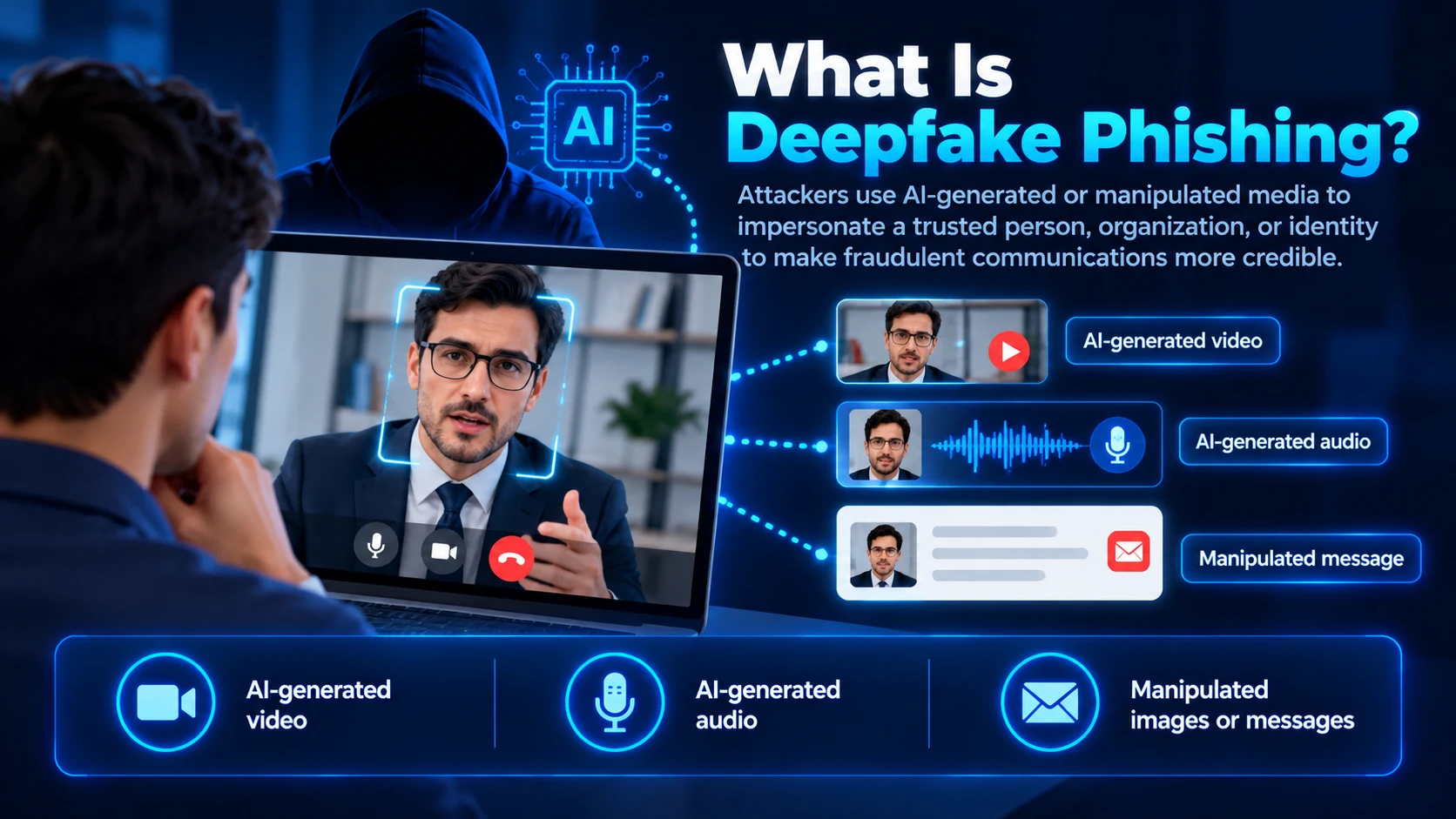
Deepfake phishing is a form of social engineering in which attackers use AI-generated or manipulated media to impersonate a trusted person, organization, or identity. The attack may involve AI-generated or manipulated audio, video, or images, often combined with personalized phishing messages to make fraudulent communications appear more credible.
Unlike traditional phishing, where the deception often centers on a fake email address, malicious link, or fraudulent website, deepfake phishing can manipulate the identity behind the communication itself. An attacker may appear to be a company executive on a video call, sound like a colleague during a phone conversation, or use a realistic digital identity to persuade a target to perform a sensitive action.
How Do Deepfake Phishing Attacks Work?
Deepfake phishing attacks typically follow a sequence that combines reconnaissance, synthetic media creation, targeted delivery, social engineering, and a final attempt to make the victim perform a sensitive action. Understanding each stage helps organizations identify where additional verification and security controls can interrupt the attack.
1. Target Selection and Information Gathering
Attackers first identify a person or organization worth impersonating and collect information that can make the deception more convincing. Publicly available videos, interviews, podcasts, social media posts, company websites, employee profiles, and previous communications can provide useful voice, facial, professional, and organizational information.
The attacker may also study the target's role and relationships. Knowing who approves payments, who manages IT access, who reports to an executive, or which employees regularly communicate with vendors can help attackers construct a believable scenario rather than sending a generic phishing message.
2. Creating the Synthetic Identity or Media
Once enough information has been collected, attackers can use AI tools to generate or manipulate the media required for the impersonation. Depending on the attack, this may involve voice cloning, face manipulation, synthetic video, AI-generated images, or highly personalized text.
The quality of the generated content can vary, but attackers do not necessarily need a perfect deepfake. They only need the communication to appear credible enough for the target to accept the identity and act before questioning the request.
3. Delivering the Deepfake Phishing Attack
The attacker then introduces the synthetic content through a communication channel appropriate to the target. This could include email, messaging applications, phone calls, video meetings, social media, or a combination of several channels.
Multi-channel delivery can make the attack more convincing because information from one interaction can support another. A phishing email can establish the context, a voice call can create urgency, and a video interaction can provide apparent visual confirmation of the impersonated person.
4. Creating Urgency and Authority
After establishing contact, attackers use social-engineering techniques to influence the target's decision. They may claim that a payment is time-sensitive, an account needs immediate attention, a confidential document must be shared, or a security problem requires an urgent response.
Authority and familiarity can make these requests more persuasive. A deepfake that appears to come from a senior executive may discourage employees from asking questions, while a cloned voice of a colleague may make an unusual request seem routine.
5. Triggering the Final Action
The final stage is when the attacker attempts to convert the deception into a measurable outcome. The target may be asked to transfer funds, disclose credentials, approve a login, change payment information, provide sensitive documents, or grant access to a system.
This is the point where independent verification becomes critical. Organizations can interrupt the attack by requiring sensitive requests to pass through established approval procedures, confirming them through a separately initiated communication channel, and ensuring that a convincing voice or video is never treated as sufficient proof of identity.
Types of Deepfake Phishing Attacks
Deepfake phishing can take several forms depending on the communication channel, target, and objective. Attackers may use one type of synthetic media or combine multiple forms to create a more convincing impersonation. Understanding these variations helps organizations recognize that deepfake phishing is not limited to manipulated video calls.

1. Deepfake Voice Phishing
Deepfake voice phishing uses AI-generated or cloned speech to imitate a trusted individual during a phone call, voicemail, or voice message. An attacker may impersonate an executive, colleague, customer, or vendor and use the familiar voice to make an unusual request appear legitimate.
Common objectives include:
Requesting urgent payments or wire transfers
Asking employees to share confidential information
Attempting to obtain authentication codes or credentials
Creating pressure to bypass normal approval procedures
2. Deepfake Video Conferencing Fraud
In video conferencing fraud, attackers use manipulated or AI-generated video to make it appear that a trusted person is participating in an online meeting. The impersonation may involve a prerecorded video, manipulated facial imagery, or synthetic video designed to support a fraudulent conversation.
Attackers may use these interactions to:
Impersonate executives or senior managers
Persuade employees to approve fraudulent financial requests
Obtain sensitive business information
Establish credibility before moving the conversation to another channel
3. AI-Generated Spear Phishing
AI can also strengthen traditional spear phishing by helping attackers create highly personalized messages. Instead of sending the same generic phishing email to thousands of people, attackers can use information about an individual, organization, role, or current business activity to make the message appear more relevant.
These attacks may involve:
Personalized emails targeting specific employees
Messages that imitate an executive's communication style
Fake requests connected to ongoing projects
Malicious links or attachments presented within a believable business context
4. Deepfake Smishing and Messaging Attacks
Deepfake phishing can extend to SMS and messaging platforms, where attackers combine personalized text with synthetic images, audio, or other identity signals. Because employees increasingly use messaging applications for quick business communication, an unexpected request through these channels can appear routine.
Potential warning signs include:
Unexpected requests from a familiar contact
Urgent instructions involving payments or credentials
Requests to move a conversation to another platform
Messages that discourage normal verification procedures
5. Multi-Channel Deepfake Phishing
Some of the more complex attacks combine several communication methods instead of relying on one interaction. An attacker might begin with an email, follow it with a voice call, and then use a video meeting or messaging platform to reinforce the same false identity.
A coordinated attack may combine:
Email phishing
Voice cloning
Video impersonation
SMS or messaging
Fake documents or digital identities
The combination can make the attack appear more legitimate because each channel seems to confirm the others. This is why organizations should verify high-risk requests independently rather than treating consistency across multiple communication channels as proof that the identity is genuine.
Who Is Most at Risk of Deepfake Phishing?
Deepfake phishing can target almost any organization, but attackers are more likely to focus on people who have access to money, sensitive information, privileged systems, or decision-making authority. The risk also increases when employees regularly communicate through voice and video channels or can authorize high-impact actions.
1. Finance and Accounting Teams
Finance employees often have the authority to initiate or approve payments, making them attractive targets for impersonation-based fraud.
Typical attack scenarios:
A fake executive requests an urgent wire transfer.
A supposed vendor asks for payment details to be changed.
A cloned voice is used to pressure an employee into bypassing approval procedures.
Require independent verification and dual approval for high-value or unusual financial transactions.
2. Executives and Senior Leaders
Executives have authority and their voices, photographs, interviews, and public appearances are often widely available online, giving attackers material that can support impersonation.
Typical attack scenarios:
An attacker impersonates a CEO during a video meeting.
A synthetic voice is used to contact an employee directly.
A fake executive request is combined with an urgent deadline.
Establish clear verification procedures for executive requests involving money, credentials, confidential information, or privileged access.
3. IT and Security Teams
IT employees can have extensive access to systems, accounts, authentication mechanisms, and sensitive technical information.
Typical attack scenarios:
An attacker impersonates an employee requesting a password reset.
A fake administrator asks for authentication information.
A deepfake is used to support a fraudulent privileged-access request.
Require strong identity verification before account recovery, privilege changes, or other sensitive administrative actions.
4. Customer Service and Support Teams
Support employees frequently communicate with customers and may have access to account information or processes for changing customer details.
Typical attack scenarios:
A synthetic voice is used to impersonate a customer.
A fake video or image is presented as identity evidence.
An attacker attempts to persuade an agent to bypass account-verification procedures.
Keep identity verification separate from conversational familiarity and require additional checks for sensitive account changes.
5. Remote Hiring and Recruitment Teams
Remote recruitment relies heavily on digital communication, making video, voice, and identity signals important parts of the hiring process.
Typical attack scenarios:
A candidate uses manipulated video during an interview.
Someone else participates using a candidate's identity.
Synthetic audio or video is used to conceal identity inconsistencies.
Combine interview monitoring with identity verification and additional checks at appropriate stages of the hiring process.
6. High-Value Customers and Business Partners
Individuals who regularly authorize transactions, manage valuable accounts, or represent important business relationships can be attractive targets for impersonation.
Typical attack scenarios:
A fraudulent request appears to come from a trusted supplier.
An attacker impersonates a customer during a sensitive account interaction.
A synthetic identity is used to establish credibility before requesting access or financial action.
Maintain established communication procedures and independently confirm unusual requests before acting on them.
Why Is Deepfake Phishing So Difficult to Detect?
Deepfake phishing is difficult to identify because attackers are no longer relying on a single suspicious message or obvious technical flaw. They can combine realistic synthetic media with legitimate-looking business context and social engineering. According to Verizon's 2025 Mobile Security Index, 77% of surveyed organizations believed AI-assisted deepfake and SMS phishing attacks were likely to succeed, while only 12% reported having protections against deepfake-enhanced voice phishing.
Deepfakes Can Remove Traditional Warning Signs
Traditional phishing awareness often teaches employees to look for spelling mistakes, suspicious domains, unusual formatting, or unfamiliar senders. Deepfake phishing can make these signals less useful because the attacker may appear to be someone the employee already knows. A realistic voice, face, or personalized message can create credibility before the victim has a reason to question the interaction.
Familiarity Can Override Suspicion
People naturally place greater trust in familiar voices, faces, names, and communication styles. A deepfake phishing attack exploits this familiarity by presenting the attacker as someone the target already expects to trust. When the communication also involves urgency or authority, employees may focus on completing the request rather than questioning the identity behind it.
Multiple Channels Can Reinforce the Same Deception
A sophisticated campaign may move between email, messaging, voice, and video rather than relying on one channel. For example, an email can establish the situation, a voice call can reinforce the request, and a video interaction can provide apparent confirmation. This makes the attack harder to recognize because the different interactions appear to support the same story.
Detection Technology Is Not a Complete Defense
Technical detection can help identify manipulated audio, video, or images, but organizations should not assume that one detection system can identify every deepfake phishing attempt. Attack methods and generation techniques continue to change, while some attacks may involve content that is difficult to classify automatically. Detection therefore works best as part of a broader identity and risk-verification process.
Attackers Are Combining Deepfakes With Other Fraud Techniques
Deepfake phishing can form part of broader, multi-step fraud campaigns rather than operating as an isolated attack. Sumsub's latest identity-fraud research describes a shift toward more sophisticated, coordinated attacks, with sophisticated fraud increasing by 180% in its 2025 analysis. This means organizations need to evaluate the complete interaction, including the request, communication channel, identity signals, and expected business process, instead of looking for a single deepfake artifact.
How to Detect Deepfake Phishing Attacks?
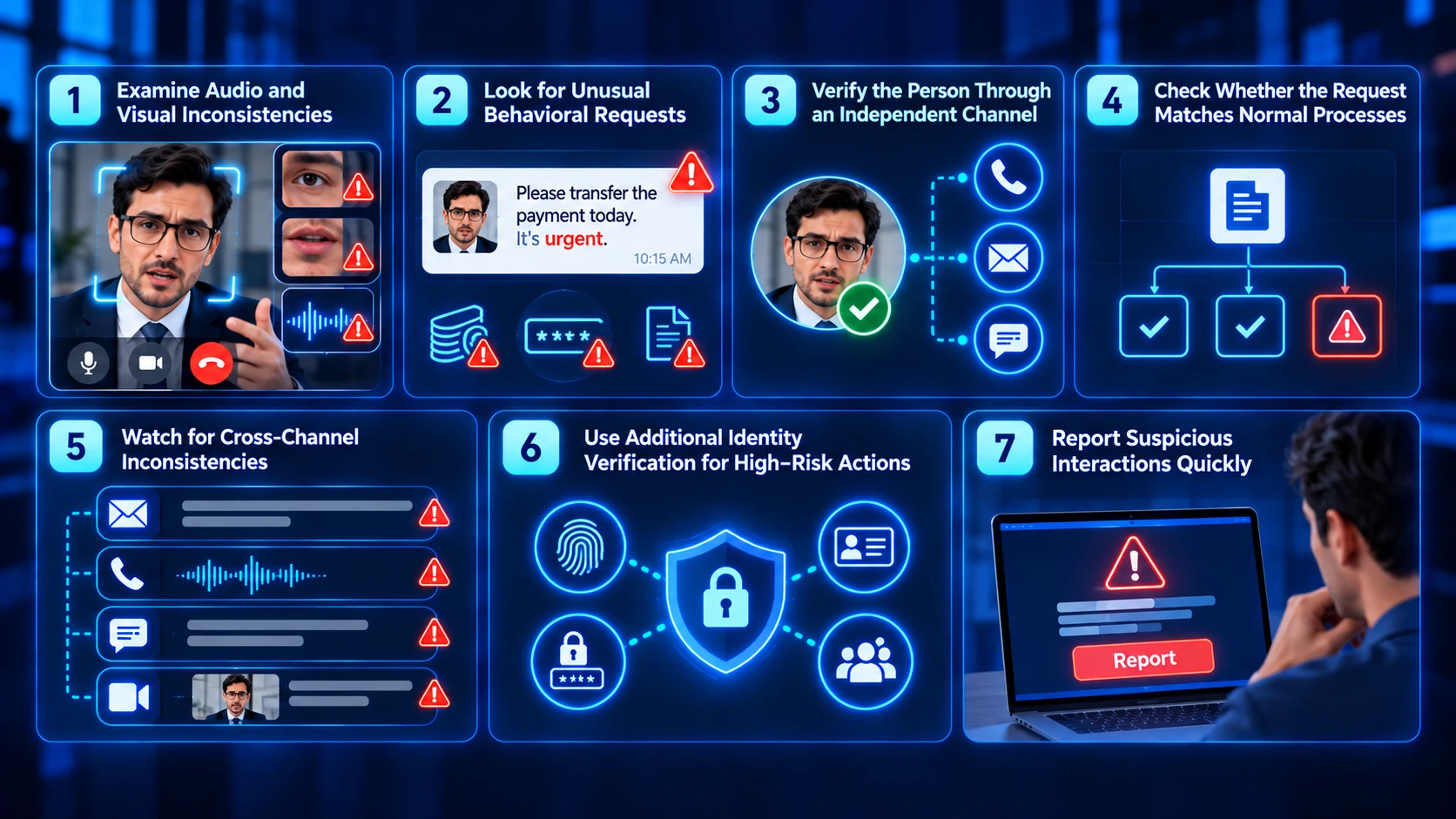
Detecting deepfake phishing requires organizations to evaluate more than whether audio or video appears authentic. The strongest approach combines media inspection, behavioral analysis, identity verification, and established business procedures. Employees should be encouraged to slow down when a communication involves urgency, authority, money, credentials, or access to sensitive systems.
1. Examine Audio and Visual Inconsistencies
Start with the communication itself. Unnatural facial expressions, inconsistent lip movement, unusual blinking, distorted backgrounds, abrupt changes in lighting, robotic speech patterns, strange pauses, or inconsistent tone can sometimes indicate manipulated media. However, these signs should be treated as warning signals rather than definitive proof because high-quality synthetic content may not contain obvious artifacts.
2. Look for Unusual Behavioral Requests
Focus on what the person is asking you to do. A familiar voice or face should not automatically validate an unusual request. Requests to bypass established procedures, disclose credentials, change payment information, transfer money urgently, or provide sensitive documents deserve additional scrutiny, particularly when the requester discourages verification.
3. Verify the Person Through an Independent Channel
Do not verify a suspicious request using the same communication channel. If an executive makes an unexpected payment request during a call, contact that executive using a known phone number or an established internal communication method. The verification should be initiated independently rather than using contact information supplied during the suspicious interaction.
4. Check Whether the Request Matches Normal Processes
Compare the request with established business procedures. A legitimate employee may occasionally make an unusual request, but sensitive actions should still follow the organization's approval and authentication requirements. A request that suddenly skips required approvals, changes normal workflows, or introduces an unfamiliar payment or access process should be investigated before any action is taken.
5. Watch for Cross-Channel Inconsistencies
Compare information across the different communication channels involved. If an email, voice call, text message, and video meeting appear to be connected, check whether the details actually match. Differences in names, timing, instructions, account information, meeting details, or requested actions can reveal that separate pieces of an impersonation campaign are being coordinated.
6. Use Additional Identity Verification for High-Risk Actions
Increase verification when the consequences are significant. Payments, password resets, privileged-access changes, confidential-data requests, and account modifications should require stronger controls than ordinary communications. Multi-factor authentication, dual approval, identity verification, and out-of-band confirmation can reduce the likelihood that a convincing deepfake alone is enough to authorize a sensitive action.
7. Report Suspicious Interactions Quickly
Treat suspected deepfake phishing as a security incident rather than an embarrassing mistake. Employees should have a clear way to report suspicious calls, messages, meetings, or identity-verification attempts. Early reporting can help security teams investigate related activity, protect other employees, secure potentially affected accounts, and prevent a single impersonation attempt from developing into a larger campaign.
How to Prevent Deepfake Phishing Attacks?
Preventing deepfake phishing requires more than identifying whether a voice, video, or image has been manipulated. Organizations need practical safeguards that make it harder for attackers to turn a convincing impersonation into an unauthorized action. This includes independent verification, stronger approval processes, employee training, and technical controls that provide protection even when an employee is deceived.
1. Verify High-Risk Requests Through a Separate Channel
Requests involving payments, sensitive information, account access, or changes to important business details should always receive additional verification. Employees should not rely solely on the voice, video, email address, or messaging account used to make the request.
Contact the person using a previously verified phone number.
Confirm unusual requests through an established internal communication system.
Independently verify changes to payment or banking information.
Avoid confirming a request through the same channel in which it was received.
Give employees the authority to pause a request when verification is incomplete.
Independent verification creates an additional barrier between a successful impersonation and the action the attacker wants the employee to take.
2. Introduce Additional Approval for Sensitive Actions
A deepfake phishing attack becomes more damaging when one employee has the authority to immediately complete a financial or administrative action. Requiring additional approval can reduce the likelihood that a single compromised interaction results in a significant loss.
Use dual approval for high-value payments.
Require separate authorization for changes to banking details.
Add additional checks before granting privileged access.
Clearly document financial and administrative approval procedures.
Ensure that the second approver independently verifies the request.
Additional approval makes it harder for attackers to convert one successful impersonation into an immediate transaction or access change.
3. Train Employees to Recognize Manipulation Tactics
Employees should not be trained only to look for obvious signs such as unnatural facial movements or unusual audio. Deepfake phishing can also rely on urgency, authority, familiarity, and emotional pressure to influence employees into acting quickly.
Training should show employees how these tactics work and explain when they should stop and verify a request.
Teach employees how deepfake phishing attacks are constructed.
Include examples involving voice, video, email, and messaging.
Explain social-engineering tactics such as urgency and authority.
Conduct regular awareness exercises instead of relying on one-time training.
Provide a simple process for reporting suspicious interactions.
A strong awareness program helps employees question the circumstances surrounding a communication instead of automatically trusting a familiar face or voice.
4. Strengthen Authentication and Access Controls
Employee judgment should never be the only barrier protecting a sensitive system against deepfake phishing. If an employee is manipulated into sharing information or initiating an action, additional technical controls can limit what the attacker is able to accomplish.
Organizations should review access to financial systems, administrative accounts, customer information, and other sensitive resources.
Use strong authentication for sensitive accounts.
Apply least-privilege access.
Separate approval privileges from transaction privileges where possible.
Review privileged accounts regularly.
Monitor unusual authentication and access activity.
Layered access controls can reduce the impact of an attack even when social engineering successfully deceives an employee.
5. Limit Information That Can Be Used for Impersonation
Attackers can use publicly available information to make deepfake phishing attempts more believable. Employee names, job titles, photographs, reporting relationships, business partners, and information about company processes can all help an attacker construct a convincing scenario.
Organizations should review what information is unnecessarily exposed through websites, professional networking platforms, social media, and public documents.
Review publicly available information about executives and employees.
Avoid unnecessarily publishing internal reporting structures.
Limit details about financial and approval processes.
Review information shared through official social media accounts.
Teach employees how publicly available information can support targeted attacks.
Reducing unnecessary information exposure can make it more difficult for attackers to personalize an impersonation and make their story appear legitimate.
6. Create a Clear Process for Reporting Suspicious Requests
Employees may sometimes be unable to determine whether a voice call, video meeting, or message is genuine. They should not be expected to make that decision alone. A clear reporting process allows suspicious interactions to be escalated before they result in financial or security consequences.
Create a dedicated channel for reporting suspicious activity.
Define when employees should contact security or fraud teams.
Preserve relevant emails, messages, recordings, or transaction information where appropriate.
Establish escalation procedures for suspicious financial requests.
Keep the reporting process simple and accessible.
When employees know exactly where to report an unusual interaction, organizations can investigate potential deepfake phishing attempts more quickly.
7. Test Deepfake Phishing Defenses Regularly
Security controls should be tested regularly rather than assumed to be effective. Organizations can conduct controlled simulations to determine whether employees recognize suspicious requests and follow the correct verification and approval procedures.
Testing can involve different scenarios, including executive impersonation, fraudulent payment requests, voice-based attacks, and suspicious video interactions.
Run realistic impersonation exercises.
Test multiple communication channels.
Measure whether employees follow verification procedures.
Review where employees or processes failed.
Update training and controls based on the results.
Regular testing helps organizations identify weaknesses before attackers have an opportunity to exploit them.
8. Prepare for Multi-Channel Deepfake Phishing
Deepfake phishing can involve several communication channels during the same attack. An attacker might begin with an email, follow it with a voice call, and then use a video meeting to reinforce the impersonation. Each interaction can make the previous one appear more credible.
Organizations should therefore avoid treating every communication as independent proof of identity. If an email is followed by a voice or video request involving a sensitive action, the request should still be verified through a trusted channel.
Monitor for unusual requests appearing across multiple channels.
Compare information provided through different communications.
Require independent verification for sensitive actions.
Train employees to recognize coordinated impersonation attempts.
Include multi-channel scenarios in security exercises.
Treating each communication as something that requires appropriate verification makes it harder for attackers to use several convincing interactions to reinforce the same false identity.
Deepfake Phishing and the Legal and Regulatory Landscape
As deepfake phishing becomes increasingly connected to financial fraud, identity theft, data breaches, and unauthorized access, organizations also need to consider the legal and regulatory obligations that may arise from these attacks. There is currently no single global law governing every malicious deepfake or deepfake phishing incident. Instead, organizations may need to consider existing fraud and cybercrime laws alongside privacy, cybersecurity, consumer-protection, financial-sector, and emerging AI-specific requirements, depending on the nature of the incident and the jurisdictions involved.
1. Laws Against Fraud and Impersonation
Deepfake phishing can fall within existing fraud and impersonation laws when synthetic media is used to deceive someone for financial or other unlawful gain. The use of AI does not necessarily create a separate category of crime; existing laws may already apply to the underlying fraudulent conduct.
In the United States, for example, The Federal Trade Commission has specifically identified AI-generated deepfakes and voice cloning as technologies that can increase the scale and effectiveness of impersonation fraud. The FTC has also strengthened its rules and enforcement tools against government and business impersonation scams. Organizations should therefore treat deepfake-enabled impersonation as a potential fraud or cybercrime event and preserve relevant evidence, including emails, messages, call records, transaction details, and digital media.
2. Data Protection and Privacy Requirements
Deepfake phishing may involve personal information belonging to employees, customers, executives, or business partners. Attackers can use publicly available photographs, videos, voice recordings, professional information, or stolen personal data to construct convincing impersonations.
This creates additional privacy and data-protection considerations. If a deepfake phishing attack results in unauthorized access to personal data, organizations may have obligations under applicable data-breach and privacy laws. For organizations subject to the EU General Data Protection Regulation (GDPR), for example, a personal-data breach may trigger notification obligations, including notification to the relevant supervisory authority within 72 hours where the GDPR's conditions for notification are met.
The important point is that the fact that a breach originated through a deepfake does not necessarily remove the organization's existing data-protection obligations.
3. Financial and Industry-Specific Requirements
Organizations operating in financial services, healthcare, telecommunications, technology, and other regulated sectors may face additional requirements when deepfake phishing affects customer information, financial transactions, regulated systems, or sensitive data.
The applicable response can therefore vary significantly depending on what the attacker accessed or attempted to access. A deepfake used to persuade an employee to authorize a fraudulent payment may raise different legal and reporting considerations from an attack that compromises healthcare information or employee credentials.
Organizations should incorporate these sector-specific requirements into their incident-response procedures rather than relying on a single general deepfake policy.
4. Deepfake Disclosure and AI-Specific Rules
Some jurisdictions are now introducing requirements specifically addressing AI-generated and manipulated content.
The European Union's AI Act provides one of the clearest examples. Under Article 50, providers of certain AI systems must ensure that generated or manipulated outputs are appropriately marked as artificially generated or manipulated. Deployers using AI to generate or manipulate image, audio, or video content that constitutes a deepfake must disclose that the content has been artificially generated or manipulated, subject to specified exceptions. These transparency obligations apply from 2 August 2026.
For organizations operating internationally, AI-related compliance requirements can vary by jurisdiction. Organizations need to determine which laws and applicable exceptions apply to their specific activities, users, and AI-generated content.
5. Build Compliance Into the Incident Response Process
Legal and regulatory considerations should be incorporated into an organization's incident-response plan before a deepfake phishing incident occurs. Security, legal, compliance, fraud, and communications teams should understand their respective responsibilities when an impersonation attempt results in financial loss, unauthorized access, or exposure of personal information.
A documented process can help an organization determine what evidence needs to be preserved, which internal teams need to be involved, whether affected individuals need to be notified, and whether the incident needs to be reported to a regulator or law-enforcement authority.
As deepfake phishing continues to evolve, organizations should treat compliance as part of their broader fraud and cybersecurity strategy rather than as a separate issue that only becomes relevant after an incident.
How Security Awareness Training Can Reduce Deepfake Phishing Risks
Security awareness training plays an important role in reducing the risk of successful deepfake phishing attacks because these attacks often exploit human trust. Employees may understand traditional phishing threats but still respond to a convincing voice, video call, or message from someone they believe they know. Training should therefore focus on helping employees recognize suspicious situations, follow verification procedures, and respond appropriately to potential impersonation attempts.

1. Build Awareness Around Modern Impersonation Techniques
Traditional phishing training often focuses on suspicious links, unexpected attachments, and poorly written emails. Deepfake phishing requires a broader understanding because an attack may involve a realistic voice, video, photograph, or AI-generated message.
Employees should understand that attackers can imitate executives, colleagues, customers, and business partners using information collected from public sources or compromised accounts. Training should also explain how several forms of communication can be combined to make an impersonation appear more credible.
This gives employees a better understanding of why a familiar face or voice should not automatically be treated as proof of identity.
2. Teach Employees to Examine the Situation
Trying to identify small visual or audio imperfections is not always practical. Instead, employees should be encouraged to consider the circumstances surrounding the communication.
Training can teach them to ask whether the request was expected, whether the person normally makes this type of request, whether the timing makes sense, and whether the action follows established company procedures. An unusual payment request from a senior executive, for example, should receive additional verification even if the executive appears clearly on screen.
This approach makes the decision process less dependent on whether an employee can personally identify a sophisticated deepfake.
3. Practice With Realistic Attack Scenarios
Employees need an opportunity to practice their response before facing an actual deepfake phishing attempt. Organizations can create controlled scenarios involving voice messages, video calls, emails, and internal messaging platforms.
A finance employee might receive a simulated request to change payment details, while an executive assistant might encounter a fake urgent request for confidential documents. After each exercise, the organization can review whether the employee verified the request, followed the correct approval process, and reported the interaction.
Practical simulations turn security awareness from a theoretical exercise into a behavior employees can apply during a real incident.
4. Reinforce the Importance of Slowing Down
Attackers often use urgency to prevent victims from thinking carefully. A request may be presented as an emergency involving a payment, customer problem, executive decision, or security issue.
Training should reinforce that urgency does not remove normal security procedures. Employees should know that they can pause a request, contact the person independently, seek another approval, or involve the security team when something does not feel right.
Creating this expectation can reduce the effectiveness of pressure-based social engineering.
5. Give Employees a Simple Way to Report Suspicious Interactions
Employees are more likely to report potential attacks when the process is clear and does not require them to prove that fraud has occurred. Training should explain exactly where suspicious calls, messages, emails, and video interactions should be reported.
Organizations can also explain what information employees should preserve, such as screenshots, messages, email headers, transaction details, or other relevant records. This can help security and fraud teams investigate the incident more quickly.
A straightforward reporting process ensures that uncertainty becomes an opportunity for investigation rather than an opportunity for the attacker.
6. Update Training as Deepfake Techniques Evolve
Deepfake phishing will continue to change as generative AI tools become easier to access and produce increasingly convincing content. Training materials that focus on a small set of obvious deepfake characteristics can quickly become outdated.
Organizations should regularly update examples based on new attack methods, recent incidents, internal security exercises, and changes in the communication platforms employees use. Training should cover both technical developments and the social-engineering techniques that make synthetic media effective.
Keeping the material current helps employees recognize the broader patterns of impersonation rather than relying on a fixed list of visual or audio warning signs.
7. Measure Employee Response, Not Just Training Completion
Completing an awareness course does not necessarily mean that employees will respond correctly during a real attack. Organizations should therefore assess whether training is changing behavior.
Controlled exercises can measure whether employees verify unusual requests, follow approval procedures, recognize suspicious communication patterns, and report incidents promptly. The results can then be used to identify areas where additional training or stronger processes are needed.
This makes security awareness an ongoing part of the organization's defense strategy rather than a one-time compliance exercise.
The Future of Deepfake Phishing
Deepfake phishing is likely to become more sophisticated as generative AI improves. Future attacks may rely less on obvious fake videos and more on highly personalized combinations of synthetic voice, video, images, and text. Organizations will need to strengthen identity verification and fraud controls alongside traditional cybersecurity measures.
1. More Realistic and Personalized Impersonation
AI-generated voices, videos, and images are becoming increasingly convincing. Future attacks may use information about specific individuals to create highly targeted impersonation attempts.
Executive voices and faces may be replicated for specific targets.
Messages may be adapted to match an individual's communication style.
Public and compromised information may be used to create realistic scenarios.
Synthetic media may be generated or modified in real time.
Familiar voices and faces may become less reliable as proof of identity.
As synthetic media becomes more convincing, organizations will need verification methods that do not depend entirely on audio or visual recognition.
2. Deepfakes as Part of Larger Attack Chains
Future phishing campaigns may combine deepfakes with other fraud and cyberattack techniques rather than using synthetic media on its own.
Stolen credentials may be combined with impersonation.
Phishing links may accompany synthetic voice or video communications.
Business email compromise may be reinforced through deepfake calls.
Account takeover techniques may follow an initial impersonation.
Information gathered during one interaction may be used to support the next stage of an attack.
This means organizations will increasingly need to assess the entire attack chain rather than treating deepfake detection as a standalone security problem.
3. From Deepfake Detection to Identity Verification
As synthetic media becomes harder to distinguish from authentic content, detection alone may not be enough. Organizations will need to verify the person, the request, and the action being taken.
Use identity verification alongside media analysis.
Require additional authentication for high-risk actions.
Monitor unusual behavioral and transaction patterns.
Maintain independent approval processes for sensitive requests.
Verify financial, access, and data-related requests through trusted channels.
The future of deepfake defense will increasingly depend on building systems that remain secure even when attackers can convincingly imitate a trusted person.
Conclusion
Deepfake phishing is changing how organizations need to think about identity, trust, and social engineering. Attackers can now combine AI-generated voices, videos, images, and personalized messages to make impersonation attempts appear more convincing than traditional phishing.
The most effective response is not to rely on employees spotting every technical sign of a deepfake. Organizations should combine employee awareness with independent identity verification, stronger authentication, additional approval for high-risk actions, clear reporting procedures, and regular security testing. These layers can help prevent a convincing impersonation from becoming a successful financial, security, or data-related incident.
As AI-generated content continues to evolve, organizations will need to regularly review their security processes and adapt to new forms of impersonation. Encouraging employees to verify unusual requests and follow established security procedures can help organizations strengthen their defenses against evolving deepfake phishing threats.