Back to all blogs
Explore everything you need to know about AI interview fraud, including common fraud techniques, detection methods, prevention strategies, real examples, industry statistics, and how Sherlock AI protects remote hiring with AI-powered interview fraud detection.

Artificial intelligence is transforming recruitment, but it is also creating an entirely new category of hiring risks. What was once limited to fake resumes or exaggerated experience has evolved into sophisticated AI interview fraud involving deepfake videos, proxy interview candidates, AI interview assistants, voice cloning, and real-time answer generation. As remote hiring becomes the standard for many organizations, recruiters now face a growing challenge of verifying whether the person attending the interview is genuinely the candidate they intend to hire.
The problem is no longer theoretical. Hiring managers across industries are already encountering candidates who use AI tools to hide their identities, receive live interview assistance, or even allow another individual to complete technical interviews on their behalf. These tactics not only result in poor hiring decisions but also expose organizations to intellectual property theft, security breaches, compliance risks, and significant financial losses.
The numbers highlight how quickly this issue is growing. According to Checkr’s Hiring Hoax Survey, 31% of hiring managers have interviewed a candidate using a fake identity, while only 19% feel extremely confident that their hiring process can detect interview fraud. Gartner also predicts that one in four job candidates globally could be fake by 2028, driven by advances in generative AI and identity manipulation. Meanwhile, research cited by Pindrop found that deepfake fraud attempts increased by 1,300% in 2024, making video interview verification more important than ever.
Traditional interview methods are no longer enough. Manual observation, webcam monitoring, and simple identity verification checks often fail against modern AI-powered fraud techniques. Organizations need intelligent interview fraud detection systems capable of identifying suspicious behavior, verifying candidate identity, detecting AI assistance, and maintaining hiring integrity throughout the recruitment process.
What Is AI Interview Fraud?
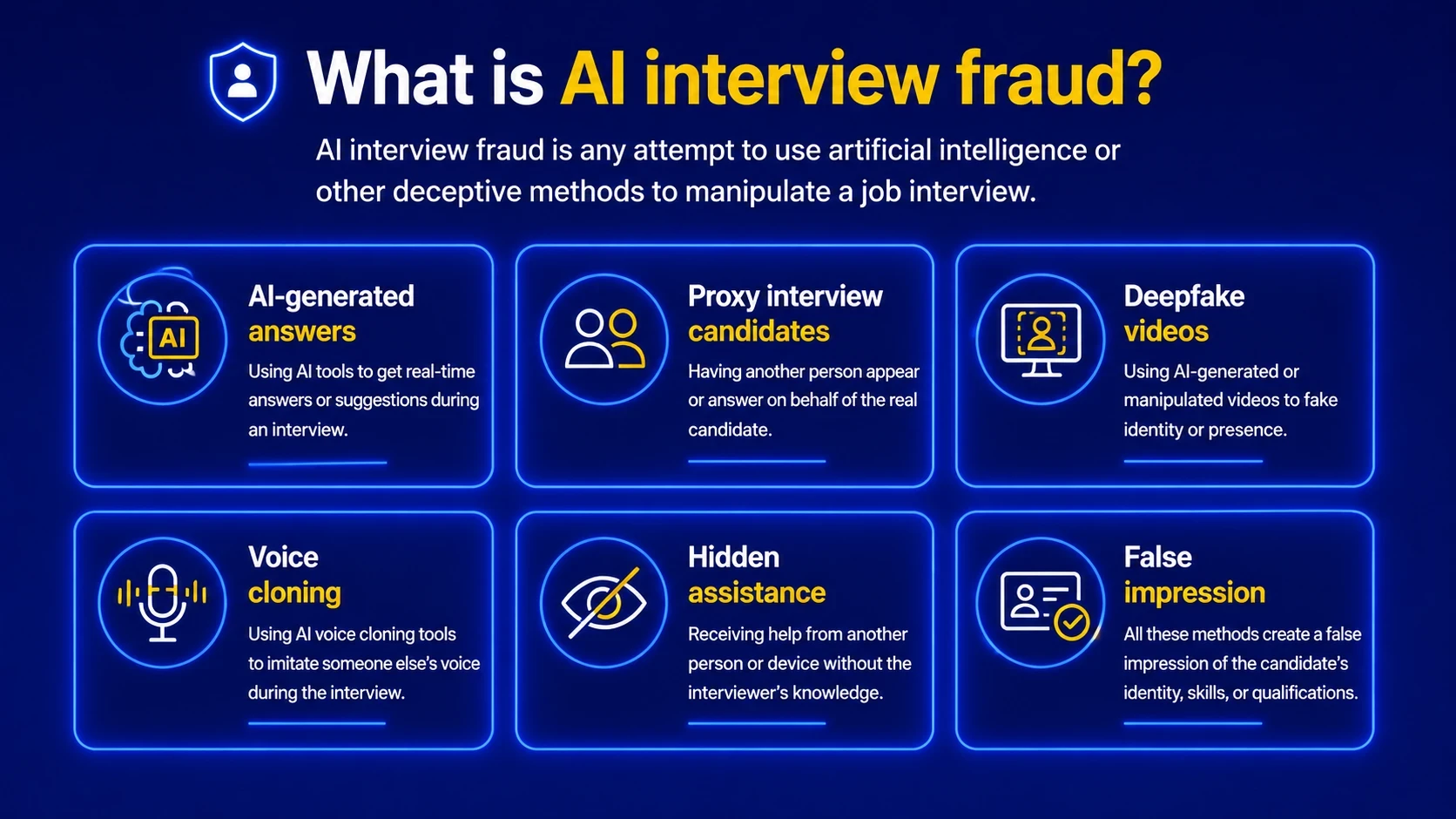
AI interview fraud is any attempt to use artificial intelligence or other deceptive methods to manipulate a job interview. It includes practices such as using AI-generated answers, proxy interview candidates, deepfake videos, voice cloning, or hidden assistance to create a false impression of a candidate’s identity, skills, or qualifications.
How to Detect AI Interview Fraud
Recruiters can no longer rely solely on interview questions and intuition to identify dishonest candidates. Modern AI interview fraud often involves sophisticated tools such as AI copilots, proxy interviewers, deepfake videos, voice cloning, and hidden devices that are difficult to detect through manual observation alone. Organizations need a combination of behavioral analysis, identity verification, environmental monitoring, and AI-powered fraud detection to protect the integrity of their hiring process.
Below are the most effective ways to detect AI interview fraud.
1. Verify Candidate Identity Before and During the Interview
Identity verification is the first line of defense against interview fraud. Before an interview begins, recruiters should confirm that the person joining the meeting matches the identification documents submitted during the hiring process.
Additional verification can include:
Government-issued ID verification
Facial matching with official documents
Live selfie verification
Continuous identity checks throughout the interview
Continuous identity verification helps detect candidate swaps, proxy interviews, and deepfake impersonation attempts during longer interview sessions.
From 2022 to Q1 2023, the proportion of deepfakes among all fraud types increased by 4,500% in Canada, by 1,200% in the U.S., by 407% in Germany, and by 392% in the UK.
2. Use Sherlock AI-Powered Interview Fraud Detection
As AI interview fraud becomes increasingly sophisticated, manual observation alone is no longer enough to identify every form of cheating. Modern interview integrity platforms use artificial intelligence to analyze multiple fraud indicators simultaneously, helping recruiters detect suspicious activity with greater accuracy and speed.
Sherlock AI helps organizations detect AI interview fraud in real time by monitoring candidate identity, behavior, devices, and interview activity throughout the hiring process.
Sherlock AI can detect:
AI interview copilots like Parakeet AI, Cluely, LockeDin AI and answer generation tools
Proxy interviews and candidate impersonation
Deepfake videos and identity manipulation
Unauthorized applications and browser extensions
Multiple devices and virtual cameras
Suspicious behavioral and environmental anomalies
By combining identity verification, behavioral analysis, device monitoring, and AI-powered fraud detection into a single platform, Sherlock AI provides recruiters with real-time alerts and actionable insights, enabling them to identify interview fraud early and make hiring decisions based on genuine candidate skills.
3. Look for Signs of AI Interview Assistants
Many candidates now use AI interview assistants that generate answers in real time by listening to interview questions.
Possible indicators include:
Unnaturally fast and perfectly structured responses
Long pauses before speaking followed by polished answers
Frequent eye movement toward another screen
Reading responses instead of speaking naturally
Consistently generic answers that lack personal experience
These behaviors may indicate that an AI tool is assisting the candidate during the interview.
4. Detect Proxy Interviews
In a proxy interview, another person attends the interview or secretly helps the candidate answer technical questions.
Common warning signs include:
Voice, appearance, or communication style changes during different interview rounds
Candidate refuses to turn on the camera
Poor synchronization between audio and lip movement
Suspicious delays before answering
Camera turning off during coding or technical discussions
Identity verification and continuous monitoring significantly reduce the risk of proxy interviews.
5. Monitor Candidate Behavior Throughout the Interview
Behavioral analysis helps identify suspicious activity that may indicate interview fraud.
Recruiters should watch for:
Repeatedly looking away from the camera
Frequent reading from another monitor
Unusual keyboard or mouse activity
Whispering or receiving prompts from someone nearby
Multiple people visible or audible in the room
Sudden changes in speaking style or confidence
Modern AI-powered interview platforms can automatically detect many of these anomalies in real time.
6. Detect Deepfake and Voice Manipulation
AI-generated video and voice technology has made impersonation more convincing than ever.
The FBI noted “voice spoofing or potentially voice deepfakes” being used in interviews – where the lip movements seen didn’t match the audio. Voice fraud is also common in phone interviews (no video). For example, a non-native speaker might use an AI voice clone with a fluent accent to answer questions, or a male candidate might use a female voice clone if the stolen identity is female.
Signs of possible deepfake usage include:
Poor lip synchronization
Blurred facial edges
Unnatural blinking patterns
Delayed facial expressions
Robotic or inconsistent voice quality
Mismatch between facial movement and speech
Advanced fraud detection systems analyze facial consistency, voice authenticity, and biometric signals to identify manipulated content.
How to Prevent AI Interview Fraud
Preventing AI interview fraud requires a proactive approach that combines technology, secure hiring practices, and continuous monitoring. Rather than relying on manual observation alone, organizations should implement multiple layers of protection throughout the recruitment process to ensure that every interview reflects a candidate’s genuine identity, skills, and qualifications.
Below are some of the most effective ways to prevent AI interview fraud.
1. Implement Strong Identity Verification
Identity verification is the first line of defense against interview fraud. Before an interview begins, recruiters should confirm that the person joining the meeting matches the identification documents submitted during the hiring process.
35% of hiring managers say someone other than the listed applicant has participated in a virtual interview. This highlights why identity verification is critical before and during remote interviews.
Additional verification can include:
Government-issued ID verification
Live selfie verification
Facial matching with identity documents
Multi-factor authentication before joining interviews
Continuous identity verification during longer interviews
2. Secure the Interview Environment
A controlled interview environment makes it more difficult for candidates to receive external assistance or use unauthorized devices.
Organizations should:
Require candidates to keep their camera on throughout the interview
Ask for a brief 360-degree room scan before starting
Restrict the use of virtual backgrounds when appropriate
Require clear visibility of the candidate’s face
Minimize opportunities for hidden devices or external support
3. Establish Clear Interview Policies
Candidates should understand the organization’s expectations before the interview begins.
Interview policies should clearly state that:
AI interview assistants are not permitted unless explicitly allowed
Proxy interviews are prohibited
Identity verification is mandatory
Interviews may be monitored for security purposes
Fraudulent behavior may result in immediate disqualification
4. Train Recruiters to Recognize AI Fraud
Recruiters and hiring managers should be trained to recognize common indicators of AI-assisted interviews.
Training should cover:
Deepfake warning signs
AI-generated response patterns
Proxy interview indicators
Suspicious behavioral changes
Identity verification procedures
5. Use Multiple Assessment Methods
Relying on a single interview increases the risk of fraud. A multi-layered evaluation process makes it significantly harder for candidates to deceive recruiters.
Organizations can strengthen hiring by combining:
Live technical interviews
Practical skill assessments
Coding or work-sample tests
Scenario-based problem-solving exercises
Follow-up interviews with different interviewers
6. Use Sherlock AI to Prevent Interview Fraud
As AI-powered interview fraud continues to evolve, organizations need intelligent prevention tools that monitor the entire interview process rather than relying solely on manual observation.
Sherlock AI helps organizations build a secure and trustworthy hiring process by:
Verifying candidate identity before and during interviews
Enforcing interview compliance with automated security checks
Providing real-time alerts that enable recruiters to act immediately
Supporting remote hiring with continuous interview monitoring
Reducing manual effort through automated fraud prevention workflows
Delivering detailed interview reports and audit trails for confident hiring decisions
By combining identity verification, continuous monitoring, policy enforcement, and AI-powered automation into a single platform, Sherlock AI helps organizations safeguard interview integrity, minimize hiring risks, and make decisions based on genuine candidate performance.
Start protecting your interviews today with Sherlock AI. |
|---|
Real Examples of AI Interview Fraud
AI interview fraud is no longer a theoretical concern—it is happening across industries as organizations increasingly rely on remote hiring. Fraudsters now use artificial intelligence, deepfake technology, proxy interviewers, and AI-powered assistants to manipulate interviews and misrepresent their skills or identities. The following examples illustrate some of the most common ways AI interview fraud can occur during the hiring process.
Example 1: Using an AI Interview Assistant During a Technical Interview
A candidate applying for a software engineering role secretly uses an AI interview copilot on a second monitor during a live coding interview. As the interviewer asks technical questions, the AI tool listens to the conversation and instantly generates code suggestions and well-structured answers. The candidate simply reads or adapts the responses, creating the impression of having strong technical expertise despite lacking the required skills.
Without AI-powered interview monitoring, recruiters may find it difficult to distinguish between genuine knowledge and AI-assisted responses.
Example 2: A Proxy Candidate Completes the Interview
A candidate applies for a senior developer position but hires an experienced programmer to attend the live interview on their behalf. The proxy candidate successfully answers technical questions, completes coding assessments, and secures the job offer. Once hired, the actual candidate joins the organization but is unable to perform the responsibilities expected for the role.
Proxy interviews can result in poor hiring decisions, project delays, and increased recruitment costs.
Example 3: Deepfake Technology Used for Identity Impersonation
A fraudster steals another person’s identity and uses AI-generated deepfake software to alter their appearance during a video interview. The manipulated video closely resembles the legitimate candidate, allowing the fraudster to bypass basic visual identity checks. Unless recruiters use advanced identity verification and deepfake detection tools, the impersonation may go unnoticed throughout the interview process.
Example 4: Voice Cloning During a Virtual Interview
A candidate uses AI voice-cloning software to modify their voice during a remote interview. For example, they may generate a fluent English voice to mask language limitations or imitate another person’s identity. Since voice cloning technology has become increasingly realistic, traditional phone or video interviews often cannot reliably detect manipulated speech without specialized voice analysis.
Example 5: Receiving Hidden Assistance Throughout the Interview
During an online interview, a candidate receives continuous assistance from AI tools or another individual outside the camera’s view. They frequently glance at another screen, pause before answering, and deliver responses that sound unusually polished and generic. Although they appear confident, much of their performance depends on external assistance rather than their own knowledge and experience.
Behavioral monitoring and AI-powered fraud detection systems can identify many of these suspicious patterns in real time.
These examples demonstrate that AI interview fraud extends far beyond exaggerated resumes or rehearsed answers. Modern fraud techniques combine AI interview assistants, proxy candidates, deepfake videos, voice cloning, and real-time answer generation to bypass traditional hiring processes. As these tactics continue to evolve, organizations need advanced interview fraud detection solutions that can verify candidate identity, detect AI assistance, monitor suspicious behavior, and protect the integrity of every hiring decision.
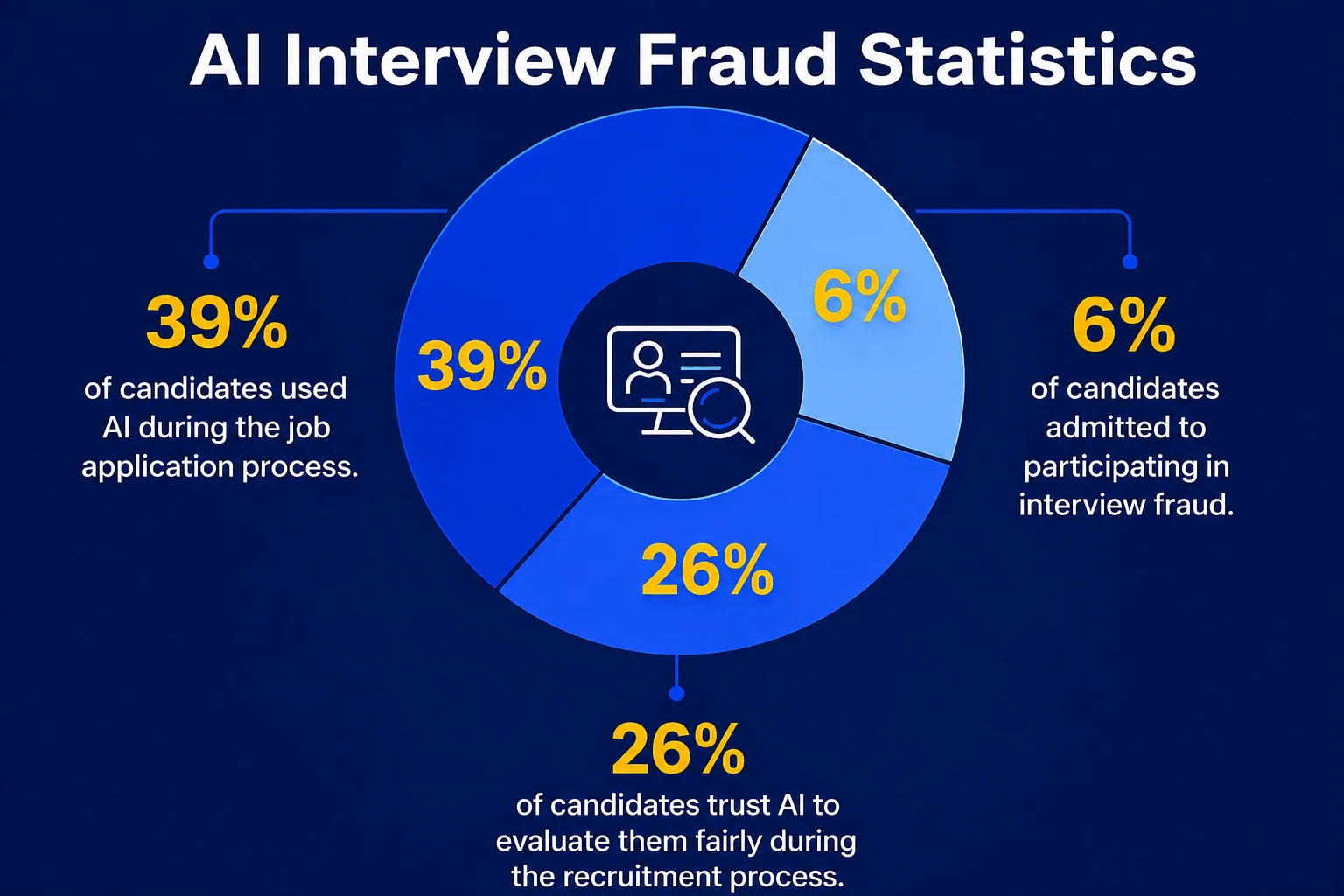
AI Interview Fraud Statistics
The rapid adoption of artificial intelligence in recruitment has brought significant efficiency gains, but it has also created new opportunities for interview fraud. Recent studies and industry reports show that organizations are increasingly encountering fake candidates, AI-assisted interviews, identity impersonation, and deepfake technologies during the hiring process. These statistics highlight why companies need stronger interview security measures and AI-powered fraud detection solutions.
A Gartner survey found that 39% of job candidates used AI during the job application process, including generating resumes, cover letters, writing samples, and answers to assessment questions.
According to Gartner, 6% of surveyed job candidates admitted to participating in interview fraud, either by impersonating someone else or having another person attend the interview on their behalf.
A Gartner survey of nearly 3,000 job candidates found that only 26% trust AI to evaluate them fairly during the recruitment process, highlighting growing concerns around AI in hiring.
Source: Gartner Survey
Why Choose Sherlock AI for Interview Fraud Detection?
As AI-powered interview fraud continues to evolve, organizations need more than manual observation and basic identity checks. Traditional hiring methods struggle to detect sophisticated fraud techniques such as AI interview copilots, proxy candidates, deepfake videos, voice cloning, and hidden external assistance. Sherlock AI addresses these challenges by combining artificial intelligence, identity verification, behavioral analysis, and device monitoring into a single interview integrity platform.
Sherlock AI continuously monitors the interview environment, analyzes candidate behavior, and detects suspicious activities in real time, enabling recruiters to make confident hiring decisions based on authentic candidate performance.
Key Features of Sherlock AI
1. Real-Time Identity Verification
Sherlock AI verifies that the person attending the interview is the same individual who applied for the role. Through continuous identity verification, facial recognition, and biometric validation, it helps prevent candidate impersonation and proxy interviews throughout the interview process.
2. AI Interview Copilot Detection
Modern AI assistants can generate answers, coding solutions, and interview responses in real time. Sherlock AI detects the presence of AI interview copilots(Parakeet AI, Cluely, LockeD AI, Interview Sidekick) and unauthorized answer-generation tools, helping recruiters assess a candidate’s genuine knowledge and skills.
3. Proxy Interview Detection
Sherlock AI identifies situations where another individual attempts to participate in or complete an interview on behalf of the actual candidate. Continuous identity monitoring and behavioral analysis help detect candidate swaps and impersonation attempts during live interviews.
4. Deepfake and Voice Manipulation Detection
AI-generated video and voice technologies are making identity fraud increasingly difficult to detect manually. Sherlock AI analyzes facial consistency, voice authenticity, lip synchronization, and biometric signals to identify potential deepfake videos and voice-cloning attempts.
5. Behavioral Intelligence
Sherlock AI continuously monitors behavioral indicators that may suggest fraudulent activity, including abnormal eye movements, repeated glances toward another screen, unusual response patterns, suspicious pauses, environmental distractions, and other anomalies commonly associated with AI-assisted interviews.
6. Device and Application Monitoring
Unauthorized software, virtual cameras, browser extensions, multiple monitors, and hidden applications can provide candidates with unfair assistance during interviews. Sherlock AI detects these unauthorized tools and alerts recruiters to suspicious device activity.
7. Comprehensive Interview Integrity Reports
At the end of each interview, Sherlock AI generates a detailed integrity report highlighting detected risks, suspicious behaviors, identity verification results, and potential fraud indicators. These reports help recruiters make informed hiring decisions while maintaining a transparent and auditable recruitment process.
As remote hiring becomes the norm, maintaining interview integrity is essential for protecting business operations, intellectual property, and organizational reputation. Sherlock AI empowers recruiters with intelligent fraud detection, continuous identity verification, and real-time behavioral analysis, ensuring that every hiring decision is based on genuine candidate skills rather than AI-assisted deception.
By combining advanced AI technology with comprehensive interview monitoring, Sherlock AI helps organizations reduce hiring risks, improve recruitment accuracy, and create a secure and trustworthy hiring process for both recruiters and candidates.
Conclusion
Artificial intelligence is transforming the way organizations recruit talent, but it is also enabling increasingly sophisticated forms of interview fraud. From AI interview assistants and proxy candidates to deepfake videos and voice cloning, traditional hiring methods are no longer sufficient to verify whether a candidate’s performance truly reflects their skills and identity.
As remote and hybrid hiring continue to grow, organizations must adopt a proactive approach to protecting interview integrity. Combining strong identity verification, structured interview policies, behavioral monitoring, practical assessments, and recruiter awareness can significantly reduce the risk of fraudulent hiring. However, because AI-powered fraud techniques are constantly evolving, manual detection alone is no longer enough.
Organizations need intelligent solutions that can continuously monitor interviews, detect suspicious behavior, verify candidate identity, and identify the use of unauthorized AI tools in real time. This not only helps prevent costly hiring mistakes but also protects sensitive business information, strengthens compliance, and ensures that hiring decisions are based on genuine talent.
Sherlock AI empowers organizations to stay ahead of modern interview fraud by combining AI-powered identity verification, behavioral analysis, deepfake detection, AI copilot detection, proxy interview detection, and comprehensive interview integrity reporting into a single platform. With real-time insights and advanced fraud detection capabilities, Sherlock AI enables recruiters to confidently identify authentic candidates and maintain a fair, secure, and trustworthy hiring process.
As AI continues to reshape recruitment, organizations that invest in robust interview fraud detection today will be better prepared to build high-performing teams, safeguard their hiring processes, and confidently navigate the future of remote recruitment.
Ready to secure your hiring process? 👉 Book a demo to see how Sherlock AI detects and prevents AI interview fraud in real time. |
|---|