Back to all blogs
Learn what AI proctoring is, how it works, what it can detect, its benefits and challenges, and how AI helps secure online exams and assessments.

Online exams and assessments have become increasingly common, but maintaining exam integrity, verifying candidate identities, and preventing unauthorized assistance remain major challenges. The AI proctoring market is expected to grow significantly as more organizations adopt technology to secure remote assessments.
AI proctoring uses artificial intelligence to monitor online exams and assessments, verify candidate identity, and detect potentially suspicious activity. It can analyze video, audio, screen activity, and other signals to identify behavior that may indicate cheating or violations of exam rules.
The market for online proctoring continues to grow rapidly as well: analysts predict the global online exam proctoring market will expand at over a 15% CAGR, reaching more than $2.3 billion by 2031 as institutions and organisations increasingly adopt remote assessment technologies.
Unlike traditional proctoring, AI-powered systems can monitor candidates at scale without requiring a human proctor to watch every assessment continuously. This makes AI proctoring useful for educational institutions, certification providers, recruiters, and organizations conducting remote assessments.
In this guide, we'll explain what AI proctoring is, how it works, what it can detect, the different types of AI proctoring, its benefits and limitations, and how organizations can use it effectively.
What Is AI Proctoring?
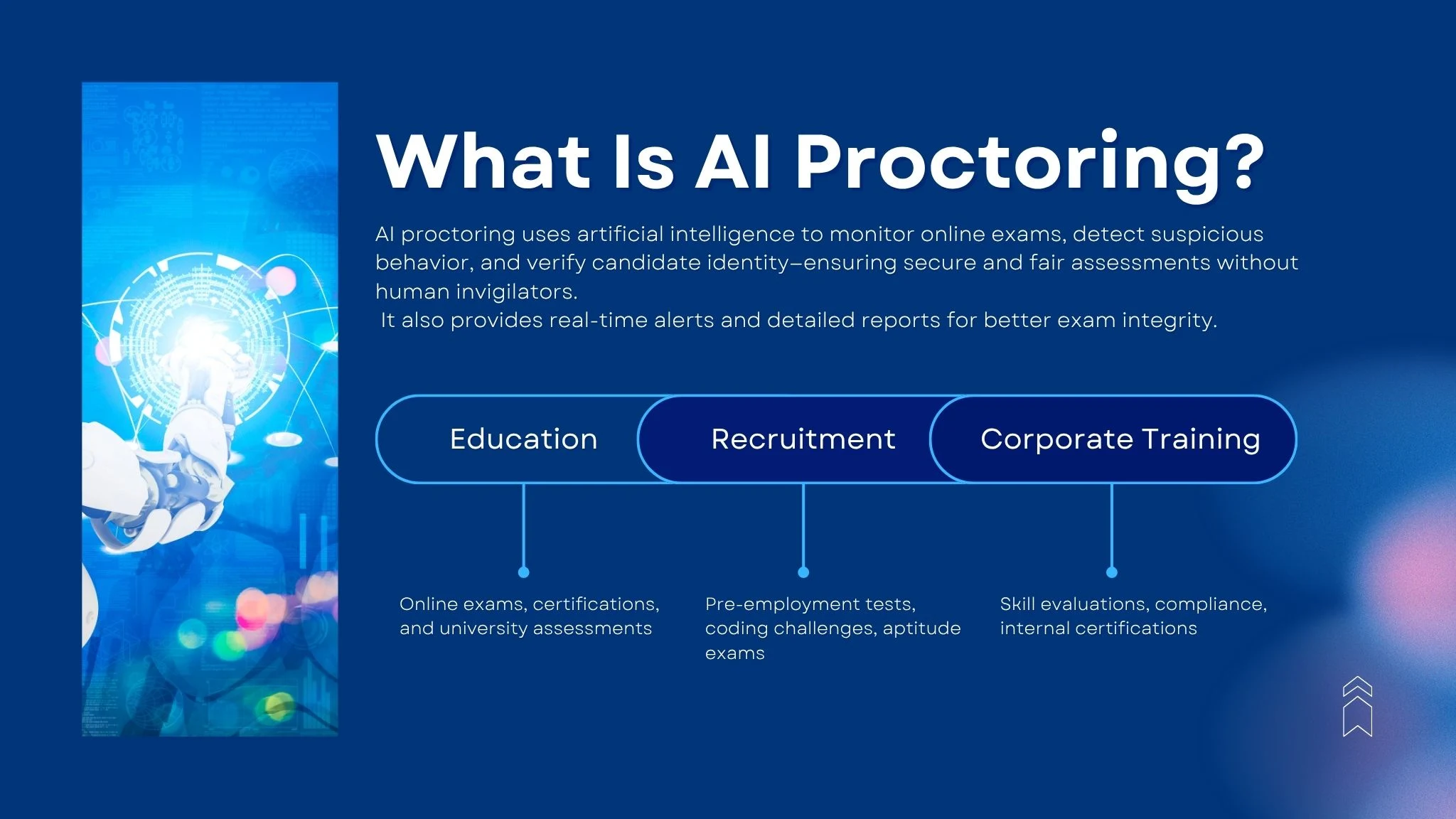
AI proctoring is an advanced technology solution designed to monitor and supervise exams remotely using artificial intelligence, machine learning, and computer vision. It ensures the integrity of assessments by detecting suspicious behavior, preventing cheating, and verifying candidate identity without the need for a full-time human invigilator.
Unlike traditional proctoring, AI proctoring can observe multiple candidates at the same time, provide real-time alerts, and generate comprehensive post-exam reports. It is suitable for a variety of settings, including:
Education: Schools, universities, and online learning platforms conducting exams or certifications
Recruitment: Pre-employment tests, coding challenges, and aptitude assessments
Corporate Training: Skill evaluations, compliance assessments, and internal certifications
AI proctoring tools like Sherlock AI combine camera monitoring, audio analysis, and screen tracking to ensure that every candidate is evaluated fairly under secure conditions. By using AI instead of solely relying on humans, organizations can scale exams globally, reduce costs, and maintain consistent standards of fairness.
In short, AI proctoring is the future of secure, reliable, and scalable assessments, making it easier for institutions and companies to maintain trust in online exams.
👉 Also Read: How Proctoring Platforms Detect and Prevent Cheating
How Does AI Proctoring Work?
AI proctoring ensures that online exams are secure, fair, and reliable by monitoring candidates continuously and analyzing their behavior using advanced technology. The process can be broken down into three main stages: before the exam, during the exam, and after the exam.
1. Before the Exam: Identity Verification and System Setup
Before the test begins, AI proctoring ensures the candidate’s identity and prepares the environment for a secure exam:
Identity Verification: Facial recognition and government-issued ID checks confirm the candidate’s identity.
Device and Environment Check: Cameras, microphones, and internet connections are tested to ensure smooth monitoring.
Exam Rules Confirmation: Candidates review and acknowledge the rules to avoid misunderstandings during the test.
These steps prevent impersonation and reduce technical issues that could affect exam integrity.
2. During the Exam: Continuous Monitoring and Behavior Analysis
While the exam is in progress, AI proctoring tools monitor multiple data points in real time:
Video Analysis: Tracks eye movement, head position, and gestures to detect suspicious activity.
Audio Analysis: Detects background noise or conversations that might indicate external assistance.
Screen Monitoring: Observes on-screen activity to prevent candidates from accessing unauthorized resources.
AI systems generate real-time alerts whenever unusual behavior is detected, allowing administrators to take immediate action. This ensures fairness while minimizing disruption to the candidate’s experience.
Also Read: For a deeper look at how these signals are used to identify potential cheating, see our guide on how proctoring platforms detect and prevent cheating.
3. After the Exam: Reporting and Data Insights
Once the assessment ends, AI proctoring produces detailed reports that include:
Flagged incidents of suspicious behavior
Candidate performance and compliance with exam rules
Insights for improving future assessments
These reports allow educators, recruiters, and HR teams to make data-driven decisions with confidence, ensuring that every exam result is reliable and trustworthy.
By combining pre-exam verification, real-time monitoring, and post-exam reporting, AI proctoring provides a complete solution for secure, scalable, and fair online assessments.
Industry Insight: 53% of remote proctoring currently uses live human monitoring, while 61% of all deployed technologies now incorporate AI-assisted features. The hybrid approach (AI flagging + human review) is becoming the industry standard. |
|---|
Benefits of AI Proctoring
AI proctoring helps organizations conduct secure, scalable, and fair online assessments by combining automated monitoring, identity verification, and suspicious behavior detection. It reduces the need for continuous human supervision while helping organizations maintain consistent assessment standards across large numbers of candidates.
Below are the key benefits of AI proctoring:
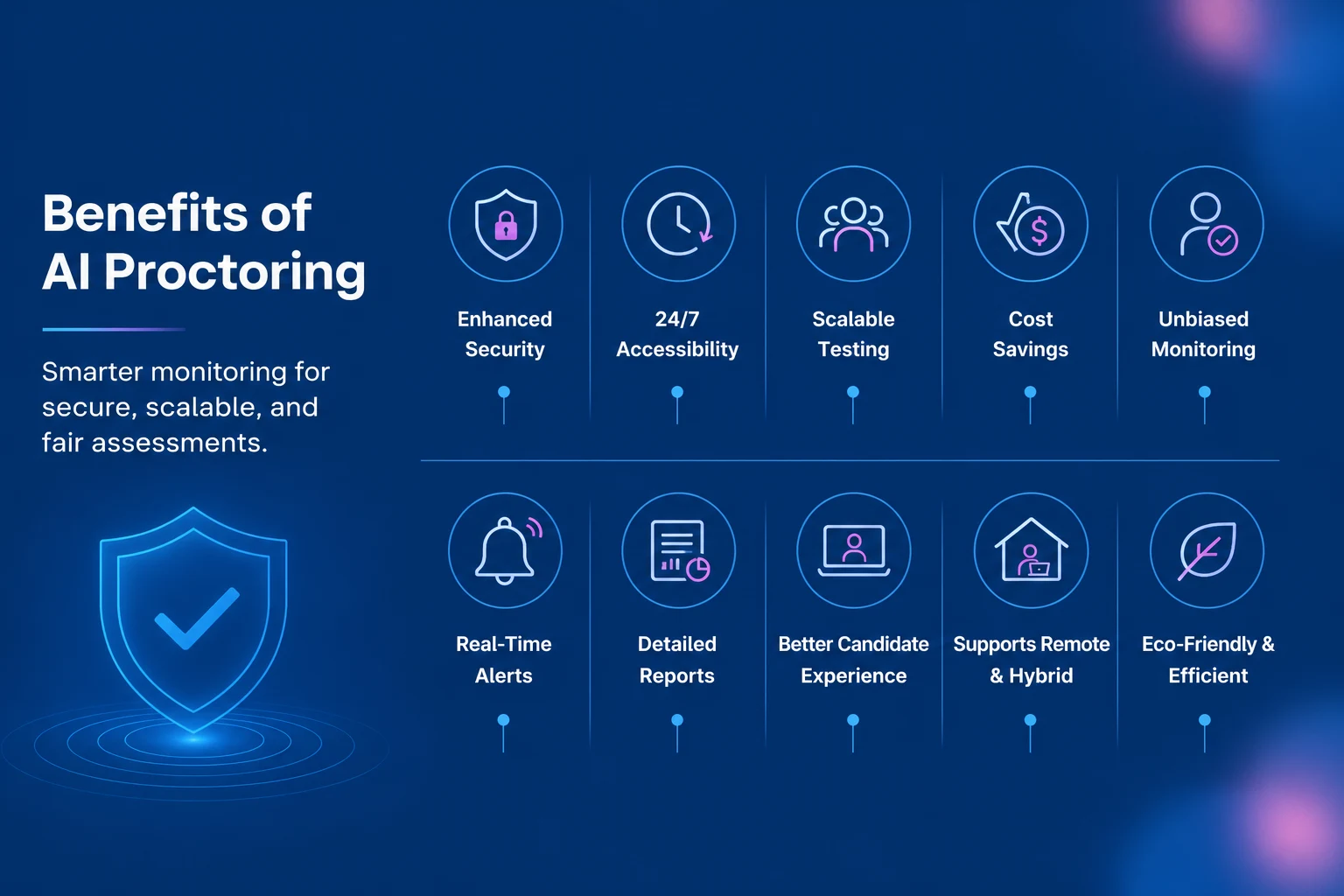
1. Enhanced Exam Security
Verifies candidate identity and helps prevent impersonation
Detects multiple people, suspicious behavior, and unauthorized objects
Monitors candidate activity to identify potential exam-rule violations
Helps maintain exam integrity and trustworthy results
2. 24/7 Accessibility and Flexibility
Enables exams anytime, anywhere
Removes geographical limitations
Ideal for remote learning and global hiring
3. Scalability for Large-Scale Testing
Monitors thousands of candidates simultaneously
Maintains performance even at high volumes
Suitable for universities and mass recruitment drives
4. Significant Cost Savings
Eliminates need for physical test centers
Reduces reliance on human invigilators
Cuts operational and logistical expenses
5. Unbiased and Consistent Monitoring
Applies the same rules to all candidates
Removes human bias and errors
Ensures fair evaluation across assessments
6. Real-Time Alerts and Quick Resolution
Instantly flags suspicious activities
Enables immediate intervention
Reduces chances of undetected cheating
7. Detailed Reports and Data-Driven Insights
Provides post-exam reports with flagged events
Includes behavioral analysis of candidates
Supports better decision-making for recruiters and educators
8. Improved Candidate Experience
Minimizes interruptions during exams
Creates a smooth and transparent process
Helps candidates focus on performance
9. Supports Remote and Hybrid Models
Enables seamless remote assessments
Works well for hybrid education and hiring setups
Supports distributed teams and learners
10. Environmentally and Operationally Efficient
Reduces paper usage and travel needs
Eliminates physical infrastructure requirements
Promotes sustainable and efficient operations
Challenges and How to Overcome Them
While AI proctoring can improve assessment security and scalability, it also comes with challenges related to accuracy, privacy, accessibility, and candidate trust. Organizations need to address these concerns carefully to ensure that AI-powered monitoring supports a fair and reliable assessment process.
Challenge | What It Means | Practical Solutions |
|---|---|---|
False Positives | AI may flag normal behaviors, such as looking away or background noise, as suspicious activity. | Use appropriate detection thresholds and human review to distinguish genuine violations from normal candidate behavior. |
Privacy Concerns | Continuous video, audio, screen monitoring, and identity verification can raise concerns about personal data and biometric information. | Clearly communicate what data is collected, obtain appropriate consent, and define how the data is stored, used, and deleted. |
Technical Requirements | AI proctoring depends on reliable internet connections, compatible devices, webcams, microphones, and suitable testing environments. | Provide clear technical requirements and system checks before the exam, along with technical support for candidates. |
Accessibility Issues | Candidates with disabilities or different testing needs may experience difficulties with automated monitoring systems. | Ensure the system supports accessibility requirements and provide appropriate accommodations or alternative assessment methods when needed. |
Algorithmic Bias | AI systems may produce inconsistent results across different candidates or misinterpret certain behaviors. | Regularly evaluate model performance, test for potential bias, and use human review when additional context is required. |
Test Anxiety | Continuous monitoring can make some candidates uncomfortable or increase stress during an assessment. | Explain how the system works before the exam, provide clear instructions, and allow candidates to complete a practice or system-check session. |
Technical Failures | Internet interruptions, browser issues, camera failures, or other technical problems can disrupt an assessment. | Conduct pre-exam system checks, provide technical support, and establish backup procedures for unexpected failures. |
Trust & Acceptance | Candidates may be concerned about surveillance, privacy, or how AI decisions are made. | Be transparent about monitoring methods, explain how flagged activity is reviewed, and clearly communicate privacy and assessment policies. |
Human Review | AI can identify potentially suspicious activity but may not understand the full context behind a candidate's behavior. | Use AI to flag and prioritize incidents, while allowing human reviewers to evaluate the context before taking action. |
By addressing these challenges proactively, organizations can unlock the full potential of AI proctoring while ensuring a fair, ethical, and reliable assessment experience.
How AI Proctoring Analyzes Candidate Behavior and Exam Environment
AI proctoring goes beyond simple monitoring. It analyzes the candidate’s behavior and surroundings using video, audio, and system data to identify potentially suspicious activity and maintain exam integrity.
1. Visual Monitoring Through Camera
AI uses the webcam to continuously analyze what is happening in front of the candidate:
Face Detection: Ensures the candidate’s face remains visible throughout the exam and can flag a missing or obstructed face.
Multiple Person Detection: Identifies when more than one person appears in the camera frame, which may indicate unauthorized assistance.
Eye and Head Movement Tracking: Analyzes gaze direction and head movements to identify unusual or prolonged attention away from the screen.
Object Detection: Detects potentially unauthorized items such as mobile phones, books, notes, or other devices.
2. Audio Analysis
AI can use the microphone to analyze sounds and voice activity during the assessment:
Voice Detection: Identifies additional voices that may indicate outside assistance.
Noise Analysis: Detects unusual sounds such as conversations, whispers, or other unexpected audio.
Microphone Monitoring: Checks whether the microphone is active and functioning as required during the exam.
3. Screen and Activity Monitoring
AI proctoring can monitor the candidate’s screen and system activity to identify potentially unauthorized actions:
Screen Tracking: Monitors on-screen activity and can detect attempts to switch tabs or access unauthorized applications, when supported.
Behavior Analysis: Analyzes actions such as copy-paste attempts and unusual activity patterns.
Browser Control: Can work with secure or lockdown browsers to restrict access to external websites and resources.
4. Identity Verification and Continuous Validation
AI helps ensure that the registered candidate is the person taking the assessment:
Pre-Exam Verification: Matches the candidate’s face with their ID or stored identity data before the exam.
Continuous Monitoring: Uses facial recognition and other signals to verify that the same candidate remains present throughout the assessment.
5. Smart Alert Classification
Instead of treating every detected event as a violation, AI proctoring can categorize alerts based on their potential severity:
High-Risk Alerts (Red Flags): Potential violations such as multiple faces or unauthorized devices.
Moderate Alerts (Suspicious Behavior): Events such as repeated gaze shifts, unusual movements, or background noise that may require additional context.
Human Review Required: AI flags potentially suspicious incidents, while human reviewers can assess the context and make the final decision to support fair evaluation.
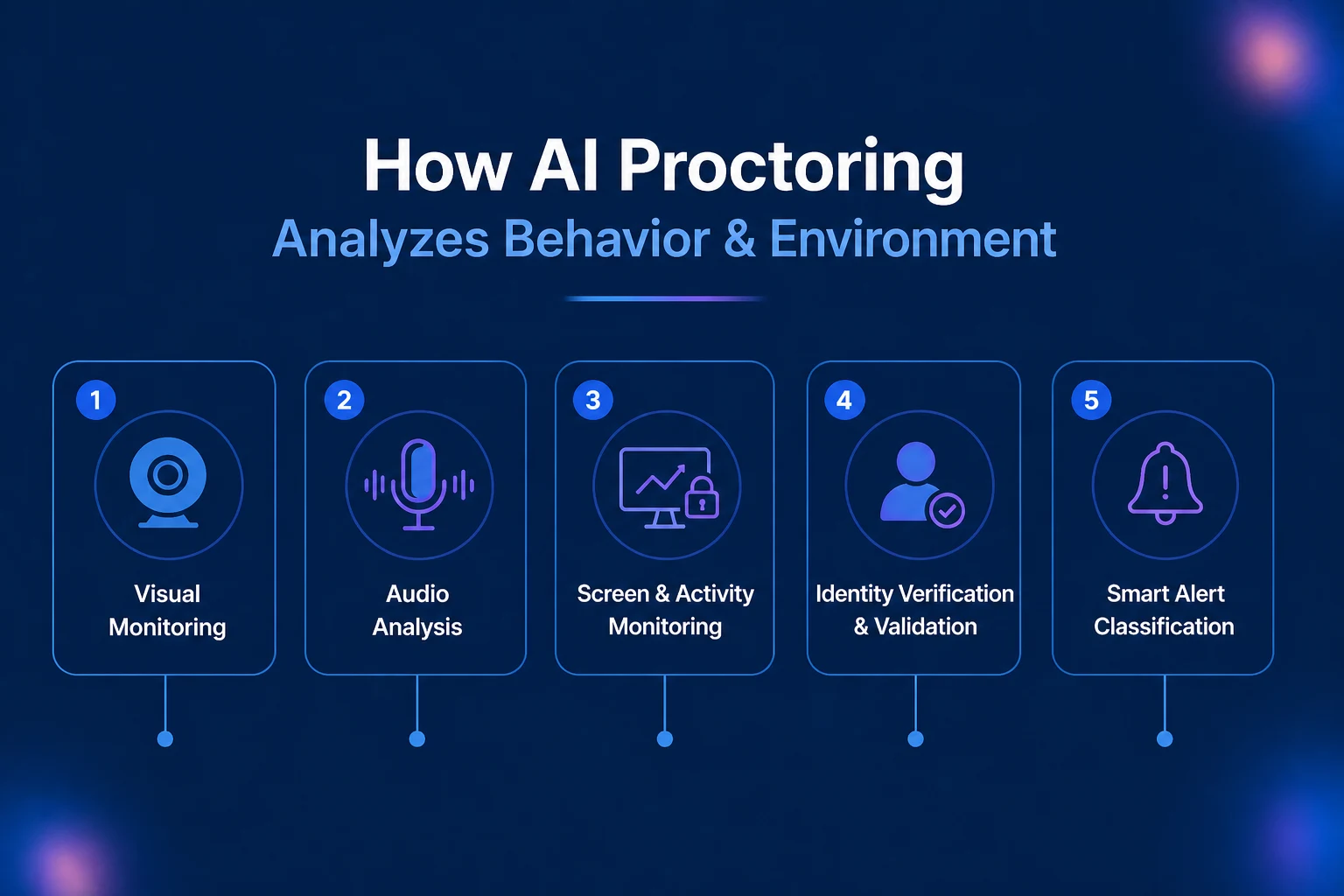
By combining visual, audio, and behavioral analysis, AI proctoring creates a controlled and trustworthy exam environment. It allows organizations to monitor exams at scale while ensuring fairness and consistency across all candidates.
Identity Verification in AI Proctoring
Identity verification is a core part of AI proctoring that helps ensure the registered candidate is the person taking the assessment from start to finish. By combining ID verification, facial recognition, and continuous monitoring, AI proctoring can help prevent impersonation and maintain trust in assessment results.
Key Components of Identity Verification
Stage | What Happens | Purpose |
|---|---|---|
Pre-Exam Verification | The candidate submits an ID and captures a face image or completes a facial verification check. | Confirms the candidate’s identity before the assessment begins. |
Identity Matching | AI compares the candidate’s face with the submitted ID or stored profile information. | Helps detect potential identity mismatches or impersonation. |
Continuous Validation | Facial recognition and other signals are used to verify that the same candidate remains present during the assessment. | Helps prevent another person from taking over the session. |
Post-Verification Flags | The system can flag events such as face mismatch, prolonged absence, or significant changes during the assessment. | Provides incidents for further review when identity-related concerns arise. |
Identity verification is most effective when combined with other proctoring signals rather than used as the sole indicator of suspicious activity. When an identity-related event is flagged, human review can provide additional context before any final decision is made.
👉 Also Read: How to Verify Candidate Identity Remotely |
|---|
Types of AI Proctoring
AI proctoring can be implemented in different ways depending on the level of automation, human involvement, and supervision required. The most common approaches include live, recorded, automated, and hybrid proctoring.
1. Live Proctoring
Monitoring Style: A human proctor supervises candidates in real time using video, audio, and screen monitoring.
Control Level: High
Best For: High-stakes exams, certifications, and regulated assessments
Key Advantage: Allows immediate human judgment and intervention when suspicious activity occurs.
2. Recorded Proctoring
Monitoring Style: The candidate's webcam, microphone, and screen activity are recorded during the assessment and reviewed afterward.
Control Level: Moderate
Best For: Exams where real-time human supervision is not required
Key Advantage: Allows suspicious events to be reviewed after the exam without requiring a proctor to monitor every candidate live.
3. Automated Proctoring
Monitoring Style: AI continuously analyzes video, audio, and screen activity to identify potentially suspicious behavior.
Control Level: Automated
Best For: Large-scale exams, recruitment assessments, and remote testing
Key Advantage: Scales across large numbers of candidates while reducing the need for continuous human supervision.
4. Hybrid Proctoring
Monitoring Style: AI monitors the assessment and flags potentially suspicious incidents, while human reviewers evaluate flagged events.
Control Level: Balanced
Best For: University exams, certifications, and medium- to high-stakes assessments
Key Advantage: Combines the scalability of AI with human judgment for more contextual and reliable review.
Looking for the right AI proctoring solution? Explore our guide to the Top 15 AI Proctoring Tools in 2026 to compare leading tools and their key features. |
|---|
AI Proctoring vs Human Proctoring
Both AI proctoring and human proctoring aim to maintain exam integrity, but they differ in how candidates are monitored, how suspicious activity is handled, and how easily assessments can scale. A hybrid approach can combine AI-powered monitoring with human review when additional context is needed.
Factor | AI Proctoring | Human Proctoring |
|---|---|---|
Monitoring Style | Automated monitoring using AI, video, audio, and screen analysis | Manual supervision by trained human proctors |
Scalability | Can monitor large numbers of candidates simultaneously | Limited by the number of available proctors |
Availability | Can operate continuously without depending on proctor schedules | Depends on proctor availability and scheduled exam times |
Consistency | Applies defined monitoring rules consistently across candidates | May vary depending on individual proctor judgment and attention |
Cost | Generally more cost-effective for large-scale assessments | Higher due to staffing and operational requirements |
Speed | Can generate automated alerts and reports quickly | Suspicious activity must be identified and documented by the proctor |
Contextual Judgment | Can identify and flag potentially suspicious patterns but may require human review | Can interpret behavior and context in real time |
Real-Time Intervention | Depends on the proctoring setup and whether human intervention is included | Can immediately communicate with or intervene with candidates |
Candidate Support | Usually limited to automated instructions and technical support systems | Human proctors can provide direct assistance during the assessment |
Best For | Large-scale exams, recruitment assessments, remote testing, and continuous monitoring | High-stakes exams where real-time human judgment and intervention are essential |
Which Proctoring Approach Should You Choose?
The right approach depends on the assessment's stakes, scale, and level of human oversight required.
Choose AI Proctoring when scalability, automated monitoring, and operational efficiency are priorities.
Choose Human Proctoring when real-time intervention and contextual judgment are essential.
Choose Hybrid Proctoring when you want AI to monitor and flag potentially suspicious activity while human reviewers evaluate incidents that require additional context.
Sherlock AI: Advanced AI Proctoring Tool
While many AI proctoring tools focus on basic candidate monitoring, Sherlock AI is designed to address modern and sophisticated forms of interview fraud. It combines behavioral analysis, identity verification, real-time detection, and comprehensive reporting to identify potentially suspicious activity and help organizations conduct secure and reliable remote interviews.
Key Features of Sherlock AI
1. Intelligent Behavior Analysis
Sherlock AI analyzes candidate behavior across multiple signals to identify patterns that may indicate suspicious activity or external assistance during an interview. Rather than relying on a single action, it considers behavioral patterns and contextual signals to help distinguish potentially concerning behavior from normal interview activity.
The system can analyze factors such as:
Gaze and Head Movements: Identifies unusual or repeated attention away from the interview screen.
Facial and Body Behavior: Monitors changes in candidate presence, positioning, and visible behavior.
Audio Signals: Detects additional voices and unusual sounds that may indicate outside assistance.
Interaction Patterns: Analyzes screen and interaction activity for potentially unauthorized behavior.
By combining multiple signals, Sherlock AI provides interviewers and hiring teams with greater context when reviewing potentially suspicious candidate behavior.
2. Detection of Advanced Interview Fraud
Interview fraud has evolved beyond traditional forms of cheating. Candidates may use AI tools, secondary devices, deepfakes, or another person to gain an unfair advantage during remote interviews.
Sherlock AI is designed to identify signals associated with sophisticated interview fraud, including:
AI-Assisted Interviewing: Identifies potential use of AI tools, real-time answer generation, or other external assistance during an interview.
Deepfake-Based Impersonation: Helps identify potential attempts to manipulate a candidate's appearance or identity using synthetic or altered video.
Proxy Candidates: Helps detect situations where someone other than the registered candidate participates in the interview.
By combining identity verification, behavioral analysis, and multiple monitoring signals, Sherlock AI helps hiring teams identify potential interview fraud that may be missed by basic webcam monitoring.
3. Real-Time Alerts and Intervention
Sherlock AI continuously monitors interview activity and identifies potentially suspicious events as they occur. Real-time alerts help interviewers and hiring teams identify incidents that may require attention without manually monitoring every signal throughout the interview.
The system can provide:
Real-Time Suspicious Activity Alerts: Flags potentially suspicious events as they occur during the interview.
Severity-Based Alerts: Helps interviewers prioritize higher-risk incidents that may require closer attention.
Timestamped Incident Tracking: Records when potentially suspicious activity occurs for easier investigation.
Human Review and Intervention: Allows interviewers or reviewers to examine flagged incidents and use additional context before making decisions.
This combination of AI monitoring and human oversight helps hiring teams respond to potential interview fraud efficiently while keeping final decisions in human hands.
4. Continuous Identity Verification
Verifying a candidate's identity only at the beginning of an interview may not be enough. Sherlock AI can continuously monitor candidate presence throughout the interview to help ensure that the person being interviewed remains the registered candidate.
The system can provide:
Continuous Face Verification: Monitors the candidate's face throughout the interview to help identify potential identity changes.
Candidate Presence Monitoring: Detects prolonged absence or situations where the candidate is no longer visible.
Identity Mismatch Alerts: Flags potential changes or inconsistencies that may require further investigation.
Ongoing Identity Validation: Combines identity signals with behavioral information to provide additional context throughout the interview.
Continuous identity verification helps reduce the risk of impersonation and supports more trustworthy remote hiring processes.
5. Comprehensive Interview Reporting
After an interview, Sherlock AI provides structured reports that help hiring teams review flagged events without having to manually analyze the entire interview session.
The system can provide:
Severity-Based Incident Reports: Organizes flagged events according to their potential level of risk.
Behavioral Timelines: Shows relevant behavioral events and when they occurred during the interview.
Evidence Snapshots: Captures relevant evidence associated with flagged incidents for easier review.
Interview Summary: Brings key monitoring events and findings together in a centralized report.
By consolidating interview activity and flagged incidents into a structured report, Sherlock AI helps hiring teams investigate potential issues more efficiently.
6. Scalable Integration for Remote Interviews
Sherlock AI is designed to support organizations conducting remote interviews across different hiring workflows and candidate volumes. Its integration capabilities allow organizations to incorporate AI-powered interview monitoring into their existing recruitment processes.
The system can provide:
Scalable Interview Monitoring: Supports remote interviews involving large numbers of candidates.
Hiring Workflow Integration: Can integrate with existing interview and recruitment workflows.
Flexible Deployment: Supports different remote interview environments and organizational requirements.
Consistent Monitoring at Scale: Applies the same monitoring approach across large candidate pools.
This allows organizations to strengthen interview integrity without completely changing their existing hiring processes.
7. Privacy-Focused and Ethical Design
Remote interview monitoring involves sensitive candidate information, making privacy, transparency, and responsible data handling important considerations. Sherlock AI emphasizes responsible monitoring practices to help organizations maintain interview security while building candidate trust.
The system can provide:
Transparent Monitoring: Helps candidates understand what is being monitored during the interview.
Consent-Based Data Collection: Supports clear communication and appropriate consent for collecting candidate data.
Secure Data Handling: Applies safeguards to help protect sensitive candidate and interview information.
Responsible AI Practices: Emphasizes fairness and appropriate human oversight when reviewing potentially suspicious activity.
By prioritizing privacy and responsible AI practices, Sherlock AI helps organizations balance interview integrity with candidate trust and data protection.
Why Choose Sherlock AI?
Choosing an AI proctoring solution for interviews is about more than simply monitoring candidates. Hiring teams need a system that can identify modern forms of interview fraud, provide useful evidence for review, and support secure remote hiring without creating unnecessary friction for candidates.
Sherlock AI brings these capabilities together through:
Advanced Interview Fraud Detection: Identifies signals associated with AI-assisted interviewing, deepfake-based impersonation, and proxy candidates.
AI-Powered Behavioral Analysis: Combines multiple monitoring signals to identify potentially suspicious behavioral patterns.
Continuous Identity Verification: Helps ensure that the verified candidate remains present throughout the interview.
Real-Time Monitoring: Provides alerts when potentially suspicious activity occurs during an interview.
Actionable Reporting: Provides structured timelines, alerts, and evidence to help hiring teams review flagged incidents efficiently.
Human Oversight: Supports human review when additional context is needed before making hiring decisions.
Privacy and Responsible Monitoring: Emphasizes transparency, consent, and secure handling of candidate information.
Whether you're conducting technical interviews, behavioral interviews, screening calls, or large-scale remote hiring, Sherlock AI helps organizations strengthen interview integrity while maintaining a scalable and consistent hiring process.
Conclusion
AI proctoring has become an important part of secure online assessments, helping organizations verify candidate identities, monitor assessment activity, and identify potentially suspicious behavior at scale.
As cheating methods continue to evolve, organizations need more than basic webcam monitoring. Combining behavioral analysis, identity verification, multiple monitoring signals, intelligent alerts, and human review can provide a more reliable approach to maintaining assessment integrity.
At the same time, effective AI proctoring should balance security with privacy, transparency, accessibility, and a positive candidate experience. When implemented responsibly, AI proctoring can help educational institutions, certification providers, and organizations conduct fair, secure, and scalable assessments.
Sherlock AI brings these capabilities together to help organizations detect modern assessment fraud while maintaining consistent and efficient online assessment processes.
Frequently Asked Questions About AI Proctoring
1. What is AI proctoring and how does it work?
AI proctoring uses artificial intelligence, computer vision, audio analysis, and activity monitoring to supervise candidates during online assessments. It can verify identity, analyze webcam and microphone signals, monitor screen activity, and flag potentially suspicious behavior for review.
2. What can AI proctoring detect during an exam?
Depending on the system, AI proctoring can detect signals such as multiple people appearing on camera, unusual gaze or head movements, additional voices, unauthorized objects, prolonged absence, suspicious screen activity, and potential identity mismatches. These signals are typically flagged for further investigation rather than treated as automatic proof of cheating.
3. Can AI proctoring detect phones or other unauthorized devices?
Yes, AI proctoring systems with object-detection capabilities can identify phones and other potentially unauthorized devices visible within the camera frame. Additional behavioral signals, such as repeatedly looking away from the screen or looking down, may provide further context for review.
4. Can AI proctoring detect ChatGPT or AI-assisted cheating?
AI proctoring can identify signals associated with potential AI-assisted cheating, including unauthorized applications, suspicious screen activity, or unusual behavioral patterns. However, detecting the use of an AI tool is not always possible through a single signal, so flagged activity may require human review and additional evidence.
5. Is AI proctoring reliable?
AI proctoring can provide consistent monitoring across large numbers of candidates, but it is not completely free from false positives or technical limitations. Factors such as camera quality, lighting, microphone performance, internet connectivity, and testing conditions can affect monitoring. Human review of flagged incidents can help improve the reliability of assessment decisions.
6. Does AI proctoring replace human proctors?
Not necessarily. AI can continuously monitor assessments, identify potentially suspicious events, and prioritize incidents for review, while human proctors or administrators can evaluate the context and make final decisions. A hybrid approach combines the scalability of AI with human judgment.
7. What are the different types of AI proctoring?
AI proctoring can be delivered through different assessment models, including automated proctoring, recorded proctoring, live proctoring supported by AI, and hybrid proctoring. The right approach depends on factors such as exam stakes, candidate volume, required human involvement, and whether real-time intervention is necessary.
8. Is AI proctoring safe for candidate privacy?
AI proctoring may involve sensitive information such as video, audio, identity documents, facial data, and screen activity. Organizations should clearly explain what data is collected, obtain appropriate consent, protect the information, limit its use to legitimate purposes, and establish clear retention and deletion policies.