Back to all blogs
Learn what AI voice spoofing is, how it works, common attack scenarios, warning signs, and ways to detect and prevent voice spoofing attacks.


Voice has long been a familiar and trusted part of phone calls, meetings, and business communication. However, advances in artificial intelligence now allow attackers to generate realistic synthetic voices that imitate real people. This has made AI voice spoofing a growing security concern for organizations that rely on voice-based communication, identity verification, and decision-making.
The threat is particularly relevant because voice is often treated as an informal form of identity verification. A finance employee may recognize an executive's voice before approving a payment, an IT employee may trust a familiar voice requesting account assistance, or a recruiter may assume that the person speaking during a remote interaction is the legitimate candidate. AI voice spoofing can exploit this trust without necessarily compromising the underlying communication system.
The scale of the broader AI-enabled fraud problem highlights the importance of addressing these threats. The FBI's 2025 Internet Crime Report recorded 22,364 complaints involving AI-related information, with reported losses of nearly $893 million. These figures cover multiple forms of AI-related cybercrime rather than voice spoofing alone. The report also identifies voice cloning as a technique that criminals can use to impersonate individuals and facilitate fraudulent payment requests.
In this guide, we explain what AI voice spoofing is, how it works, common attack scenarios, warning signs, and practical strategies organizations can use to prevent and detect these threats. The focus is on strengthening identity verification and security controls rather than relying on voice recognition alone.
What Is AI Voice Spoofing?
AI voice spoofing is the use of artificial intelligence to generate or manipulate speech to impersonate a person or misrepresent a speaker's identity. Attackers may use AI voice cloning to reproduce the voice of a specific individual or generate synthetic speech that creates the impression of a trusted person.
Unlike traditional caller ID spoofing, which manipulates the phone number displayed to a recipient, AI voice spoofing targets the voice itself. Voice cloning is one technique used in these attacks, allowing attackers to generate speech that resembles a particular person using available audio samples.
Attackers may obtain these samples from publicly available videos, voicemail messages, meeting recordings, podcasts, or other audio sources. The resulting synthetic voice can then be used to impersonate an employee, executive, customer, vendor, or business partner during a fraudulent interaction.
For organizations, the challenge is not simply determining whether a voice sounds real. The more important question is whether the speaker's identity has been independently verified and whether the requested action follows established security procedures. AI voice spoofing therefore presents risks involving synthetic media, identity fraud, social engineering, and weaknesses in authentication processes.

How Does AI Voice Spoofing Work?
AI voice spoofing typically works in five steps: attackers collect a voice sample, create an AI voice clone, generate a fraudulent message, deliver it through a communication channel, and use social engineering to persuade the target to take action.
1. Collecting Voice Samples
Attackers first obtain recordings of the person they want to impersonate. These may come from social media videos, podcasts, webinars, voicemail messages, online meetings, training recordings, or other publicly available or compromised audio sources. The FBI and Mandiant have highlighted voice recordings as potential inputs for AI-powered impersonation attacks.
2. Creating a Voice Clone
The collected audio is processed by an AI voice-cloning system that learns characteristics of the speaker's voice, including tone, pronunciation, accent, and speaking patterns. The system can then generate new speech that resembles the original speaker rather than simply replaying an existing recording.
3. Generating the Fraudulent Message
The attacker creates a message designed for a specific target or situation. For example, the generated voice could be used to make a payment request, ask for sensitive information, request an account change, or create a sense of urgency around a business decision.
4. Delivering the Spoofed Voice
The synthetic voice can be delivered through different communication channels, including phone calls, voice messages, video meetings, customer-service interactions, or other voice-enabled systems. Attackers may also combine voice spoofing with other forms of impersonation, making the interaction appear more credible.
5. Manipulating the Target Into Taking Action
The final objective is usually to exploit trust in the person's identity. An employee may approve a transaction, disclose information, share credentials, or bypass a normal verification process because the voice sounds familiar. This is why organizations should use independent verification and multiple authentication signals rather than relying on voice recognition alone.
Common AI Voice Spoofing Attack Scenarios
AI voice spoofing can be used across different organizational scenarios, depending on who is being impersonated and what action the attacker wants the target to take. These illustrative scenarios range from financial fraud and unauthorized access to social engineering and identity impersonation.
1. Executive Impersonation
An attacker may clone the voice of a CEO, CFO, or another senior executive and contact an employee with an urgent request. The message could involve transferring money, approving an invoice, sharing confidential information, or changing payment details.
FTC guidance on voice cloning warns that scammers can use cloned voices to make impersonation requests more convincing. This type of attack exploits familiarity and authority, making independent verification important for high-risk requests.
2. Vendor and Business Partner Fraud
AI voice spoofing can also be used to impersonate a trusted vendor, supplier, or business partner. An attacker may contact a finance or procurement employee and request a change to payment information, bank details, or another business instruction.
Because the caller may sound like someone the employee has previously interacted with, the request can appear legitimate. Organizations should therefore avoid treating a familiar voice as sufficient proof of identity when a request involves financial or sensitive business actions.
3. IT and Account Takeover Scams
Attackers may impersonate IT support staff or internal employees to obtain credentials, authentication information, or access to business systems. A spoofed voice can make an urgent technical request appear to come from a legitimate member of the organization's support team.
CISA notes that cybercriminals can use AI-generated audio to impersonate employees, gain access to sensitive information, or persuade organizations to take specific actions. This makes voice spoofing relevant not only to financial fraud but also to broader identity and access security.
4. Recruitment and Remote Interview Fraud
AI-generated voices can also create risks during remote hiring. An attacker could use voice manipulation to impersonate a candidate or another participant during an interview, particularly when the hiring process relies heavily on video and voice interactions.
Voice cloning may also be combined with other forms of impersonation, making it difficult to establish identity based on appearance or voice alone. Organizations can reduce this risk by combining identity verification with other authentication and interview integrity measures.
5. Customer and Financial Service Fraud
Voice spoofing can target customer-service and financial processes where employees or automated systems use voice as part of identity verification. An attacker may attempt to sound like a legitimate customer while requesting account access, changing information, or initiating a transaction.
The broader risk is that a convincing synthetic voice can create a false sense of trust. Organizations should therefore apply additional verification before approving sensitive requests, particularly when the interaction involves money, credentials, account changes, or confidential information.
Why AI Voice Spoofing Is So Dangerous?
AI voice spoofing is dangerous because it attacks one of the most basic assumptions in business communication: that a familiar voice belongs to the person it appears to represent. When synthetic speech is combined with personal information, urgency, and a believable scenario, employees may be persuaded to take actions they would normally question.

1. Loss of Trust in Voice-Based Verification
Organizations have traditionally used voice familiarity as an informal identity signal. Employees may recognize a manager, executive, customer, or vendor by their voice and feel confident that they are communicating with the correct person.
AI voice spoofing weakens this assumption. Organizations should therefore treat voice recognition as one signal rather than complete proof of identity, particularly when the conversation involves payments, credentials, confidential information, or changes to access.
2. Financial Losses
Financial fraud is one of the most direct risks associated with AI-generated voices. Attackers can impersonate executives or business partners and create urgent requests involving payments, invoices, wire transfers, or changes to financial information.
3. Credential and Data Theft
AI voice spoofing can also support attempts to obtain passwords, authentication information, confidential documents, or access to business systems. An attacker may impersonate an IT employee or manager and claim that immediate action is required to resolve an account or security issue.
Microsoft's 2025 Digital Defense Report highlights how AI-generated impersonation can lead to the disclosure of sensitive information, unauthorized password resets, or changes to two-factor authentication. This demonstrates that the threat is not limited to financial fraud and can also affect identity and access security.
4. Social Engineering at Scale
AI allows attackers to create more personalized impersonation attempts using information gathered about their targets. A threat actor can combine publicly available information about an employee's role, colleagues, responsibilities, and communication patterns with a synthetic voice to construct a convincing scenario.
Research from Mandiant demonstrated this risk through a red-team exercise in which an AI-generated voice was used to impersonate an employee's superior. The exercise showed how attackers could combine voice spoofing, employee information, caller ID spoofing, and a convincing pretext to persuade a target to bypass security controls.
5. Difficulty Detecting Synthetic Voices
Another major concern is that synthetic voices can sound sufficiently natural that listeners may struggle to identify them simply by hearing them. ENISA's threat research notes that generative AI has improved the quality of synthetic audio and that AI-generated audio can become difficult to distinguish from authentic material.
For organizations, this means prevention should not depend entirely on an employee's ability to recognize whether a voice sounds genuine. Sensitive requests should be supported by independent verification, authorization procedures, and additional authentication signals. The key question should be whether the request has been properly verified, rather than simply whether the voice sounds familiar.
Who Is Most at Risk of AI Voice Spoofing?
AI voice spoofing can affect almost any organization that relies on voice communication, but some industries and business functions face greater exposure because they regularly handle financial transactions, sensitive information, customer identities, or privileged system access.
1. Financial and Banking Teams
Banks, financial institutions, and corporate finance departments can be attractive targets because employees routinely handle payments, account changes, financial approvals, and sensitive customer information. A convincing impersonation can be used to create urgency around a transaction, request a change to payment instructions, or pressure an employee into approving an unusual financial activity.
2. Customer Service and Contact Centers
Customer-service teams communicate with large numbers of people by phone, making voice an important part of everyday interactions and, in some cases, identity verification. Attackers may attempt to impersonate customers, employees, or supervisors to obtain account information or bypass established procedures. Organizations can reduce this risk by combining voice interactions with additional authentication and account-level verification.
3. Healthcare Organizations
Healthcare organizations regularly communicate with patients, healthcare professionals, pharmacies, insurers, and other service providers, often while handling highly sensitive personal information. A spoofed voice could be used to impersonate a patient, employee, or healthcare professional and request access to records, prescriptions, payments, or other protected information. Additional verification is particularly important when a voice-based request involves sensitive patient or system data.
4. IT and Security Teams
IT and security teams can be attractive targets because they often have access to credentials, administrative tools, business systems, and sensitive infrastructure. An attacker could impersonate an employee or manager and claim that an account needs to be reset, a security issue requires immediate attention, or privileged access must be granted. Requests involving password resets, authentication changes, or administrative access should therefore be independently verified before action is taken.
5. Recruiters and Remote Hiring Teams
Recruiters and hiring managers can also face AI voice spoofing risks as remote recruitment becomes more common. Candidates may complete interviews entirely online, making voice and video important parts of the interaction. An attacker could use synthetic audio as part of an attempt to impersonate another person during the hiring process, particularly when identity verification is limited. This makes stronger candidate verification important for roles involving sensitive information, privileged system access, or financial responsibilities.
AI Voice Spoofing Red Flags to Watch For
AI voice spoofing can be difficult to identify from audio quality alone, so organizations should look for inconsistencies in the request, context, behavior, and communication channel. NIST notes that synthetic-audio detection performance can vary considerably depending on the generation method, dataset, preprocessing, and real-world audio conditions, which reinforces the need for multiple verification signals rather than relying on a single detection method.
1. Unexpected Urgent Requests
An unexpected request that demands immediate action should receive additional scrutiny, particularly when it involves money, credentials, confidential information, or access to systems.
The caller creates pressure to act immediately.
The request bypasses the normal approval process.
The person discourages independent verification.
The request involves an unusual payment, account change, or access request.
2. Changes in Normal Speaking Patterns
Although these signs are not reliable proof of voice spoofing, there may be subtle inconsistencies in the way the conversation is delivered. Employees should pay attention to unusual pauses, unnatural responses, inconsistent conversational flow, or answers that do not match the context.
Unusual pauses or response timing.
Repetitive or unnatural phrasing.
Difficulty responding to unexpected questions.
Responses that do not match the person's usual communication style.
3. Requests to Bypass Security Procedures
A legitimate employee or business partner should generally be able to follow established verification and authorization procedures. A request to skip those controls can be a stronger warning sign than the quality of the voice itself.
Requests to skip multi-factor authentication.
Pressure to avoid a callback or secondary confirmation.
Requests for passwords, verification codes, or access credentials.
Instructions to use an unfamiliar payment or communication channel.
4. Mismatch Between the Voice and the Situation
Context can provide important clues when assessing a suspicious call. A familiar voice may still be associated with an unexpected request, unfamiliar phone number, or situation that does not fit the person's normal responsibilities.
The caller contacts the employee through an unusual channel.
The request does not match the person's normal role.
The timing of the request is unusual.
The caller provides an explanation for why standard procedures cannot be followed.
5. Difficulty Verifying the Person Independently
The strongest warning sign can be the inability or unwillingness to verify the caller through another trusted channel. If the request is sensitive, employees should independently contact the person using previously known contact information rather than relying on details supplied during the suspicious interaction.
End the conversation if necessary and call the person back using a trusted number.
Confirm sensitive requests with another authorized employee.
Use established approval workflows for financial or access-related actions.
Record and report suspicious interactions according to the organization's incident-response process.
How to Protect Your Organization From AI Voice Spoofing
Protecting an organization from AI voice spoofing requires more than identifying whether a voice sounds artificial. A stronger security approach combines employee awareness, independent verification, authentication controls, monitoring, and incident-response procedures. Organizations should establish workflows that prevent a single voice interaction from authorizing high-risk actions.
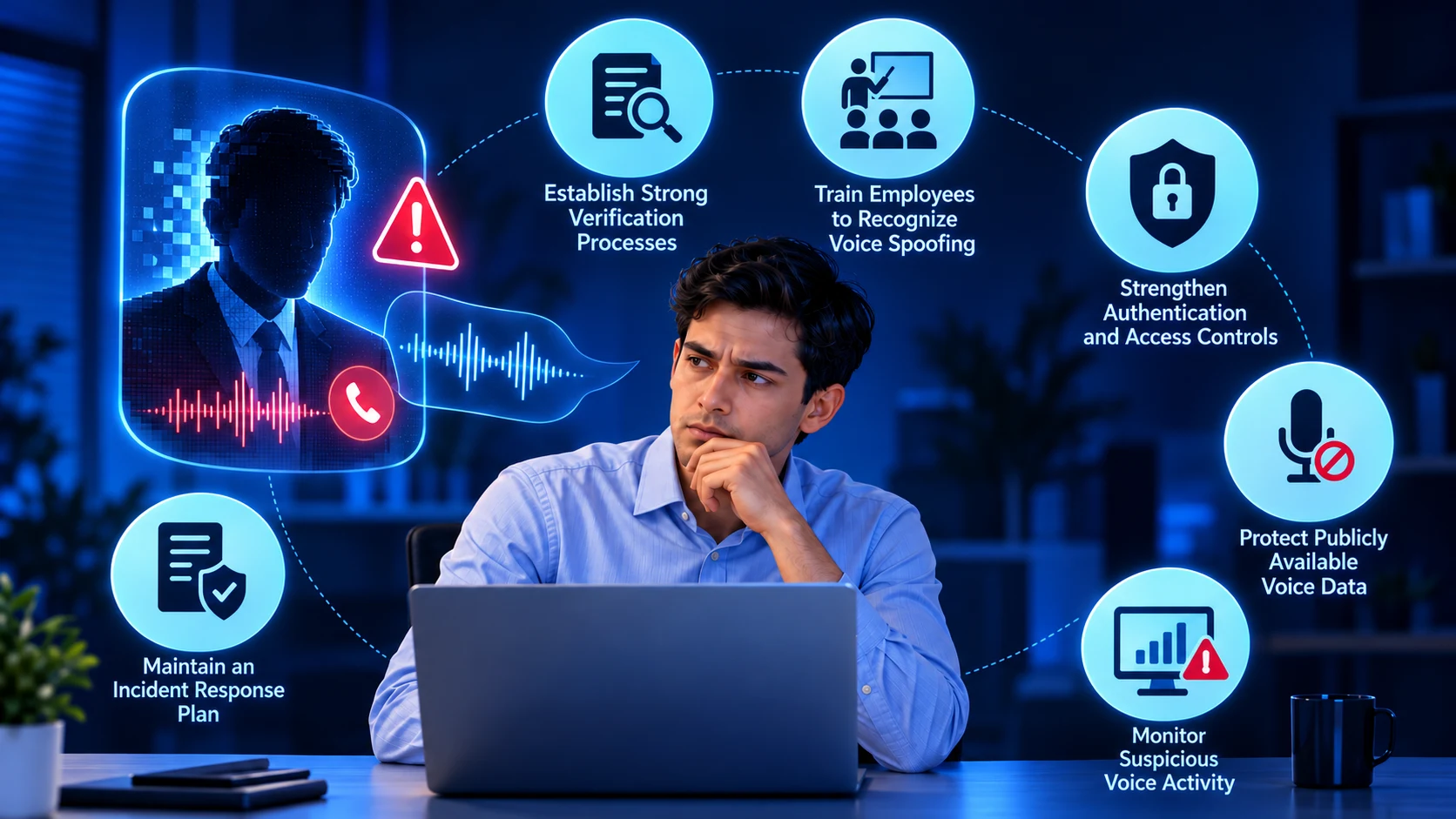
1. Establish Strong Verification Processes
Organizations should establish clear verification procedures for requests involving payments, credentials, confidential information, account changes, or privileged access. Employees should independently confirm sensitive requests rather than relying on a familiar voice.
Key measures include:
Independent callbacks: Verify unexpected requests using previously established phone numbers or trusted communication channels.
Secondary approvals: Require additional authorization for high-value transactions and sensitive account changes.
Standard verification procedures: Follow established approval processes, even when requests appear urgent.
Identity confirmation: Independently verify the person making the request before taking sensitive actions.
2. Train Employees to Recognize Voice Spoofing
Employee awareness is an important defense against AI voice spoofing because these attacks often rely on social engineering. Training should help employees recognize suspicious situations and understand why a familiar voice does not necessarily confirm someone's identity.
Organizations should focus on:
Recognizing impersonation attempts: Explain how attackers imitate executives, vendors, customers, and IT personnel.
Identifying suspicious requests: Train employees to recognize unusual urgency, authority pressure, and requests to bypass procedures.
Practicing realistic scenarios: Conduct security-awareness sessions and simulated voice-based social-engineering exercises.
Encouraging incident reporting: Make it easy for employees to question unusual requests and report suspected impersonation.
3. Strengthen Authentication and Access Controls
Organizations should avoid using voice as the sole authentication factor for sensitive systems, transactions, or account recovery. Strong authentication and access controls can limit the impact of successful impersonation attempts.
Important security measures include:
Multi-factor authentication (MFA): Require additional authentication for sensitive accounts and systems.
Role-based access controls: Grant access according to employees' responsibilities.
Least-privilege access: Limit permissions to what employees need to perform their duties.
Additional verification: Apply stronger checks to password resets, privileged-access changes, and authentication updates.
Regular access reviews: Periodically review permissions and remove unnecessary access.
4. Protect Publicly Available Voice Data
Attackers may collect voice samples from videos, webinars, podcasts, interviews, social-media posts, and recorded meetings. Organizations should review how employee and executive recordings are stored, shared, and published.
Recommended practices include:
Review public recordings: Identify unnecessary exposure of employee and executive voice recordings.
Restrict internal recordings: Limit access to meeting recordings and other sensitive audio materials.
Establish recording policies: Define appropriate procedures for recording, storing, sharing, and publishing employee media.
Control information sharing: Avoid making sensitive meeting recordings broadly accessible without a legitimate business reason.
Reducing unnecessary voice-data exposure does not eliminate spoofing risks, but it can limit the material available for potential misuse.
5. Monitor Suspicious Voice Activity
AI voice spoofing attempts may not always be identifiable through audio analysis alone. Organizations should monitor unusual activities associated with voice interactions, particularly when they involve financial transactions, account changes, or access requests.
Monitoring should focus on:
Unusual transactions: Identify unexpected payments, financial changes, or account activity following voice interactions.
Suspicious access requests: Review unusual authentication attempts, password resets, and privileged-access changes.
Employee reports: Provide a simple process for reporting suspected voice impersonation.
Incident information: Record relevant details such as timestamps, caller information, communication channels, and requested actions.
Combined security signals: Review communication, identity, access, and transaction activity together to identify potential fraud.
6. Maintain an Incident Response Plan
Organizations should prepare for situations where AI voice spoofing attempts reach employees despite preventive controls. A defined incident-response plan helps teams respond quickly, investigate suspicious interactions, and reduce potential damage.
An effective response plan should include:
Clear reporting channels: Define how employees should report suspected impersonation attempts.
Incident escalation: Identify responsible security teams and procedures for handling suspicious requests.
Immediate containment: Review and secure potentially affected accounts, credentials, transactions, and access permissions.
Evidence preservation: Retain relevant call details, recordings, messages, and transaction records for investigation.
Post-incident improvements: Review weaknesses in verification processes and update employee training, authentication controls, and approval procedures.
Regularly reviewing and updating the incident-response plan helps organizations strengthen their defenses against future AI voice spoofing attacks.
How Can Organizations Detect AI Voice Spoofing?
Detecting AI voice spoofing should not depend on whether an employee can hear something unusual in a conversation. A stronger approach combines technical detection with identity verification, behavioral analysis, and contextual checks. Organizations can use multiple signals to determine whether a voice interaction is genuine before allowing sensitive actions to proceed.
1. Voice Authentication and Speaker Verification
Voice authentication systems can analyze characteristics of a speaker's voice and compare them against an enrolled voice profile. These systems can provide an additional identity signal by assessing whether the current speaker matches the expected individual, but they do not independently establish that the audio is authentic or live. However, organizations should avoid treating voice matching as definitive proof of identity because synthetic voices can be designed to imitate legitimate speakers.
2. AI-Based Deepfake Audio Detection
AI-based detection tools can analyze audio for characteristics associated with synthetic or manipulated speech. These systems may examine acoustic patterns, speech artifacts, inconsistencies in voice characteristics, and other signals that can be difficult for human listeners to identify. Detection technology can therefore provide an additional layer of analysis when an organization suspects that audio has been manipulated, although results are not conclusive and performance can vary with the audio and generation method.
3. Voice Liveness Detection
Voice liveness detection attempts to determine whether the audio originates from a genuine, live speaker rather than a replayed or artificially generated recording. These systems can analyze characteristics of the audio interaction to distinguish live speech from recorded or synthetic inputs. However, detecting live or non-replayed audio does not, by itself, establish the speaker’s identity, and effectiveness against synthetic speech varies by system.
4. Behavioral Analysis
The behavior surrounding a voice interaction can provide important clues about whether the interaction is legitimate. Organizations can examine whether the request matches the person's normal responsibilities, communication patterns, transaction history, or access behavior. A familiar voice making an unusual request, communicating at an unusual time, or behaving differently from the expected pattern should therefore receive additional scrutiny, even when the audio itself does not appear suspicious.
5. Identity and Context Verification
Organizations can also validate the context surrounding a voice interaction rather than relying on the voice alone. This can include checking whether the caller's identity, role, location, communication history, and stated purpose are consistent with the surrounding circumstances. A request that appears inconsistent with the person's usual activities or with information available through trusted systems can indicate that the voice interaction requires further investigation.
6. Post-Interaction Monitoring
Detection should not necessarily stop when a voice interaction ends. Organizations can monitor subsequent account activity, transactions, access requests, and authentication changes for unusual behavior that may indicate an earlier impersonation attempt. Combining these signals can help security teams identify suspicious activity even when the synthetic voice itself is difficult to detect.
Best Practices to Prevent AI Voice Spoofing Attacks
Use this checklist alongside the protection measures described above:
Use multi-factor authentication for sensitive systems and privileged access.
Create independent callback procedures using previously verified contact details.
Establish approval controls for high-risk actions, including payment changes and account recovery.
Limit unnecessary exposure of employee voice recordings and restrict access to internal recordings.
Train employees to verify unusual voice requests rather than relying on familiarity.
Regularly test and update security procedures through realistic, authorized exercises.
What to Do After an AI Voice Spoofing Attack?
An AI voice spoofing attempt should be treated as a security incident, even if the attacker does not successfully obtain money, credentials, or sensitive information. A structured response can help organizations contain potential damage, determine how the impersonation attempt occurred, and strengthen weak points in their verification process. The Australian Cyber Security Centre advises reporting suspected workplace social-engineering attempts to IT or cybersecurity teams and preserving relevant messages for investigation.
1. Stop and Verify the Request
Employees should stop the requested action as soon as they suspect that a voice interaction may be fraudulent. Instead of continuing the conversation or using contact information supplied by the caller, the employee should independently contact the supposed sender through a previously trusted channel. The Australian Cyber Security Centre also recommends contacting individuals directly through trusted methods when impersonation is suspected.
2. Secure Potentially Affected Accounts
If the interaction involved credentials, authentication codes, account information, or privileged access, security teams should immediately review the potentially affected accounts and take appropriate protective measures. Depending on the incident, this may include resetting credentials, reviewing authentication activity, restricting access, or temporarily suspending compromised accounts while the investigation takes place.
3. Review Financial and Business Activity
If the spoofing attempt involved payments, invoices, banking information, or other financial instructions, the organization should immediately review related transactions and approval records. Any suspicious transaction should be escalated immediately through the organization’s financial-fraud process, including contacting the bank or payment provider promptly to request a recall or freeze where possible.
4. Preserve Evidence From the Interaction
Organizations should preserve relevant information rather than deleting suspicious messages or recordings after the incident. Call details, timestamps, phone numbers, voice messages, meeting records, screenshots, transaction information, and employee reports can help security teams understand how the attack was conducted and whether other employees may have been targeted.
5. Update Verification Procedures
An attempted attack can reveal weaknesses in existing business processes. Organizations should review how the request was handled, identify which verification step failed or was missing, and update procedures accordingly.
6. Report and Learn From the Incident
Suspected AI voice spoofing should be reported through the organization's established security or incident-response channels so that similar attempts can be identified across the business. Security teams can use the incident to update employee training, improve verification workflows, strengthen authentication requirements, and identify other areas where attackers could exploit trust in voice communication.
Common AI Voice Spoofing Security Mistakes
Organizations can reduce their exposure to AI voice spoofing by recognizing where traditional security assumptions fall short. The following mistakes are particularly important because they can allow a convincing voice impersonation to bypass otherwise effective security controls.
Common Mistake | Why It Creates Risk | What Organizations Should Do |
|---|---|---|
Relying on voice recognition alone | Employees may assume that a familiar voice automatically confirms someone's identity. | Treat voice as one verification signal and require additional authentication for sensitive requests. |
Depending entirely on detection tools | Detection systems may not identify every synthetic or manipulated audio sample, especially as generation techniques evolve. | Combine detection technology with authentication, behavioral analysis, and independent verification. |
Ignoring social engineering | Attackers can combine synthetic voices with urgency, authority, and personal information to influence employees. | Include AI voice spoofing scenarios in security awareness training and simulations. |
Allowing sensitive actions through one channel | A single phone call or voice message could potentially be enough to trigger a payment, password reset, or account change. | Require secondary confirmation for financial, identity, and privileged-access requests. |
Failing to update security procedures | Static policies can become less effective as voice-generation and impersonation techniques change. | Regularly review procedures, test employee responses, and update controls based on emerging threats. |
The central issue is that AI voice spoofing is not only a technology problem. It is also an identity, authorization, and human-behavior problem. Organizations that combine technical controls with strong verification procedures are better positioned to prevent a convincing voice from becoming an unauthorized business action.
Conclusion
AI voice spoofing has changed the way organizations need to think about voice-based trust. A familiar voice can no longer be treated as reliable proof of identity, particularly when attackers can use AI to create convincing synthetic speech and combine it with social engineering. From financial requests and account access attempts to recruitment fraud and executive impersonation, the potential impact can extend beyond a single fraudulent interaction.
A stronger approach is to build security around verification rather than familiarity. Organizations should combine independent identity checks, multi-factor authentication, approval controls, employee awareness, monitoring, and appropriate detection technologies. High-risk requests should receive additional verification regardless of how authentic the speaker sounds.
As AI-generated voices become more realistic and accessible, organizations will need to continuously review how they authenticate people across phone calls, online meetings, and other communication channels. Preparing employees, strengthening verification workflows, and treating voice as only one part of identity verification can help organizations reduce the risk of AI voice spoofing and protect sensitive information, systems, and business operations.