Back to all blogs
Learn how to detect, prevent, and measure AI recruitment fraud using identity verification, deepfake detection, behavioral analysis, and AI-powered hiring security.

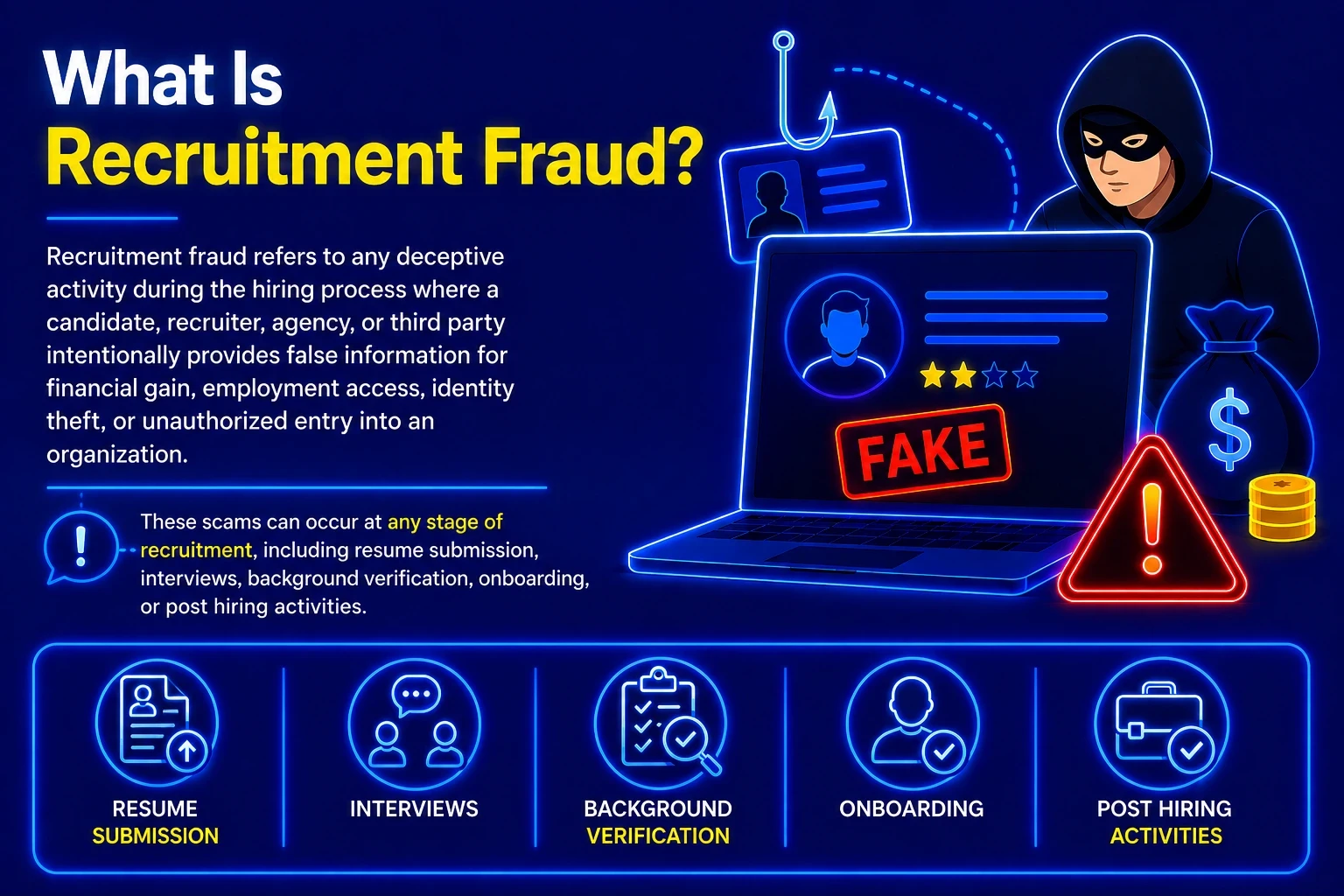
Artificial intelligence is transforming recruitment, helping organizations automate sourcing, screening, and candidate engagement. However, the rapid adoption of AI has also created a new challenge for employers: AI recruitment fraud. Candidates can now use generative AI, deepfake technology, voice cloning, and synthetic identities to manipulate hiring processes, making it increasingly difficult for recruiters to distinguish genuine applicants from fraudulent ones.
What makes AI recruitment fraud particularly concerning is its scale. According to a 2025 survey reported by NextShark, 72% of recruiters have encountered AI-generated resumes, deepfake interview attempts, face-swapping technology, or other forms of AI-assisted deception during the hiring process. The survey also found that recruiters are increasingly seeing fabricated references, fake portfolios, and counterfeit credentials submitted by candidates.
Real-world incidents further illustrate the growing threat. Security researchers uncovered a large-scale operation involving nearly 167,000 job applications submitted using stolen identities, AI-generated resumes, and AI-assisted interview techniques. The campaign reportedly led to more than 21,000 interviews and dozens of successful job placements, exposing how sophisticated AI recruitment fraud has become.
As AI-powered deception continues to evolve, traditional hiring methods such as resume screening and standard video interviews are no longer sufficient. Organizations need stronger identity verification, behavioral analysis, interview integrity checks, and AI-powered fraud detection to protect hiring outcomes and maintain trust in the recruitment process.
Why AI Recruitment Fraud Is Increasing
Several factors are contributing to the rise of AI-powered hiring deception:
Widespread Access to AI Tools
Generative AI platforms can create professional resumes, cover letters, portfolios, and interview responses within seconds. While many job seekers use these tools responsibly, others exploit them to fabricate qualifications, exaggerate achievements, or conceal skill gaps.
Expansion of Remote Hiring
Remote recruitment has enabled companies to access global talent pools, but it has also reduced opportunities for in-person verification. Virtual interviews create new opportunities for impersonation, deepfake usage, and proxy interviewing.
Pressure to Stand Out in Competitive Job Markets
As competition for remote and high-paying roles increases, some candidates resort to unethical methods to gain an advantage. AI-generated content makes it easier to create applications that appear highly qualified even when the underlying skills or experience do not exist.
The Business Impact of Recruitment Fraud
Hiring a fraudulent candidate can create significant risks for organizations. Beyond the direct costs of a bad hire, companies may face productivity losses, security concerns, compliance issues, and reputational damage. In sensitive roles, fraudulent candidates may gain access to confidential systems, customer data, or intellectual property before their deception is discovered.
The challenge is compounded by the fact that traditional hiring methods were not designed to identify AI-assisted fraud. Resume screening, reference checks, and standard video interviews often fail to detect sophisticated manipulation techniques.
As AI technology continues to evolve, organizations must rethink how they validate candidate identity, verify qualifications, and assess authenticity throughout the recruitment process. Understanding the reality of AI recruitment fraud is the first step toward building a more secure and trustworthy hiring strategy.
Industries most targeted in Recruitment fraud
Technology roles were named by 65% of recruiters as most vulnerable to AI-driven fraud, followed by marketing at 49%, creative and design at 47% and finance at 42%. Government jobs were flagged in 21% of cases, healthcare in 19% and education in 15%. Larger companies with more than 250 staff were seen as particularly exposed, though 35% of respondents said organizations of all sizes face the problem.
Source: NextShark
How to Detect AI Recruitment Fraud Effectively
As AI-powered deception becomes more sophisticated, recruiters can no longer rely solely on traditional screening methods. Identifying fraudulent candidates requires a combination of technology, structured hiring processes, and human judgment. Organizations that implement multiple verification layers are better equipped to spot inconsistencies before a hiring decision is made.
1. Interview Technique Modifications
Structured interviews can help recruiters identify signs of AI-assisted responses and candidate impersonation. Asking follow-up questions based on previous answers often reveals whether a candidate genuinely understands the subject matter or is relying on external assistance.
Behavioral and situational questions can also provide deeper insights into a candidate’s real-world experience. When candidates are required to explain their decision-making process, discuss project challenges, or describe specific outcomes in detail, it becomes more difficult to rely on AI-generated responses.
Additional techniques include:
Asking candidates to elaborate on resume claims
Using role-specific problem-solving exercises
Requesting real-time demonstrations of technical skills
Conducting multiple interview rounds with different stakeholders
These interview modifications help recruiters move beyond rehearsed answers and assess whether candidates possess the knowledge and experience they claim to have.
Example: A candidate claims to have managed a large-scale cloud migration project on their resume. During the interview, the recruiter asks follow-up questions about the migration strategy, key challenges, and outcomes. The candidate struggles to provide specific details, raising concerns about the authenticity of their experience.
2. Technical Fraud Detection Methods
Technology plays a critical role in detecting AI recruitment fraud. Modern fraud detection solutions like Sherlock AI can analyze candidate behavior, verify identities, and identify signs of manipulation throughout the hiring process.
Common technical detection methods include:
Identity verification and government ID validation
Facial matching and liveness detection
Deepfake and face-swapping detection
Voice verification during virtual interviews
Browser and device integrity checks
Monitoring for unusual candidate behavior patterns
These technologies help organizations verify that the individual participating in the hiring process is the same person who submitted the application.
Example: During a virtual interview, a candidate’s facial movements appear unnatural and out of sync with their speech. A deepfake detection system flags the session for further review, helping recruiters identify a potential impersonation attempt before proceeding with the hiring process.
3. Process-Based Prevention Strategies
Strong hiring processes remain one of the most effective defenses against recruitment fraud. Organizations should establish clear verification procedures at every stage of the recruitment journey.
Best practices include:
Validating employment history and educational credentials
Conducting reference checks with verified contacts
Implementing candidate identity checks before interviews
Requiring skill assessments relevant to the role
Maintaining documented hiring policies and fraud response procedures
Combining these practices with AI-powered fraud detection tools creates a layered approach that significantly reduces the risk of fraudulent hires.
Example: A candidate claims to hold an advanced cybersecurity certification and several years of experience at a leading technology company. During background verification, the certification authority cannot verify the credential, and the former employer confirms that the candidate never worked there. The discrepancy helps the organization avoid a potentially costly hiring mistake.
4. Behavioral Pattern Analysis
Behavioral analysis focuses on identifying unusual actions or inconsistencies that may indicate AI assistance, proxy interviewing, or identity fraud. Recruiters can evaluate communication patterns, response timing, eye movements, and interaction behavior throughout the hiring process.
Indicators may include:
Consistently delayed responses to technical questions
Frequent eye movement away from the camera
Sudden changes in communication style
Overly polished answers that lack depth
Inconsistencies between interview rounds
Behavioral analysis helps recruiters identify signs of external assistance that may not be visible through traditional screening methods.
Example: During multiple interview rounds, a candidate provides highly detailed technical answers but takes unusually long pauses before responding. Recruiters later discover that the candidate was using an AI-powered interview assistant to generate responses in real time.
No single method can eliminate recruitment fraud entirely. However, organizations that combine structured interviews, advanced verification technologies, behavioral analysis, and robust hiring processes are far more likely to identify suspicious activity before it leads to a costly hiring mistake.
5. Skills Validation and Practical Assessments
Practical assessments provide direct evidence of a candidate’s capabilities and help verify whether they possess the skills listed on their resume. Unlike traditional interviews, hands-on exercises require candidates to demonstrate their knowledge in real-world scenarios, making it harder to rely on AI-generated answers or exaggerated credentials.
Effective assessment methods include:
Live coding challenges
Case study evaluations
Job simulations
Technical presentations
Collaborative problem-solving exercises
These assessments help recruiters evaluate genuine competency rather than relying solely on self-reported experience.
Example: A software developer claims extensive experience with Python and machine learning. During a live coding exercise, they struggle to solve fundamental programming tasks, revealing a gap between their stated qualifications and actual skill level.
6. Continuous Verification Throughout the Hiring Process
Fraud detection should not be limited to a single stage of recruitment. Continuous verification ensures candidate authenticity from application submission through onboarding. Multiple validation checkpoints make it more difficult for fraudsters to bypass hiring controls.
This may include:
Identity verification before interviews
Credential checks during candidate evaluation
Reference validation before offer issuance
Final identity confirmation before onboarding
Access verification before granting system permissions
Continuous verification creates a layered defense that helps organizations detect inconsistencies before a candidate is officially hired.
Checkr’s 2025 Hiring Hoax Survey of 3,000 hiring managers reinforces the scale: 31% reported they had personally interviewed a candidate with a fake identity. Only 19% said they were “extremely confident” their hiring process could detect fraud.
Example: A candidate successfully passes resume screening and interview rounds. However, during a final identity verification check before onboarding, recruiters discover that the individual attending the interviews differs from the person who originally submitted the application, preventing an impersonation-based hiring fraud attempt.
How to Prevent AI Recruitment Fraud Effectively
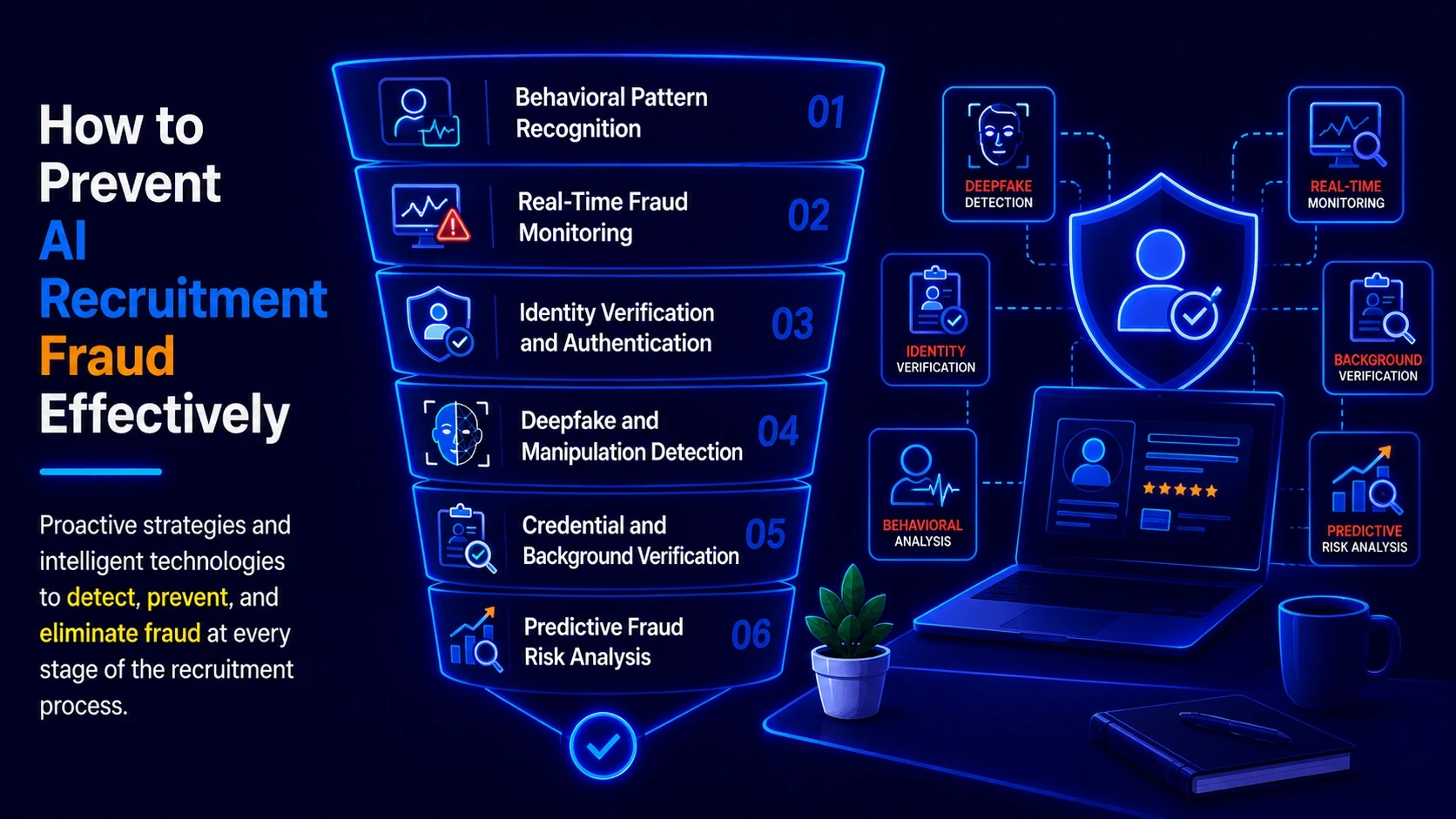
As AI recruitment fraud becomes more sophisticated, organizations need stronger safeguards than traditional screening methods alone. Artificial intelligence can help recruiters identify suspicious activity, verify candidate authenticity, and strengthen hiring integrity throughout the recruitment process. By analyzing large volumes of data and detecting patterns that may be difficult for humans to spot, AI provides an additional layer of protection against fraudulent candidates.
1. Behavioral Pattern Recognition
AI can analyze candidate behavior during interviews and assessments to identify unusual patterns that may indicate fraud. These systems evaluate factors such as response timing, communication consistency, facial movements, eye gaze, and interaction behavior.
Common behavioral indicators include:
Unusual response delays
Repetitive or scripted answers
Inconsistent communication patterns
Frequent eye movement away from the screen
Behavioral changes across interview rounds
Behavioral analysis helps recruiters detect potential AI assistance, impersonation attempts, and other suspicious activities that may otherwise go unnoticed.
Example: During a virtual interview, a candidate consistently pauses before answering technical questions and frequently looks away from the camera. AI-powered behavioral analysis identifies these anomalies and flags the interview for further review.
2. Real-Time Fraud Monitoring
AI-powered monitoring solutions can evaluate candidate activity during live interviews and assessments. These systems help identify suspicious behavior, unauthorized assistance, and signs of digital manipulation as they occur.
Real-time monitoring capabilities may include:
Interview activity analysis
Candidate environment monitoring
Detection of multiple participants
Identification of suspicious screen activity
Continuous risk assessment
Real-time monitoring enables recruiters to investigate potential fraud before making hiring decisions.
Example: During a remote interview, an AI system detects unusual background changes and repeated off-screen interactions. The activity is flagged, prompting recruiters to conduct additional verification before proceeding.
3. Identity Verification and Authentication
AI enhances identity verification by confirming that the individual attending the interview is the same person who submitted the application. Advanced verification technologies can compare identity documents, facial features, and biometric indicators to validate authenticity.
Verification methods may include:
Government ID validation
Facial recognition matching
Liveness detection
Biometric verification
Multi-step identity authentication
These capabilities help reduce the risk of impersonation, proxy interviewing, and synthetic identity fraud.
Example: Before an interview begins, a candidate completes an identity verification check. The AI system compares the submitted identification document with a live image and confirms that both belong to the same individual.
4. Deepfake and Manipulation Detection
Deepfake technology and face-swapping tools can be used to alter a candidate’s appearance during virtual interviews. AI-powered detection systems like Sherlock AI analyze video and audio signals to identify signs of manipulation.
Detection capabilities may include:
Deepfake identification
Face-swapping detection
Voice manipulation detection
Lip-sync analysis
Video authenticity verification
These technologies help organizations maintain confidence in the authenticity of virtual interviews.
First Advantage research shows 69% of UK hiring leaders now rank AI-enabled impersonation as the top emerging threat to hiring - which is why a single checkpoint is no longer sufficient.
Example: During a video interview, an AI detection system identifies inconsistencies between a candidate’s facial movements and speech patterns. The interview is flagged for possible deepfake usage and subjected to additional review.
5. Credential and Background Verification
AI can automate the verification of candidate credentials, employment history, certifications, and professional records. This helps recruiters validate information more efficiently while reducing the likelihood of fraudulent claims being overlooked.
Verification processes may include:
Employment history validation
Certification verification
Education checks
Professional license confirmation
Cross-referencing public records
Automated verification improves accuracy while reducing manual effort for hiring teams.
Example: A candidate claims to possess a specialized certification required for the role. The AI-powered verification system checks the issuing authority’s records and discovers that the credential is invalid.
6. Predictive Fraud Risk Analysis
AI can analyze historical hiring data and known fraud indicators to identify candidates who may require additional verification. By recognizing patterns associated with previous fraud attempts, organizations can proactively reduce risk.
Predictive risk analysis may evaluate:
Application inconsistencies
Identity-related anomalies
Unusual behavioral patterns
Verification discrepancies
Historical fraud indicators
This proactive approach helps recruiters focus their attention on applications that present a higher likelihood of fraud.
Example: A candidate’s application contains inconsistencies between employment dates, professional profiles, and submitted credentials. AI assigns a higher fraud-risk score and recommends further investigation before the candidate advances in the hiring process.
No single technology can eliminate recruitment fraud entirely. However, organizations that combine behavioral analysis, identity verification, deepfake detection, credential validation, predictive analytics, and real-time monitoring are better equipped to identify fraudulent candidates and protect the integrity of their hiring process.
10-Step Implementation Framework for Preventing AI Recruitment Fraud
Building a strong defense against AI recruitment fraud requires more than a few verification checks. Organizations need a structured implementation plan that combines governance, technology, recruiter training, and ongoing monitoring. The following framework provides a practical roadmap for reducing hiring risks while maintaining an efficient and candidate-friendly recruitment process.
Foundation and Policy Development
Step 1: Identify Recruitment Fraud Risks
Start by evaluating your current hiring process to determine where fraud is most likely to occur. Review application screening, interviews, assessments, reference checks, and onboarding procedures to uncover potential weaknesses.
Step 2: Establish Recruitment Integrity Standards
Develop clear guidelines that define acceptable candidate behavior and outline how fraudulent activity will be handled. Setting expectations early helps create transparency and supports consistent decision-making across hiring teams.
Step 3: Build Organizational Alignment
Fraud prevention should involve more than just recruiters. Collaborate with leadership, security teams, compliance stakeholders, and hiring managers to create a unified approach to recruitment integrity and risk management.
Organizations do not need to transform their hiring process overnight. A phased approach allows teams to introduce stronger controls gradually while maintaining recruitment efficiency and a positive candidate experience.
Technology and Training Implementation
Step 4: Introduce Candidate Verification Solutions
Implement technologies that verify candidate identities throughout the recruitment process. Identity validation helps reduce risks associated with impersonation, proxy interviewing, and synthetic identities.
Step 5: Equip Recruiters With Fraud Detection Skills
Provide recruiters and hiring managers with training on emerging fraud tactics, AI-assisted interview manipulation, credential fraud, and behavioral warning signs. Awareness remains one of the strongest defenses against recruitment fraud.
Step 6: Integrate AI-Powered Detection Tools
Adopt solutions that can identify suspicious behaviors, detect deepfakes, analyze interview activity, and flag inconsistencies across candidate interactions. Automated detection strengthens human decision-making and improves hiring confidence.
Step 7: Enhance Interview and Assessment Processes
Update interview frameworks to include practical assessments, scenario-based questions, and role-specific evaluations. These methods make it easier to validate candidate skills and reduce reliance on rehearsed or AI-generated responses.
Monitoring and Optimization
Step 8: Implement Continuous Recruitment Monitoring
Monitor recruitment activities across applications, interviews, assessments, and onboarding workflows. Continuous oversight enables organizations to identify unusual patterns before they result in fraudulent hires.
Step 9: Measure Recruitment Security Performance
Track key metrics such as verification success rates, assessment discrepancies, fraud detection incidents, and candidate authentication outcomes. These insights help evaluate the effectiveness of existing controls.
Step 10: Continuously Improve Fraud Prevention Strategies
AI technologies and fraud techniques continue to evolve. Regularly review hiring procedures, detection tools, verification processes, and recruiter training programs to ensure they remain effective against emerging threats.
A successful AI recruitment fraud prevention strategy is built on continuous improvement. Organizations that combine strong governance, recruiter education, advanced verification technologies, and ongoing monitoring are better positioned to protect hiring integrity and make confident recruitment decisions in an increasingly AI-driven hiring landscape.
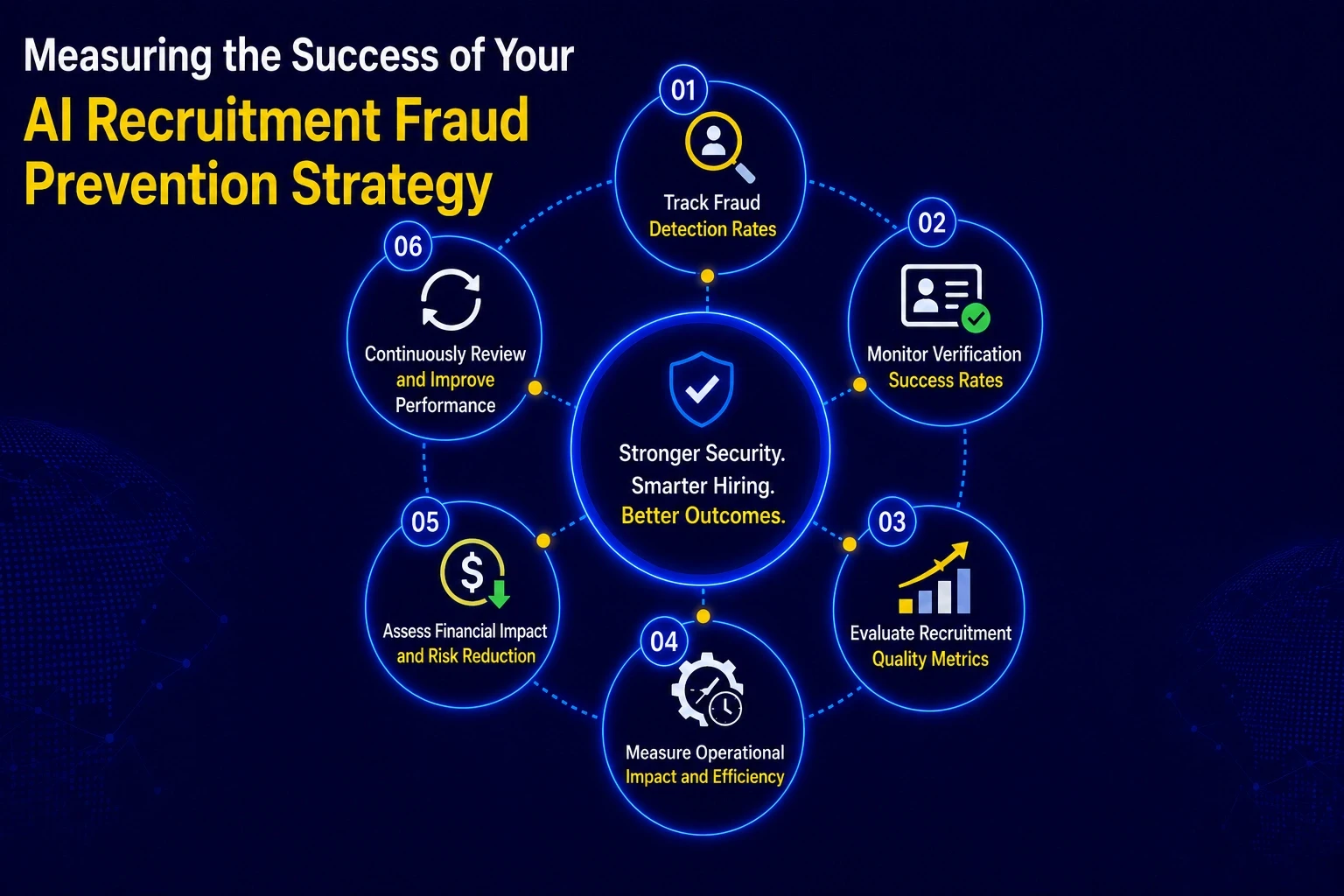
Measuring the Success of Your AI Recruitment Fraud Prevention Strategy
Implementing fraud prevention measures is only the first step. To ensure your recruitment security strategy is delivering results, organizations need to track performance, identify gaps, and continuously optimize their approach. Measuring success helps recruiters understand whether their verification processes, detection tools, and hiring controls are effectively reducing fraud risks.
1. Track Fraud Detection Rates
One of the most important indicators of success is the number of fraudulent applications, impersonation attempts, or suspicious activities identified during the hiring process.
Monitoring detection rates can help organizations:
Identify high-risk recruitment channels
Understand common fraud patterns
Evaluate the effectiveness of existing controls
Improve detection capabilities over time
A consistent increase in detected fraud attempts may indicate that monitoring systems are successfully identifying risks that would have otherwise gone unnoticed.
2. Monitor Verification Success Rates
Candidate verification processes should be measured regularly to ensure they are functioning effectively. This includes identity verification, credential validation, employment history checks, and reference verification.
Key metrics may include:
Identity verification completion rates
Credential validation success rates
Employment verification accuracy
Number of verification discrepancies identified
Tracking these metrics helps organizations identify weaknesses in their verification process and strengthen hiring controls where needed.
3. Evaluate Recruitment Quality Metrics
Fraud prevention efforts should improve hiring quality rather than create unnecessary barriers for legitimate candidates. Organizations should monitor recruitment outcomes alongside fraud-related metrics.
Relevant indicators include:
Quality of hire
New hire retention rates
Time-to-hire
Candidate experience scores
Hiring manager satisfaction
Balancing security with recruitment effectiveness ensures fraud prevention measures support business goals rather than hinder them.
4. Measure Operational Impact and Efficiency
Fraud prevention strategies should enhance security without significantly increasing recruitment workloads. Measuring operational efficiency helps organizations determine whether their processes are scalable and sustainable.
Useful metrics include:
Time spent on candidate verification
Number of applications reviewed
Recruiter productivity levels
Reduction in manual verification tasks
Investigation and resolution timelines
These insights help organizations optimize resources while maintaining strong hiring security.
5. Assess Financial Impact and Risk Reduction
Recruitment fraud can result in financial losses, productivity issues, compliance risks, and reputational damage. Measuring the business impact of prevention efforts helps justify investments in fraud detection technologies and verification processes.
Organizations may evaluate:
Reduction in fraudulent hires
Cost savings from avoided hiring mistakes
Reduced compliance and security risks
Improved workforce reliability
Return on investment from fraud prevention initiatives
Understanding the financial impact helps leadership recognize the value of proactive recruitment security.
6. Continuously Review and Improve Performance
Fraud prevention is not a one-time initiative. Organizations should regularly review performance metrics, analyze emerging fraud patterns, and adjust their strategies as threats evolve.
Continuous improvement may include:
Updating verification procedures
Refining interview processes
Enhancing recruiter training
Adopting new fraud detection technologies
Reviewing recruitment security policies
Organizations that consistently monitor performance and adapt their approach are better equipped to stay ahead of evolving AI recruitment fraud tactics.
The success of an AI recruitment fraud prevention strategy is not measured by a single metric. It requires a combination of fraud detection effectiveness, hiring quality, operational efficiency, and risk reduction. By tracking these indicators, organizations can build a more secure, reliable, and resilient recruitment process.
How Sherlock AI Detects and Prevents AI Recruitment Fraud
AI recruitment fraud is becoming increasingly difficult to identify through manual reviews alone. Deepfake interviews, AI-assisted responses, impersonation attempts, and fabricated candidate information can often bypass traditional hiring processes. Sherlock AI helps organizations address these challenges by providing real-time fraud detection and candidate verification throughout the recruitment journey.
1. Detects Deepfakes and Digital Manipulation
Sherlock AI analyzes video interviews to identify signs of deepfake technology, face swapping, and other forms of digital manipulation. By examining facial movements, video authenticity signals, and behavioral inconsistencies, the platform helps recruiters identify candidates who may be misrepresenting their identity. This enables organizations to detect manipulated video content before it influences hiring decisions.
2. Verifies Candidate Identity
Identity verification is a critical component of recruitment security. Sherlock AI helps confirm that the individual participating in the interview is the same person who applied for the role, reducing the risk of impersonation and proxy interviewing. Through advanced verification workflows and authentication mechanisms, organizations can strengthen candidate validation and improve trust throughout the hiring process.
3. Identifies Suspicious Interview Behavior
Sherlock AI analyzes candidate behavior during interviews to identify patterns commonly associated with AI-assisted cheating or external assistance. By evaluating communication consistency, engagement patterns, and interview interactions, the platform helps recruiters uncover anomalies that may indicate fraudulent activity. This additional layer of intelligence supports more informed hiring decisions.
4. Strengthens Candidate Verification Processes
Sherlock AI enhances recruitment security by introducing verification checkpoints throughout the hiring lifecycle. Rather than relying on a single validation step, organizations can assess candidate authenticity at multiple stages of the recruitment process. This approach helps reduce verification gaps, strengthen hiring integrity, and minimize the likelihood of fraudulent applicants progressing through the pipeline.
5. Provides Real-Time Fraud Detection Insights
Recruiters need visibility into potential risks before making hiring decisions. Sherlock AI delivers real-time insights that help hiring teams identify suspicious activity, assess candidate risk levels, and prioritize cases that require additional review. By surfacing potential concerns early, the platform enables faster and more effective fraud prevention.
6. Detects AI Interview Copilots and External Assistance Tools
AI interview copilot tools are increasingly being used by candidates to receive real-time answers, coding assistance, and interview guidance during virtual interviews. While these tools may help candidates respond more quickly, they can make it difficult for recruiters to accurately assess a candidate’s genuine skills and knowledge.
Sherlock AI helps organizations identify potential usage of interview assistance platforms such as Interview Coder, Cluely, Interview Sidekick, Parakeet AI, and similar real-time AI Interview Copilots. By analyzing candidate behavior, response patterns, interaction signals, and interview activity, Sherlock AI can detect indicators that suggest a candidate may be relying on external assistance during the interview process.
Secure Your Hiring Process Against AI Recruitment Fraud
AI is transforming recruitment, but it is also creating new opportunities for fraud. Deepfake interviews, AI-generated resumes, impersonation attempts, interview copilots, and synthetic identities are making it increasingly difficult for organizations to verify candidate authenticity using traditional hiring methods alone.
As fraud tactics become more sophisticated, recruiters must adopt a proactive approach that combines identity verification, behavioral analysis, structured assessments, and advanced fraud detection technologies. A layered recruitment security strategy not only helps identify fraudulent candidates but also protects hiring quality, organizational reputation, and business operations.
The most effective defense against AI recruitment fraud is a combination of people, processes, and technology. Organizations that invest in stronger verification measures, recruiter training, and AI-powered detection capabilities will be better equipped to make confident hiring decisions while maintaining a positive candidate experience.
By implementing robust fraud prevention practices and leveraging solutions like Sherlock AI, organizations can stay ahead of evolving threats, strengthen recruitment integrity, and ensure that every hiring decision is based on genuine talent and verified credentials.
Protect your organization from deepfakes, impersonation, interview copilots, and other emerging hiring threats. Discover how Sherlock AI can help you detect AI recruitment fraud, verify candidate authenticity, and build a more secure hiring process. |
|---|