Back to all blogs
Explore AI recruiment statistics covering adoption, automation, hiring efficiency, candidate experience, AI bias, fraud, and hiring trends.

Artificial intelligence is rapidly changing how companies attract, evaluate, interview, and hire talent. From AI-powered resume screening and candidate sourcing to automated interviews and fraud detection, recruiting teams are increasingly using AI to make hiring faster, more scalable, and data-driven.
At the same time, the growing use of AI in recruitment is creating new challenges. Candidates are also using generative AI to write resumes, prepare for interviews, and complete assessments, while employers are dealing with concerns around bias, transparency, privacy, and AI-assisted candidate fraud.
100 AI Recruitment Statistics and Trends for 2026
We have compiled 100 AI recruitment statistics for 2026 to highlight how artificial intelligence is transforming the recruitment process. The statistics cover AI adoption, recruiting automation, resume screening, candidate sourcing, interviews, candidate experience, AI-assisted job searches, recruitment fraud, bias, challenges, and the future of AI-powered hiring.
Whether you are a recruiter, talent acquisition professional, HR leader, hiring manager, or business owner, these AI recruiting statistics provide a data-driven view of how AI is changing hiring in 2026.
AI Recruiting Adoption Statistics
Artificial intelligence has moved from an emerging HR technology to a mainstream part of the recruiting process. Companies are now using AI across sourcing, resume screening, candidate matching, interview scheduling, candidate communication, and hiring analytics.
The adoption numbers vary between studies because researchers measure different things. Some surveys measure whether organizations use AI anywhere in HR, while others specifically measure AI use in recruiting or ask hiring managers whether their organization uses AI. Together, these figures show the direction of the market: AI recruiting adoption is accelerating rapidly.
1. 43% of Organizations Used AI for HR and Recruiting in 2025
The increase from 26% to 43% represents a substantial year-over-year jump in AI adoption. Rather than remaining limited to experimental programs, AI is increasingly being incorporated into everyday HR and talent-acquisition workflows.
Recruiting is one of the areas where this adoption makes particular sense because hiring involves large volumes of repetitive information. Recruiters may need to review hundreds of resumes, search multiple talent pools, communicate with candidates, schedule interviews, and maintain applicant records simultaneously. AI can automate or assist with many of these activities.
The increase also suggests that organizations are becoming more comfortable moving from AI pilots to practical implementation. (SHRM 2025 Talent Trends)
2. Nearly 9 in 10 HR Professionals Say AI Saves Time or Improves Recruiting Efficiency
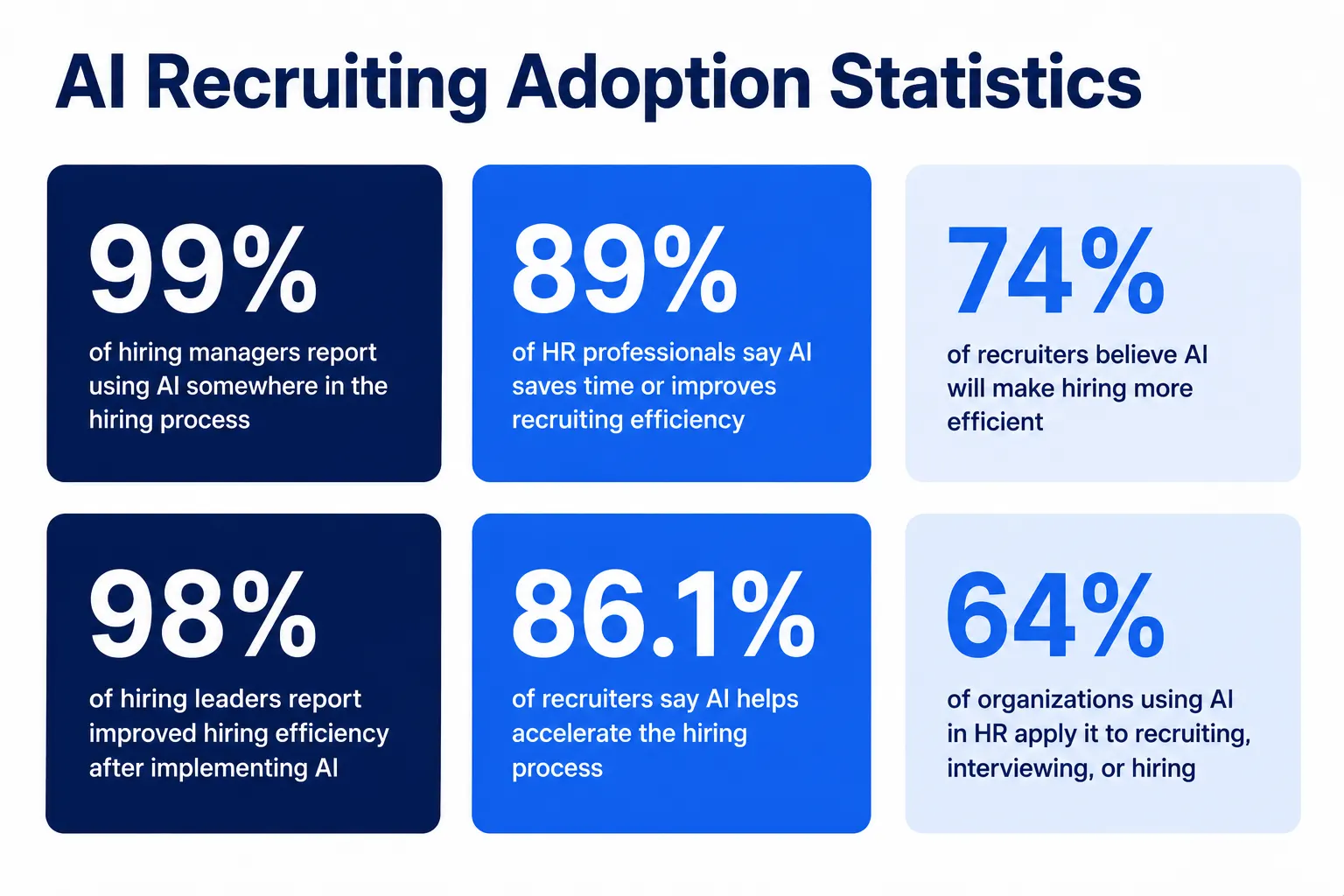
89% of HR professionals say AI saves time or increases recruiting efficiency. Efficiency remains one of the strongest reasons companies adopt AI in recruitment. Recruiting teams routinely spend significant amounts of time on administrative work, including reviewing applications, coordinating interviews, writing candidate messages, searching databases, and updating applicant information.
AI can assist with these tasks by processing information faster and automating repetitive workflows. This does not necessarily mean recruiters are being replaced. Instead, AI can allow recruiters to spend more time on activities that require human judgment, such as interviewing candidates, advising hiring managers, building relationships, and evaluating cultural or organizational fit.
The statistic also explains why AI adoption continues to grow even when companies remain cautious about automated decision-making. Saving recruiter time is a relatively straightforward benefit to demonstrate. (SHRM 2025 Talent Trends)
3. 64% of Organizations Using AI in HR Apply It to Recruiting, Interviewing, or Hiring
64% of organizations using AI in HR apply the technology to recruiting, interviewing, or hiring. Recruitment is one of the most prominent use cases for artificial intelligence within HR. Unlike some HR activities that may require highly specialized datasets, recruiting produces large quantities of structured and unstructured information that AI systems can process.
Resumes, job descriptions, candidate profiles, interview transcripts, skills assessments, application responses, and communication histories can all potentially be analyzed or summarized using AI.
This widespread use also reflects the fact that recruitment has several stages where automation can create measurable improvements. (SHRM 2025 Talent Trends)
4. 99% of Hiring Managers Report Using AI Somewhere in the Hiring Process
99% of hiring managers report using AI in some part of the hiring process. This is one of the strongest indicators of how deeply AI has entered modern recruitment. AI use can include everything from generating job descriptions and writing candidate messages to screening resumes, sourcing applicants, scheduling interviews, and analyzing candidates.
Importantly, this statistic does not mean that 99% of hiring managers allow AI to make final hiring decisions. In many organizations, AI is used as an assistant that helps recruiters process information and complete repetitive work.
The distinction between AI-assisted hiring and fully automated hiring is therefore important when interpreting adoption statistics. (Insight Global’s 2025 AI in Hiring Report)
5. 98% of Hiring Leaders Report Improved Hiring Efficiency After Implementing AI
98% of hiring leaders report improved hiring efficiency after implementing AI. The reported improvement is associated with several common AI recruiting applications, including resume screening, candidate assessment, sourcing, interview scheduling, and candidate engagement.
Hiring efficiency is important because recruitment teams are often measured by both the quality and speed of their hiring outcomes. A recruiting process that identifies strong candidates but takes too long can still lose talent to competing employers.
AI can help reduce delays by processing candidate information more quickly and automating tasks that previously required manual intervention. (Insight Global’s 2025 AI in Hiring Report)
6. 86.1% of Recruiters Say AI Helps Accelerate the Hiring Process
86.1% of recruiters say AI helps accelerate the hiring process. Recruitment speed can influence whether companies successfully secure high-demand talent. When several employers compete for the same candidate, lengthy screening and interview processes can increase the likelihood that a candidate accepts another offer.
AI can accelerate multiple stages of recruitment. Automated resume analysis can shorten screening, AI sourcing can help identify candidates faster, and scheduling automation can reduce delays between interview stages.
However, speed should not be the only measure of successful AI recruiting. Moving unsuitable candidates through the funnel faster does not improve hiring outcomes. (Zippia AI Recruitment Statistics)
7. Organizations Using AI-Assisted Recruiter Messaging Are 9% More Likely to Make a Quality Hire
Organizations that frequently use AI-assisted recruiter messaging are 9% more likely to make a quality hire, according to LinkedIn data cited by CVViZ.
Recruiter messaging is one area where generative AI can support rather than replace human interaction. AI can help recruiters create personalized outreach, adjust messages for different candidate profiles, and reduce the amount of time spent drafting repetitive communications.
The quality-hire connection is particularly interesting because it suggests that AI-assisted communication may contribute to better recruiting outcomes, rather than simply improving productivity.
However, personalization remains important. Candidates may respond poorly to generic AI-generated messages that do not demonstrate a genuine understanding of their background. (LinkedIn, Future of Recruiting 2025)
8. Around 70% of Recruiters Report Better Candidate Quality When Using AI Recruiting Tools
70% of recruiters report better candidate quality when using AI recruiting tools. AI can improve candidate quality by helping recruiters identify candidates based on combinations of skills, experience, qualifications, and other job-specific requirements.
Traditional recruiting often relies heavily on keywords and manual searches. AI-based matching can analyze broader relationships between candidate experience and job requirements, potentially identifying qualified candidates who might not appear in conventional keyword searches.
The reported improvement also highlights an important shift in how organizations evaluate recruiting AI. The focus is moving beyond simple time savings toward quality of hire and candidate matching. (Industry Recruiting Surveys - Various)
9. AI Recruiting Automation Can Reduce Time-to-Hire by Up to 75%
AI recruiting automation can reduce time-to-hire by as much as 75%. AI can shorten the hiring cycle by automating multiple activities across the recruiting funnel. Instead of treating sourcing, screening, scheduling, and candidate communication as completely separate manual tasks, organizations can connect them through automated workflows.
For example, AI can identify potential candidates, prioritize applicants, generate outreach messages, and assist with scheduling. This can reduce the amount of time candidates spend waiting between stages.
The actual reduction will depend on the organization's existing process, hiring volume, technology infrastructure, and implementation quality. The 75% figure should therefore be treated as a reported upper-end result rather than a universal benchmark. (Chipotle case study using Paradox's AI chatbot)
10. 74% of Recruiters Believe AI Will Make Hiring More Efficient
74% of recruiters believe AI will make hiring more efficient. Recruiters increasingly view AI as an augmentation tool rather than simply an automation technology. The goal is to remove repetitive work so recruiters can focus on higher-value responsibilities such as candidate engagement, stakeholder management, interviewing, and workforce planning.
This perception is important because successful AI implementation depends heavily on recruiter adoption. Even highly capable technology can fail to deliver results if recruiters do not trust it or understand how to incorporate it into their workflows.
The figure also indicates that the recruiting profession itself is becoming more receptive to AI-assisted workflows. (LinkedIn’s 2025 Future of Recruiting report)
AI Recruiting Efficiency & Productivity Statistics
AI is increasingly being used to automate time-consuming recruiting activities, from resume screening and candidate sourcing to job-description creation, interview scheduling, and candidate communication. The statistics below focus specifically on how AI affects recruiter productivity, hiring speed, and operational efficiency.
11. Employers Using AI Report Up to a 75% Reduction in Time-to-Hire
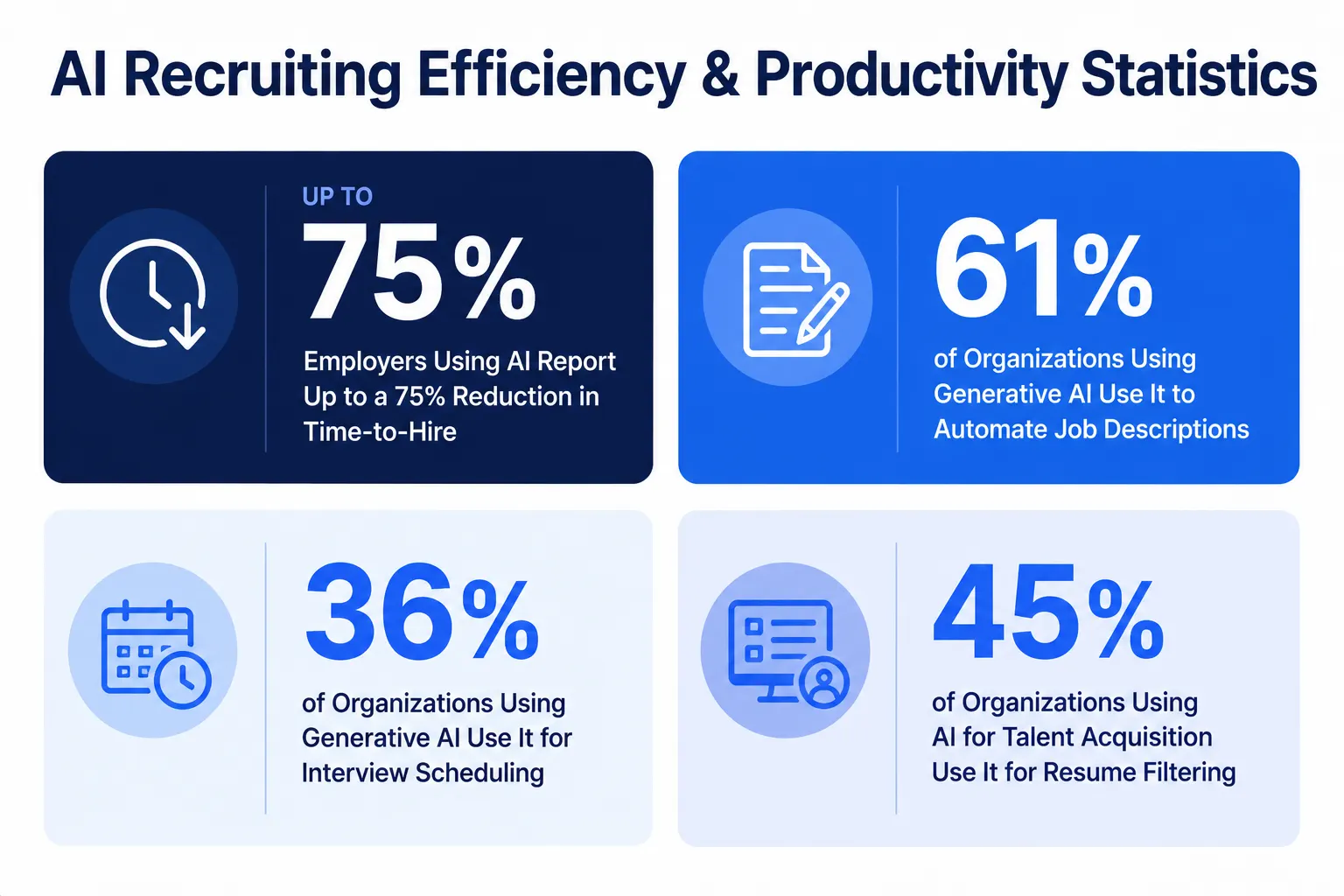
Employers using AI recruiting technology report up to a 75% reduction in time-to-hire.
AI can accelerate multiple stages of the hiring funnel simultaneously. Recruiters can use AI to identify relevant candidates, filter applications, automate communication, coordinate interviews, and support assessments. Instead of waiting for each task to be completed manually, several parts of the workflow can happen automatically or in parallel.
However, the 75% figure represents the upper end of reported results rather than a guaranteed improvement for every organization. The actual reduction depends on the organization's hiring volume, existing processes, level of automation, and how well the technology integrates with its recruiting stack. (SelectSoftwareReviews - Latest AI Recruiting Statistics)
12. 70% of Hiring Managers Say AI Helps Them Move Faster With Fewer Recruiting Resources
70% of hiring managers say AI helps them move faster and make stronger decisions with fewer recruiter resources.
Recruiting teams frequently face the challenge of managing more applications and open positions without proportionally increasing headcount. AI can help absorb some of this additional workload by automating repetitive tasks such as candidate screening, scheduling, and communication.
The benefit is especially relevant for high-volume recruiting. A recruiter who previously had to manually review hundreds of applications can use AI to prioritize candidates based on predefined requirements before conducting a deeper human review. (SelectSoftwareReviews - Latest AI Recruiting Statistics)
13. Companies Using LinkedIn Hiring Assistant Make 11% More Quality Hires
Companies using LinkedIn Hiring Assistant make 11% more quality hires, on average, than companies using traditional recruiting methods.
LinkedIn's 2026 analysis found that organizations using Hiring Assistant achieved an 11% increase in quality hires compared with companies using LinkedIn Recruiter without Hiring Assistant. The analysis covered more than 110 million LinkedIn members and compared hiring outcomes across organizations using the AI-powered recruiting tool.
The improvement was also shown to increase with longer adoption. Companies using Hiring Assistant for at least 12 months saw a 15% increase in quality hires, compared with an 11% increase among companies using it for three months or more.
The findings suggest that the impact of recruiting AI may extend beyond simply saving recruiters time. As organizations become more familiar with AI-assisted recruiting, the technology may help teams identify stronger candidates and improve the quality of hiring outcomes. (LinkedIn, 2026)
14. Recruiters Can Save Around 20% of Their Workweek With Generative AI
Recruiting organizations integrating generative AI can potentially save around 20% of a recruiter's workweek.
Generative AI can assist with activities such as writing job descriptions, preparing candidate outreach, summarizing candidate information, creating interview questions, and handling routine administrative tasks.
For a recruiter working a standard 40-hour week, a 20% time saving would represent roughly eight hours of capacity. That time can potentially be redirected toward candidate conversations, hiring-manager collaboration, strategic sourcing, and workforce planning. (LinkedIn’s 2025 survey reports)
15. Recruiters Spend Up to 14 Hours a Week on Manual Candidate Sourcing
Recruiters can spend up to 14 hours per week on manual candidate sourcing.
Sourcing requires recruiters to search professional networks, candidate databases, previous applicants, referrals, and other talent pools. For difficult-to-fill roles, this process can become particularly time-consuming because recruiters need to repeatedly search for candidates with specific combinations of skills and experience.
AI-powered sourcing can automate portions of this work by identifying potential matches and prioritizing candidates based on job requirements. (SelectSoftwareReviews - Latest AI Recruiting Statistics)
16. 61% of Organizations Using Generative AI Use It to Automate Job Descriptions
61% of organizations using generative AI use it to automate job-description creation.
Writing job descriptions is a common but repetitive recruiting task. Recruiters need to communicate responsibilities, qualifications, expectations, and employer information in a way that is clear and appealing to candidates.
Generative AI can create an initial draft based on information supplied by the recruiter or hiring manager. It can also help restructure descriptions, improve clarity, and tailor content to specific roles.
Human review remains important because AI-generated job descriptions can introduce inaccurate requirements or language that does not reflect the actual position. (SelectSoftwareReviews - Latest AI Recruiting Statistics)
17. 55% of Organizations Using Generative AI Use It for Candidate Communication
55% of organizations using generative AI use it for candidate communication.
Recruiters communicate with candidates throughout the hiring process, including initial outreach, application updates, interview instructions, follow-ups, and rejection notifications.
Generative AI can help recruiters draft these messages more quickly and adapt communication to different candidate profiles. It can also help maintain consistent messaging when recruiting teams are managing large applicant volumes.
However, automation should not come at the expense of personalization. Candidates can quickly recognize generic communication, particularly when messages contain irrelevant information or fail to acknowledge their experience. (SelectSoftwareReviews - Latest AI Recruiting Statistics)
18. 36% of Organizations Using Generative AI Use It for Interview Scheduling
36% of organizations using generative AI use it for interview scheduling.
Interview coordination can become surprisingly complex when recruiters need to match candidate availability with hiring managers, interview panels, and multiple time zones.
AI-powered scheduling tools can automate much of this coordination. Instead of recruiters manually exchanging messages to identify suitable times, systems can connect calendars and suggest or arrange available slots.
This is particularly valuable for organizations conducting large numbers of interviews, where even small scheduling delays can accumulate into significant recruitment bottlenecks. (SelectSoftwareReviews - Latest AI Recruiting Statistics)
19. 35% of Organizations Using Generative AI Use It for Candidate Discovery
35% of organizations using generative AI use it for candidate discovery.
Candidate discovery involves identifying people who could potentially match an open position. Traditional approaches often depend on recruiters manually searching job boards, professional networks, talent databases, and previous applicants.
AI can analyze candidate profiles against job requirements and surface potential matches more quickly. It can also help identify transferable skills, allowing recruiters to consider candidates whose previous titles do not perfectly match the advertised position. (SelectSoftwareReviews - Latest AI Recruiting Statistics)
20. 45% of Organizations Using AI for Talent Acquisition Use It for Resume Filtering
45% of organizations using AI for talent acquisition use it for resume filtering.
Resume filtering is one of the most practical applications of AI in recruiting because recruiters often have to process large numbers of applications for a single position. AI can analyze resumes against predefined job requirements and help recruiters identify candidates who deserve closer review.
AI-powered filtering can examine skills, experience, qualifications, job history, and other candidate information much faster than manual screening. This allows recruiters to spend more time evaluating shortlisted candidates rather than manually reviewing every application.
The statistic also shows that resume screening remains one of the most established applications of generative AI in talent acquisition, alongside job-description creation, candidate communication, scheduling, and candidate discovery. (SelectSoftwareReviews - Latest AI Recruiting Statistics)
21. Companies Using AI Screening With Human Interviews Cut Time-to-Hire by 40%
Companies that combine AI screening with human-led final interviews report a 40% reduction in time-to-hire, while also reporting a 25% improvement in first-year retention.
This approach demonstrates how AI can be used as an initial screening and prioritization layer rather than as a replacement for recruiters. AI handles large volumes of candidate information, while human interviewers remain responsible for deeper evaluation and final decisions.
The combination can create a more efficient hiring funnel. Candidates can be screened quickly at the beginning of the process while qualified applicants still receive meaningful human interaction before an offer is made. (SelectSoftwareReviews - Latest AI Recruiting Statistics)
22. 49% of Hiring Managers Say AI Has Improved Quality of Hire
49% of hiring managers say AI has improved the quality of their hires, while only 1% say AI has caused quality to decline.
This indicates that the perceived value of recruiting AI is extending beyond productivity. While faster screening and automation are important benefits, hiring managers are increasingly evaluating AI based on whether it helps them identify candidates who are better aligned with the role.
AI can support this by analyzing candidate skills, experience, and other signals across large applicant pools. However, the quality of the underlying data and the criteria used by the system remain important factors in determining whether AI recommendations are useful. (SelectSoftwareReviews - Latest AI Recruiting Statistics)
23. AI-Using Companies Report 21% Better Role Alignment in New Hires
Companies using AI in recruitment report 21% better role alignment among new hires.
Role alignment refers to how closely a candidate's capabilities and experience match the requirements of the position. AI can contribute to this by analyzing candidate information against job requirements and identifying relevant skills or experience that may be difficult to evaluate manually at scale.
Better alignment can potentially reduce mismatches between candidates and positions. This is particularly useful for specialized roles where recruiters need to evaluate combinations of technical skills, experience, and transferable capabilities. (SelectSoftwareReviews - Latest AI Recruiting Statistics)
24. 95% of U.S. Hiring Managers Expect More AI Investment
95% of U.S. hiring managers expect their organizations to invest more money or resources in AI to streamline hiring.
Among C-level decision-makers, the figure rises to 99%.
The expectation of increased investment suggests that organizations are moving beyond initial AI experimentation. Companies that have already introduced AI into recruiting are increasingly looking at additional applications and broader implementation.
Investment can include AI-powered sourcing, screening, candidate communication, interview technology, fraud detection, analytics, and recruiting automation. (SelectSoftwareReviews - Latest AI Recruiting Statistics)
25. 73% of Hiring Managers Say AI Frees Time for Collaboration
73% of hiring managers using AI say it frees up time for cross-training and collaboration with colleagues.
AI can remove some of the repetitive administrative work associated with recruiting, allowing hiring managers and HR teams to redirect time toward activities that require communication and collaboration.
This includes working with other hiring stakeholders, discussing candidate requirements, reviewing recruitment strategies, and coordinating hiring decisions.
The statistic highlights that productivity gains from AI are not necessarily limited to the individual recruiter. Reducing administrative workload can create additional capacity across the wider hiring team. (SelectSoftwareReviews - Latest AI Recruiting Statistics)
26. 61% of Hiring Managers Say AI Frees Time for Personnel Management
61% of hiring managers say AI frees up time for personnel management.
Recruiting technology can reduce the amount of time managers spend on repetitive hiring administration, allowing them to focus more heavily on managing people and teams.
This is particularly relevant for hiring managers who are responsible for recruitment alongside their normal management responsibilities. Automating tasks such as candidate communication, scheduling, and initial screening can give managers more capacity for employee development and team leadership. (SelectSoftwareReviews - Latest AI Recruiting Statistics)
27. 60% of Hiring Managers Say AI Creates More Time for Employee Training
60% of hiring managers say AI creates more time for training other employees.
When AI takes over portions of repetitive recruiting workflows, the resulting time savings can be redirected toward employee development. Training is particularly important for organizations that are trying to build internal capabilities while also hiring externally.
Rather than measuring AI productivity only through the number of hours saved, this statistic shows another potential outcome: organizations can use the additional capacity for activities that contribute to workforce development. (SelectSoftwareReviews - Latest AI Recruiting Statistics)
28. 60% of Hiring Managers Say AI Improves Their Work-Life Balance
60% of hiring managers say AI improves their work-life balance.
Recruiting can involve repetitive administrative work, large application volumes, constant candidate communication, and coordination between multiple stakeholders. These responsibilities can contribute to workload pressure, particularly during periods of high hiring demand.
By automating portions of these processes, AI can reduce the amount of manual work that hiring managers need to complete themselves.
The statistic suggests that the impact of AI adoption is not limited to organizational efficiency. It can also affect how hiring professionals experience their day-to-day workload. (SelectSoftwareReviews - Latest AI Recruiting Statistics)
29. 56% of Hiring Managers Say AI Creates More Time for Team Building
56% of hiring managers say AI creates more time for team-building activities.
Team building requires time that can be difficult to find when managers are occupied with administrative responsibilities. Automating recruiting tasks can potentially create additional capacity for managers to focus on team development and collaboration.
This represents another example of AI shifting work rather than simply eliminating it. Routine processes can increasingly be handled by technology while managers dedicate more attention to people-oriented responsibilities. (SelectSoftwareReviews - Latest AI Recruiting Statistics)
30. 56% of Hiring Managers Say AI Allows Greater Attention to Detail
56% of hiring managers say AI allows them to pay greater attention to detail.
Recruiting involves processing significant amounts of candidate and job information. When managers spend less time on repetitive administrative work, they can devote more attention to reviewing candidate information, refining requirements, and evaluating hiring decisions.
AI can therefore function as an additional layer of processing while human decision-makers concentrate on areas where contextual understanding and judgment are important. (SelectSoftwareReviews - Latest AI Recruiting Statistics)
31. 73% of Talent Acquisition Professionals Say AI Will Change How Companies Hire
73% of talent acquisition professionals agree that AI will change the way companies hire.
This figure comes from LinkedIn's Future of Recruiting 2025 research, which analyzed billions of LinkedIn data points and responses from more than 1,000 talent professionals.
The finding reflects the broader shift from viewing AI as a specialized recruiting tool to recognizing it as a technology capable of changing how recruitment teams operate. AI can influence sourcing, screening, candidate assessment, communication, and the way recruiters allocate their time. (LinkedIn's Future of Recruiting 2025)
32. 37% of Talent Acquisition Professionals Are Experimenting With or Integrating Generative AI
37% of talent acquisition professionals say they are currently experimenting with or actively integrating generative AI into their hiring process.
The statistic shows that adoption is not limited to organizations that have already completed large-scale AI implementations. A significant portion of the recruiting industry is still in the experimentation and integration phase.
This stage can involve testing AI for job descriptions, candidate communication, sourcing, screening, interview preparation, and other recruiting activities before organizations decide which applications should become permanent parts of their workflows. (LinkedIn's Future of Recruiting 2025)
33. 89% of Talent Acquisition Professionals Say Measuring Quality of Hire Will Become More Important
89% of talent acquisition professionals believe measuring quality of hire will become increasingly important.
As AI makes recruiting processes faster, organizations are increasingly looking beyond traditional efficiency metrics such as time-to-fill. The focus is shifting toward whether the people hired actually perform, stay, grow, and contribute to the organization.
This shift is important because AI can make a recruiting process faster without necessarily making the final hiring decisions better. Quality-of-hire measurement provides organizations with a way to evaluate whether technology is improving actual hiring outcomes. (LinkedIn's Future of Recruiting 2025)
34. 61% of Talent Acquisition Professionals Believe AI Can Improve Quality-of-Hire Measurement
61% of talent acquisition professionals believe AI can help improve how organizations measure quality of hire.
AI can analyze large amounts of information across the hiring and employee lifecycle, potentially helping organizations connect recruiting decisions with later outcomes.
This could include examining candidate skills, hiring sources, performance indicators, retention, career progression, and other signals. Better measurement can help recruiting teams understand which sourcing and assessment approaches are actually producing successful hires. (LinkedIn, Future of Recruiting 2025)
35. Companies With the Most Skills-Based Searches Are 12% More Likely to Make a Quality Hire
Companies with the highest levels of skills-based searches are 12% more likely to make a quality hire than companies with no skills-based searches.
Skills-based hiring focuses on what candidates can actually do rather than relying primarily on traditional signals such as job titles, degrees, or previous employers.
AI can support this approach by analyzing resumes and candidate profiles for skills and identifying relationships between candidate capabilities and job requirements. (LinkedIn's Future of Recruiting 2025)
36. 93% of Talent Acquisition Professionals Say Accurate Skills Assessment Is Crucial
93% of talent acquisition professionals believe accurately assessing a candidate's skills is crucial for improving quality of hire.
The finding reflects the growing importance of skills-based recruitment. As job requirements change rapidly, recruiters increasingly need to determine whether candidates possess the capabilities required for the actual role rather than relying solely on historical credentials.
AI can assist by analyzing candidate profiles, identifying skills, and helping recruiters compare those capabilities with job requirements. (LinkedIn - Skills as the New Hiring Currency)
AI Recruiting, Quality & Human Oversight Statistics
AI recruiting is improving hiring efficiency, but human judgment remains essential. These statistics show how organizations are balancing AI-powered screening and automation with human oversight, candidate evaluation, fairness, and decision-making.
37. 93% of Hiring Managers Say AI Is Useful but Cannot Replace Human Decision-Making
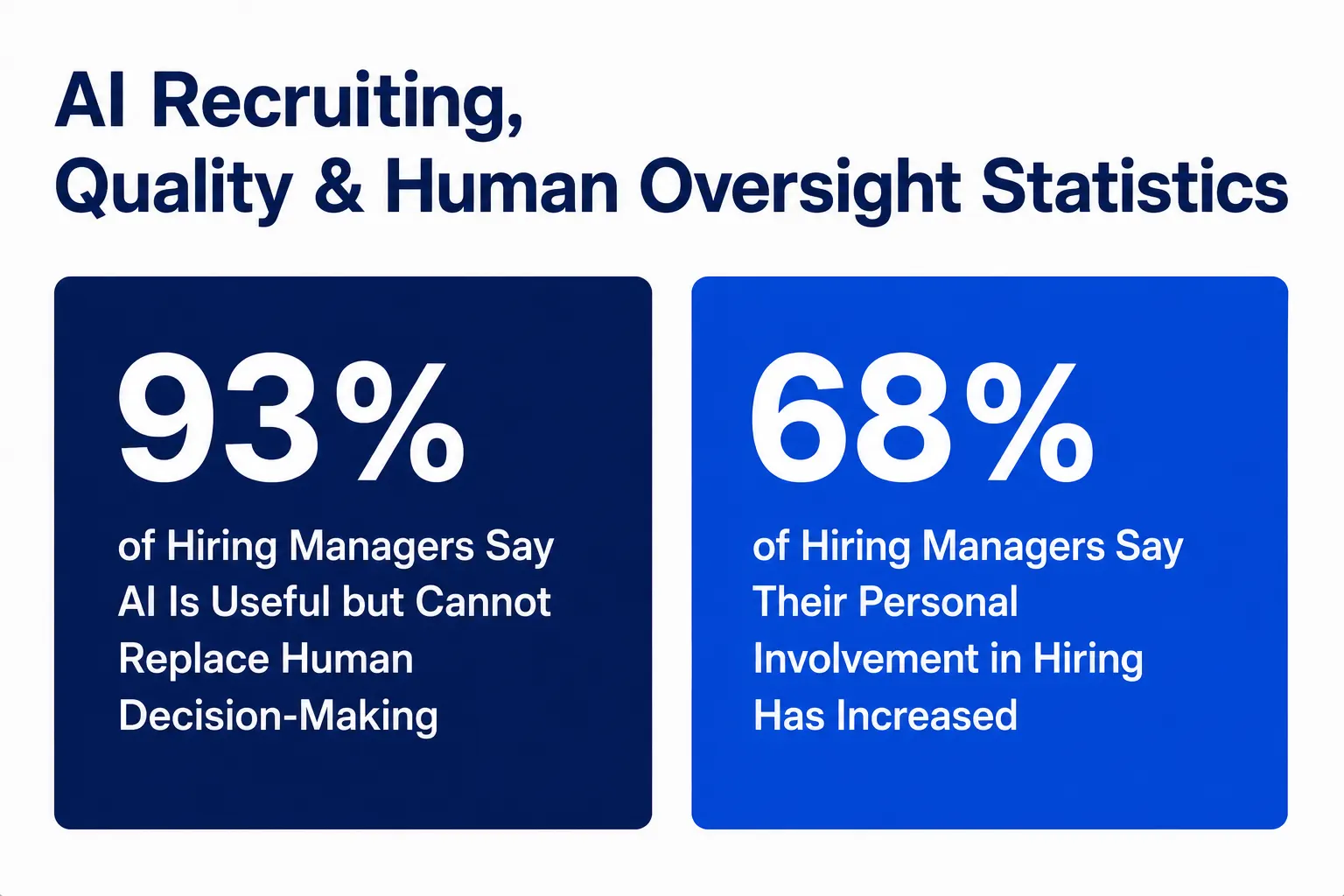
93% of hiring managers agree that AI is a useful recruiting tool but is not a substitute for human decision-making.
The statistic highlights an important distinction in modern AI recruiting. Organizations may use AI to process resumes, identify potential candidates, generate content, or support recruiting workflows, but final hiring decisions still require human judgment.
Recruitment involves factors that can be difficult to capture entirely through automated systems, including communication ability, motivation, interpersonal skills, team dynamics, and context around a candidate's career history. (Insight Global - AI in Hiring Survey Report)
38. 100% of Hiring Managers Say Human Involvement Is Important for a Personable Candidate Experience
100% of hiring managers say human involvement remains important to ensure the candidate experience feels personable.
As AI becomes more involved in recruitment, organizations face the challenge of maintaining meaningful human interaction. Automated communication can improve speed, but candidates still expect opportunities to interact with real people during important stages of the hiring process.
Human involvement can be particularly important during interviews, candidate questions, feedback, negotiations, and final hiring decisions. (Insight Global - AI in Hiring Survey Report)
39. 96% of C-Suite Hiring Managers Say AI Cannot Replace Human Judgment
96% of C-suite hiring managers agree that AI cannot replace human judgment in hiring.
Senior decision-makers appear particularly cautious about allowing AI to independently determine hiring outcomes. AI can provide recommendations and process information, but executives continue to view human judgment as essential when making decisions that affect the organization's workforce.
This reinforces the human-in-the-loop model, where technology handles processing and administrative work while people retain responsibility for consequential decisions. (Insight Global - AI in Hiring Survey Report)
40. 98% of C-Suite Hiring Managers Say Human Involvement Is Extremely or Very Important
98% of C-suite hiring managers say human involvement is extremely or very important in recruitment.
The figure demonstrates that increased AI adoption does not necessarily translate into reduced human participation. Instead, organizations are increasingly using AI to support recruiters while retaining people in critical parts of the hiring workflow.
Human involvement can help recruiters interpret AI-generated recommendations, evaluate candidates in context, and ensure that automated systems do not become the sole determinant of hiring outcomes. (Insight Global - AI in Hiring Survey Report)
41. 68% of Hiring Managers Say Their Personal Involvement in Hiring Has Increased
68% of hiring managers say their personal level of involvement in the hiring process has increased compared with a year earlier.
This is notable because it challenges the assumption that greater automation necessarily means less human participation.
As AI handles more administrative work, hiring managers can potentially devote more attention to interviews, candidate evaluation, stakeholder discussions, and final decision-making.
The shift suggests that AI may be changing where humans spend their time rather than simply reducing the amount of human involvement. (Greenhouse - 2026 AI Hiring Report)
42. 61% of Hiring Managers Use Software to Detect AI Use During Interviews
61% of hiring managers say they are now using software to detect AI use during interviews.
The growing use of AI by job seekers has created a new requirement for employers: determining whether candidates are independently demonstrating their knowledge and skills.
Recruiters are therefore increasingly using technology not only to apply AI to hiring but also to identify potential AI-assisted behavior during the candidate evaluation process.
This creates a new layer of recruitment technology focused on authenticity and assessment integrity. (Greenhouse - 2026 AI Hiring Report)
43. 39% of Hiring Managers Are Conducting More In-Person Interviews
39% of hiring managers say they are conducting more in-person interviews.
The increase in face-to-face interviews is occurring alongside greater use of AI in recruitment. One reason is the growing importance of verifying candidate identity, communication skills, and genuine understanding of the role.
In-person interviews can provide hiring teams with additional signals that may be difficult to obtain from automated screening or remote assessments alone. (Greenhouse - 2026 AI Hiring Report)
44. 91% of Recruiters and Hiring Managers Have Spotted or Suspected Candidate Deception
91% of recruiters and hiring managers say they have spotted or suspected candidate deception.
The widespread availability of generative AI has introduced new challenges around candidate authenticity. Deception can involve exaggerated resumes, fake references, AI-assisted interviews, identity issues, or other forms of misrepresentation.
As AI-generated content becomes increasingly difficult to distinguish from human-created material, recruitment teams are placing greater emphasis on verification and skills-based evaluation. (Greenhouse - 2026 AI Hiring Report)
45. 74% of Hiring Managers Are More Concerned About Fake Credentials
74% of hiring managers say they are more worried about fake credentials than they were a year earlier.
Credential verification has become a more significant concern as AI makes it easier to generate convincing documents and representations of professional experience.
Employers increasingly need to verify qualifications rather than simply accept information presented in resumes and applications. This can include validating employment history, education, certifications, references, and demonstrated skills. (Greenhouse - 2026 AI Hiring Report)
46. 63% of Recruiters Report AI-Generated Resume Exaggeration
63% of recruiters and hiring managers say they have encountered AI-generated resume exaggeration.
Generative AI can help candidates improve the wording of resumes, but it can also make exaggerated or inaccurate claims appear more polished and credible.
This creates additional pressure on recruiters to verify whether the skills and experience described in a resume correspond to what the candidate can actually demonstrate. (Greenhouse - 2026 AI Hiring Report)
47. 48% of Recruiters Have Encountered Fake References
48% of recruiters and hiring managers report encountering fake references.
Reference checks are traditionally intended to provide employers with additional confirmation about a candidate's background and performance. However, AI and other digital tools can make it easier to create convincing but unreliable supporting information.
As a result, organizations may need stronger verification processes rather than relying solely on references supplied by candidates. (Greenhouse - 2026 AI Hiring Report)
48. 35% of Recruiters Have Seen Candidates Use AI During Interviews
35% of recruiters and hiring managers report seeing candidates use AI during interviews.
AI tools can provide candidates with real-time assistance during remote interviews, potentially generating answers or suggestions while the interview is taking place.
This creates a challenge for employers because an interview may no longer represent only the candidate's unaided knowledge or communication ability.
Organizations are consequently exploring additional methods of evaluating skills, including live exercises, structured interviews, work samples, and technical assessments. (Greenhouse - 2026 AI Hiring Report)
49. 31% of Recruiters Have Encountered Candidates in Different Time Zones Than Stated
31% of recruiters and hiring managers report encountering candidates whose actual time zone differed from the one they had provided.
Time-zone inconsistencies can be one signal of inaccurate candidate information, particularly in remote hiring. While a different time zone does not necessarily indicate deception on its own, it can prompt recruiters to verify candidate location and availability.
The statistic forms part of the broader challenge recruiters face in establishing candidate authenticity in increasingly digital hiring processes. (Greenhouse - 2026 AI Hiring Report)
50. 31% of Recruiters Have Encountered a Different Person Than the Applicant During an Interview
31% of recruiters and hiring managers report encountering a situation where the person interviewed was different from the person who originally applied.
Remote recruitment can make identity verification more difficult because candidates may complete the application, assessment, and interview from different locations and devices.
The emergence of this problem demonstrates why organizations are increasingly considering identity verification and live assessment methods as part of their recruitment processes. (Greenhouse - 2026 AI Hiring Report)
51. 18% of Recruiters Have Encountered Deepfake Video Interviews
18% of recruiters and hiring managers report encountering deepfake video interviews.
Deepfake technology can manipulate a person's appearance or voice during a video interaction. In recruitment, this creates a particularly serious concern because interviews are traditionally treated as direct evidence of a candidate's identity and communication abilities.
As synthetic media becomes more sophisticated, employers may need to combine video interviews with other forms of identity and skills verification. (Greenhouse - 2026 AI Hiring Report)
52. 41% of Candidates Say They Have Used Prompt Injections to Bypass AI Screening
41% of candidates surveyed say they have used prompt injections or hidden instructions to attempt to bypass AI-powered screening systems.
Prompt injection involves inserting instructions into candidate materials that are intended to influence how an AI system processes the document.
This creates a new problem for automated recruitment systems. A resume may contain information designed not for the recruiter but specifically to influence an AI screening model. (Greenhouse - 2026 AI Hiring Report)
53. 87% of Candidates Want Employers to Be Transparent About AI Use
87% of candidates say they want employers to be transparent about how AI is used in hiring.
Candidates increasingly want to understand whether AI is involved in evaluating their resumes, interviews, assessments, or applications.
Transparency can help candidates understand what to expect and may reduce concerns that automated systems are making decisions without their knowledge.
For employers, clearly communicating where AI is used can therefore become an important part of candidate experience and trust. (Greenhouse - 2026 AI Hiring Report)
54. 46% of Job Seekers Say Their Trust in Hiring Has Decreased
46% of job seekers say their trust in the hiring process has decreased over the past year.
Among those reporting lower trust, 42% attribute the decline to the increasing use of AI.
The finding illustrates the other side of AI adoption. While employers may see efficiency benefits, candidates can become concerned about whether their applications are being evaluated fairly or whether meaningful human interaction remains part of the process.
As AI becomes more common, organizations will need to balance automation with transparency and communication. (Greenhouse - 2026 AI Hiring Report)
55. 34% of Recruiters Spend Up to Half Their Workweek Filtering Spam Applications
34% of recruiters say they spend up to half of their working week filtering spam and junk applications.
The increase in AI-assisted applications has created a volume problem for recruiting teams. Candidates can now generate resumes and application responses much faster, potentially increasing the number of applications recruiters must process.
This means that AI can simultaneously create efficiency for candidates while increasing workload for recruiters. Screening and verification tools are consequently becoming more important as application volumes rise. (Greenhouse - 2026 AI Hiring Report)
AI Recruiting Adoption & Employer Usage Statistics
AI adoption in recruitment is growing rapidly, while candidate expectations are changing alongside it. These statistics highlight how employers are expanding AI use across hiring and how candidates are responding to AI-powered recruitment experiences.
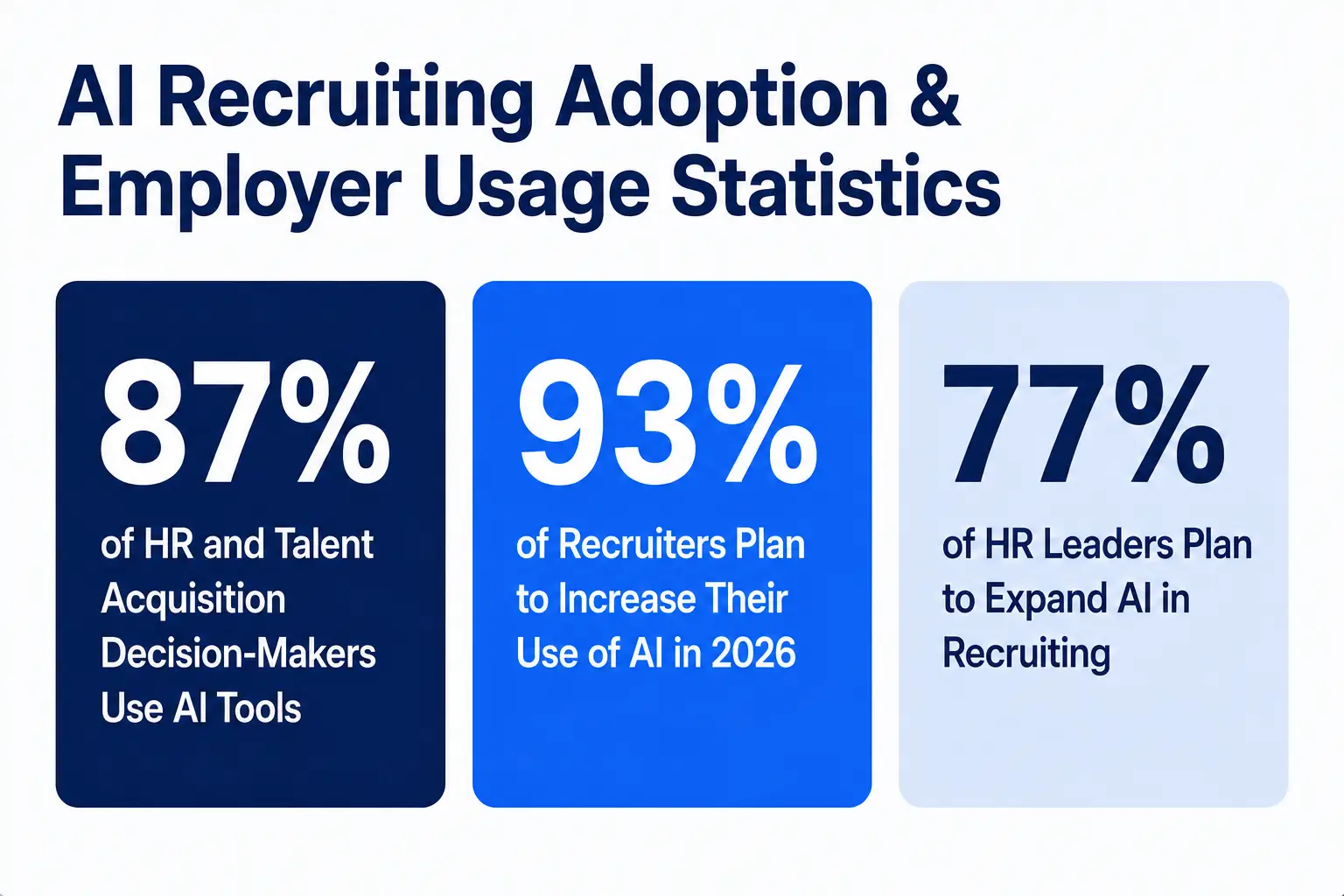
56. 87% of HR and Talent Acquisition Decision-Makers Use AI Tools
87% of HR and talent acquisition decision-makers report using AI tools.
AI adoption is no longer limited to experimental recruiting teams. HR and talent leaders are increasingly incorporating AI into everyday workflows, including candidate sourcing, resume review, job-description creation, communication, and administrative tasks.
The high adoption rate also shows that the conversation around AI in recruiting is shifting from whether organizations should use AI to how they should use it effectively and responsibly. (Incruiter Report)
57. 93% of Recruiters Plan to Increase Their Use of AI in 2026
93% of recruiters plan to increase their use of AI in 2026.
The figure indicates that recruiting teams that have already adopted AI are generally looking to expand its role rather than scale it back.
This expansion can include moving AI beyond basic content generation into sourcing, candidate matching, screening, interview preparation, analytics, and workflow automation.
As organizations gain more experience with AI, they are also becoming more selective about where the technology creates measurable value. (Incruiter Report)
58. 77% of HR Leaders Plan to Expand AI in Recruiting
77% of HR leaders plan to expand their use of AI in recruiting.
The statistic demonstrates that AI adoption is increasingly becoming part of longer-term talent-acquisition strategy. Rather than treating AI as a one-time technology project, HR leaders are looking at additional recruiting use cases and broader implementation.
Expansion can involve adding AI capabilities to existing applicant tracking systems, introducing specialized recruiting tools, or increasing the number of recruitment stages supported by AI. (Incruiter Report)
59. 25.9% of Employers Used AI in Recruitment in 2025
25.9% of employers reported using AI in recruitment in 2025.
This figure provides a broader measure of employer adoption and demonstrates that AI recruiting had moved beyond isolated experimentation by 2025.
Employers are applying AI across multiple parts of the hiring process, including sourcing, screening, candidate communication, job-description creation, and candidate assessment.
The adoption rate also provides an important benchmark for measuring future growth as organizations continue investing in AI-enabled recruiting technologies. (Incruiter Report)
AI Recruiting Bias, Trust & Legal Compliance Statistics
Growing AI adoption in recruiting has surfaced parallel concerns around fairness, transparency, and legal exposure. Regulators in multiple jurisdictions have begun requiring audits and disclosures, while candidate trust in automated hiring decisions remains mixed.
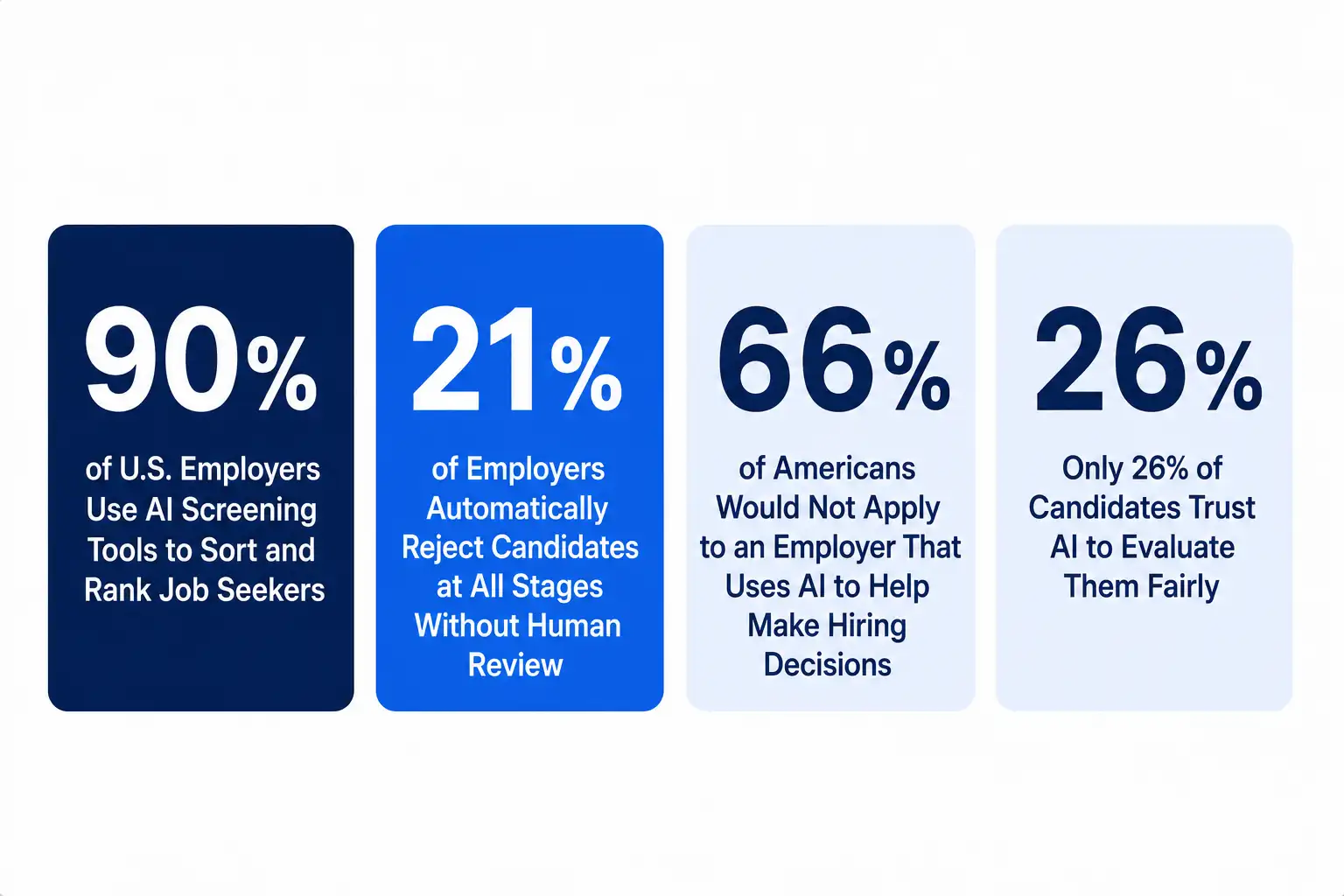
60. 90% of U.S. Employers Use AI Screening Tools to Sort and Rank Job Seekers
90% of U.S. employers use AI screening tools to sort and rank job seekers, according to the first large-scale study of hiring algorithms deployed in the wild.
Most employers rely on the same handful of third-party vendors for these systems, which means bias or errors in a single vendor's model can affect candidate outcomes across a large share of the labor market simultaneously.
This concentration also raises the stakes for auditing and oversight, since a flaw discovered in one widely used system could have outsized downstream effects on hiring fairness across many employers at once. (Stanford HAI)
61. 26% of Black Applicants and 15% of Asian Applicants Faced AI Discrimination in a Major Study
A large-scale audit of hiring algorithms found that 26% of Black applicants and 15% of Asian applicants applied to positions where the AI system discriminated against their racial group, measured against U.S. Title VII adverse-impact standards.
The findings demonstrate that algorithmic bias in hiring is not merely theoretical. Even systems presented as neutral or objective can reproduce and, in some cases, amplify existing patterns of discrimination present in historical hiring data.
This has direct implications for employer liability, since disparate impact under existing civil rights law does not require intent to discriminate, only a demonstrable disparate outcome. (Stanford HAI)
62. 21% of Employers Automatically Reject Candidates at All Stages Without Human Review
About 21% of employers automatically reject candidates at every stage of the hiring process without any human review taking place.
Fully automated rejection removes the safeguard of human judgment that might otherwise catch qualified candidates who were miscategorized by an algorithm, whether due to unconventional career paths, resume formatting issues, or gaps in employment.
This statistic is often cited alongside concerns about "false negative" rejections, where AI systems screen out candidates who would have performed well in the role but did not match the system's learned pattern of a "good" applicant. (ResumeBuilder, cited in SQ Magazine)
63. 71% of Americans Oppose Letting AI Make the Final Hiring Decision
71% of Americans oppose allowing AI to make the final hiring decision on its own.
This figure highlights a persistent gap between employer enthusiasm for AI efficiency and public comfort with automated decision-making in consequential, life-affecting processes like employment.
The finding reinforces why many organizations continue to position AI as a decision-support tool rather than a decision-maker, keeping a human accountable for the final call even when AI heavily informs the process. (Pew Research Center - Americans' Views on Use of AI in Hiring)
64. 66% of Americans Would Not Apply to an Employer That Uses AI to Help Make Hiring Decisions
66% of Americans say they would not want to apply for a job at a company that uses AI to help make hiring decisions.
This candidate resistance can create a real recruiting cost for organizations that are not transparent about how and where they use AI, since qualified candidates may self-select out of the applicant pool entirely before ever submitting an application.
Employer transparency about AI use, rather than AI use itself, may therefore be a more important lever for protecting employer brand and applicant volume. (Pew Research Center)
65. Only 26% of Candidates Trust AI to Evaluate Them Fairly
Only about 26% of candidates say they trust AI systems to evaluate them fairly during the hiring process.
This low trust figure exists even as candidates report relatively high satisfaction with AI-powered chatbots and communication tools earlier in the funnel, suggesting the trust gap is concentrated specifically around evaluative and decision-making uses of AI rather than administrative ones.
The distinction matters for employers designing their AI strategy: candidates appear far more receptive to AI handling scheduling or FAQs than to AI scoring or ranking their qualifications. (Gartner Survey)
66. HR Confidence in AI Hiring Systems Rose From 37% to 51% in a Year
Confidence in AI hiring systems among HR professionals rose from 37% to 51% year-over-year, based on a global survey of more than 4,000 respondents.
The increase suggests that as HR teams gain hands-on experience with AI tools, initial skepticism gives way to greater trust, likely as processes are refined and early implementation issues are resolved.
However, even at 51%, confidence remains far from universal, indicating that many HR leaders still see meaningful room for improvement in AI reliability and fairness. (HireVue 2025 Global Survey, cited in SQ Magazine)
67. AI Adoption Among HR Professionals Rose From 58% to 72% in a Single Year
AI adoption among HR professionals surged from 58% in 2024 to 72% in 2025, based on a global survey of more than 4,000 respondents.
This figure differs from other adoption statistics because it measures individual HR professionals' personal use of AI tools rather than organization-wide policy adoption, capturing a broader and faster-moving trend of grassroots AI usage within HR teams.
The gap between this figure and more conservative organization-level adoption numbers suggests that individual practitioners are often adopting AI tools faster than their organizations formally sanction or govern. (HireVue 2025 Global Survey, cited in SQ Magazine)
68. EU AI Act Classifies Hiring Algorithms as High-Risk, With Fines Up to €15 Million
The EU AI Act classifies AI tools used for employment decisions, worker management, and access to self-employment as "high-risk," carrying fines of up to €15 million or 3% of global annual turnover, whichever is higher.
High-risk classification imposes significant compliance obligations on employers and vendors operating in the EU, including conformity assessments, transparency documentation, and mandatory human oversight of automated employment decisions.
Multinational employers using AI recruiting tools across jurisdictions increasingly need to design compliance processes that satisfy the strictest applicable regional standard rather than treating each market separately. (SQ Magazine)
69. Colorado's AI Act Requires Reasonable Care to Prevent Algorithmic Discrimination in Hiring
Colorado's AI Act requires developers and users of AI hiring tools to exercise reasonable care to prevent algorithmic discrimination, joining a growing list of state and municipal regulations governing automated hiring decisions.
This adds to a patchwork of U.S. state-level requirements that employers must navigate, alongside New York City's Local Law.
The trend suggests that U.S. employers will increasingly need a compliance framework capable of adapting to jurisdiction-specific AI hiring regulations rather than a single national standard. (Sanford Heisler Sharp)
70. NYC Local Law 144 Requires Annual Independent Bias Audits of Hiring Algorithms
Under NYC Local Law 144, employers using automated employment decision tools must conduct an annual bias audit performed by an independent auditor, measuring selection rates and impact ratios by race, ethnicity, and sex, and publicly report the results.
This was among the first laws in the U.S. to require proactive, ongoing algorithmic auditing in hiring, rather than relying solely on after-the-fact discrimination complaints.
The law has since become a reference model that other jurisdictions have used when drafting their own AI hiring regulations. (Curriculo ATS — AI Hiring Bias in 2026)
AI Chatbot & Candidate Engagement Statistics
AI-powered chatbots have become one of the most visible candidate-facing applications of recruiting AI, handling everything from initial inquiries to scheduling. The statistics below examine how chatbots are affecting engagement, satisfaction, and conversion.
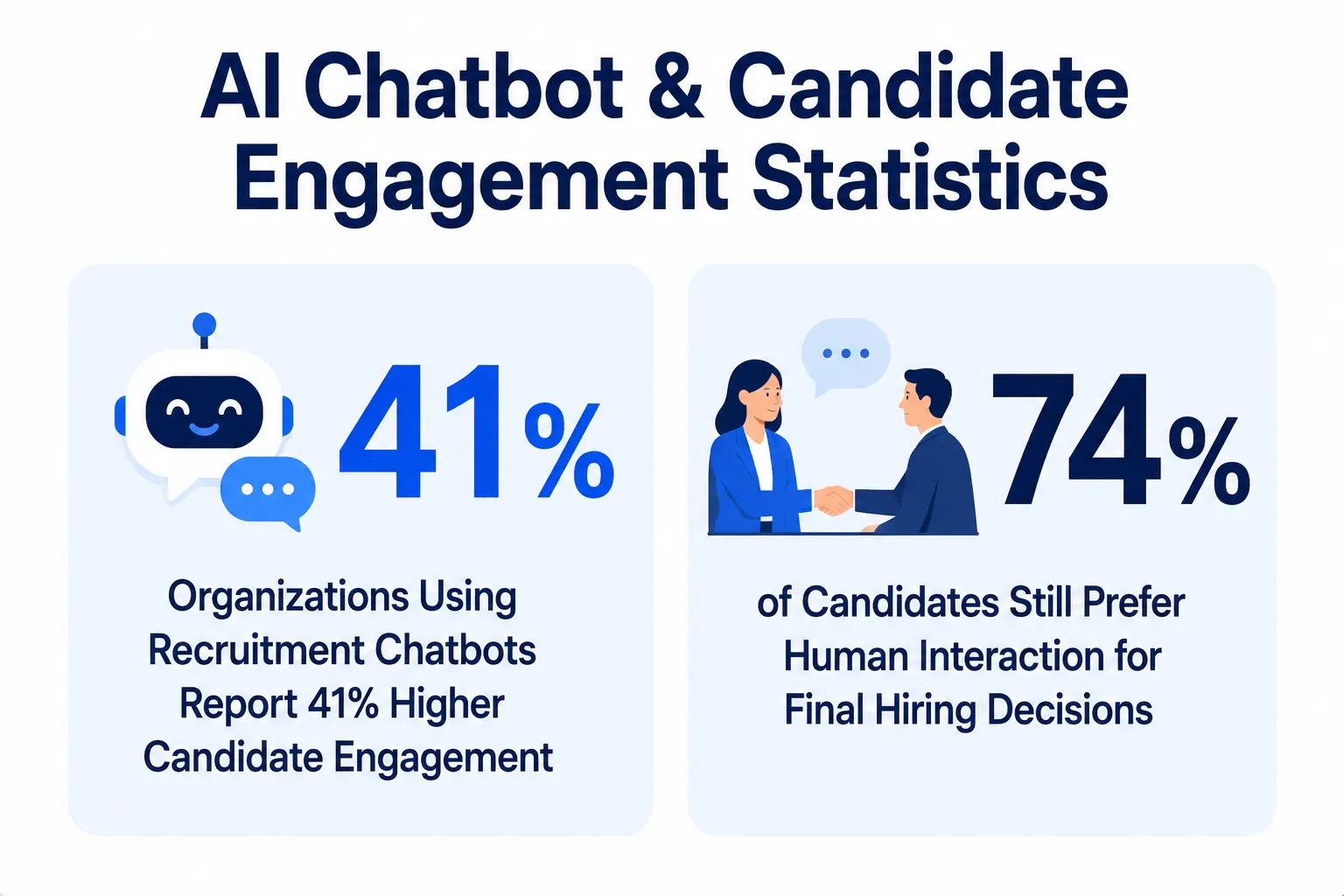
71. Organizations Using Recruitment Chatbots Report 41% Higher Candidate Engagement
Organizations using recruitment chatbots report 41% higher candidate engagement and 34% faster application completion rates.
Chatbots can reduce the friction candidates experience during the early stages of an application by providing instant answers to common questions, rather than requiring candidates to wait for a recruiter's response.
This speed advantage matters most for high-volume, competitive hiring, where slow initial response times can cause candidates to abandon an application entirely in favor of a faster-moving employer. (ZipRecruiter chatbot analysis, cited in StealthAgents)
72. 76% of Candidates Are Satisfied With AI Chatbot Response Speed
76% of candidates report satisfaction with the speed of AI chatbot responses during recruiting, while a slightly smaller share, 68%, are satisfied with the accuracy of the answers those chatbots provide.
The gap between speed satisfaction and accuracy satisfaction suggests that while candidates value fast responses, there remains room for improvement in how well AI systems actually understand and answer nuanced candidate questions.
Employers deploying chatbots may need to balance investment in response latency against investment in answer quality and knowledge-base accuracy. (Gartner data, cited in StealthAgents)
73. 74% of Candidates Still Prefer Human Interaction for Final Hiring Decisions
Despite generally positive experiences with AI chatbots earlier in the process, 74% of candidates still prefer human interaction when it comes to final hiring decisions.
This reinforces a consistent theme across candidate experience research: automation is broadly welcomed for administrative, low-stakes interactions but is far less welcomed for consequential, high-stakes moments in the hiring journey.
Organizations that automate too aggressively at the final decision stage risk damaging candidate trust even if the same automation was well received earlier in the funnel. (Gartner data, cited in StealthAgents)
74. L'Oréal's AI Chatbot Engaged With 92% of Candidates and Achieved Nearly 100% Satisfaction
L’Oréal’s Mya AI chatbot engaged effectively with 92% of candidates in its first 10,000 recruiting conversations and achieved a near-100% candidate satisfaction rate.
L’Oréal deployed Mya to handle high-volume recruiting interactions, including answering candidate questions and checking basic job requirements. The company receives more than 1 million applications per year, making automated candidate communication particularly valuable.
The results suggest that AI can improve the candidate experience when it is used to provide fast, personalized communication and support rather than replace human decision-making. (L'Oréal — Using AI to Improve Candidate Experience)
75. Unilever's AI-Powered Hiring Program Saved 50,000+ Recruiter Hours Annually
Unilever's AI-powered video interviews and predictive analytics for its Future Leaders programme process over 250,000 applications a year to hire roughly 800 people, saving 50,000+ recruiter hours annually and generating £1 million in cost savings.
The program also reported a 16% increase in the diversity of new hires and a 96% candidate completion rate, suggesting that well-designed AI screening does not have to come at the expense of either efficiency or inclusion. (Unilever's results are among the most frequently cited enterprise-scale benchmarks in the AI recruiting industry)
76. 62% of Job Seekers Believe AI Gives Them a Better Chance of Being Hired
62% of job seekers believe they have a better chance of being hired when AI is used in recruiting and hiring processes.
Capterra's survey of nearly 3,000 job seekers across 12 countries also found that 70% believe AI is generally less biased than humans when evaluating candidates. (Capterra)
Job Seekers-Side AI Use Statistics
As employers deploy AI throughout recruiting, candidates are increasingly turning to their own AI tools to research companies, write applications, and even assist during interviews. The following statistics illustrate how widespread and, at times, how covert this candidate-side AI use has become.
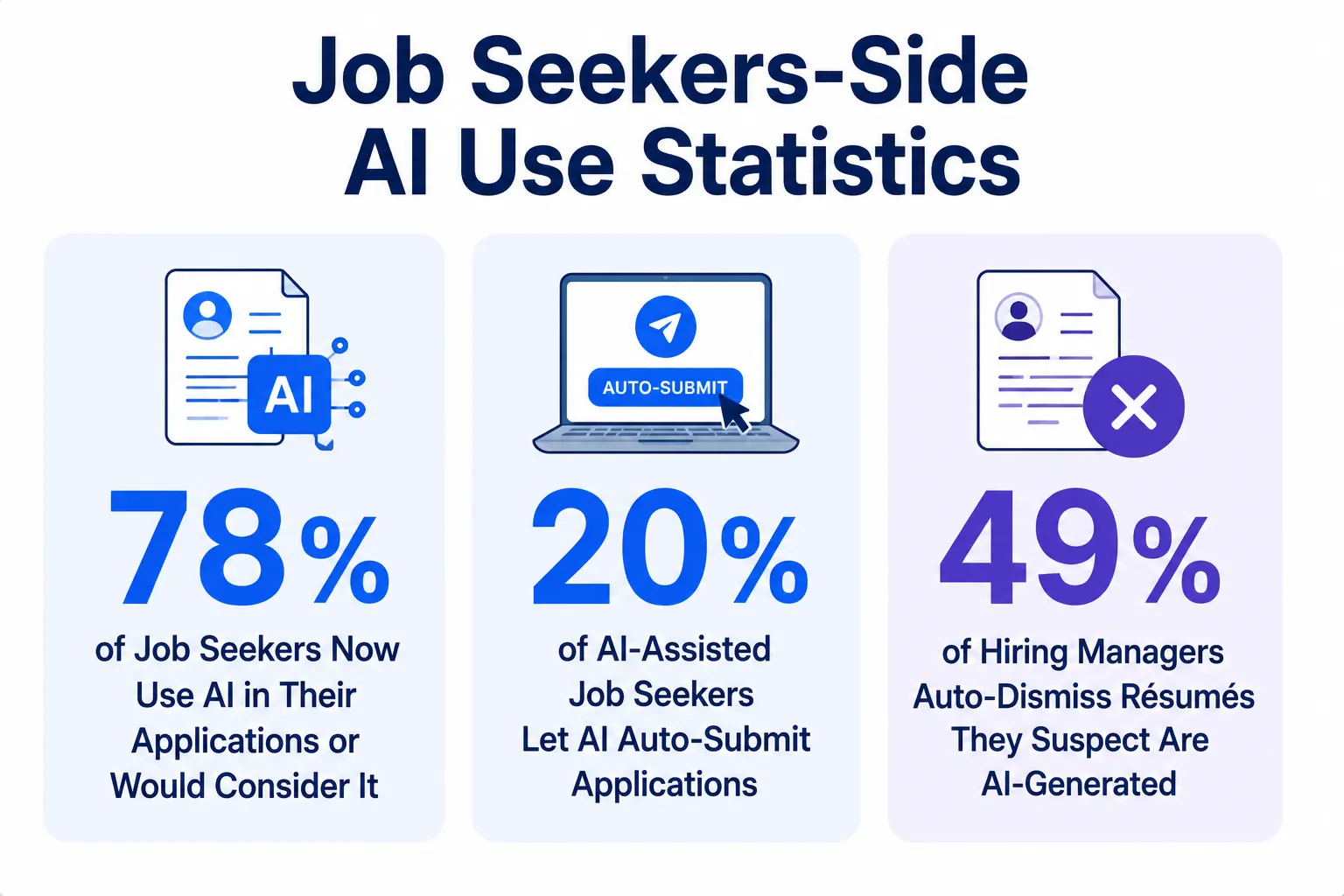
77. 78% of Job Seekers Now Use AI in Their Applications or Would Consider It
78% of job seekers now use AI somewhere in their job applications or say they would consider doing so, and 63% report having sat through an AI-run interview in the past six months.
This figure captures both active and prospective AI use, suggesting that even among candidates not currently using AI tools, the large majority view it as a legitimate part of the modern job search rather than something to avoid.
The scale of this adoption creates growing pressure on employers to develop clear, published policies on what forms of candidate AI use are and are not acceptable. (Resume Genius, 2026)
78. 1 in 3 Job Seekers Uses AI to Find Work, Receiving 40% More Job Offers
A survey of 500 U.S. job seekers found that one in three now uses AI in their job search, and receives 40% more job offers as a result.
The productivity benefit associated with AI-assisted job searching may be contributing to a broader normalization of the practice, even as many candidates remain reluctant to disclose it openly to employers.
Notably, 54.2% of surveyed job seekers say they would never tell an employer they used AI, and only about one in eight always discloses it. (GlobeNewswire )
79. 20% of AI-Assisted Job Seekers Let AI Auto-Submit Applications
Among job seekers who use AI in their search, 20% let AI submit applications automatically on their behalf, and one in ten reports that AI was feeding them prompts during a live interview.
This level of automation goes considerably further than using AI simply to draft or edit materials, raising new questions for employers about how to verify that the person interviewing is actually the person who applied and prepared the responses.
The practice also complicates traditional recruiting funnel metrics, since AI-driven mass application could inflate apparent candidate interest without a corresponding increase in genuinely qualified or interested applicants. (GlobeNewswire )
80. 72% of Job Seekers Have Used ChatGPT to Write a Cover Letter
72% of job seekers report having used ChatGPT to write a cover letter, and 51% have used it to write a resume.
The near-universal availability of generative AI tools has made AI-assisted application writing the norm rather than the exception, which has significant implications for how recruiters interpret the polish and structure of the materials they receive.
As AI-assisted writing becomes standard, the differentiating signal for recruiters is shifting away from writing quality itself and toward specificity, personalization, and verified skills. (Resume Now / Huntr 2025 data, cited in DetectionDrama)
81. 49% of Hiring Managers Auto-Dismiss Résumés They Suspect Are AI-Generated
49% of U.S. hiring managers say they automatically dismiss résumés they identify as AI-generated, while 62% specifically reject AI-generated résumés that lack personalization.
The gap between these two figures suggests that outright AI use is not necessarily disqualifying on its own; the deciding factor for many hiring managers is whether the resulting content still feels genuine and tailored to the specific role.
This distinction is important for candidates: using AI as an editing aid appears far less risky than submitting fully AI-generated, generic content. (Resume.io 2026 Hiring Survey, cited in Hirelytica)
82. AI-Assisted Résumé Editing Increased Hire Rates by 7.8% in a Randomized Trial
A randomized controlled trial of 480,948 jobseekers found that AI-assisted résumé editing of human-written prose increased hire rates by 7.8%, and lifted resulting wages by 8.4% for candidates in the treatment group.
Critically, the study found the benefit came specifically from AI editing existing human-written content, not from AI generating a résumé from scratch, a distinction often lost in less rigorous survey-based statistics.
This is one of the few AI recruiting statistics based on a true randomized controlled trial rather than a self-reported survey, giving it stronger methodological weight than most figures in this space. (NBER Working Paper 30886, cited in JobCannon)
83. Only 1 in 3 Recruiters Say They Can Spot a ChatGPT Résumé in Under 20 Seconds
About one in three recruiters say they can identify an AI-generated résumé in under 20 seconds, typically by spotting generic buzzwords, vague accomplishments, and uniform sentence structure.
This suggests that while many recruiters believe they can detect AI-written content, actual detection ability may be inconsistent, and blind testing often reveals lower accuracy than recruiters self-report.
The gap between perceived and actual detection ability is an important caveat when interpreting employer confidence statistics about spotting AI use. (ResumeVera)
AI Recruiting Cost, Time & ROI Statistics
For many organizations, the ultimate business case for AI recruiting comes down to measurable cost and time savings. The statistics below quantify the financial return companies report from AI-powered hiring investments.
84. AI Recruiting Tools Deliver an Average ROI of 340% Within 18 Months
Organizations report an average ROI of 340% within 18 months of implementing AI recruiting tools, alongside a roughly 30% reduction in cost-per-hire.
This figure is one of the most widely cited benchmarks in the industry, drawn from an analysis of PwC data, and is frequently used by vendors and analysts to justify continued or expanded AI recruiting investment.
As with most ROI figures, actual results vary considerably based on implementation quality, hiring volume, and how deeply AI is embedded across the recruiting workflow rather than applied as a single point solution. (InCruiter 2026 analysis of PwC data, via Incruiter)
85. The Average U.S. Cost-Per-Hire Is $4,700, Up 14% Since 2019
The average cost per hire in the U.S. is approximately $4,700 for non-executive roles, up 14% from $4,129 in 2019, with average time-to-fill around 44 days.
Rising cost-per-hire figures, even amid growing AI adoption, illustrate that AI implementation alone does not automatically reduce overall recruiting costs; the benefit depends heavily on how effectively the technology is deployed across the hiring funnel.
This baseline figure is frequently used as the denominator against which AI-driven cost-reduction percentages, such as the 30–35% figures cited elsewhere, are calculated. (SHRM 2025 Recruiting Benchmarking Report, cited in SQ Magazine)
86. AI-Enabled Recruiting Teams Complete 66% More Candidate Screens Per Week
A 2025 survey of 380 recruiters found that AI-enabled teams complete 66% more candidate screens per week and spend 41% less time on documentation and administrative tasks.
This productivity gain allows recruiting teams to handle higher application volumes without proportionally increasing headcount, which is particularly valuable during periods of high hiring demand or economic uncertainty about staffing budgets.
The reduction in documentation time also frees up recruiter capacity for higher-value activities such as candidate conversations and stakeholder collaboration. (Pin - Time-to-Hire Metrics)
87. Sourced Candidates Are 5x More Likely to Be Hired Than Inbound Applicants
Candidates proactively identified and contacted by a recruiter, known as sourced candidates, are five times more likely to be hired than candidates who apply inbound.
This statistic highlights why many organizations are investing in AI-powered sourcing tools rather than focusing solely on inbound application screening, since proactive outreach appears to produce meaningfully stronger hiring outcomes.
Despite this advantage, sourcing is often the recruiting stage most neglected by overwhelmed teams managing high application volumes, making AI sourcing automation a particularly high-leverage investment. (Pin - Time-to-Hire Metrics)
88. McKinsey: Talent Acquisition Holds Roughly 20% of Generative AI's Potential HR Value
McKinsey estimates that talent acquisition and recruiting represent roughly 20% of the total potential value generative AI can create within the broader HR function, the largest single share of any HR use case.
This estimate helps explain why recruiting has emerged as one of the earliest and most heavily invested-in areas for generative AI deployment within HR departments, ahead of other functions like performance management or learning and development.
The concentration of potential value in recruiting also suggests that organizations prioritizing AI investment by expected ROI would naturally focus there first. (Pin - Time-to-Hire Metrics via McKinsey)
89. Companies Combining AI Screening With Human Interviews See 25–35% Higher First-Year Retention
Companies that combine AI-assisted candidate matching with human-led final interviews report 25–35% higher first-year retention rates compared with fully manual or fully automated processes.
This finding reinforces the "human-in-the-loop" model favored by many recruiting leaders: AI handles the volume and initial filtering, while humans retain responsibility for the deeper evaluation that appears to correlate with better long-term hiring outcomes.
The retention improvement also strengthens the ROI case for AI recruiting beyond simple time or cost savings, since employee turnover carries its own substantial replacement costs. (LinkedIn data, cited in Incruiter)
90. Blind Screening Cuts Gender Bias in Hiring by 54%
Blind screening approaches, which remove identifying demographic information before AI or human evaluation, have been found to cut gender bias in candidate selection by 54%.
This statistic illustrates a specific, measurable technique organizations can adopt to reduce bias, distinct from broader AI adoption itself, which can sometimes introduce new forms of bias if not carefully designed and audited.
Blind screening is increasingly being combined with AI systems as a bias-mitigation layer rather than treated as a standalone practice. (Incruiter)
AI Recruiting Adoption Scale & Organizational Statistics
The final set of statistics examines how AI adoption in recruiting varies by organization type, size, and use case, along with regulatory developments shaping the near-term future of AI in hiring.
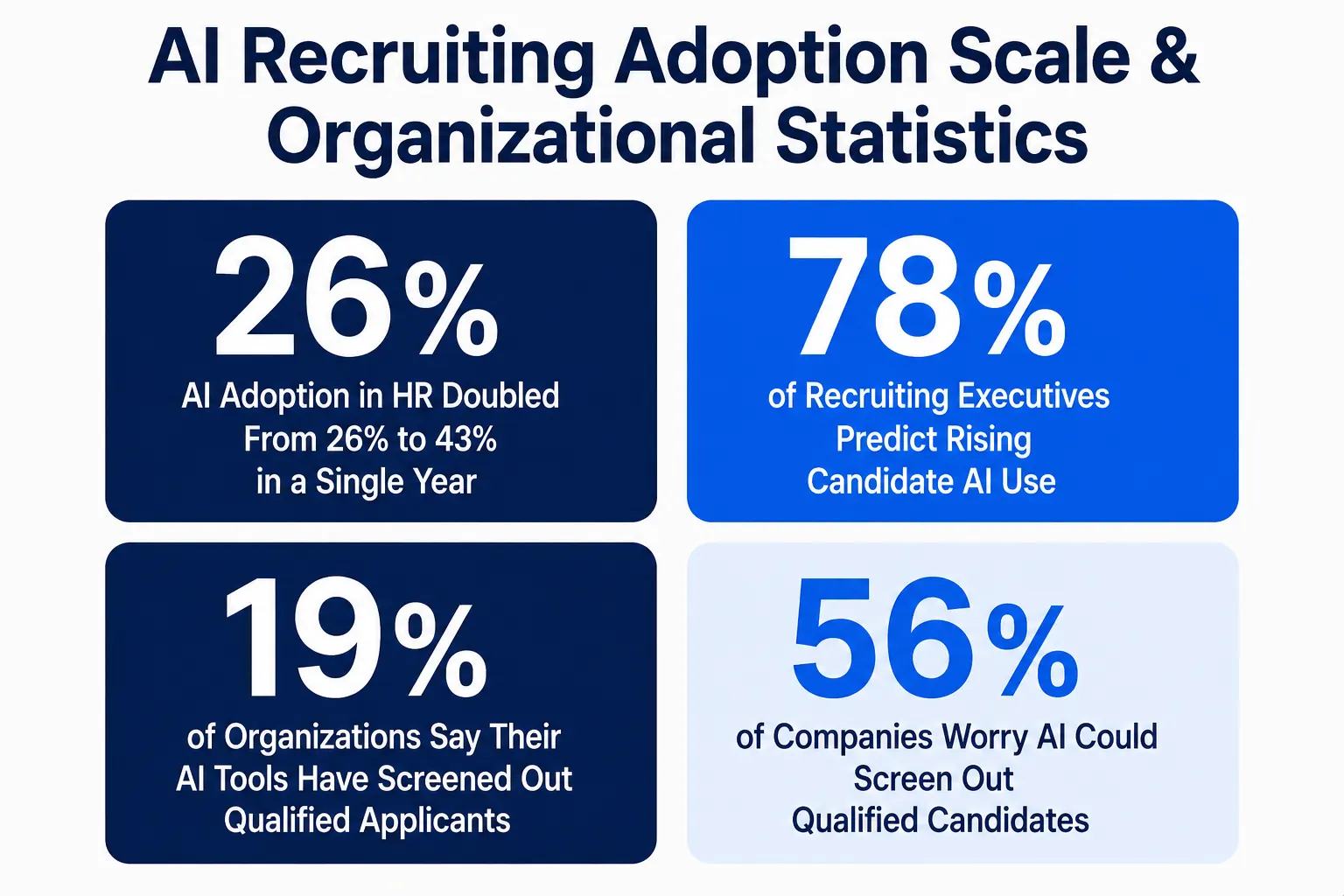
91. AI Adoption in HR Doubled From 26% to 43% in a Single Year
AI adoption across HR tasks climbed to 43% in 2025, up from 26% in 2024, a jump SHRM researchers describe as a "step-change" rather than gradual growth.
The pace of this increase suggests that what was a pilot program for most enterprise HR teams as recently as a couple of years earlier has, for a large share of organizations, become standard operating procedure.
This trajectory is frequently cited as the headline statistic anchoring most 2026 AI recruiting reports because it captures the scale of the shift more clearly than any single use-case figure. (SHRM - 2025 Talent Trends)
92. Publicly Traded For-Profit Organizations Lead AI Adoption in HR at 58%
Publicly traded for-profit organizations lead AI adoption in HR at 58%, ahead of private for-profits (45%), nonprofits (38%), state and local governments (35%), and the federal government (19%).
Since publicly traded organizations are held to defined profit-margin and revenue targets, their higher AI adoption suggests these companies see HR automation as a critical enabler for meeting financial performance goals.
The gap between sectors also indicates that AI recruiting adoption is not evenly distributed across the economy, and nonprofit and government employers may face different resource or compliance constraints slowing their adoption. (SHRM)
93. AI Adoption Splits Sharply by Company Size: 60% of Large Firms vs. 33% of Small Firms
AI adoption in HR splits significantly by organization size: about 60% of organizations with 5,000 or more employees use AI in HR, compared to just 33% of organizations with fewer than 100 employees.
This gap likely reflects differences in available budget, technical infrastructure, and dedicated HR technology staff, all of which tend to favor larger organizations when it comes to adopting and integrating new recruiting technology.
Smaller organizations may increasingly close this gap as AI recruiting tools become cheaper and more accessible through off-the-shelf SaaS products rather than requiring custom enterprise implementation. (SHRM's 2026 State of AI in HR report)
94. 78% of Recruiting Executives Predict Rising Candidate AI Use
Nearly 4 in 5 (78%) of recruiting executives predict that job candidates will increasingly use AI to apply for open positions.
This expectation reflects a growing acknowledgment among recruiting leadership that candidate-side AI adoption is now a permanent and growing feature of the hiring landscape rather than a temporary trend.
The finding also underscores why many organizations are simultaneously investing in AI-generated content detection and authenticity verification, alongside their own AI-powered screening tools. (SHRM talent trends survey, cited in SQ Magazine)
95. Only 30% of Organizations Are Regularly Using Generative AI in Recruiting
Despite high overall AI adoption figures, only about 30% of organizations are regularly using generative AI specifically in their recruiting processes.
This distinction matters because "AI" in recruiting spans a wide range of technologies, from older rules-based automation and applicant tracking algorithms to newer generative AI tools capable of drafting content or holding conversations.
The relatively low regular-use figure for generative AI specifically suggests that much of the reported overall AI adoption still relies on more established, non-generative automation. (Mercer data, cited in SQ Magazine)
96. 19% of Organizations Say Their AI Tools Have Screened Out Qualified Applicants
19% of organizations using automation or AI in hiring report that their tools had overlooked or screened out qualified applicants.
This self-reported figure is notable because it comes directly from organizations using the technology, rather than from external audits, suggesting that the risk of false-negative rejections is a known and acknowledged issue even among AI adopters themselves.
The statistic reinforces why maintaining some form of human review, spot-checking, or override capability remains important even in largely automated screening workflows. (SHRM analysis, cited in SQ Magazine)
97. 56% of Companies Worry AI Could Screen Out Qualified Candidates
56% of companies express concern that their AI recruiting tools could inadvertently screen out qualified candidates.
This concern is notably higher than the 19% of organizations that report having actually experienced the problem, suggesting that anxiety about AI screening errors may be running ahead of confirmed incidents, at least based on what organizations are able to detect and report.
The gap could also reflect limited visibility: organizations may simply be unaware of qualified candidates their systems have silently filtered out, making the true rate of false negatives difficult to measure with confidence. (ResumeBuilder survey data, cited in SQ Magazine)
98. Mobley v. Workday Alleges Systemic AI Discrimination Across Hundreds of Employers
A pending federal case, Mobley v. Workday, alleges that Workday's AI screening tools systematically discriminated against older, Black, and disabled applicants across hundreds of employers using the platform.
The case is widely watched because a ruling against Workday could establish that AI vendors, not just the employers who deploy their tools, can bear legal liability for discriminatory hiring outcomes.
This has significant implications for how recruiting technology vendors design, test, and audit their systems going forward, regardless of the case's ultimate outcome. (Employer Branding News)
99. Interview-Cheating Flags Jumped From 9% to 38.5% of Interviews Within Six Months
The share of technical interviews flagged for suspected AI-assisted cheating jumped from roughly 9% to 38.5% within a single six-month window in 2026.
This dramatic rise reflects both the growing availability of real-time AI interview assistance tools and improved detection capabilities among interview platforms now actively monitoring for this behavior.
The trend is prompting many technical hiring teams to reconsider remote, unsupervised coding assessments in favor of live, proctored, or in-person technical evaluations. (Truffle)
100. EU Pushed AI Act's High-Risk Compliance Deadline for Hiring Tools to December 2027
The EU pushed back its AI Act high-risk compliance deadline for employment-related AI tools from August 2026 to December 2027, after the Digital Omnibus cleared final Council approval on June 29, 2026.
The delay gives employers and AI vendors additional time to prepare compliance documentation, conformity assessments, and human oversight processes required under the high-risk classification for hiring algorithms.
Despite the extended timeline, organizations operating in the EU are generally advised to continue compliance preparation on the original schedule, since further regulatory changes before the new deadline remain possible. (European Council / Digital Omnibus tracking, June 2026, cited in Truffle)
Conclusion: AI Is Reshaping Recruiting in 2026
AI is no longer an emerging technology in recruitment. The statistics in this report show that organizations are increasingly using AI across sourcing, resume screening, candidate communication, interviewing, scheduling, and hiring analytics. At the same time, recruiters are reporting improvements in efficiency, hiring speed, and productivity.
But the data also shows that AI adoption is moving faster than candidate trust. Candidates continue to raise concerns about fairness, transparency, bias, privacy, and the amount of human involvement in hiring. Only a small share of candidates believe employers are using AI responsibly and transparently, highlighting the growing gap between how employers and candidates experience AI-powered recruitment.
Another major trend is that AI is transforming both sides of the hiring process. Employers are using AI to automate recruiting workflows and handle increasing application volumes, while candidates are using AI to write resumes and cover letters, prepare for interviews, research employers, and navigate their job searches. This creates new challenges around candidate authenticity, AI-assisted interviews, application spam, deepfakes, and recruitment fraud.
The statistics also make one point clear: the future of AI recruiting is unlikely to be fully automated hiring. Human judgment remains important, particularly for interviews, final decisions, candidate relationships, and situations where context and fairness matter. The strongest recruiting strategies will combine AI's ability to process information and automate repetitive work with human oversight, transparency, and meaningful candidate interaction.
As AI adoption continues to expand through 2026 and beyond, organizations that focus not only on efficiency but also on trust, fairness, candidate experience, and responsible implementation will be better positioned to use AI effectively. The goal should not be to automate every part of hiring, but to use AI where it creates genuine value while keeping people at the center of important employment decisions.