
Back to all blogs
Learn what are deepfakes, how they are created, how to detect deepfake interviews, and how organizations can prevent candidate impersonation and hiring fraud with AI-powered detection tools.

Remote hiring has transformed recruitment by enabling organizations to access talent from anywhere in the world. Video interviews, online assessments, and virtual onboarding have become standard hiring practices. However, the same technology that makes hiring faster and more efficient has also created opportunities for a new form of recruitment fraud: deepfakes.
Deepfakes are AI-generated or AI-manipulated videos, images, and audio recordings designed to imitate real people. Using advanced machine learning models, fraudsters can create synthetic candidates, clone voices, alter facial appearances, or even conduct entire job interviews using fake identities. As these technologies become more accessible, recruiters are finding it increasingly difficult to determine whether the person on the screen is genuinely the candidate they claim to be.
The threat is no longer theoretical. According to industry research, 31% have interviewed a candidate who was later revealed to be using a fake identity, while 35% say someone other than the listed applicant has participated in a virtual interview. 23% report losses of more than $50,000 in the past year due to hiring or identity fraud, and 10% say losses exceeded $100,000.
The impact on organizations can be significant. Recent reports suggest that 41% of organizations have unknowingly hired fraudulent candidates, exposing businesses to financial losses, security risks, intellectual property theft, and compliance challenges. Gartner also predicts that by 2028, one in four candidate profiles globally could be fake or fraudulent.
In this guide, we will explore what deepfakes are, how they work, why they pose a growing threat to modern recruitment, and the most effective ways to detect deepfakes during interviews before they become costly hiring mistakes.
What Are Deepfakes?
Deepfakes are synthetic media created using artificial intelligence to imitate a real person’s appearance, voice, expressions, or actions. The term “deepfake” combines “deep learning” and “fake,” referring to AI models that learn from large amounts of data to generate highly realistic but fabricated content.
Deepfakes can take several forms, including:
AI-generated videos that make someone appear to say or do things they never did
Voice clones that replicate a person’s speech patterns and tone
Face-swapped videos where one individual’s face is digitally placed onto another person’s body
Real-time deepfakes that alter a person’s appearance during live video calls or virtual meetings
While deepfake technology has legitimate applications in entertainment, education, and content creation, it is increasingly being used for fraud, impersonation, misinformation, and cybercrime.
How Do You Spot a Deepfake?
Spotting a deepfake is becoming increasingly difficult as AI technology improves. Early deepfakes often contained obvious flaws such as unnatural blinking, poor lip synchronization, facial distortions, or inconsistent lighting. However, many of these weaknesses have been addressed by newer AI models, making manual detection far more challenging.
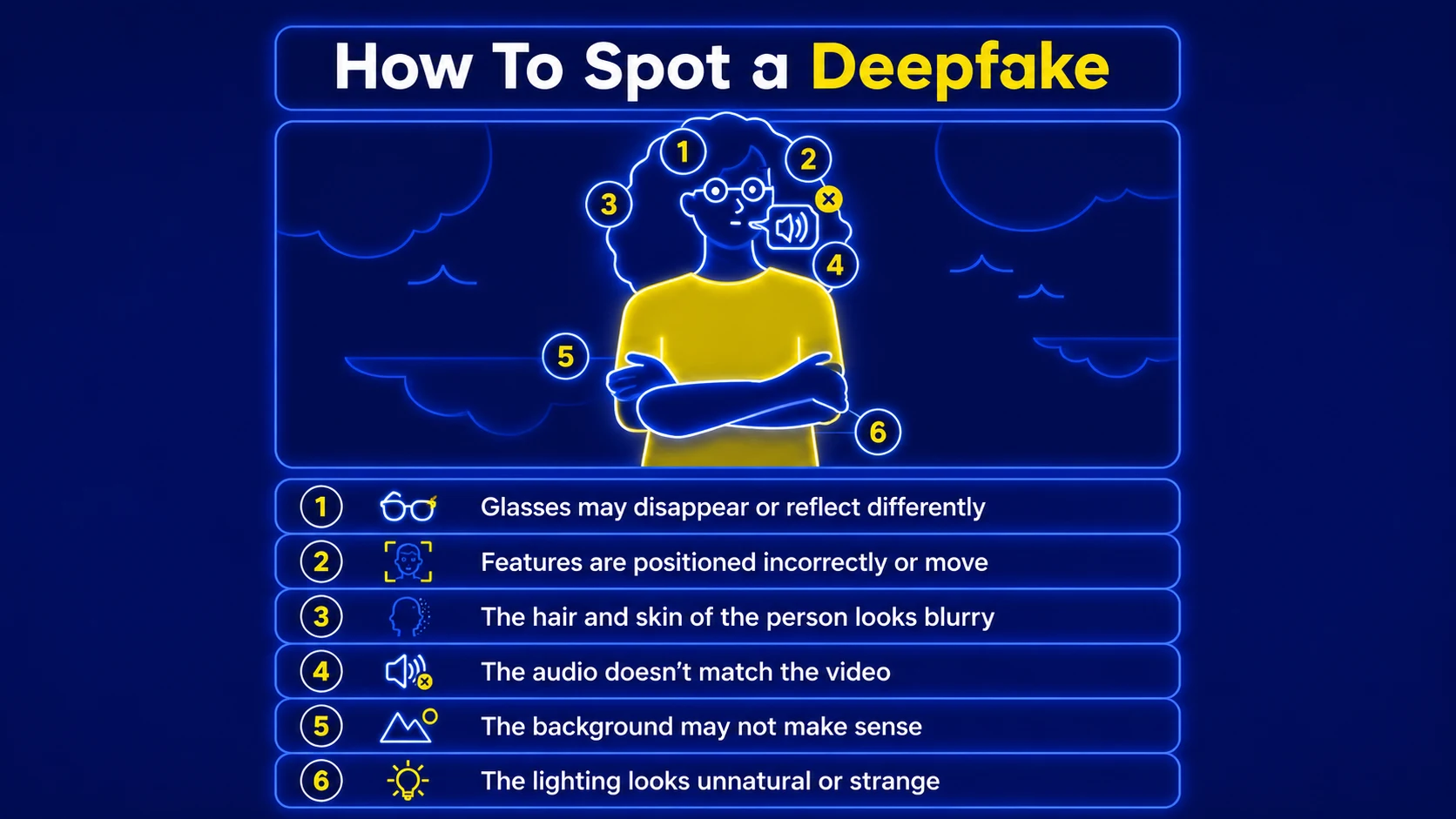
Today, some common warning signs include:
Lip movements that do not perfectly match speech
Flickering or blurred facial edges
Unnatural skin textures or facial expressions
Strange lighting, shadows, or reflections in the eyes
Poorly rendered hair, teeth, or jewelry
Because visual clues alone are no longer reliable, researchers have developed advanced deepfake detection systems trained on large datasets. One of the most widely used resources is the Deepfake Detection Challenge (DFDC) dataset, created by Meta, Microsoft, Amazon Web Services, and academic partners. The dataset contains more than 100,000 video clips sourced from 3,426 paid actors, making it one of the largest publicly available datasets for training and evaluating deepfake detection models.
For recruitment teams, the most effective approach combines human observation with identity verification, liveness detection, and AI-powered solutions such as Sherlock AI to identify deepfake interview fraud and candidate impersonation attempts.
How to Detect Deepfakes
Detecting deepfakes has become increasingly challenging as AI-generated content becomes more realistic. Modern deepfake tools can replicate facial expressions, synchronize lip movements, and clone voices with remarkable accuracy. However, even sophisticated deepfakes often leave behind subtle signs that recruiters and hiring teams can identify.
When conducting virtual interviews, organizations should look for a combination of visual, behavioral, and technical indicators rather than relying on a single detection method. Experts recommend examining facial movements, audio consistency, contextual clues, and identity verification signals to identify potential deepfakes.
1. Look for Lip-Sync Mismatches
One of the most common indicators of a deepfake is inconsistent synchronization between speech and lip movements. While AI-generated videos have improved significantly, they can still struggle to perfectly match every spoken word with natural mouth movements.
Warning signs include:
Delayed lip movements
Speech that appears out of sync with facial expressions
Distorted mouth shapes during fast conversations
Unnatural jaw movements
During interviews, recruiters should pay close attention when candidates speak rapidly or answer unexpected questions, as deepfake systems often perform less effectively in these situations.
2. Watch for Unnatural Eye Movements and Blinking
Human blinking follows natural patterns that AI models often struggle to replicate consistently.
Potential red flags include:
Excessive blinking
Very little blinking
Eyes that appear fixed on the screen
Unnatural eye movement during conversation
Delayed reactions when shifting focus
Candidates using deepfake software may display eye movements that feel robotic or disconnected from the flow of conversation.
3. Check for Facial Distortions and Visual Artifacts
Deepfake technology frequently introduces subtle visual inconsistencies around manipulated facial regions.
Common indicators include:
Blurry edges around the face
Flickering facial features
Distorted ears or hairlines
Unnatural skin texture
Inconsistent facial proportions
These artifacts may become more noticeable when a candidate turns their head, changes expressions, or moves quickly during a video interview.
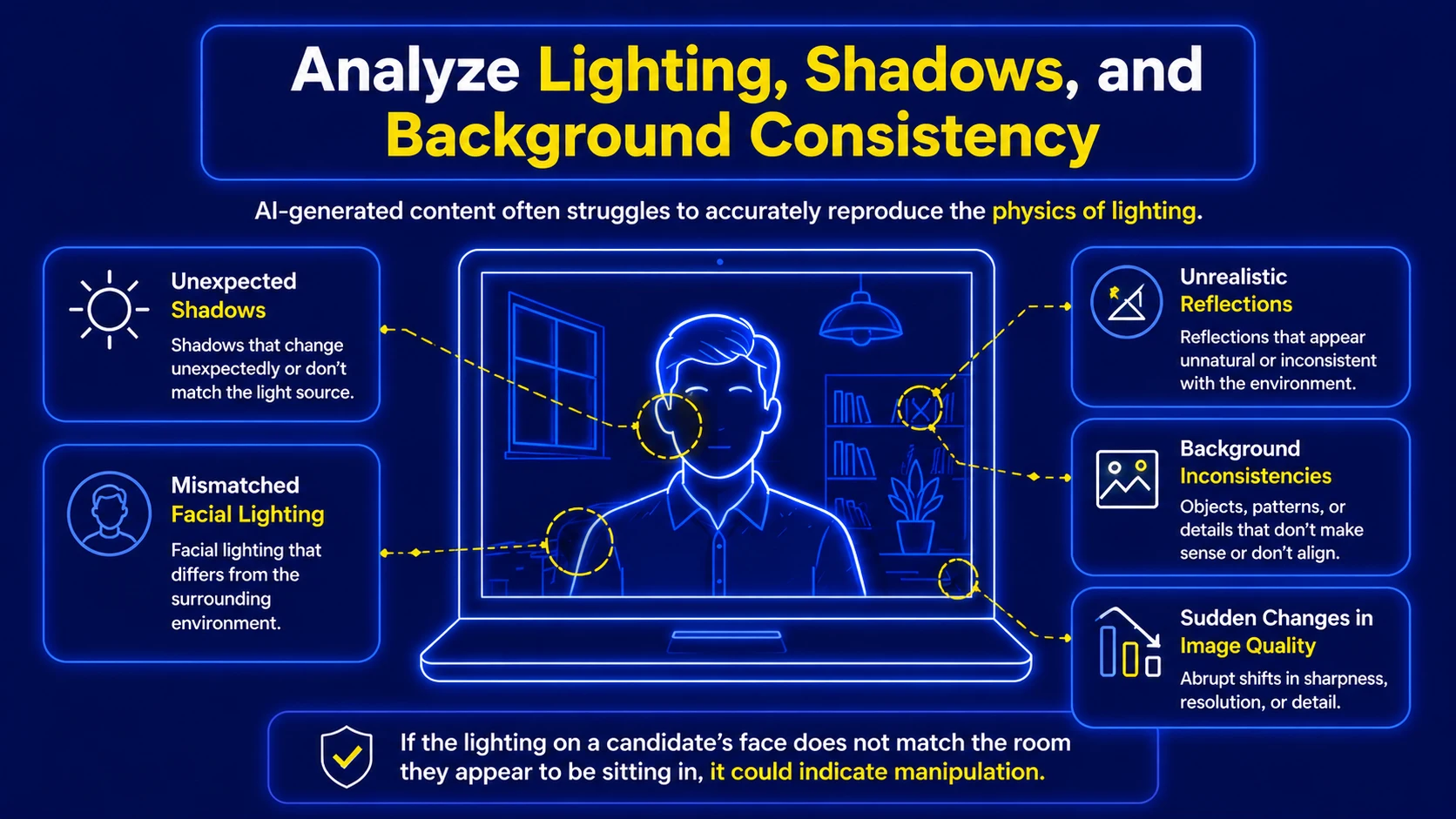
4. Analyze Lighting, Shadows, and Background Consistency
AI-generated content often struggles to accurately reproduce the physics of lighting.
Watch for:
Shadows that change unexpectedly
Facial lighting that differs from the surrounding environment
Reflections that appear unrealistic
Background inconsistencies
Sudden changes in image quality
If the lighting on a candidate’s face does not match the room they appear to be sitting in, it could indicate manipulation.
5. Listen for Voice Cloning Indicators
Deepfake fraud is not limited to video. Many attackers use AI-generated voice cloning to impersonate candidates.
Possible warning signs include:
Robotic speech patterns
Unusual pauses
Flat emotional tone
Audio distortions
Delayed responses
Recruiters should pay attention to whether the candidate’s voice consistently matches their facial expressions and emotional reactions throughout the interview.
6. Ask Dynamic and Unexpected Questions
Many deepfake systems perform best when conversations follow predictable patterns.
To challenge potential fraud attempts:
Ask candidates to explain recent projects in detail
Request spontaneous demonstrations
Change topics unexpectedly
Ask follow-up questions that require contextual reasoning
Request candidates to perform simple actions on camera
Unexpected interactions can reveal delays, inconsistencies, or technical limitations in real-time deepfake systems. This is one of the most effective manual detection techniques available to interviewers.
7. Verify Candidate Identity Beyond Video
Visual inspection alone is no longer sufficient for deepfake detection.
Organizations should implement:
Government ID verification
Biometric authentication
Liveness detection
Multi-factor identity checks
Cross-verification of employment history
This layered approach reduces the risk of fraudulent candidates bypassing traditional interview processes. Recent reports have shown that fraudsters are increasingly using deepfake technology to bypass facial authentication systems and identity verification checks.
8. Use AI-Powered Deepfake Detection Tools
As deepfake technology evolves, manual review should be supplemented with automated detection systems.
Advanced deepfake detection platforms can analyze:
Facial micro-expressions
Biometric inconsistencies
Audio-video synchronization
Liveness signals
Behavioral anomalies
Identity verification data
AI-powered detection tools provide an additional layer of protection against increasingly sophisticated interview fraud attempts. Experts recommend combining human review with machine learning-based analysis and forensic verification techniques for the highest level of accuracy.
Solutions such as Sherlock AI help organizations strengthen interview security by verifying candidate identity, detecting potential impersonation attempts, analyzing behavioral anomalies, and validating candidate authenticity throughout the hiring process. By combining AI-powered fraud detection with real-time identity verification, organizations can reduce the risk of deepfake interview fraud, proxy interviews, and synthetic candidate identities while improving confidence in hiring decisions.
Why Traditional Detection Methods Are No Longer Enough
While visual clues can help identify some deepfakes, the technology is advancing rapidly. Many modern deepfakes can bypass manual inspection, making it difficult for recruiters to confidently verify candidate authenticity through observation alone.
For organizations conducting remote hiring at scale, the most effective defense is a combination of identity verification, liveness detection, behavioral analysis, and AI-powered fraud prevention. By implementing multiple verification layers, companies can significantly reduce the risk of deepfake interview fraud and ensure they are hiring genuine candidates.
How Deepfakes Are Created
Deepfakes are created using artificial intelligence models that learn how a person looks, sounds, and behaves. By analyzing large amounts of photos, videos, and audio recordings, these systems can generate highly realistic content that mimics a real individual. While the technology has legitimate uses in entertainment and media production, it is increasingly being exploited for fraud, impersonation, and identity deception.
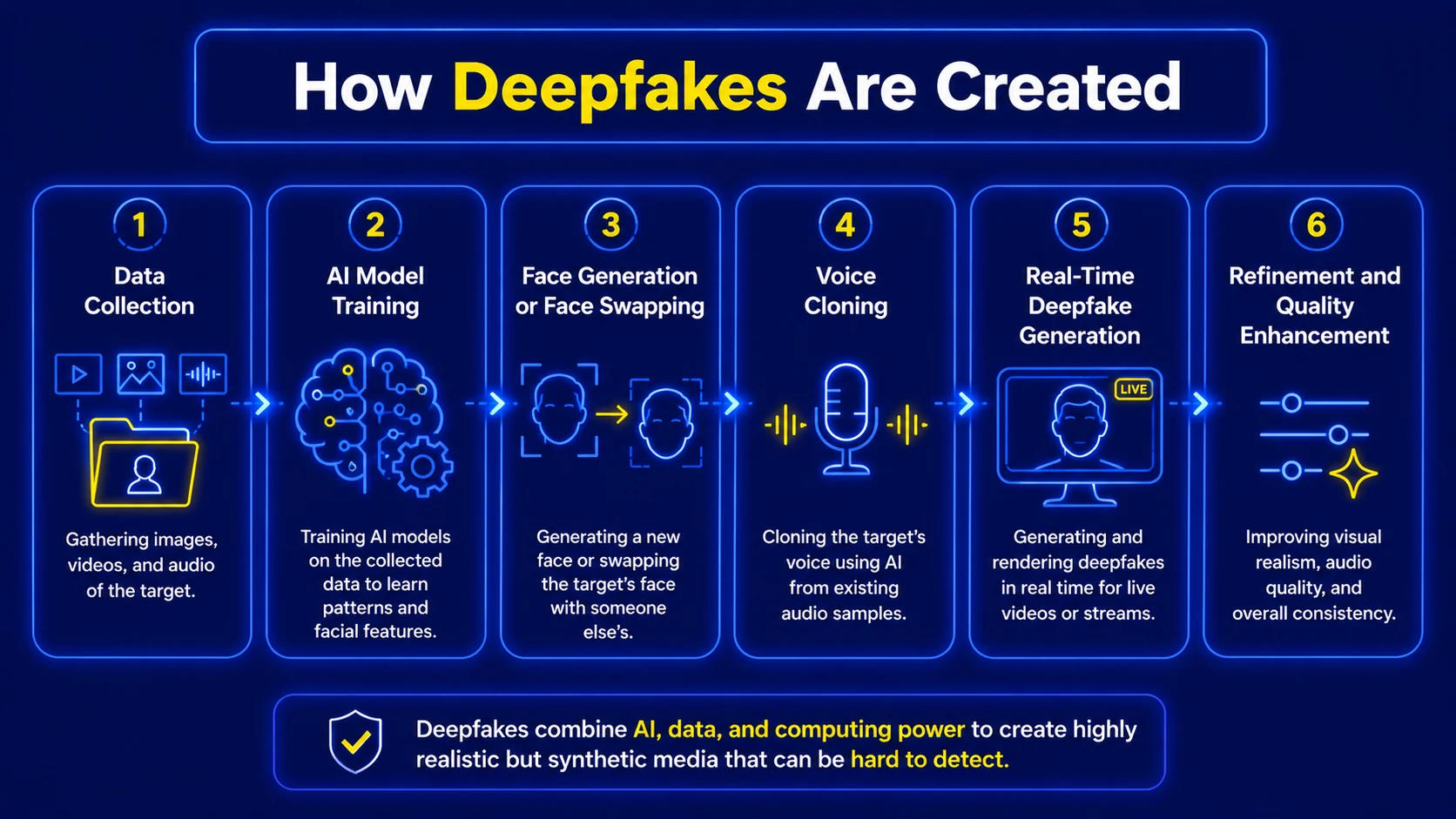
The deepfake creation process typically involves several stages:
1. Data Collection
The first step is gathering training data about the target individual. This may include:
Photos from social media profiles
Video recordings from interviews or public appearances
Voice samples from podcasts, meetings, or online content
Publicly available images and recordings
The more data available, the more realistic the deepfake can become.
This is one reason deepfake creation has become increasingly accessible. Research shows that an average social media user may have hundreds of publicly available photos and videos online, providing sufficient training data for AI systems to replicate facial features and expressions.
2. AI Model Training
Once sufficient data is collected, machine learning models are trained to understand the target’s:
Facial structure
Expressions and emotions
Head movements
Speech patterns
Voice characteristics
Modern deepfake systems often use deep learning techniques such as neural networks, autoencoders, and generative adversarial networks (GANs) to create realistic synthetic content.
Recent advances in generative AI have dramatically improved quality. Models that once required extensive computing resources can now be trained using commercially available software and cloud services, making deepfake creation accessible to a much wider audience.
3. Face Generation or Face Swapping
After training, the AI can generate a synthetic version of the person’s face or replace one person’s face with another in an existing video.
This allows attackers to:
Create entirely fake video recordings
Impersonate someone during video interviews
Modify existing footage to appear authentic
Conduct real-time face swaps during live calls
The realism of face-swapping technology has improved significantly in recent years. Studies have found that many users struggle to distinguish high-quality deepfakes from authentic videos, particularly when viewing content on mobile devices or during short interactions.
4. Voice Cloning
Deepfake creators frequently combine visual manipulation with AI voice cloning.
Using only a few minutes of audio, modern voice synthesis tools can replicate:
Accent and pronunciation
Speaking rhythm
Tone and pitch
Emotional expression
This enables fraudsters to create convincing conversations that sound remarkably similar to the real person.
Some commercial AI voice-cloning tools can generate realistic synthetic speech from less than three minutes of recorded audio, making voice impersonation significantly easier than in previous years.
5. Real-Time Deepfake Generation
Recent advances have made it possible to generate deepfakes in real time.
During a live video call, AI software can:
Alter facial appearance instantly
Replace identities during interviews
Synchronize generated facial movements with speech
Modify voices while maintaining natural conversation flow
These real-time capabilities have become a growing concern for organizations conducting remote hiring and virtual identity verification.
The threat is already impacting recruitment. Industry surveys indicate that 35% of employers have encountered situations where someone other than the listed applicant participated in a virtual interview, highlighting the growing risk of impersonation and proxy interview fraud.
6. Refinement and Quality Enhancement
Before deployment, creators often enhance the deepfake using additional AI tools that improve:
Video resolution
Lip synchronization
Facial realism
Lighting consistency
Audio quality
These improvements make modern deepfakes significantly harder to detect than earlier versions.
As generative AI models continue to evolve, many of the visual flaws that once exposed deepfakes such as unnatural blinking, distorted facial features, and poor lip synchronization have become increasingly rare.
Deepfakes are created by training AI models on real images, videos, and audio recordings to replicate a person’s appearance and voice. What once required advanced technical expertise can now be achieved using readily available AI tools, enabling fraudsters to create highly convincing fake identities and impersonation attempts during remote hiring processes.
The risk is expected to grow rapidly. Gartner predicts that by 2028, one in four candidate profiles worldwide could be fake, making identity verification and deepfake detection critical components of modern recruitment security.
How Deepfakes Are Used in Recruitment Fraud
In hiring environments, attackers may use deepfake technology to:
Impersonate legitimate candidates
Conceal their real identity during interviews
Conduct proxy interviews on behalf of another applicant
Bypass identity verification processes
Gain unauthorized access to sensitive company systems
As AI tools become more accessible, creating convincing deepfakes requires less technical expertise than ever before, making proactive detection and identity verification increasingly important for modern recruitment teams.
Research on Deepfake Detection
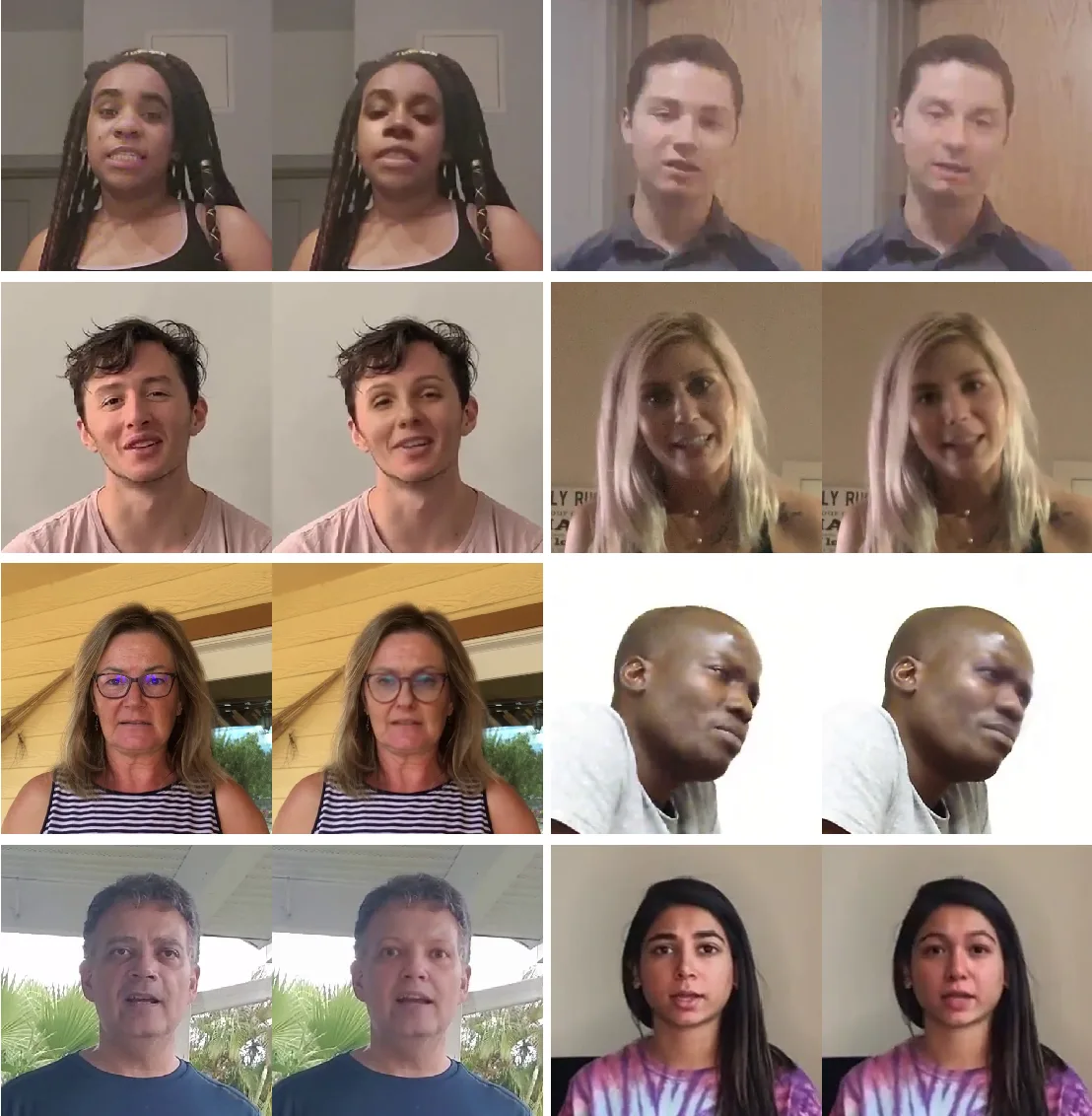
Source: Deepfakes Detection Challenge (DFDC) dataset
How Sherlock AI Helps Prevent Deepfakes
As deepfake technology, AI-assisted cheating, and candidate impersonation become more sophisticated, recruiters need more than manual observation to protect the integrity of their hiring process. Traditional video interviews and identity checks can miss subtle fraud signals, especially during remote hiring.
This is where Sherlock AI comes in.
Sherlock AI is an interview integrity platform designed specifically to detect interview fraud, candidate impersonation, deepfake usage, proxy interviews, and AI-assisted cheating during remote hiring. According to Sherlock AI, its platform uses a multimodal machine learning approach that combines device activity, audio signals, behavioral analysis, and interview context to identify suspicious patterns in real time. The platform reports detection accuracy exceeding 97%, up from approximately 85% through continuous model retraining.
Key Sherlock AI Features
1. AI Fraud and Deepfake Detection
Sherlock AI monitors interviews for signs of:
Deepfake video manipulation
AI-generated candidate impersonation
Synthetic identities
Voice cloning attempts
Proxy interviews
AI-assisted cheating
Rather than relying solely on visual cues, Sherlock analyzes multiple behavioral and technical signals simultaneously, helping recruiters identify fraud that may not be visible to the human eye.
2. Real-Time Interview Monitoring
During live interviews, Sherlock AI continuously evaluates candidate behavior and provides real-time alerts when suspicious activity is detected.
This enables interviewers to:
Identify potential fraud as it occurs
Investigate suspicious responses immediately
Maintain interview integrity without disrupting the conversation
Focus on evaluating candidate skills rather than policing the interview environment
Sherlock joins interview meetings automatically and monitors for suspicious activity throughout the session.
3. Identity and Continuity Verification
One of the most common forms of interview fraud involves a different person participating in part or all of the interview process.
Sherlock AI helps address this risk through:
Face pattern continuity verification
Voice pattern continuity verification
Detection of identity swaps during interviews
Identification of proxy interview attempts
This helps organizations verify that the same candidate remains present throughout the hiring process.
4. Detection of AI-Assisted Cheating
Candidates increasingly use AI tools, hidden assistants, secondary devices, and external coaching systems during interviews.
Sherlock AI is designed to detect:
Hidden AI copilots
Off-screen assistance
Suspicious behavioral patterns
External coaching attempts
Unnatural response patterns
The platform analyzes interaction signals that may indicate answers are being generated or assisted in real time.
5. Automated Interview Notes and Insights
Sherlock AI automatically generates interview notes and insights, reducing administrative work for recruiters and hiring managers.
Features include:
Automated interview documentation
Candidate performance insights
Interviewer effectiveness insights
Centralized interview intelligence
This eliminates the need for separate note-taking tools while creating a more consistent interview record.
6. Seamless Workflow Integration
Sherlock AI integrates directly into existing hiring workflows by connecting with:
Google Calendar
Outlook Calendar
Apple Calendar
Once enabled, Sherlock can automatically join interview meetings, monitor sessions, and provide integrity insights without requiring major process changes.
Conclusion
Deepfakes have evolved from a niche technological curiosity into a serious recruitment security challenge. From candidate impersonation and proxy interviews to AI-generated identities and voice cloning, fraudsters are increasingly exploiting remote hiring environments to bypass traditional verification methods.
While recruiters can look for warning signs such as lip-sync inconsistencies, unnatural facial movements, and behavioral anomalies, manual detection alone is no longer enough. As deepfake technology becomes more advanced, organizations need a layered approach that combines identity verification, liveness detection, behavioral analysis, and AI-powered fraud prevention.
Solutions like Sherlock AI help organizations stay ahead of these emerging threats by detecting interview fraud in real time, verifying candidate authenticity, identifying AI-assisted cheating, and providing deeper visibility into the interview process.
As hiring continues to move online, protecting interview integrity is no longer optional. Organizations that proactively invest in deepfake detection and interview fraud prevention will be better equipped to hire genuine talent, reduce risk, and build a more secure recruitment process.
👉 Book a Demo with Sherlock AI: Schedule Your Demo Today |
|---|