Back to all blogs
Learn what a deepfake job candidate is, how AI is used to impersonate candidates, the risks for employers, and how to detect interview fraud.

What if the person appearing on your screen during a job interview is not actually the person who applied for the role? With generative AI, this is becoming a real concern for hiring teams. Deepfake technology can manipulate a person's face, voice, or video in real time, making it possible for someone to impersonate a candidate or hide who is actually behind the screen.
The scale of the problem is already raising concerns across the hiring industry. According to Greenhouse's 2025 AI in Hiring Report, 18% of hiring managers surveyed said they had caught applicants showing up as deepfakes during interviews, while 74% said they were more concerned about fake credentials, deepfakes, or misrepresented experience than they were a year earlier.
For recruiters, this creates a problem that goes beyond spotting suspicious video or unusual facial movements. A candidate may have a convincing resume, provide polished answers, and appear completely credible during a remote interview, while the person behind the screen may not be who they claim to be. This is where interview integrity and identity verification become critical.
In this guide, we will explain what a deepfake job candidate is, how deepfake technology is being used during job interviews, the warning signs recruiters should look for, and how hiring teams can detect AI-powered impersonation and protect the integrity of their hiring process.
What Is a Deepfake Job Candidate?
A deepfake job candidate is an applicant who uses AI-generated or AI-manipulated audio, video, or facial imagery to misrepresent their identity during a job interview. Instead of simply exaggerating their qualifications on a resume, the candidate may manipulate what the interviewer sees or hears in real time, making it appear that a different person is participating in the interview.
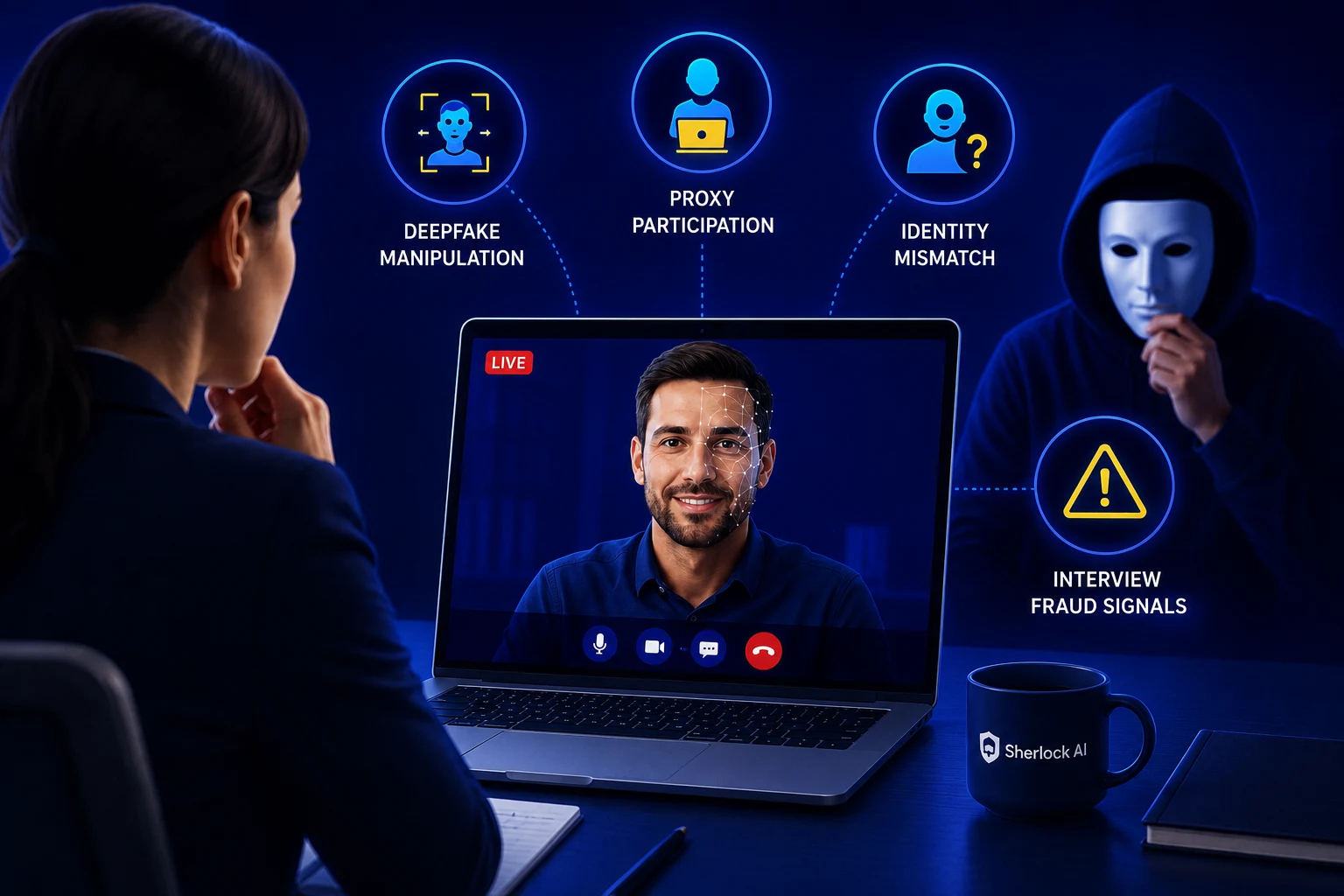
Deepfake technology can be used in several ways during remote interviews. A fraudster may use a face swap to appear as the actual applicant, clone the applicant's voice, or manipulate a live video feed to alter facial features and expressions. In some cases, the person on the call may not be the candidate at all. A proxy interviewer can appear on their behalf while using AI tools to provide answers or support throughout the conversation. Sherlock AI categorizes these risks across deepfake manipulation, proxy participation, identity mismatches, and other signals of interview fraud.
Deepfake Candidate vs. Proxy Candidate
Although the terms are sometimes used interchangeably, deepfake and proxy candidates are not exactly the same.
A deepfake candidate uses synthetic or manipulated media to alter their identity or appearance. A proxy candidate is a different person who participates in the interview on behalf of the actual applicant. These methods can also overlap. For example, a proxy interviewer could use a deepfake face and AI-generated voice to make their identity match the person listed on the application.
This distinction matters because simply verifying that a face appears on camera is no longer enough. Hiring teams need to consider whether the person participating in the interview is the same person who applied, whether their identity remains consistent throughout the process, and whether their responses genuinely reflect their own skills and experience. Sherlock AI helps hiring teams investigate these signals by connecting identity continuity, behavioral changes, voice patterns, interview context, and other evidence for human review.
Read more: How to Detect AI Deepfake Candidate in Interviews?
How Are Deepfake Candidates Used in Job Interviews?
Deepfake candidate fraud can take several forms. As AI tools become more accessible, impersonation during a remote interview no longer requires sophisticated technical expertise or a completely fabricated identity. A fraudster can manipulate their appearance, voice, or even the person participating in the interview to make a candidate appear legitimate.
Here are some of the most common ways deepfake technology can be used in job interviews:
1. Real-Time Face Swapping
Face-swapping technology can replace the interviewer's view of one person's face with another person's identity. The person operating the technology may be physically present on the call, but their appearance is altered to match the candidate whose application was submitted.
This can make a proxy candidate appear to be the actual applicant, particularly when the interview is conducted entirely online.
2. AI-Generated or Cloned Voices
Voice cloning can be used to replicate a candidate's voice or alter the speaker's voice during an interview. This can make it harder for recruiters to identify an identity mismatch based on speech alone.
Voice manipulation can also be combined with facial manipulation, creating a more convincing impersonation across both audio and video.
3. AI-Generated Video and Identity Manipulation
More sophisticated deepfake systems can manipulate a candidate's facial appearance and video feed during a live conversation. These systems can attempt to preserve facial expressions and movements while presenting a synthetic identity to the interviewer.
This is particularly concerning for remote hiring because the interview itself becomes part of the deception. A candidate may appear consistent enough for a recruiter to continue the conversation without realizing that the visual identity has been manipulated.
4. Proxy Interviews Combined With Deepfakes
Not every fraudulent interview involves a completely synthetic person. Sometimes, another individual participates in the interview on behalf of the actual applicant.
A proxy candidate may answer questions while using deepfake technology to make their face or voice resemble the person who applied. Sherlock AI identifies proxy participation and identity mismatch as separate but connected signals that can indicate interview fraud.
5. Deepfakes Combined With Other AI Assistance
Deepfake technology can be combined with other forms of AI-assisted interview cheating to make fraudulent interviews even harder to detect. A candidate may use a deepfake to alter their face or voice while simultaneously relying on hidden AI copilots, real-time answer generation, or other forms of external assistance during the interview.
This creates a broader interview integrity problem. The issue is no longer simply whether a video is fake. Hiring teams need to establish whether the person being evaluated is actually the candidate, whether they are participating independently, and whether the performance observed during the interview genuinely represents their capabilities.
Why Are Deepfake Job Candidates a Serious Problem for Employers?
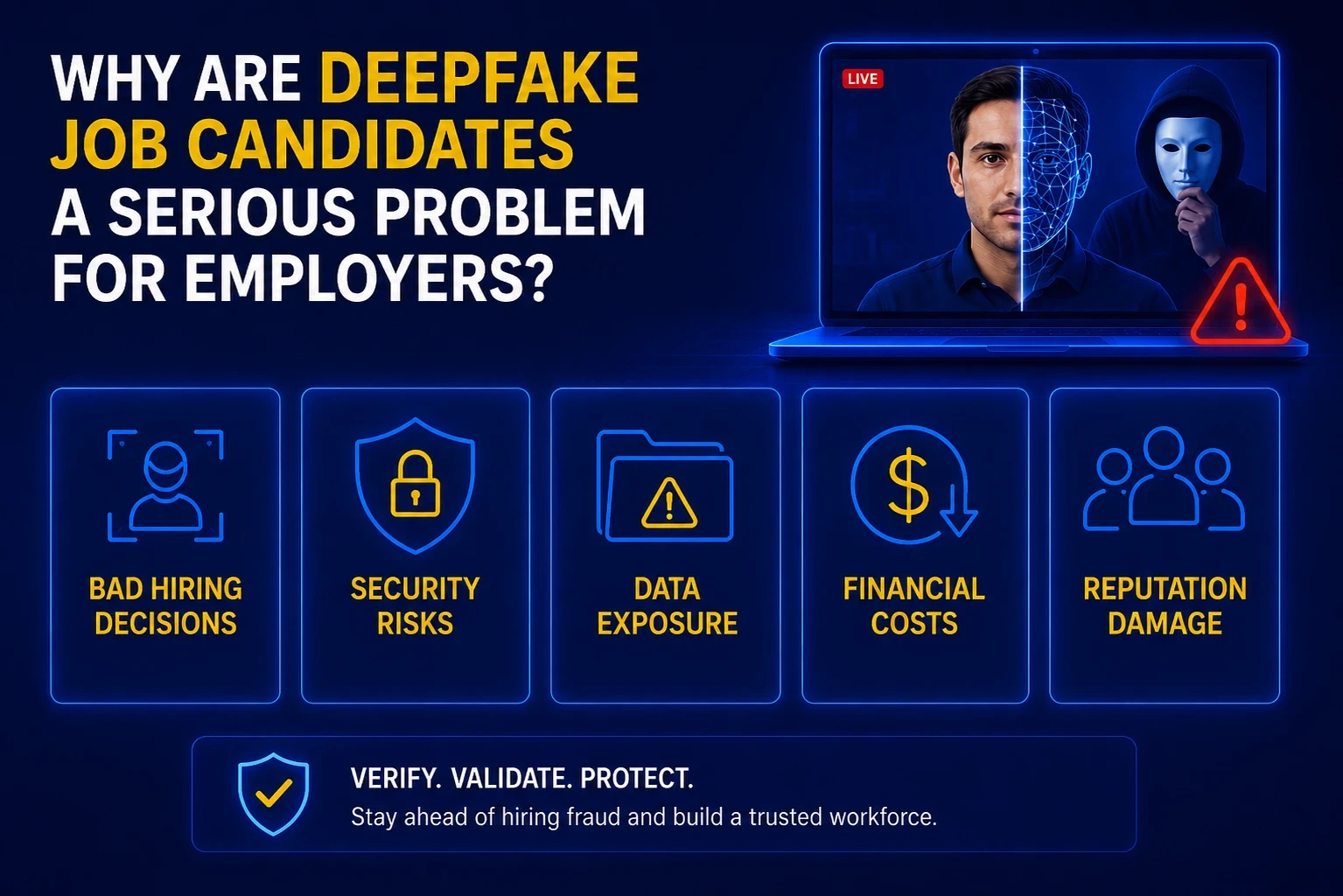
Deepfake job candidates create a serious risk because they can make it difficult for employers to verify whether the person interviewing is actually the candidate who applied for the role. Using AI-generated faces, voices, or real-time video manipulation, bad actors can impersonate qualified applicants and potentially gain access to jobs they are not genuinely qualified for.
1. Bad Hiring Decisions
Fraudulent candidates can fake skills and experience.
Recruiters may evaluate someone other than the actual applicant.
This can lead to costly bad hires.
2. Security Risks
Fraudsters can gain access to internal systems and tools.
Sensitive company or customer data could be exposed.
The risk is higher for technical and security-sensitive roles.
3. Data Exposure
Fake employees may access confidential files and information.
Background checks alone may not verify who attended the interview.
Identity verification needs to continue throughout hiring.
4. Financial Costs
Bad hires increase recruitment and training costs.
Replacing fraudulent employees takes time and resources.
Security incidents can create additional financial losses.
5. Reputation Damage
Hiring fraud can undermine trust in an organization.
Customers may question how securely the company operates.
Public incidents can damage the employer's reputation.
How to Detect a Deepfake Job Candidate
Detecting a deepfake job candidate is becoming increasingly difficult as AI can now manipulate video, audio, facial expressions, and even a candidate’s identity in real time. Recruiters cannot rely on a single visual clue or an unusual pause to determine whether an interview is fraudulent.
This is already a growing concern for hiring teams. 31% of hiring managers say they have interviewed a candidate who was later found to be using a fake identity, while 35% say someone other than the listed applicant participated in a virtual interview.
Instead of looking for one obvious sign, recruiters should evaluate multiple signals across a candidate’s identity, behavior, video, audio, and interview history.
Look for Unnatural Facial Movements
Deepfake technology can create realistic facial movements, but imperfections may still appear during a live interview.
Recruiters should watch for unusual blinking, unnatural facial expressions, distorted facial edges, inconsistent lighting, or movements that appear slightly delayed. A mismatch between facial expressions and speech can also be a warning sign.
However, one unusual movement does not necessarily mean a candidate is using a deepfake. These signals become more meaningful when several anomalies appear together.
Check for Audio and Lip-Sync Issues
AI can manipulate a candidate’s voice as well as their appearance. During an interview, recruiters may notice that the candidate’s lip movements do not perfectly match their speech.
Other warning signs include sudden changes in voice quality, unnatural pauses, inconsistent background noise, or noticeable changes in accent or tone.
Since modern voice-cloning technology can sound highly realistic, audio should be evaluated alongside other identity and behavioral signals.
Watch for Identity Inconsistencies
A candidate may appear legitimate during an initial screening but fail to match the person who appears during a later interview.
For example, the individual attending the technical interview may look or sound noticeably different from the person who completed the first interview. In other cases, the candidate may provide identification that does not align with information provided during the application process.
Identity verification should therefore not be treated as a one-time step. For higher-risk roles, organizations should maintain identity continuity throughout the hiring process.
Pay Attention to Unusual Response Patterns
Deepfake candidates may use real-time AI assistance or have another person helping them answer questions.
Deepfake candidates may also rely on real-time AI answer copilots to generate or assist with responses.
Unusually long pauses before answering straightforward questions, responses that sound disconnected from the question, or answers that appear overly polished but fail when challenged with follow-up questions can be warning signs.
Recruiters should not automatically assume that hesitation means fraud. Nervousness, poor internet connections, or unfamiliarity with an interview format can produce similar behavior. The important factor is whether unusual response patterns occur alongside other suspicious signals.
Ask Detailed Questions About Resume Claims
A candidate with a fraudulent identity may have a convincing resume but struggle to explain the experience behind it.
Instead of asking only general questions, interviewers can ask candidates to explain specific projects, technical decisions, challenges they encountered, and the results they achieved.
For example, if a candidate claims to have led a major software migration, the interviewer can ask what problems occurred during the migration, how they were resolved, and what trade-offs the candidate made.
These detailed follow-ups make it more difficult for someone relying on scripted or AI-generated answers to maintain a convincing story.
Use AI-Powered Interview Fraud Detection Tools Like Sherlock AI
Human recruiters are essential to the hiring process, but they cannot reliably identify every sophisticated deepfake or candidate impersonation attempt.
AI-powered interview fraud detection can analyze multiple signals simultaneously, including video, audio, behavior, device activity, and identity consistency.
This allows organizations to identify suspicious patterns that may not be obvious to a recruiter watching a video call.
Sherlock AI helps hiring teams detect deepfake interviews, candidate impersonation, proxy participation, and other forms of interview fraud in real time.
The goal is not to replace human judgment. Instead, tools like Sherlock AI give hiring teams additional evidence to investigate potential fraud and determine whether the person being interviewed is actually the candidate who applied for the role.
How Sherlock AI Helps Detect Deepfake Job Candidates?
Traditional hiring processes are designed to evaluate a candidate’s skills, experience, and cultural fit. They were not designed to determine whether the person on a video call is using a synthetic identity or whether someone else is participating on their behalf.
Sherlock AI addresses this gap by treating the interview as more than a video conversation. It analyzes multiple signals throughout the interview to help hiring teams identify potential identity manipulation and interview fraud.
Real-Time Deepfake Detection
Sherlock AI can identify potential deepfake indicators during live interviews, including changes in facial appearance, video artifacts, lip-sync inconsistencies, and voice-related anomalies.
Rather than relying on one visual clue, Sherlock AI looks at multiple signals to determine whether the candidate’s video and audio remain consistent throughout the interview.
Continuous Identity Verification
A candidate may pass an initial identity check and still use a different person or manipulated identity later in the hiring process.
Sherlock AI helps maintain identity continuity throughout the interview by monitoring changes in the candidate’s appearance, voice, and participation. This can help identify situations where the person who starts an interview may not be the same person participating later.
Detecting Proxy Candidates
Deepfake candidates are not the only threat facing remote hiring teams. A candidate may also ask another person to attend the interview and answer questions on their behalf.
Sherlock AI can surface signals associated with proxy participation, including identity changes, secondary speakers, off-screen assistance, and unusual behavioral patterns.
This is important because a proxy candidate can appear completely normal on camera while still misrepresenting who is actually being evaluated.
Combining Video, Audio, and Behavioral Signals
A sophisticated fraud attempt may not produce an obvious deepfake artifact. A video may look normal while the candidate’s voice, behavior, or identity changes in subtle ways.
Sherlock AI combines different types of evidence instead of relying on a single detection method. By comparing identity, audio, video, and behavioral signals, it can highlight inconsistencies that deserve further investigation.
Evidence for Human Review
The purpose of fraud detection should not be to automatically reject candidates based on an unexplained score.
Sherlock AI provides reviewable evidence that helps recruiters understand why an interview may require additional verification. This allows hiring teams to investigate suspicious moments, review relevant signals, and make the final decision themselves.
This human-in-the-loop approach is particularly important because legitimate candidates can also experience technical problems, changes in lighting, poor connectivity, or unusual interview behavior.
Protecting the Hiring Process Before a Bad Hire
The biggest advantage of detecting a deepfake candidate is catching the problem before the person gains access to the organization.
A fraudulent candidate who passes an interview may eventually receive access to internal systems, confidential information, customer data, or sensitive projects. For employers, candidate verification is therefore not only a recruiting concern but also part of their broader security strategy.
By combining continuous identity verification, deepfake detection, behavioral analysis, and evidence-based review, Sherlock AI helps organizations verify that they are hiring the person they actually interviewed.
Conclusion
Deepfake job candidates are becoming a serious challenge for employers as AI makes it easier to manipulate video, audio, facial appearance, and candidate identities during remote interviews. The risk goes beyond a bad hiring decision, as fraudulent candidates may gain access to company systems, confidential information, customer data, or other sensitive resources after being hired.
To reduce these risks, hiring teams need to look beyond traditional interview practices and use multiple signals to verify candidate identity and interview integrity. Recruiters can combine identity verification, liveness checks, detailed follow-up questions, behavioral analysis, and AI-powered detection to identify potential impersonation, proxy participation, and other forms of interview fraud.
Sherlock AI helps hiring teams strengthen this process by detecting potential deepfakes, candidate impersonation, proxy participation, and other suspicious interview signals. By giving recruiters additional evidence to review before making a hiring decision, Sherlock AI can help organizations verify that the person they interview is actually the person they intend to hire and protect the integrity of their hiring process.
Protect Your Hiring Process with Sherlock AI. |
|---|
FAQs
What is a deepfake job candidate?
A deepfake job candidate is someone who uses AI-generated or manipulated video, audio, or identity information to appear as another person during the hiring process. They may use deepfake technology to impersonate a qualified candidate during a remote interview.
How can recruiters identify a deepfake candidate?
Recruiters can look for inconsistencies in facial movements, lip-sync, voice, identity, behavior, and interview responses. However, advanced deepfakes can be difficult to detect manually, so organizations should combine human observation with identity verification and technical detection tools.
Are deepfake candidates the same as proxy candidates?
No. A deepfake candidate uses manipulated or synthetic media to misrepresent their identity, while a proxy candidate is a real person who participates in an interview on behalf of someone else. Both can result in the wrong person being evaluated during the hiring process.
How does Sherlock AI detect deepfake candidates?
Sherlock AI analyzes multiple signals during interviews, including video, audio, identity, and behavioral patterns. By combining these signals, it can help hiring teams identify potential deepfake activity, candidate impersonation, and proxy participation.
Why should companies be concerned about deepfake job candidates?
Deepfake candidates can lead to fraudulent hires, compromised company systems, data exposure, financial losses, and security risks. The risk can be particularly serious for remote roles where identity verification may be more difficult.