Back to all blogs
Discover how to detect Cluely in interviews and prevent unfair advantages while evaluating true candidate skills.

Remote interviews are increasingly being influenced by AI interview assistants that can generate answers in real time. Among these tools, Cluely AI has gained attention for helping candidates respond to interview questions as the conversation unfolds. Instead of relying solely on their own reasoning, candidates can receive AI-generated suggestions during the interview itself, making it harder for recruiters to evaluate genuine skills and decision-making.
Interviews are designed to understand how a candidate thinks, explains decisions, and solves problems. When AI tools generate responses behind the scenes, polished answers may no longer reflect the candidate's own experience or judgment. This creates a growing challenge for hiring teams trying to make fair and informed decisions.
Leading employers like Amazon have already taken the step of explicitly banning the use of AI assistance during live job interviews, warning recruiters that candidates caught using generative AI tools for real‑time answers may be disqualified because such tools give applicants an “unfair advantage” and obscure their true abilities.
As these tools become more common, interviews become harder to trust. In fact, 1 in 5 U.S. professionals admit to secretly using AI during job interviews, with 55 % agreeing it’s becoming the norm rather than an exception. To keep interviews fair and meaningful, teams need better ways to detect and prevent live AI assistance like Cluely.
What Is Cluely?
Cluely is a real-time assistance tool that listens to live conversations and suggests what a person should say next. It is designed to work during calls, meetings, and interviews, not before them, and is one example of the cheating patterns now emerging in remote interviews.
In an interview, Cluely listens to the interviewer’s questions as they are asked. It then generates suggested responses that the candidate can read or paraphrase while speaking. These responses often include:
Structured answers to behavioral and technical questions
Follow-up points to sound more thorough and confident
Clear phrasing that removes pauses, uncertainty, or gaps
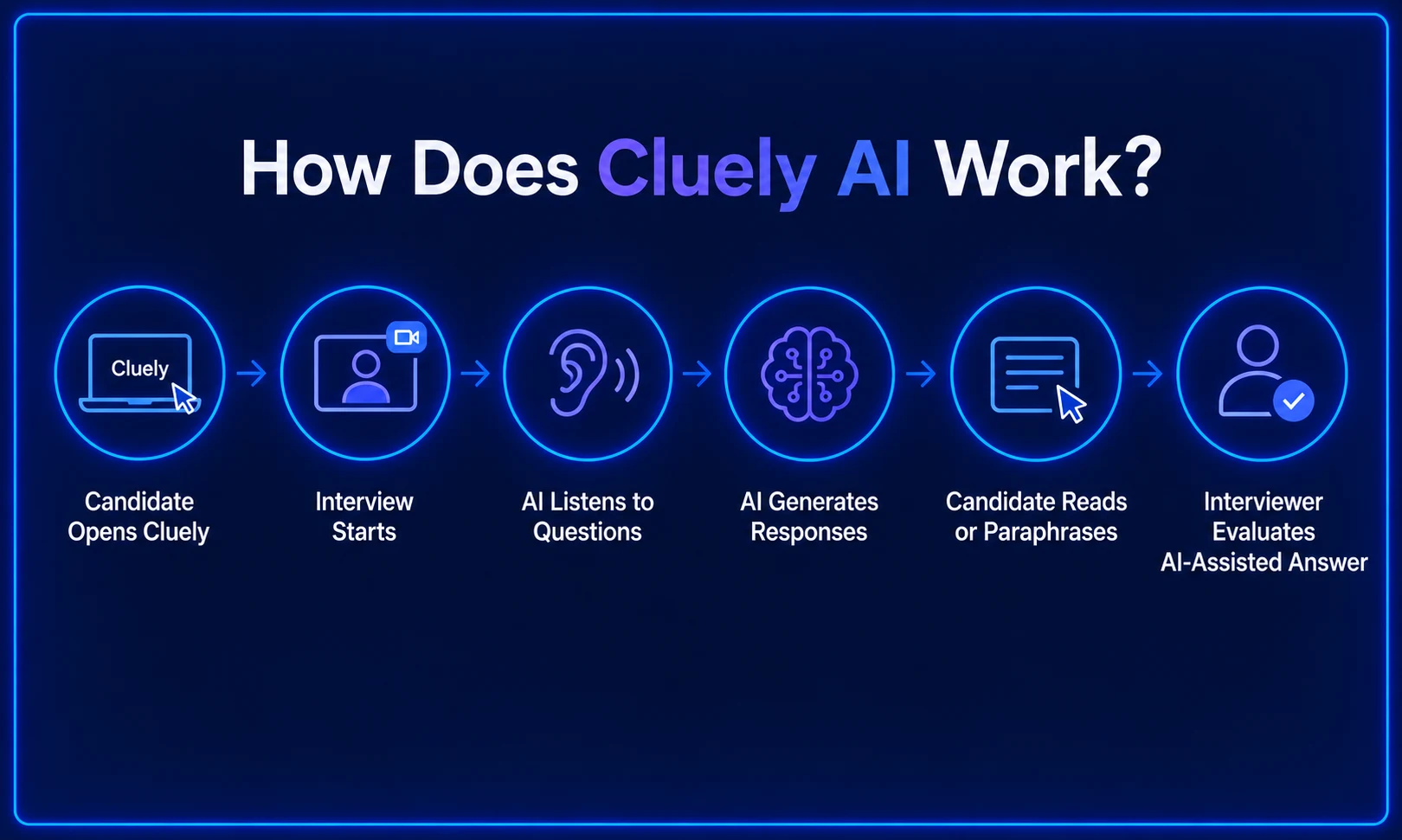
Cluely is not an interview preparation tool. It operates during the interview itself, handling the thinking in real time while the candidate delivers the output.
Because Cluely runs quietly in the background and does not join the call as a visible participant, interviewers usually have no clear way to know it is being used. This makes Cluely difficult to detect and creates a real risk to interview fairness and trust, especially in video interviews where most signals are already compressed into a small frame
How Does Cluely AI Work?
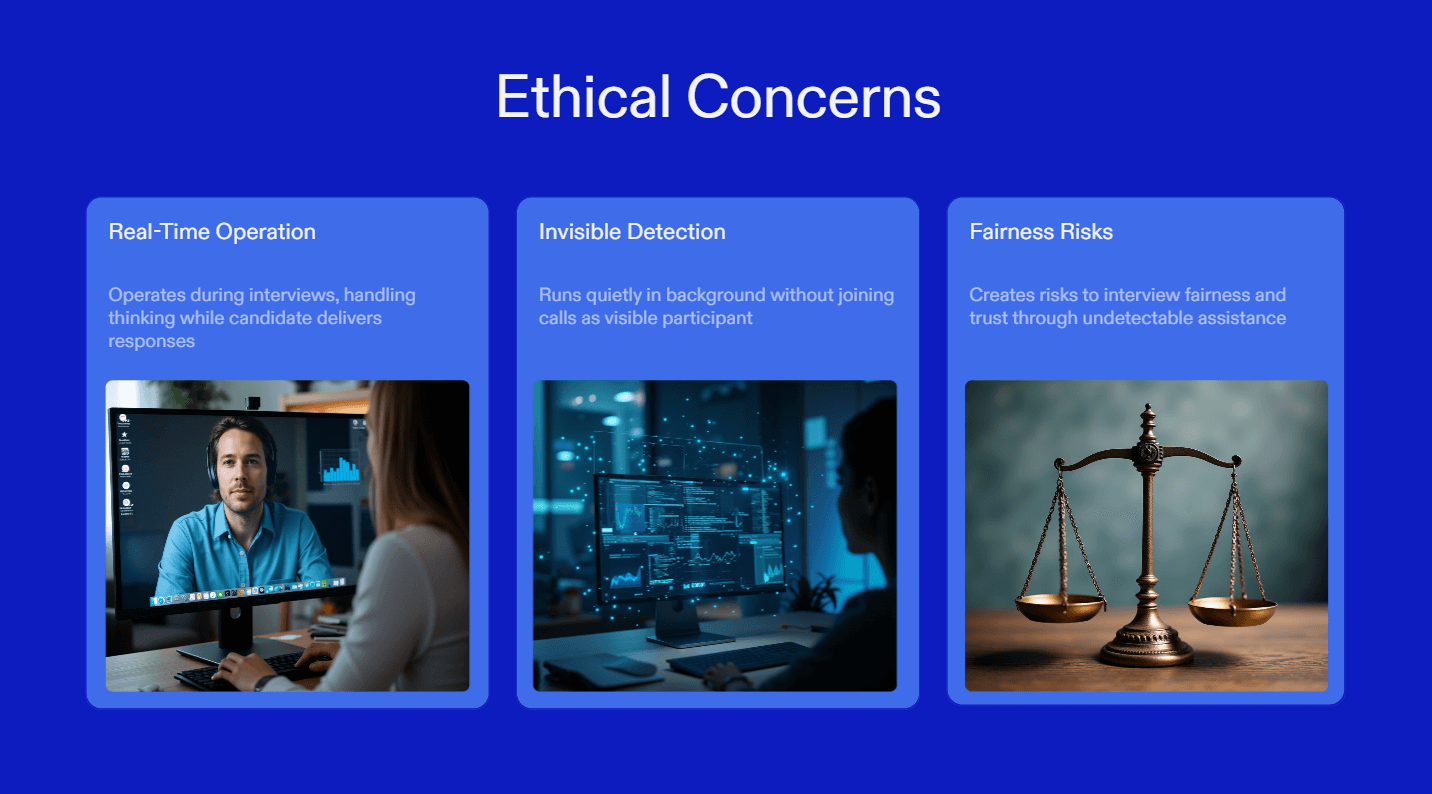
Cluely AI operates during the interview itself rather than before it. Instead of helping candidates prepare in advance, it listens to live conversations, processes questions in real time, and generates suggested responses while the interview is still in progress. The candidate can then read or paraphrase these suggestions before answering, making AI-assisted responses appear natural to the interviewer.
Step 1 – Cluely Starts Before the Interview
Before the interview begins, the candidate launches Cluely on their device. The application runs quietly in the background and remains active throughout the conversation without appearing as a participant in video conferencing platforms such as Zoom, Google Meet, or Microsoft Teams.
Step 2 – It Listens to Interview Questions
As the interviewer asks questions, Cluely continuously captures the conversation and identifies the intent behind each question. Whether the discussion involves behavioural, technical, or situational topics, the AI immediately begins generating an appropriate response.
Step 3 – AI Generates Suggested Answers
Within seconds, Cluely produces structured responses that candidates can read or adapt before speaking. These suggestions often include:
Complete answers to behavioural and technical questions
STAR-format response structures
Follow-up points to sound more detailed
Professional wording that removes hesitation or uncertainty
Step 4 – Candidate Delivers the AI Response
Instead of thinking through the question independently, the candidate delivers the AI-generated response either verbatim or with minor adjustments. To the interviewer, the answer may appear confident and well-structured even though much of the reasoning was produced by AI.
Step 5 – Interviewers Evaluate AI-Assisted Performance
Because Cluely operates discreetly and does not join the meeting as a visible participant, interviewers often have no obvious indication that external AI assistance is being used. Without additional behavioural analysis or interview integrity tools, polished AI-generated responses can be mistaken for genuine expertise and decision-making.
Real-World Example: Cluely in a Mock Job Interview
A recent mock interview conducted by a journalist demonstrated how Cluely can generate interview responses in real time. During the test, the AI suggested answers to common interview questions, helping the candidate respond more confidently. While some responses were generic or factually incorrect, the experiment highlighted how difficult it can be for interviewers to distinguish AI-assisted answers from genuine responses. The journalist concluded that tools like Cluely could make remote hiring significantly more challenging as they become faster and more accurate.
Source: AOL
Can Cluely AI Be Detected?
Yes, but not through traditional interview methods alone.
Cluely AI is designed to operate discreetly during live interviews, making it difficult to identify through observation alone. Because it runs in the background and generates responses in real time, recruiters often have no obvious indication that a candidate is receiving AI assistance. Standard interview setups and video conferencing platforms are not built to detect this type of behaviour.
The following comparison shows how different approaches perform when it comes to identifying Cluely AI during interviews.
Approach | Can Detect Cluely AI? | How It Works |
|---|---|---|
Traditional interviews | ❌ No | Relies on interviewer observation, response flow, and answer quality. |
Video platforms (Zoom, Google Meet, Microsoft Teams) | ❌ No | Enable virtual interviews but do not monitor background applications or analyse how responses are generated. |
✅ Yes | Analyses behavioural patterns, response timing, reasoning consistency, and interaction signals to identify potential AI assistance. |
In most cases, standard interview setups do not provide enough visibility to detect tools like Cluely AI. As a result, candidates may use AI assistance without clear indication.
With additional visibility into response patterns and interaction signals, Sherlock AI helps organizations move toward more reliable and consistent interview evaluations.
AI-generated answers can be difficult to spot through observation alone. See how Sherlock AI helps hiring teams detect real-time AI assistance during interviews. |
|---|
Why Is Cluely AI Difficult to Detect?
Cluely AI is designed to provide real-time assistance without interrupting the flow of an interview. It operates quietly in the background, allowing candidates to receive AI-generated responses while maintaining a natural conversation. Because there are few visible signs of AI assistance, recruiters often have limited evidence that external support is being used.
Several factors make Cluely AI particularly difficult to detect during live interviews.
1. Real-Time AI Assistance
Cluely listens to interview questions as they are asked and generates responses within seconds. Candidates can read or paraphrase these suggestions before answering, making the conversation appear smooth and uninterrupted. Since the assistance happens in real time, interviewers rarely notice obvious delays or unusual pauses.
2. Runs Discreetly in the Background
Cluely operates quietly on the candidate's device throughout the interview. It does not appear as a participant in Zoom, Google Meet, or Microsoft Teams, and it does not interrupt the interview experience. From the interviewer's perspective, everything appears normal.
3. Minimal On-Screen Interaction
Candidates do not need to switch between multiple applications or manually enter prompts throughout the interview. AI-generated suggestions are displayed with minimal interaction, allowing candidates to stay focused on the conversation while reducing visible signs of external assistance.
4. Standard Video Platforms Have Limitations
Video conferencing platforms are built to support communication, not detect AI-assisted interviews. While they capture audio and video, they cannot determine whether responses are being generated by an AI tool running in the background.
5. Behaviour Alone Isn't Enough
Recruiters often rely on eye contact, confidence, communication style, and response quality to evaluate candidates. Although these signals remain valuable, they are not always enough to identify AI-assisted responses. Candidates using Cluely may still appear confident, engaged, and well prepared throughout the interview.
6. Traditional Monitoring Has Blind Spots
Traditional interview monitoring focuses on what interviewers can see and hear during the conversation. Background AI tools like Cluely leave few visible traces, making it difficult to distinguish genuine reasoning from AI-assisted responses without additional interview integrity measures.
👉 Explore: Why Traditional Interview Monitoring Fails Against AI
Why Zoom, Google Meet, or Microsoft Teams Can't Catch It
Many recruiters assume that video conferencing platforms can detect AI-assisted interviews. However, platforms like Zoom, Google Meet, and Microsoft Teams are designed to facilitate communication, not monitor interview integrity. They cannot detect background applications, analyse how candidates generate their responses, or determine whether AI tools like Cluely are being used during a live interview. As a result, recruiters cannot rely on the meeting platform alone to identify AI-assisted cheating.
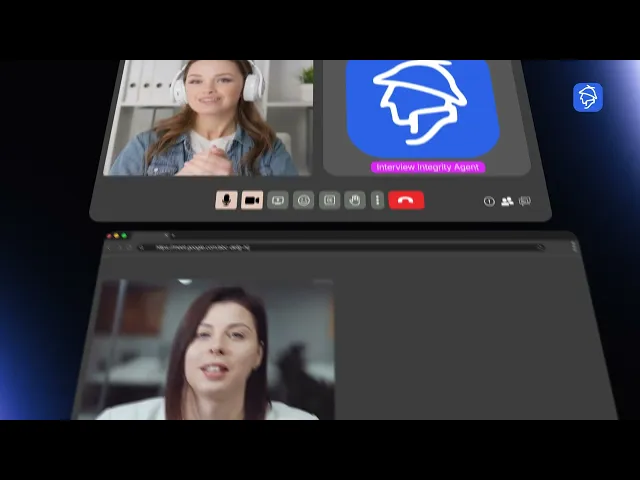
Read more: How to Detect Cheating in a Zoom Interview
Signs a Candidate May Be Using Cluely AI
Candidates using Cluely AI often appear confident, articulate, and well prepared. However, AI-assisted interviews can leave subtle behavioural and conversational patterns that differ from genuine human reasoning. While no single sign proves AI assistance, recruiters should look for a combination of indicators throughout the interview.
Here are some of the most common signs that a candidate may be relying on Cluely during a live interview.
1. Replacing Real-Time Thinking With Pre-Packaged Answers
During the interview, Cluely listens to each question and generates a complete response before the candidate finishes speaking. The candidate then reads or paraphrases the output.
This is why answers often:
Sound polished even when the question is unexpected
Follow familiar interview structures instead of natural recall
Avoid pauses, uncertainty, or incomplete thoughts
For hiring teams, this creates a false signal. The candidate appears articulate and prepared, but the interview no longer reflects how they think under pressure or ambiguity.
2. Handling Follow-Up Questions Without Owning the Experience
The real damage happens after the first answer. When interviewers probe deeper, Cluely fills in details the candidate does not actually own.
Common patterns include:
Expanded explanations that add length, not insight
Tradeoffs described at a high level, without personal judgment
Decisions framed as obvious or risk-free
Interviewers often mistake this for strong experience. In reality, the AI is generating safe, generic reasoning that sounds correct but is not grounded in real decisions.
3. Masking Weak Judgment and Inexperience
Cluely is especially effective at hiding what interviews are meant to expose.
It helps candidates:
Avoid admitting uncertainty or mistakes
Smooth over gaps in knowledge
Maintain confidence even when discussing unfamiliar problems
As a result, weak decision-makers pass interviews designed to filter them out. The cost shows up later as slow execution, poor ownership, and decision paralysis on the job. These failures look very similar to the mis-hire patterns companies report when AI-driven interview fraud goes undetected.
Cluely succeeds because many interview systems reward the exact behaviors AI is best at generating. Until interviews are redesigned to test real judgment and ownership, tools like Cluely will continue to pass candidates who should not be hired.
Read more: How to Detect & Prevent AI-Assisted Interview Cheating?
Interview Questions That Expose Cluely-Generated Answers
AI interview assistants like Cluely perform well when questions are predictable and candidates can rely on structured responses. They become less effective when interviewers explore personal reasoning, challenge assumptions, or introduce unexpected scenarios.
The following interview techniques can help recruiters distinguish genuine experience from AI-assisted responses.
1. Ownership-Focused Questions
Start by asking candidates to explain their personal contribution rather than the overall project.
Example questions:
What decisions did you personally make in that situation?
What part of the project would have been different if you had not been involved?
Which decision was entirely yours, and why did you make it?
Why it works
Candidates with genuine experience can usually explain their own decisions in detail. AI-generated responses often stay at a higher level, describing the team's work rather than the candidate's individual ownership.
2. Decision-Making Questions
Move beyond outcomes and explore how the candidate reached their conclusions.
Example questions:
What options did you consider before making that decision?
What information were you missing at the time?
What trade-offs influenced your final choice?
Why it works
Real experiences include uncertainty, changing priorities, and imperfect information. AI-generated answers often focus on polished outcomes rather than the reasoning behind them.
3. Scenario Change Questions
Introduce a new constraint after the candidate has answered.
Example questions:
What would you do if the deadline were reduced by half?
How would your decision change if your budget was cut?
What if your team disagreed with your recommendation?
Why it works
Candidates who genuinely understand the situation can adapt their reasoning naturally. AI-assisted answers may become generic or fail to address the updated scenario directly.
4. Reflection Questions
Ask candidates to discuss mistakes, lessons learned, or decisions they would change.
Example questions:
What do you think you got wrong?
What would you do differently today?
What feedback challenged your original thinking?
Why it works
Authentic experiences usually include setbacks and learning moments. AI-generated responses often provide safe, polished reflections without explaining genuine personal growth.
5. Time-Boxed Reasoning Questions
Reduce preparation time and encourage candidates to think out loud.
Example questions:
You have 30 seconds. How would you approach this problem?
Don't structure your answer. Talk me through your thinking as it happens.
Explain your first instinct before refining your response.
Why it works
Cluely performs best when there is enough time to generate and structure responses. Asking candidates to reason aloud under time constraints makes it more difficult to rely on AI-generated suggestions.
How Sherlock AI Detects Cluely Cheating
Sherlock AI uses behavior‑based detection approach to spot when candidates are relying on live AI assistance like Cluely in interviews. Instead of surface checks or simple rule triggers, it analyzes patterns that indicate unnatural interaction, AI dependence, or external assistance, even if the candidate tries to hide it.

1. Observing Real-Time Behavior
Sherlock AI monitors multiple signals simultaneously to see how candidates respond during the interview:
Pauses, timing, and speech rhythm
Voice patterns and fluency
Subtle behavioral cues such as eye movement and micro-pauses
Why it matters: Cluely-generated answers often show unnatural pacing or timing inconsistencies. Real human reasoning is rarely perfectly uniform under pressure.
2. Analyzing Interaction Patterns
Sherlock looks beyond the words to how candidates engage:
Changes in response speed when questions shift
Overly smooth or rehearsed speech patterns
Discrepancies between the candidate’s behavior and the expected flow of conversation
Why it matters: Candidates using Cluely may respond too quickly or too confidently to complex questions. Sherlock flags these patterns to highlight potential AI assistance.
3. Checking Continuity and Ownership
Sherlock verifies that the same person is consistently providing answers throughout the interview:
Compares behavioral patterns from start to finish
Looks for signs of off-camera prompts or proxy assistance
Confirms that reasoning is internally consistent across questions
Why it matters: Cluely can supply answers, but it cannot replicate the candidate’s personal judgment or continuous behavior. Discrepancies reveal potential external help.
4. Detecting Anomalies in Reasoning
Instead of relying on simple rules, Sherlock examines reasoning patterns:
Consistency of logic across different questions
Depth and structure of decision-making explanations
Repetition or formulaic responses that don’t match real human thinking
Why it matters: AI-generated answers may appear polished but often lack the natural variation of genuine reasoning. Sherlock highlights these anomalies.
5. Providing Contextual Insights in Real Time
Sherlock gives interviewers actionable signals, not accusations:
Flags potential AI-assisted answers during the conversation
Highlights areas where reasoning or ownership may be weak
Helps interviewers ask follow-up questions to confirm true understanding
These signals also generate structured AI interview notes, turning interview observations into actionable insights that help hiring panels align, collaborate, and defend hiring decisions with confidence.
Why it matters: Immediate, context-driven insights allow interviewers to probe further and make better decisions, rather than relying on gut feeling or retroactive review.
Key Takeaway: Sherlock AI does not replace human judgment. It amplifies visibility into reasoning, ownership, and consistency, exposing when polished answers may be AI-assisted. This allows teams to focus on real thinking and decision-making, even in interviews increasingly influenced by tools like Cluely.
Rethinking Interview Fairness in the Age of Live AI
Live AI tools like Cluely are changing interviews. Answers that sound confident and polished may no longer reflect the candidate’s true reasoning. This puts fairness and trust in the hiring process at risk.
Traditional interviews often reward delivery over decision-making. That means strong candidates who rely on AI can appear better than they are, while honest candidates may be undervalued. The result: costly hiring mistakes and lost trust in the process.
To maintain fairness, interviews must focus on what AI cannot replicate:
Personal ownership of decisions
Real-time reasoning under pressure
Adaptability when situations change
Consistent logic across questions
Sherlock AI helps hiring teams detect Cluely assistance without accusations. It highlights reasoning gaps, ownership inconsistencies, and unusual interaction patterns, ensuring interviews measure actual thinking, not AI polish.
Conclusion
Cluely AI represents a new generation of interview assistance tools that can generate responses in real time, making it increasingly difficult for recruiters to distinguish genuine expertise from AI-assisted answers. While traditional interviews and video conferencing platforms are not designed to detect this type of assistance, understanding how these tools work and recognising common behavioural patterns can help hiring teams conduct more effective interviews.
Protecting interview integrity requires more than simply identifying suspicious behaviour. It involves asking better follow-up questions, evaluating a candidate's reasoning and ownership, and using interview processes that measure authentic problem-solving rather than polished responses.
As AI-assisted interviewing continues to evolve, organisations need solutions that provide greater visibility into candidate behaviour without disrupting the interview experience. Sherlock AI helps hiring teams identify potential AI-assisted interviews through behavioural analysis and interview integrity insights, enabling more confident and informed hiring decisions.
Ready to strengthen your interview process? Book a demo to see how Sherlock AI helps organisations detect AI-assisted interviews and protect hiring integrity. |
|---|
FAQ's - How to Detect and Prevent Cluely
1. What is Cluely AI?
Cluely AI is a real-time AI assistant that listens to live conversations and generates suggested responses during interviews, meetings, and calls. In interviews, it helps candidates answer questions by providing AI-generated responses as the conversation unfolds.
2. How does Cluely AI work during an interview?
Cluely AI runs in the background, listens to interview questions in real time, processes the conversation, and generates suggested answers. Candidates can then read or paraphrase these responses before speaking, making AI-assisted answers appear natural.
3. Can Cluely AI be detected?
Yes, but not through traditional interviews alone. Because Cluely operates discreetly in the background, interviewers often cannot detect it through observation. Behavioral analysis and interview integrity tools provide greater visibility into potential AI-assisted responses.
4. Can Zoom, Google Meet, or Microsoft Teams detect Cluely AI?
No. Video conferencing platforms are designed for communication, not interview integrity. They cannot detect background AI applications or determine whether a candidate is using real-time AI assistance during an interview.
5. What are the signs that a candidate may be using Cluely AI?
Common indicators include unusually polished answers, limited personal ownership of decisions, difficulty handling unexpected follow-up questions, overly structured responses, and reasoning that lacks genuine depth or experience.
6. What interview questions help expose AI-assisted answers?
Questions that focus on personal ownership, decision-making, trade-offs, unexpected scenarios, and real-time reasoning are often more effective at distinguishing genuine experience from AI-assisted responses.
7. How does Sherlock AI detect Cluely AI?
Sherlock AI analyzes behavioral patterns, response timing, reasoning consistency, interaction signals, and ownership throughout the interview. These insights help hiring teams identify potential AI assistance without disrupting the interview process.
8. Why are companies concerned about Cluely AI?
Real-time AI assistants can make candidates appear more knowledgeable than they actually are, making it harder for recruiters to assess genuine skills, decision-making, and problem-solving. This increases the risk of inaccurate hiring decisions and reduces interview fairness.