Back to all blogs
Learn how to detect and prevent Final Round AI and other AI-assisted cheating in remote interviews. Discover how Sherlock ensures interview integrity and fair hiring.

Remote interviews have become the standard for modern hiring, but they’ve also introduced a new challenge. Recent industry research shows that nearly half of employers report candidates using AI during interviews, and around 20–27% of job seekers admit to relying on AI tools when responding to interview questions. In some cases, employers even suspect AI-assisted cheating in up to 81% of candidate interactions.
AI-powered interview assistants like FinalRound AI are now being used by candidates to generate real-time answers during live interviews. While these tools claim to “support” candidates, they significantly distort a recruiter’s ability to evaluate genuine skills, thinking, and communication.
For hiring teams, the problem is no longer just cheating, it’s undetectable cheating. This blog explores how to detect and prevent FinalRound AI in interviews, why traditional methods fall short, and how intelligent platforms like Sherlock AI are redefining interview integrity.
What Is Final Round AI?
FinalRound AI is a real-time interview assistant designed to listen to interview questions and generate suggested responses instantly. It often operates discreetly through browser tabs, external devices, or hidden windows, making it difficult for interviewers to notice during live conversations.
In remote setups, that behavior sits alongside other discreet cheating methods like off-screen devices and background tools.
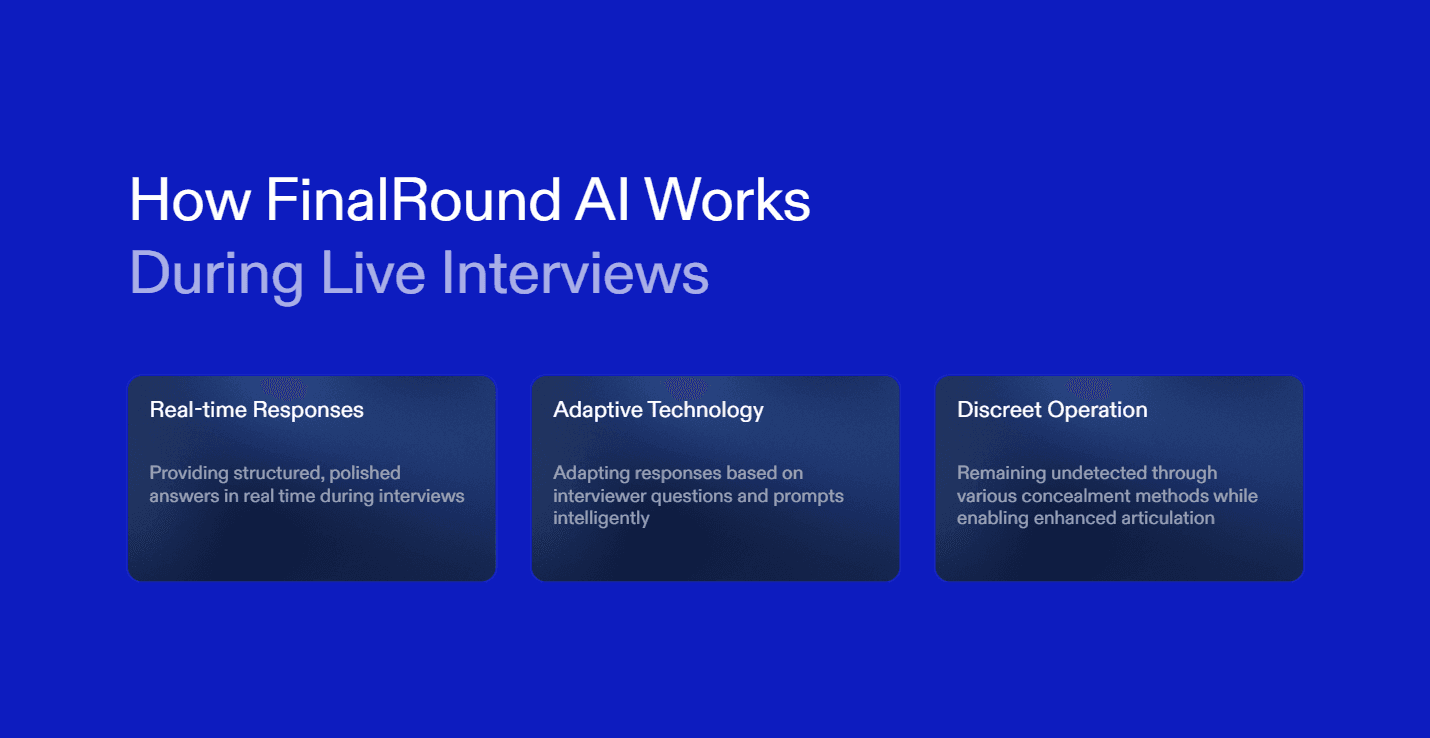
Unlike traditional preparation tools, FinalRound AI actively participates in the interview by:
Providing structured, polished answers in real time
Adapting responses based on interviewer prompts
Remaining hidden from basic screen or webcam monitoring
This creates a scenario where candidates appear confident and articulate without demonstrating their actual skills.
Is Final Round AI Detectable?
Yes, Final Round AI is detectable, but only with the right interview integrity tools and techniques. While AI interview assistants have become increasingly sophisticated, most traditional interview setups are not designed to identify AI-assisted responses. Standard video conferencing platforms such as Zoom, Google Meet, and Microsoft Teams focus on communication, not detecting hidden AI tools running in the background.
Whether Final Round AI can be detected depends on the technology used during the interview. Manual observation alone often isn't enough, especially when candidates receive AI-generated responses discreetly through hidden windows or secondary devices. Behaviour-based detection platforms provide a more effective way to identify suspicious interaction patterns without disrupting the interview experience.
Approach | Can It Detect Final Round AI? | How It Works |
|---|---|---|
Traditional interviews | ❌ No | Relies on interviewer observation, including pauses, confidence, and answer quality. |
Video platforms (Zoom, Google Meet, Microsoft Teams) | ❌ No | Designed for communication and collaboration, not for detecting AI tools or monitoring background applications. |
✅ Yes | Analyses behavioural patterns, monitors interview activity signals, and flags potential AI-assisted responses in real time. |
In most cases, traditional interviews and standard video platforms are not designed to detect AI assistance, which allows tools like Final Round AI to go unnoticed.
Sherlock AI fills this gap by providing real time visibility into candidate behavior and interaction patterns, helping recruiters identify AI assisted responses and ensure fair and authentic hiring decisions.
Can Zoom, Google Meet, or Microsoft Teams Detect Final Round AI?
No. Video conferencing platforms such as Zoom, Google Meet, and Microsoft Teams are designed for communication, not interview integrity. While they support features like screen sharing, recording, and chat, they do not detect AI interview assistants running in the background or identify AI-generated responses.
Organisations concerned about AI-assisted interview cheating typically need additional interview integrity solutions that analyse behavioural patterns and interview activity beyond what standard meeting platforms can provide.
Read more: How to Detect Cheating in a Microsoft Teams Interview
Why Is Final Round AI Hard to Detect?
Detecting FinalRound AI is challenging because it does not rely on obvious cheating signals. Candidates may not switch tabs, glance away, or behave suspiciously on camera. Instead, AI assistance happens quietly in the background, allowing candidates to receive real-time suggestions while maintaining natural eye contact and conversation flow.
Unlike traditional forms of cheating, FinalRound AI is designed to blend seamlessly into the interview experience. Candidates can paraphrase AI-generated responses in their own words, making answers appear authentic even when they are receiving external assistance. This makes it much harder for recruiters to distinguish between genuine expertise and AI-assisted responses through observation alone.
Key reasons it's hard to detect:
AI-generated responses sound natural and conversational.
Minimal visible behavioural cues during the interview.
Works alongside standard video conferencing tools without disrupting the meeting.
Can operate through secondary devices, hidden windows, or discreet overlays.
Candidates can adapt or personalise AI-generated responses, making them seem more authentic.
As a result, manual observation and simple proctoring tools are often ineffective. AI assistance is only one part of the problem. Recruiters should also understand the different types of cheating in remote interviews before evaluating candidates, as modern interview fraud extends well beyond AI-generated responses.
How Can Recruiters Detect Final Round AI?
While there is no single indicator that confirms a candidate is using FinalRound AI, recruiters can look for behavioural patterns that may suggest AI-assisted responses. Rather than relying on one signal, it's important to evaluate multiple aspects of a candidate's performance throughout the interview.
Common indicators include:
Responses that sound unusually polished but lack depth when challenged.
Delayed answers to straightforward questions.
Inconsistent reasoning across follow-up questions.
Difficulty explaining the thought process behind an answer.
Sudden changes in communication style or confidence.
These signs do not necessarily indicate cheating on their own. However, when several patterns appear together, they may warrant further review using interview integrity tools.
Why traditional detection methods fall short
Most interview platforms focus on enabling communication rather than verifying interview integrity. Webcam monitoring, screen sharing, and interviewer observation cannot reliably identify whether a candidate is receiving AI-generated assistance in the background.
As a result, organisations relying only on manual observation or basic proctoring tools may overlook AI-assisted responses. Detecting modern interview cheating requires analysing behavioural patterns, interaction signals, and contextual inconsistencies instead of relying solely on visible actions.
AI assistance is only one form of interview fraud. Recruiters should also be aware of other remote interview risks, including impersonation, off-screen assistance, hidden communication devices, and answer coaching, all of which can affect the fairness of the hiring process.
Read more: AI Interview Cheating vs Traditional Interview Cheating
How Sherlock AI Detects FinalRound AI in Interviews
Traditional interview platforms cannot reliably identify AI-assisted responses because they focus on communication rather than interview integrity. Sherlock AI takes a behaviour-based approach by analysing interview activity, behavioural signals, and response patterns in real time to help recruiters identify potential AI assistance while maintaining a fair candidate experience.
1. Behavioural Pattern Analysis
Sherlock AI evaluates how candidates respond, reason, and adapt throughout the interview. Instead of analysing only the final answer, it looks at the overall response behaviour, including consistency, confidence, and how candidates handle unexpected follow-up questions. Sudden shifts in communication style or reasoning patterns are highlighted for further review.
2. Audio and Environment Intelligence
AI-assisted interviews often introduce subtle audio and environmental cues that are difficult to identify manually. Sherlock AI analyses unusual response delays, unexpected pauses, background voice inputs, and other environmental signals that may indicate external assistance during the interview.
3. Device and Activity Monitoring
Candidates using AI interview assistants may rely on hidden browser windows, secondary devices, or external overlays. Sherlock AI monitors interview activity beyond standard webcam and screen-sharing capabilities to identify suspicious interaction patterns that could suggest off-screen AI assistance.
4. Real-Time Behavioural Alerts
Rather than generating reports after the interview, Sherlock AI provides real-time behavioural alerts whenever unusual patterns are detected. This allows interviewers to ask additional follow-up questions while the interview is still in progress, making it easier to verify a candidate's genuine understanding.
5. AI-Assisted Response Detection
Sherlock AI identifies behavioural indicators commonly associated with AI-generated responses, such as unusually polished answers to complex questions, inconsistent reasoning across follow-up discussions, and responses that appear disconnected from the candidate's demonstrated knowledge.
6. Interview Integrity Scoring
Sherlock AI combines multiple behavioural and activity signals into a structured interview integrity assessment. Instead of relying on a single indicator, it evaluates patterns across the entire interview, helping recruiters make fair and evidence-based hiring decisions.
7. Works with Existing Interview Workflows
Sherlock AI integrates with existing remote interview workflows without requiring significant process changes. Recruiters can continue using familiar interview platforms while adding an additional layer of interview integrity and behavioural analysis.
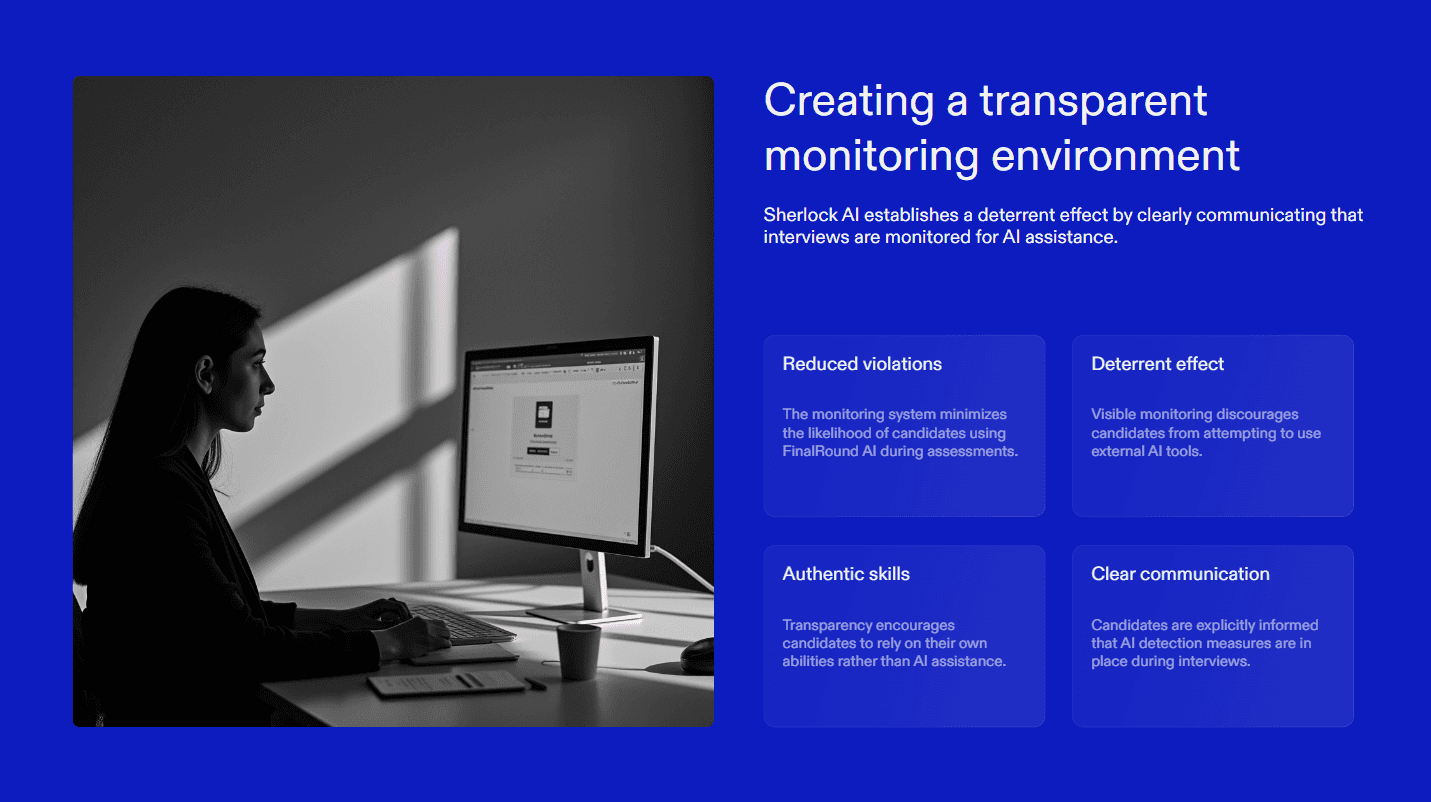
How Sherlock AI Prevents AI-Assisted Cheating
Detection alone is not enough. Prevention is equally critical.
Sherlock AI prevents FinalRound AI usage by:
Creating a deterrent effect through transparent monitoring
Reducing opportunities for hidden AI assistance
Encouraging authentic, skill-based responses
Supporting interviewers with real-time insights
By combining prevention with detection, Sherlock AI helps organizations maintain trust throughout the hiring process.
Best Practices to Strengthen AI Detection in Interviews
Technology is most effective when combined with a well-designed interview process. While interview integrity tools can identify suspicious behaviour, recruiters can further reduce the risk of AI-assisted cheating by adopting structured interviewing techniques that encourage authentic responses.
Here are some best practices to strengthen AI detection during remote interviews:
1. Ask Follow-Up Questions
Candidates using AI tools often perform well on prepared or straightforward questions but may struggle when asked to explain or expand on their answers. Follow-up questions that require clarification or deeper reasoning make it more difficult to rely on AI-generated responses.
2. Use Scenario-Based and Problem-Solving Questions
Present candidates with realistic situations that require them to explain how they would approach a problem. These questions assess critical thinking and decision-making rather than memorised or AI-generated responses.
3. Evaluate the Candidate's Thought Process
Instead of focusing only on whether the answer is correct, ask candidates to explain how they arrived at their conclusion. Understanding their reasoning provides better insight into their actual knowledge and experience.
4. Look for Consistency Throughout the Interview
Pay attention to whether a candidate's communication style, technical depth, and confidence remain consistent across different topics. Sudden changes in response quality or reasoning may warrant additional follow-up.
5. Vary the Order and Structure of Questions
Changing the sequence of questions or introducing unexpected follow-up prompts can make it more difficult for candidates to rely on real-time AI assistance. This also helps assess their ability to think independently under changing conditions.
6. Include Practical or Live Exercises
Where appropriate, incorporate live coding tasks, case studies, whiteboarding sessions, or role-playing exercises. These activities encourage candidates to demonstrate their skills in real time and provide additional context for evaluating their performance.
7. Combine Human Judgement with Behaviour-Based Technology
No single technique can reliably detect every instance of AI-assisted cheating. Combining structured interviews, interviewer expertise, and behaviour-based interview integrity platforms provides a more comprehensive approach to identifying suspicious patterns while reducing false positives.
By combining these best practices with intelligent interview integrity solutions such as Sherlock AI, organisations can create a fairer and more reliable hiring process. Rather than relying on a single signal, recruiters gain a more complete understanding of candidate behaviour, helping them identify potential AI-assisted responses while ensuring hiring decisions are based on genuine skills and capabilities.
The Future of Interviews: Authenticity Over Automation
As AI interview assistants become more capable, interview processes must evolve alongside them. Future hiring practices will increasingly combine structured interviews, behavioural analysis, and interview integrity technology to ensure candidates are evaluated on genuine knowledge and decision-making rather than AI-generated responses.
Organisations that adopt proactive detection strategies today will be better prepared to maintain fairness and trust as AI-assisted interviewing becomes more common.
Conclusion
Final Round AI is changing the way organisations approach interview integrity. While traditional interview monitoring methods struggle to detect AI-assisted responses, combining structured interviewing techniques with behaviour-based detection can help recruiters make more confident hiring decisions.
As AI interview assistants continue to evolve, organisations can no longer rely solely on webcam monitoring, screen sharing, or interviewer intuition. Protecting the integrity of remote interviews requires a combination of well-designed interview processes, thoughtful follow-up questioning, and technology capable of identifying behavioural signals that may indicate AI assistance.
Whether you're hiring for technical, sales, or leadership roles, ensuring candidates are evaluated on their own knowledge and decision-making is becoming an essential part of modern recruitment. Solutions such as Sherlock AI provide recruiters with additional behavioural insights that support fair, evidence-based hiring while preserving a positive candidate experience.
By investing in interview integrity today, organisations can reduce hiring risks, improve candidate trust, and make decisions based on genuine skills rather than AI-generated responses. As AI continues to reshape recruitment, the organisations that adapt early will be better equipped to build stronger, more reliable teams.
Book a demo today to see how Sherlock AI helps organisations detect Final Round AI, strengthen interview integrity, and make confident hiring decisions based on authentic candidate performance. |
|---|
FAQ's - How to Detect and Prevent Final Round AI
1. What is FinalRound AI?
FinalRound AI is an AI-powered interview assistant that listens to interview questions and generates suggested responses in real time. It is designed to help candidates during live interviews by providing structured answers, making it difficult for interviewers to determine whether responses reflect the candidate's own knowledge.
2. Is FinalRound AI detectable during remote interviews?
Yes, FinalRound AI can be detected when organisations use interview integrity solutions that analyse behavioural patterns and interview activity. Standard video conferencing platforms such as Zoom, Google Meet, and Microsoft Teams cannot identify hidden AI assistance on their own.
3. How does Sherlock AI detect FinalRound AI?
Sherlock AI detects potential use of FinalRound AI by analysing behavioural patterns, interview activity, and response consistency throughout the interview. Instead of trying to detect a specific application running on a candidate's device, Sherlock AI identifies signals that may indicate AI-assisted responses, such as unusual response patterns, inconsistencies during follow-up questions, delayed reactions, and other behavioural indicators. These real-time insights help recruiters identify potential AI assistance while maintaining a fair, secure, and authentic interview experience.
4. Can Zoom, Google Meet, or Microsoft Teams detect FinalRound AI?
No. Zoom, Google Meet, and Microsoft Teams are communication platforms designed for virtual meetings. They do not detect AI interview assistants running in the background or analyse behavioural signals that may indicate AI-assisted responses.
5. Is using FinalRound AI considered cheating?
Whether using FinalRound AI is considered cheating depends on an organisation's interview policies. However, if candidates rely on AI-generated answers during a live interview instead of demonstrating their own knowledge and reasoning, many employers consider it a breach of interview integrity.
6. How can recruiters identify AI-assisted interview responses?
Recruiters should look for behavioural patterns rather than a single indicator. Common signs include delayed responses, inconsistent reasoning, unusually polished answers that lack depth, difficulty explaining thought processes, and noticeable changes in communication style during follow-up questions.
7. How can organisations prevent candidates from using FinalRound AI?
Organisations can reduce AI-assisted interview cheating by combining structured interview techniques with interview integrity technology. Asking scenario-based follow-up questions, evaluating reasoning instead of memorised answers, and using behavioural detection tools can help ensure a fair and authentic hiring process.