Back to all blogs
Discover the document verification process, common types, verification methods, business benefits, and important compliance considerations. Copy both


A document can look convincing and still contain an altered photograph, changed personal details, or information that belongs to someone else. Document verification helps businesses assess whether documents are genuine, valid, and appropriate for their intended purpose before making important decisions.
The growing concern around identity misuse highlights the need for reliable verification processes. According to the Federal Trade Commission, more than 1.1 million identity theft reports were submitted through IdentityTheft.gov in 2024. Although these reports do not all involve forged documents, they demonstrate why businesses need reliable ways to assess identity-related claims.
Document verification plays an important role across industries such as recruitment, banking, education, and financial services. For example, a recruiter may need to confirm whether a candidate's identity document is authentic and belongs to the person attending an interview. Similarly, financial institutions may verify customer documents during onboarding, while educational institutions may check the authenticity of academic certificates.
An effective document verification process involves more than reading the information printed on a document. Depending on the document type and verification requirements, businesses may examine security features, extract relevant information, compare details with trusted sources, and investigate inconsistencies. Automated verification tools can support these activities, while manual review helps address cases requiring additional assessment.
Businesses must also consider data privacy, secure document handling, and applicable compliance requirements throughout the process.
This guide explains what document verification is, why it matters, the different types and methods, how the verification process works, its benefits, compliance considerations, and common business applications.
What Is Document Verification?
Document verification is the process of checking whether a document is authentic, valid, and consistent with reliable information. It helps businesses confirm the credibility of documents submitted to support claims related to identity, education, employment, address, income, or business registration.
The verification process depends on the document type and the information that needs to be confirmed. For example, verifying an academic certificate may involve checking its details with the issuing university, while verifying a government-issued identity document may involve examining security features, validating document information, and checking its validity.
Document verification and identity verification are closely related but serve different purposes. Document verification focuses on the authenticity and validity of the document, whereas identity verification establishes whether the person presenting the document is its rightful holder. An authentic identity document alone does not confirm that it belongs to the individual submitting it.
Businesses may use both processes together to make more informed decisions during recruitment, customer onboarding, financial transactions, and other activities requiring reliable evidence.

Why Is Document Verification Important?
Document verification helps businesses assess the reliability of information before making important decisions. Without appropriate checks, altered documents, inaccurate details, or unsupported claims may lead to fraudulent approvals, compliance issues, and operational risks. A structured verification process allows organizations to identify discrepancies, evaluate supporting evidence, and make decisions based on reliable information.
1. Reduce the Risk of Misrepresentation
Documents may contain altered personal details, substituted photographs, incorrect expiry dates, or fabricated information. Accepting such documents without verification can expose businesses to identity fraud, false claims, and inappropriate approvals.
Document verification helps identify potential inconsistencies and gives businesses an opportunity to investigate suspicious information before approving applications, granting access, or completing onboarding.
2. Establish Confidence in Hiring Decisions
Recruitment teams often rely on documents to assess a candidate's identity, educational qualifications, and employment history. However, submitting an identity document does not establish whether the candidate holds the qualifications or professional experience claimed.
Verifying relevant documents and confirming information with appropriate sources helps recruiters assess candidate claims more reliably. It also supports consistent hiring decisions based on verified information rather than submitted documents alone.
3. Support Regulatory Obligations
Businesses operating in regulated industries may be required to verify customer identities and maintain appropriate records as part of their compliance responsibilities.
Document verification can support these obligations by helping organizations assess identity evidence and maintain records of relevant checks. However, document verification alone does not establish full regulatory compliance.
4. Create Consistent Decision Criteria
Without clearly defined verification procedures, different reviewers may assess similar documents differently. This can result in inconsistent approvals, unnecessary delays, and difficulties explaining verification decisions.
Establishing document acceptance criteria, validation requirements, and procedures for handling discrepancies helps businesses apply consistent standards. It also makes it easier to determine when additional evidence or manual review is necessary.
How Identity Document Verification Works?
Identity document verification involves examining government-issued identity documents to assess their authenticity, validity, and consistency with the information provided by an individual. The process typically includes document submission, data capture and extraction, and document validation. Depending on the verification requirements, additional checks may be needed to establish whether the document belongs to the person presenting it.

1. Document Submission
The process begins when an individual submits an accepted identity document, such as a passport, driving licence, or national identity card. Documents may be submitted through a digital verification platform or presented physically for examination.
During this stage, the following checks help ensure the document is suitable for verification:
Document selection: Confirm that the submitted identity document is accepted for the intended verification purpose.
Document capture: Obtain clear images or scans of the required document pages or sides.
Image quality assessment: Check for blur, glare, cropping, missing details, or other issues that could affect verification.
Secure submission: Use appropriate secure channels to protect sensitive personal information during digital transmission.
A clear and complete document submission helps reduce processing errors and unnecessary requests for resubmission.
2. Data Capture and Extraction
Once the identity document is submitted, the relevant information is extracted for further examination. Automated systems may use optical character recognition (OCR), image processing, and other technologies to capture and organize document details.
Common activities include:
Image preprocessing: Adjust document images to improve readability by correcting alignment, reducing visual noise, or enhancing clarity.
Automated data extraction: Extract information such as the holder's name, date of birth, document number, issue date, and expiry date.
Field identification: Identify relevant information from specific document areas, including visible text and supported machine-readable fields.
Data consistency checks: Compare extracted details with information supplied during the application or onboarding process.
Although automated extraction improves the efficiency of collecting document information, it does not independently establish whether the document is authentic.
3. Document Validation
Document validation involves examining the submitted identity document to determine whether its characteristics and information are consistent with a genuine, valid document.
Depending on the document type and available verification technology, validation may include:
Security feature checks: Examine supported security elements, such as holograms, watermarks, or other expected document features.
Document format checks: Assess layout, fonts, formatting, and other characteristics for inconsistencies.
Alteration detection: Look for signs of manipulated photographs, changed personal details, or other unexpected modifications.
Machine-readable data checks: Compare information contained in supported machine-readable zones, barcodes, or QR codes with visible document details.
Cross-reference validation: Compare relevant information with authorized databases, issuing authorities, or other trusted sources where access is available and legally permitted.
Document validation helps identify potential inconsistencies and determine whether further investigation is necessary. However, confirming that an identity document is authentic does not automatically establish that it belongs to the individual submitting it. Additional holder verification, such as facial comparison, may be required depending on the purpose and assurance level of the verification.
What Are the Different Types of Document Verification?
Document verification can be categorized based on the type of information or claim that needs to be confirmed. Businesses use different verification approaches depending on whether they need to establish an individual's identity, address, educational qualifications, employment history, financial information, or business credentials.
Understanding these categories helps organizations select appropriate documents and verification methods for their specific requirements.
Type | Common Documents | Main Verification Objective |
|---|---|---|
Identity Verification | Passports, national identity cards, driving licences | Assess document authenticity and validate identity-related information |
Address Verification | Utility bills, bank statements, official correspondence | Confirm whether documents support a claimed residential or business address |
Education Verification | Degree certificates, academic transcripts, professional qualifications | Verify academic credentials and relevant details with issuing institutions |
Employment Verification | Employment letters, experience certificates, payslips | Assess employment history, job-related details, and supporting records |
Financial Verification | Bank statements, income records, tax documents | Validate specified income, financial, or transaction-related information |
Business Verification | Incorporation certificates, registration records, business licences | Confirm business registration details and relevant authorizations |
The documents accepted for verification depend on the organization's requirements, applicable regulations, and the purpose of the check. A document suitable for confirming one type of information may not provide sufficient evidence for another.
Verification may involve manual examination, automated document analysis, or confirmation through authorized sources. For example, software may extract information from an academic certificate, while the issuing university may need to confirm whether the qualification was awarded.
Components of Document Verification
Document verification relies on several components that work together to assess document authenticity, extract relevant information, identify inconsistencies, and support reliable decisions. Each component serves a specific purpose, and the combination used depends on the document type, verification requirements, and level of assurance needed.
1. Document Capture
Document capture involves obtaining a clear and complete copy of the document for examination. Depending on the verification method, this may involve uploading a digital file, scanning a physical document, or capturing images through a mobile device.
Image quality is important because blurred text, glare, cropped edges, or missing pages can affect the reliability of subsequent checks. Clear capture instructions and quality assessments help ensure that submitted documents contain the information and features required for verification.
2. Data Extraction
Data extraction converts relevant document information into a format that can be processed and compared. Optical character recognition (OCR) is commonly used to identify printed text, while other extraction technologies may process structured or machine-readable information.
The extracted data may include names, document numbers, dates, addresses, or other details relevant to the verification purpose. However, successful extraction only establishes that information has been captured; it does not confirm that the document or its contents are genuine.
3. Authenticity and Validity Checks
Authenticity and validity checks assess whether a document has the expected characteristics of a genuine document and whether it is acceptable for its intended purpose.
These checks may involve examining security features, identifying possible alterations, validating digital signatures, reviewing expiry dates, or assessing document formatting. The checks available depend on the document type and verification technology. A document may be genuine but no longer valid for a particular purpose, making both assessments important.
4. Information Matching
Information matching involves comparing relevant document details with information provided in an application, other supporting documents, or authorized reference sources.
For example, a candidate's name and qualification details may be compared with an employment application and records available through the issuing institution. Differences do not always indicate fraud, as legitimate name changes, spelling variations, or transliteration differences may require further clarification.
5. Holder Verification
Holder verification establishes whether an identity document belongs to the individual presenting it. This is particularly important because an authentic identity document can still be submitted or used by someone other than its rightful holder.
Depending on the verification requirements, holder verification may involve facial comparison, in-person identity checks, or other appropriate methods. Liveness detection may also support remote biometric verification by assessing whether a biometric sample comes from a live person. These checks complement document authenticity assessments rather than replacing them.
6. Decision Records
Decision records document the checks performed, their results, identified discrepancies, and the reasons behind a verification outcome. They may also record whether manual review was required and how unresolved issues were handled.
Maintaining appropriate records helps organizations explain verification decisions, investigate disputes, and review the consistency of their procedures. Records should be limited to necessary information and managed according to applicable privacy, security, and retention requirements.
What Are the Different Ways to Verify Identity Documents?
Identity documents can be verified using manual inspection, automated analysis, machine-readable information, digital signatures, and checks against authoritative records. Each method examines different aspects of a document, and the appropriate approach depends on the document type, available verification technology, and required level of assurance. Businesses may combine multiple methods to assess document authenticity and identify inconsistencies.
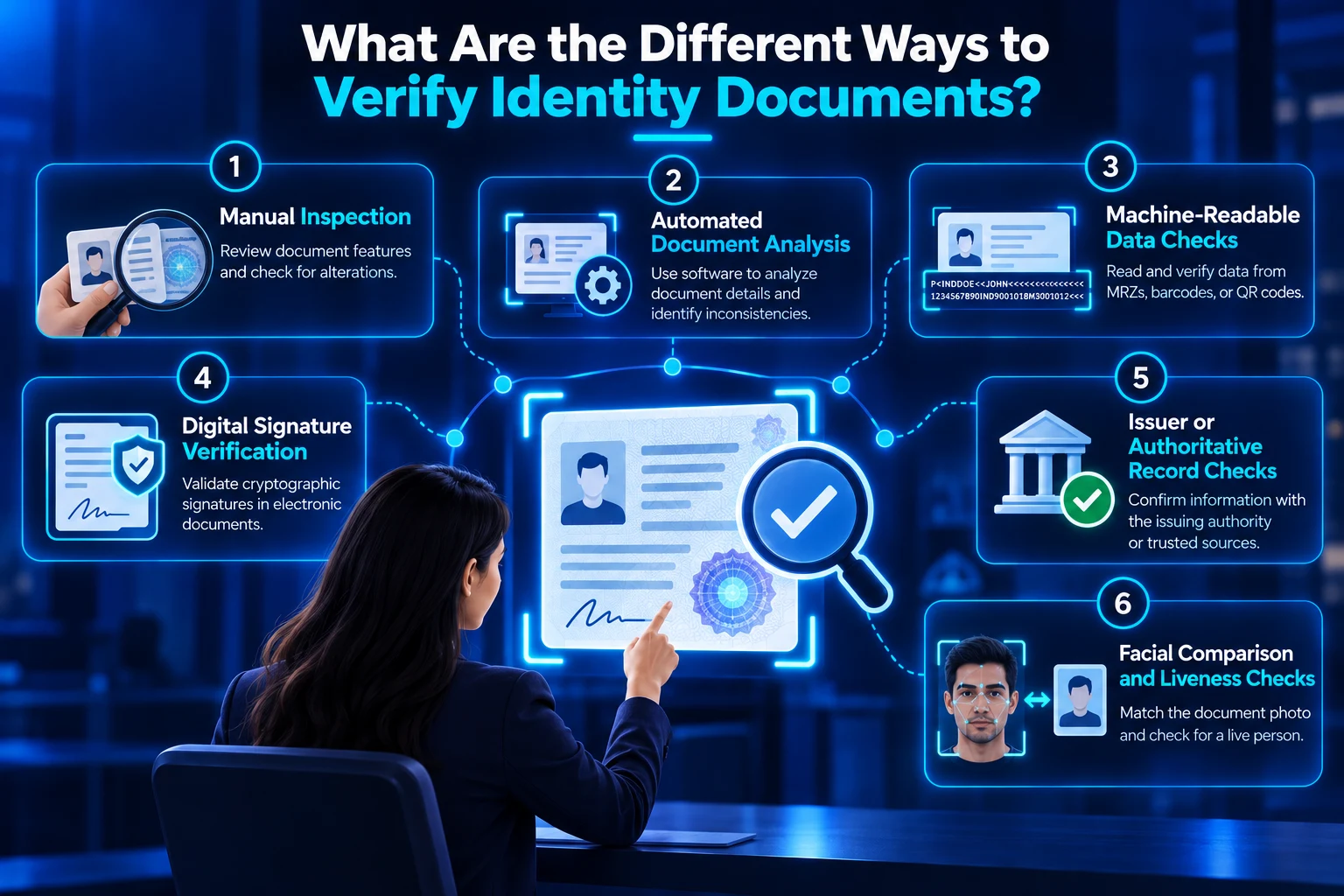
1. Manual Inspection
Manual inspection involves a trained reviewer examining an identity document for expected characteristics, visible alterations, and inconsistencies. Depending on whether the document is presented physically or digitally, the reviewer may assess its layout, photograph, personal details, expiry date, and available security features.
Physical inspection may also allow reviewers to examine security elements that cannot be reliably assessed through a standard photograph. However, the effectiveness of manual verification depends on reviewer expertise, document quality, and access to reliable reference information.
2. Automated Document Analysis
Automated document analysis uses software to examine supported identity documents and identify potential inconsistencies. These systems may assess document layouts, extract information, compare expected features, and flag signs of possible alteration.
Automated analysis can help process large volumes of documents and reduce repetitive manual tasks. However, its accuracy depends on the technology, document type, and quality of the submitted image. Documents flagged as suspicious or producing uncertain results may require further investigation rather than automatic rejection.
3. Machine-Readable Data Checks
Some identity documents contain machine-readable zones (MRZs), barcodes, or QR codes that store information in a structured format. Verification systems can read this information and compare it with the details displayed on the document.
For example, a passport's machine-readable zone may contain information such as the holder's name, document number, nationality, date of birth, and expiry date. Comparing these details with the visible information can help identify inconsistencies or data-entry errors.
However, successfully reading machine-readable information or validating its check digits does not independently establish document authenticity.
4. Digital Signature Verification
Digital signature verification is used for supported electronic documents or digitally signed information contained within certain identity documents. It involves checking a cryptographic signature to assess whether the signed data has been altered and whether the signature can be validated against a trusted issuer.
For example, Aadhaar's secure QR code contains digitally signed information that can be verified using supported verification tools. The Unique Identification Authority of India (UIDAI) explains that its secure QR code supports offline verification of the signed information.
Digital signature verification can provide stronger evidence of data integrity and issuer authenticity when the relevant trust checks succeed. However, it does not independently confirm that the person presenting the document is its rightful holder.
5. Issuer or Authoritative Record Checks
Issuer-based verification involves confirming relevant document information with the issuing authority or another reliable, authorized source. Depending on the document and available services, this may include checking document status, validity, or specific identity-related details.
These checks can provide additional confidence when the information is obtained directly from an authoritative source. However, access to official records varies by jurisdiction, document type, and applicable legal requirements.
Businesses should therefore establish which sources are available and understand what information a successful verification result confirms.
6. Facial Comparison and Liveness Checks
Facial comparison and liveness detection support identity verification by helping establish whether the person presenting an identity document matches its photograph and is physically participating in the verification attempt.
Facial comparison evaluates the similarity between a captured facial image and the photograph associated with the identity document. Liveness detection assesses whether the biometric sample appears to come from a live person rather than certain presentation attacks, such as photographs, replayed videos, or masks.
These methods can strengthen remote identity verification when used alongside appropriate document authenticity checks. However, they do not independently establish that a document is genuine or provide an absolute guarantee against impersonation.
What Is the Document Verification Process?
The document verification process involves collecting relevant documents, extracting information, validating details, reviewing discrepancies, and recording verification outcomes. Although the specific requirements vary by document type and purpose, a structured process helps businesses assess submitted evidence consistently and identify information that requires further investigation.
Step 1: Document Data Capture
The process begins with collecting the document that needs to be verified. Documents may be uploaded through a secure digital platform, scanned, or presented physically, depending on the verification requirements.
The submitted document should be complete, clearly visible, and suitable for examination. Issues such as blurred text, glare, cropped edges, or missing pages may prevent reliable verification and require resubmission.
For example, a recruiter may request a candidate to upload a degree certificate through a secure portal. If the certificate is incomplete or unreadable, the candidate may need to provide a clearer copy before verification continues.
Step 2: Data Extraction
Once the document is collected, relevant information is extracted for verification. This may be performed manually or through automated technologies such as optical character recognition (OCR), which converts text from document images into machine-readable information.
The extracted details depend on the document type and may include names, identification numbers, qualifications, issuing institutions, dates, addresses, or other relevant information.
For example, an automated system may extract a candidate's name, degree title, university, and graduation year from an academic certificate. This information can then be used for subsequent validation.
Step 3: Document Validation
Document validation involves assessing whether the submitted document is authentic, valid, and consistent with the information it is intended to support.
Depending on the document type, validation may include examining security features, identifying possible alterations, checking expiry dates, verifying digital signatures, or comparing information with authorized records and issuing institutions.
For example, a recruitment team may verify a candidate's academic qualification through the issuing university's authorized verification channel. This helps establish whether the qualification details match the institution's records.
Step 4: Manual Review
Documents that produce incomplete results, conflicting information, or potential authenticity concerns may require manual review. A trained reviewer examines the available evidence to determine whether additional checks or supporting information are necessary.
Manual review is particularly useful when discrepancies have legitimate explanations, such as name changes, spelling variations, or differences in document formats. Applicants should have an appropriate opportunity to clarify or correct information before a final decision is made.
For example, if a candidate's surname differs between an academic certificate and an identity document, the recruiter may request supporting evidence of a legal name change.
Step 5: Verification Decision and Recordkeeping
After the relevant checks are completed, the organization determines the verification outcome based on the available evidence and established acceptance criteria.
Depending on the results, the document may be accepted, rejected, or referred for additional verification. The decision should reflect which information has been verified and whether any discrepancies remain unresolved.
Organizations should maintain appropriate records of the checks performed, verification findings, reviewer involvement, and reasons for the final decision. These records can support internal reviews, dispute resolution, and applicable compliance requirements.
For example, a recruitment team may record that a candidate's academic qualification was confirmed through the issuing university, along with the verification date and relevant outcome. Records should be handled according to applicable privacy, security, and retention requirements.
Compliance Guide: What Should Businesses Consider?
Document verification can support regulatory compliance, but the requirements vary depending on the industry, jurisdiction, and purpose of verification. Businesses should establish appropriate procedures to protect personal information and meet applicable legal obligations.
Key compliance considerations include:
Regulatory requirements: Identify applicable laws and industry-specific obligations, including customer due diligence and identity verification requirements.
Lawful data collection: Establish an appropriate legal basis for collecting personal information, provide required privacy notices, and obtain consent where necessary.
Data security: Limit document collection to necessary information and restrict access to authorized personnel.
Data retention: Define appropriate retention periods and securely delete documents when they are no longer required, subject to applicable recordkeeping obligations.
Vendor assessment: Evaluate third-party verification providers for security practices, data handling, and procedures for reviewing disputed results.
The NIST Digital Identity Guidelines provide useful guidance on identity proofing, privacy, and assurance. However, businesses must assess their specific regulatory obligations separately, as document verification alone does not establish full compliance.
What Are the Benefits of Document Verification?
Document verification helps businesses assess submitted information, streamline administrative tasks, and make more consistent decisions. By combining appropriate verification checks with clear procedures and manual review when necessary, organizations can improve operational efficiency while reducing risks associated with inaccurate or misleading documents.
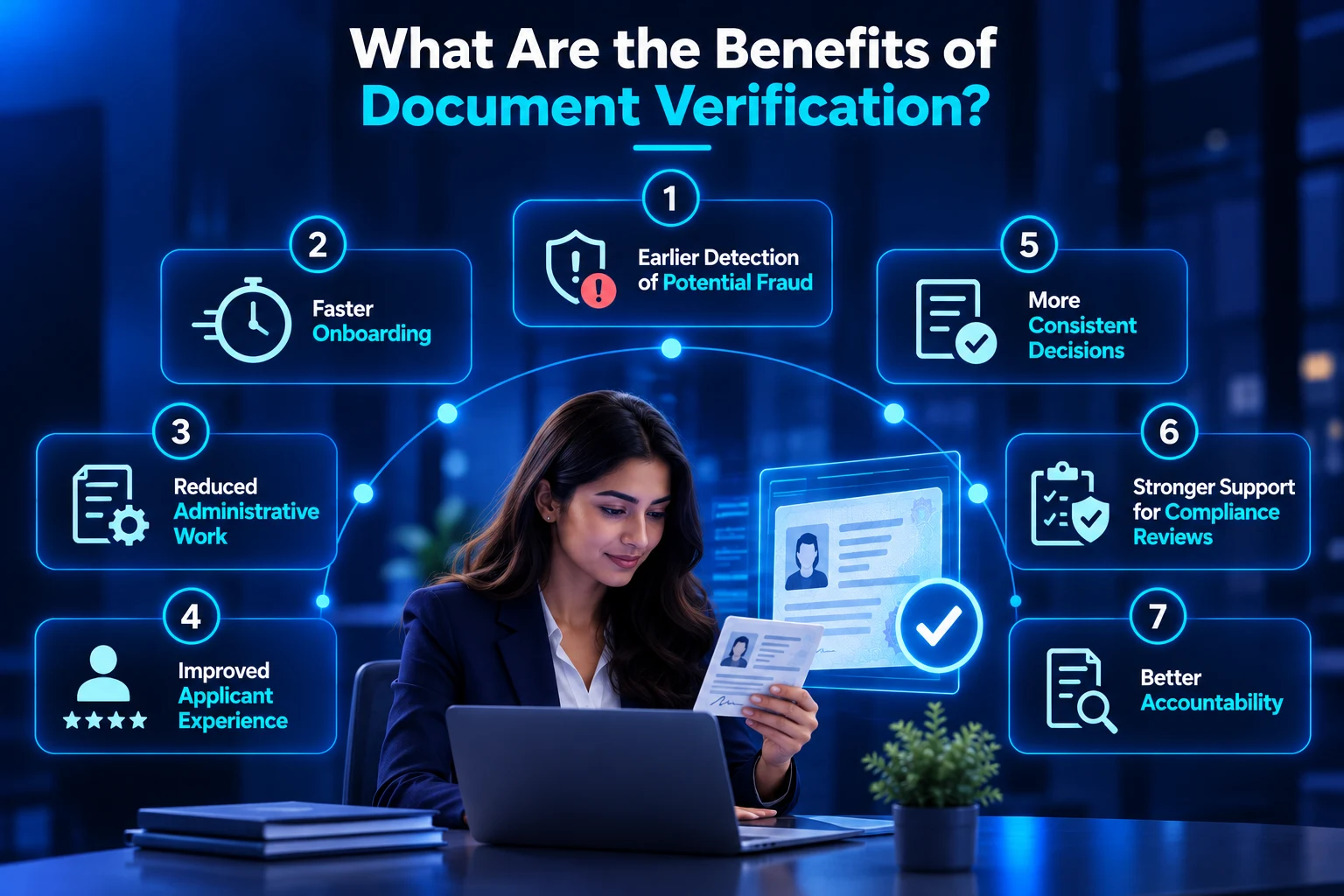
1. Earlier Detection of Potential Fraud
Document verification can help identify altered information, inconsistent details, or suspicious documents before an application is approved. Detecting these issues early allows businesses to investigate potential misrepresentation and take appropriate action before completing onboarding or granting access.
2. Faster Onboarding
Automated document verification can reduce the time needed to process straightforward submissions by extracting information and performing supported checks. Clear document requirements also help minimize delays caused by incomplete uploads or repeated requests, while complex cases can be referred for further review.
3. Reduced Administrative Work
Automated data extraction reduces the need for manual entry of document details, helping limit transcription errors and repetitive tasks. This allows employees to spend more time reviewing discrepancies, handling exceptions, and making decisions that require human judgment.
4. Improved Applicant Experience
Clear submission instructions and timely feedback make the verification process easier for applicants. When a document is incomplete or unreadable, providing specific guidance helps individuals correct the issue without unnecessary delays or repeated submissions.
5. More Consistent Decisions
Standardized document acceptance criteria and verification procedures help businesses assess similar submissions using consistent standards. This reduces unnecessary differences between reviewers and makes verification outcomes easier to explain and review.
6. Stronger Support for Compliance Reviews
Maintaining appropriate verification records can help businesses demonstrate which checks were performed and how decisions were reached. These records may support internal audits and applicable regulatory reviews, although document verification alone does not establish full compliance.
7. Better Accountability
Recording verification findings, unresolved discrepancies, and decision outcomes helps organizations investigate errors and address disputes. Reviewing these records can also reveal recurring issues that require improvements to verification procedures or employee training.
What Are the Common Use Cases of Document Verification?
Document verification is used across industries to assess the authenticity and validity of documents submitted during applications, onboarding, and other business processes. The documents and verification methods required depend on the information being confirmed, the associated risks, and applicable regulatory requirements.
The following table highlights common applications of document verification across different industries.
Use Case | Common Documents | Verification Purpose |
|---|---|---|
Recruitment | Identity documents, degree certificates, employment records | Verify candidate identity, educational qualifications, and relevant employment claims |
Financial Onboarding | Passports, national identity cards, address documents | Validate customer identity information as part of applicable due diligence requirements |
Education Admissions | Academic transcripts, degree certificates, educational records | Confirm academic qualifications and the authenticity of submitted records |
Marketplace Onboarding | Identity documents, business registration certificates | Assess seller identity and relevant business registration details |
Property Applications | Identity documents, income statements, address documents | Verify relevant identity, income, and address information |
Insurance Claims | Medical records, invoices, supporting claim documents | Assess the authenticity and consistency of documents submitted with claims |
Professional Licensing | Qualification certificates, professional credentials | Confirm whether applicants hold the required qualifications or credentials |
Age-Restricted Services | Government-issued identity documents, accepted age credentials | Establish whether individuals meet applicable age requirements |
For example, during recruitment, verifying a candidate's identity document helps assess identity-related information, while confirming an academic certificate with the issuing institution supports verification of educational qualifications. These checks serve different purposes and may be required together depending on the hiring process.
Future of Document Verification
The future of document verification will focus on improving fraud detection, making digital documents easier to validate, protecting personal data, and resolving errors more efficiently.
Key developments are likely to include:
Better detection of altered names, photographs, dates, and other document details.
Greater use of digitally signed credentials and issuer verification.
Stronger links between document checks and holder verification where appropriate.
Better controls over data access, retention, and deletion.
Clearer feedback and human review when documents cannot be verified automatically.
These improvements can help businesses strengthen verification while reducing unnecessary friction for genuine applicants.
Conclusion
Document verification helps businesses assess the authenticity and validity of documents used to support identity, education, employment, financial, and other important claims. By identifying inconsistencies and validating relevant information, organizations can reduce the risk of misrepresentation and make more informed decisions.
An effective document verification process combines appropriate authenticity checks, comparison with trusted sources, and manual review when necessary. Businesses should also establish consistent verification procedures, protect sensitive information, and follow applicable regulatory requirements to ensure documents are handled responsibly.
As verification technologies continue to evolve, organizations can improve the efficiency and reliability of their verification processes through automation, digital credentials, and stronger fraud detection methods. Balancing these technologies with appropriate human oversight can help businesses strengthen verification practices while providing a smoother experience for genuine applicants.