Back to all blogs
Learn how to identify fake job applicants, spot warning signs, verify candidates, and prevent hiring fraud with practical strategies for employers.


Fake job applicants are becoming harder to distinguish from genuine candidates. The problem goes beyond exaggerated job titles or inflated skills on a resume. Employers may encounter stolen identities, fabricated work histories, proxy interviewees, AI-assisted impersonation, face-swapping, and organized schemes designed to obtain legitimate employment and access to company systems.
A recent U.S. Department of Justice case shows how serious applicant fraud can become. North Korean IT workers, assisted by a U.S.-based facilitator, obtained remote jobs at 309 U.S. companies using stolen, purchased, or false identities. According to the Justice Department, the operation generated at least $17 million in revenue and compromised 68 U.S. identities. While this represents an extreme case, it demonstrates why candidate verification can be more than an HR concern, it can also be an identity, access-control, and cybersecurity issue.
Generative AI adds another layer to the challenge. AI can help legitimate candidates improve resumes, prepare for interviews, or communicate more clearly. At the same time, it can make fabricated profiles, scripted answers, synthetic media, and impersonation easier to create and scale. Employers therefore should not treat AI use itself as evidence of fraud. Instead, they need to verify the candidate's identity, experience, qualifications, and work when those details are material to the hiring decision.
This guide explains what fake job applicants are, the different forms applicant fraud can take, the warning signs recruiters should look for, and practical ways employers can strengthen candidate verification without turning every hiring interaction into an investigation.
What Are Fake Job Applicants?
Fake job applicants are candidates who intentionally misrepresent important information about their identity, experience, qualifications, work history, or location to pass a hiring process. The deception can be relatively limited, such as claiming a qualification they do not have, or extensive enough that the person being interviewed is not the person who will ultimately perform the job.
Not every inconsistency makes someone a fake applicant. An outdated LinkedIn profile, a minor difference in employment dates, nervous interview behavior, or the use of AI to improve writing does not automatically indicate fraud. The concern is deliberate misrepresentation that affects an employer's ability to evaluate a candidate or safely provide employment, payment, equipment, or system access.
Fake applicants are also different from fake job postings. Fake job postings target job seekers, while fake applicants target legitimate employers. In more serious cases, the goal may extend beyond securing a paycheck to obtaining access to company systems, stealing proprietary information, concealing a worker's actual location, or supporting organized fraud.
The key distinction is intentional and material misrepresentation. Employers should focus on claims that can be verified and discrepancies that could affect the hiring decision rather than treating normal differences in candidate behavior or information as evidence of fraud.

Why Fake Job Applicants Are Becoming a Bigger Hiring Risk?
Hiring has become faster, more remote, and more digital. Those changes benefit employers and candidates, but they also remove some of the physical checks that once made impersonation harder. Fraudsters can now combine false identity data, polished application material, remote access tools, and AI-assisted media in the same hiring attempt.
Remote interviews can make it harder to establish continuity between the applicant, the interviewee, and the person who eventually receives company access.
Generative AI can quickly produce tailored resumes, cover letters, portfolio text, scripts, and plausible answers at scale.
Stolen or borrowed identity information can help a fraudulent applicant pass basic name, address, payroll, or eligibility checks.
Remote devices and proxy infrastructure can make an overseas worker appear to be operating from another location.
Some remote IT workers may use false identities, local facilitators, company-issued devices and remote access software to hide their actual location. This can create security risks for organisations, especially when hiring and managing remote employees. Companies should verify employee identities carefully, confirm employment and education details directly, and maintain strict controls over company devices and remote-access permissions.
Common Types of Fake Job Applicants
A fraudulent application may involve one tactic or several at once. These are the patterns hiring teams are most likely to encounter.
1. False or Stolen Identity Applicants
A candidate may apply using identity information that is not genuinely theirs. The identity may belong to another real person, combine genuine and invented information, or be supported by fabricated contact details and online profiles.
This becomes particularly serious when the false identity is used to meet location, employment eligibility, payroll, background-check, or system-access requirements. If identity checks are handled separately at different stages of hiring, inconsistencies may go unnoticed. Connecting identity verification across recruitment, onboarding, payroll, and access processes can help reduce this risk.
2. Fabricated Work-History Applicants
Some candidates may invent employers, extend employment dates, exaggerate seniority, copy another person's accomplishments, or claim responsibility for work they did not perform. A resume may also contain a mixture of genuine and fabricated experience, making discrepancies difficult to identify from the document alone.
Specific follow-up questions can help verify claimed experience. Ask how a project started, what decisions the candidate personally made, what problems occurred, who depended on their work, and what changed after delivery. Genuine experience generally includes specific details, practical decisions, challenges, and lessons learned.
3. Fake Credential Applicants
Credential fraud can include altered degrees, invented certifications, false licences, or claims that a qualification is still valid when it has expired. The level of risk depends on the position. False credentials can be particularly serious in regulated, safety-sensitive, financial, healthcare, or privileged-access roles.
When a qualification is an essential job requirement, employers should verify it directly through the issuing institution, licensing body, or an authorised screening provider rather than relying only on documents supplied by the candidate.
4. Proxy Interviewees
A proxy interview occurs when another person completes an interview or assessment on behalf of the actual candidate. The substitute may be a friend, paid participant, or someone involved in a coordinated fraud attempt. As a result, the employer may evaluate one person's identity, communication, and technical ability but eventually onboard someone else.
Maintaining continuity throughout the recruitment process can reduce this risk. Recruiters can compare identity and interview records across different stages, ask spontaneous role related follow up questions, and reconfirm identity through an approved process before equipment, accounts, or system access are issued.
5. Deepfake or AI Assisted Impersonators
Synthetic video, face swapping, voice modification, generated profile images, and real time AI assistance can make impersonation more convincing during remote recruitment.
Recruiters should not depend only on unusual video behaviour to identify possible impersonation. Poor internet connections, virtual backgrounds, accessibility tools, camera processing, and hardware problems can also cause visual or audio irregularities. A stronger approach is to examine several signals together, including identity information, employment history, interview responses, submitted work, device or location information where lawfully available, and direct verification results.
6. Assessment and Work Sample Impersonators
A candidate may ask another person to complete a coding test, writing exercise, case study, technical task, or other assessment on their behalf. Candidates may also use AI or external assistance in ways that do not follow the assessment rules.
Employers do not necessarily need to prohibit every digital or AI tool. Instead, they should clearly state what assistance is permitted. Candidates can then be asked to explain important parts of their submission, including their decisions, alternatives considered, difficulties encountered, and changes they would make. This helps establish whether the candidate understands and can take ownership of the submitted work.
7. Coordinated Fraud Networks
More complex hiring fraud can involve several people and different forms of supporting infrastructure, such as stolen identities, facilitators, proxy computers, remote access tools, payment accounts, fabricated websites, interview assistance, or devices operated from another location.
The purpose may extend beyond obtaining a salary and can include gaining unauthorised access to company systems or information, stealing intellectual property, concealing a worker's actual location, or supporting other unlawful activity.
Such cases should not be treated in the same way as an ordinary resume discrepancy. They may cross recruitment, HR, IT, security, payroll, legal, and compliance functions. Recruiters should therefore follow established escalation procedures when several serious warning signs appear rather than attempting to investigate a complex case independently.
Common Signs of a Fake Job Applicant
Fake job applicants are not always easy to identify from a resume or a single interview. In many cases, concerns emerge gradually when information provided at one stage of hiring does not match what appears later. A discrepancy on its own does not prove fraud. Genuine candidates may have outdated profiles, minor differences in employment dates, incomplete records, or technical problems during remote interviews.
Recruiters should therefore focus on material inconsistencies that remain unresolved after reasonable clarification or verification, rather than treating individual behaviors as proof of fraud.
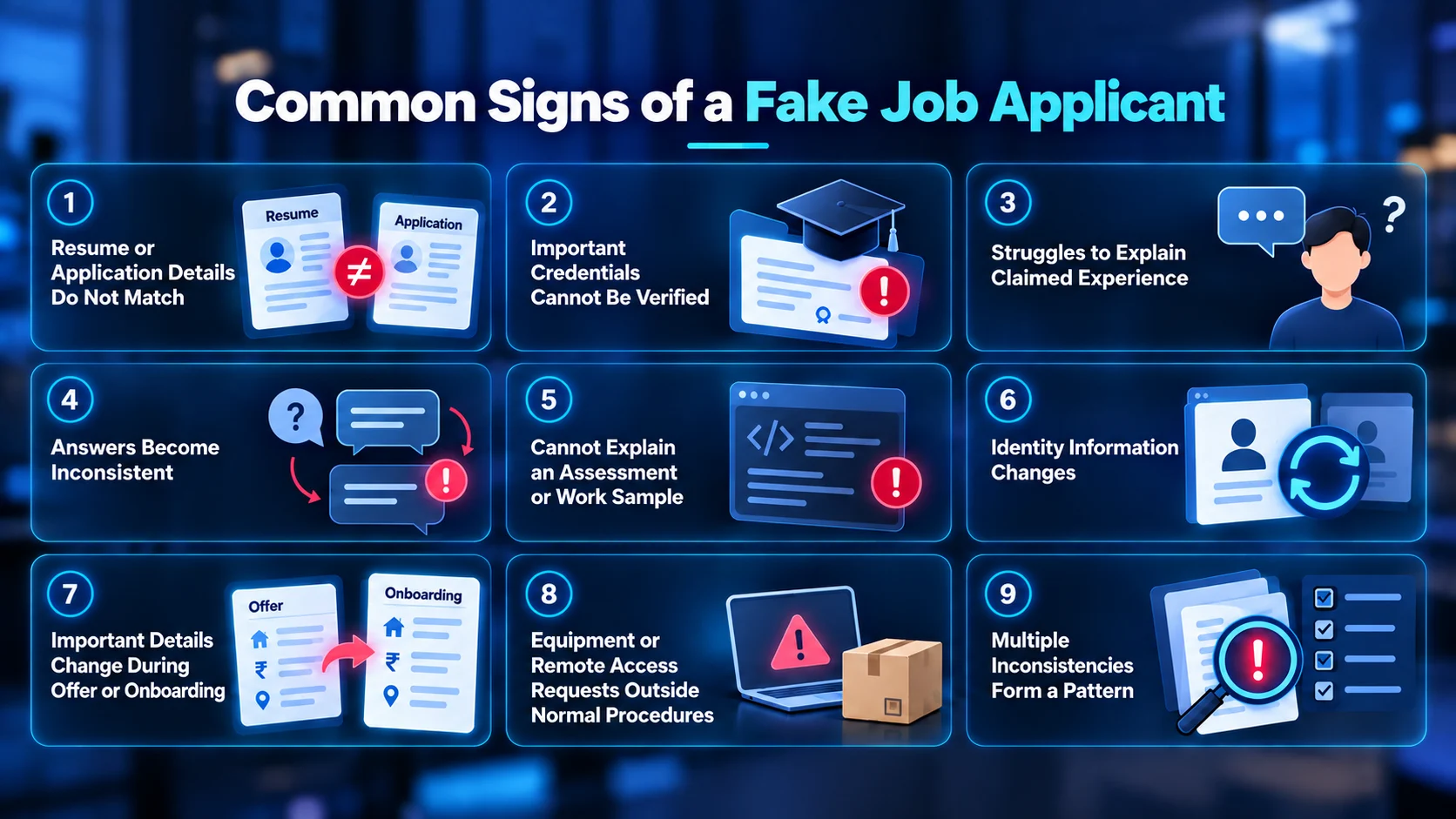
1. Resume or Application Details Do Not Match
Minor differences between a resume, application form, and professional profile are fairly common, especially when candidates have not updated every record at the same time.
Pay closer attention when:
Employment dates repeatedly change
Job titles or seniority levels are inconsistent
Responsibilities differ significantly between sources
Employers listed on the resume cannot be confirmed
Qualifications or skills change during the hiring process
For example, experience presented as a major responsibility on a resume may become much narrower when discussed during the interview. When a difference could affect the hiring decision, recruiters should ask for clarification and verify the relevant information rather than relying on assumptions.
2. Important Credentials Cannot Be Verified
Education, professional licenses, certifications, and previous employment may need independent verification when they are important requirements for the role.
Potential concerns include:
A degree or certification cannot be confirmed
A professional license cannot be verified
Previous employment cannot be independently confirmed
Information on a credential differs from the candidate's application
The candidate cannot provide reasonable supporting information
Difficulty confirming a record does not automatically mean it is false. Older records, company closures, name changes, and administrative delays can make verification more difficult. The concern becomes more significant when an important claim remains unverified and the candidate cannot provide a reasonable explanation or supporting information.
3. The Candidate Struggles to Explain Claimed Experience
A candidate who has genuinely performed the work described on their resume should generally be able to discuss it with reasonable depth.
During the interview, pay attention to whether the candidate can explain:
Their specific responsibilities
Their contribution to a project
Decisions they personally made
Problems they encountered
How the work was completed
What they learned from the experience
Not remembering every detail is normal, and nervousness or difficulty communicating should not be treated as evidence of deception. However, when a candidate claims substantial or specialized experience but repeatedly gives vague or generic explanations of their own work, the underlying experience may need closer verification.
4. Answers Become Inconsistent During Follow-Up Questions
Prepared responses are common in interviews, so a polished initial answer is not a warning sign by itself. The more important question is whether the factual details remain consistent as the conversation develops.
Look for repeated changes in:
The candidate's role in a project
Their responsibilities
Project timelines
Tools or technologies used
The people they worked with
Their individual contribution
Occasional differences can result from misunderstanding or imperfect recall. Repeated contradictions in important details are more relevant, particularly when they conflict with information already provided in the application or earlier stages of the interview. In such cases, recruiters should clarify the inconsistency and verify the underlying information if it is material to the role.
5. The Candidate Cannot Explain an Assessment or Work Sample
Take-home assessments and work samples require additional attention now that candidates have access to generative AI, coding assistants, online resources, and other forms of support. The use of these tools should not automatically be treated as dishonest, particularly when the employer has not clearly stated what assistance is permitted.
After reviewing an assessment, consider whether the candidate can:
Explain their overall approach
Discuss important decisions they made
Explain why they chose a particular solution
Describe challenges they encountered
Make changes to the work when requirements change
Explain the reasoning behind their final output
A significant gap between the quality of a submitted assessment and the candidate's understanding of that work may be a reason for further review.
6. Identity Information Changes Across Hiring Stages
Material differences in identity information deserve closer attention, particularly in remote recruitment. Employers should be able to establish reasonable continuity between the person who submits the application, attends interviews, completes required verification, accepts the offer, and begins employment.
Pay attention to changes involving:
Name or identity information
Contact details
Verified records
Location information
Other identity details collected during the hiring process
Significant inconsistencies should be resolved before the hiring process moves forward. These checks should rely on approved verification methods and objective information rather than assumptions based on appearance, accent, communication style, or video quality.
7. Important Details Change During Offer or Onboarding
Some inconsistencies appear only after an offer has been made. A candidate may provide a different address, work location, payment detail, contact number, or equipment shipping destination from the information supplied earlier.
Review unexpected changes involving:
Residential or work location
Payment details
Contact information
Equipment delivery address
Other previously verified employment information
These changes can have legitimate explanations and should not automatically be treated as suspicious. They become more relevant when several details change unexpectedly, conflict with previously verified information, or involve requests to bypass normal onboarding procedures.
8. Equipment or Remote Access Requests Fall Outside Normal Procedures
Unusual requests involving company devices or remote access may require additional review, particularly for remote roles.
Examples include requests to:
Send company equipment to an unexpected location
Allow another person to receive a company device
Use an unapproved remote access arrangement
Bypass established equipment procedures
Make exceptions to normal access requirements
There may be a legitimate reason for such a request, so it should not automatically be treated as evidence of fraud. However, unexplained deviations should be checked with the appropriate IT or security team before approval, especially when they appear alongside identity, location, or employment inconsistencies.
9. Multiple Inconsistencies Begin to Form a Pattern
Potential applicant fraud is often identified through a pattern of unresolved discrepancies rather than one obvious warning sign. Individual issues may have legitimate explanations, but several unrelated inconsistencies deserve closer review.
The pattern may involve:
Identity information
Employment history
Claimed skills
Interview responses
Assessment performance
Location details
Equipment or payment information
Onboarding records
Recruiters should focus on the specific facts that can be clarified or verified rather than deciding whether a candidate simply appears suspicious. Looking at the overall pattern while checking individual discrepancies on their own merits provides a more reliable basis for identifying potential fake applicants without unfairly treating ordinary candidate differences as evidence of fraud.
How Fake Job Applicants Can Affect Employers?
The impact depends on what was falsified and how far the applicant progressed. A fabricated skill claim may create a performance problem. A stolen identity can create payroll and compliance problems. A malicious hire can create a security incident.
Hiring cost and delay: recruiter time, interviews, assessments, verification, and onboarding may need to be repeated.
Performance risk: the person may not have the skills or experience used to justify the hiring decision.
Data and intellectual-property risk: an onboarded fraudster may receive access to code, customer information, credentials, internal documents, or proprietary processes.
Compliance and legal risk: identity, work authorization, sanctions, privacy, licensing, tax, or regulated-access requirements may be affected.
Trust and candidate-experience risk: poorly designed fraud controls can burden genuine candidates and damage employer reputation.
How to Avoid Fake Job Applicants?
There is no single check that can reliably keep fake job applicants out of the hiring process. A resume can look convincing, an interview can go well, and basic verification may not reveal every problem.
A better approach is to build sensible checks into different stages of hiring. The goal is not to make genuine candidates complete unnecessary checks. It is to verify the information that actually matters before making a hiring decision or providing access to company systems, data, equipment, or other resources.

1. Decide What Actually Needs to Be Verified
Not every role requires the same level of verification. Start by identifying which information genuinely matters for the position.
Depending on the role, this may include:
Employment history and relevant experience
Technical skills
Education and professional qualifications
Licenses and certifications
Work authorization
Identity and location
Information related to sensitive systems or privileged access
Defining these requirements upfront keeps the verification process focused. Recruiters know what they need to confirm, candidates know what to expect, and the company avoids collecting information that has little relevance to the hiring decision.
2. Make Interviews Harder to Fake, Not Harder for Candidates
A good interview should give candidates an opportunity to talk about work they have actually done. Instead of relying heavily on questions such as “How many years have you used this tool?”, ask candidates to walk through a real project.
You can ask:
What were you responsible for?
Which decisions did you make yourself?
What problems did you encounter?
How did you solve them?
What would you do differently now?
Follow-up questions are particularly useful because they move the conversation beyond prepared answers. Someone who genuinely worked on a project can usually discuss the details, including challenges and decisions that may not appear on a resume.
Hesitation, nervousness, or an imperfect answer should not automatically be treated as suspicious. The goal is to understand whether the candidate's explanation supports the experience presented in the application.
3. Check Important Claims Instead of Taking Documents at Face Value
A professional-looking resume or certificate is not independent verification. When a qualification or piece of experience matters to the job, confirm it through an appropriate source.
Depending on the claim, this could include:
Verifying employment history
Contacting references
Confirming a degree with an educational institution
Verifying a professional license
Checking other role-specific qualifications
Focus on claims that could genuinely affect the hiring decision. There is little value in trying to verify every line of a resume if only a handful of details are important to the role.
If something does not match immediately, ask the candidate about it. Companies close, records change, job titles differ between internal and public systems, and administrative errors happen. A discrepancy is a reason to check further, not automatic proof of fraud.
4. Be Clear About AI and Outside Help During Assessments
AI has made traditional assumptions about take-home assessments less reliable. Rather than assuming candidates will never use these tools, employers should explain the rules before the assessment begins.
Be clear about whether candidates can use:
Generative AI
Search engines
Coding assistants
Reference material
Collaboration tools
Other external resources
If an assessment must be completed independently, say so clearly.
For important assessments, a short follow-up conversation can also help establish whether the candidate understands the work they submitted. Ask why they chose a particular approach, how they would change the work under different conditions, or what they found difficult.
The goal is not simply to catch someone using AI. It is to establish whether the candidate understands and can take ownership of the work they present as their own.
5. Make Sure the Same Person Moves Through the Hiring Process
For remote and higher-risk roles, identity verification should not be treated as a one-time check. The person who submits the application should be the same person who attends the interview, completes required checks, accepts the offer, and ultimately starts work.
Employers should maintain reasonable continuity across:
Application
Interviews
Assessments
Identity verification
Offer documentation
Onboarding
Equipment delivery
If something significant changes between stages, such as identity information, contact details, location, payment information, or the person appearing during onboarding, verify the change before moving ahead.
These checks should rely on approved verification methods rather than subjective judgments about someone's appearance, accent, camera quality, or communication style.
6. Use AI-Powered Interview Proctoring Tools like Sherlock AI
For remote and high-volume hiring, AI-powered interview proctoring can provide an additional layer of protection against identity and interview-integrity risks. Sherlock AI helps organizations identify potential proxy candidates, identity mismatches, deepfake or synthetic-media concerns, and unauthorized assistance during remote interviews.
Organizations can use interview proctoring alongside:
Identity verification
Structured interviews
Assessment monitoring
Candidate behavior signals
Human review
AI-based signals should not be treated as proof of fraud on their own. Instead, recruiters should review the relevant evidence, verify important discrepancies, and follow established hiring and escalation procedures before making a decision. This helps organizations strengthen remote interview integrity without relying on a single signal or subjective judgment.
7. Give Recruiters Somewhere to Escalate Concerns
Some warning signs may sit outside the recruiter's view. A recruiter may notice an inconsistency in an application while IT notices unusual device activity. Payroll may see unexpected payment details, while security may identify a location or access pattern that does not match the information provided during hiring.
Create a clear escalation route for concerns involving:
HR
IT or security
Payroll
Legal
Compliance
Other relevant internal teams
These pieces become much more useful when teams know how to connect them. A clear escalation process also helps recruiters avoid trying to investigate complex identity or security concerns on their own.
This becomes particularly important when a concern appears after the person has already joined. At that point, the issue may involve both the hiring decision and company access or security.
8. Do Not Give New Hires More Access Than They Need
Even a strong hiring process cannot eliminate every risk. Onboarding provides another layer of protection. New employees should receive the systems, data, and permissions they need to perform their jobs rather than automatic access to everything they might eventually use.
Organizations can:
Limit access based on actual job responsibilities
Restrict access to sensitive systems initially
Add permissions when there is a genuine business need
Review access as responsibilities change
Follow established security procedures
This is the principle of least privilege, and it matters well beyond applicant fraud. If a fraudulent candidate does make it through the hiring process, limiting initial access can reduce how much sensitive information or infrastructure they can reach.
9. Keep the Process Fair for Genuine Candidates
Fraud prevention can become counterproductive if every unusual behavior is treated as suspicious. Poor video quality does not prove someone is using a deepfake. Looking away from the camera does not prove they are reading AI-generated answers. A limited social media presence does not make an identity fake.
Recruiters should not treat the following as proof of fraud on their own:
Nervousness
An accent or communication difference
Poor video quality
Looking away from the camera
Limited social media presence
Use of permitted AI tools
Minor differences in candidate records
The same principle applies to candidate data. Collect what is genuinely needed, protect it properly, and follow applicable employment, privacy, biometric, and data-protection requirements.
The strongest hiring process is not the one with the most checks. It is the one that applies the right checks at the right points. When identity verification, thoughtful interviews, source-level checks, clear assessment rules, secure onboarding, and human judgment work together, it becomes harder for a fake applicant to maintain a false story throughout the hiring process.
A Practical Applicant Verification Process
A simple operating model helps recruiters respond consistently when something does not add up: Observe → Verify → Validate → Escalate → Document.
Step | What it means | Action |
Observe | Notice a specific inconsistency without deciding what it means | Record the factual signal |
Verify | Check the relevant identity or claim through an approved source | Use direct or authorized verification |
Validate | Compare the verified information with the application, interview, and role requirements | Resolve innocent discrepancies where possible |
Escalate | Move serious or unresolved concerns to the right function | Involve HR, security, legal or compliance as appropriate |
Document | Create a factual record of the process and decision | Retain information according to policy and applicable law |
For organizations designing digital identity checks, NIST's 2025 Digital Identity Guidelines provide a useful technical reference on identity proofing, authentication, fraud controls, and forged media. They are written for digital identity systems, not as a hiring rulebook, so employers should adapt the principles to their own legal and operational context rather than treating them as a universal employment requirement.
Can AI Detect Fake Job Applicants?
AI can help hiring and security teams identify patterns that may be difficult to review manually. Depending on the system and the information available, it may help identify duplicate applications, repeated identifiers, unusual application activity, inconsistent records, or device and network patterns.
However, AI cannot determine intent with certainty. A candidate using a VPN may simply be protecting their privacy. An unusual writing pattern may reflect an individual's communication style rather than deception. Similarly, an automated system may identify a difference in candidate information without understanding why that difference exists.
This is why AI-based detection should be used as a starting point for further review rather than an automatic decision-making tool. Potential concerns should be checked against the available evidence and, where appropriate, verified through approved sources.
A more reliable approach combines automation with human review, structured interviews, direct verification, and appropriate access controls. Employers should also consider applicable employment, privacy, biometric, location, and automated decision-making requirements before using these types of systems during hiring.
What to Do If You Suspect a Fake Applicant?
If a candidate appears suspicious, do not confront or reject them based only on a hunch or a single technical signal. Start by identifying the specific inconsistency, verify it through an approved process, and involve the appropriate team when the issue remains unresolved.
1. Pause the Affected Hiring or Onboarding Step
If the unresolved issue could affect the hiring decision, equipment delivery, payment, or system access, pause that step until the relevant information has been reviewed.
2. Preserve Relevant Records
Keep the relevant application, interview, communication, assessment, and verification records according to company policy. This gives the appropriate teams the information they need if the concern requires further review.
3. Verify the Specific Inconsistency
Check the issue through an approved source and give the candidate an opportunity to explain legitimate differences where appropriate.
Avoid expanding the review into unrelated personal information. Focus on the specific claim or identity detail that needs to be confirmed.
4. Escalate Serious Concerns
Identity, sanctions, security, payroll, or network-access concerns may require involvement from HR, security, legal, compliance, or another relevant internal team.
Recruiters should follow the organization's established escalation process rather than attempting to investigate complex concerns independently.
5. Protect Access If the Person Has Already Started
If the candidate has already joined the organization, coordinate with the appropriate security or IT team before making decisions about system access.
The response may need to address both the employment issue and any potential security risk.
6. Document the Final Decision
Record the factual basis for the review and the decision that follows. Documentation should be maintained according to company policy and applicable legal requirements.
Where criminal or state-linked activity is reasonably suspected, organizations should follow legal advice and applicable reporting channels.
The goal is to handle potential applicant fraud carefully and consistently while giving genuine candidates a reasonable opportunity to resolve legitimate discrepancies.
Conclusion
Fake job applicants are not one problem. They range from fabricated experience to stolen identities, proxy interviews, synthetic media, and organized attempts to gain trusted access. That is why a checklist of visual red flags is not enough.
The better approach is to verify what matters. Confirm identity at appropriate points, test claimed experience through structured conversation, validate important credentials at the source, set clear rules for assessments and AI use, and connect recruiting with security before access is granted. Just as importantly, avoid turning ordinary candidate behavior into evidence of fraud.
A hiring process built around evidence rather than suspicion is harder to deceive and fairer to genuine applicants. That balance is becoming increasingly important as both hiring and identity move further online.