Back to all blogs
Explore the most common ways candidates cheat in online interviews, including AI-generated answers, deepfakes, proxy interviews, and hidden assistance. Learn how recruiters can detect and prevent interview fraud.

Remote hiring has completely changed the recruitment landscape, but it has also created a new challenge for recruiters and hiring teams: candidates cheating in online interviews. From AI generated answers and real time coding assistance to deepfake impersonation and proxy interviews, online interview fraud is becoming more sophisticated every year.
What once involved simple googling during an interview has now evolved into advanced AI powered cheating techniques. Candidates are using tools like ChatGPT, invisible browser overlays, remote desktop software, voice cloning apps, and even professional interview proxies to manipulate hiring processes. According to a 2026 study analyzing 19,368 interviews, 38.5% of candidates showed signs of cheating behavior during AI conducted interviews, while technical roles reported cheating rates as high as 48%.
Beyond technical assessments, interview cheating is now affecting behavioral interviews, communication rounds, and even final leadership discussions. Recruiters are increasingly reporting cases where candidates receive live assistance through hidden earpieces, second screens, or messaging apps during interviews. In some extreme cases, fraudsters use deepfake video filters and AI voice changers to impersonate completely different individuals during virtual interviews. The rise of remote hiring across global teams has made it easier for candidates to exploit gaps in identity verification and interview monitoring.
The financial and operational impact of hiring fraud is massive. A bad hire caused by interview impersonation or AI assisted cheating can lead to productivity loss, project delays, security risks, compliance issues, and additional rehiring costs.
Why Candidates Cheat in Online Interviews
The rise in online interview cheating is closely connected to the rapid growth of remote hiring and AI powered tools. As companies continue to conduct technical assessments and interviews virtually, candidates now have easier access to technologies that can help them manipulate the hiring process without being physically present in an office environment.
One major reason candidates cheat is the intense competition in the job market. Technical roles in software development, cybersecurity, data science, and AI engineering often attract thousands of applicants for a single opening. Many candidates feel pressured to perform perfectly during online interviews, leading them to use unfair methods such as AI generated coding answers, hidden assistance, or proxy interviewers.
Another key factor is the accessibility of generative AI tools. Platforms like OpenAI ChatGPT and other coding assistants can now solve programming questions, explain algorithms, and generate interview answers within seconds. Candidates can secretly use these tools during interviews through hidden browser tabs, virtual displays, mobile devices, or screen overlay software. As AI tools become more advanced, detecting AI assisted cheating is becoming harder for recruiters who rely only on traditional interview methods.
Common Ways Candidates Cheat In Online Interviews
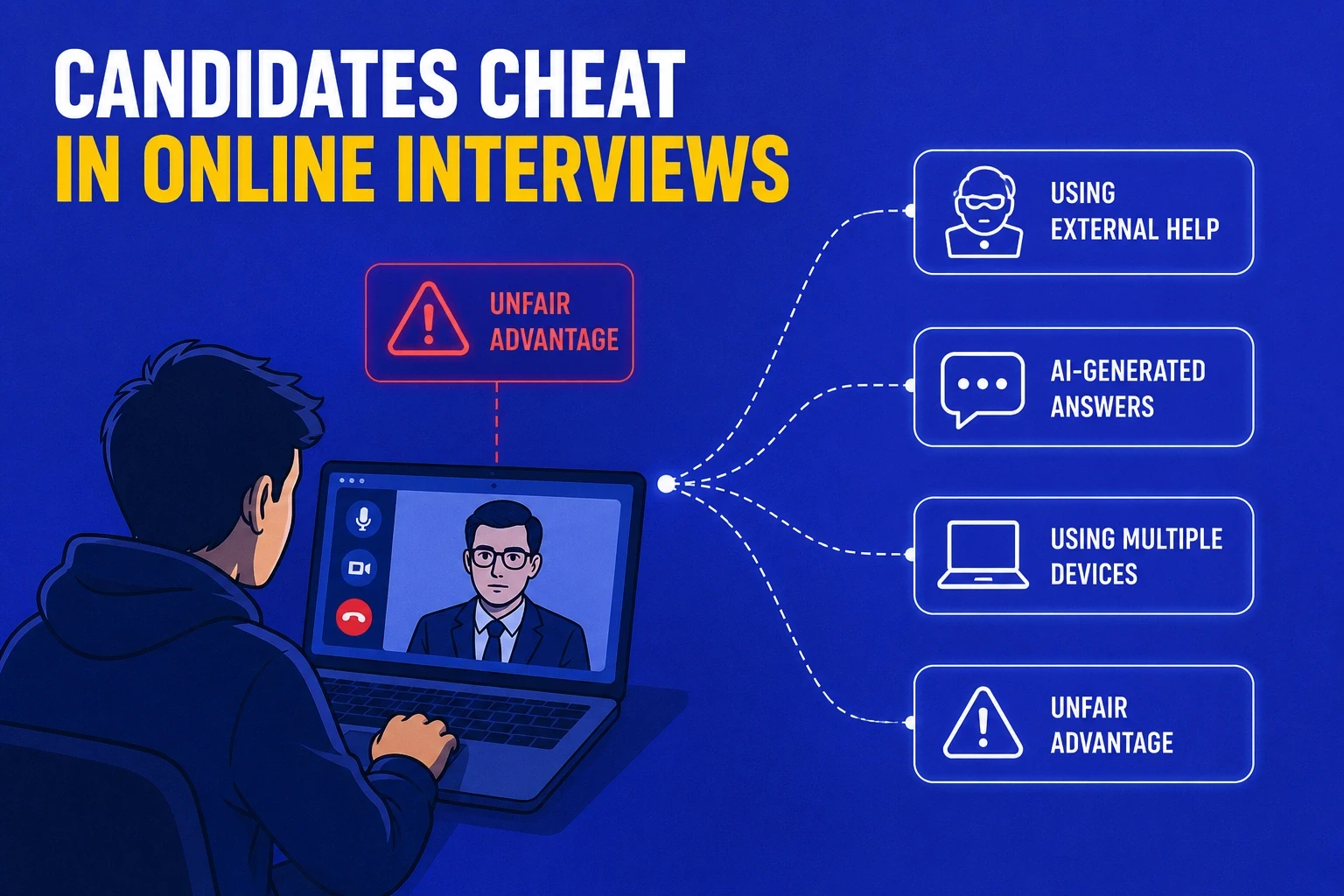
Online interview fraud has evolved far beyond simple answer searching. Candidates today use advanced AI tools, hidden devices, remote assistance, and impersonation tactics to manipulate interviews and technical assessments. Below are some of the most common ways candidates cheat in online interviews and how these methods are impacting remote hiring.
1. Using AI Tools During Online Interviews
Candidates today are increasingly relying on AI tools like ChatGPT, coding assistants, and AI interview helpers during remote interviews. These tools allow candidates to generate instant answers for technical, behavioral, and coding questions in real time.
In many cases, candidates use a second monitor, hidden browser tab, or another device to copy interview questions into AI tools and read back generated responses. While the answers may sound impressive initially, candidates often struggle when recruiters ask deeper follow-up questions.
What to Look For:
Long pauses before answering even simple questions
Eyes repeatedly moving away from the screen
Answers that sound overly polished or scripted
Candidate unable to explain their own answer clearly
Sudden improvement in answer quality during technical discussions
Example
A recruiter asks a backend developer candidate to explain microservices architecture. The candidate pauses for several seconds, looks toward another screen repeatedly, and then delivers a highly detailed textbook-style response. However, when asked practical implementation questions, the candidate struggles to answer confidently.
2. Getting Help From Someone Off Camera
One of the most common ways candidates cheat in online interviews is by receiving real-time assistance from another person sitting nearby. This helper may be a friend, mentor, professional interview coach, or technical expert providing answers during the interview.
Since remote interviews only show a limited camera angle, off-camera assistance can remain hidden throughout the conversation. Candidates may listen to whispered responses, read prompts from another screen, or use hidden earbuds connected to someone guiding them live.
What to Look For:
Frequent pauses before answering questions
Candidate looking repeatedly toward one side
Background whispering or unusual noises
Sudden changes in communication confidence
Answers that sound disconnected from the candidate’s earlier responses
Example
During a cloud engineering interview, a candidate consistently pauses before answering Kubernetes-related questions and repeatedly looks toward the left side of the room. The recruiter later notices faint whispering sounds in the background whenever technical questions are asked.
3. Proxy Interviews and Interview Impersonation
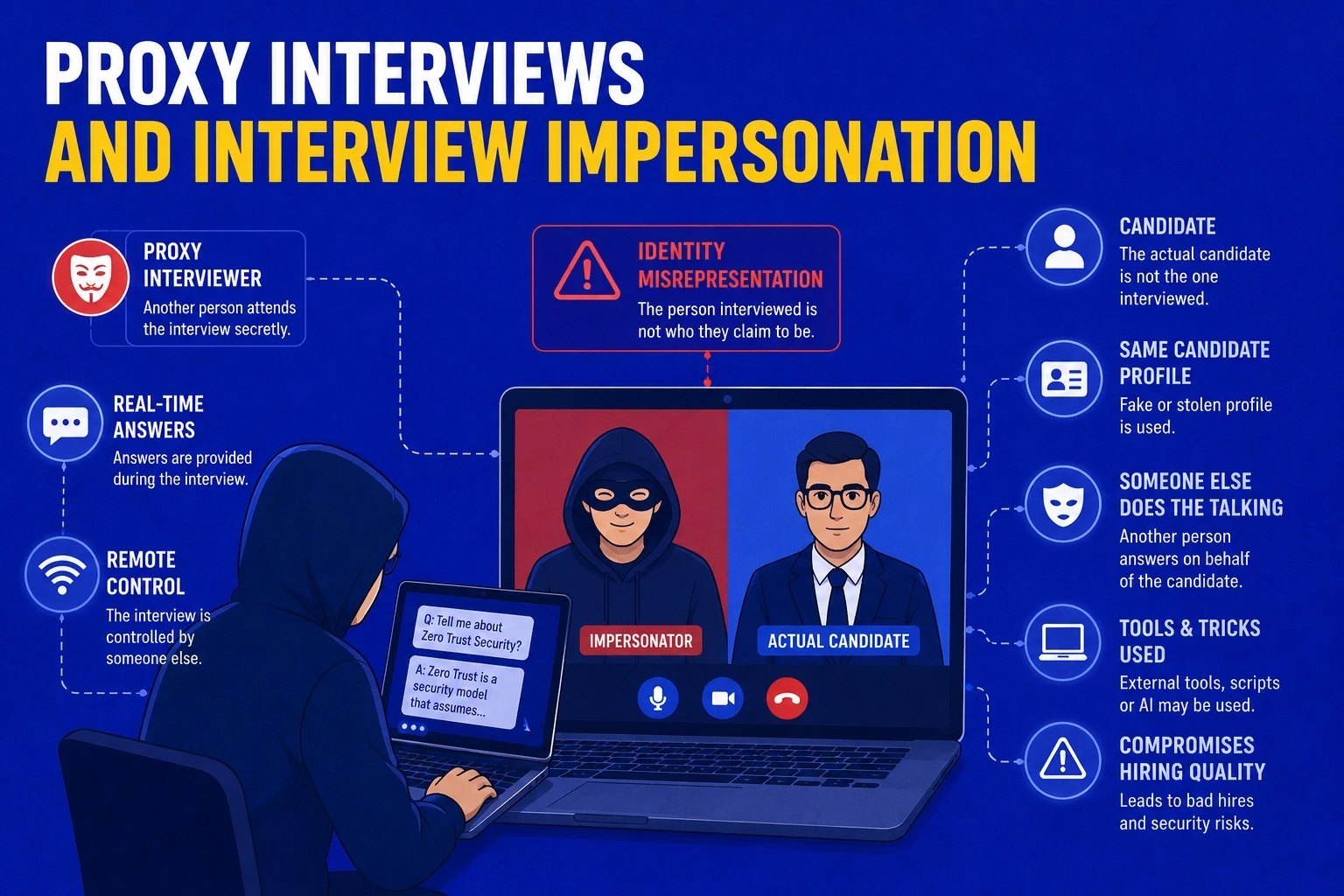
Some candidates cheat by having another person attend the interview on their behalf. This is known as a proxy interview or interview impersonation. In remote hiring, fraudsters may use skilled professionals to clear technical rounds and later replace them with the actual candidate after hiring.
This type of fraud has increased significantly with the growth of remote work and online hiring.
What to Look For:
Face visibility issues during interviews
Different communication style across rounds
Candidate refusing identity verification
Voice or appearance inconsistencies
Skill mismatch between interview stages
Example
A candidate performs exceptionally well during live coding interviews but struggles with basic development tasks after joining the company. The hiring team later discovers that a different person attended the original technical interview.
4. Using Multiple Devices During Interviews
Many candidates use smartphones, tablets, or second laptops during online interviews to search for answers in real time. Since recruiters usually focus only on the candidate’s primary screen, these hidden devices can be difficult to detect without proper monitoring.
This tactic is especially common during coding interviews, technical assessments, and problem-solving rounds.
What to Look For:
Frequent downward eye movement
Reflections visible in glasses or screen surfaces
Hands moving below the desk repeatedly
Delayed responses to direct questions
Candidate appearing distracted during conversations
Example
During a SQL interview, a candidate repeatedly looks down before answering every database-related question. The recruiter later notices smartphone reflections visible in the candidate’s glasses throughout the interview.
5. Using AI Voice Tools and Hidden Audio Assistance
Some candidates use AI-powered voice tools, hidden earbuds, or live audio assistance during remote interviews. These tools can improve speaking confidence, change accents, provide real-time answer suggestions, or allow another person to feed responses secretly.
As AI voice technology becomes more advanced, detecting manipulated audio during online interviews is becoming increasingly difficult.
What to Look For:
Robotic or overly polished speech patterns
Slight delays before verbal responses
Lip movement not matching audio perfectly
Candidate touching ears frequently
Sudden changes in tone or speaking confidence
Example
During a customer support interview, a candidate answers communication questions with near-perfect fluency but shows noticeable delays before every response. The recruiter later suspects the candidate was receiving live audio assistance through a hidden earbud.
6. Manipulating Online Coding Assessments
Technical assessments are one of the most common areas where candidates cheat during remote hiring. Candidates may use ChatGPT, GitHub, Stack Overflow, remote desktop tools, or external experts to complete coding tests instead of solving problems independently.
This creates major hiring risks because candidates who perform well in assessments may lack the actual skills required for the job.
What to Look For:
Extremely fast test completion times
Perfect answers with weak explanations
Candidate unable to debug their own code
Large skill difference between assessment and live interview
Similar coding patterns across multiple candidates
Example
A candidate scores exceptionally high in an online Java assessment but struggles to explain basic logic during a live coding interview. The recruiter later discovers the submitted solution closely matches code available online.
7. Using Deepfake Technology During Interviews
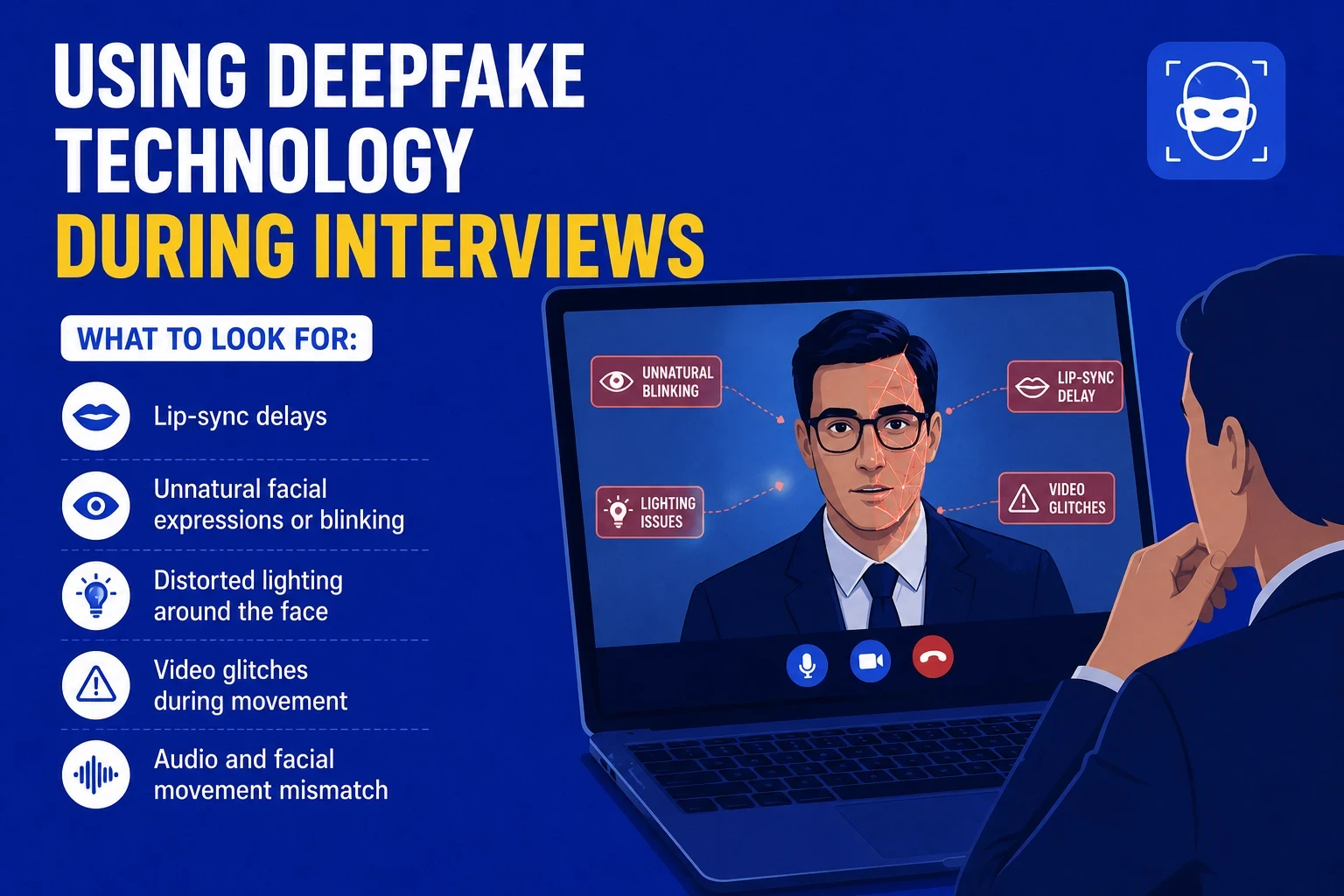
Deepfake technology is becoming a growing threat in remote hiring. Candidates can now use AI-generated video and voice manipulation tools to alter their appearance, clone voices, or impersonate another person during online interviews.
As these tools become more accessible, recruiters face increasing risks of identity fraud and interview impersonation.
What to Look For:
Lip-sync delays during speaking
Unnatural facial expressions or blinking
Distorted lighting around the face
Video glitches during movement
Audio and facial movement not matching properly
Example
During a video interview, a recruiter notices slight delays between the candidate’s lip movement and voice. After further review, the company discovers the candidate was using deepfake software to manipulate their appearance in real time.
8. Using Screen Sharing Tricks to Hide Cheating
Some candidates manipulate screen sharing during online interviews to hide unauthorized tools, notes, or external assistance. They may share only a specific application window instead of the full screen while using hidden tabs, AI tools, or messaging apps in the background.
This tactic is commonly used during technical interviews and online assessments.
What to Look For:
Candidate refusing full-screen sharing
Frequent switching between windows
Long pauses while typing answers
Cursor movement that appears unnatural
Delays before sharing screens or tabs
Example
During a coding interview, a candidate shares only the coding platform window and repeatedly pauses before writing solutions. The recruiter later suspects the candidate was using hidden AI tools on another screen.
9. Reading From Pre-Written Notes or Scripts
Some candidates prepare detailed notes, scripts, or model answers before the interview and read them during the conversation. While preparation is normal, continuously reading scripted responses can indicate dishonest interview behavior, especially during technical or behavioral rounds.
Candidates may place notes beside the screen, use sticky notes around the monitor, or keep answers open on another device.
What to Look For:
Eyes moving side-to-side repeatedly while answering
Responses sounding overly memorized or robotic
Lack of natural conversation flow
Candidate struggling when interrupted with follow-up questions
Identical response structure across multiple questions
Example
During a behavioral interview, a candidate gives highly polished answers for every leadership question but becomes confused when the recruiter asks spontaneous follow-up questions outside the prepared script.
10. Creating Fake Technical Experience or Projects
Some candidates exaggerate or completely fabricate technical experience, certifications, or project work to increase their chances of getting hired. In remote hiring, verifying project authenticity becomes more difficult, especially when recruiters rely only on resumes and virtual interviews.
Candidates may claim ownership of copied GitHub projects, fake previous job experience, or present AI-generated portfolios as their own work.
What to Look For:
Candidate unable to explain project details clearly
Inconsistent answers about tools or technologies used
Resume experience not matching actual skill level
Overly broad project claims without technical depth
Difficulty answering practical implementation questions
Example
A candidate claims to have led a large-scale cloud migration project but struggles to explain basic deployment workflows and infrastructure decisions during the interview.
How Recruiters Can Prevent Cheating In Online Interviews
As remote hiring continues to grow, recruiters are facing new challenges in maintaining interview integrity. Candidates today have access to AI tools, hidden communication devices, proxy interview services, and deepfake technology that can manipulate online interviews and technical assessments.
Without proper verification methods, companies risk hiring underqualified or fraudulent candidates, leading to productivity issues, security concerns, and costly hiring mistakes. To reduce these risks, recruiters need a combination of behavioral monitoring, structured interview techniques, identity verification, and AI-powered proctoring systems.
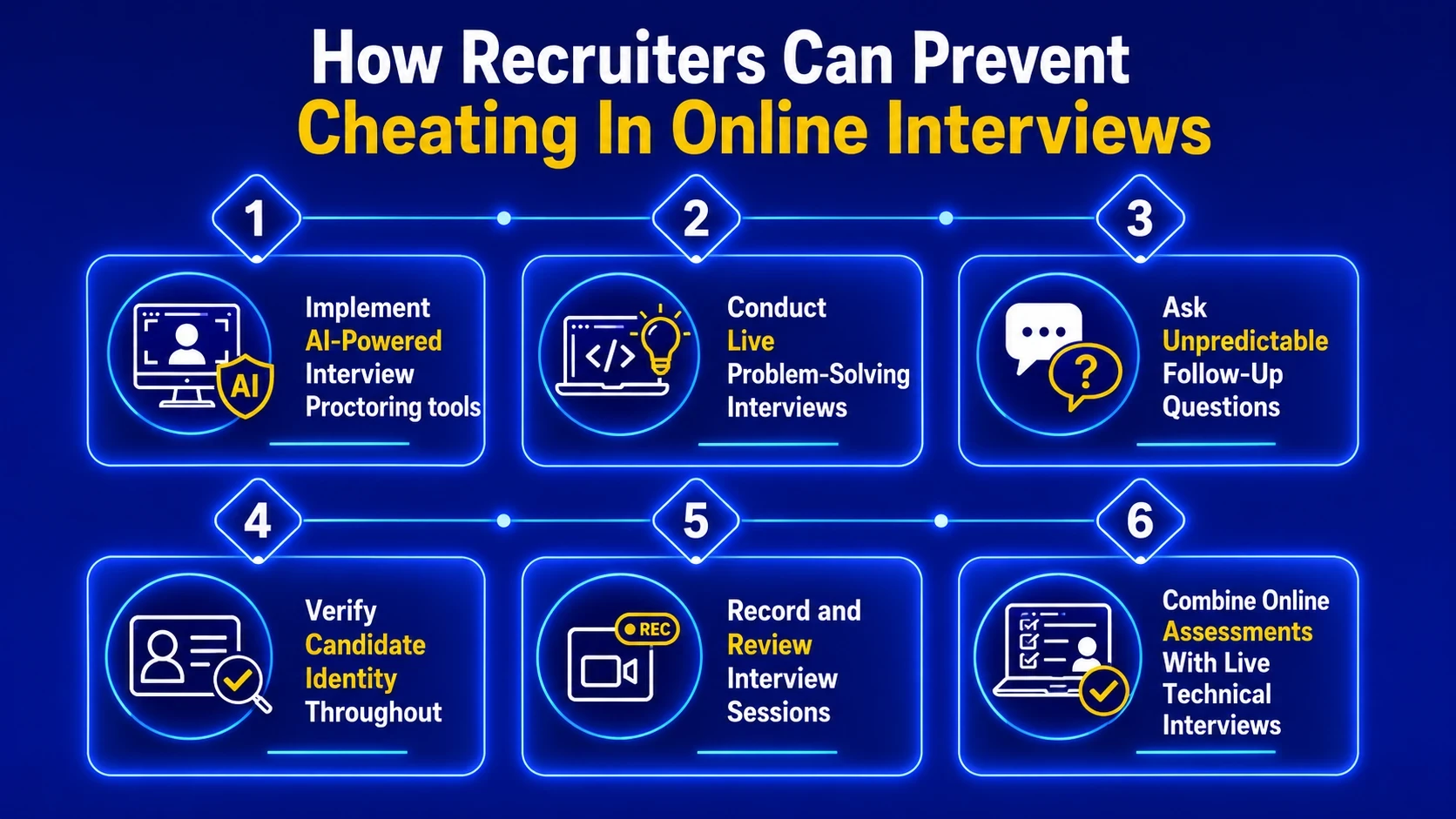
Below are some of the most effective ways recruiters can prevent cheating in online interviews and improve hiring security.
1. Implement AI-Powered Interview Proctoring tools
Modern interview cheating methods are often difficult to detect manually. AI-powered interview monitoring tools help recruiters identify suspicious behavior such as unusual eye movement, lip-sync mismatch, multiple face detection, screen switching, and audio anomalies during remote interviews.
Sherlock AI help companies monitor online interviews, detect impersonation attempts, and improve hiring integrity without disrupting the candidate experience.
2. Conduct Live Problem-Solving Interviews
Candidates using AI-generated answers or external help often struggle during live problem-solving sessions. Including real-time coding rounds, practical tasks, or case-study discussions helps recruiters evaluate genuine skills instead of memorized responses.
Recruiters should also ask candidates to explain their thought process step by step to identify inconsistencies.
3. Ask Unpredictable Follow-Up Questions
Many candidates prepare scripted responses or rely on AI-generated answers during interviews. Asking unexpected follow-up questions helps recruiters test whether candidates truly understand the topic or are simply reading prepared answers.
Scenario-based questions and practical examples are especially effective for identifying fake expertise.
4. Verify Candidate Identity Throughout the Hiring Process
Identity verification should continue across multiple interview stages, not just during the initial screening. Recruiters can reduce impersonation risks by verifying IDs, monitoring facial consistency, and confirming candidate appearance during each interview round.
This becomes especially important for technical and remote-first hiring roles.
5. Record and Review Interview Sessions
Recording interview sessions allows recruiters to review suspicious behavior later and compare candidate performance across rounds. This also helps companies investigate potential fraud cases more effectively.
Recorded interviews can provide valuable evidence in cases involving impersonation or inconsistent technical performance.
6. Combine Online Assessments With Live Technical Interviews
Online assessments alone can be manipulated using ChatGPT, GitHub, or external experts. Combining assessments with live technical interviews helps recruiters confirm whether candidates genuinely understand the submitted solutions.
Live debugging sessions and code explanation rounds are highly effective for identifying cheating.
Stop Online Interview Cheating With Sherlock AI
Online interview cheating is becoming harder to detect with the rise of AI tools, deepfake technology, proxy interviews, and hidden external assistance. Recruiters can no longer rely only on manual observation during remote hiring.
Sherlock AI helps organizations secure online interviews by identifying suspicious candidate behavior and improving hiring transparency throughout the recruitment process. Below are the key capabilities of Sherlock AI:
1. AI-Powered Interview Monitoring
Sherlock AI uses advanced AI-powered monitoring to analyze candidate behavior throughout the interview process. The system helps recruiters identify suspicious patterns such as repeated off-screen focus, unusual eye movement, delayed responses, and inconsistent interview behavior that may indicate cheating or external assistance.
This allows hiring teams to monitor interviews more effectively without interrupting the candidate experience.
2. Interview Impersonation Detection
Interview impersonation and proxy interviews are becoming increasingly common in remote hiring. Sherlock AI helps recruiters detect identity inconsistencies by monitoring facial appearance, behavioral patterns, and candidate verification across multiple interview stages.
This helps organizations reduce the risk of hiring candidates who use another person to clear technical interviews or assessments.
3. Deepfake and Lip-Sync Detection
As deepfake technology becomes more accessible, recruiters face growing risks of AI-generated identity fraud during online interviews. Sherlock AI analyzes facial synchronization, lip movement, and audio-video consistency to identify possible deepfake usage or manipulated interview footage.
These insights help recruiters detect suspicious interview activity that may not be visible through manual observation alone.
4. Multiple-Device and Hidden Assistance Detection
Candidates often use secondary devices, hidden screens, or off-camera assistance during remote interviews. Sherlock AI helps identify suspicious activity patterns linked to external help, including repeated eye movement toward another device, unusual response timing, and inconsistent interaction behavior.
This helps recruiters maintain fairness and transparency throughout the hiring process.
5. Real-Time Interview Insights and Suspicious Activity Alerts
Sherlock AI provides recruiters with real-time interview insights and alerts whenever suspicious behavior is detected during remote interviews. Hiring teams can review flagged moments, analyze behavioral patterns, and investigate potential cheating attempts before moving candidates to the next stage.
This improves hiring confidence and helps organizations make more secure recruitment decisions in remote hiring environments.
Final Thoughts
Cheating in online interviews is becoming more advanced as AI tools, deepfake technology, and remote hiring continue to evolve. From AI-generated answers and hidden audio assistance to proxy interviews and multiple-device usage, recruiters now face challenges that traditional interview methods were never designed to handle.
While remote hiring offers flexibility and access to global talent, it also increases the risk of hiring fraud, impersonation, and skill misrepresentation. Even a single bad hire can lead to productivity loss, security concerns, project delays, and significant financial impact for organizations.
This is why companies must move beyond basic video interviews and adopt smarter hiring strategies. Behavioral monitoring, live problem-solving rounds, identity verification, and AI-powered interview monitoring are becoming essential for maintaining hiring integrity in remote recruitment.
Sherlock AI help organizations detect suspicious interview behavior, identify impersonation attempts, and secure online hiring processes without affecting the candidate experience.
As interview cheating methods continue to evolve, recruiters who invest in secure and intelligent hiring practices will be better prepared to identify genuine talent and build stronger remote teams.