

Back to all blogs
Learn how to conduct an effective interview with practical tips on preparation, questioning, evaluation, and avoiding common mistakes to make better hiring decisions.

Interviews are one of the most important steps in the hiring process, but conducting an effective interview requires more than asking a list of standard questions. Research shows that structured interviews are more reliable and predictive than unstructured conversations. A meta-analysis of 150 validity coefficients found that structured interviews had mean validity coefficients about twice as high as unstructured interviews.
A well-structured interview helps hiring teams assess a candidate’s skills, experience, problem-solving ability, communication, and overall fit for the role while reducing bias and improving consistency across candidates. A review of employment-interview research reported that McDaniel et al.'s meta-analysis examined 160 studies involving more than 25,000 subjects and found that structured interviews were more valid predictors of future job performance than unstructured interviews, particularly when questions were job-specific.
To conduct an effective interview, start by defining the role requirements, preparing relevant questions, setting a clear interview structure, asking thoughtful follow-up questions, and evaluating candidates against consistent criteria. Interviewers should also document evidence-based observations rather than relying on intuition or first impressions.
In this guide, we’ll explain how to conduct an interview step by step—from preparation and question selection to candidate evaluation, remote interviews, and common mistakes to avoid.
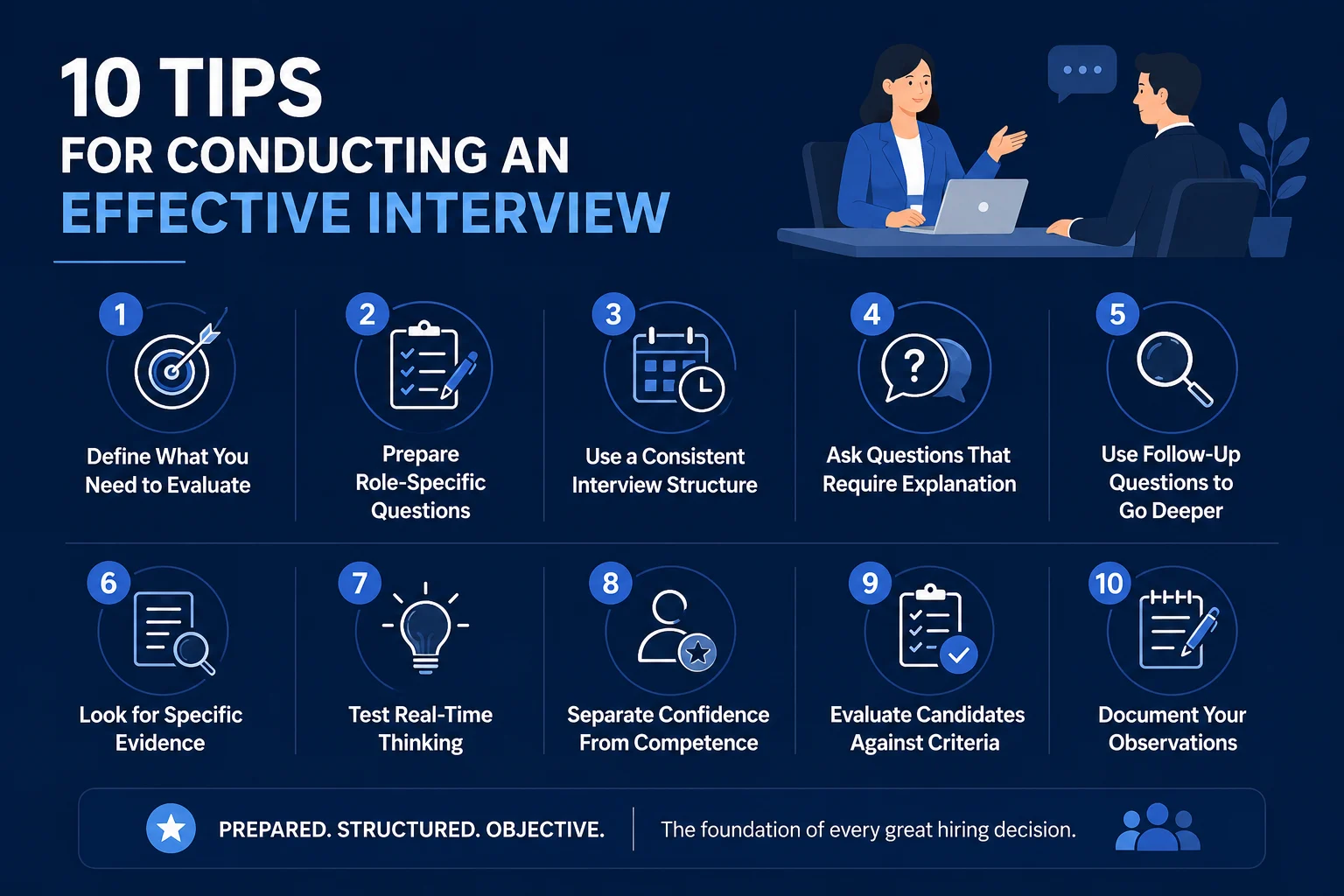
10 Tips for Conducting an Effective Interview
A successful interview is not just about asking the right questions. It requires preparation, structure, active listening, thoughtful follow-ups, and consistent evaluation. These ten practical tips can help interviewers gather better evidence and make more informed hiring decisions.
1. Define What You Need to Evaluate
Before the interview, identify the skills, competencies, and responsibilities that matter most for the role. Clear requirements give you a better foundation for deciding what to ask and what evidence to look for.
2. Prepare Role-Specific Questions
Avoid relying entirely on generic interview questions. Build questions around the actual responsibilities, challenges, and decisions the candidate will face in the role.
3. Use a Consistent Interview Structure
Give each candidate a similar interview framework, including the core topics, approximate timing, and evaluation areas. A consistent structure makes it easier to compare candidates fairly and reduces inconsistencies in the interview process.
4. Ask Questions That Require Explanation
Don't focus only on whether a candidate can provide the right answer. Ask them to explain their approach, reasoning, decisions, and trade-offs to understand how they think through problems.
5. Use Follow-Up Questions to Go Deeper
The first answer rarely tells the whole story. Ask questions such as “Why?”, “How?”, and “What if?” to explore the candidate's reasoning, individual contribution, and ability to adapt when circumstances change.
6. Look for Specific Evidence
Move beyond broad claims by asking candidates for specific examples, actions, decisions, and outcomes. Concrete details provide stronger evidence of actual experience and capability than general statements.
7. Test Real-Time Thinking
Use role-relevant scenarios and introduce changes or constraints during the discussion. Seeing how candidates respond to new information can reveal their adaptability, problem-solving ability, and depth of understanding.
8. Separate Confidence From Competence
A confident and polished delivery does not necessarily indicate strong capability. Evaluate the quality of the candidate's reasoning, evidence, and ability to handle deeper questions rather than relying on communication style alone.
9. Evaluate Candidates Against Predefined Criteria
Define what strong, average, and weak performance looks like before interviewing candidates. Use the same criteria for everyone to reduce bias and make evaluations more consistent.
10. Document Your Observations Immediately
Record specific evidence after the interview while the conversation is still fresh. Document what the candidate demonstrated rather than relying on general impressions or memory when making the final hiring decision.
These principles provide a practical foundation for conducting more focused, consistent, and evidence-based interviews. The sections below explore each part of the process in greater detail, from interview preparation and question selection to follow-up questioning, candidate evaluation, and post-interview decision-making.
Interview Preparation
Strong interviews are built before the conversation begins. Preparation determines whether you collect meaningful evidence about a candidate or simply hear well-rehearsed answers. A structured preparation process also helps interviewers evaluate candidates consistently and stay focused on the skills and competencies that matter for the role.
Before the interview, define what you need to evaluate, establish clear criteria for assessing candidates, and prepare questions that are directly connected to the responsibilities of the role.
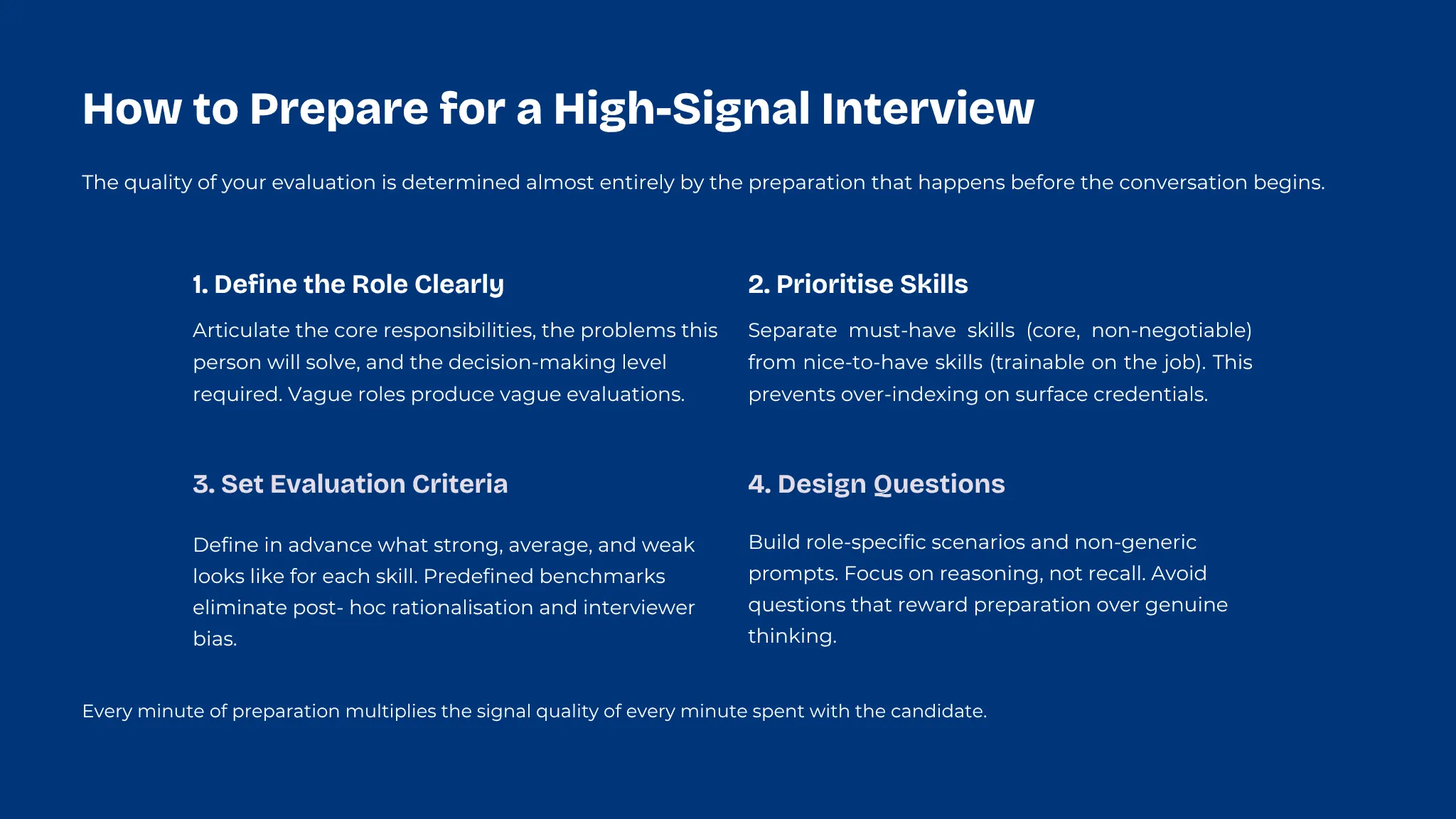
Defining Role Requirements Clearly
Start by translating the job description into something more practical: what will this person actually be responsible for doing on a weekly basis? This gives interviewers a clearer foundation for deciding what to ask and what to evaluate during the interview.
Break the role down into:
Key responsibilities (what they will own)
Types of problems they will solve
Level of decision-making expected
For example, instead of writing:
“Strong problem-solving skills”
Clarify it into:
Ability to break down ambiguous problems into structured steps
Comfort making decisions with incomplete information
Ability to explain reasoning clearly
Identifying Must-Have vs Nice-to-Have Skills
Not all requirements carry the same weight, but interviews often treat them as if they do. These priorities should directly influence the questions you ask and the criteria you use to evaluate candidates during the interview.
Separate skills into two categories:
Must-have skills
Core capabilities required from day one
Directly tied to job performance
Difficult to train quickly
Nice-to-have skills
Can be learned after joining
Improve efficiency but are not essential
Often tool- or domain-specific
This distinction sharpens decision-making during interviews. It prevents situations where:
A candidate is rejected for lacking a secondary skill
A candidate is selected because they check many boxes but miss critical ones
It also helps interviewers stay focused during evaluation instead of being influenced by irrelevant strengths.
Creating Evaluation Criteria Before the Interview
Evaluation often becomes inconsistent when interviewers decide what they think about a candidate while listening to their answers. Instead, define your evaluation criteria before the interview so you know what evidence to look for in each response.
A more reliable approach is to define evaluation criteria in advance.
For each key skill, outline:
What a strong response includes
What an average response looks like
What indicates a weak or concerning response
For example, when assessing problem-solving:
Strong: breaks problem into steps, explains trade-offs, justifies decisions
Average: reaches a solution but lacks depth in explanation
Weak: jumps to conclusions, struggles to explain reasoning
This creates a shared standard, especially when multiple interviewers are involved. It also reduces the tendency to rely on vague impressions like “felt like a good candidate.”
Without clear criteria, it becomes much harder to distinguish genuine thinking from patterns.
👉 Learn how to detect scripted answers during job interviews
Preparing Role-Specific Interview Questions
Generic interview questions tend to produce polished, predictable answers. Candidates often prepare for common questions in advance, which can limit how much an interviewer learns about their actual experience, decision-making, and problem-solving ability.
Questions should be tied directly to:
The responsibilities of the role
The types of decisions the candidate will make
Situations they are likely to encounter
For example:
Instead of asking about a generic challenge, focus on a situation relevant to the role
Instead of broad behavioral prompts, ask for decisions, trade-offs, and outcomes
You can also incorporate:
Real scenarios from the job
Hypothetical situations that require structured thinking
Questions that require explanation of approach, not just outcomes
For interviews where candidates may use AI assistance, questions that require candidates to explain their approach and reasoning can provide stronger signals of actual capability.
See our guide on how to measure real skills vs. AI-powered answers for additional strategies.
How to Structure an Interview
A structured interview gives the conversation a clear purpose and helps interviewers evaluate candidates consistently. Rather than moving randomly between topics, divide the interview into defined stages, with each stage designed to assess specific skills, experience, or competencies.
A typical interview can be structured into the following stages:
Introduction & Expectation Setting (5–10 minutes)
This stage sets the tone for the rest of the conversation.
Cover:
Brief introduction of yourself and your role
Overview of the company and team (keep it concise)
What the interview will include (stages, duration)
This reduces uncertainty for the candidate and allows them to focus on responding thoughtfully rather than trying to guess what’s coming next.
It also gives you a quick read on:
Communication clarity
Baseline confidence
Role Alignment (5–10 minutes)
Before evaluating capability, ensure both sides have a shared understanding of the role.
Discuss:
Key responsibilities
Expectations from the role
What success looks like
Then ask:
What the candidate understands about the role
Why they are interested
This step helps identify early mismatches. A candidate may have strong skills but a different expectation of the role, which often leads to poor outcomes later if not addressed.
Experience Deep Dive (15–20 minutes)
This is where you assess past work in detail.
Focus on:
Specific projects or responsibilities
Decisions the candidate made
Challenges they faced and how they handled them
Instead of covering many experiences, go deeper into a few:
What was the context?
What actions did they take?
What alternatives did they consider?
What was the outcome?
Depth matters more than breadth here. Surface-level summaries rarely reveal how the candidate actually operates.
Problem-Solving / Real-Time Thinking (15–20 minutes)
Past experience shows exposure, but this stage helps assess how the candidate thinks in the present.
Use:
Role-relevant scenarios
Hypothetical situations
Case-based questions
Observe:
How they structure their approach
How they handle ambiguity
Whether they can explain their reasoning clearly
You can also introduce slight variations mid-way:
Change constraints
Add new information
Ask them to reconsider their approach
This helps evaluate adaptability and depth of understanding.
Candidate Questions (5–10 minutes)
Allow time for the candidate to ask questions.
This serves two purposes:
Provides a better candidate experience
Offers insight into how they think about roles and decisions
Strong candidates often ask:
Thoughtful, specific questions
Questions tied to impact, team, or challenges
Avoid treating generic or minimal questions as an automatic negative signal. Candidate questions can provide useful context, but they should be considered alongside the rest of the interview rather than used as a standalone measure of candidate quality.
6. Closing & Next Steps (2–5 minutes)
End the interview by briefly summarizing the conversation and explaining what happens next.
Cover:
Any remaining questions from the candidate
Next steps in the hiring process
When they can expect an update, if known
A clear closing helps create a better candidate experience and ensures that the interview ends with clear expectations for both sides.
How Long Should an Interview Be?
For a typical 45–60 minute interview, a balanced distribution would be:
Introduction & expectations: 5–10 minutes
Role alignment: 5–10 minutes
Experience deep dive: 15–20 minutes
Problem-solving: 15–20 minutes
Candidate questions: 5–10 minutes
Closing & next steps: 2–5 minutes
The exact timing can vary based on the role, seniority, and interview format. The key is to:
Allocate enough time for depth-heavy sections (experience + problem-solving)
Avoid spending too long on introductions or general discussion
Leave enough time for candidate questions and closing
A clear structure does not make interviews rigid; it makes them intentional. Each stage serves a specific purpose, and together they create a more complete picture of the candidate.
Types of Interview Questions to Ask
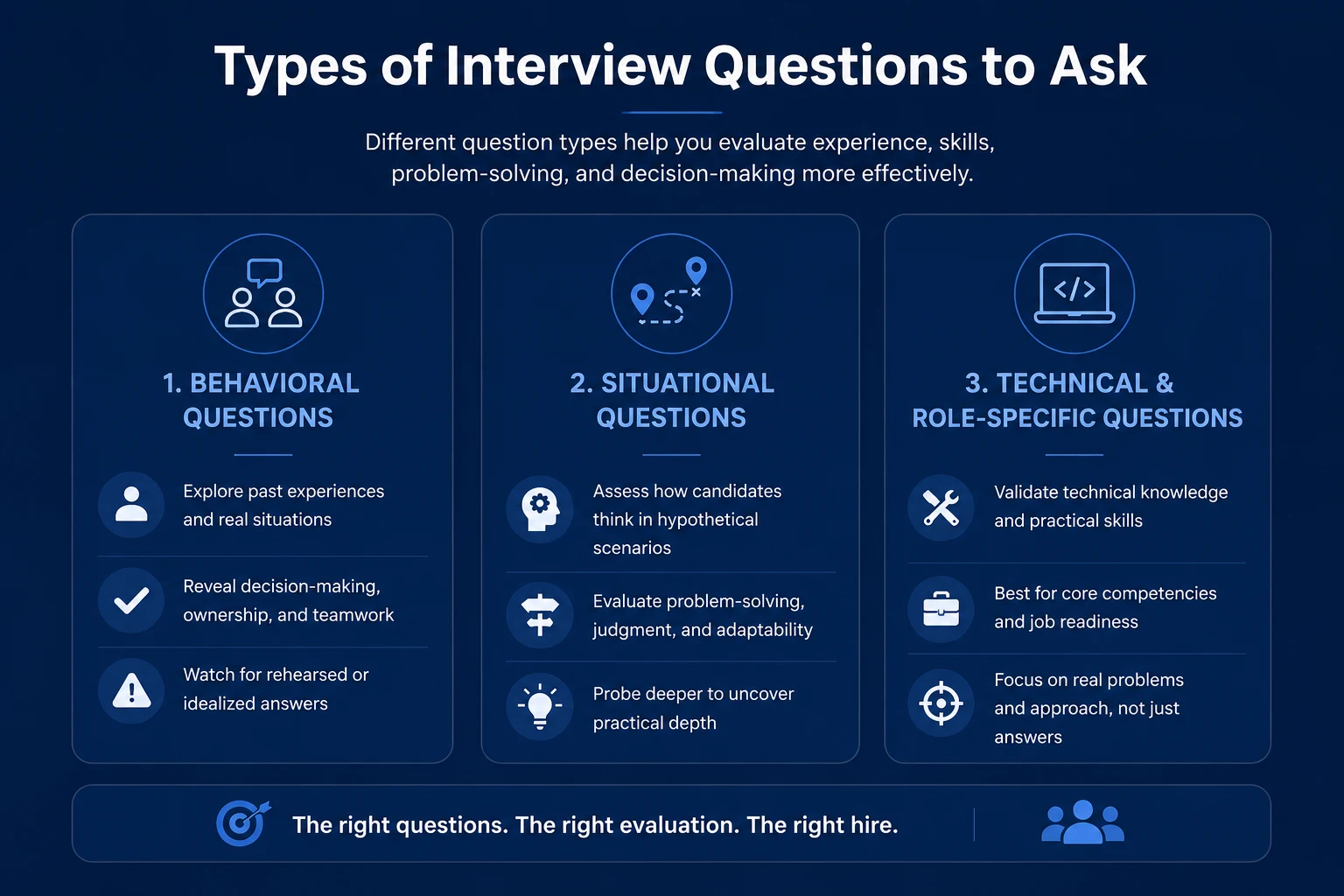
The questions you ask determine the quality of evidence you collect during an interview. A strong interview uses different types of questions to assess a candidate's experience, behavior, technical skills, problem-solving ability, and approach to real-world situations.
Rather than relying on a long list of generic questions, choose questions based on the skills and competencies you need to evaluate for the role.
Behavioral Interview Questions
Behavioral interview questions ask candidates to describe how they handled situations in the past. They can help interviewers understand a candidate's decision-making, communication, collaboration, and problem-solving based on real experiences.
Useful prompts include:
Tell me about a time when you...
Describe a situation where...
Give me an example of...
What did you do when...?
What to evaluate:
The candidate’s role in the situation (not just the team’s outcome)
The decisions they made and why
How they handled challenges or constraints
The actual outcome and what they learned
Where they work well:
Understanding exposure to real-world scenarios
Evaluating ownership and accountability
Assessing consistency in past performance
Limitations to be aware of:
Answers are often rehearsed
Candidates may present idealized versions of events
It’s difficult to assess how much was individual contribution vs team effort
To make behavioral questions more effective:
Ask for specifics (timeline, actions, decisions)
Probe beyond the initial answer
Focus on reasoning, not just results
Situational Interview Questions
Situational questions present a hypothetical scenario and ask the candidate how they would respond. They are particularly useful for evaluating problem-solving, judgment, prioritization, and adaptability when there is no directly comparable past experience.
Examples include:
What would you do if...?
How would you handle...?
Suppose you were faced with...?
How would you approach...?
What to evaluate:
How the candidate structures their thinking
Their approach to problem-solving
Ability to handle ambiguity
Awareness of trade-offs and risks
Where they work well:
Assessing thinking in unfamiliar or new situations
Understanding decision-making frameworks
Evaluating adaptability
To improve effectiveness:
Ask candidates to walk through their approach step-by-step
Introduce constraints or changes during the discussion
Ask follow-ups like “why” and “what would you prioritize”
Some candidates may give theoretical answers without practical depth. These answers can sound complete while still lacking clear reasoning behind the choices being made.
Technical and Role-Specific Interview Questions
These questions assess the technical knowledge and practical skills required for the position. They should reflect the actual responsibilities of the role rather than testing knowledge that is unlikely to be used on the job.
Where possible, ask candidates to explain their approach, the decisions they made, and the trade-offs they considered, not simply provide a final answer.
Examples:
Technical problems or case studies
Role-based scenarios
Practical tasks or exercises
What to evaluate:
Depth of knowledge
Ability to apply knowledge in context
Clarity in explaining solutions
Accuracy and completeness
Where they work well:
Validating core competencies
Differentiating between theoretical knowledge and practical ability
Assessing job readiness
Limitations to be aware of:
Overly academic or abstract questions may not reflect real work
Candidates may prepare specifically for common question patterns
To make these questions more effective:
Base them on real problems from the role
Focus on approach, not just the final answer
Encourage candidates to explain their reasoning as they go
Asking Questions That Reveal Real Ability
The way an interview question is framed determines the kind of answer you get. Many interviews rely on familiar, predictable prompts, which often lead to polished responses that are difficult to evaluate. If the goal is to understand how a candidate actually thinks and works, questions need to be designed to draw out reasoning, not just responses.
This requires moving beyond surface-level questions and being intentional about how interview questions are structured.
Open-Ended vs Closed Questions
Closed questions are useful for verifying facts:
“Have you worked with X tool?”
“Did you manage a team?”
They are efficient, but limited. Most can be answered with a “yes” or a short explanation, which doesn’t provide much insight into capability.
Open-ended questions, on the other hand, create space for the candidate to explain:
“How did you approach managing that team?”
“What challenges did you face while using that tool?”
Open-ended questions help uncover:
Thought process
Decision-making
Depth of understanding
A practical approach is to:
Start with a closed question to establish context
Transition quickly into open-ended follow-ups to explore depth
Questions That Test Thinking Instead of Memorization
Many candidates prepare for interviews by memorizing frameworks and practicing answers in familiar formats. While this can improve clarity, it can also mask gaps in understanding.
To move beyond memorized responses:
Ask candidates to explain why they took a certain approach
Explore alternatives they considered
Introduce new constraints or variables and ask how they would adapt
For example:
“What led you to choose that solution?”
“What would you do differently if the constraints changed?”
These types of questions shift the focus from what the candidate has prepared to how they process information in real time.
How to Avoid Leading Questions
Leading interview questions guide candidates toward a specific answer, often unintentionally.
For example:
“Do you think collaboration is important in that situation?”
“Would you agree that this was the best approach?”
These questions:
Reduce the reliability of responses
Encourage agreement rather than independent thinking
A better approach is to keep questions neutral:
“How did you approach collaboration in that situation?”
“What factors influenced your decision?”
Neutral phrasing ensures that the response reflects the candidate’s perspective, not the interviewer’s expectation.
Framing Questions That Require Explanation
Questions that produce short answers rarely provide enough information to evaluate a candidate effectively.
To encourage depth:
Ask candidates to walk through their thinking step by step
Focus on process over outcome
Request specific details and context
For example:
Instead of asking for the result, ask how the result was achieved
Instead of accepting a summary, ask for the sequence of decisions
You can also guide responses without restricting them:
“Walk me through how you approached this from start to finish”
“What were the key decisions you had to make along the way?”
This approach helps surface:
How structured their thinking is
Whether they can articulate reasoning clearly
How they handle complexity
A smaller number of well-framed questions, followed by thoughtful probing, will reveal far more than a long list of generic prompts.
When questions are designed to elicit explanation and reasoning, the interview goes from a rehearsed exchange to a more accurate assessment of how a candidate actually thinks and works.
Follow-Up Questioning (Deep Dive)
Initial answers often provide only a high-level view of a candidate’s experience or approach. Follow-up questions help interviewers investigate the details behind an answer, clarify the candidate’s individual contribution, and understand the decisions that led to the outcome.
Rather than moving to a new question after every response, stay with important answers long enough to understand what the candidate actually did, why they made certain decisions, and what they learned from the experience.
How to Probe Beyond the First Answer
When a candidate gives a broad or polished answer, don't immediately move to the next topic. Use the response as a starting point and identify the areas that need more detail.
Focus your follow-ups on:
Context: What was the specific situation or problem?
Role: What were you personally responsible for?
Actions: What did you actually do?
Decisions: What choices did you make, and why?
Outcome: What happened as a result?
Reflection: What would you do differently today?
For example, if a candidate says, “I helped improve the team's performance,” don't accept the statement at face value. Ask what their specific responsibility was, what action they took, how they decided on that approach, and what changed as a result.
The goal is to move from a broad claim to a clear account of the candidate's actual contribution.
Using Layered Follow-Up Questions
Different follow-up questions can reveal different parts of a candidate's thinking. Use them selectively based on what is missing from the initial answer.
Why? Explore the reasoning behind a decision.
“Why did you choose that approach?”
How? Understand how the candidate actually executed it.
“How did you put that solution into practice?”
What if? Test whether the candidate can reassess their approach when circumstances change.
“What would you do if that approach stopped working?”
You don't need to ask all three after every response. Choose the question that addresses the gap in the candidate's answer and continue probing until you have enough evidence to evaluate it.
Asking for Specific Examples and Details
When an answer remains broad, ask the candidate to anchor it in a specific situation. This makes it easier to distinguish personal experience from general familiarity with a topic.
Useful follow-ups include:
“Can you walk me through a specific example?”
“What exactly did you do in that situation?”
“What was your role versus the team's role?”
“What was the outcome?”
“What would you do differently now?”
Listen for concrete details, including the candidate's actions, decisions, responsibilities, and results. If the candidate continues to describe the team's work without explaining their own contribution, continue probing until their individual role is clear.
👉 How to Detect Fake Behavioral Stories in Interviews
Changing Constraints to Test Adaptability
Follow-up questions can also be used to see how a candidate responds when the conditions of a problem change.
After the candidate explains an approach, introduce one meaningful change, such as:
Less time or fewer resources
A new piece of information
A change in priorities
A different business constraint
For example:
“How would your approach change if you had half the time?”
or:
“What would you do if your original assumption turned out to be wrong?”
Pay attention to whether the candidate can reassess the situation, explain what would change, and justify their revised approach. The goal is not to expect a perfect answer, but to understand how they respond when the original plan no longer applies.
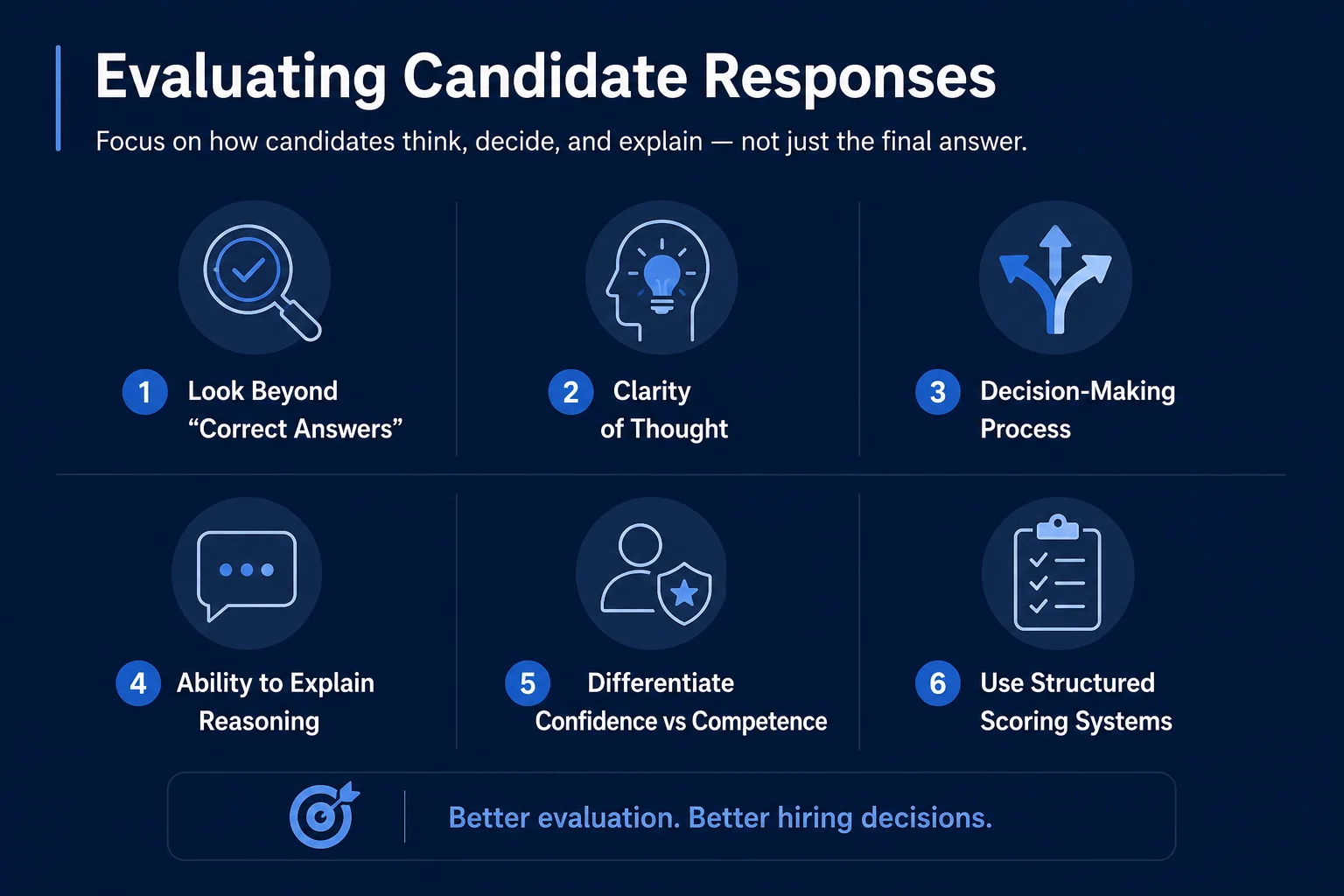
How to Evaluate Candidate Responses
Interviews often place too much weight on whether an answer sounds correct or complete. In practice, most roles don’t require perfect answers. They require clear thinking, sound judgment, and the ability to work through problems.
Evaluation should therefore focus not only on the outcome, but also on how the candidate approaches the problem, makes decisions, and explains their reasoning.
Looking Beyond “Correct Answers”
A technically correct answer doesn’t always indicate strong capability. It may reflect memorization, prior exposure, or familiarity with common interview patterns.
Instead, pay attention to:
How the candidate approaches the problem
Whether they can break it down logically
How they handle uncertainty or missing information
Two candidates may arrive at similar answers, but the candidate who demonstrates a clear and structured approach provides stronger evidence of how they may perform in real-world scenarios.
Clarity of Thought
Clarity shows up in how well a candidate can:
Structure their response
Organize ideas logically
Communicate without unnecessary complexity
Look for:
A clear starting point (how they frame the problem)
A logical flow of ideas
The ability to stay focused without drifting
Lack of clarity often appears as:
Jumping between ideas
Overuse of jargon without explanation
Difficulty summarizing key points
Clarity is especially important because it can provide insight into how a candidate may communicate and collaborate in a working environment.
Decision-Making Process
Understanding how a candidate makes decisions is more valuable than the decision itself.
Focus on:
What factors they considered
How they prioritized trade-offs
Whether they explored alternatives
For example:
Did they consider multiple approaches before choosing one?
Did they weigh risks and constraints?
Can they explain why their approach made sense in that context?
Strong candidates demonstrate:
Intentional choices
Awareness of trade-offs
Ability to justify decisions under constraints
Ability to Explain Reasoning
Being able to arrive at an answer is different from being able to explain it.
Ask yourself:
Can the candidate walk through their thinking step by step?
Do they make their assumptions explicit?
Can they adjust their explanation when prompted?
Clear reasoning indicates:
Depth of understanding
Ownership of the solution
Ability to collaborate and communicate effectively
Candidates who struggle to explain their reasoning may be relying on memorized patterns or may not have fully understood the approach they are describing.
Differentiating Confidence vs Competence
Confidence can make an answer sound convincing, even when it lacks depth.
Indicators of confidence:
Smooth delivery
Assertive tone
Quick responses
Indicators of competence:
Thoughtful structuring of answers
Willingness to pause and think
Ability to handle follow-up questions without losing clarity
Watch for situations where:
Answers sound polished but lack detail
The candidate avoids going deeper when probed
Certainty is expressed without clear justification
Confidence can be useful in communication, but it should not be treated as a substitute for evidence of competence. Look for whether the candidate can support their answers with specific examples, explain their reasoning, respond thoughtfully to follow-up questions, and acknowledge uncertainty when appropriate.
Using Structured Scoring Systems
Unstructured evaluation often leads to inconsistent decisions.
A structured scoring system helps:
Standardize evaluation across candidates
Reduce bias
Make comparisons more objective
Define scoring criteria for key areas such as:
Problem-solving
Communication
Role-specific skills
For each, outline what different levels look like (e.g., weak, average, strong).
Best practices:
Score immediately after the interview
Base scores on observed behavior, not general impressions
Keep criteria consistent across candidates
Consistent scoring also helps make interviews more fair by ensuring candidates are evaluated against the same criteria rather than subjective impressions.
How to Avoid Bias in Interviews
Bias in interviews is often subtle. It can show up in small decisions—how much time you spend probing one candidate versus another, how you interpret confidence, or how quickly you form an opinion. Without safeguards, these patterns can lead to inconsistent and unreliable hiring decisions.
Reducing interview bias does not require a complicated framework. It starts with consistency, clear evaluation criteria, structured questioning, and discipline throughout the interview process.
Using Standardized Questions
When each candidate is asked a different set of questions, comparisons become difficult. Some candidates may be evaluated on depth, while others are only assessed at a surface level.
Standardizing questions ensures that:
Every candidate is evaluated on the same core areas
The level of difficulty remains consistent
Differences in performance are easier to identify
This does not mean every interview must feel rigid. You can still:
Ask follow-up questions
Explore interesting responses in more detail
The key is that the core questions remain consistent, forming a common baseline for evaluation. Standardization should apply to the core evaluation areas, not necessarily every word of the conversation. Interviewers can still ask relevant follow-up questions when candidates provide different experiences or need clarification.
Evaluating Based on Predefined Criteria
Deciding what a “good answer” looks like during the interview introduces subjectivity. Predefined criteria create a reference point that keeps evaluation grounded.
For each key competency, define:
What strong performance looks like
What average performance looks like
What indicates a weak response
This approach helps:
Reduce reliance on interpretation
Keep evaluation focused on observable behaviors
Improve alignment across multiple interviewers
It also prevents shifting expectations based on the candidate, which is a common source of bias.
Avoiding Gut-Based Decisions
Initial impressions can form quickly—often within the first few minutes of an interview. While these instincts may feel accurate, they are not always reliable.
Common patterns include:
Favoring candidates who communicate in a familiar style
Overvaluing confidence or fluency
Making early judgments and unconsciously looking for confirmation
To counter this:
Delay final judgments until the interview is complete
Rely on structured notes instead of memory
Evaluate responses against predefined criteria, not overall “feel”
This helps ensure that hiring decisions are based on evidence gathered throughout the conversation rather than early impressions.
Ensuring Consistency Across Candidates
Consistency is what allows fair comparison.
This includes:
Asking the same core questions
Allocating similar time for each section of the interview
Applying the same evaluation criteria
Inconsistent interviews often lead to:
Some candidates being evaluated more rigorously than others
Decisions based on incomplete information
Difficulty justifying hiring choices
Together, these practices create a more consistent process where hiring decisions are grounded in demonstrated capability rather than subjective impressions.
Conducting Remote Interviews Effectively
Remote interviews introduce challenges that can affect both the candidate experience and the quality of the assessment. Technical problems, distractions, communication issues, and the virtual environment can all influence how the interview unfolds.
Before the interview, test the video and audio setup, choose a quiet environment, and make sure the candidate understands how the interview will be conducted. During the conversation, avoid letting technical problems or an overly informal setting affect your assessment. Keep the discussion structured, give the candidate enough opportunity to explain their thinking, and document your observations in the same way you would for an in-person interview.
Candidate experience also matters in a remote setting. Clear communication about the interview format, technology requirements, timing, and next steps can help candidates feel prepared and make the process more consistent. Interviewers should also consider how remote interviews can affect communication, distractions, and the ability to accurately assess a candidate's skills.
Because these factors can require a different approach from a traditional interview, conducting remote interviews requires some additional preparation around technology, communication, interview structure, and candidate experience.
Since detecting AI-coached responses is one of the trickier parts of running a remote interview, here's a short walkthrough on how Sherlock AI flags AI-assisted cheating in real time:
Common Interview Mistakes to Avoid
Even well-intentioned interviews can produce poor hiring decisions when common interviewing mistakes go unchecked. These mistakes can reduce the quality of the information you collect, make candidate comparisons less reliable, and cause interviewers to focus on the wrong signals.
Recognizing these problems before and during the interview helps create a more focused and consistent evaluation process.
1. Talking More Than Listening
Interviews are designed to evaluate the candidate, yet it is common for interviewers to dominate the conversation. This can happen when the interviewer spends too much time explaining the company or role, turns questions into long explanations, or shifts the conversation toward their own opinions and experiences.
When interviewers talk too much:
Candidates have less time to demonstrate their skills and thinking
Responses may remain too shallow to evaluate properly
Important details may never surface
The interview can become more conversational than evaluative
Keep introductions and explanations concise, particularly during the parts of the interview focused on evaluating the candidate. Give candidates enough time to explain their experience, reasoning, decisions, and approach in detail.
Listening carefully also makes it easier to identify areas that need clarification and ask relevant follow-up questions rather than moving through a predetermined list of questions.
2. Accepting Vague or Surface-Level Answers
When an answer is vague, don't treat a polished summary as sufficient evidence. Ask for enough detail to understand the candidate's actual contribution and the outcome of their work.
For example:
“What specifically did you change?”
“What was your role in making that change?”
“What was the outcome?”
If the candidate cannot provide concrete details after reasonable follow-up, note the limitation in your evaluation rather than assuming the answer demonstrates strong experience.
3. Overvaluing Polished Communication
Clear communication is important, but a polished interview performance should not be mistaken for strong capability.
Interviewers can be influenced by candidates who:
Speak confidently and fluently
Use familiar interview frameworks
Give highly polished responses
Appear comfortable with the interview format
The mistake is allowing presentation style to outweigh the substance of the candidate's answers.
Evaluate the evidence behind the response, including the candidate's reasoning, relevant experience, decisions, and ability to handle follow-up questions.
4. Relying Only on Past Experience
Past experience provides useful context, but it does not always show how a candidate will approach a new problem or unfamiliar situation. A candidate may have worked in a similar environment without being responsible for the decisions being discussed, or their previous role may have involved different requirements and constraints.
If an interview focuses only on past experience:
You may overestimate exposure as evidence of competence
You may miss how the candidate approaches unfamiliar problems
You learn what the candidate has done without necessarily understanding how they think
Balance past-experience questions with role-relevant scenarios or problem-solving exercises. This gives candidates an opportunity to demonstrate how they approach situations they may not have encountered before.
Past experience should be treated as evidence, not as the sole measure of future performance.
Post-Interview Evaluation Process
The interview itself is only one part of the hiring process. What happens immediately afterward can have a significant impact on the quality of the final decision. Without a structured post-interview process, important details can be forgotten, subjective impressions can influence the outcome, and candidates may be compared inconsistently.
The goal of post-interview evaluation is to turn the evidence collected during the conversation into a clear, consistent assessment that can support the final hiring decision.
1. Documenting Feedback Immediately
Interviewers should record their observations as soon as possible after the interview, while specific details are still fresh.
Focus on documenting:
Specific examples from the candidate's responses
Decisions and reasoning the candidate explained
Strengths demonstrated during the interview
Areas where the candidate struggled or lacked depth
Evidence related to the predefined evaluation criteria
Avoid vague comments such as:
“Strong candidate”
“Good communicator”
“Not a great fit”
“I liked them”
Instead, record the evidence behind your assessment. For example, rather than writing “strong problem-solving skills,” note the specific behavior that demonstrated it, such as how the candidate structured an ambiguous problem, considered alternatives, or explained trade-offs.
Documenting feedback immediately creates a more reliable record and reduces the risk of relying on memory when candidates are compared later.
2. Comparing Candidates Against Set Criteria
Candidates should be compared against the same criteria established before the interviews rather than against each other on general impressions.
For each candidate, consider:
How they performed against the required competencies
Whether they demonstrated the must-have requirements
How their demonstrated capabilities align with the responsibilities of the role
Instead of asking:
“Who felt better overall?”
Ask:
“Which candidate provided stronger evidence against the requirements we defined?”
This distinction helps prevent subjective preferences from becoming the basis for the hiring decision.
When multiple interviewers are involved, each interviewer should contribute observations based on the same criteria. This makes it easier to identify areas of agreement and investigate meaningful differences in assessment.
3. Avoiding Recency Bias
Recency bias occurs when the most recently interviewed candidate has a disproportionate influence on the final decision. Fresh impressions can feel more memorable than observations from interviews conducted earlier.
This can lead to:
Overvaluing the last candidate interviewed
Forgetting important strengths or concerns from earlier interviews
Comparing candidates based on memory rather than evidence
Making inconsistent decisions across the interview process
To reduce recency bias:
Review notes from all candidates before making a final decision
Evaluate each candidate independently against the same criteria
Refer to specific evidence from the interviews rather than relying on memory
Avoid making an immediate decision based only on the latest interview
Written feedback makes it easier to return to what each candidate actually demonstrated rather than allowing the most recent conversation to dominate the decision.
4. Making Structured Hiring Decisions
The final hiring decision should follow the same structured approach used throughout the interview process. Rather than allowing the discussion to become a general debate about which candidate interviewers preferred, focus on the evidence collected against the role requirements.
A structured decision process should include:
Reviewing scores or assessments across key competencies
Discussing specific observations rather than general impressions
Identifying strengths, weaknesses, and potential gaps
Confirming whether the candidate meets the must-have requirements
Aligning the final decision with the needs of the role
When multiple interviewers are involved, it can also help for each interviewer to provide their assessment independently before group discussion begins. This reduces the risk that an early or strongly expressed opinion influences everyone else's evaluation.
Differences in assessment should be discussed using specific evidence from the interview. If one interviewer believes a candidate demonstrated strong problem-solving ability while another disagrees, the discussion should focus on the responses and behaviors that led to those conclusions.
How Sherlock AI Can Help You Conduct Better Interviews
Even a well-structured interview can be difficult to evaluate when candidates arrive with highly prepared, polished, or AI-assisted answers. Traditional interview techniques can help uncover depth by asking follow-up questions, exploring reasoning, and introducing new constraints, but interviewers still have to identify these signals consistently across candidates.
Sherlock AI helps hiring teams add another layer of insight to the interview process by analyzing candidate responses and identifying patterns that may be difficult to assess through conversation alone.
It can help interviewers look beyond whether an answer sounds convincing and focus on signals such as:
Whether responses appear overly scripted or rehearsed
Whether a candidate can demonstrate genuine understanding beyond a prepared answer
How consistently a candidate responds when questions are explored in greater depth
Whether answers provide specific evidence of the candidate’s own experience and contribution
Signals that may indicate AI-assisted or coached responses
This does not replace the interviewer’s judgment. Instead, it gives interviewers additional context they can use alongside structured questions, follow-up probing, and predefined evaluation criteria.
Conclusion
Effective interviewing requires more than asking a list of questions and selecting the candidate with the most polished responses. Interviewers should define the role requirements, prepare relevant questions, and use clear evaluation criteria to give every candidate a fair opportunity to demonstrate their skills, experience, judgment, communication style, and problem-solving ability.
During the interview, questions should encourage candidates to explain their decisions, describe real experiences, and discuss the results they achieved. Follow-up questions, practical scenarios, and requests for clarification can help reveal whether candidates genuinely understand their answers or are relying mainly on rehearsed responses, coaching, or AI-assisted preparation.
After the interview, candidates should be evaluated against the same criteria using documented evidence rather than personal impressions. Tools such as Sherlock AI may help identify responses that require closer evaluation, but they should support, not replace, professional judgment and direct conversation. Ultimately, a structured and consistent process helps organizations make fair, informed hiring decisions based on demonstrated capability.
Frequently Asked Questions
1. How do you conduct an effective interview?
To conduct an effective interview, prepare role-specific questions, use a clear structure, ask thoughtful follow-ups, and evaluate candidates against consistent criteria.
2. What is the purpose of a job interview?
A job interview helps employers assess a candidate’s skills, experience, problem-solving ability, and suitability for a role.
3. How should I prepare for an interview?
Review the role requirements, identify the skills to evaluate, prepare relevant questions, and define your evaluation criteria beforehand.
4. What questions should I ask in a job interview?
Ask a combination of behavioral, situational, technical, and role-specific questions that encourage candidates to explain their experience and reasoning.
5. How long should a job interview last?
A typical job interview lasts around 45–60 minutes, depending on the role, seniority, and interview format.
6. How can interviewers evaluate candidates fairly?
Use consistent questions, predefined evaluation criteria, structured scoring, and evidence-based observations rather than relying on personal impressions.
7. What are some tips for conducting an effective interview?
Prepare thoroughly, create a welcoming environment, listen actively, ask clear follow-up questions, avoid leading or discriminatory questions, take objective notes, and evaluate every candidate using the same criteria.
8. What should I do after a job interview?
Document your observations immediately, compare the candidate against the predefined criteria, and base the hiring decision on specific evidence from the interview.