Back to all blogs
Learn how identity verification works, the methods used, key benefits, use cases, risks, standards, and best practices for secure digital identity checks.


Identity verification has become a basic trust layer for digital interactions. Businesses now open accounts, interview candidates, approve transactions, recover access, and deliver services to people they may never meet in person. Before an organization can rely on the information someone provides online, it needs a reasonable way to establish that the person is genuinely connected to the identity being claimed.
The scale of the problem is visible in current data. The U.S. Federal Trade Commission received more than 1.1 million identity theft in 2024. At the same time, access to trustworthy identification remains uneven. The World Bank estimates that around 800 million people worldwide still lack official proof of identity.
That challenge is not limited to financial services. It affects marketplaces, government portals, healthcare services, remote work, online communities, and hiring processes where identity substitution can change the outcome of an assessment or give the wrong person access to sensitive systems.
Identity verification is the process of establishing that a claimed identity is real, that the evidence supporting it can be trusted, and that the person presenting that evidence is its legitimate owner. Depending on the risk, the process may use government-issued documents, authoritative records, facial comparison, liveness detection, biometrics, digital credentials, or several signals together.
The goal is not to collect as much personal information as possible. A useful verification process collects evidence that is proportionate to the decision being made, handles uncertain results without automatically treating them as fraud, and protects sensitive identity data throughout the process.
This guide explains how identity verification works, the main methods used to verify identity, the benefits and use cases, and the practical limitations organizations need to consider when building a verification workflow.
What Is Identity Verification?
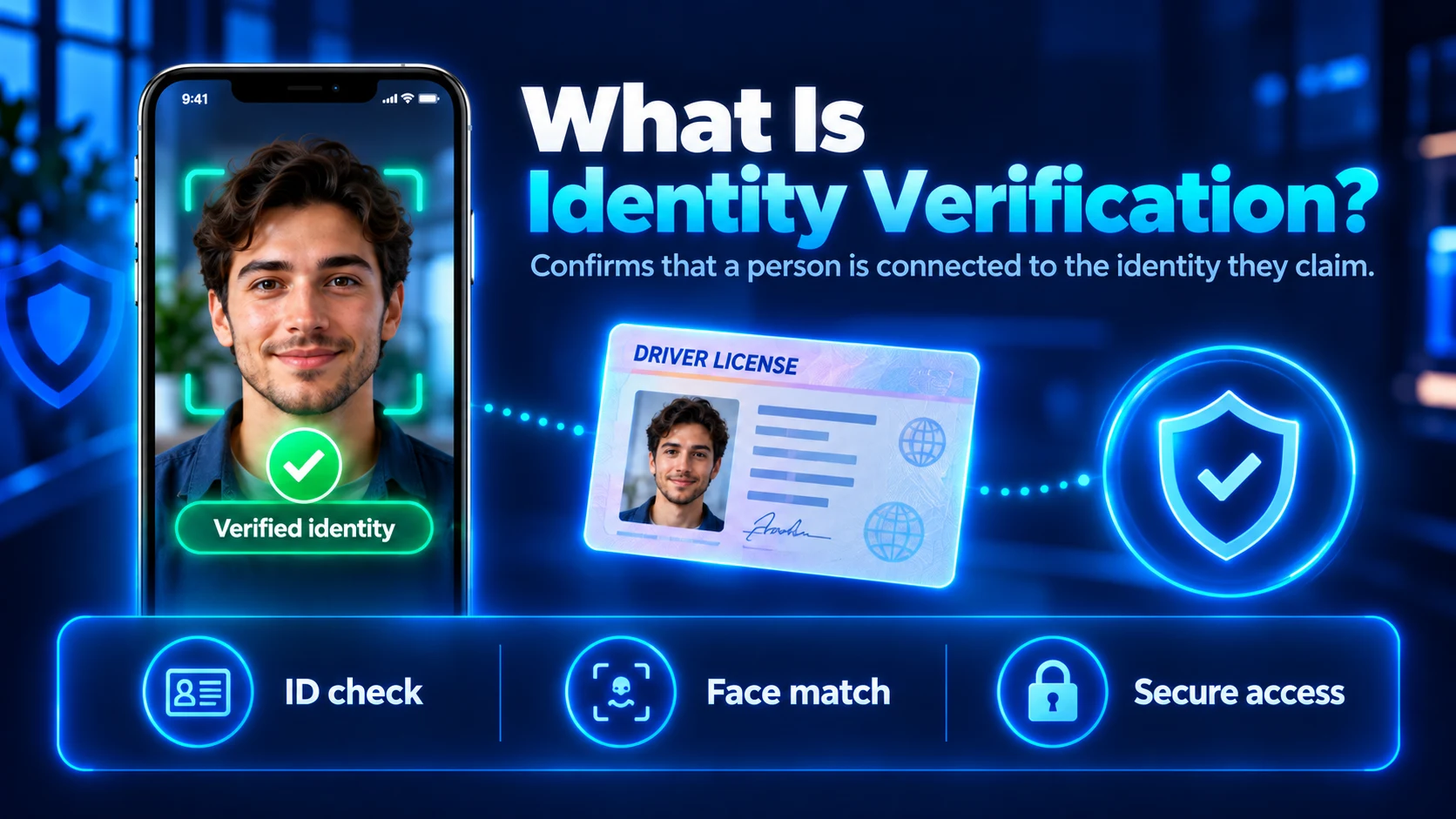
Identity verification is the process of establishing that a person is genuinely connected to the identity they claim. It goes beyond checking whether basic details, such as a name or date of birth, appear correct. An organization needs evidence that the identity exists and a way to confirm that the person presenting that evidence is its rightful owner.
A driver's license illustrates the distinction. The document may be genuine, but that alone does not prove that the person presenting it is the person named on it. A complete verification process therefore involves validating the identity evidence and establishing a reliable link between that evidence and the individual.
The strength of the verification process should reflect the level of risk involved. A low-risk service may require limited identity evidence, while opening a financial account, accessing sensitive records, or granting privileged workplace access may justify stronger checks.
In common industry usage, identity verification is often used broadly to describe this overall process. Formal frameworks may use more specific terminology. For example, NIST treats identity verification as one stage within the broader identity proofing process, alongside identity resolution and evidence validation.
What Is Digital Identity Verification?
Digital identity verification applies those checks through an online or technology-assisted process. The evidence may still begin with a physical document, such as a passport or driver's license, but the document can be captured remotely and evaluated alongside other signals.
A digital workflow may combine document data with a selfie, live video, biometric comparison, an authoritative record, control of a trusted account, or a digitally issued credential. The combination should be driven by risk rather than by a fixed assumption that every user needs the same checks.
Digital verification is particularly useful when the person and organization cannot conveniently meet. It supports remote onboarding, account recovery, marketplaces, government services, distributed work, and hiring. But moving the check online also creates attack paths such as manipulated document images, replay attacks, synthetic media, and stolen identity data, so the design of the verification process matters as much as the fact that it is digital.
How Identity Verification Works?
Identity verification is rarely based on a single check. Instead, it builds confidence step by step: first by collecting identity evidence, then checking whether that evidence is trustworthy, and finally confirming that it belongs to the person presenting it. The exact checks can vary by use case, but a typical digital verification process follows this flow.

Step 1: Capture Identity Information and Evidence
The process begins with the user providing basic identity details and an accepted form of evidence, such as a passport, driver's license, or national identity card. In a digital process, that usually means photographing or scanning the document.
Before anything else can happen, the capture needs to be usable. If important details are hidden by glare, the image is blurred, or part of the document is missing, the user may be asked to try again. Getting a clear capture at this stage helps prevent avoidable problems later in the process.
Step 2: Extract the Document Information
Once the document can be read clearly, relevant information is extracted from it. Depending on the document, this may include the person's name, date of birth, document number, expiry date, and information stored in a barcode or machine-readable zone.
This turns the submitted document into information that can be compared and checked. If a date, document number, or other detail does not line up with the rest of the evidence, the inconsistency can be identified before the verification moves further.
Step 3: Check Whether the Document Is Genuine
The next step is to establish whether the identity document itself can be trusted. Checks can look at the document's format, expiry information, security characteristics, and any signs that an image or data field may have been altered.
This distinction matters because a document can look convincing without being genuine. At the same time, even a genuine document does not prove that it belongs to the person submitting it. Document validation answers one part of the identity question; the next step addresses the other.
Step 4: Confirm the Person Behind the Document
To connect the document to its owner, the user may be asked to take a live selfie or short video. Facial comparison can then assess whether the person in the live capture matches the photograph on the identity document.
Liveness detection may provide an additional check by helping distinguish a real person from a photograph, screen replay, prerecorded video, or another presentation attack. Together, these checks make it harder to succeed with a genuine document that has been stolen or borrowed.
Step 5: Review the Evidence and Make a Decision
The final step considers the different signals together rather than treating any single check as conclusive. When the document appears genuine, its information is consistent, and the person can be connected to it, there is stronger evidence to support the claimed identity.
Not every unclear result means fraud. A poor image may simply need to be captured again, while conflicting information or a significant identity mismatch may require additional evidence or review. Depending on the outcome, the identity can be verified, rejected, or referred for further assessment.
Identity Verification Methods
Identity verification can rely on different types of evidence, and each method answers a slightly different question. Some methods determine whether identity evidence can be trusted, while others establish whether the person presenting it is genuinely connected to that identity. For higher risk decisions, several methods may be used together rather than relying on a single signal.
1. Document and Record-Based Verification
Document verification examines identity evidence such as passports, driver's licenses, and national identity cards to determine whether it appears genuine and valid. The document's structure, information, and security characteristics can all contribute to that assessment. Record-based verification approaches the same problem from another direction. Instead of examining the document itself, it compares submitted identity information with authoritative or credible records to determine whether the claimed identity can be supported by an independent source.
Typical checks can include:
Document expiry and issue information
Machine readable zones or barcodes
Consistency between document fields
Expected document and security features
Matches against trusted records
Signs of alteration or manipulation
These methods establish confidence in the evidence, but not necessarily in the person presenting it. A genuine passport, for example, can still be stolen. Document and record checks are therefore often combined with a method that connects the evidence to the individual completing the verification.
2. Facial Verification and Liveness Detection
Facial verification commonly compares the photograph associated with identity evidence against a selfie or live video. Its purpose is one-to-one comparison: does the participant appear to be the person represented by the evidence? Liveness detection addresses a different problem. It looks for evidence that a real person is present during the verification attempt rather than a photograph, replay, mask, or another form of presentation attack.
Common presentation attacks may include:
A photograph held in front of the camera
A face replayed from another screen
Prerecorded video presented as a live session
Some forms of masks or synthetic media presentation
These techniques can strengthen remote verification, but they should not be treated as infallible. Image quality, lighting, changes in appearance, accessibility needs, and manipulated media can affect results. An uncertain biometric result is better considered alongside other identity evidence than treated as automatic proof of fraud.
3. Biometric Verification Beyond the Face
Facial comparison is not the only biometric method available for identity verification. Depending on the system and use case, organizations may use physiological or behavioral characteristics to establish a connection between an individual and an identity.
Physiological biometrics can include:
Fingerprints
Iris patterns
Other measurable physical characteristics
Behavioral biometrics may use patterns in how a person speaks, types, moves, or interacts with a device. Voice characteristics can also be used as a biometric signal depending on how the system is designed.
These methods can provide additional evidence because they rely on characteristics associated with the individual rather than only on information they know or documents they possess.
The sensitivity of biometric information makes its handling particularly important. Unlike a password, many biometric characteristics cannot simply be replaced after exposure. Organizations therefore need to consider collection, storage, access, retention, and deletion alongside the accuracy and suitability of the matching technology itself.
4. Digital Identity Credentials
Digital identity credentials provide identity information or individual attributes in a form that can be validated electronically. Rather than repeatedly photographing the same physical document, a person may be able to present a credential issued by a trusted source. The receiving service can then evaluate the credential and the information it contains instead of depending entirely on visual inspection of a document.
Depending on the credential, verification may establish:
Who issued the credential
Whether it is valid
Whether it has been altered
Whether the required identity attribute is present
Whether the credential is appropriate for the transaction
Digital credentials can also support more selective sharing of identity information. A person may be able to prove a required attribute without disclosing every field contained in an identity record. Their reliability, however, still depends on how the identity was originally established, who issued the credential, how it is protected, and whether that level of assurance is appropriate for the use case.
Benefits of Identity Verification
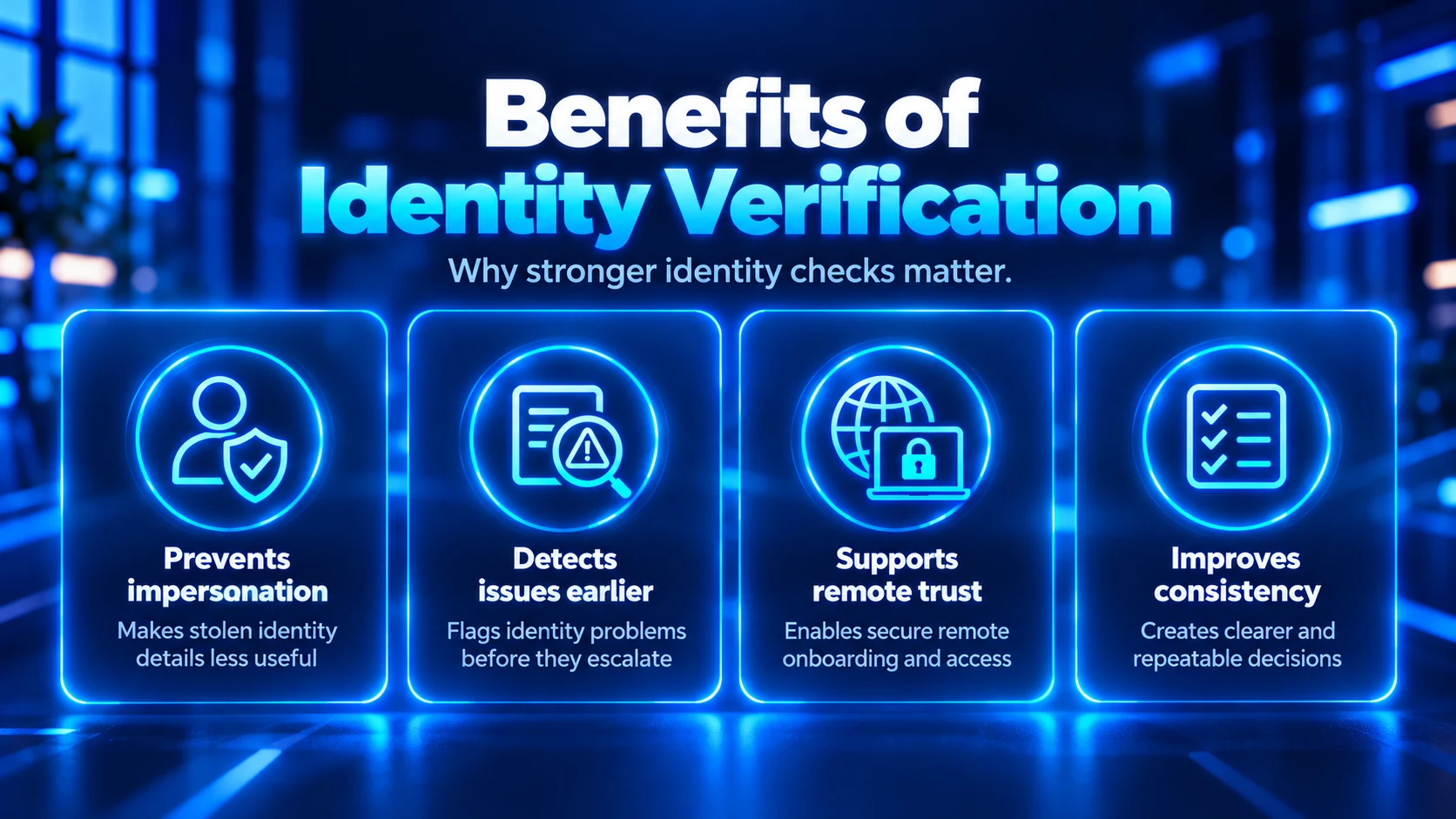
Effective identity verification reduces uncertainty before an organization creates an account, grants access, completes a transaction, or advances an applicant. Its value comes from establishing a credible connection between a person and the identity they claim before an incorrect identity creates financial, security, operational, or compliance consequences.
1. Makes Impersonation Harder to Sustain
Personal information alone is not proof of identity. Someone may know another person's name, address, or date of birth, or even have access to a genuine identity document. Identity verification adds another requirement by asking the person to demonstrate a credible connection to the identity being presented.
Identity verification can make several forms of impersonation more difficult, including:
Using stolen personal information to create an account
Presenting another person's identity document
Substituting another individual during a remote process
Attempting to regain access using someone else's identity
Verification does not eliminate impersonation on its own. However, it can make stolen information or documents less useful when the person must also establish that the identity belongs to them.
2. Identifies Identity Problems Before They Progress
The consequences of an incorrect identity can become more serious after an account has been opened, an applicant has advanced, or access has already been granted. At that point, an organization may need to investigate suspicious activity, recover an account, reverse transactions, repeat recruitment work, or determine what information and systems an unauthorized person accessed.
Identity verification moves part of that control earlier by evaluating identity evidence before a higher-risk decision is completed.
Problems that may be identified during verification include:
Manipulated or altered identity documents
Information that conflicts across identity evidence
A person who does not match the presented identity
Evidence that cannot be validated reliably
This does not replace authentication, transaction monitoring, behavioral signals, or human review. Instead, it reduces the likelihood that later controls begin with an identity that should not have been accepted.
3. Supports High-Trust Remote Processes
Digital identity verification allows organizations to establish identity without requiring every user to appear in person. Identity evidence can be collected and evaluated remotely, making identity-dependent services more practical across locations.
Common use cases include:
Customer onboarding
Account recovery
Government and public services
Online marketplaces
Remote hiring and employee onboarding
Access to sensitive digital services
Remote verification still needs to account for legitimate users who cannot complete the standard process. Alternative evidence, accessibility requirements, poor connectivity, unsupported documents, or inadequate devices may require a fallback route rather than an automatic rejection.
4. Creates More Consistent Identity Decisions
Informal identity checks can vary depending on who performs them. One employee may accept evidence that another employee questions, while visual or technical issues during a remote interaction can be interpreted differently by different reviewers.
A defined verification process creates clearer criteria for:
Which forms of identity evidence are accepted
Which checks are required for a particular level of risk
What results require additional evidence
When a case should move to manual review
How verification outcomes are recorded
This consistency can also support documentation and auditability in regulated or higher-risk environments. Identity verification does not create compliance by itself, but a defined process gives organizations a clearer foundation for applying the requirements relevant to their use case.
Identity Verification Use Cases
Identity verification is useful whenever an organization needs confidence about the person behind a transaction, account, application, or interaction. The level of verification should reflect what could happen if the wrong person were accepted.
1. Financial Services
Banks, fintech companies, lenders, payment services, and other regulated financial organizations may need to establish customer identity during onboarding and other high-risk interactions. The consequences of weak identity controls can be substantial. Javelin Strategy & Research reported that traditional identity fraud losses reached nearly $23 billion in 2023.
2. Remote Hiring
Remote hiring can make it harder to establish whether the person completing an assessment, attending an interview, and entering onboarding is the same individual represented in the application.
Identity verification can help employers address risks such as candidate impersonation, proxy interviewing, stolen identities, and identity substitution between recruitment stages. The level and timing of verification should reflect the sensitivity of the hiring decision rather than requiring repeated checks throughout the entire process.
3. Online Marketplaces
Marketplaces need to establish trust between people who may never meet. Identity verification can be applied to sellers, service providers, hosts, drivers, contractors, or other participants where impersonation could create financial or physical risk.
4. Government and Public Services
Digital government services may require assurance that the person accessing a benefit, record, license, tax service, or other restricted resource is the correct individual.
European eID rules recognize three assurance levels, low, substantial, and high, illustrating that the level of identity assurance can vary with the sensitivity of the service.
5. Healthcare and Insurance
Healthcare providers and insurers can use identity verification to confirm that patients, policyholders, or claimants are connected to the identity they present. This can be particularly important during patient onboarding, access to sensitive health records, insurance enrollment, claims processing, and remote healthcare services, where an identity mismatch could expose personal information or enable fraudulent activity.
Identity Verification vs. Authentication
Identity verification and authentication are closely related, but they serve different purposes. Identity verification establishes confidence in who a person is, while authentication checks whether a returning user can prove they are authorized to access an account or system.
Aspect | Identity Verification | Authentication |
Main purpose | Establishes that a person is genuinely connected to the identity they claim. | Confirms that a returning user can demonstrate control of an accepted authenticator. |
When it happens | Commonly used during onboarding, enrollment, account recovery, or another high-risk identity event. | Usually occurs when an existing user signs in or attempts to access a protected account or system. |
What it may use | Identity documents, trusted records, facial comparison, liveness checks, biometrics, or digital credentials. | Passwords, passkeys, security keys, authentication apps, or other accepted authenticators. |
Question it answers | “Are you really the person connected to this identity?” | “Can you prove that you are authorized to access this account?” |
Example | A bank checks a new customer's identity documents and supporting evidence before opening an account. | The customer later uses a passkey or security key to sign in. |
Challenges and Limitations of Identity Verification
Identity verification can strengthen trust in digital interactions, but no verification process is completely frictionless or error free. Organizations need to balance security with accuracy, accessibility, privacy, and the experience of legitimate users.
1. False Acceptances and False Rejections
Automated verification can make mistakes in both directions. A false acceptance allows an illegitimate attempt to pass, while a false rejection prevents a genuine user from completing verification. The impact depends on the use case, but both can create problems for the organization.
This is why uncertain results should not always lead to an immediate rejection. Additional evidence or manual review can provide a more appropriate route when the system cannot reach a reliable decision.
2. Capture Quality and Technical Limitations
Digital verification depends heavily on the quality of the information being submitted. Poor lighting, glare, low resolution cameras, damaged documents, or unstable connectivity can interfere with document checks and biometric comparisons.
These issues can resemble suspicious activity even when there is no fraud involved. Clear capture instructions, opportunities to retry, and a fallback process can help separate ordinary technical problems from genuinely questionable evidence.
3. Accessibility and Identity Coverage
A standard verification process will not work equally well for every user. Some people may not have the preferred identity document, while others may use older devices, have limited connectivity, or be unable to complete a particular biometric action.
Organizations should account for these situations when designing the verification journey. Providing alternative documents, assisted verification, or manual review can help legitimate users complete the process without weakening the standard verification path for everyone else.
4. Privacy and Data Protection
Identity verification can involve sensitive information, including government-issued documents, personal identifiers, facial images, and biometric data. Collecting more information than necessary increases the amount of sensitive data an organization needs to protect.
A verification process should therefore have a clear reason for every identity signal it collects. Organizations also need to consider who can access the information, how it is protected during processing and storage, how long it is retained, and when it should be deleted.
5. Evolving Fraud Techniques
Fraud methods change in response to stronger verification controls. Better document checks can encourage the use of stolen genuine documents, while facial verification may face replay attacks, synthetic media, or attempts to bypass liveness detection.
Identity verification should therefore be treated as an evolving risk control process rather than a one-time implementation. Organizations need to review suspicious patterns, verification failures, false rejections, and emerging attack methods to determine whether existing controls still provide the level of assurance they were designed to deliver.
How to Build a Strong Identity Verification Process?
A strong identity verification process should reflect the risk of the decision being made. The goal is not to add as many checks as possible, but to use the right evidence, provide a path for uncertain cases, and regularly review whether the process is working as intended.

1. Start With the Risk
Begin by considering what could happen if the wrong person is accepted. Creating a low-risk online profile does not require the same level of assurance as opening a financial account, accessing sensitive records, or hiring someone who will receive privileged system access.
Before choosing verification checks, define:
What could happen if an incorrect identity is accepted
How much identity assurance the decision actually requires
Starting with risk helps prevent unnecessary verification steps from adding friction without meaningfully improving security.
2. Choose the Right Verification Methods
Different verification methods answer different questions. Document validation can determine whether identity evidence appears genuine, facial comparison can connect a person to that evidence, and liveness detection can help establish whether a real person is present during remote verification.
When selecting methods, consider:
Which identity risk each verification method is intended to address
Whether independent signals should be combined for higher-risk decisions
The strongest workflow is not necessarily the one with the most checks. Each method should contribute something useful to the final identity decision.
3. Plan for Unclear Results
Identity verification does not always end with a clear pass or fail. Poor image quality, differences across records, older document photographs, or uncertain biometric comparisons can prevent a system from reaching a confident result even when the user is legitimate.
A fallback process should define:
When the user should be allowed to retry or provide alternative evidence
When an uncertain case should move to manual review
This helps separate technical or usability problems from evidence that genuinely requires further investigation.
4. Minimize Identity Data
Identity verification can involve sensitive information, including government documents, personal identifiers, facial images, and biometric data. Organizations should avoid collecting or retaining information simply because the verification system makes it available.
Data handling decisions should consider:
Whether each piece of information is necessary for the verification purpose
How long sensitive identity information needs to be retained
Reducing unnecessary collection and retention limits privacy exposure while keeping the verification process focused on information that actually contributes to the decision.
5. Monitor Verification Performance
A verification process should continue to be evaluated after implementation. A high pass rate alone does not show whether the process is secure, accurate, or easy for legitimate users to complete.
Teams should monitor:
False rejections, retries, abandonment, and recurring verification failures
Manual review outcomes and confirmed fraud that passed the initial checks
These signals can reveal excessive friction, weak controls, or changes in fraud patterns. Reviewing them over time allows the verification process to evolve instead of remaining fixed while the risks around it change.
Identity Verification in Remote Hiring
Remote hiring creates an additional identity question alongside candidate assessment: can this person do the job, and is this actually the person whose application is being evaluated?
Identity verification addresses the second question. Rather than repeating checks throughout the entire recruitment process, employers can introduce verification at stages where identity substitution could materially affect a hiring decision or create access risk.
Where Identity Verification Fits in Remote Hiring
Verification may be appropriate before a high-stakes assessment, a final remote interview, or before a new hire receives access to company systems. The aim is to maintain reasonable confidence that the same identity continues through the stages where identity matters most.
For example, an organization may need to re-establish identity when:
A different person appears to participate in a later hiring stage
Candidate identity details change without a clear explanation
The person being onboarded does not match the identity established earlier
Other meaningful inconsistencies appear between recruitment stages
These situations do not automatically prove fraud. They indicate that the organization may need to apply its established verification process again rather than relying on visual judgment alone.
Identity Continuity and Deepfake Risks
Synthetic video, voice cloning, replay attacks, and other forms of manipulated media can reduce the reliability of visual familiarity during remote interviews. At the same time, ordinary issues such as poor lighting, network delays, camera quality, and audio problems can also make a legitimate participant appear unusual.
Employers should therefore avoid treating a recruiter's visual impression as proof of either identity or fraud. When meaningful inconsistencies appear, identity should be re-established using the organization's defined verification process and supporting evidence.
This approach helps separate genuine identity concerns from ordinary technical problems while maintaining confidence that the person being evaluated is the person ultimately being hired.
Identity Verification Standards and Regulatory Considerations
Identity verification does not follow one universal set of requirements. The level of assurance an organization needs depends on its industry, jurisdiction, the type of transaction, and the consequences of accepting the wrong identity. A financial institution conducting customer due diligence, for example, may need stronger identity controls than an employer confirming a remote candidate's identity.
Standards and regulatory guidance can help organizations determine what evidence to collect, how identity checks should be structured, and how sensitive verification data should be handled.
NIST Digital Identity Guidelines
The NIST SP 800-63A-4 guidelines provide a framework for identity proofing and distinguish between identity resolution, evidence validation, and identity verification.
Identity resolution establishes which real-world identity is being claimed. Evidence validation determines whether the documents or other evidence supporting that identity are authentic, accurate, and acceptable. Identity verification then establishes that the applicant is genuinely connected to the validated identity evidence.
This distinction is important because evidence can be valid without establishing ownership. A passport, for example, may be authentic and pass document validation while still being presented by someone other than its rightful holder.
Organizations can use the NIST framework to determine an appropriate level of identity assurance and structure proofing processes around the risks of a particular service.
FATF Digital Identity Guidance
The Financial Action Task Force provides guidance on using digital identity systems for customer due diligence in anti-money-laundering and counter-terrorist financing contexts.
Its approach is risk-based rather than centered on a particular verification technology. Organizations relying on digital identity for relevant customer identification processes need to understand how the identity system works, what evidence supports it, and whether its level of assurance is appropriate for the risks involved.
A system being described as “verified” is therefore not sufficient on its own. Organizations need to understand the underlying identity proofing process, the evidence it relies on, and its limitations before using it for higher-risk activities.
Data Protection and Privacy Requirements
Identity verification can involve sensitive personal information, including government identifiers, document images, facial images, and biometric data. The requirements governing that information vary by jurisdiction, so verification workflows also need to account for the privacy and data protection rules that apply where they operate. Depending on the jurisdiction and use case, organizations may need to consider how identity data is collected, why it is required, who can access it, how long it is retained, and how it is protected. Principles such as data minimization and purpose limitation are particularly relevant because collecting additional identity information does not automatically make a verification process more reliable.
Regulatory compliance therefore extends beyond successfully verifying someone's identity. Organizations also need to consider whether the verification method is appropriate for the use case and whether the personal information involved is handled in accordance with the applicable requirements.
The Future of Identity Verification
Identity verification is likely to become more digital, contextual, and adaptable as organizations move beyond repeated physical document checks. Digital credentials can allow identity information to be validated electronically and may support selective disclosure, helping users prove specific attributes without sharing unnecessary personal data. At the same time, growing risks from deepfakes, voice cloning, replay attacks, and other forms of synthetic media are increasing the need for stronger identity assurance based on multiple signals, such as document authenticity, liveness detection, biometric comparison, and trusted credentials. Rather than applying the same verification checks to every interaction, organizations can use stronger controls when risk increases and re-establish identity when circumstances materially change.
Conclusion
Identity verification comes down to a practical question: is there enough trustworthy evidence to believe that this person is genuinely connected to the identity they are using? The answer may come from documents, trusted records, biometrics, digital credentials, or several signals working together.
More checks do not automatically create a better process. Strong verification uses evidence that fits the risk, gives genuine users a sensible route when something is unclear, and limits the amount of sensitive information collected and retained.
As more hiring, banking, government services, marketplaces, and account recovery move online, that balance will matter even more. Organizations need to make impersonation difficult without making ordinary users fight their way through the verification process.