Back to all blogs
Learn how to detect interview fraud, identify common cheating and impersonation tactics, and use effective strategies to prevent fraud and ensure fair, secure hiring.

The hiring landscape has changed dramatically over the past few years. While remote recruitment has enabled organizations to access global talent pools, it has also opened the door to a growing threat: interview fraud.
Today, recruiters face challenges that barely existed a few years ago. Deepfake technology can alter a candidate’s face and voice in real time. Proxy candidates can attend interviews on behalf of someone else. AI copilots can generate instant answers during technical assessments. In many cases, hiring teams do not discover the deception until after the candidate has been hired and onboarded.
Recent industry research highlights how serious the problem has become. According to a 2025 Checkr survey, 31% of hiring managers reported interviewing a candidate who was later found to be using a fake identity, while 35% encountered situations where someone other than the listed applicant participated in a virtual interview. The same study revealed that only 19% of hiring managers were extremely confident in their ability to detect hiring fraud.
The rapid advancement of artificial intelligence is accelerating these risks. A Gartner survey found that 6% of job applicants admitted to participating in interview fraud, including impersonation and proxy interviewing. Gartner also predicts that by 2028, one in four candidate profiles globally could be fake, creating unprecedented challenges for recruiters and talent acquisition teams. For companies embracing remote and hybrid hiring, interview fraud is no longer an isolated problem. It has become a critical business risk that affects hiring quality, workforce integrity, and enterprise security.
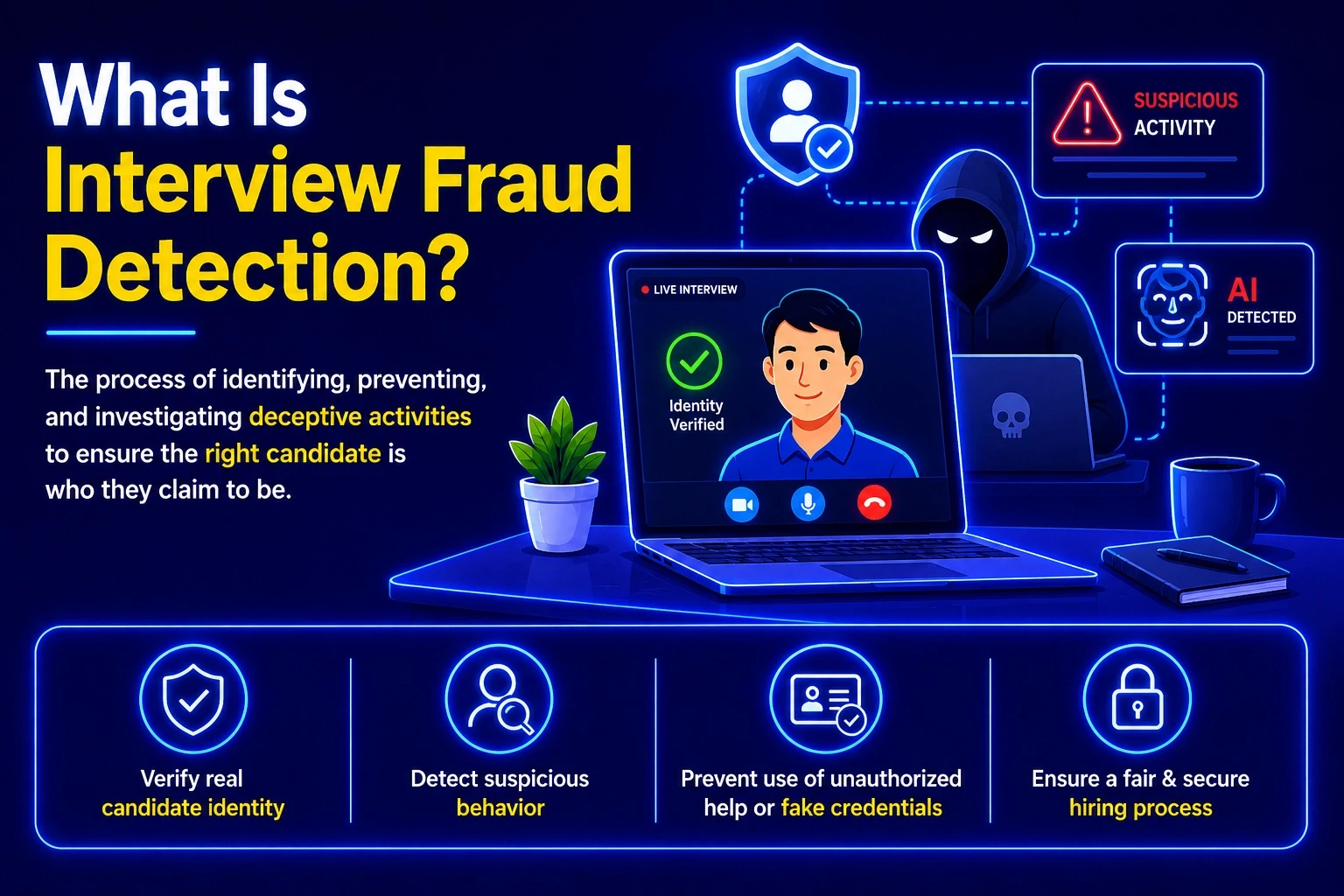
What Is Interview Fraud Detection?
Interview fraud detection is the process of identifying, preventing, and investigating deceptive activities that occur during the hiring process. It helps organizations verify that the person participating in an interview is genuinely the candidate who applied for the role and that they are not using unauthorized assistance, fake credentials, or AI-generated impersonation tools.
As remote and hybrid hiring become standard practice, interview fraud detection has evolved from a niche security measure into a critical component of modern recruitment. Organizations are no longer evaluating candidates solely based on their skills and experience. They must also verify candidate authenticity throughout the hiring journey.
Interview fraud can take many forms. Some candidates use proxy interviewers who secretly answer questions on their behalf. Others rely on real-time AI assistants to generate responses during technical or behavioral interviews. More sophisticated fraudsters may use deepfake technology to alter their appearance or voice, making it difficult for recruiters to verify their identity. In extreme cases, fraudulent candidates use stolen identities, fake employment histories, or fabricated educational credentials to secure employment.
The growing prevalence of these tactics is forcing organizations to rethink traditional hiring processes. What worked for in-person interviews is often insufficient in a virtual hiring environment where recruiters may never meet candidates face-to-face.
How Interview Fraud Actually Works: The Methods Fraudsters Use
Interview fraud can take many forms, ranging from simple misrepresentation to highly sophisticated AI-powered impersonation. Understanding how these tactics work is the first step toward building an effective interview fraud detection strategy.
Modern fraudsters often combine multiple techniques during the hiring process. A candidate may use a fake identity, receive real-time AI assistance, and rely on a proxy interviewer during technical assessments. Without proper verification measures, these activities can be difficult to detect.
Below are the most common interview fraud methods organizations encounter today.
1. Deepfake Interview Fraud
Deepfake technology uses artificial intelligence to manipulate a person’s face, voice, or appearance during a live video interview. Fraudsters can use these tools to conceal their identity or impersonate another individual.
In some cases, candidates use AI-generated avatars or face-swapping technology to alter their appearance in real time. More advanced setups combine voice cloning and facial manipulation to create highly convincing impersonations.
Common Warning Signs
Unnatural facial movements or expressions
Lip-sync delays during conversations
Inconsistent lighting around facial features
Blurred edges around the face
Voice patterns that sound synthetic or robotic
Video artifacts that appear intermittently
As deepfake technology becomes more accessible, recruiters can no longer rely solely on visual verification. Organizations need advanced detection tools capable of identifying manipulated video and audio during live interviews.
2. Proxy Candidates
Proxy interviewing occurs when someone other than the actual applicant participates in part or all of the interview process.
This tactic is especially common in technical hiring. A highly skilled individual attends coding interviews or technical assessments on behalf of a less qualified candidate. Once hired, the original applicant assumes the role despite lacking the demonstrated skills.
Common Warning Signs
Different communication styles across interview rounds
Sudden changes in technical competency
Inconsistent accents, speech patterns, or mannerisms
Candidate avoids turning on their camera
Delays between questions and responses
Candidate struggles with topics they previously mastered
Proxy interviews can lead to costly mis-hires and create significant performance issues after onboarding. Detecting proxy candidates early helps organizations avoid hiring individuals who cannot perform the required responsibilities.
3. AI-Assisted Interview Cheating
Generative AI tools can now provide real-time responses during interviews, enabling candidates to answer questions beyond their actual level of knowledge or experience.
Candidates may use hidden screens, browser-based AI assistants, secondary devices, or automated coaching tools to generate answers during interviews and assessments.
Common Warning Signs
Responses appear overly polished or scripted
Long pauses before answering simple questions
Answers that lack personal context or examples
Candidate struggles with follow-up questions
Consistently perfect responses across unrelated topics
Eye movements suggesting off-screen assistance
While AI can be a valuable productivity tool, excessive reliance during interviews can prevent recruiters from accurately evaluating a candidate’s skills, critical thinking, and problem-solving abilities.
How Sherlock AI Helps
Sherlock AI helps organizations identify potential AI-assisted interview cheating by analyzing candidate behavior during live interviews. The platform monitors suspicious eye movements, unusual response patterns, screen-switching indicators, and behavioral inconsistencies that may suggest the use of external AI assistance. By combining behavioral intelligence with advanced fraud detection signals, Sherlock AI enables recruiters to evaluate candidates based on their genuine skills and knowledge.
4. Identity Fraud
Identity fraud occurs when an individual uses stolen, synthetic, or fabricated personal information to apply for a position.
Fraudsters may use forged identification documents, fake social profiles, or manipulated employment records to create a convincing candidate profile.
Common Warning Signs
Inconsistencies between documents and interview responses
Mismatched profile photos across platforms
Limited digital footprint for experienced professionals
Conflicting employment history information
Unverifiable credentials or certifications
Suspicious identification documents
Identity fraud can expose organizations to security threats, compliance violations, and unauthorized access to sensitive systems and data.
5. Credential and Resume Fraud
Resume fraud remains one of the most common forms of hiring deception. Candidates may exaggerate qualifications, fabricate work experience, claim certifications they never earned, or misrepresent technical expertise.
Although this form of fraud predates AI, modern technology makes it easier to create convincing resumes, portfolios, and supporting documents.
Common Warning Signs
Employment dates that cannot be verified
Inflated job titles or responsibilities
Unverifiable certifications
Technical knowledge that does not match claimed experience
Generic project descriptions lacking detail
References that cannot be authenticated
Hiring decisions based on false qualifications often result in poor performance, increased turnover, and significant recruitment costs.
How to Detect Interview Fraud in Real Time
Interview fraud often leaves behind subtle clues that recruiters can identify during candidate interactions. While a single warning sign may not indicate fraudulent activity, multiple red flags appearing together should prompt further investigation.
The following indicators can help hiring teams identify potential interview fraud before a candidate progresses through the hiring process.

1. Technical Red Flags
Candidates using deepfake technology, external assistance tools, or other manipulation methods may exhibit unusual technical behaviors during virtual interviews.
Warning Signs to Watch For
Frequent video lag during critical questions
Lip-sync mismatches between audio and video
Blurred or distorted facial features
Unnatural eye movements
Sudden changes in voice quality
Camera angles that partially obscure the face
Requests to keep the camera turned off
2. Behavioral Red Flags
Behavioral inconsistencies are often among the strongest indicators of interview fraud. Candidates may struggle to maintain consistency when relying on external help or fabricated experience.
Warning Signs to Watch For
Answers that sound scripted or rehearsed
Long pauses before responding
Difficulty handling follow-up questions
Generic responses lacking specific examples
Contradictions in work experience or project details
Significant differences between interview rounds
Reluctance to engage in spontaneous discussion
3. Identity Verification Red Flags
Identity-related fraud attempts often involve fabricated documents, stolen identities, or misrepresented personal information.
Warning Signs to Watch For
Inconsistencies across submitted documents
Profile photos that differ across platforms
Unverifiable employment history
Missing professional presence despite extensive experience claims
Refusal to participate in verification processes
Suspicious or altered identification documents
4. Proxy Candidate Red Flags
Proxy interviewing occurs when another individual participates in the interview on behalf of the applicant.
Warning Signs to Watch For
Different communication styles between interviews
Changes in accent or speech patterns
Varying levels of technical expertise across rounds
Delayed responses that suggest external coaching
Candidate avoids video interaction
Strong interview performance followed by weak assessment results
5. AI-Assisted Interview Red Flags
The growing availability of generative AI tools has introduced new challenges for recruiters attempting to assess genuine candidate skills.
Warning Signs to Watch For
Overly polished responses to every question
Repetitive language patterns
Lack of personal experiences or examples
Frequent eye movement toward another screen
Delayed responses followed by highly detailed answers
Difficulty explaining thought processes or decision-making steps
Interview Fraud Across Industries: Who Is Most at Risk?
Interview fraud can affect organizations of any size, but certain industries face a significantly higher risk due to remote hiring practices, access to sensitive information, and ongoing talent shortages. These sectors often recruit candidates across different regions and rely heavily on virtual interviews, making them attractive targets for fraudsters.
Understanding which industries are most vulnerable can help organizations implement stronger interview fraud detection and candidate verification measures.
Industry | Why It’s at Risk | Common Fraud Risks |
|---|---|---|
Technology & Software Development | High demand for developers, engineers, and data scientists. Remote hiring and online technical assessments are common. | Proxy candidates, AI-assisted interviews, credential misrepresentation, outsourced assessments. |
Cybersecurity | Roles provide access to critical systems, infrastructure, and sensitive security information. Talent shortages often accelerate hiring. | Identity fraud, fake certifications, credential inflation, proxy interviewing. |
Financial Services | Banks, fintech firms, insurance providers, and investment companies handle sensitive financial and customer data. | Identity impersonation, fake experience, fraudulent credentials, compliance risks. |
Healthcare & Life Sciences | Remote hiring for telehealth, compliance, administrative, and technology roles often involves access to regulated data and systems. | Credential fraud, identity fraud, qualification misrepresentation, regulatory exposure. |
Remote-First Organizations | Candidates may never meet recruiters or hiring managers in person, making verification more challenging. | Candidate impersonation, AI-assisted interviews, proxy candidates, identity verification failures. |
As fraud tactics continue to evolve, organizations in these high-risk sectors are increasingly adopting advanced interview fraud detection tools, identity verification processes, and behavioral analysis technologies to reduce hiring risks and protect business operations.
The Hidden Consequences of Interview Fraud
Interview fraud affects far more than the hiring process. While organizations often focus on the immediate challenge of replacing a fraudulent hire, the long-term consequences can impact security, productivity, compliance, and business performance.
As fraud tactics become more sophisticated, organizations need to understand the risks associated with allowing unverified candidates into their workforce.
1. Financial Losses and Hiring Costs
Every new hire requires investment. From sourcing and interviewing to onboarding and training, organizations dedicate significant resources to bringing talent into the business.
When a fraudulent candidate is discovered, these investments are often lost, and the recruitment process must start again.
Potential Impact
Increased recruitment expenses
Wasted onboarding and training costs
Additional hiring cycles
Extended time-to-fill positions
Reduced return on hiring investments
2. Security and Data Risks
Fraudulent candidates may gain access to internal systems, customer information, proprietary data, and sensitive business resources before their deception is detected.
For organizations handling confidential information, a single fraudulent hire can create substantial security concerns.
Potential Impact
Unauthorized access to company systems
Data breaches and information exposure
Intellectual property theft
Increased cybersecurity threats
Operational security vulnerabilities
3. Productivity and Team Disruption
Candidates who misrepresent their skills often struggle to perform once hired. Teams may need to spend additional time supporting, retraining, or compensating for the individual’s lack of expertise.
These challenges can affect project timelines, team morale, and overall productivity.
Potential Impact
Missed project deadlines
Reduced team efficiency
Increased management overhead
Employee frustration
Higher turnover risk
4. Compliance and Reputation Damage
Organizations operating in regulated industries face additional risks when fraudulent candidates bypass hiring controls. Failure to verify candidate identity or qualifications can lead to compliance issues and reputational harm.
Trust can be difficult to rebuild once stakeholders, customers, or employees question the integrity of hiring practices.
Potential Impact
Regulatory penalties
Compliance violations
Negative publicity
Reduced customer trust
Damage to employer brand
Best Practices for Recruiters and Hiring Teams
As interview fraud becomes more sophisticated, organizations can no longer rely solely on traditional hiring methods to verify candidate authenticity. A proactive approach that combines verification, structured processes, and technology is essential for reducing hiring risks
The following best practices can help recruiters and hiring teams strengthen their interview fraud prevention strategy.

1. Verify Candidate Identity Before the Interview
Identity verification should begin before the first interview takes place. Confirming that candidates are who they claim to be helps prevent impersonation, synthetic identity fraud, and proxy interviewing.
Best Practices
Request government-issued identification when appropriate
Compare candidate information across submitted documents
Verify professional profiles and employment history
Use secure identity verification tools
Confirm candidate details before advancing to later interview stages
2. Implement Structured Multi-Round Interviews
Structured interviews make it easier to identify inconsistencies across different stages of the hiring process. When multiple interviewers evaluate the same candidate, unusual changes in communication style, technical knowledge, or behavior become more apparent.
Best Practices
Conduct multiple interview rounds
Include both technical and behavioral assessments
Use standardized evaluation criteria
Compare observations across interviewers
Document inconsistencies for further review
3. Watch for AI-Assisted Interview Cheating
Generative AI tools are increasingly being used during interviews and assessments. Recruiters should be aware of behaviors that may indicate unauthorized assistance.
Best Practices
Ask follow-up questions that require personal experience
Request detailed explanations of problem-solving approaches
Use scenario-based questions
Encourage candidates to explain their reasoning process
Assess practical skills rather than memorized answers
4. Strengthen Technical Assessment Security
Technical interviews and coding assessments are common targets for proxy candidates and AI-assisted cheating. Implementing additional controls can help ensure assessment integrity.
Best Practices
Use live coding exercises when possible
Include discussion-based technical evaluations
Verify consistency between assessment and interview performance
Monitor unusual assessment behaviors
Require candidates to explain their solutions
5. Conduct Thorough Background and Credential Verification
Resume fraud and credential misrepresentation remain common hiring challenges. Verifying key information before making an offer helps reduce risk.
Best Practices
Validate employment history
Verify educational qualifications
Confirm certifications and licenses
Conduct reference checks
Review inconsistencies in candidate documentation
6. Use Interview Fraud Detection Technology
Manual verification alone is becoming increasingly difficult as fraud tactics evolve. AI-powered fraud detection solutions can help organizations identify suspicious activity during the hiring process.
Best Practices
Monitor for deepfake indicators
Detect proxy candidate behavior
Analyze interview authenticity signals
Identify AI-assisted interview activity
Integrate fraud detection into existing hiring workflows
Preventing interview fraud requires more than a single verification step. Organizations should adopt a layered approach that combines identity verification, structured interviews, behavioral analysis, assessment integrity, and fraud detection technology.
By implementing these best practices, recruiters can improve hiring accuracy, reduce organizational risk, and ensure that hiring decisions are based on genuine candidate qualifications rather than deception.
How Sherlock AI Detects and Prevents Interview Fraud
As interview fraud becomes more sophisticated, recruiters need more than manual verification and traditional interview techniques. Deepfakes, proxy candidates, AI-assisted cheating, and identity fraud can be difficult to detect using conventional hiring processes alone.
Sherlock AI helps organizations strengthen hiring integrity by providing real-time interview fraud detection and candidate authenticity verification throughout the recruitment process.
1. Deepfake Detection
Deepfake technology can alter a candidate’s appearance, facial movements, or voice during live interviews, making it difficult for recruiters to verify identity through visual observation alone.
How Sherlock AI Helps
Detects signs of AI-generated video manipulation
Identifies facial inconsistencies and anomalies
Analyzes authenticity signals during live interviews
Helps recruiters verify candidate presence and identity
2. Proxy Candidate Detection
Proxy interviewing occurs when someone other than the applicant participates in the interview process. This often results in unqualified candidates progressing through hiring stages.
How Sherlock AI Helps
Monitors behavioral consistency throughout interviews
Detects potential candidate substitution patterns
Helps identify discrepancies between interview stages
Supports more accurate candidate verification
3. AI-Assisted Interview Detection
Generative AI tools can provide candidates with real-time responses during interviews, making it difficult to assess genuine skills and expertise.
How Sherlock AI Helps
Identifies behavioral indicators of external assistance
Detects suspicious response patterns
Flags potential AI-assisted interview activity
Helps recruiters evaluate authentic candidate performance
4. Identity Verification and Candidate Authentication
Verifying candidate identity is one of the most important steps in preventing hiring fraud. Identity-related risks continue to increase as organizations expand remote hiring efforts.
How Sherlock AI Helps
Supports candidate identity verification workflows
Helps reduce impersonation risks
Strengthens candidate authentication processes
Improves confidence in hiring decisions
5. Real-Time Fraud Risk Insights
Interview fraud often involves multiple signals that may be difficult for recruiters to detect independently. Sherlock AI helps consolidate these indicators into actionable insights.
How Sherlock AI Helps
Provides fraud risk visibility during interviews
Highlights suspicious candidate behavior
Supports recruiter decision-making
Enables faster investigation of potential fraud attempt
Why Organizations Choose Sherlock AI
Traditional hiring processes were not designed to address modern interview fraud tactics. As AI-powered impersonation and cheating tools become more accessible, organizations need solutions capable of detecting threats in real time.
Sherlock AI helps organizations:
Reduce hiring fraud risks
Improve candidate authenticity verification
Detect deepfakes and proxy candidates
Identify AI-assisted interview activity
Protect hiring integrity at scale
By combining advanced fraud detection capabilities with a recruiter-friendly experience, Sherlock AI enables organizations to make confident hiring decisions while maintaining a fair and secure recruitment process.
Conclusion
Interview fraud is no longer a rare hiring challenge. From deepfake impersonation and proxy candidates to AI-assisted interview cheating and identity fraud, organizations face increasingly sophisticated threats throughout the recruitment process.
As remote and hybrid hiring continue to grow, traditional verification methods are often insufficient to detect modern fraud tactics. Recruiters must be able to verify candidate authenticity, identify suspicious behavior, and ensure that hiring decisions are based on genuine skills and qualifications.
The good news is that interview fraud can be prevented. By combining structured hiring processes, identity verification, behavioral analysis, and advanced fraud detection technologies, organizations can significantly reduce hiring risks and protect the integrity of their workforce.
Ready to stop interview fraud before it impacts your organization? Explore how Sherlock AI can help you build a secure, fraud-resistant hiring process. 👉 Visit to learn more or schedule a demo. |
|---|