Back to all blogs
Learn how to interview remote candidates effectively with proven best practices for preparation, candidate evaluation, interview structure, and remote hiring success. Discover how Sherlock AI helps recruiters improve interview integrity and make confident hiring decisions.

Remote hiring has transformed modern recruitment, allowing organizations to connect with talent beyond geographical boundaries while accelerating hiring timelines. As remote and hybrid work models continue to expand, interviewing remote candidates has become a critical skill for recruiters, hiring managers, and talent acquisition teams seeking to identify the best candidates efficiently.
Recent hiring data highlights just how significant this shift has become. According to remote hiring research, 92% of companies now conduct initial interviews virtually, while 84% of candidates prefer virtual first-round interviews because of the convenience, flexibility, and reduced travel requirements.
At the same time, virtual interviewing presents unique challenges. Recruiters must evaluate communication skills, technical expertise, cultural alignment, and job readiness without the advantages of face-to-face interactions. Technical disruptions, inconsistent interview processes, scheduling complexities across time zones, and difficulties assessing candidate engagement can all impact hiring outcomes if not managed effectively. Research examining candidate experiences with virtual interviews also highlights the importance of creating structured, professional, and engaging interview experiences to maintain positive employer branding.
In this guide, we will explore the best practices for interviewing remote candidates, covering everything from interview preparation and candidate experience to evaluation techniques and AI-powered recruitment strategies that help organizations hire top talent faster and more confidently.
Preparing for Remote Interviews
Successful remote interviews begin long before the interview call starts. Proper preparation helps recruiters create a professional experience, reduce technical disruptions, and evaluate candidates more effectively. A structured approach also ensures consistency across interviews, leading to fairer hiring decisions and a better candidate experience.
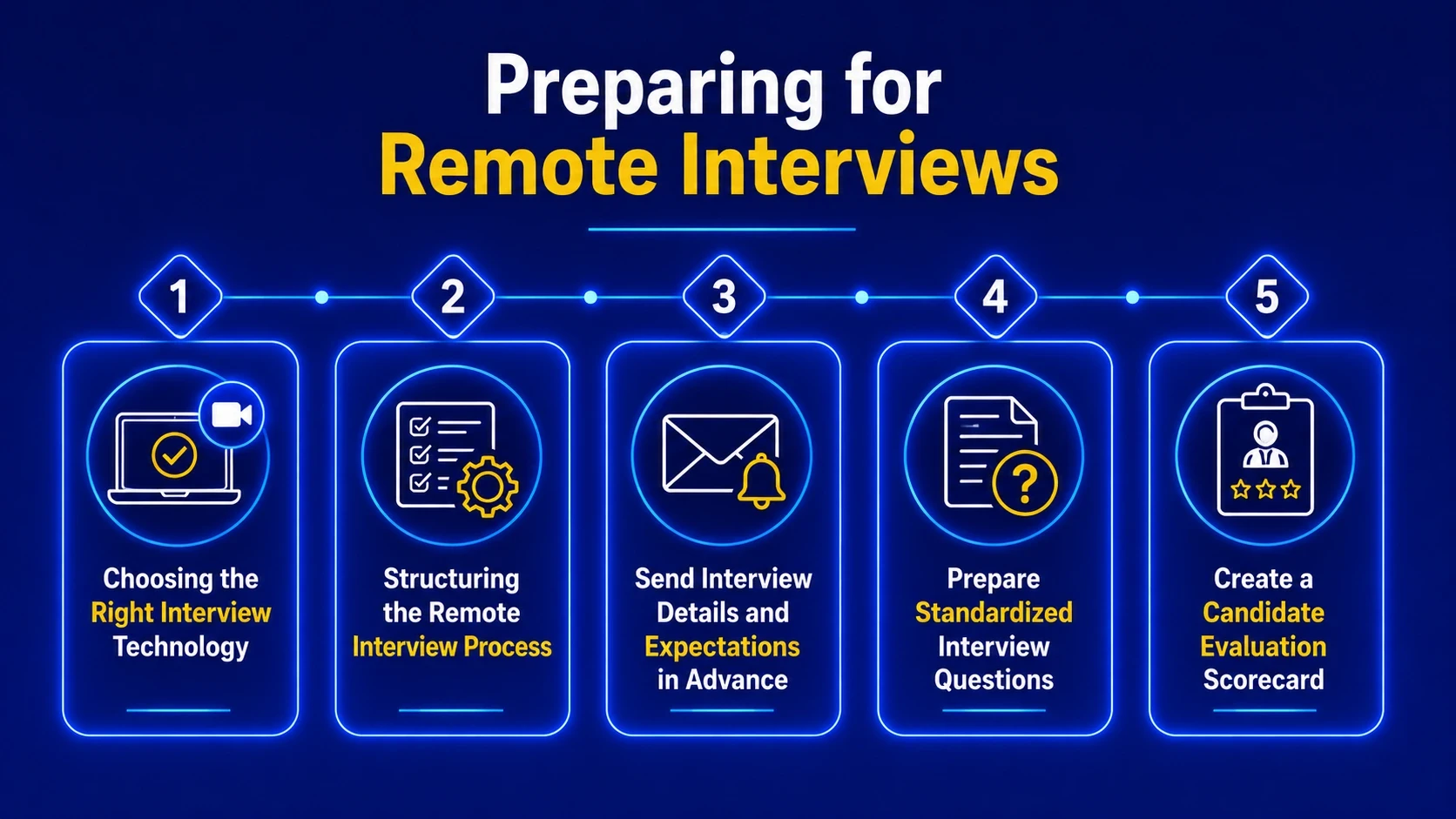
Before conducting a remote interview, hiring teams should select reliable interview technology, establish a standardized interview process, prepare relevant interview questions, and communicate expectations clearly with candidates. Recruiters should also test their equipment, internet connection, audio, and video settings to avoid technical issues that could disrupt the conversation.
It is equally important to provide candidates with interview details in advance, including the interview schedule, platform access instructions, meeting links, and any preparation requirements. This helps candidates feel confident and ready for the discussion.
Organizations should also develop a structured evaluation framework to assess candidates consistently. Using predefined interview criteria, competency-based questions, and standardized scorecards enables hiring teams to compare candidates objectively and minimize unconscious bias.
By investing time in preparation, recruiters can create a seamless interview experience, improve candidate engagement, and make more informed hiring decisions throughout the remote recruitment process.
Choosing the Right Interview Technology
The success of a remote interview largely depends on the technology used to facilitate it. Selecting a reliable interview platform ensures smooth communication, minimizes technical disruptions, and creates a professional experience for both recruiters and candidates. Poor audio quality, video lag, or connectivity issues can negatively impact candidate engagement and make it difficult for interviewers to accurately assess skills and qualifications.
When choosing interview technology, organizations should look for features such as high-quality video conferencing, interview recording, scheduling capabilities, collaborative evaluation tools, and secure data management. The platform should also be easy for candidates to access without requiring complex setup or extensive technical knowledge.
Some commonly used remote interview tools include:
Zoom for video interviews and panel discussions.
Microsoft Teams for collaborative hiring and interview management.
Google Meet for simple and accessible virtual interviews.
Sherlock AI for AI-powered interview scheduling and candidate evaluation
For companies conducting high-volume hiring, AI-powered interview platforms can further streamline the recruitment process. Sherlock AI helps recruiters to analyze candidate responses, identify interview fraud, and make data-driven hiring decisions. These capabilities reduce manual effort while improving consistency and efficiency throughout the recruitment process.
It is also important to ensure compatibility across devices, browsers, and operating systems. Candidates should be able to join interviews seamlessly whether they are using a laptop, desktop, or mobile device.
By investing in the right interview technology, organizations can improve interview quality, enhance the candidate experience, and conduct remote hiring more efficiently and effectively.
Structuring the Remote Interview Process
A structured remote interview process helps hiring teams evaluate candidates consistently, reduce bias, and improve hiring outcomes. By establishing clear stages and evaluation criteria, recruiters can ensure every candidate receives a fair and professional interview experience.
1. Define the Interview Stages
Break the hiring process into clear stages, such as an initial screening interview, skills assessment, hiring manager interview, and final decision round. This creates a predictable and organized candidate journey.
2. Assign Roles and Responsibilities
Determine who will participate in each interview stage and what they will assess. For example, recruiters can evaluate communication skills and cultural fit, while hiring managers focus on technical expertise and role-specific competencies.
3. Standardize Interview Questions
Use a consistent set of questions for all candidates applying for the same position. This allows interviewers to compare responses fairly and make more objective hiring decisions.
4. Create a Candidate Evaluation Framework
Develop scorecards based on key competencies, qualifications, and job requirements. A structured evaluation process helps reduce unconscious bias and improves decision-making.
5. Communicate the Interview Timeline
Share interview schedules, meeting links, expected duration, and next steps with candidates in advance. Clear communication helps candidates prepare and creates a positive experience.
A clearly defined interview structure enables hiring teams to conduct remote interviews more effectively while ensuring consistency, fairness, and a better candidate experience.
Send Interview Details and Expectations in Advance
Clear communication before a remote interview helps candidates prepare effectively and reduces the likelihood of confusion or technical issues. Providing interview details in advance also demonstrates professionalism and creates a positive candidate experience.
Make sure candidates receive all essential information, including:
Interview date and time with the relevant time zone.
Meeting link and platform instructions for joining the interview.
Names and roles of interviewers participating in the session.
Expected interview duration and interview format.
Any assessments or preparation requirements that need to be completed beforehand.
Technical requirements, such as a stable internet connection, webcam, and microphone.
Sharing these details a few days before the interview allows candidates to prepare adequately and address any technical concerns in advance. It also helps reduce interview-day stress and enables more productive conversations.
Recruiters can further streamline this process using platforms like Sherlock AI, which automate interview scheduling, send interview invitations, and provide candidates with all necessary information through a centralized workflow.
When candidates know what to expect, they are more likely to feel comfortable, confident, and fully focused on showcasing their skills during the interview.
Prepare Standardized Interview Questions
Using standardized interview questions is one of the most effective ways to evaluate remote candidates fairly and consistently. When every candidate is asked the same core questions, hiring teams can compare responses objectively and make more informed hiring decisions.
Start by identifying the key skills, competencies, and qualifications required for the role. Develop a mix of behavioral, situational, and role-specific questions that help assess a candidate’s experience, problem-solving abilities, communication skills, and overall suitability for the position.
Some examples include:
Behavioral Question: “Can you describe a time when you successfully managed a challenging project while working remotely?”
Situational Question: “How would you handle a communication breakdown with a remote team member?”
Role-Specific Question: “What strategies do you use to prioritize tasks and meet deadlines in a remote work environment?”
In addition to technical and job-related questions, consider including questions that evaluate remote work competencies such as self-motivation, time management, adaptability, and collaboration. These skills are often critical for success in remote and distributed teams.
AI-powered platforms like Sherlock AI can further streamline this process by generating role-specific interview questions and helping recruiters maintain consistency across interviews.
A structured question framework not only improves hiring accuracy but also creates a more professional and equitable interview experience for every candidate.
Create a Candidate Evaluation Scorecard
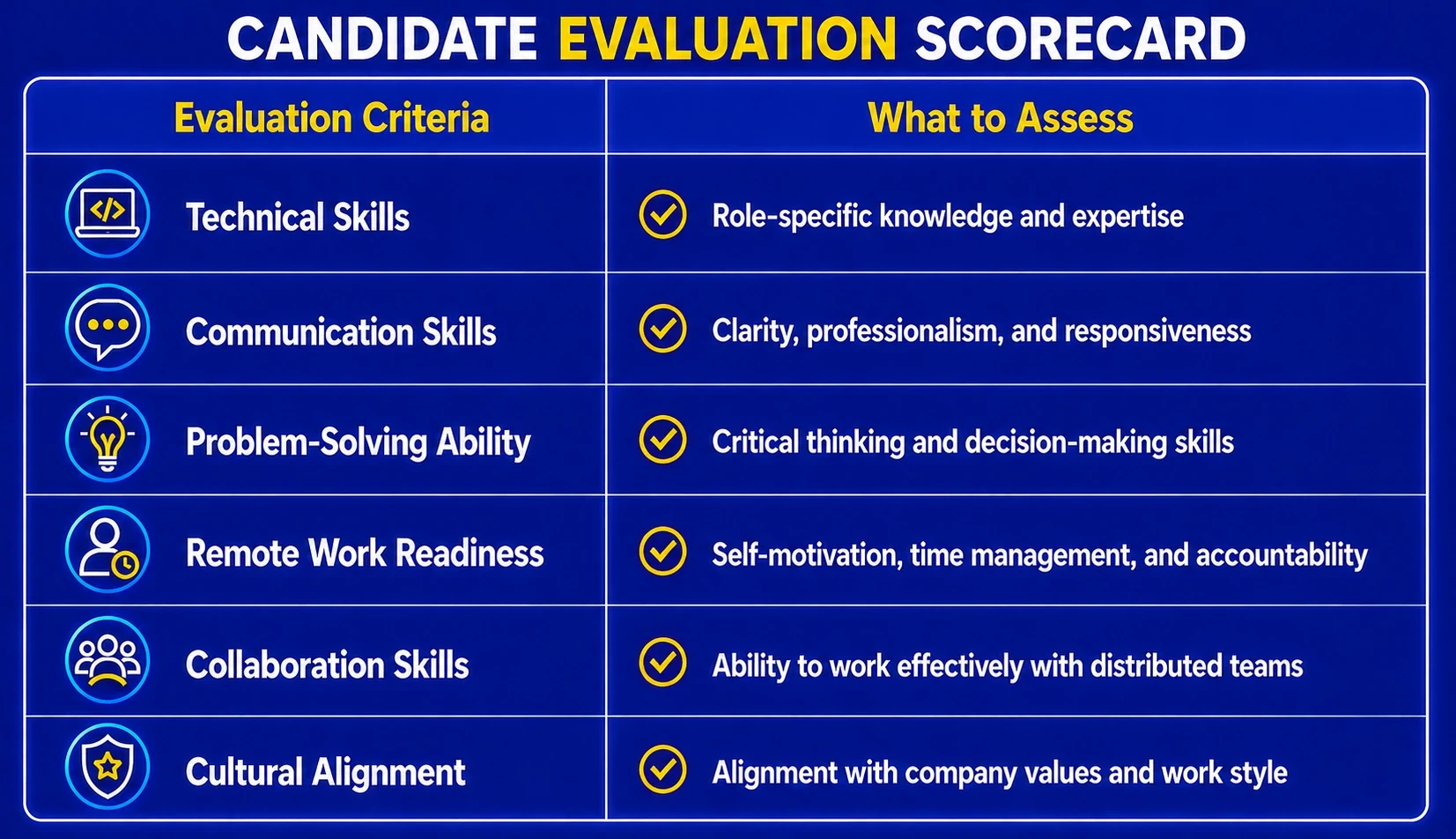
A candidate evaluation scorecard helps hiring teams assess remote candidates using consistent criteria rather than subjective impressions. By defining evaluation standards before interviews begin, recruiters can make more objective hiring decisions and reduce unconscious bias.
The scorecard should be based on the key competencies required for the role and assign a rating scale to each criterion. This allows interviewers to score candidates consistently and compare results across the hiring process.
Consider evaluating candidates based on:
To maintain consistency, interviewers should complete scorecards immediately after each interview while observations are still fresh. The final hiring decision should be based on collective feedback rather than a single interviewer’s opinion.
Organizations conducting high-volume recruitment can use platforms like Sherlock AI to automate candidate evaluations, track interviewer feedback, and generate structured hiring insights. This helps teams make faster, data-driven decisions while maintaining fairness throughout the hiring process.
A standardized evaluation scorecard improves interview consistency, strengthens candidate comparisons, and supports more accurate hiring outcomes.
Best Practices for Interviewing Remote Candidates
Conducting remote interviews requires more than simply replacing an in-person meeting with a video call. Recruiters must create a structured, engaging, and professional experience that allows candidates to demonstrate their skills while enabling hiring teams to make accurate hiring decisions. Following proven remote interviewing best practices can improve candidate experiences, reduce bias, and increase hiring success rates.
From creating a positive first impression to evaluating remote work competencies, every stage of the interview plays an important role in identifying the right candidate. Organizations should focus on consistency, communication, and objective evaluation methods to ensure each candidate receives a fair assessment.
The following best practices can help recruiters conduct more effective remote interviews and build a stronger remote hiring process:
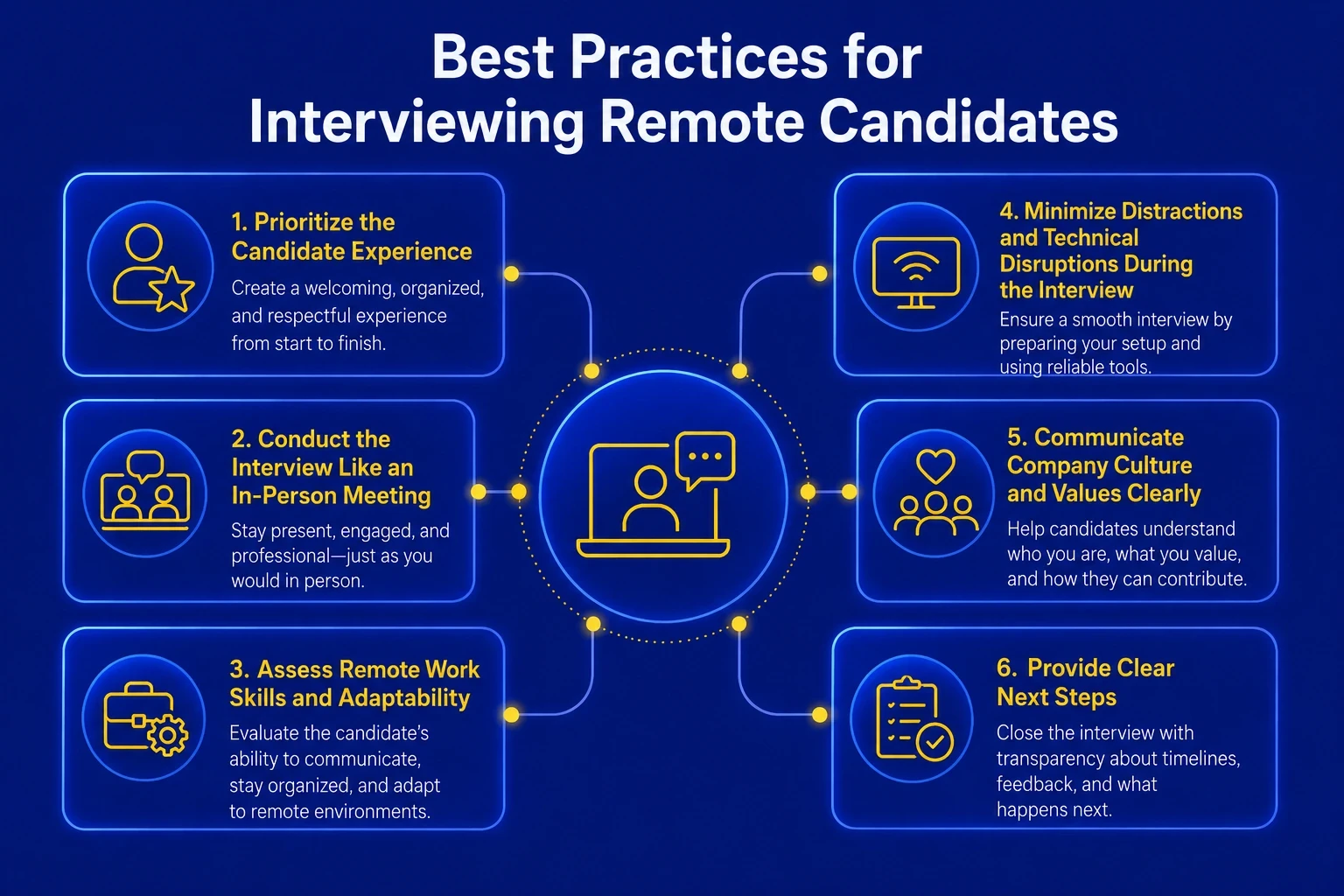
Prioritize the Candidate Experience
A positive candidate experience can significantly influence how candidates perceive your organization during the hiring process. Since remote interviews limit in-person interactions, recruiters must focus on creating a professional, engaging, and candidate-friendly experience from the first communication to the final hiring decision.
Candidates often evaluate employers just as much as employers evaluate candidates. A smooth interview process demonstrates professionalism, respect for candidates’ time, and a strong organizational culture.
To improve the candidate experience during remote interviews:
Share interview schedules, meeting links, and instructions well in advance.
Clearly communicate interview expectations and hiring timelines.
Start interviews on time and respect scheduled durations.
Create a welcoming and conversational environment.
Allow candidates sufficient time to answer questions.
Address technical issues professionally and patiently.
Provide timely updates and feedback throughout the hiring process.
A positive remote interview experience helps candidates feel comfortable and confident, allowing them to showcase their skills more effectively. It also strengthens employer branding, increases candidate engagement, and improves the likelihood of securing top talent in competitive hiring markets.
Conduct the Interview Like an In-Person Meeting
Remote interviews should maintain the same level of professionalism and structure as traditional face-to-face interviews. Treating virtual interviews with the same importance helps create a positive candidate experience and ensures a fair and effective evaluation process.
From the moment the interview begins, recruiters should focus on building rapport, maintaining professionalism, and creating an environment where candidates feel comfortable sharing their experiences and skills. A well-conducted remote interview can provide insights that are just as valuable as an in-person meeting.
To conduct a remote interview effectively:
Join the meeting a few minutes early to verify audio and video settings.
Dress professionally and choose a clean, distraction-free background.
Introduce yourself and explain the interview agenda.
Maintain eye contact by looking into the camera when speaking.
Listen actively and avoid interrupting candidates.
Allow sufficient time for candidates to answer questions.
Take notes without losing engagement during the conversation.
Ensure all interviewers follow a consistent evaluation approach.
Just as in an in-person interview, candidates should have the opportunity to ask questions about the role, team, and company. Ending the conversation by explaining the next steps helps create transparency and leaves candidates with a positive impression of the organization.
By approaching remote interviews with the same professionalism as traditional interviews, organizations can improve candidate engagement, strengthen employer branding, and make more informed hiring decisions.
Assess Remote Work Skills and Adaptability
Technical qualifications alone do not determine success in a remote role. Candidates must also demonstrate the ability to work independently, communicate effectively, and remain productive in a distributed work environment. Evaluating these remote work competencies during the interview process can help organizations identify candidates who are more likely to succeed in remote or hybrid teams.
Remote employees often face unique challenges, including managing their schedules, collaborating across time zones, and maintaining productivity without direct supervision. Assessing how candidates handle these situations provides valuable insight into their readiness for remote work.
Key remote work skills to evaluate include:
Self-motivation and accountability.
Time management and organizational skills.
Written and verbal communication abilities.
Adaptability to changing priorities and work environments.
Collaboration and teamwork in virtual settings.
Problem-solving and independent decision-making.
Consider asking candidates to share examples of how they have managed remote projects, handled communication challenges, or maintained productivity while working independently. Their responses can reveal how effectively they navigate the realities of remote work.
Recruiters can also use structured assessments and AI-powered interview platforms like Sherlock AI to evaluate role-specific competencies and identify strengths that may not be immediately visible through traditional interview methods.
By assessing remote work skills alongside technical qualifications, organizations can make more informed hiring decisions and build stronger, more productive remote teams.
Minimize Distractions and Technical Disruptions During the Interview
Technical issues and distractions can negatively impact the effectiveness of a remote interview and create a poor experience for both interviewers and candidates. While some disruptions may be unavoidable, taking proactive steps can help ensure a smooth and professional interview process.
Before the interview begins, recruiters should test their internet connection, audio equipment, webcam, and interview platform to identify and resolve any potential issues. It is also important to choose a quiet, well-lit location where interruptions are unlikely to occur.
To create a distraction-free interview environment:
Test audio, video, and internet connectivity beforehand.
Choose a professional and quiet interview setting.
Use a neutral background and proper lighting.
Silence notifications and close unnecessary applications.
Have a backup communication method available if technical issues occur.
Encourage candidates to test their equipment before the interview.
If technical difficulties arise during the interview, remain patient and professional. Give candidates the opportunity to reconnect or reschedule if the issue significantly affects the conversation. Technical challenges should not influence the evaluation of a candidate’s qualifications unless the role specifically requires technical troubleshooting skills.
By minimizing distractions and preparing for potential technical issues, recruiters can maintain interview quality, improve candidate engagement, and ensure a more accurate assessment of each candidate’s abilities.
Communicate Company Culture and Values Clearly
One of the biggest challenges of remote hiring is helping candidates understand what it is like to work at your organization. Unlike in-person interviews, remote candidates do not have the opportunity to experience the workplace environment, interact with team members naturally, or observe company culture firsthand. As a result, recruiters must make a conscious effort to communicate the organization’s culture, values, and work environment during the interview process.
Candidates want to understand more than just the job responsibilities. They also want to know how teams collaborate, how success is measured, and what they can expect from the employee experience. Providing this information helps candidates determine whether the organization aligns with their professional goals and working style.
To effectively communicate company culture during remote interviews:
Explain the organization’s mission, vision, and core values.
Share how teams collaborate in remote or hybrid environments.
Discuss leadership style and communication practices.
Highlight employee development and growth opportunities.
Describe work-life balance initiatives and employee benefits.
Share examples of team achievements, events, or company traditions.
This is also an excellent opportunity to showcase your employer brand and answer any questions candidates may have about the organization. Providing an authentic and transparent view of company culture helps build trust and enables candidates to make informed decisions.
By clearly communicating company values and workplace expectations, organizations can attract candidates who are not only qualified for the role but also aligned with the company’s culture and long-term goals.
Provide Clear Next Steps
Candidates appreciate transparency throughout the hiring process, especially after completing an interview. Providing clear next steps helps manage expectations, reduces uncertainty, and creates a more positive candidate experience. It also demonstrates professionalism and reinforces your organization’s commitment to effective communication.
At the end of every remote interview, take a few minutes to explain what candidates can expect moving forward. This ensures they understand the remaining stages of the hiring process and when they are likely to receive updates.
Be sure to communicate:
The next stage of the interview process.
Expected timelines for feedback and hiring decisions.
Any additional assessments or interviews required.
Key contacts for follow-up questions.
When and how candidates will be notified of the outcome.
Even if hiring decisions take longer than expected, keeping candidates informed through regular updates can significantly improve their experience. Lack of communication is one of the most common frustrations reported by job seekers and can negatively impact employer branding.
Recruitment platforms like Sherlock AI can help automate candidate communications, interview updates, and scheduling notifications, ensuring candidates remain informed throughout the hiring journey.
By providing clear next steps and maintaining consistent communication, organizations can build trust with candidates, strengthen their employer brand, and create a more engaging and professional remote hiring experience.
Evaluate Remote Candidates More Effectively with Sherlock AI
As remote hiring becomes more common, recruiters face a growing challenge: determining whether interview responses genuinely reflect a candidate’s skills and thinking. The rise of AI assistants, hidden devices, proxy candidates, and interview fraud has made it increasingly difficult to assess candidates accurately through traditional video interviews alone.
Sherlock AI helps organizations maintain interview integrity by providing an additional layer of verification during remote interviews. Instead of disrupting the interview process, Sherlock AI works in the background, allowing interviewers to focus on evaluating communication, problem-solving, and job-related competencies.
How Sherlock AI Improves Remote Candidate Evaluation
Sherlock AI supports recruiters and hiring managers by helping identify suspicious interview behavior that may impact candidate evaluations.
Key interview-specific capabilities include:
AI-Assisted Interview Detection to identify potential use of AI-generated responses during interviews.
Behavior Pattern Analysis to detect unusual response patterns, hesitation signals, and reasoning inconsistencies.
Response Timing Analysis to identify delays and behavioral signals associated with external assistance.
Identity Verification Support to help reduce the risk of proxy interviews and candidate impersonation.
Real-Time Interview Monitoring that observes interview activity without interrupting the conversation.
Device and Environment Monitoring to identify suspicious activity that may indicate unauthorized assistance.
Audio and Behavioral Signal Analysis to evaluate response authenticity and interview integrity.
Real-Time Alerts for Interviewers when suspicious patterns require further questioning or review.
Remote interviews are designed to assess a candidate’s true skills, communication abilities, and problem-solving approach. When candidates rely on unauthorized AI assistance or external support, recruiters may struggle to evaluate actual job readiness.
Sherlock AI helps hiring teams maintain fair, consistent, and trustworthy remote interviews by providing objective integrity signals while keeping human judgment at the center of the hiring decision. This enables recruiters to conduct remote interviews with greater confidence and make hiring decisions based on authentic candidate performance rather than assisted responses.
Conclusion
As remote hiring continues to become a standard recruitment practice, organizations must adapt their interview processes to effectively identify, evaluate, and engage top talent from anywhere in the world. A successful remote interview strategy goes beyond simply conducting conversations online. It requires thoughtful preparation, structured evaluation methods, clear communication, and a strong focus on candidate experience.
By choosing the right interview technology, standardizing interview questions, assessing remote work competencies, and maintaining consistent evaluation criteria, recruiters can make more informed hiring decisions while creating a fair and professional interview process.
At the same time, ensuring interview integrity has become increasingly important. As AI-assisted interviewing and candidate impersonation become growing concerns, hiring teams need greater visibility into candidate authenticity during remote interviews. Sherlock AI helps organizations conduct more trustworthy remote interviews through AI-assisted interview detection, behavioral analysis, identity verification support, and real-time interview monitoring, enabling recruiters to make hiring decisions with greater confidence.
Organizations that combine structured remote interviewing best practices with advanced interview integrity solutions will be better positioned to build high-performing teams and hire the right candidates faster.
Ready to Conduct More Secure and Effective Remote Interviews? |