Back to all blogs
Learn what liveness detection is, how it works, its types, benefits, limitations, and how it helps prevent biometric spoofing in identity verification.


Remote identity verification allows people to open accounts, complete onboarding, verify their identity, and access sensitive services without meeting someone in person. However, seeing the right face through a camera does not necessarily mean the right person is actually present. Attackers may use photographs, replayed videos, masks, or manipulated media to deceive biometric systems.
Liveness detection helps address this risk. It is a biometric security technique used to determine whether a biometric sample comes from a real, living person who is present during verification. While facial recognition checks whether a face matches a reference identity, liveness detection focuses on whether the biometric capture itself is genuine.
The risk extends beyond sophisticated deepfakes. ENISA identifies photographs, replayed videos, 3D masks, and deepfakes as forms of presentation attack against remote facial identity verification. The importance of defending against these attacks is also reflected in NIST’s Digital Identity Guidelines, which require presentation attack detection for facial recognition and recommend an impostor attack presentation accept rate (IAPAR) of less than 0.07 during deployment testing.
For this reason, liveness detection is typically used as one layer within a broader identity verification process. Facial comparison can establish whether the captured face resembles the expected person, while document verification and other checks provide additional evidence. Liveness detection adds assurance that the biometric sample appears to come from someone genuinely present during the interaction.
The right liveness detection method depends on factors such as risk level, biometric technology, user experience, and the presentation attacks a system needs to address. Understanding the different types of liveness detection and how they work can help organizations choose an approach suited to their identity verification requirements.
What Is Liveness Detection?
Liveness detection is a biometric security technique used to determine whether a biometric sample is being captured from a living person who is physically present at the point of capture. It helps biometric systems distinguish genuine, live biometric input from presentation attacks involving printed photographs, displayed images, replayed videos, masks, or other artificial representations.
Liveness detection is part of the broader field of Presentation Attack Detection (PAD). NIST defines PAD as the automated determination of a presentation attack, with liveness detection forming one subset of these methods. Depending on the technology, systems may analyze anatomical characteristics or voluntary and involuntary responses to assess whether a biometric sample comes from a living subject who is present during capture.
Liveness detection does not establish identity on its own. It determines whether the biometric capture appears to come from a live and present person, while facial or biometric comparison determines whether that person matches the claimed or expected identity. The two controls therefore address different security questions and are commonly used together.
This distinction is especially important in remote identity verification, where attackers may attempt to fool biometric systems using photographs, replayed videos, 3D masks, or deepfake content. In practice, liveness detection works best as one layer within a broader identity-verification process alongside biometric comparison, identity-document verification, fraud controls, and other authentication measures.

How Liveness Detection Works?
Liveness detection works by examining a biometric capture for signals associated with genuine human presence and for indicators that may suggest spoofing. The exact process varies depending on the biometric modality, the device being used, and whether the system uses an active or passive approach.
1. Capture the biometric sample
The process begins when the user provides the required biometric input. This could involve looking into a smartphone camera for facial verification, placing a finger on a fingerprint sensor, speaking into a microphone for voice authentication, or using an iris scanner.
Capture quality is important. Poor lighting, an obstructed face, background noise, incorrect positioning, or low image quality can make liveness assessment less reliable. Many systems therefore check the quality of the sample before continuing and may ask the user to retry if the capture is unsuitable.
2. Analyze signs of live presence
Once the biometric sample has been captured, the system analyzes characteristics that may help distinguish a live person from an artificial representation. For facial liveness, this may include texture, depth, reflections, natural movement, lighting patterns, and other visual characteristics.
The signals depend on the type of liveness technology being used. Passive systems typically analyze the capture in the background, while active systems may ask the user to perform an action, such as turning their head or following an on-screen instruction.
3. Detect indicators of spoofing
The system also looks for patterns that may indicate a presentation attack. A printed photograph may lack realistic depth, a face shown on another screen may produce display or reflection patterns, and a replayed video may contain characteristics that differ from a live camera interaction.
Some systems may also be designed to detect masks, manipulated media, or other presentation attacks. However, effectiveness depends on the attack types, devices, and conditions the technology has been designed and tested to handle.
4. Return a liveness result
After analyzing the available signals, the liveness engine produces a result for the wider identity verification or authentication process. Depending on the implementation, this may be a pass/fail decision, a confidence score, or another risk signal.
If the result is uncertain or suspicious, the user may be asked to repeat the capture, complete an additional verification step, or undergo manual review.
Independent evaluation is important because performance can vary across algorithms, attack types, and operating conditions. NIST evaluations of passive face Presentation Attack Detection have shown that results can differ depending on the algorithm and the attack being tested. Organizations should therefore examine the attacks, datasets, and testing conditions included in an evaluation rather than relying on a single headline accuracy figure.
Types of Liveness Detection
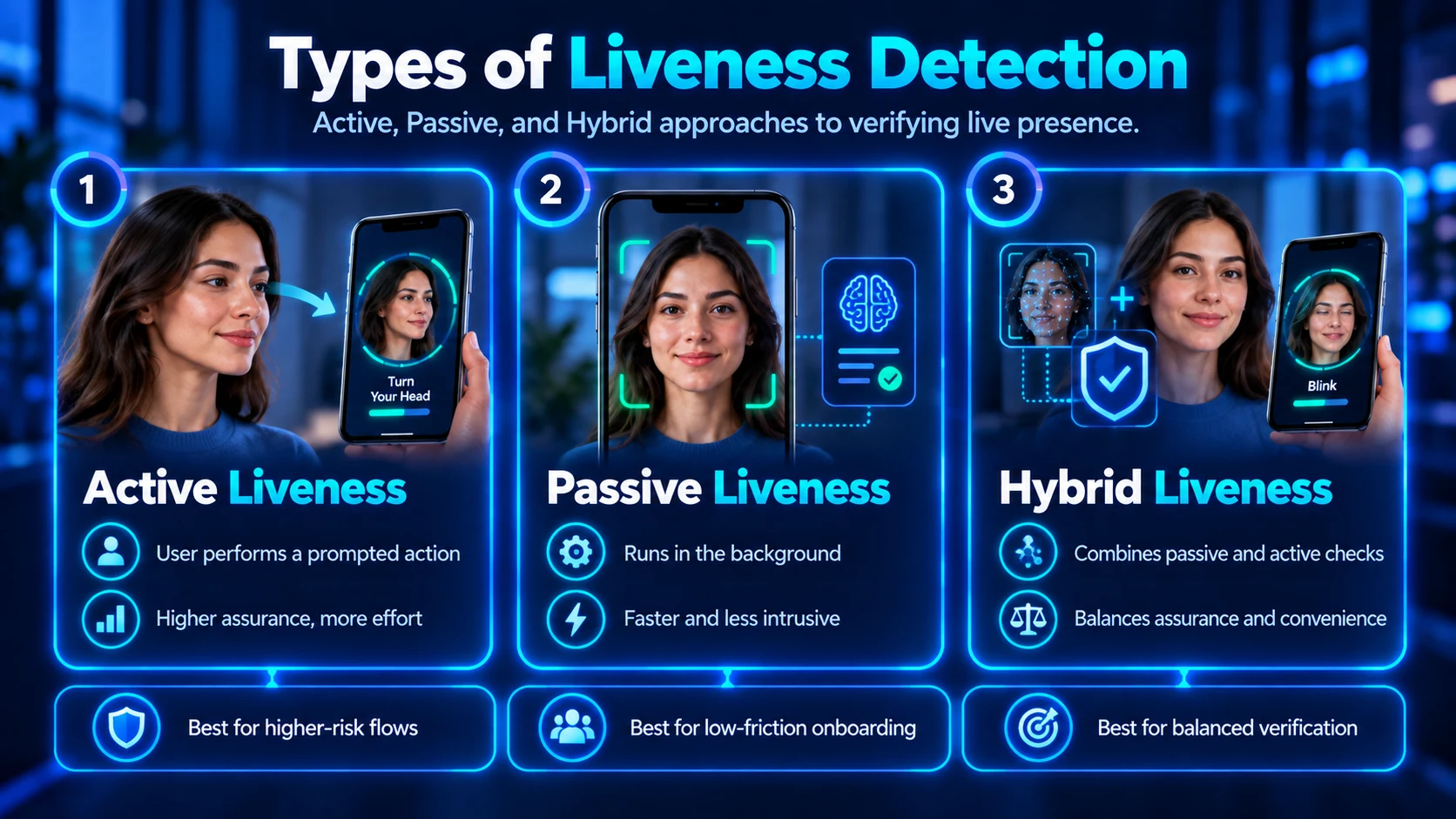
Liveness checks are commonly grouped according to how much interaction they require from the user. The two main categories are active and passive liveness, while some implementations combine elements of both.
1. Active Liveness Detection
Active liveness detection requires the user to perform a specific action or respond to a challenge during capture. For example, a facial liveness check may ask the user to turn their head, blink, smile, or follow an on-screen instruction.
The system then evaluates whether the response is consistent with a live person interacting in real time. This can provide additional evidence of genuine presence, but it also introduces more user effort and may increase capture time or failure rates.
2. Passive Liveness Detection
Passive liveness detection works in the background without requiring the user to complete a deliberate challenge. A person may simply take a selfie or look at the camera while the system analyzes the capture for signs of genuine presence and potential spoofing.
This approach can provide a faster and less intrusive user experience. Its effectiveness still depends on factors such as the algorithm, sensor, image quality, lighting conditions, device characteristics, and the attack types it has been designed and tested to detect.
3. Hybrid Liveness Detection
Hybrid liveness detection combines passive analysis with a limited user action or an additional capture signal. For example, a system may perform passive analysis first and request a simple movement only when more evidence is needed.
This approach can help balance security assurance with user convenience, although the exact implementation varies between systems.
Active vs. Passive Liveness Detection: What Is the Difference?
Neither active nor passive liveness is automatically the best choice for every workflow. The most suitable approach depends on the transaction risk, expected attack methods, user population, devices, and the level of friction the organization can accept.
Factor | Active liveness | Passive liveness | Hybrid liveness |
|---|---|---|---|
User interaction | Requires a prompted action or challenge | Usually no extra action beyond normal capture | Uses passive analysis plus limited interaction |
User experience | More visible and potentially slower | Usually faster and less intrusive | Moderate interaction |
Signals used | Challenge-response plus capture signals | Automated analysis of capture signals | Combination of passive and prompted signals |
Typical fit | Higher-assurance or step-up flows where extra interaction is acceptable | High-volume onboarding or authentication where low friction matters | Flows seeking a balance between assurance and convenience |
Where Is Liveness Detection Used?
Liveness detection is most useful in remote processes where biometric verification needs additional evidence that a real person is present. It is typically added to workflows where photographs, replayed videos, deepfakes, or other spoofing attempts could undermine biometric verification.
1. Customer Onboarding
Liveness detection is commonly used during remote account opening and customer onboarding. A user may be asked to submit an identity document and capture a selfie or short video as part of the verification process.
The identity document provides evidence of identity, facial comparison checks whether the user resembles the person shown on the document, and liveness detection helps determine whether the biometric sample comes from someone who is actually present.
2. Biometric Authentication
When facial biometrics are used for authentication, a successful face match alone may not provide sufficient assurance. An attacker could attempt to present a photograph, replayed video, or another representation of the legitimate account holder.
Liveness detection adds a presence check before the biometric match is trusted and can be combined with other authentication controls when greater assurance is required.
3. Account Recovery and Profile Changes
Account recovery can be particularly sensitive because normal authentication may already have failed or become unavailable. If facial verification is used to restore access, liveness detection can help determine whether the biometric sample comes from a live participant rather than previously captured media.
The same principle can apply to sensitive profile changes, such as resetting authentication methods or modifying important account information.
4. High-Risk Transactions
Liveness detection can also be used when a user attempts an action with greater financial or security consequences. Instead of applying the same biometric checks to every interaction, organizations can introduce stronger verification when risk increases.
This may be relevant before large money transfers, access to restricted information, sensitive approvals, or other high-value actions where impersonation could have serious consequences.
5. Remote Hiring and Workforce Access
Remote hiring creates another use case because candidates may complete interviews and onboarding without meeting the employer in person. When facial identity verification is used, liveness detection can help establish that the biometric capture involves a real person rather than a photograph, replay, or synthetic representation.
The same control can support higher-risk workforce events, such as privileged access or sensitive account resets, where organizations need stronger evidence that a real person is participating in the verification process.
Benefits of Liveness Detection
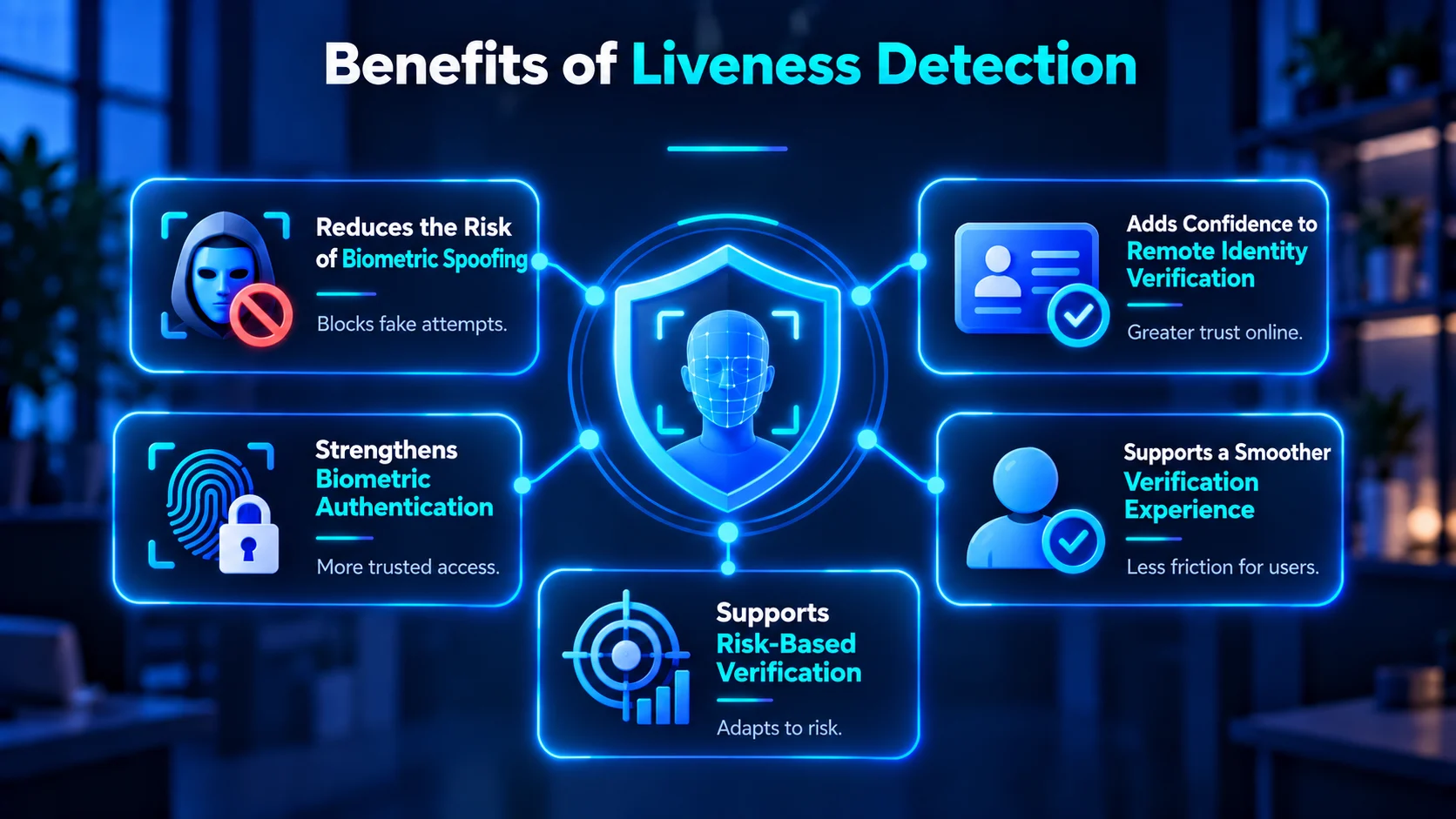
The main value of liveness detection is that it addresses a specific weakness in remote biometrics: a system may receive a convincing biometric sample even when the genuine person is not actually present.
1. Reduces the Risk of Biometric Spoofing
Liveness detection is designed to make presentation attacks harder to use successfully. Instead of evaluating only whether a captured face resembles a reference image, the system also looks for evidence that the biometric comes from a live subject.
Depending on the technology, this can help detect attempts involving printed photographs, displayed images, replayed videos, masks, or other presentation attack instruments. Liveness is most effective when combined with controls that address other forms of identity and authentication fraud.
2. Adds Confidence to Remote Identity Verification
Remote verification lacks the direct observation available in face-to-face identity checks. Liveness detection adds evidence that the person submitting the biometric is physically participating in the capture.
When combined with document verification and biometric comparison, it helps distinguish between a face that merely resembles the reference and a biometric sample produced by a live person during the verification attempt.
3. Strengthens Biometric Authentication
Biometric matching and liveness detection answer different security questions. Matching assesses whether the captured biometric corresponds to a trusted reference, while liveness assesses whether the new sample appears to come from a live person during the interaction.
Using both signals can reduce reliance on biometric similarity alone and provide stronger assurance before a biometric match is trusted.
4. Supports a Smoother Verification Experience
Passive liveness can operate during a normal selfie or video capture without requiring every user to complete a visible challenge. This can reduce friction in high-volume digital services and help legitimate users move through verification more quickly.
When more assurance is needed, organizations can route uncertain or higher-risk attempts to another capture, an active challenge, manual review, or another verification method.
5. Supports Risk-Based Verification
Not every transaction requires the same level of verification. Liveness detection can be incorporated into a risk-based process in which the strength of verification changes according to the action, session, user context, or other risk indicators.
For example, a routine interaction might use passive liveness as part of normal biometric capture, while an unusual or sensitive action could trigger additional verification. This helps organizations balance security requirements with user effort.
Limitations of Liveness Detection
Liveness detection can strengthen biometric security, but it should not be treated as a universal fraud-prevention control. Its effectiveness depends on the attacks it was designed to detect, the conditions in which it operates, and how it is integrated into the wider verification process.
1. It Does Not Prove Identity on Its Own
A successful liveness result indicates that a live person appears to be present, but it does not establish who that person is. Someone can be genuinely present while still attempting to use another person’s identity.
Liveness detection therefore needs to work alongside biometric matching, identity evidence, authentication factors, or other controls appropriate to the workflow.
2. Performance Varies by Attack Type and Environment
Lighting, camera quality, image compression, sensor characteristics, capture angle, connectivity, and user behavior can all affect biometric capture.
Performance can also vary across attack types. Detecting a printed photograph is not the same challenge as detecting a high-quality replay, mask, or more sophisticated presentation attack. Testing should therefore reflect the devices, environments, and attack scenarios in which the system will actually operate.
3. False Accepts and False Rejects Both Matter
A liveness system must balance security with legitimate-user success. If thresholds are too permissive, more attack presentations may pass. If they are too strict, genuine users may be asked to retry or may fail verification.
Teams should therefore evaluate security error rates alongside completion rates, retry rates, and overall user experience rather than optimizing only one side of the decision.
4. Threats Continue to Evolve
Presentation attack techniques do not remain static. Improvements in displays, cameras, synthetic media, masks, and attack tooling can change the types of threats a system needs to recognize.
A liveness solution that performs well against a fixed test set at one point in time should not be assumed to provide permanent protection. Regular monitoring, testing, and re-evaluation are therefore important.
5. Capture-Channel Security Still Matters
Liveness detection typically focuses on what is presented to the biometric sensor, but attackers may also target the digital path around that sensor. Manipulated or injected data can create a different class of risk from presenting a spoof directly to a camera.
Organizations should therefore consider device integrity, capture-channel protections, and injection defenses alongside presentation attack detection.
What to Consider When Evaluating Liveness Detection
A useful evaluation should begin with the threat model rather than a headline accuracy figure. Organizations should identify which biometric attacks are relevant to their workflow, what devices and environments users rely on, and how much friction the process can tolerate.
Key considerations include:
Independent testing: Check whether the technology has been evaluated independently and review the methodology used.
Attack coverage: Understand which presentation attack instruments and attack categories were included in testing.
Error rates: Review both attack acceptance and legitimate-user rejection rates rather than relying on a single accuracy percentage.
Real-world conditions: Test performance across realistic devices, lighting conditions, networks, capture environments, and user behaviors.
User experience: Consider how often legitimate users are asked to retry, fail verification, or require manual review.
Capture-channel security: Determine whether the solution addresses only presentation attacks or also includes protections against manipulated or injected capture data.
Privacy and data handling: Assess how biometric data is collected, processed, stored, retained, and protected.
Integration with other controls: Use liveness detection alongside appropriate measures such as biometric matching, document verification, device or session signals, and risk-based review.
Liveness and Presentation Attack Detection performance should be evaluated using relevant error rates and realistic attack scenarios. A single headline accuracy figure may hide important differences in attack coverage, testing conditions, and legitimate-user impact.
Conclusion
Liveness detection helps biometric systems determine whether a biometric sample comes from a live person who is genuinely present during capture. It can reduce exposure to presentation attacks and strengthen remote verification when used alongside biometric matching, document verification, secure capture, and other fraud controls.
Its effectiveness depends on the technology, attack types, operating conditions, and the wider verification process in which it is used. Organizations should therefore evaluate liveness solutions based on the attacks they have been tested against, their performance under realistic conditions, their effect on legitimate users, and how well they integrate with other security controls.
A meaningful evaluation provides a clearer picture of real-world effectiveness than relying on a single accuracy claim.