
Back to all blogs
From verifying candidate identity to reducing costly mis-hires, discover the biggest remote hiring challenges and proven strategies to build a secure and effective hiring process.

Remote hiring has transformed the way organizations recruit talent. Instead of limiting hiring to a single city or region, companies can now connect with skilled professionals across countries and time zones. While this shift creates new opportunities, it also introduces several recruitment obstacles that employers must overcome to hire efficiently and accurately.
Today, businesses are increasingly adopting remote hiring to reduce recruitment costs, access specialized talent, and accelerate hiring timelines. remote hiring has become a standard recruitment approach for many organizations. Remote hiring practices continue to expand access for candidates from underrepresented groups by removing geographic concentration requirements, making talent from rural areas, smaller cities, and diverse regions eligible for roles previously available only to candidates willing to relocate, based on Gallup workplace research cited in the SelectSoftwareReviews 2026 recruitment statistics report.
The challenge is clear: companies need a hiring process that balances speed, accuracy, fairness, and recruitment security.
However, remote hiring is not without its difficulties. Employers often struggle with accurately assessing skills, evaluating soft skills without face-to-face interaction, verifying candidate identities, coordinating interviews across time zones, maintaining communication, and ensuring a fair and consistent hiring process. In many cases, recruiters also face challenges related to interview fraud, resume misrepresentation, and proxy candidates during virtual interviews.
In this guide, we will explore the 15 biggest challenges to remote hiring and how to tackle them effectively. From evaluating soft skills virtually and managing communication barriers to reducing hiring fraud and improving candidate verification, this article will help employers build a smarter, more reliable, and scalable remote hiring process.
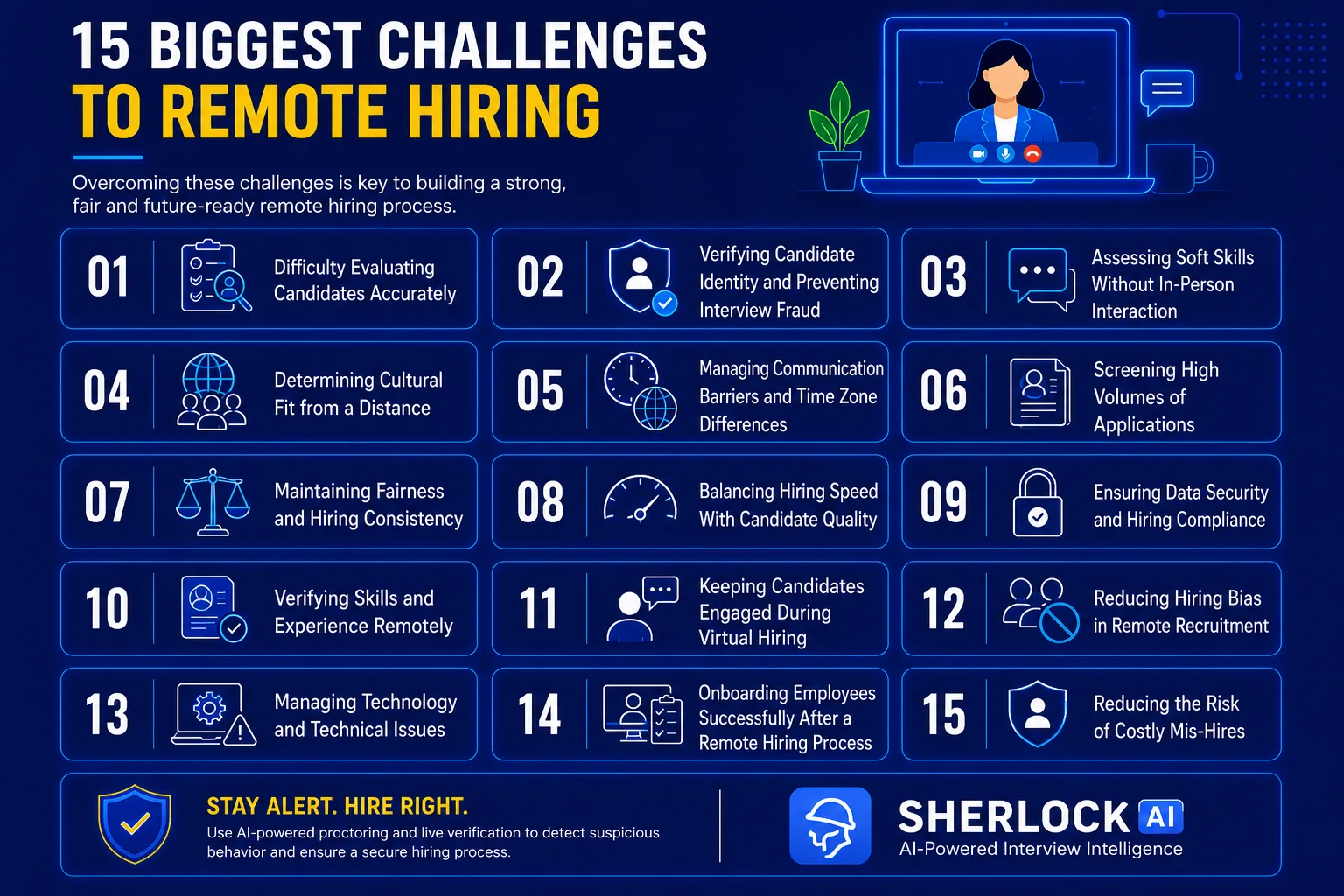
15 Biggest Challenges to Remote Hiring
Remote hiring gives organizations access to wider talent pools, faster recruitment opportunities, and greater hiring flexibility. However, hiring employees virtually also introduces several challenges that can affect recruitment accuracy, candidate experience, and long-term hiring success.
Unlike traditional hiring, remote recruitment limits face-to-face interaction, making it harder for recruiters to assess communication skills, verify candidate authenticity, and evaluate cultural fit. Employers must also navigate issues such as interview fraud, time zone coordination, remote onboarding, hiring compliance, and inconsistent candidate evaluation processes.
As remote hiring continues to grow, businesses are increasingly looking for ways to improve hiring transparency and reduce recruitment risks.
To build a successful remote hiring process, organizations need structured hiring systems, standardized interview methods, secure verification processes, and scalable recruitment technology that helps improve hiring accuracy.
Below are the 15 biggest challenges to remote hiring and practical ways to tackle them effectively.
1. Difficulty Evaluating Candidates Accurately
One of the biggest challenges to remote hiring is accurately evaluating candidates without in-person interaction. In traditional hiring environments, recruiters can assess body language, communication style, problem-solving approaches, and overall professionalism more naturally during face-to-face interviews. However, in remote hiring, these evaluation signals are often limited to video calls, digital assessments, and resumes.
Without a structured evaluation process, hiring teams may rely too heavily on resumes or first impressions, which can result in poor hiring decisions. Inconsistent interview methods can also lead to bias, miscommunication, and inaccurate candidate assessments. As a result, organizations risk hiring candidates who may not have the required skills, experience, or ability to perform effectively in remote work environments.
How to Overcome This Challenge
Organizations can improve candidate evaluation accuracy by implementing structured hiring frameworks that focus on measurable skills and standardized assessment criteria.
Here are a few effective ways to improve remote candidate evaluation:
Use structured interviews: Create standardized interview questions for every candidate to maintain consistency and reduce hiring bias.
Implement skill-based assessments: Practical tests, role-specific assignments, and scenario-based tasks help recruiters evaluate actual job capabilities instead of relying solely on resumes.
Use multiple evaluation stages: Combining screening calls, technical assessments, behavioral interviews, and team discussions helps create a more complete picture of each candidate.
Leverage AI-powered hiring tools: Platforms like Sherlock AI help improve hiring transparency by supporting structured candidate screening, interview intelligence, and better hiring visibility, helping recruiters make more informed hiring decisions.
A structured and transparent hiring process allows organizations to improve hiring accuracy while reducing the risk of costly mis-hires in remote recruitment.
2. Verifying Candidate Identity and Preventing Interview Fraud
Verifying candidate identity and preventing interview fraud has become one of the most important challenges to remote hiring. Since interviews and assessments happen virtually, recruiters often have limited visibility into whether candidates are genuinely representing themselves throughout the hiring process. Unlike traditional in-person recruitment, remote hiring creates opportunities for issues such as fake identities, proxy interviews, resume misrepresentation, and AI-assisted interview manipulation.
This challenge is becoming increasingly relevant as organizations expand global hiring efforts. Recruiters may encounter situations where the person attending the interview differs from the person who eventually joins the organization. In other cases, candidates may exaggerate qualifications, outsource technical assessments, or receive unauthorized assistance during interviews.
Without proper verification systems, businesses risk hiring individuals who may not possess the required skills, experience, or qualifications for the role. This can lead to reduced productivity, performance issues, compliance concerns, poor team collaboration, and costly hiring mistakes.
Interview fraud can also negatively affect hiring timelines. Recruiters may spend valuable time screening candidates who are not authentic, slowing down the recruitment process and making it harder to identify qualified talent efficiently.
How to Overcome This Challenge
Organizations can reduce interview fraud and improve hiring transparency by implementing stronger verification methods throughout the recruitment process. This is where platforms like Sherlock AI can help recruiters create a more secure and reliable remote hiring process.
Here are a few effective ways to tackle candidate identity and interview fraud challenges:
Verify candidate identity with advanced screening: Sherlock AI helps recruiters improve hiring transparency by enabling stronger candidate verification measures, reducing the risk of fake identities and proxy interviews during remote hiring.
Use structured interview workflows: A standardized hiring process helps recruiters evaluate candidates consistently across multiple stages. Sherlock AI supports structured interview workflows that improve hiring accuracy and reduce inconsistencies.
Conduct skill-based evaluations: Instead of relying only on resumes, recruiters can assess candidates through role-specific assessments and interview intelligence, helping validate real skills and capabilities.
Improve interview visibility: Sherlock AI provides deeper interview insights that help recruiters identify inconsistencies in candidate responses, communication, and performance across hiring stages.
Centralize candidate information: Keeping candidate screening, interview data, and hiring feedback in one place helps recruiters make more informed and transparent hiring decisions.
By combining structured hiring processes with AI-powered hiring intelligence, organizations can reduce interview fraud, improve candidate authenticity, and make more confident remote hiring decisions.
Hire with Confidence Using Sherlock AI |
3. Assessing Soft Skills Without In-Person Interaction
Assessing soft skills is one of the most common challenges to remote hiring. In traditional hiring environments, recruiters can observe how candidates communicate, respond to situations, interact with others, and present themselves during in-person interviews. Remote hiring limits these natural interactions, making it harder to evaluate qualities such as communication, adaptability, collaboration, emotional intelligence, and problem-solving.
Soft skills are especially important in remote work environments because employees often work independently and communicate primarily through digital platforms. A candidate may have strong technical expertise but still struggle with remote collaboration, time management, or clear communication, which can negatively affect productivity and team dynamics.
Virtual interviews can sometimes make it difficult to interpret behavioral cues accurately. Technical glitches, internet issues, or uncomfortable video settings may also affect how candidates present themselves during interviews. As a result, recruiters risk making decisions based on incomplete information.
How to Overcome This Challenge
Organizations can improve soft skill assessment in remote hiring by adopting a more structured evaluation approach.
Here are a few effective strategies:
Use behavioral interview questions: Ask candidates to explain how they handled real workplace situations. Questions based on past experiences often reveal communication style, adaptability, and problem-solving abilities.
Conduct scenario-based assessments: Present candidates with job-related challenges to evaluate how they think, communicate, and respond under pressure.
Include team-based interviews: Involving managers or future team members in interviews can provide broader perspectives on a candidate’s communication and collaboration skills.
Evaluate asynchronous communication: Since remote teams rely heavily on written communication, recruiters should assess how clearly and professionally candidates communicate through email, messaging, or written tasks.
Leverage structured interview insights: AI-powered hiring platforms can help standardize candidate evaluations and improve visibility into interview performance, helping recruiters assess candidates more consistently.
By focusing on measurable behaviors instead of assumptions, organizations can make better hiring decisions and improve the quality of remote hires.
4. Determining Cultural Fit from a Distance
Determining cultural fit from a distance is one of the most significant challenges to remote hiring. In traditional office environments, recruiters can better understand how candidates interact with others, communicate in team settings, and adapt to workplace culture through face-to-face conversations and in-office interactions. In remote hiring, these natural opportunities are limited, making it harder to evaluate whether a candidate aligns with company values, work styles, and team expectations.
This challenge matters because cultural fit directly impacts employee engagement, collaboration, and retention. Candidates who perform well technically may still struggle in remote work environments if they lack communication skills, accountability, or alignment with the organization’s culture.
Without a clear process for assessing culture fit remotely, organizations risk making poor hiring decisions that can lead to low engagement, communication issues, reduced productivity, and early employee turnover.
How to Overcome This Challenge
Organizations can improve cultural fit assessments in remote hiring by creating structured evaluation methods that focus on measurable behaviors instead of assumptions.
Here are a few effective ways to assess cultural fit from a distance:
Define company values clearly: Identify the communication styles, work ethics, and behaviors that align with your organization.
Ask behavioral interview questions: Questions about teamwork, accountability, adaptability, and conflict resolution help reveal how candidates may perform in remote teams.
Include team members in interviews: Involving future colleagues helps recruiters better evaluate communication and collaboration styles.
Use realistic work simulations: Trial projects and collaborative tasks can help employers assess how candidates operate in remote environments.
Standardize candidate evaluation: Using structured scorecards, consistent interview criteria, and collaborative feedback systems can help organizations make remote hiring decisions more objective and consistent.
A well-structured remote hiring process helps companies evaluate cultural alignment more effectively while reducing the risk of costly mis-hires.
5. Managing Communication Barriers and Time Zone Differences
Managing communication barriers and time zone differences is another major challenge to remote hiring. When recruiters and candidates are located in different cities or countries, coordinating interviews, maintaining consistent communication, and ensuring smooth collaboration throughout the hiring process can become difficult.
Unlike traditional hiring, remote recruitment often requires scheduling interviews across multiple time zones, which can slow down decision-making and create delays in the hiring process. Miscommunication may also occur due to language differences, delayed responses, or limited availability between hiring teams and candidates.
Communication challenges can negatively affect both recruiters and candidates. Delayed responses, unclear expectations, inconsistent updates, and scheduling conflicts may create a poor hiring experience and reduce candidate engagement. In some cases, top candidates may even lose interest if communication is slow or disorganized.
Without a clear communication strategy, organizations may face interview scheduling conflicts, candidate drop-offs, delayed hiring decisions, and hiring inefficiencies. Since remote hiring depends heavily on virtual communication, maintaining clarity and responsiveness throughout the recruitment process becomes essential.
How to Overcome This Challenge
Organizations can reduce communication barriers and improve remote hiring efficiency by creating structured communication processes.
Here are a few effective strategies:
Set clear communication expectations: Inform candidates about interview timelines, hiring stages, and expected response times.
Use scheduling tools: Automated scheduling platforms can simplify interview coordination across different time zones.
Create overlapping availability windows: When hiring globally, designate shared working hours for interviews and hiring discussions.
Use asynchronous communication when needed: Recorded assessments, written responses, and flexible interview formats can help accommodate different schedules.
Maintain regular candidate updates: Keeping candidates informed throughout the process improves engagement and reduces drop-offs.
A well-structured communication process helps organizations create a smoother hiring experience while improving recruitment efficiency across distributed teams.
6. Screening High Volumes of Applications
Screening high volumes of applications is another major challenge to remote hiring. Since remote positions are accessible to candidates across different cities, countries, and regions, organizations often receive significantly more applications than traditional office-based roles. While access to a larger talent pool can be beneficial, managing and evaluating a large number of candidates efficiently can quickly become overwhelming for recruiters.
Unlike traditional hiring, remote recruitment removes geographic limitations, allowing candidates from various locations to apply for the same role. This often leads to recruiters spending more time reviewing resumes, shortlisting candidates, and identifying applicants who truly match job requirements. Without a structured process, screening large application volumes can slow hiring timelines and reduce recruitment efficiency.
The challenge becomes even greater when recruiters rely solely on manual resume reviews. Important candidates may get overlooked, while unqualified applicants may move further into the hiring process. Delays in screening can also negatively affect candidate experience, causing skilled professionals to lose interest or accept offers from faster-moving companies.
Without an effective screening strategy, organizations may experience hiring bottlenecks, inconsistent evaluations, delayed recruitment decisions, and increased recruiter workload. Since remote hiring often attracts a larger and more competitive talent pool, businesses need scalable systems to manage applications effectively.
How to Overcome This Challenge
Organizations can improve recruitment efficiency and manage high application volumes more effectively by implementing structured screening systems.
Here are a few effective strategies:
Use clear and detailed job descriptions: Clearly outlining job responsibilities, required skills, and expectations helps attract more qualified candidates while reducing irrelevant applications.
Implement structured screening criteria: Creating predefined qualification benchmarks helps recruiters evaluate candidates consistently and shortlist applicants faster.
Prioritize skills over resumes alone: Instead of relying only on resumes, recruiters should focus on evaluating relevant skills, work experience, and job-specific competencies.
Use pre-screening assessments: Skills assessments, screening questions, and role-specific evaluations can help identify suitable candidates earlier in the hiring process.
Automate repetitive hiring tasks: Using automation for resume filtering, application tracking, and candidate organization can reduce recruiter workload and improve hiring speed.
A structured screening process helps organizations handle high application volumes more efficiently while improving hiring quality and reducing recruitment delays.
7. Maintaining Fairness and Hiring Consistency
Maintaining fairness and hiring consistency is another major challenge to remote hiring. In virtual recruitment environments, candidates may experience different interview formats, evaluation styles, communication approaches, and hiring expectations depending on the recruiter or hiring manager involved. Without a standardized process, remote hiring can become inconsistent, subjective, and difficult to manage fairly.
Unlike traditional hiring, remote recruitment relies heavily on video interviews, online assessments, and digital communication. This can sometimes lead to inconsistent candidate evaluations, especially when interviewers use different questions, scoring methods, or expectations. Technical disruptions, communication styles, and unconscious bias may also unintentionally influence hiring decisions.
Without standardized hiring systems, organizations may experience biased decision-making, inconsistent candidate experiences, poor hiring quality, and increased risks of mis-hires. Maintaining fairness becomes even more important in remote hiring, where recruiters have fewer opportunities to assess candidates in person.
How to Overcome This Challenge
Organizations can improve hiring fairness and consistency by implementing structured recruitment processes.
Here are a few effective strategies:
Standardize interview questions: Asking all candidates the same role-specific questions helps ensure fair evaluation and reduces bias.
Create candidate scorecards: Structured evaluation frameworks allow recruiters to compare candidates using measurable criteria rather than personal assumptions.
Train hiring teams: Providing interviewer training helps maintain consistency in evaluation standards and reduces unconscious bias.
Gather collaborative feedback: Collecting input from multiple interviewers improves decision-making and prevents hiring decisions from relying on a single perspective.
Document hiring processes: Maintaining clear hiring workflows and evaluation criteria improves transparency and consistency across recruitment stages.
A fair and structured hiring process helps organizations make better hiring decisions while improving candidate trust and overall recruitment outcomes.
8. Balancing Hiring Speed With Candidate Quality
Balancing hiring speed with candidate quality is another major challenge to remote hiring. Organizations often face pressure to fill open roles quickly, especially when business demands are increasing. However, moving too fast in the hiring process can lead to poor hiring decisions, while lengthy recruitment cycles may result in losing highly qualified candidates to competitors.
Unlike traditional hiring, remote recruitment often involves multiple virtual stages such as online screenings, video interviews, technical assessments, and asynchronous communication. While these processes help evaluate candidates thoroughly, they can also slow hiring timelines if not managed efficiently.
Research from CareerPlug’s Candidate Experience Report found that 66% of candidates say a positive hiring experience influences their decision to accept a job offer, emphasizing the importance of balancing speed, communication, and hiring quality.
Hiring candidates too quickly without proper assessment may result in poor performance, lower engagement, and increased turnover. However, lengthy recruitment processes can also cause organizations to lose highly qualified candidates to faster-moving competitors, making balance essential in remote hiring.
How to Overcome This Challenge
Organizations can improve hiring efficiency without sacrificing candidate quality by creating more structured and streamlined recruitment processes.
Here are a few effective strategies:
Create structured hiring stages: Defining clear screening, interview, and evaluation steps helps improve decision-making and reduce delays.
Reduce unnecessary interview rounds: Keeping the hiring process focused and efficient prevents candidate fatigue and speeds up recruitment.
Prioritize must-have skills: Focus on essential qualifications and job-specific competencies rather than unrealistic hiring expectations.
Maintain clear candidate communication: Providing timely updates helps candidates stay engaged throughout the hiring process.
Use consistent evaluation criteria: Structured assessments and standardized interview processes help recruiters make faster, more confident hiring decisions.
A balanced remote hiring process helps organizations move efficiently while maintaining hiring accuracy and candidate quality.
9. Ensuring Data Security and Hiring Compliance
Ensuring data security and hiring compliance is another major challenge to remote hiring. Since remote recruitment relies heavily on digital tools, organizations often collect and share sensitive candidate information such as resumes, identification documents, assessment results, contracts, and employment records online. Without proper safeguards, this information can become vulnerable to security risks and compliance issues.
Unlike traditional hiring, remote recruitment frequently involves multiple platforms for interviews, assessments, background verification, and communication. This increases the risk of data breaches, unauthorized access, and inconsistent handling of candidate information. Organizations hiring across countries may also face additional compliance challenges related to labor laws, employment eligibility, tax regulations, and data privacy requirements.
As businesses expand remote hiring across regions and countries, maintaining secure hiring processes becomes increasingly important. Improper handling of candidate data or failure to comply with local employment laws can create legal risks, damage employer trust, and negatively affect recruitment operations.
Without secure hiring systems, organizations risk exposing candidate information, facing compliance penalties, damaging employer reputation, and creating unnecessary legal complications.
How to Overcome This Challenge
Organizations can improve hiring security and compliance by implementing stronger recruitment processes and secure technology practices.
Here are a few effective strategies:
Use secure hiring platforms: Choose recruitment systems that securely manage candidate information and hiring workflows.
Limit access to candidate data: Restrict sensitive information to authorized recruiters and hiring managers only.
Follow local hiring regulations: Understand labor laws, hiring requirements, and compliance standards when recruiting across regions.
Establish clear data handling policies: Create internal guidelines for storing, sharing, and managing candidate information.
Conduct regular compliance reviews: Periodically review hiring practices to ensure alignment with legal and privacy requirements.
A secure and compliant hiring process helps organizations protect candidate information while reducing legal and operational risks in remote recruitment.
10. Verifying Skills and Experience Remotely
Verifying skills and experience remotely is another major challenge to remote hiring. Since recruiters often rely on resumes, video interviews, and online interactions, it can be difficult to accurately assess whether candidates truly possess the skills and experience required for the role.
Unlike traditional hiring, remote recruitment limits opportunities for in-person assessments and direct observation. Candidates may present strong resumes or interview well virtually, but their actual job performance may differ once hired. In some cases, candidates may exaggerate experience, overstate technical expertise, or rely on external assistance during remote interviews and assessments.
This challenge becomes even more significant when hiring for specialized or technical roles where practical ability directly affects business performance. Without effective skill verification, organizations risk making hiring decisions based on assumptions rather than proven capability.
Poor skill validation can lead to productivity issues, project delays, reduced team performance, and costly hiring mistakes. Since remote teams often work independently, employers need greater confidence that candidates can perform effectively without continuous supervision.
How to Overcome This Challenge
Organizations can improve skill verification and hiring accuracy by using structured evaluation methods.
Here are a few effective strategies:
Use skill-based assessments: Practical tests and role-specific assignments help recruiters evaluate actual capabilities instead of relying only on resumes.
Assign real-world tasks: Simulated projects or job scenarios allow employers to observe how candidates approach challenges and solve problems.
Request portfolios or work samples: Reviewing previous work helps validate expertise and professional experience.
Conduct role-specific interviews: Ask deeper technical or situational questions to better understand practical knowledge and experience.
Cross-check professional backgrounds: Verify certifications, employment history, and references before final hiring decisions.
A structured skill verification process helps organizations make more informed hiring decisions while reducing the risk of poor remote hires.
11. Keeping Candidates Engaged During Virtual Hiring
Keeping candidates engaged during virtual hiring is another major challenge to remote hiring. Since the entire recruitment process happens online, maintaining strong communication and a positive candidate experience can become difficult. Delayed responses, unclear hiring timelines, or inconsistent communication may reduce candidate interest and negatively impact recruitment outcomes.
Unlike traditional hiring, remote recruitment limits face-to-face interaction and personal engagement. Candidates often rely on emails, virtual interviews, and online assessments to understand the company, role expectations, and hiring progress. If communication feels slow, impersonal, or disorganized, candidates may lose confidence in the employer or accept opportunities elsewhere.
Without proper engagement strategies, organizations may experience higher candidate drop-off rates, lower offer acceptance, and slower hiring timelines.
How to Overcome This Challenge
Organizations can improve candidate engagement by creating a more transparent and responsive hiring experience.
Here are a few effective strategies:
Provide regular updates: Keep candidates informed about interview progress, timelines, and next steps.
Simplify interview scheduling: Reduce delays by making scheduling easier and more flexible.
Maintain clear communication: Respond promptly to questions and set expectations early in the hiring process.
Create a positive virtual experience: Ensure interviews feel professional, welcoming, and organized.
Set realistic timelines: Help candidates understand when they can expect feedback or hiring decisions.
A strong candidate experience helps organizations improve engagement, strengthen employer branding, and increase hiring success during remote recruitment.
12. Reducing Hiring Bias in Remote Recruitment
Reducing hiring bias in remote recruitment is another major challenge to remote hiring. Since remote hiring depends heavily on virtual communication, video interviews, and digital assessments, recruiters may unintentionally make decisions influenced by unconscious bias rather than actual candidate qualifications.
Unlike traditional hiring, remote recruitment limits in-person interaction and may increase reliance on first impressions, communication style, video quality, or background environment during interviews. Candidates may sometimes be evaluated differently based on internet connectivity issues, speaking styles, accents, camera presence, or personal assumptions that are unrelated to job performance.
Bias in hiring can negatively affect recruitment fairness, workforce diversity, and candidate experience. It may also cause organizations to overlook highly qualified candidates due to inconsistent or subjective evaluation methods.
Without structured hiring systems, organizations may unintentionally create unfair candidate experiences, reduce workforce diversity, and increase the risk of poor hiring decisions.
How to Overcome This Challenge
Organizations can reduce hiring bias and improve fairness by implementing more structured recruitment processes.
Here are a few effective strategies:
Use standardized evaluation criteria: Focus candidate assessments on measurable skills, role requirements, and job performance indicators.
Ask consistent interview questions: Evaluate all candidates using the same role-specific questions to improve fairness.
Train hiring teams: Improve awareness of unconscious bias and encourage objective decision-making during interviews.
Use collaborative hiring feedback: Collect input from multiple stakeholders to reduce reliance on individual opinions.
Focus on skills over assumptions: Prioritize qualifications, capabilities, and practical performance instead of subjective impressions.
A structured and unbiased hiring process helps organizations improve fairness, strengthen diversity, and make better remote hiring decisions.
13. Managing Technology and Technical Issues
Managing technology and technical issues is another major challenge to remote hiring. Since remote recruitment depends entirely on digital tools and virtual communication, technical disruptions can negatively affect both recruiters and candidates during the hiring process.
Unlike traditional hiring, remote recruitment relies on video conferencing platforms, online assessments, scheduling systems, and digital communication tools. Poor internet connections, software glitches, audio failures, login issues, or incompatible devices can interrupt interviews and create unnecessary frustration.
Technical problems can also influence how candidates are evaluated. For example, internet disruptions or platform issues may affect interview flow, communication quality, or assessment performance, potentially creating an unfair hiring experience. Candidates may feel stressed or disengaged if technology repeatedly disrupts the process.
This challenge becomes even more significant when organizations hire candidates across multiple locations with varying internet access, device quality, and technical familiarity. Without proper preparation, technical issues can delay hiring timelines, reduce candidate satisfaction, and negatively affect employer perception.
How to Overcome This Challenge
Organizations can reduce technical disruptions and improve remote hiring experiences by preparing reliable systems and backup processes.
Here are a few effective strategies:
Test hiring platforms beforehand: Ensure video conferencing tools, assessments, and scheduling systems work properly before interviews.
Provide technical instructions in advance: Share platform access details, interview guidelines, and troubleshooting steps with candidates.
Offer backup communication options: Prepare alternative channels such as phone calls or secondary meeting links if technical problems occur.
Choose reliable hiring tools: Use stable and user-friendly recruitment platforms that support smooth virtual hiring experiences.
Allow flexibility during disruptions: Give candidates opportunities to reschedule or continue interviews if technical problems affect performance.
A well-prepared remote hiring process helps organizations reduce disruptions, improve candidate experience, and maintain hiring efficiency.
14. Onboarding Employees Successfully After a Remote Hiring Process
Onboarding employees successfully after a remote hiring process is another major challenge to remote hiring. Hiring the right candidate is only part of the recruitment journey. Once employees join remotely, organizations often struggle to integrate them into teams, communicate expectations clearly, and help them adapt to company processes without in-person support.
Unlike traditional hiring, remote onboarding limits face-to-face interaction and informal workplace learning. New hires may not have opportunities to meet colleagues naturally, ask quick questions, or observe workplace culture directly. This can sometimes lead to confusion, lower engagement, delayed productivity, and difficulty building team relationships.
A weak onboarding experience can negatively affect employee confidence and retention. Candidates who experience poor onboarding may take longer to become productive or feel disconnected from their teams, especially in fully remote work environments.
Without a structured onboarding process, organizations may face slower employee adaptation, lower engagement, communication challenges, and increased turnover risk.
How to Overcome This Challenge
Organizations can improve remote onboarding experiences by creating more structured and supportive onboarding processes.
Here are a few effective strategies:
Create a structured onboarding plan: Define clear expectations, timelines, training schedules, and role responsibilities.
Provide digital training resources: Give employees access to onboarding materials, documentation, and self-learning resources.
Assign mentors or onboarding buddies: Help new hires build relationships and navigate team workflows more easily.
Schedule regular check-ins: Managers should maintain communication to answer questions and support early progress.
Encourage team introductions: Virtual meetings and collaborative sessions can help employees feel connected faster.
A strong onboarding process helps organizations improve employee confidence, engagement, and long-term success after remote hiring.
15. Reducing the Risk of Costly Mis-Hires
Reducing the risk of costly mis-hires is one of the biggest challenges to remote hiring. Since recruiters often rely on virtual interviews, digital assessments, and limited face-to-face interaction, evaluating whether a candidate is truly the right fit for a role can become more difficult.
Unlike traditional hiring, remote recruitment may limit visibility into a candidate’s working style, communication habits, adaptability, and collaboration skills. Even candidates with strong resumes and successful interviews may sometimes struggle to perform effectively once hired, especially in remote environments where self-management and communication are critical.
Poor hiring decisions can significantly affect productivity, team performance, employee morale, and recruitment costs. Replacing the wrong hire often requires restarting the hiring process, investing additional resources, and spending more time on onboarding and training.
This challenge becomes even more important because hiring mistakes can be expensive. According to the U.S. Department of Labor, a bad hire can cost employers at least 30% of an employee’s first-year earnings, reinforcing why organizations need stronger evaluation methods during remote hiring.
Without structured hiring systems, organizations may experience higher turnover, delayed productivity, reduced team performance, and increased recruitment expenses.
How to Overcome This Challenge
Organizations can reduce the risk of costly mis-hires by creating more structured and reliable hiring processes.
Here are a few effective strategies:
Use structured interviews: Consistent interview questions help recruiters evaluate candidates fairly and accurately.
Conduct skill-based assessments: Practical evaluations help validate whether candidates can perform job-specific tasks.
Assess communication and remote readiness: Evaluate how candidates collaborate, communicate, and manage responsibilities in remote environments.
Verify experience thoroughly: Cross-check employment history, certifications, and references before finalizing hiring decisions.
Prioritize long-term fit: Consider both technical qualifications and alignment with team expectations and work styles.
A structured remote hiring process helps organizations improve hiring accuracy, reduce turnover, and minimize the risk of expensive hiring mistakes.
How Sherlock AI Helps Solve Remote Interview Challenges
Remote interviews often create challenges for recruiters, especially when it comes to verifying candidate authenticity, preventing interview fraud, maintaining hiring transparency, and evaluating candidates fairly. Since recruiters cannot physically monitor interview environments, identifying suspicious behavior or external assistance becomes significantly harder during virtual hiring.
Sherlock AI is built specifically for remote interview integrity, helping organizations conduct more secure, transparent, and reliable interviews without disrupting the candidate experience.
AI-Powered Interview Fraud Detection
One of the biggest remote interview challenges is identifying suspicious candidate behavior during interviews. Sherlock AI uses AI-powered fraud detection to help recruiters detect issues such as proxy interviews, AI-assisted cheating, suspicious candidate behavior, and deepfake risks during live interviews.
By monitoring interview signals through vision, hearing, and reasoning analysis, Sherlock AI helps hiring teams identify inconsistencies that may affect interview authenticity.
Real-Time Interview Monitoring and Alerts
Recruiters often struggle to monitor interview integrity while simultaneously evaluating communication, technical ability, and candidate responses. Sherlock AI provides real-time interview monitoring and alerts, helping recruiters identify suspicious activity as interviews happen.
This allows interviewers to focus on candidate evaluation while maintaining greater visibility into interview authenticity.
AI Fluency Observation During Interviews
As AI usage becomes increasingly common, organizations also need to understand how candidates interact with AI tools during interviews and problem-solving discussions. Sherlock AI includes an AI Fluency Observation feature that helps recruiters understand whether candidates are using AI effectively and responsibly during interview scenarios.
This creates better visibility into a candidate’s real-world problem-solving approach instead of simply detecting AI usage.
Automated Interview Notes and Interview Insights
Taking notes during virtual interviews often distracts recruiters from actively evaluating candidates. Sherlock AI provides automated interview notes and interview insights, helping hiring teams capture key interview moments, candidate responses, and interview observations automatically.
This improves interviewer focus and creates better hiring documentation without manual effort.
Easy Integration Into Interview Workflows
Sherlock AI integrates directly with interview scheduling workflows through Google Calendar, Apple Calendar, and Outlook, allowing recruiters to add Sherlock to remote interviews without changing existing hiring processes.
The platform automatically joins virtual interviews and helps organizations improve remote interview transparency with minimal setup.
Improve Interview Transparency With Sherlock AI
For organizations conducting remote interviews, Sherlock AI helps reduce interview fraud risks, improve interview visibility, and create a more transparent hiring process. By strengthening interview integrity, recruiters can make more confident hiring decisions in remote environments.
Conclusion: How to Overcome Remote Hiring Challenges Successfully
Remote hiring offers organizations access to wider talent pools, greater hiring flexibility, and faster recruitment opportunities. However, it also introduces several challenges that can affect hiring quality, candidate experience, and overall recruitment efficiency. From assessing soft skills and cultural fit to managing communication barriers, verifying candidate identity, and reducing hiring bias, organizations must address multiple obstacles to hire successfully in remote environments.
The good news is that most remote hiring challenges can be overcome with the right strategies. Companies that adopt structured hiring processes, standardized evaluations, strong communication systems, practical skill assessments, and secure recruitment practices are better positioned to make informed hiring decisions and reduce costly mistakes.
As remote recruitment continues to grow, businesses that prioritize transparency, consistency, and candidate experience will gain a competitive advantage in attracting and retaining top talent. Rather than treating remote hiring as a temporary solution, organizations should focus on building scalable recruitment systems that support long-term hiring success.
By understanding the biggest challenges to remote hiring and implementing effective solutions, companies can improve hiring accuracy, reduce recruitment risks, and build stronger distributed teams.
Ready to secure your remote hiring process? Explore Sherlock AI today. |