Back to all blogs
Learn what remote interviews are, their types, benefits, challenges, best practices, preparation tips, and technologies shaping modern hiring.


Remote interviews have become a fundamental part of modern hiring. Instead of meeting candidates in a physical office, employers conduct interviews through video conferencing platforms, phone calls, or asynchronous video interview tools. As organizations increasingly embrace remote work, distributed teams, and global hiring strategies, remote interviews have evolved from a temporary solution into a standard recruitment practice.
The growing adoption of virtual hiring is supported by industry data. According to Indeed’s report, only 2% of employers reported that they never use virtual interview platforms, while 62% of job seekers had already participated in a virtual interview. The study also found that 53% of candidates value virtual interviews because they eliminate travel requirements, and 51% appreciate the flexibility of interviewing from any location.
For employers, remote interviews provide access to a much larger talent pool without geographical limitations. Recruiters can evaluate candidates across different cities, regions, and countries while reducing travel expenses, scheduling challenges, and time-to-hire. Virtual interviewing also allows hiring teams to coordinate interviews more efficiently and streamline recruitment workflows.
For candidates, remote interviews offer greater convenience, reduced travel costs, and more flexibility when participating in the hiring process. Many professionals can attend interviews from their homes or current workplaces, making it easier to explore new career opportunities without significant disruption to their schedules.
The shift toward virtual hiring is also reflected in employer preferences. According to an Economic Times survey, nearly 90% of companies continue to conduct virtual interviews as part of their recruitment process, highlighting how remote interviewing has become deeply integrated into modern hiring strategies.
In this guide, you’ll learn everything you need to know about remote interviews, including their meaning, types, benefits, challenges, preparation tips, interview etiquette, and the role technology plays in shaping the future of hiring.
What Is a Remote Interview?
A remote interview is a job interview conducted online rather than in person. Employers and candidates communicate through video conferencing platforms, phone calls, or interview software to discuss qualifications, skills, and job requirements.
Remote interviews enable organizations to evaluate candidates from any location, making the hiring process faster, more flexible, and cost-effective. They are widely used in remote, hybrid, and traditional recruitment processes to connect with talent without geographical limitations.
Types of Remote Interviews
Remote interviews are not limited to a single format. Organizations use different types of remote interviews depending on the role, hiring stage, and evaluation requirements. Some interviews focus on screening candidates, while others assess technical skills, communication abilities, or cultural fit.
Understanding the various types of remote interviews helps both employers and candidates prepare more effectively for the hiring process.
1. One-Way Video Interview
One-way video interviews, also known as asynchronous or pre-recorded interviews, allow candidates to record responses to predetermined interview questions without interacting with an interviewer in real time. Candidates receive a set of questions and are asked to submit their video responses within a specified timeframe.
This interview format gives candidates the flexibility to complete the interview from any location while allowing recruiters to review responses whenever it is convenient. Since every applicant answers the same questions, employers can evaluate candidates more consistently and objectively.
Many organizations use one-way video interviews during the initial stages of recruitment to screen a large number of applicants efficiently before moving qualified candidates to subsequent interview rounds.
Employers commonly use one-way video interviews to:
Streamline candidate screening processes
Reduce scheduling challenges and time zone conflicts
Evaluate communication and presentation skills
Standardize candidate assessments
Accelerate hiring decisions
This type of remote interview is particularly effective for high-volume hiring, graduate recruitment programs, and entry-level positions where recruiters need to evaluate numerous candidates quickly.
2. Two-Way Video Interview
Two-way video interviews are live, real-time conversations between candidates and interviewers conducted through video conferencing platforms such as Zoom, Microsoft Teams, or Google Meet. This format closely resembles a traditional face-to-face interview, allowing both parties to interact, ask questions, and engage in meaningful discussions.
Because communication happens in real time, interviewers can evaluate a candidate’s communication skills, professionalism, and problem-solving abilities while candidates can learn more about the role and organization.
Employers commonly use two-way video interviews to:
Conduct real-time candidate assessments
Evaluate communication and interpersonal skills
Discuss role-specific qualifications and experience
Answer candidate questions about the position
Advance candidates through later hiring stages
This type of remote interview is widely used for screening interviews, hiring manager discussions, behavioral interviews, and final-round evaluations.
3. Phone Interview
Phone interviews are conducted through voice calls without the use of video. They are typically used during the early stages of the hiring process to assess a candidate’s qualifications, experience, and interest in a role before scheduling more detailed interviews.
Although they lack visual interaction, phone interviews provide a quick and effective way for recruiters to identify qualified candidates and narrow down applicant pools.
Employers commonly use phone interviews to:
Conduct preliminary candidate screenings
Verify qualifications and work experience
Assess verbal communication skills
Discuss salary expectations and availability
Shortlist candidates for further evaluation
This type of remote interview is particularly useful for high-volume recruitment and initial screening stages.
4. Group Remote Interview
A group remote interview involves multiple candidates, multiple interviewers, or both participating in the same virtual interview session. Employers often use this format to evaluate how candidates interact with others, communicate in team settings, and respond to collaborative challenges.
Group interviews can help hiring teams assess leadership, teamwork, and problem-solving skills more effectively.
Employers commonly use group remote interviews to:
Evaluate teamwork and collaboration abilities
Compare multiple candidates simultaneously
Assess leadership and communication skills
Save time during high-volume recruitment
Simulate real workplace interactions
This type of remote interview is frequently used for graduate recruitment programs, customer-facing roles, and team-oriented positions.
5. Panel Interview
A panel interview involves a single candidate being interviewed by multiple stakeholders at the same time. Participants may include recruiters, hiring managers, department heads, and technical experts.
This format enables organizations to gather feedback from different perspectives while reducing the number of separate interview rounds required.
Employers commonly use panel interviews to:
Gain comprehensive candidate evaluations
Reduce interview scheduling complexities
Improve hiring decision-making
Assess candidates from multiple viewpoints
Increase consistency in evaluations
Panel interviews are commonly used for management positions, senior-level roles, and specialized professional positions.
6. Technical Remote Interview
Technical remote interviews are designed to evaluate a candidate’s job-specific knowledge and practical skills. Depending on the role, candidates may be asked to complete coding exercises, solve technical problems, analyze case studies, or demonstrate specific competencies.
These interviews help employers verify whether candidates possess the expertise required to perform successfully in the role.
Employers commonly use technical remote interviews to:
Assess technical knowledge and skills
Evaluate problem-solving capabilities
Verify practical job competencies
Measure role-specific expertise
Reduce hiring risks
Technical interviews are widely used for software development, engineering, IT, cybersecurity, and data-related positions.
Benefits of Remote Interviews
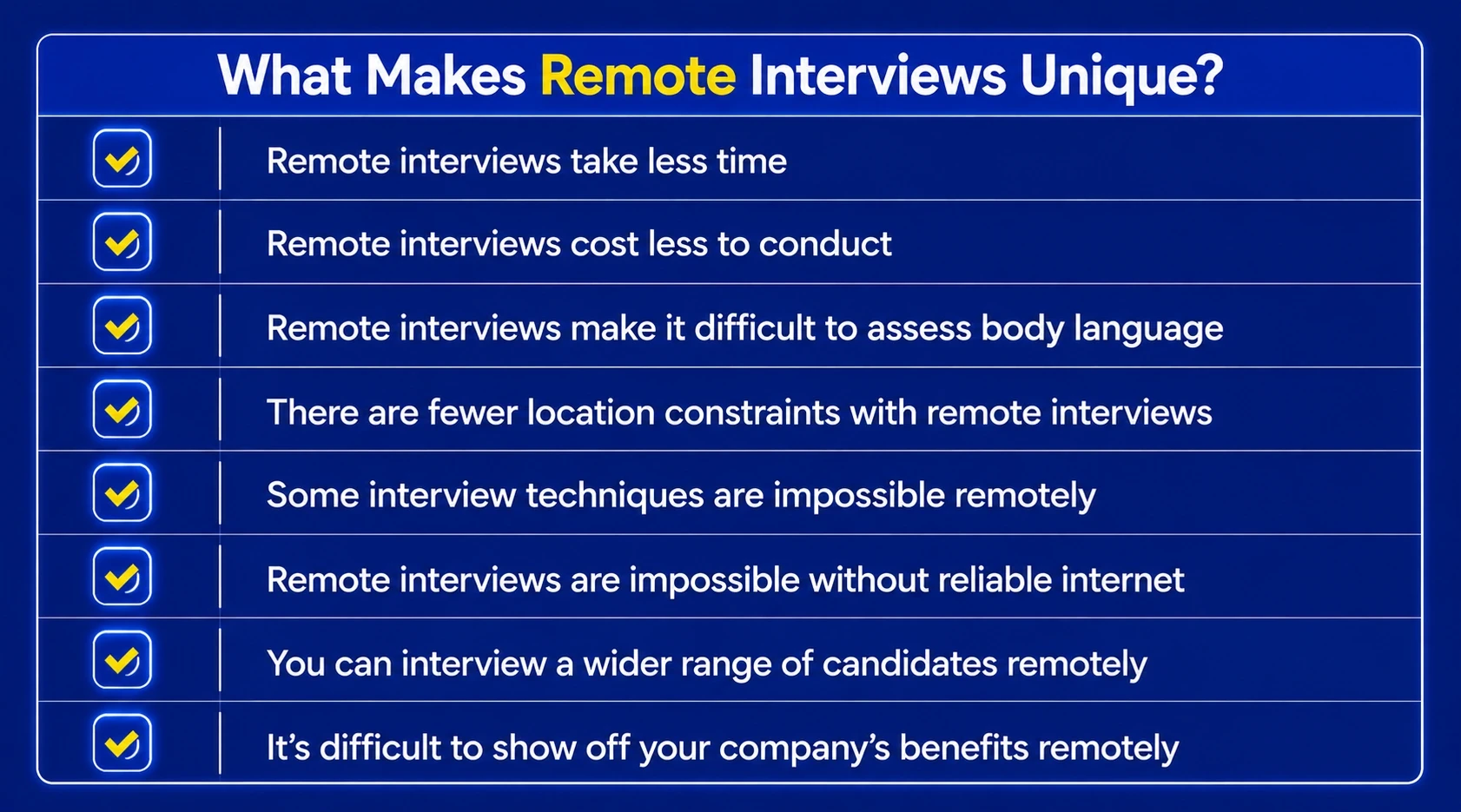
Remote interviews have become a preferred hiring method for many organizations because they offer flexibility, efficiency, and accessibility. By eliminating geographical barriers, employers can connect with qualified candidates from different locations while reducing the time and costs associated with traditional recruitment processes.
1. Access to a Wider Talent Pool
Remote interviews enable organizations to recruit candidates from different cities, states, and countries without requiring travel. This broader reach helps employers find the most qualified talent while increasing workforce diversity.
2. Reduced Hiring Costs
Conducting interviews virtually eliminates expenses related to travel, accommodation, office space, and interview logistics. This makes remote interviews a cost-effective solution for organizations of all sizes.
3. Faster Recruitment Process
Remote interviews simplify scheduling and allow hiring teams to evaluate candidates more quickly. As a result, organizations can reduce time-to-hire and secure top talent before competitors.
4. Greater Flexibility
Both employers and candidates benefit from the flexibility of remote interviews. Interviews can be scheduled across different locations and time zones, making the hiring process more convenient for everyone involved.
5. Improved Candidate Experience
Candidates can participate in interviews from familiar environments without the stress of commuting or traveling. This convenience often leads to a more positive and comfortable interview experience.
6. Enhanced Recruitment Efficiency
Virtual interview platforms often include features such as interview recordings, automated scheduling, and digital assessments, helping recruiters streamline workflows and make more informed hiring decisions. With AI-powered tools like Sherlock AI, recruiters can further enhance efficiency by analyzing interview responses in real time for structured evaluation, matching candidate answers with job-specific skill requirements, and generating data-driven insights to support faster shortlisting and selection decisions, ultimately reducing manual effort and improving overall interview efficiency.
Challenges of Remote Interviews
Despite their advantages, remote interviews can present several challenges that may affect communication, evaluation accuracy, and the overall interview experience. Understanding these challenges can help organizations prepare more effectively.
1. Technical Difficulties
Internet connectivity issues, software glitches, audio problems, and hardware failures can disrupt interviews and create frustration for both candidates and interviewers.
2. Limited Assessment of Non-Verbal Communication
Virtual interactions can make it more difficult to observe body language, facial expressions, and other non-verbal cues that often contribute to candidate evaluations.
3. Communication Barriers
Audio delays, poor video quality, or connectivity interruptions can affect the flow of conversation and sometimes lead to misunderstandings during the interview.
4. Environmental Distractions
Background noise, interruptions, and other distractions in home or remote work environments can reduce focus and negatively impact the interview experience.
5. Time Zone Coordination Challenges
Organizations hiring across multiple regions may face scheduling difficulties when coordinating interviews between candidates and interviewers located in different time zones.
6. Candidate Engagement Issues
Building rapport and creating a personal connection can be more challenging in a virtual setting compared to face-to-face interviews, potentially affecting candidate engagement and overall interview effectiveness.
Best Practices for Conducting Effective Remote Interviews
Remote interviews require a thoughtful approach to ensure a smooth experience for both interviewers and candidates. By implementing the right strategies, organizations can improve candidate assessment, reduce hiring bias, and make more informed recruitment decisions.
These practices are essential for organizations that rely on virtual hiring to attract and assess talent effectively across locations.
1. Define Clear Interview Objectives
Defining clear interview objectives involves identifying the key skills, competencies, and qualifications required for the role before the interview begins. This ensures that every question asked is purposeful and aligned with job expectations.
This is commonly used to:
Focus interviews on role-relevant skills
Improve question quality and relevance
Ensure structured evaluation
Avoid irrelevant or repetitive questioning
Support fair candidate comparison
This practice is essential for maintaining clarity and direction throughout the interview process.
2. Use a Structured Interview Format
A structured interview format refers to using a fixed set of questions and standardized evaluation criteria for all candidates. This ensures that every candidate is assessed under the same conditions.
This is commonly used to:
Maintain consistency across interviews
Enable fair comparison between candidates
Reduce interviewer bias
Improve decision-making accuracy
Support objective scoring systems
This approach helps organizations make more reliable hiring decisions.
3. Test Technology Before the Interview
Testing technology involves checking video conferencing tools, internet connectivity, audio systems, and screen-sharing features before the interview begins. This helps avoid disruptions during the session.
This is commonly used to:
Prevent technical interruptions
Ensure smooth communication
Improve interview flow and timing
Reduce candidate frustration
Maintain professionalism during interviews
This step is critical for ensuring a seamless virtual experience.
4. Create a Professional Interview Environment
Creating a professional environment means conducting the interview in a quiet, well-lit space with minimal distractions and a clean background. This helps maintain focus and professionalism.
This is commonly used to:
Improve communication clarity
Enhance interviewer and candidate focus
Create a positive impression
Reduce background distractions
Support a professional atmosphere
This helps maintain the quality of virtual interactions.
5. Encourage Interactive Communication
Encouraging interactive communication means making the interview conversational rather than one-sided. Candidates are given opportunities to express ideas, ask questions, and engage in discussion.
This is commonly used to:
Improve candidate engagement
Build natural conversation flow
Assess communication skills effectively
Understand candidate thinking better
Create a comfortable interview environment
This leads to a more insightful evaluation process.
6. Assess Remote Work Skills
Assessing remote work skills involves evaluating a candidate’s ability to work effectively in virtual environments, including communication, self-management, and adaptability.
This is commonly used to:
Evaluate remote job readiness
Assess communication effectiveness
Measure time management skills
Understand adaptability in virtual settings
Identify collaboration abilities
This is especially important for distributed or hybrid teams.
7. Document Feedback Immediately
Documenting feedback involves recording candidate responses and interviewer observations right after the interview while details are still fresh.
This is commonly used to:
Improve evaluation accuracy
Support fair candidate comparison
Reduce memory-based bias
Strengthen hiring decisions
Improve team collaboration
This ensures a more reliable hiring process.
8. Communicate Next Steps Clearly
Communicating next steps means informing candidates about the hiring timeline, future stages, and expected updates after the interview.
This is commonly used to:
Improve candidate experience
Reduce uncertainty in hiring process
Build employer trust
Maintain professional communication
Increase candidate engagement
This helps create a transparent and positive recruitment process.
Technology Used in Remote Interviews
Technology plays a critical role in the success of remote interviews. Modern virtual interviewing tools enable organizations to connect with candidates regardless of location, streamline recruitment workflows, and improve the overall hiring experience. As remote hiring continues to grow, employers increasingly rely on digital solutions to conduct, manage, and evaluate interviews more effectively.
1. Video Conferencing Platforms
Video conferencing tools such as Zoom, Microsoft Teams, and Google Meet enable real-time face-to-face communication between candidates and interviewers. These platforms support features such as video calls, screen sharing, meeting recordings, and virtual collaboration, making them the most commonly used technology for remote interviews.
2. AI-Powered Interview Integrity Software - Sherlock AI
Artificial intelligence is increasingly being used to enhance remote interviews. AI-powered solutions such as Sherlock AI help organizations strengthen interview integrity by detecting AI-assisted cheating, deepfake fraud, suspicious candidate behavior, and unauthorized external assistance during remote interviews. Sherlock AI uses multimodal analysis of candidate behavior, device activity, and audio environments to provide real-time fraud detection and alerts. The platform also offers AI fluency observation, enabling recruiters to assess how effectively candidates use AI tools when permitted, along with automated interview note-taking and performance insights that support more reliable and informed hiring decisions
3. One-Way Video Interview Platforms
One-way video interview platforms allow candidates to record responses to pre-set interview questions and submit them for later review. These platforms help recruiters evaluate large numbers of applicants efficiently while maintaining a consistent interview process.
4. Applicant Tracking Systems (ATS)
Applicant Tracking Systems help organizations manage candidate information, interview scheduling, communication, and recruitment workflows within a centralized platform. Integration between ATS software and interview tools improves hiring efficiency and candidate management.
5. Online Assessment Tools
Many organizations use online assessment platforms to evaluate technical knowledge, cognitive abilities, language proficiency, and job-specific skills. These assessments provide additional data that supports more informed hiring decisions.
6. Collaboration and Scheduling Tools
Remote hiring often involves multiple interviewers across different locations. Digital scheduling and collaboration tools help coordinate interview calendars, share candidate feedback, and improve communication among hiring teams, making the recruitment process more organized and efficient.
As technology continues to evolve, remote interviews are becoming more sophisticated, data-driven, and scalable, enabling organizations to identify and hire qualified talent more effectively regardless of geographical boundaries.
Remote Interviews: A Key to Smarter Hiring
Remote interviews have become an essential component of modern recruitment, enabling organizations to connect with talent across locations while improving hiring efficiency and flexibility. From one-way video interviews and live virtual discussions to technical assessments and AI-powered interview technologies, remote interviewing offers multiple ways to evaluate candidates effectively without geographical limitations.
To maximize the benefits of remote interviews, organizations must combine structured interview processes, reliable technology, clear communication, and professional interview practices. Addressing common challenges such as technical disruptions, candidate engagement, and evaluation consistency helps create a more effective and positive hiring experience for both recruiters and candidates.
As remote and hybrid work models continue to expand, remote interviews will play an increasingly important role in talent acquisition. Organizations that leverage advanced interview technologies, adopt standardized evaluation methods, and prioritize candidate experience will be better equipped to identify, assess, and hire top talent in a competitive global workforce.
See how Sherlock AI can help your team conduct secure, trustworthy, and scalable remote hiring at every stage of recruitment. |