Back to all blogs
Learn how remote recruitment works, explore the best hiring tools, and discover proven strategies to improve candidate quality, hiring efficiency, and remote hiring success.


Hiring is no longer limited by geography. Companies today can find skilled candidates across cities, countries, and time zones without requiring them to step into a physical office. This shift has changed how organizations attract, evaluate, and hire talent, making remote recruitment an essential strategy for modern businesses.
Remote recruitment refers to the process of sourcing, screening, interviewing, assessing, and onboarding candidates using digital tools instead of in person interactions. From video interviews and online skill assessments to AI powered hiring workflows, organizations are increasingly relying on technology to streamline recruitment while accessing a wider talent pool. Research shows that companies hiring remotely can reduce time-to-hire by around 10%, helping recruiters move candidates faster through the pipeline.
At the same time, remote recruitment introduces new challenges. Recruiters must evaluate candidates without face to face interactions, ensure communication remains smooth across locations, verify candidate authenticity, and maintain hiring fairness throughout the process. With AI generated resumes, deepfakes, and online interview fraud becoming more common, hiring teams also need better systems to ensure trust and integrity during remote interviews.
In this guide, we will explore what remote recruitment is, how it works, its benefits and challenges, the best tools for hiring remotely, and practical best practices to improve hiring outcomes in a distributed hiring environment..
What is Remote Recruitment?
Remote recruitment is the process of finding, evaluating, interviewing, and hiring candidates without requiring in person interactions. Instead of traditional face to face hiring, organizations use digital platforms, video interviews, online assessments, applicant tracking systems, and communication tools to manage the entire recruitment process remotely.
In a remote recruitment model, every stage of hiring can happen online. Recruiters can source candidates through job boards and professional networks, conduct virtual interviews using video conferencing platforms, assess technical or role specific skills through online tests, and even complete onboarding digitally.
The growing adoption of remote work has made remote recruitment an important strategy for companies looking to hire faster and access talent beyond geographical limitations. Businesses are no longer restricted to local talent pools. A company in one city or country can hire highly skilled professionals from different regions while reducing travel costs and scheduling barriers.
A typical remote recruitment process often includes:
Candidate Sourcing: Recruiters identify candidates through job portals, social platforms, employee referrals, talent marketplaces, and recruitment agencies.
Resume Screening: Applications are reviewed digitally using applicant tracking systems and AI powered recruitment tools to shortlist qualified candidates.
Remote Interviews: Hiring managers conduct structured interviews through video conferencing platforms to evaluate communication, technical expertise, problem solving skills, and role suitability.
Online Assessments: Many organizations use coding tests, aptitude assessments, case studies, or behavioral evaluations to assess candidate capabilities remotely.
Virtual Onboarding: Once selected, employees complete documentation, training, and company orientation online.
Remote recruitment is especially valuable for distributed teams, global hiring, and organizations seeking specialized talent. However, it also comes with challenges such as candidate verification, communication gaps, interview fraud, and maintaining hiring consistency. This is why many companies now invest in AI driven hiring technologies to improve screening accuracy, interview integrity, and hiring confidence.
Tips for Successful Remote Recruitment
Building an effective remote recruitment process requires more than simply moving interviews online. Organizations need clear communication, reliable technology, structured evaluation methods, and a strong candidate experience to hire successfully. Here are some practical tips to improve remote hiring outcomes.
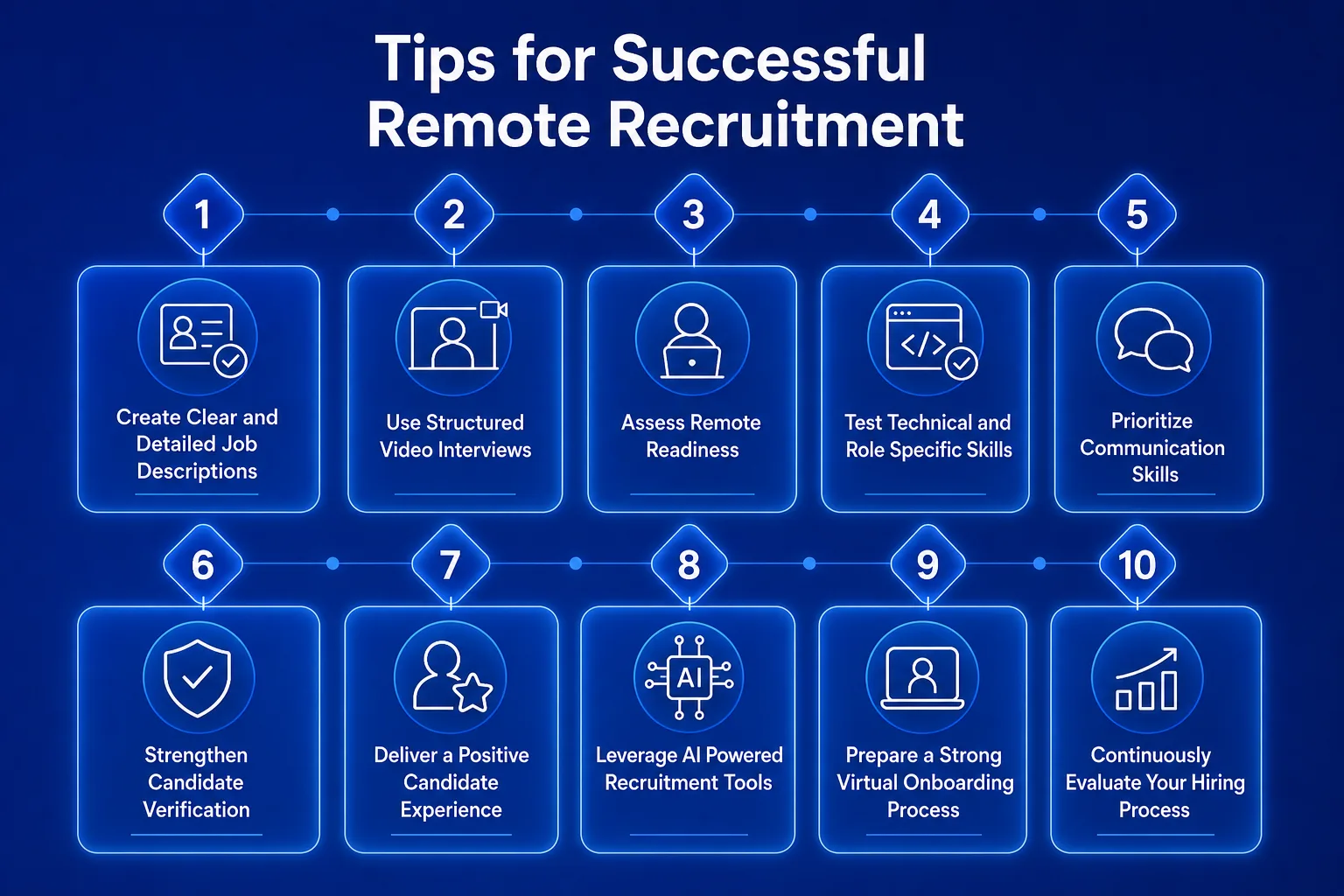
1. Create Clear and Detailed Job Descriptions
A well written job description helps attract the right candidates from the beginning. Clearly define job responsibilities, required skills, expectations, working hours, and whether the role is fully remote, hybrid, or location dependent. Transparent job descriptions reduce confusion and improve candidate quality.
2. Use Structured Video Interviews
Remote interviews can sometimes feel inconsistent if different candidates are evaluated differently. Create a standardized interview structure with role specific questions, scorecards, and evaluation criteria. This improves fairness and helps recruiters compare candidates objectively.
3. Assess Remote Readiness
Not every candidate thrives in a remote work environment. During interviews, evaluate skills such as self management, communication, accountability, collaboration, and time management. Ask candidates about their experience working independently and handling virtual collaboration.
4. Test Technical and Role Specific Skills
Relying only on resumes and interviews can lead to poor hiring decisions. Use online assessments, coding tests, case studies, or practical assignments to evaluate technical proficiency and problem solving ability. Skills based hiring often improves recruitment accuracy.
5. Prioritize Communication Skills
Strong communication is essential in remote environments where teams collaborate digitally. Evaluate how clearly candidates express ideas, respond to questions, and communicate during virtual interactions.
6. Strengthen Candidate Verification
Remote recruitment can increase risks related to impersonation, AI assisted cheating, or interview fraud. Employers should consider identity verification, live interview monitoring, behavioral analysis, and structured assessments to ensure candidate authenticity and hiring integrity.
7. Deliver a Positive Candidate Experience
Keep candidates informed throughout the recruitment process. Share interview schedules in advance, provide clear instructions, and communicate updates promptly. A smooth hiring experience improves employer branding and candidate trust.
8. Leverage AI Powered Recruitment Tools
Modern hiring teams increasingly use AI to streamline screening, scheduling, interview analysis, and recruitment workflows. Intelligent hiring tools can help recruiters save time while improving hiring consistency and decision making.
9. Prepare a Strong Virtual Onboarding Process
Recruitment does not end after an offer letter. A structured onboarding process with digital documentation, training sessions, and team introductions helps new hires integrate smoothly into remote teams.
10. Continuously Evaluate Your Hiring Process
Track metrics such as time to hire, interview completion rate, candidate satisfaction, and quality of hire. Reviewing recruitment performance regularly helps organizations identify gaps and improve future hiring outcomes.
Tools and Technologies for Remote Recruitment
Successful remote recruitment depends on having the right technology stack in place. From sourcing and screening candidates to conducting interviews and onboarding employees, modern recruitment tools help organizations streamline hiring, improve collaboration, and create a smoother candidate experience.
As remote hiring becomes more common, companies are increasingly investing in technologies that improve hiring accuracy, reduce recruitment delays, and strengthen interview integrity. Below are some of the most important tools and technologies that support effective remote recruitment.
1. AI Powered Recruitment and Interview Intelligence Platforms
AI powered recruitment and interview intelligence platforms are becoming an essential part of remote recruitment. These tools help organizations improve hiring accuracy, strengthen interview integrity, reduce manual effort, and create a more reliable hiring process.
Sherlock AI helps organizations improve remote recruitment by combining interview intelligence, fraud detection, and recruiter support into one platform.
Common Sherlock AI capabilities include:
Interview fraud detection
Behavioral intelligence and candidate insights
AI Copilots for recruiter assistance
Candidate integrity monitoring
Hiring workflow intelligence and decision support
Sherlock AI is particularly valuable for organizations conducting high volume remote hiring, virtual interviews, and online assessments where hiring trust and candidate authenticity are critical.
Hire smarter with Sherlock AI. Improve remote hiring accuracy today. |
|---|
2. Applicant Tracking Systems (ATS)
An Applicant Tracking System serves as the foundation of modern recruitment. ATS platforms help recruiters organize candidate information, manage applications, automate workflows, and improve collaboration between hiring teams.
Common ATS capabilities include:
Resume parsing and screening
Interview scheduling
Candidate pipeline tracking
Automated communication
Recruitment analytics and reporting
An ATS is particularly valuable for organizations managing high volumes of remote applicants.
3. Video Interviewing Platforms
Video interviews have become a standard part of remote recruitment. These platforms allow recruiters and hiring managers to evaluate candidates from any location while maintaining structured hiring workflows.
Video interviewing tools support:
Live virtual interviews
Recorded interview sessions
Panel interviews
Screen sharing for technical evaluations
Candidate assessments across locations
Structured virtual interviews can also help improve consistency and hiring fairness.
4. Collaborative Hiring Tools
Remote recruitment often involves recruiters, hiring managers, department leaders, and interview panels working from different locations. Collaborative hiring tools make coordination easier by enabling shared feedback and faster decision making.
These tools help with:
Interview scheduling
Candidate scorecards
Team collaboration
Feedback sharing
Recruitment planning
Strong collaboration improves hiring speed and reduces communication gaps.
5. Assessment and Skill Testing Platforms
Resumes alone do not always provide a complete picture of a candidate’s abilities. Assessment tools help recruiters evaluate technical proficiency, communication skills, problem solving ability, and job readiness.
Organizations commonly use:
Technical skill assessments
Coding tests
Behavioral evaluations
Aptitude testing
Role specific simulations
Skills based hiring can improve hiring quality and reduce the risk of poor recruitment decisions.
6. AI Powered Recruitment Tools
Artificial intelligence continues to transform remote recruitment by automating repetitive hiring tasks and improving decision making.
AI recruitment technologies are commonly used for:
Resume screening
Candidate matching
Interview scheduling
Recruitment analytics
Candidate engagement chatbots
These tools help recruiters save time while improving efficiency across the hiring process.
7. Collaboration and Communication Platforms
Effective communication is essential in remote recruitment. Recruiters and candidates rely heavily on digital communication tools to coordinate interviews, share updates, and manage hiring discussions.
Communication platforms help organizations:
Schedule interviews efficiently
Improve candidate communication
Coordinate hiring teams
Share hiring feedback faster
Smooth communication often leads to a better candidate experience.
8. Remote Onboarding Software
Recruitment does not end once a candidate accepts an offer. Remote onboarding software helps organizations transition new hires smoothly into distributed teams.
These platforms typically support:
Digital documentation
Compliance paperwork
Employee training
Company introductions
Team integration
A strong onboarding experience can improve employee engagement and long term retention.
Choosing the right combination of remote recruitment tools is essential for improving hiring speed, candidate experience, and recruitment accuracy. However, technology alone is not enough. Organizations also need clear hiring strategies and best practices to make remote recruitment successful.
Best Practices for Conducting Effective Remote Recruitment
A strong interview process is at the heart of successful digital hiring. Since recruiters do not meet candidates in person, every interaction needs to be intentional, structured, and consistent to ensure fair evaluation and a smooth candidate experience. Below are key practices that help improve the quality and reliability of remote recruitment.
1. Define Interview Expectations Clearly
Before the interview begins, it is important to set clear expectations for candidates so they understand the process in advance. Share details such as the interview format, number of rounds, expected duration, tools or platforms being used, and the names or roles of interviewers. This reduces uncertainty and helps candidates prepare in a structured way. When expectations are clearly communicated, candidates perform better because they can focus on showcasing their skills instead of worrying about logistics or surprises during the interview.
2. Ensure Technology Readiness
Technology issues can disrupt the flow of a remote recruitment and create a poor experience for both the interviewer and the candidate. To avoid this, always ensure that internet connectivity, camera, microphone, and software tools are tested in advance. Many organizations also conduct a short pre-interview tech check to confirm everything is working smoothly. This step is especially important for remote hiring because even a small technical glitch can impact communication, reduce interview quality, and lead to inaccurate assessments.
3. Maintain a Professional Interview Environment
Even though interviews are conducted online, maintaining a professional environment is still very important. Interviewers should sit in a quiet, well-lit, and distraction-free space with a neutral background. Candidates should also be guided to do the same. A professional setup helps maintain focus, reduces interruptions, and creates a serious tone for the interview. This also reflects well on the company brand and shows candidates that the organization values structured and respectful hiring practices.
4. Use a Structured Interview Format
A structured interview format ensures that every candidate is evaluated fairly and consistently. This involves using a predefined set of questions, role-specific scenarios, and a scoring system to assess responses. Structured interviews reduce bias and make it easier to compare candidates objectively. Instead of relying on intuition, recruiters can make data-informed decisions based on standardized evaluation criteria, which significantly improves hiring accuracy and fairness.
5. Evaluate Remote Work Readiness
Not every skilled professional is naturally suited for remote work. It is important to evaluate how candidates manage independence, deadlines, communication, and accountability without constant supervision. Ask questions about previous remote experience, tools they use for productivity, and how they handle challenges like time zone differences or isolation. Strong remote readiness is often a better predictor of success than technical skills alone in distributed teams.
6. Assess Cultural Alignment
Cultural alignment remains a key factor in hiring, even in fully remote environments. During interviews, explore how candidates collaborate, handle feedback, and adapt to different communication styles. Discuss organizational values and expectations around teamwork and responsibility. When candidates align well with company culture, they integrate faster into teams and contribute more effectively to long-term goals.
7. Focus on Communication Skills
In remote recruitment, communication becomes even more important because physical cues are limited. Evaluate how clearly candidates express their thoughts, structure their answers, and respond to follow-up questions. Strong communication skills ensure smoother collaboration in remote teams where most interactions happen through chat, video calls, or written documentation. Candidates who communicate effectively tend to reduce misunderstandings and improve overall team productivity.
8. Encourage Candidate Questions
Allowing time for candidate questions is an essential part of a balanced interview process. It gives candidates the opportunity to understand the role, team structure, expectations, and company culture in more detail. At the same time, it helps recruiters assess the candidate’s level of interest and preparation. A transparent two-way conversation creates trust and improves the overall candidate experience.
9. Record Interviews with Consent
Recording interviews, with the candidate’s permission, can significantly improve evaluation quality. It allows hiring teams to revisit responses, compare candidates more accurately, and reduce reliance on memory-based judgments. Recorded interviews also help when multiple stakeholders are involved in the hiring decision. However, it is important to always maintain transparency and ensure candidates are comfortable with the process before recording.
10. Provide Timely Feedback and Follow-Up
Timely communication after the interview is a critical part of maintaining a positive candidate experience. Inform candidates about next steps, timelines, and outcomes as soon as possible, even if they are not selected. Delayed communication can negatively impact employer branding and candidate trust. A structured follow-up process ensures clarity, reduces uncertainty, and leaves a positive impression of the organization, regardless of the hiring outcome.
When these practices are applied consistently, remote interviews become more structured, fair, and effective in identifying the right talent.
How Sherlock AI Improves Remote Recruitment
In remote hiring environments, ensuring fairness, accuracy, and trust in candidate evaluation has become more challenging than ever. Traditional interview methods often fall short when it comes to verifying authenticity and maintaining consistency across distributed hiring teams. This is where intelligent hiring system like Sherlock AI add real value by strengthening decision-making and reducing manual effort.
1. AI Fraud Detection
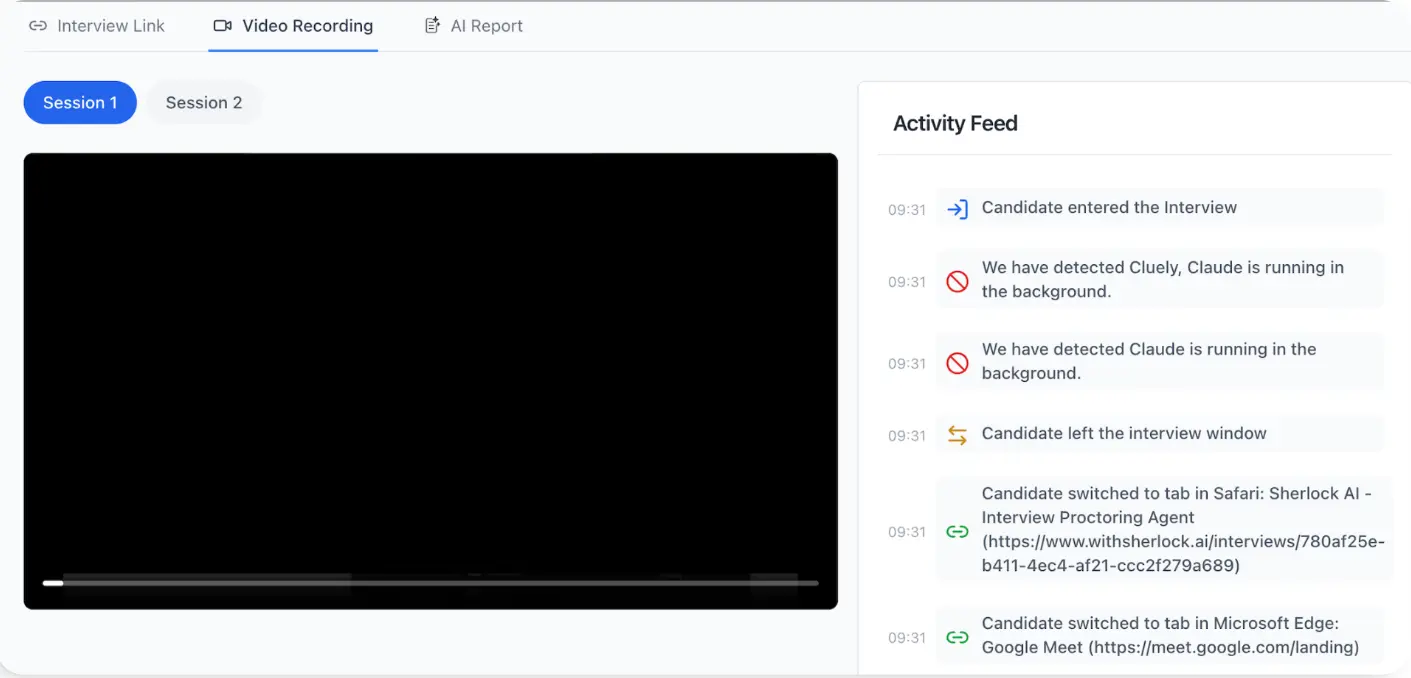
One of Sherlock AI’s core capabilities is detecting AI-assisted cheating and interview fraud during remote interviews. The platform monitors candidate behavior, response patterns, and session signals to identify suspicious activity that may impact interview integrity. This includes identifying AI-generated responses, impersonation risks, and deepfake-related fraud attempts during virtual assessments.
This feature helps organizations:
Protect interview integrity across remote hiring processes
Detect suspicious candidate behavior in real time during interviews
Reduce risks of AI-assisted cheating and impersonation
Improve trust and authenticity in candidate evaluations
2. Behavioral Intelligence Analysis
Sherlock AI analyzes candidate communication patterns, tone consistency, and response behavior to provide deeper insights beyond traditional interview notes. It helps recruiters understand how candidates think, respond under pressure, and communicate in real time.
This feature helps organizations:
Understand candidate behavior beyond resumes and answers
Evaluate communication clarity and consistency more effectively
Identify strengths and weaknesses in real interview settings
Support more informed hiring decisions
3. Structured Interview Evaluation
Sherlock AI enables standardized evaluation frameworks to ensure every candidate is assessed fairly and consistently. It reduces subjectivity by guiding interviewers with structured scoring and feedback models.
This feature helps organizations:
Maintain consistency across multiple interviewers
Reduce bias in hiring decisions
Improve fairness in candidate interviews
Enable objective comparison between candidates
4. Communication Quality Analysis
The platform evaluates how effectively candidates communicate their ideas during virtual interviews, focusing on clarity, structure, and relevance of responses.
This feature helps organizations:
Assess communication skills more accurately in remote settings
Identify candidates who can collaborate effectively in distributed teams
Improve evaluation of soft skills
Reduce misunderstandings in hiring assessments
5. Hiring Accuracy Enhancement
By combining behavioral insights, fraud detection, and structured evaluation, Sherlock AI improves overall hiring accuracy and reduces poor-fit hires in remote recruitment.
This feature helps organizations:
Improve quality of hire across remote roles
Reduce hiring mistakes and mismatches
Increase confidence in final selection decisions
Strengthen overall recruitment outcomes
|
Conclusion
Remote recruitment has transformed the way organizations attract, evaluate, and hire talent by removing geographical barriers and enabling access to a global workforce. However, this shift also brings new challenges such as maintaining interview integrity, ensuring fair evaluations, and delivering a consistent candidate experience across digital channels.
To succeed in this environment, companies must combine structured hiring practices with the right technology stack. Clear communication, standardized interview processes, and strong candidate experience principles help create a smooth and reliable recruitment workflow. At the same time, AI driven tools like Sherlock AI add an essential layer of intelligence by improving evaluation accuracy, detecting fraud risks, and supporting recruiters with data driven insights.
As hiring continues to evolve, organizations that adopt smarter, more transparent, and technology enabled recruitment strategies will be better positioned to attract top talent and make confident hiring decisions in a competitive market.
Ready to hire smarter and faster? Explore how Sherlock AI can strengthen your remote hiring process with better accuracy, trust, and efficiency. |
|---|