Back to all blogs
Learn how to spot fake job interviews, identify common recruitment scams, and protect yourself from fake recruiters, phishing, and identity theft.

Landing a new job should be an exciting experience, but today’s hiring landscape has become increasingly difficult to navigate. As remote recruitment and virtual interviews become the norm, scammers are finding new ways to exploit both job seekers and employers through fake job interviews. What once involved phishing emails and fraudulent job postings has evolved into sophisticated scams that use fake recruiters, AI-generated interviewers, deepfake technology, and identity theft to deceive victims.
An EY India study found a significant rise in employment fraud, including forged documents, fake credentials, deepfake interviews, and identity-related hiring risks. The study analyzed over one million background verification checks and found that digital hiring fraud is becoming a major concern across industries.
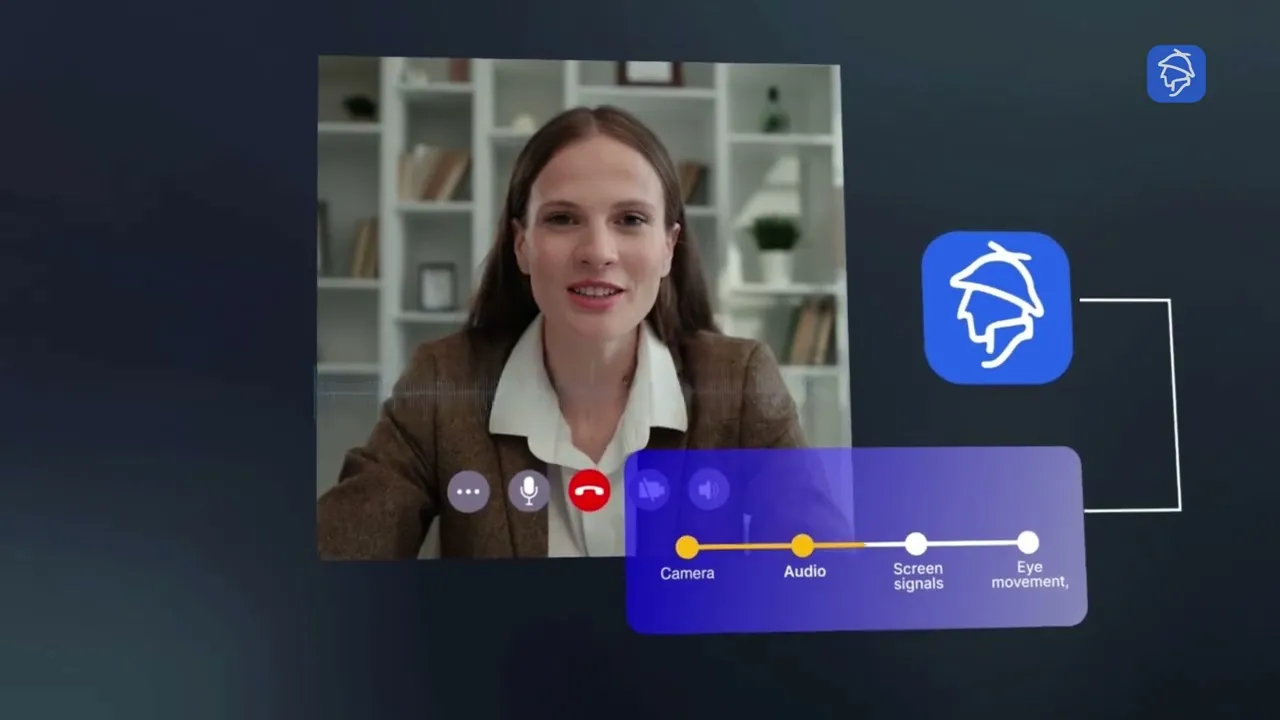
As recruitment fraud becomes more sophisticated, organizations need more than awareness, they need technology that can detect fake interviews before a bad hire is made. Platforms like Sherlock AI help recruiters identify proxy interviews, AI-assisted cheating, deepfake manipulation, and identity mismatches, making remote hiring more secure and trustworthy.
What Are Fake Job Interviews?
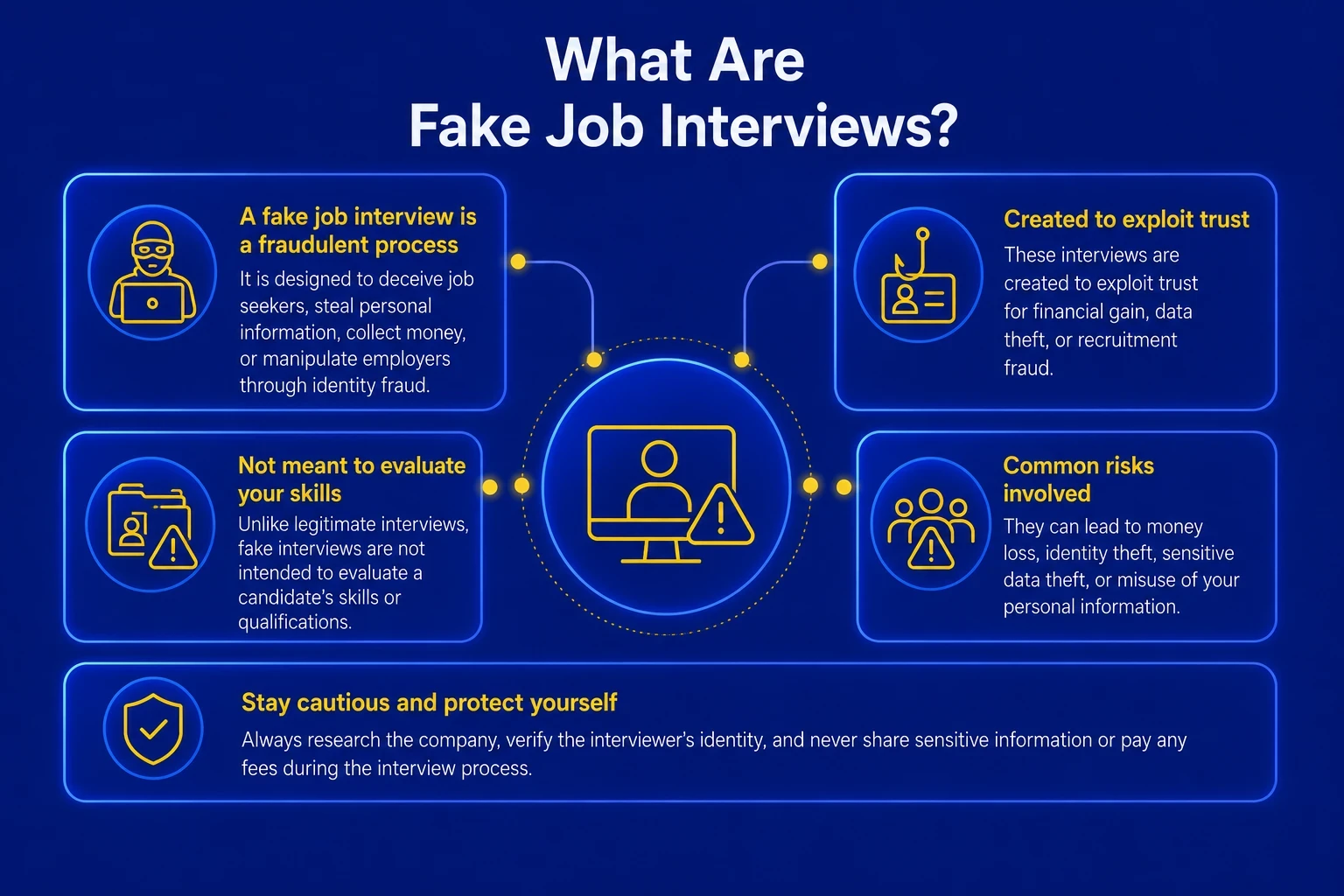
A fake job interview is a fraudulent interview process designed to deceive job seekers, steal personal information, collect money, or manipulate employers through identity fraud. Unlike legitimate interviews, fake interviews are not intended to evaluate a candidate’s skills or qualifications. Instead, they are created to exploit trust for financial gain, data theft, or recruitment fraud.
Fake job interviews have become more sophisticated as companies embrace remote hiring. Scammers no longer rely only on fake job postings or phishing emails. They now impersonate well-known companies, create convincing recruiter profiles on professional networking platforms, conduct interviews through messaging apps, and even use artificial intelligence to make the hiring process appear legitimate.
At the same time, employers face a different but equally serious challenge. Some candidates use proxy interviews, where another person answers interview questions on their behalf. Others rely on AI-powered tools, voice cloning, or deepfake technology to misrepresent their identity or abilities during virtual interviews. In many cases, the individual who completes the interview is not the same person who eventually joins the organization.
Fake Job Interviews Can Target Both Job Seekers and Employers
Many people assume fake job interviews only affect candidates. In reality, recruitment fraud impacts both sides of the hiring process.
Fake Interviews That Target Job Seekers
Fraudsters often pretend to represent trusted companies and invite candidates to interviews for jobs that do not exist. Their objective may include:
Stealing personal information such as passport details, Aadhaar numbers, Social Security numbers, or banking information.
Asking candidates to pay for training, equipment, software, or background checks before starting work.
Sending phishing links that install malware or capture login credentials.
Collecting sensitive documents that can later be used for identity theft.
Victims often realize the fraud only after sharing confidential information or transferring money.
Fake Interviews That Target Employers
Organizations are increasingly dealing with candidates who intentionally manipulate virtual interviews. Common tactics include:
Having another person attend the interview.
Using AI tools to generate answers in real time.
Employing voice-changing software or deepfake video technology.
Switching identities after receiving a job offer.
These attacks can lead to poor hiring decisions, insider security risks, compliance issues, and financial losses, particularly for organizations hiring remote employees.
Detecting these sophisticated forms of interview fraud manually is becoming increasingly difficult. Sherlock AI helps organizations verify candidate identity, detect AI-assisted interviews, identify proxy candidates, and flag suspicious interview behavior in real time, allowing recruiters to make hiring decisions with greater confidence.
15 Signs of a Fake Job Interview
Not every unusual interview is a scam, but certain warning signs should immediately raise concerns. Fraudsters often follow similar patterns to gain your trust, collect personal information, or convince you to send money. Learning to recognize these red flags can help you avoid becoming a victim of recruitment fraud.
Here are the most common signs of a fake job interview.
1. The Job Offer Sounds Too Good to Be True
Scammers often attract job seekers by advertising roles with unrealistically high salaries, excellent benefits, and little to no experience required. They may promise immediate hiring, flexible working hours, or guaranteed employment without conducting a proper interview. Legitimate employers usually have a structured hiring process and offer compensation that aligns with the role, experience level, and industry standards.
The Better Business Bureau reports that employment scams are among the riskiest scams for people aged 18–44, with scammers commonly using high-paying remote jobs and fake recruiters to attract victims.
Example:
You receive a message offering a remote customer support role that pays $6,000 per month, requires no prior experience, and guarantees a job after a short 10-minute interview. The recruiter insists you can start the next day without any additional evaluation. While the offer sounds attractive, the unrealistic salary and rushed hiring process are strong indicators that the interview may be fake.
2. You Cannot Verify the Company Online
Before attending any interview, take a few minutes to research the company. A legitimate employer should have an official website, a LinkedIn company page, employee profiles, and information about its products or services. If you cannot find any credible online presence or the information seems inconsistent, the interview could be part of a job scam. Scammers often create fake company names or copy the identity of well-known businesses to appear trustworthy.
Example:
A recruiter invites you to interview with a company called “Global Tech Solutions.” When you search online, you cannot find an official website, verified social media accounts, or any employee profiles on LinkedIn. The only results are a recently created website with limited information and no business address. These are clear warning signs that you should verify the company before proceeding.
3. The Recruiter Uses a Personal Email Address
Most legitimate recruiters communicate using an official company email address that matches the organization’s domain. If interview invitations come from personal email services such as Gmail, Yahoo, or Outlook, it is worth verifying the recruiter’s identity. While small businesses may occasionally use personal email addresses, established companies almost always use corporate email accounts for recruitment.
Example:
You apply for a position at a well-known technology company but receive an interview invitation from techhiring2026@gmail.com instead of an official company email. Before responding, check the company’s careers page or contact their HR team to confirm whether the email is genuine.
4. The Job Description Is Vague
A legitimate job posting clearly explains the role, responsibilities, required qualifications, and reporting structure. Fake job interviews often begin with vague descriptions that focus only on attractive benefits while providing little information about the actual work. This lack of detail makes it easier for scammers to target a wide range of candidates.
Example:
A job advertisement says, “Work from home. Great salary. Flexible hours. Start immediately.” It does not mention the job title, daily responsibilities, required skills, or the company’s business. Such vague postings should always be treated with caution.
5. You Are Asked to Pay Money
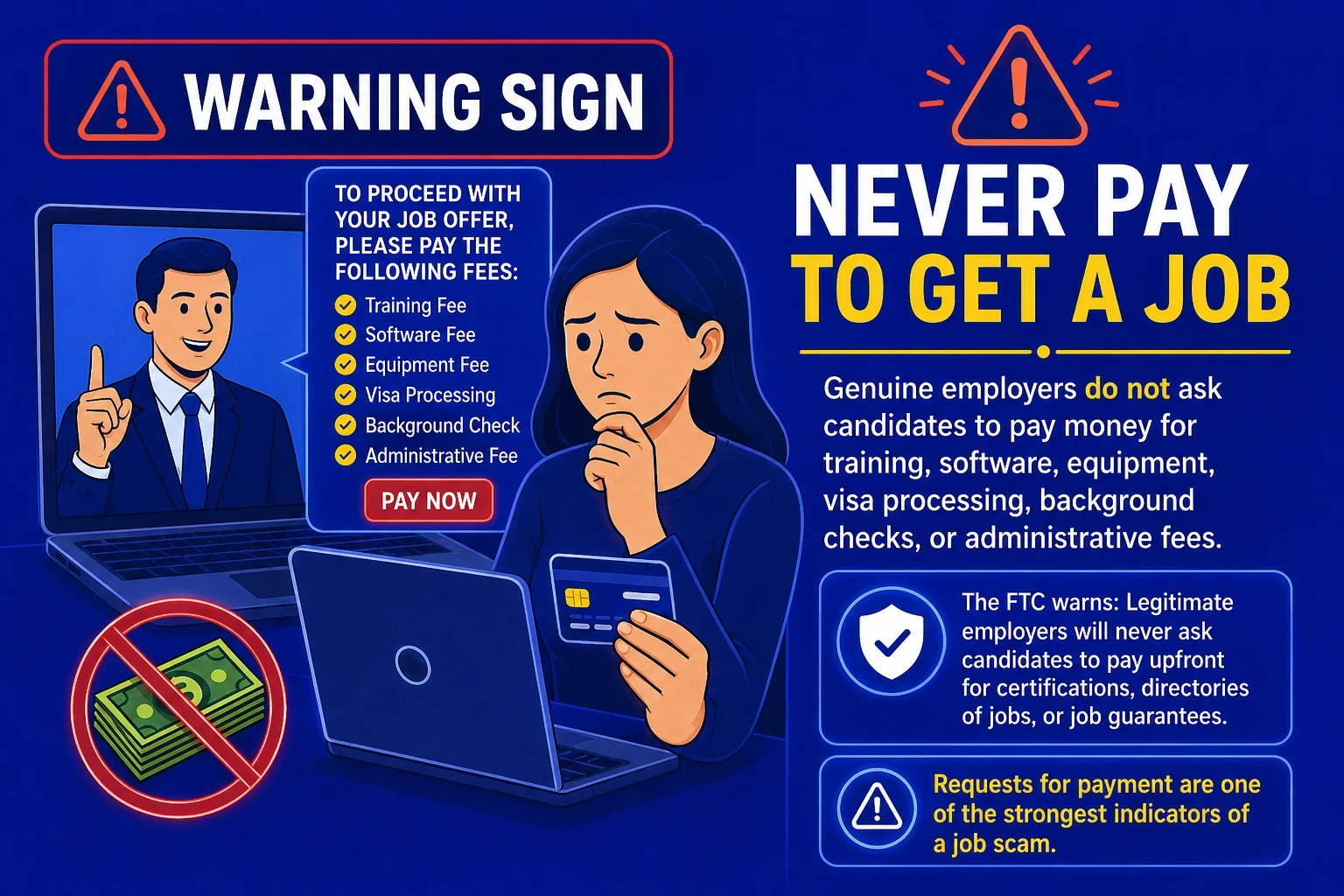
One of the biggest warning signs of a fake job interview is any request for payment. Fraudsters may ask candidates to pay for training, software, equipment, visa processing, background checks, or administrative fees. Genuine employers do not ask candidates to pay money as part of the hiring process.
The FTC warns that legitimate employers will never ask candidates to pay upfront for certifications, directories of jobs, or job guarantees. Requests for payment are one of the strongest indicators of a job scam.
Example:
After completing an interview, the recruiter congratulates you and asks you to pay $150 for a mandatory background verification before your offer letter can be issued. This is a common recruitment scam. A legitimate employer either covers these costs or clearly explains the process without requesting upfront payments.
6. The Interview Happens Only Through Chat
Many companies use messaging platforms to schedule interviews, but the actual interview is usually conducted over a phone call or video meeting. If the entire hiring process takes place through chat without any face-to-face interaction, it could be a sign of a fake job interview.
Example:
Instead of scheduling a video interview, the recruiter asks you to answer questions only through WhatsApp or Telegram. Within a few minutes, they inform you that you have been selected without ever speaking to you. This should immediately raise concerns about the legitimacy of the opportunity.
7. You Receive an Immediate Job Offer
Most employers evaluate candidates through one or more interview rounds before making a hiring decision. If you receive a job offer immediately after applying or after a very brief conversation, the recruiter may be trying to gain your trust before asking for money or personal information.
Example:
You submit your resume in the morning and receive an offer letter the same afternoon without attending a proper interview or discussing your experience. The recruiter then asks you to complete several formalities immediately. This rushed hiring process is a common sign of recruitment fraud.
8. The Interviewer Avoids Your Questions
A genuine recruiter should be able to explain the company’s business, the role, the team structure, salary expectations, and the next steps in the hiring process. If the interviewer gives vague answers, changes the subject, or refuses to provide basic information, you should verify the opportunity before continuing.
Example:
During the interview, you ask about the company’s products, office location, and reporting manager. Instead of answering your questions, the interviewer repeatedly says, “We’ll discuss that after you complete the joining process.” This lack of transparency is a strong indication that the interview may not be genuine.
9. You Are Asked to Share Sensitive Information Too Early
While employers may request identity documents after you accept a job offer, they should never ask for sensitive information during the initial stages of the hiring process. Be cautious if a recruiter asks for your Aadhaar number, passport, Social Security number, bank account details, credit card information, passwords, or one-time passwords before you have verified the company and received an official offer.
Example:
After your first interview, the recruiter asks you to send a copy of your passport and bank account details so they can “process your salary account.” Since you have not received an offer letter or completed the hiring process, this request is suspicious and could lead to identity theft.
10. The Communication Contains Multiple Errors
Professional companies usually maintain high communication standards. Interview invitations and recruitment emails should be free from major spelling mistakes, grammatical errors, broken links, or inconsistent branding. Poorly written messages often indicate that the sender is not a legitimate recruiter.
Example:
An email claiming to be from a multinational company contains several spelling mistakes, uses an unfamiliar logo, and addresses you as “Dear Applicant” even though you applied with your full name. These inconsistencies should prompt you to verify the sender before responding.
11. The Interview Is Scheduled at Unusual Hours
Global companies may occasionally schedule interviews across different time zones. However, if a recruiter contacts you late at night, insists on an immediate interview, or refuses to schedule a meeting during normal business hours, it may be a warning sign. When combined with other red flags, unusual interview timing can indicate a fake hiring process.
Example:
A recruiter calls you at midnight and insists that you join an interview within the next 15 minutes or lose the opportunity. Legitimate employers generally provide advance notice and accommodate reasonable scheduling requests.
12. The Recruiter Pressures You to Act Immediately
Scammers often create a false sense of urgency to prevent candidates from verifying the company or thinking critically. They may claim that the position is available for only a few hours or that you must accept the offer immediately. Genuine employers usually give candidates enough time to review the offer and ask questions.
Example:
The recruiter tells you that you must accept the offer and submit your documents within one hour, otherwise the position will be given to someone else. This pressure tactic is commonly used to rush candidates into making poor decisions.
13. The Interview Link Looks Suspicious
Always check the interview invitation before clicking any links. Fraudsters may create fake meeting links that closely resemble popular video conferencing platforms or redirect candidates to phishing websites designed to steal login credentials or personal information.
Example:
You receive an interview invitation with a link that looks similar to a Zoom meeting but uses a different web address. Instead of clicking the link immediately, verify the invitation with the company’s HR team or compare it with the official meeting platform.
14. The Hiring Process Skips Verification Steps
Most organizations verify a candidate’s identity, qualifications, and work experience before extending a final offer. If the recruiter never asks about your experience, does not verify your identity, or skips every standard hiring step, the interview may not be genuine.
Example:
You are offered a software engineering position without discussing your technical skills, previous projects, or work history. The recruiter simply asks for your joining documents. A legitimate employer would typically assess your qualifications before making an offer.
15. You Are Asked to Communicate Outside Official Channels
Legitimate employers usually manage the hiring process through official channels such as their careers portal, company email, or verified video conferencing platforms. If a recruiter asks you to move the conversation to personal messaging apps or unofficial platforms without a valid reason, proceed with caution. Scammers often use these channels because they are harder to trace and allow them to avoid company oversight.
Example:
After your initial interview, the recruiter asks you to continue the hiring process exclusively through Telegram and requests that you avoid contacting the company’s HR team directly. This attempt to move communication away from official channels is a strong indication that the interview may be fraudulent.
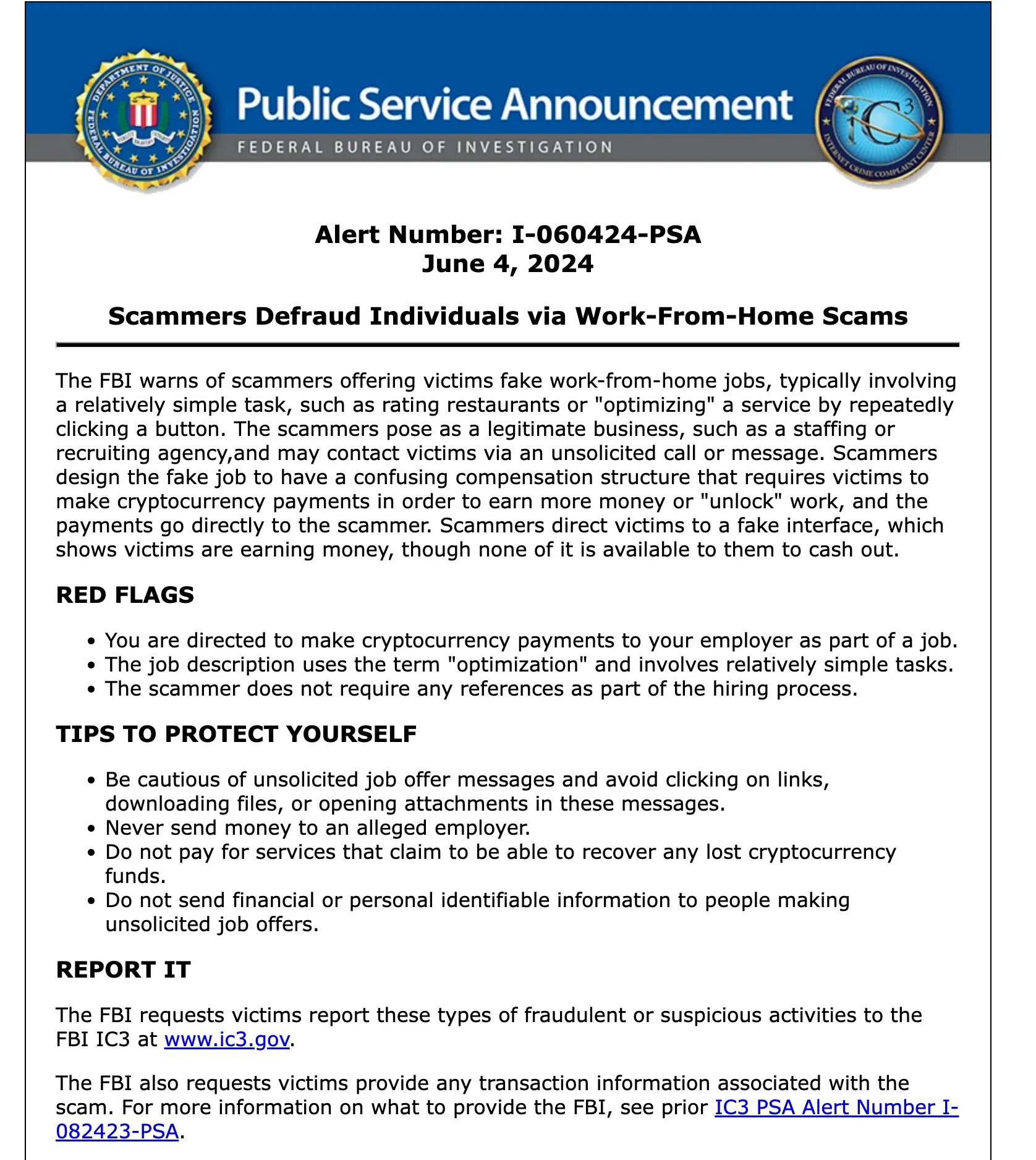
FBI Public Service Announcement on Fake Job Scams
Fake job interviews aren’t just isolated incidents, they’re a growing concern recognized by law enforcement agencies worldwide. The Federal Bureau of Investigation (FBI) has issued public warnings about fake work-from-home jobs and recruitment scams, highlighting how fraudsters impersonate legitimate employers to steal money and personal information. The advisory also outlines common red flags and practical steps job seekers can take to protect themselves.
How to Protect Yourself from Fake Job Interviews
Spotting the warning signs is only part of staying safe. Taking a few preventive steps before and during the hiring process can help you avoid fake job interviews and protect your personal information.
1. Research the Employer
Always verify the company’s website, LinkedIn page, and online reviews before accepting an interview invitation. If the company has little or no online presence, investigate further before proceeding.
2. Verify the Recruiter’s Identity
Check whether the recruiter is using an official company email address and has a genuine professional profile. If you’re unsure, contact the company’s HR team using the contact details available on its official website.
3. Never Pay to Get Hired
Legitimate employers do not charge candidates for interviews, background checks, training, equipment, or onboarding. Treat any payment request as a major warning sign.
4. Protect Your Personal Information
Avoid sharing sensitive details such as your bank account information, Aadhaar number, passport, Social Security number, passwords, or one-time passwords until you have verified the employer and accepted a legitimate job offer.
5. Confirm the Interview Details
Review the interview invitation carefully. Verify the meeting link, interviewer’s name, job title, and interview platform. If anything seems unusual, contact the company directly before joining the interview.
6. Trust Verified Communication Channels
Communicate through official company email addresses and verified video conferencing platforms whenever possible. Be cautious if a recruiter asks you to continue the hiring process through personal messaging apps.
7. Report Suspicious Activity
If you encounter a fake job interview or recruitment scam, report it to the job portal, the company being impersonated, and your local cybercrime authority. Reporting scams helps protect other job seekers from similar fraud.
Following these best practices can significantly reduce your risk of becoming a victim of job interview scams and help you navigate the hiring process with greater confidence.
How Employers Can Protect Their Hiring Process from Fake Job Interviews
As interview fraud becomes more advanced, employers need more than traditional hiring practices to verify candidate authenticity. Proxy interviews, AI-assisted responses, and identity impersonation can easily bypass manual screening if the right safeguards are not in place.
To reduce hiring risks, organizations should implement these best practices throughout the recruitment process.
1. Verify Candidate Identity at Every Stage
Identity verification should begin before the interview and continue throughout the hiring process. Confirming that the person attending the interview is the same individual who submitted the application helps prevent impersonation and proxy interviews.
2. Use Structured Video Interviews
Conduct interviews on secure video platforms and encourage candidates to keep their cameras on throughout the session. A structured interview process makes it easier to verify identities and identify suspicious behavior.
3. Ask Dynamic Follow-Up Questions
Instead of relying only on prepared questions, ask candidates to explain their previous projects, demonstrate problem-solving skills, or expand on earlier responses. Genuine candidates can usually answer confidently, while proxy candidates or AI-assisted applicants may struggle with unexpected questions.
4. Watch for Unusual Interview Behavior
Recruiters should pay attention to signs such as delayed responses, frequent eye movement away from the screen, unusual audio quality, inconsistent communication, or someone prompting the candidate off camera. While these behaviors do not always indicate fraud, they may warrant additional verification.
5. Strengthen Background and Identity Verification
Before extending an offer, verify the candidate’s identity, employment history, education, certifications, and other supporting documents. A comprehensive verification process helps reduce the risk of hiring fraudulent candidates.
6. Use Sherlock AI to Detect Interview Fraud
As AI-powered interview fraud becomes more sophisticated, manual checks alone may not be enough to identify proxy interviews, deepfakes, identity impersonation, or AI-assisted responses. Sherlock AI helps employers strengthen interview integrity by monitoring virtual interviews and identifying suspicious behaviors in real time.
With Sherlock AI, recruiters can verify candidate identity, detect potential proxy interviews, identify signs of AI-assisted interview manipulation, and gain actionable insights to support confident hiring decisions. By combining Sherlock AI with structured interviews and background verification, organizations can significantly reduce recruitment fraud while ensuring a fair and secure hiring process.
Conclusion
Fake job interviews are becoming more sophisticated as remote hiring and AI-powered technologies continue to evolve. From fake recruiters and phishing scams to proxy interviews and deepfake candidates, both job seekers and employers face growing risks throughout the hiring process.
Recognizing the warning signs, verifying identities, and following secure hiring practices can help prevent financial loss, identity theft, and costly hiring mistakes. For employers, combining these best practices with AI-powered interview integrity solutions adds an extra layer of protection against recruitment fraud.
As hiring continues to evolve, organizations need tools that can keep pace with emerging threats. Sherlock AI helps employers detect interview fraud, verify candidate identity, and maintain interview integrity, enabling teams to hire genuine talent with greater confidence.
Looking to reduce interview fraud and build a more secure hiring process? Sherlock AI empowers recruiters with AI-driven interview monitoring, identity verification, and fraud detection capabilities to help organizations make confident hiring decisions.
Book a demo today and see how Sherlock AI can help you hire with confidence. |
|---|