Back to all blogs
Explore the latest AI interview fraud techniques, proxy interview scams, and practical strategies to protect your hiring process from AI-powered deception.

Remote hiring has made recruitment faster, more flexible, and accessible to a global talent pool. However, it has also created new opportunities for fraudsters to exploit the hiring process. Recruiters today face challenges that extend far beyond fake resumes. AI interview fraud, proxy interviews, deepfake videos, voice cloning, AI-generated responses, and identity impersonation have become real threats that can compromise hiring decisions and expose organizations to financial, operational, and security risks.
The rapid adoption of generative AI has significantly accelerated these risks. According to a Study Finds survey, 72% of recruiters have encountered AI-generated fake resumes, portfolios, or credentials, while 15% have experienced deepfake video or voice cloning during interviews. Despite the growing sophistication of these tactics, only 31% of organizations currently use AI or deepfake detection tools during recruitment. These findings highlight a widening gap between the speed at which fraud techniques are evolving and the safeguards many organizations have in place.
The challenge does not stop there. A Greenhouse survey of more than 4,100 hiring professionals and job seekers found that 91% of recruiters have noticed candidates using AI-generated responses or deceptive techniques during interviews. These findings demonstrate that AI has transformed hiring into an ongoing race between increasingly sophisticated fraud tactics and modern detection technologies.
As AI-powered hiring fraud becomes more sophisticated, organizations can no longer rely on manual verification or conventional interview practices alone. Preventing AI interview fraud requires continuous identity verification, behavioral analysis, deepfake detection, and real-time monitoring throughout the recruitment journey.
What Is AI Interview Fraud?
AI interview fraud is the use of artificial intelligence or deceptive technologies to manipulate the interview process and create a false impression of a candidate’s qualifications, identity, or abilities. Unlike traditional hiring fraud, where candidates may exaggerate experience or provide inaccurate information on a resume, AI interview fraud involves technology that actively assists or impersonates candidates during interviews.
Wall Street Journal reported, even corporate giants like Google and McKinsey were responding - reintroducing mandatory in-person interviews to counter the surge in AI interview fraud.
The rise of remote hiring has made these tactics easier to execute. Candidates can now use AI-powered tools to generate answers in real time, clone voices, create deepfake videos, receive assistance through hidden devices, or even have another person attend the interview on their behalf. As these technologies become more accessible, recruiters are finding it increasingly difficult to distinguish genuine candidates from fraudulent ones.
AI interview fraud can occur at multiple stages of the recruitment process, including:
Submitting AI-generated resumes tailored to every job description
Using fake identities or stolen credentials during screening
Attending proxy interviews where another person answers questions
Using AI assistants to generate responses during live interviews
Manipulating video or audio using deepfake technology
Providing fabricated work samples, certifications, or portfolios
The impact extends far beyond a bad hiring decision. Hiring an unqualified or fraudulent candidate can result in project delays, financial losses, security vulnerabilities, compliance issues, and reputational damage. In industries handling sensitive customer data or intellectual property, the consequences can be even more severe.
As AI-powered deception continues to evolve, organizations need hiring processes that verify not only what a candidate knows but also whether the candidate is genuinely the person participating throughout the recruitment journey. This requires a combination of identity verification, behavioral analysis, interview integrity monitoring, and AI-driven fraud detection to ensure every hiring decision is based on authentic candidate performance.
What Are Proxy Interviews?
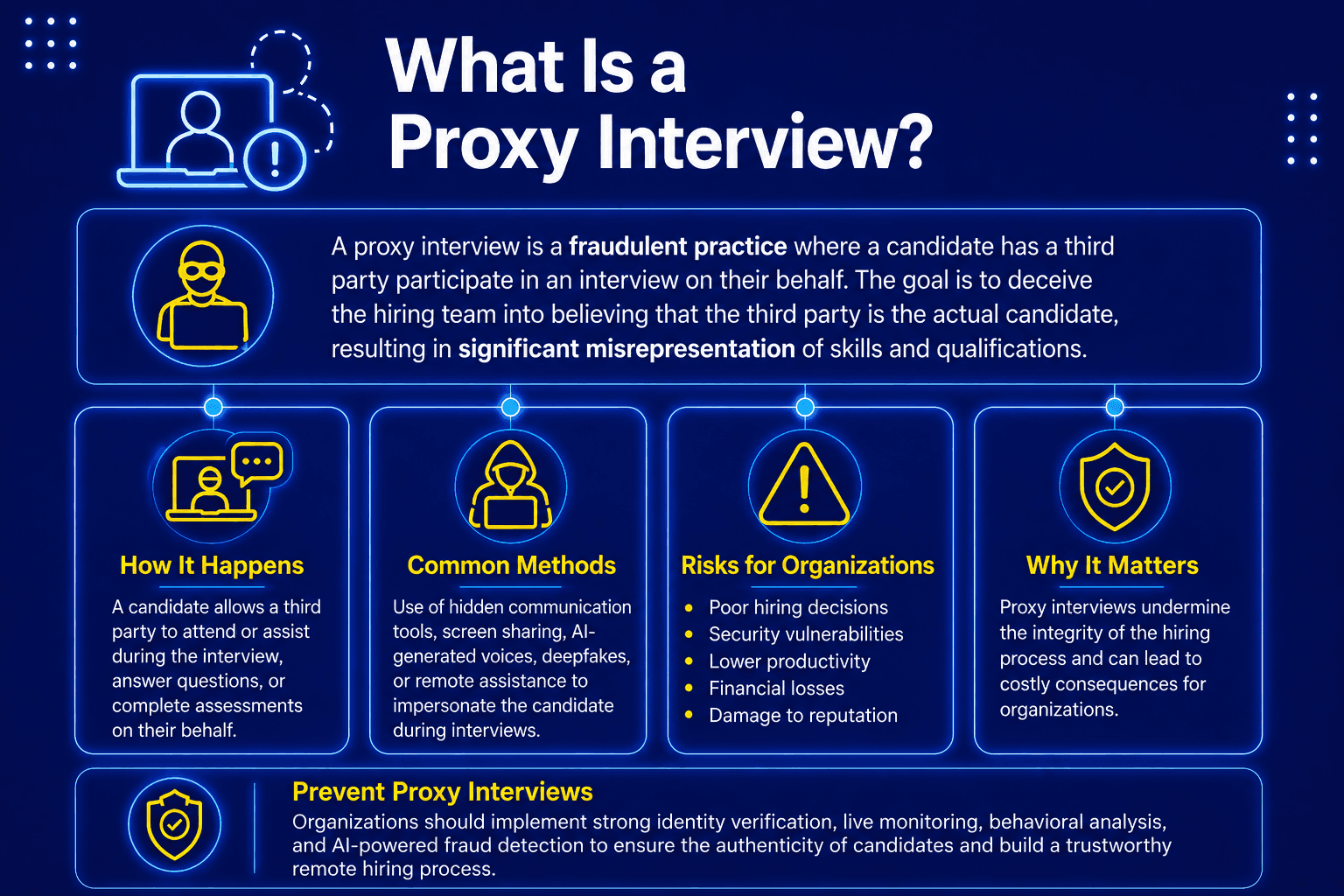
A proxy interview is a type of interview fraud where someone other than the actual applicant participates in part or all of the interview process. The substitute may answer technical questions, complete coding assessments, or communicate on behalf of the candidate without the recruiter’s knowledge. Proxy interviews have become increasingly common in remote hiring, where verifying a candidate’s identity can be more challenging.
In some cases, the proxy attends the entire interview while pretending to be the candidate. In others, the real candidate remains on camera while another person provides answers through hidden earpieces, messaging apps, remote desktop software, or AI-powered assistance. More advanced cases involve deepfake video technology or voice cloning to make the deception even harder to detect.
Proxy interviews are particularly common for technical and remote roles where candidates are evaluated primarily through virtual interviews. Because recruiters cannot physically verify the candidate’s identity, fraudsters exploit the virtual environment to bypass hiring processes and secure job offers for individuals who may lack the required skills or experience.
How Proxy Interviews Work
While every case is different, proxy interviews typically follow a similar pattern:
The candidate submits a legitimate or AI-generated resume.
A proxy or AI tool assists during technical screening or live interviews.
The proxy answers difficult questions while the actual candidate remains silent or repeats responses.
If hired, either the original applicant joins the organization without the required skills or another individual performs the job using the candidate’s identity.
Some fraudsters even switch identities after receiving an offer. The person interviewed may never become the employee, making it difficult for organizations to detect the fraud until performance issues or security concerns arise.
Common AI Interview Fraud Techniques Recruiters Should Know
AI interview fraud is no longer limited to one type of deception. Fraudsters combine artificial intelligence with traditional impersonation techniques to bypass recruitment processes. Understanding these methods and their real-world applications helps recruiters recognize suspicious behavior early and strengthen hiring security.
1. AI-Generated Interview Responses
AI tools can now listen to interview questions and generate polished responses within seconds. While some candidates use AI responsibly for interview preparation, others rely on hidden AI assistants during live interviews to answer questions they cannot solve on their own. This prevents recruiters from accurately assessing a candidate’s knowledge, communication skills, and problem-solving ability.
AI-powered interview fraud often involves candidates who:
Use hidden AI assistants to generate answers in real time
Read AI-generated responses from a secondary screen
Depend on AI instead of demonstrating their own technical expertise
Example: During a software engineering interview, the interviewer asks how to optimize a database query. The candidate pauses briefly, looks away from the camera, and then delivers a highly detailed answer generated by an AI assistant running on another device..
2. Deepfake Video and Voice Cloning
Advances in generative AI allow fraudsters to manipulate live video and audio during virtual interviews. These tools can create realistic facial movements, lip synchronization, and cloned voices, making identity verification significantly more difficult.
Deepfake interview fraud may involve candidates who:
Use AI-generated face filters during video interviews
Clone another person’s voice to match their identity
Manipulate video feeds to hide the actual speaker
Example: A fraudster uses deepfake software to overlay another person’s face while answering interview questions using an AI-generated voice, making the interview appear authentic.
3. AI-Generated Resumes and Fake Credentials
AI tools can generate highly convincing resumes, portfolios, and cover letters within seconds. While many job seekers use AI to improve grammar or formatting, some create entirely fabricated work histories, certifications, and project experience to secure interviews.
Resume fraud often involves candidates who:
Generate resumes that closely match every job description
Add fake certifications or employment history
Create AI-written portfolios showcasing non-existent projects
Example: A candidate claims to have led multiple cloud migration projects on their resume. During background verification, the employer discovers the companies, certifications, and project experience cannot be verified.
4. Hidden Communication Devices
Candidates may use hidden devices to receive live assistance during interviews without the recruiter’s knowledge. These devices allow another person or an AI assistant to provide answers throughout the interview.
Hidden assistance often includes:
Wireless earbuds hidden beneath hair or clothing
Smartwatches displaying interview answers
Secondary laptops or mobile phones placed outside the camera view
Example: During a technical interview, the candidate repeatedly glances toward a second monitor where another individual is sending step-by-step solutions through a chat application.
5. Remote Desktop Assistance
Some candidates allow another person to remotely access their computer during coding assessments or technical interviews. The external user completes tasks while the candidate appears to be working independently.
Remote desktop fraud typically includes:
Sharing computer access through remote desktop software
Allowing another person to solve coding challenges
Receiving external control during technical assessments
Example: During a live coding test, an experienced developer secretly connects to the candidate’s computer through remote desktop software and completes the programming exercise.
6. Identity Impersonation
Identity fraud occurs when candidates use stolen identities, forged documents, or another individual’s credentials to obtain employment. In some cases, the interviewed person is replaced after the offer is accepted.
Identity fraud commonly involves:
Using forged identity documents
Applying with someone else’s credentials
Replacing the interviewed candidate after hiring
Example: A recruiter verifies a candidate’s documents during the interview. However, a completely different individual reports for work on the first day using the same employee records.
7. AI-Enhanced Coding and Technical Assessments
AI coding assistants can solve programming challenges within seconds. Candidates who rely on these tools during assessments may appear highly skilled despite lacking the required technical knowledge.
Assessment fraud often includes:
Using AI coding assistants during online tests
Copying assessment questions into AI tools
Submitting AI-generated solutions as original work
Example: A candidate completes a complex coding assessment with nearly perfect accuracy. During a follow-up interview, they are unable to explain the logic behind the code they previously submitted.
Case Study: AI-Assisted Identity Fraud at KnowBe4
A Remote worker hired by KnowBe4 as a software engineer on its internal IT team was actually a persona controlled by a North Korean threat actor, detailing a seemingly thorough interview process that included background checks, verified references and four video conference-based interviews, KnowBe4 founder and CEO Stu Sjouwerman said the worker avoided being caught by using a valid identity that was stolen from a U.S.-based individual. The scheme was further enhanced by the actor using a stock image augmented by artificial intelligence.
Common Proxy Interview Techniques Recruiters Should Know
Proxy interviews have become more sophisticated as remote hiring and AI technologies continue to evolve. Instead of relying on a single method, fraudsters often combine multiple techniques to hide the identity of the actual participant and increase their chances of passing the interview.
Understanding these proxy interview techniques can help recruiters identify suspicious behavior and strengthen hiring security.
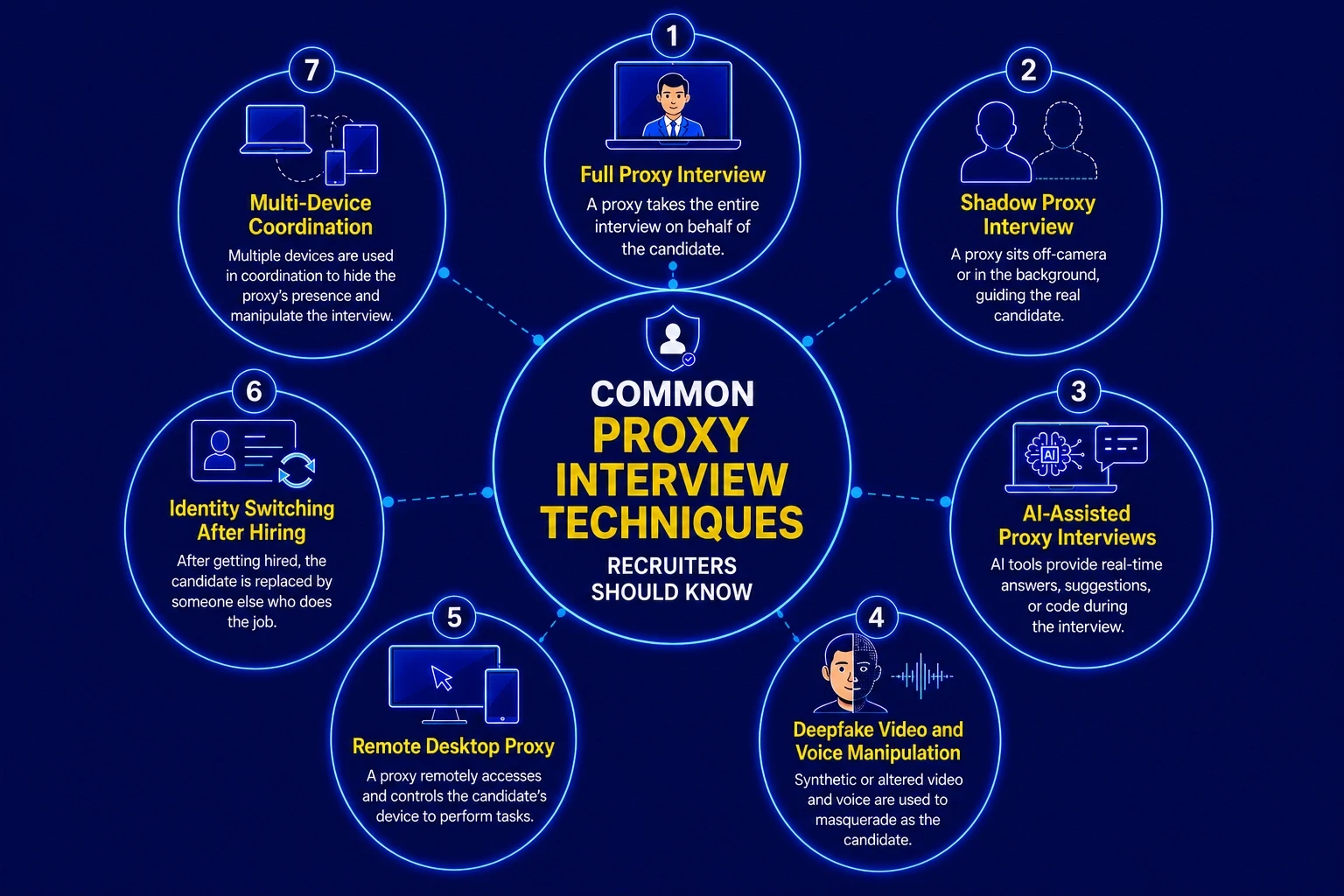
1. Full Proxy Interview
A completely different individual attends the interview while pretending to be the candidate. The recruiter believes they are evaluating the applicant, but the person answering the questions is someone else.
Example: A candidate applies for a DevOps Engineer role, but an experienced DevOps professional attends all interview rounds using the candidate’s identity. Once hired, the actual applicant joins the company and struggles with day-to-day responsibilities.
2. Shadow Proxy Interview
The real candidate appears on camera, but another person secretly provides answers through hidden communication channels such as wireless earbuds, messaging apps, or collaboration tools.
This technique often involves:
Hidden Bluetooth earpieces
Live chat applications
Smartwatches displaying responses
Secondary laptops or mobile devices
Example: During a technical interview, the candidate pauses after every question while another person sends detailed answers through a messaging application displayed on a second monitor.
3. AI-Assisted Proxy Interviews
Instead of another individual, candidates rely on AI tools to generate responses during the interview. Hidden AI assistants listen to interview questions and provide instant answers that candidates repeat aloud.
This technique may include:
AI chatbots generating live responses
AI-powered coding assistants
AI-generated behavioral interview answers
Real-time speech coaching tools
Example: An interviewer asks a system design question. The candidate silently enters the prompt into an AI assistant and delivers the generated answer as if it were their own.
4. Deepfake Video and Voice Manipulation
Fraudsters use AI-generated video filters and voice cloning to impersonate another individual during virtual interviews. These tools create realistic facial movements and speech patterns that make manual verification more difficult.
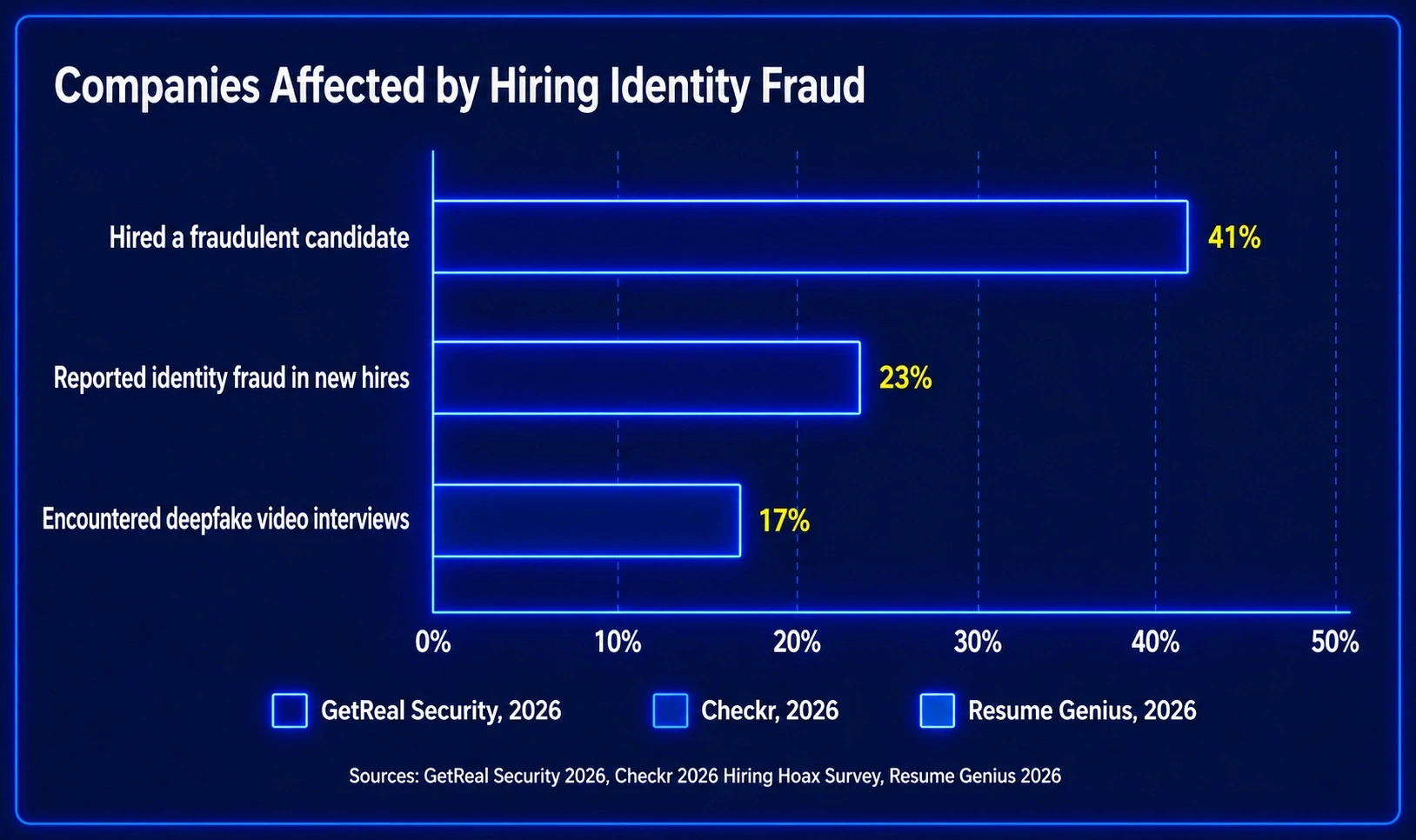
A study in mid-2025 found 17% of HR managers had directly encountered deepfake technology in a video interview. Sectors like tech and finance report the highest rates, but no industry is immune.
This technique often includes:
AI-generated face replacement
Voice cloning software
Lip-sync manipulation
Synthetic video overlays
Example: A candidate uses deepfake software to replace their face with another individual’s identity while simultaneously using AI voice cloning throughout the interview.
5. Remote Desktop Proxy
The candidate shares their screen during a coding assessment while another individual remotely controls the computer and completes technical tasks without the interviewer’s knowledge.
Common methods include:
Remote desktop software
Screen sharing applications
Hidden remote access tools
Virtual machine environments
Example: During a live coding assessment, the candidate appears to be typing, but an experienced developer connected remotely writes and submits the code.
6. Identity Switching After Hiring
Some fraudsters successfully complete the interview process and then replace themselves with another individual after receiving the job offer. Recruiters often discover the fraud only after the employee joins the organization.
This technique typically involves:
Stolen identities
Fake government documents
Employee substitution
Credential misuse
Example: The individual interviewed is highly skilled and performs exceptionally well. However, a different person reports on the first day of work using the same employment documents.
7. Multi-Device Coordination
Candidates use multiple devices simultaneously to receive external assistance without alerting recruiters. One device is used for the interview, while others provide AI-generated responses, coding help, or live communication.
Common setups include:
Laptop for the interview
Mobile phone running an AI assistant
Tablet displaying coding solutions
Second monitor for hidden chat support
Example: During a programming interview, the candidate attends the video call on one laptop while using a second device to generate coding solutions with an AI assistant.
As proxy interview techniques continue to evolve, manual observation alone is no longer sufficient to detect sophisticated hiring fraud. Organizations can significantly reduce these risks by combining identity verification, continuous candidate authentication, behavioral analysis, deepfake detection, and AI-powered interview monitoring throughout the recruitment process.
How to Stop AI Interview Fraud & Proxy Interviews
As AI-powered deception becomes more sophisticated, traditional hiring practices are no longer enough to protect organizations from interview fraud. Recruiters need a multi-layered approach that combines technology, structured hiring processes, and continuous identity verification throughout the recruitment lifecycle.
Here are the most effective strategies to stop AI interview fraud and proxy interviews.
1. Verify Candidate Identity Before and Throughout the Hiring Process
One of the most effective ways to stop AI interview fraud and proxy interviews is to verify that the same person participates throughout the entire recruitment process. Many organizations perform identity verification only before the first interview. However, fraudsters often change participants in later interview rounds or even after receiving a job offer. A single verification step is no longer enough to prevent identity impersonation.
Instead, organizations should adopt continuous identity verification across every stage of the hiring journey. This includes validating a candidate’s identity before interviews, confirming their identity during live interview sessions, and performing a final verification before onboarding. This layered approach makes it significantly more difficult for fraudsters to replace candidates or use proxy interviewers without being detected.
Continuous identity verification also helps recruiters build confidence that the individual who completes the interview is the same person who accepts the offer and ultimately joins the organization. When combined with behavioral monitoring and interview integrity checks, identity verification becomes a powerful defense against hiring fraud.
Example: A candidate successfully completes the initial HR screening and identity verification. Before the final technical interview, the recruiter performs another identity check and discovers that a different individual has joined the meeting. Because the discrepancy is detected before the interview begins, the organization prevents a proxy interview and avoids hiring an unqualified candidate.
2. Use AI-Powered Interview Proctoring Tools - Sherlock AI
As AI interview fraud becomes more advanced, manual observation alone is no longer enough to detect every form of deception. Recruiters can easily miss subtle signs of fraud while focusing on evaluating a candidate’s technical knowledge, communication skills, and cultural fit. This is where AI-powered interview proctoring tools play a critical role.
AI-powered interview proctoring solutions, such as Sherlock AI, continuously analyze video, audio, facial behavior, voice characteristics, and interview patterns throughout the hiring process. Instead of relying solely on human judgment, these platforms automatically identify suspicious activities that may indicate AI-assisted cheating, proxy interviews, deepfake manipulation, or identity impersonation. This allows recruiters to focus on evaluating candidates while the platform monitors interview integrity in the background.
Unlike traditional interview recording software, modern interview proctoring platforms provide real-time insights instead of post-interview analysis. If suspicious behavior is detected, recruiters can immediately investigate, perform additional verification, or pause the interview before making a hiring decision. This proactive approach significantly reduces the risk of fraudulent candidates progressing through the recruitment pipeline.
Example: During a virtual technical interview, Sherlock AI detects repeated eye movements toward a secondary screen whenever coding questions are asked. It also identifies unusually structured responses that closely resemble AI-generated content and notices inconsistencies between the candidate’s current voice and voice samples from an earlier interview round. The platform instantly alerts the recruiter to a potential AI-assisted proxy interview, allowing additional identity verification before the hiring process continues.
3. Detect Deepfakes and AI-Generated Manipulation
Deepfake technology has evolved rapidly, making it increasingly difficult to distinguish genuine candidates from manipulated video or audio streams. Fraudsters can now use AI to alter facial expressions, synchronize lip movements, clone voices, and even replace their appearance during live interviews. As these technologies become more accessible, organizations can no longer rely solely on visual observation to verify a candidate’s identity.
Deepfake manipulation is particularly concerning in remote hiring because recruiters interact with candidates through a screen. Even experienced interviewers may not notice subtle inconsistencies in facial movements, voice patterns, or video quality. Without specialized detection tools, a manipulated interview can appear completely authentic.
To reduce this risk, organizations should incorporate deepfake detection into their interview process. Modern AI-powered detection systems analyze facial landmarks, liveness signals, voice biometrics, lip synchronization, and other behavioral indicators to determine whether the interview feed has been manipulated. When combined with continuous identity verification, these technologies provide an additional layer of protection against sophisticated interview fraud.
Example: A candidate appears confident throughout a virtual interview, and nothing seems unusual to the interviewer. However, the interview security platform detects inconsistencies between the candidate’s lip movements and speech, along with irregular facial landmark patterns that are commonly associated with deepfake technology. The recruiter receives an alert and performs an additional identity verification step before allowing the candidate to proceed to the next interview round.
4. Conduct Structured and Skill-Based Interviews
A well-designed interview process is one of the most effective ways to reduce AI interview fraud and proxy interviews. Unstructured interviews often rely on generic questions that candidates can easily answer using AI tools, memorized responses, or external assistance. Structured interviews, on the other hand, require candidates to demonstrate their knowledge, explain their thought process, and solve problems in real time.
Rather than asking questions with straightforward answers, interviewers should encourage candidates to describe real experiences, explain technical decisions, and work through practical scenarios. Follow-up questions based on previous responses make it much harder for candidates to depend on AI-generated answers or hidden assistance.
Research also supports the effectiveness of structured interviews. According to the U.S. Office of Personnel Management (OPM), structured interviews are among the most reliable and valid methods of predicting future job performance, while also improving consistency and reducing bias in hiring.
Example: Instead of asking, “What is Kubernetes?”, ask the candidate to troubleshoot a production issue, explain each step they would take, and justify why they selected a particular solution. This approach evaluates practical knowledge rather than memorized information.
5. Monitor Candidate Behavior Throughout the Hiring Process
Interview fraud is rarely identified through a single suspicious action. More often, it becomes apparent when recruiters observe inconsistencies across multiple interview stages. Monitoring candidate behavior throughout the hiring process allows organizations to identify unusual patterns that may indicate AI assistance, proxy interviews, or identity impersonation.
Behavioral analysis goes beyond evaluating technical skills. It focuses on whether the candidate demonstrates consistent communication, confidence, voice characteristics, and interaction patterns throughout the recruitment journey. Even subtle changes between interview rounds can reveal potential fraud..
Modern AI platforms can automatically compare these behavioral signals throughout multiple interviews, helping recruiters detect inconsistencies that may otherwise go unnoticed.
Example: During the HR interview, the candidate struggles to explain basic technical concepts. In the final interview, they suddenly provide expert-level answers with noticeably different communication patterns. This inconsistency prompts the recruiter to perform additional identity verification before proceeding.
6. Strengthen Background and Credential Verification
Interview performance alone should never determine whether a candidate is hired. Even highly convincing candidates may present fabricated employment histories, fake certifications, or inaccurate educational qualifications. Comprehensive background verification provides an additional layer of protection against hiring fraud.
Identity verification confirms who the candidate is, while background verification confirms whether their qualifications and professional experience are genuine. Together, they help organizations reduce hiring risks and make more informed decisions.
Example: A candidate claims to have worked as a Senior Cloud Security Engineer for five years. During background verification, the employer discovers that one company has no record of the candidate’s employment and the listed certification has expired.
7. Train Recruiters to Recognize AI Interview Fraud
Technology alone cannot eliminate interview fraud. Recruiters remain the first line of defense because they interact directly with candidates and can recognize subtle behaviors that automated systems may flag for further investigation. Regular training ensures hiring teams understand the latest fraud techniques and know how to respond when suspicious activity occurs.
As AI continues to evolve, recruiters should stay informed about new methods used to manipulate remote interviews, including proxy interviews, deepfake technology, AI-generated responses, and identity impersonation. Training should focus on recognizing behavioral patterns, following consistent verification procedures, and using AI-powered detection tools effectively.
Recruiter training should include:
Identifying common proxy interview techniques.
Recognizing AI-generated interview responses.
Understanding deepfake warning signs.
Following standardized identity verification procedures.
Escalating suspicious interviews for additional review.
Example: During a virtual interview, the recruiter notices repeated delays before each answer, frequent off-camera glances, and significant differences between the candidate’s communication style and previous interview rounds. Rather than proceeding with the interview, the recruiter initiates an additional identity verification process to confirm candidate authenticity.
How Sherlock AI Helps Prevent AI Interview Fraud and Proxy Interviews
As AI-powered hiring fraud becomes increasingly sophisticated, organizations need more than traditional interview practices to ensure candidate authenticity. From AI-generated interview responses and deepfake videos to proxy interviews and identity impersonation, modern recruitment faces a growing range of threats.
Sherlock AI is an AI-powered interview integrity platform designed to secure every stage of the interview process. By combining real-time fraud detection, continuous identity verification, and behavioral analysis, Sherlock AI helps recruiters identify suspicious activity early and make hiring decisions with greater confidence.
1. AI Interview Fraud Detection
Sherlock AI continuously monitors interviews to identify signs of AI-assisted cheating and interview manipulation. The platform detects suspicious behaviors such as AI-generated responses, hidden AI assistants, unauthorized screen assistance, and abnormal interview patterns that may indicate candidates are relying on external tools instead of their own knowledge. Real-time alerts enable recruiters to investigate potential fraud before candidates progress further in the hiring process.
2. Proxy Interview Detection
Proxy interviews are one of the fastest-growing forms of recruitment fraud, where another individual participates in the interview on behalf of the applicant or secretly assists them. Sherlock AI analyzes facial behavior, voice consistency, candidate interactions, and interview patterns to identify signs of proxy participation. This helps recruiters verify that the individual answering the questions is the same person who applied for the role.
3. Continuous Identity Verification
Identity fraud often occurs after the initial screening, when candidates switch participants in later interview rounds or after receiving an offer. Sherlock AI performs continuous identity verification throughout the interview process, helping organizations detect impersonation, identity switching, and unauthorized participant changes before a hiring decision is made.
4. Deepfake and Voice Cloning Detection
AI-generated face swaps and voice cloning technologies can make fraudulent candidates appear authentic during remote interviews. Sherlock AI analyzes facial landmarks, lip synchronization, voice characteristics, and liveness signals to detect potential deepfake manipulation, providing an additional layer of protection against sophisticated identity fraud.
5. Behavioral Analysis and Interview Integrity Monitoring
Rather than relying on a single indicator, Sherlock AI evaluates multiple behavioral signals throughout the interview. It monitors eye movements, communication consistency, speaking patterns, off-screen distractions, and other anomalies that may indicate external assistance or interview manipulation. This comprehensive analysis helps recruiters detect subtle fraud techniques that are difficult to identify manually.
6. Real-Time Interview Risk Alerts
Sherlock AI provides recruiters with instant notifications whenever suspicious activity is detected during a live interview. Instead of discovering potential fraud after the interview is complete, hiring teams can immediately perform additional verification or investigate the issue before moving the candidate to the next stage.
7. AI-Powered Interview Insights
Beyond fraud prevention, Sherlock AI automatically generates interview summaries and integrity insights, reducing manual note-taking while providing recruiters with a complete view of both candidate performance and interview authenticity. This allows interviewers to focus on meaningful conversations instead of administrative tasks.
Secure Every Remote Interview with Sherlock AI
Whether organizations are hiring for technical, finance, customer support, healthcare, or leadership roles, Sherlock AI helps ensure that every interview is conducted with the right candidate. By combining AI interview fraud detection, proxy interview detection, continuous identity verification, deepfake detection, behavioral analysis, and real-time interview monitoring, Sherlock AI enables recruiters to build a secure, trustworthy, and fraud-resistant hiring process.
Build a Fraud-Resistant Hiring Process
AI interview fraud and proxy interviews are no longer isolated incidents. They have become a growing challenge for organizations hiring remotely, particularly for technical and high-value roles. As AI tools become more advanced, fraudsters will continue to develop new ways to manipulate interviews, impersonate candidates, and bypass traditional hiring processes.
Protecting your organization requires more than a single identity check or a well-conducted interview. It requires a comprehensive recruitment security strategy that combines continuous identity verification, AI-powered interview proctoring, deepfake detection, behavioral analysis, structured interviews, and thorough background verification.
Platforms like Sherlock AI help organizations strengthen every stage of the hiring process by detecting proxy interviews, identifying AI-assisted interview fraud, verifying candidate identity, and monitoring interview integrity in real time. Instead of relying solely on manual observation, recruiters receive actionable insights that enable faster, more confident hiring decisions.
By adopting a proactive approach to interview security, organizations can reduce hiring risks, protect sensitive business information, improve hiring quality, and ensure that every candidate is evaluated fairly based on their genuine skills and experience. In today’s AI-driven hiring landscape, preventing interview fraud is no longer optional. It is an essential part of building a secure, trustworthy, and future-ready recruitment process.
Book a demo today to see how Sherlock AI can help you hire genuine talent with confidence. |
|---|