Back to all blogs
Learn what talent mapping is, its key benefits, process, tools, skills gap analysis, and best practices for workforce planning and talent development.


Organizations need to know more than how many people they employ. They need to understand the skills those employees have, the roles they could move into, and the capabilities the business will need as it grows. Talent mapping gives HR and hiring teams a structured way to assess current talent and prepare for future workforce needs.
This is becoming more important as the skills businesses need continue to change. The World Economic Forum’s Future of Jobs Report 2025 estimates that 39% of workers’ existing skill sets will be transformed or become outdated between 2025 and 2030. This shift makes it harder for organizations to rely only on current job roles and skills when planning workforce needs.
Talent mapping helps address this challenge by bringing together information about employees, critical roles, skills, potential successors, development needs, and external talent. It can help organizations identify capability gaps before they become urgent hiring problems and find internal employees who may be suitable for new roles with the right development.
For recruiters, talent mapping can help build relevant talent pools before critical roles become difficult to fill. For HR teams, it can support internal mobility, succession planning, skills development, and workforce planning. It is particularly useful when business priorities are changing and organizations need to decide whether to develop existing employees, move internal talent, or recruit externally.
In this guide, we’ll explain what talent mapping is, why it matters, how the process works, how skills gap analysis fits into it, which tools can support the process, and the best practices for making talent mapping more effective.
What Is Talent Mapping?
Talent mapping is the process of assessing the skills, experience, and potential of talent against an organization’s current and future workforce needs. It gives HR and hiring teams a clear view of where the right capabilities exist and where gaps may need to be addressed.
The process typically begins by identifying critical roles and the skills required for them. Organizations then assess their internal workforce to identify suitable employees, potential successors, and development needs. Where capabilities are not available internally, talent mapping can help recruiters identify relevant external talent pools and potential candidates.
Talent mapping supports more than recruitment. It can inform succession planning, internal mobility, employee development, and workforce planning by showing where talent can be developed, moved, or sourced externally.
In simple terms, talent mapping answers four questions: What talent do we have? What do we need? Where are the gaps? And how should we address them?

Benefits of Talent Mapping
Talent mapping gives organizations a structured view of the talent and capabilities available to them and what they will need in the future. It supports better decisions across workforce planning, talent acquisition, employee growth, and long-term workforce strategy. The most valuable benefits are those that help organizations identify gaps early, use existing talent effectively, and prepare for changing workforce needs.
1. Identifies Critical Skills Gaps
Talent mapping helps organizations identify which skills are available, which are in short supply, and which are missing across the workforce. This creates a clearer understanding of capability gaps that could affect current operations or future business requirements.
By identifying these gaps early, organizations can prioritize the capabilities that require attention and determine the most appropriate way to address them.
2. Enables Strategic Workforce Planning
Talent mapping helps organizations look beyond their current workforce and plan for future talent requirements. It connects business goals with the people and capabilities needed to support them.
This gives HR and business leaders a stronger basis for anticipating workforce changes, planning talent requirements, and aligning workforce capacity with long-term organizational priorities.
3. Improves Internal Talent Utilization
Talent mapping makes it easier to see the skills, experience, and potential already present within an organization. This visibility can reveal opportunities to make better use of existing employees across roles and teams.
By understanding where internal capabilities exist, organizations can improve talent deployment and reduce the risk of overlooking valuable skills within their own workforce.
4. Strengthens Succession and Leadership Readiness
Talent mapping supports succession planning by providing visibility into employees who may be able to take on critical responsibilities in the future. It helps organizations assess readiness and identify areas where additional development is required.
This creates a more deliberate approach to preparing future talent for important roles and maintaining continuity in key areas of the business.
5. Builds Proactive Talent Pipelines
Talent mapping gives recruitment teams a structured way to understand external talent markets and maintain relevant talent pools for future requirements.
Rather than treating recruitment as a response to immediate vacancies, organizations can develop talent pipelines around critical roles and capabilities. This creates greater preparedness when external hiring becomes necessary.
6. Aligns Employee Development With Future Needs
Talent mapping connects employee development with the capabilities the organization expects to need. Instead of treating learning and development as a separate activity, organizations can use talent insights to identify which skills employees need to build for future roles.
This creates more focused development priorities and helps employees grow in ways that support both their career progression and the organization’s changing talent requirements.
The Talent Mapping Process
A well-built talent map can help HR teams plan ahead for hiring, employee development, succession, and critical roles.
Here’s how the process works:
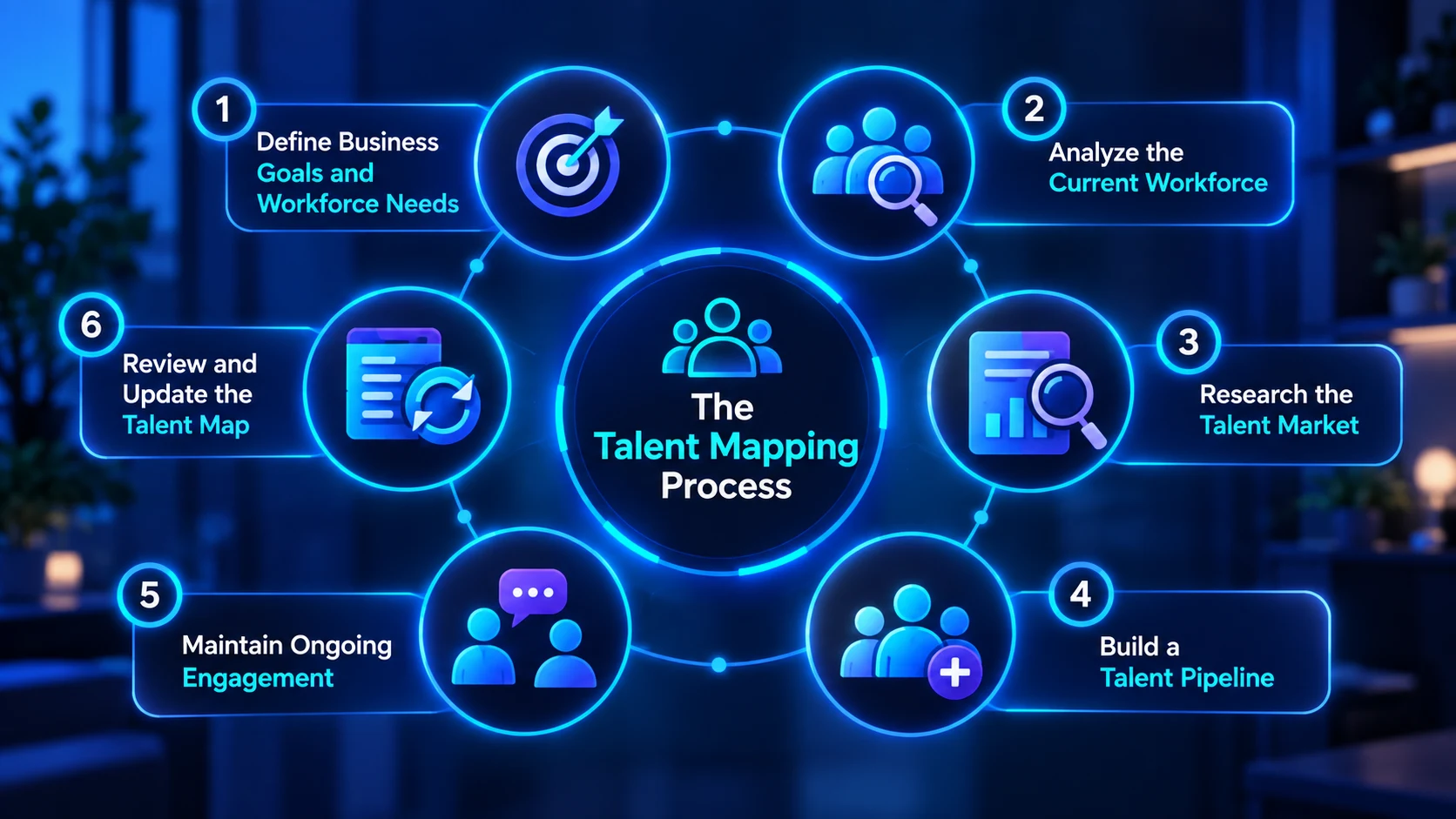
Step 1: Define Business Goals and Workforce Needs
Start with the company’s business plans and identify what they mean for the workforce. Look at upcoming growth, new projects, expansion plans, and changes in the skills the business will need.
For example, a company planning to expand its technology team may need more people with experience in AI, data, or cloud computing. Defining these requirements first helps focus the talent mapping process on roles and skills that will matter in the future.
Step 2: Analyze the Current Workforce
Next, assess the talent already available within the organization. Review employees’ skills, qualifications, experience, performance, and potential for future roles.
Skills audits, performance reviews, and succession planning can help identify both existing strengths and areas where employees may need further development. This step can also uncover skills that may not be fully reflected in employees’ current job titles.
Step 3: Research the Talent Market
Once the organization understands its internal capabilities, look at the external talent market. Research where people with the required skills are working and what kind of experience they have.
This can include studying competitor hiring, industry trends, talent availability in different locations, and changing skill requirements. The aim is to understand where suitable candidates may be found when external hiring is needed.
Step 4: Build a Talent Pipeline
Use the information gathered to create a pool of potential candidates for important current and future roles. This can include employees who may be ready for internal opportunities as well as external candidates with relevant skills and experience.
Recruiters can find potential external candidates through professional networks, industry communities, recruitment platforms, and other talent sources. Building this pipeline early gives the company a starting point when a position becomes available.
Step 5: Maintain Ongoing Engagement
Talent mapping does not end once potential candidates have been identified. Some candidates may not be looking for a new role when they first enter the talent pool.
Keep suitable candidates engaged through regular communication, company updates, professional networking, and information about relevant opportunities. Maintaining these relationships can make it easier to reconnect with candidates when the right position becomes available.
Step 6: Review and Update the Talent Map
Review the talent map regularly to keep it accurate and useful. Employees gain new skills, change roles, develop new career goals, or leave the organization. External candidates may also change jobs or become unavailable.
Business priorities and skill requirements can change as well. Updating the talent map helps HR teams make workforce decisions based on current information rather than an outdated list of candidates and skills.
Talent mapping works best when it leads to clear action. After completing the map, HR teams should know which roles need attention, which employees could be developed, where external talent can be found, and what needs to happen next. Keeping the map updated then turns it from a one-time exercise into a useful part of ongoing workforce planning.
Talent Mapping Example
A simple example can help explain how talent mapping works in practice.
Suppose a growing e-commerce company expects to open new locations and needs more team leaders over the next year. Before hiring externally, the HR team looks at its existing employees to see who could move into these positions.
The company looks at factors such as the employee’s current role, skills, performance, potential, and readiness for the new role.
Employee | Current Role | Key Skills | Performance | Potential | Readiness |
Employee A | Senior Operations Executive | Team coordination, problem-solving, reporting | Strong | High | Ready soon |
Employee B | Operations Executive | Communication, process management, customer handling | Good | High | Needs development |
Employee C | Operations Associate | Data analysis, teamwork, process knowledge | Strong | Medium | Future potential |
From the map, Employee A may be able to take on a team leader role after some preparation. Employee B has the potential but would benefit from leadership training and more experience. Employee C may not be ready yet, but could be developed for a future opportunity.
The company can then decide what each employee needs. This could include training, mentoring, or giving employees more responsibility in their current roles. At the same time, HR can continue looking at external candidates if there are not enough suitable people internally.
As the business grows, the talent map can be updated to reflect new skills, promotions, and changing requirements. This helps the company keep track of its talent and prepare people for roles it expects to need in the future.
Skills Matrix and Skills Gap Analysis
Talent mapping shows where capabilities exist across an organization, but that information becomes more useful when skills are assessed consistently. A skills matrix helps organize those capabilities, while skills gap analysis shows where current skills fall short of what specific roles or business priorities require. Together, they give HR teams and managers a clearer basis for decisions around development, internal mobility, succession, and hiring.
What Is a Skills Matrix?
A skills matrix is a simple framework for recording employees’ skills and their level of proficiency. The skills included in the matrix should be relevant to the roles or capabilities being assessed. Depending on the organization, this could include technical skills, functional knowledge, leadership abilities, certifications, or other role-specific capabilities.
A four-level scale is usually enough for a practical assessment:
Skill Level | What It Looks Like |
Beginner | Understands the basics and can complete simple tasks with guidance. |
Intermediate | Works independently on routine tasks and can handle common problems. |
Advanced | Handles complex work independently and can support others with the skill. |
Expert | Has deep knowledge, handles difficult situations, and can guide or coach others. |
The important part is not the labels themselves but the criteria behind them. A manager should be able to explain why an employee has been assessed as “advanced” rather than relying on personal judgment or seniority alone. For this reason, assessments should be based on observable work, experience, completed projects, or demonstrated ability wherever possible.
A skills matrix can also reveal capabilities that may otherwise be overlooked. An employee may have developed a skill through previous roles, projects, certifications, or independent learning even though it is not reflected in their current role. Capturing this information can give HR and managers a better understanding of the talent already available internally.
How Skills Gap Analysis Fits In?
Once the current skills have been mapped, the next step is to compare them with the skills required for important roles or business priorities. This is where skills gap analysis becomes useful.
For example, an organization may determine that a critical role requires advanced data analysis skills, while its current workforce has several employees with beginner or intermediate capability. The gap is then not simply that the organization “needs data analysts.” It can see the level of capability it has, what level is required, and where the difference exists.
From there, the organization can decide how to address the gap. Some employees may be suitable for upskilling or reskilling, while others may be better candidates for internal movement or future succession. If the required capability is not available internally, external recruitment may be necessary.
Keeping the Skills Matrix Useful
A skills matrix needs regular updates to remain accurate. Employees develop new skills, move between roles, and take on different responsibilities, while business priorities can change the capabilities the organization needs.
Regular reviews, combined with input from managers and employees, help keep assessments aligned with actual skills rather than outdated job information. This makes the matrix a useful reference when planning development, internal moves, succession, or recruitment.
Talent Mapping Tools
Talent mapping can be managed using simple tools or dedicated HR software. The right option depends on the size of the organization, the number of employees and roles being mapped, and how often the information needs to be updated. A small team may be able to manage its talent map with a spreadsheet, while larger organizations may need systems that bring employee, skills, performance, and recruitment information together.

1. Spreadsheets
Spreadsheets are a practical starting point for smaller teams or organizations beginning with talent mapping. HR teams can use them to record employee roles, skills, experience, qualifications, proficiency levels, career interests, critical positions, and identified talent gaps.
They can also be used to compare the skills required for a role with the skills available within the workforce. For example, HR teams can identify employees who already have the skills needed for a critical position and those who may need additional training. Spreadsheets are flexible and easy to customize, but maintaining accurate information and managing access can become more difficult as the workforce grows.
2. HR Management Systems
An HR management system (HRMS) provides a more centralized way to manage employee information. Depending on the system, HR teams can track roles, skills, experience, qualifications, performance, training, and career history in one place.
This gives managers better visibility into capabilities across different teams. It can also help HR teams identify employees who may be suitable for future roles, find areas where skills are limited, and support decisions around succession planning and internal mobility.
3. Applicant Tracking Systems
An applicant tracking system (ATS) supports the recruitment side of talent mapping. Recruiters can use an ATS to organize candidate profiles, resumes, skills, qualifications, interview details, and application history.
An ATS can also help maintain talent pools for specific roles or skills. For example, candidates with relevant experience can be grouped together even when there is no immediate opening. When a suitable position becomes available, recruiters can revisit these profiles instead of starting the sourcing process from scratch.
4. Skills and Talent Management Platforms
Skills and talent management platforms provide more specialized features for organizations that need a detailed view of workforce capabilities. They can help track employee skills, assess proficiency levels, identify capability gaps, and connect employees with development or internal mobility opportunities.
These platforms can also help organizations assess how existing skills align with future workforce requirements. For example, if a business expects to need more employees with a particular technical skill, HR teams can identify employees who already have related capabilities and may be able to develop them further.
These tools are particularly useful for larger organizations where talent information needs to be managed across several departments, locations, or job levels.
5. Learning and Performance Tools
Learning management systems, performance review tools, and skills assessment platforms can provide additional information for talent mapping. They can show which skills employees are developing, where capability gaps exist, and what areas may require further training.
For example, if an employee is being considered for a future leadership role, performance information and learning records can help identify the areas they already perform well in and the skills they still need to develop. Bringing this information into the talent mapping process can make development plans more targeted.
Choosing the Right Tool
The right tool should fit the organization’s needs rather than simply offer the most features. Before choosing one, consider the size of the workforce, the amount and type of talent information that needs to be managed, and how frequently the information will change.
Integration is another important factor. If an organization already uses an HRMS, ATS, learning platform, or performance management system, a talent mapping tool that can work with these systems can reduce duplicate data entry and make information easier to manage.
Search and reporting features can also be useful. HR teams should be able to find employees with specific skills, identify gaps, review potential successors, and manage talent pools without spending excessive time sorting through records.
Data security should not be overlooked. Talent maps may contain personal employee information, performance details, career plans, and candidate data. Organizations should have clear rules around who can view, edit, and share this information.
Tips for Using Talent Mapping Tools
Keep the information current. Employee skills, responsibilities, qualifications, career interests, and business requirements can change over time. Regular reviews help ensure that the talent map continues to reflect the current workforce.
Involve managers and employees. Managers can provide useful insight into employees’ current capabilities and future potential, while employees can share their skills, career interests, and development goals.
Start with critical roles. Organizations do not need to map every position at the same level of detail from the beginning. Focusing first on roles that have a significant impact on the business can make the process easier to manage.
Use more than one source of information. Employee profiles alone may not provide a complete picture. Skills assessments, performance reviews, training records, manager feedback, and recruitment data can provide additional context.
Most importantly, connect the information to action. A talent map should help the organization decide what to do next, whether that means developing an employee, preparing a successor, supporting internal mobility, or looking for talent externally.
Best Practices for Effective Talent Mapping
A talent map can contain a lot of information, but that does not automatically make it useful. What matters is whether the information is accurate, the right people are involved, and the findings lead to practical decisions.
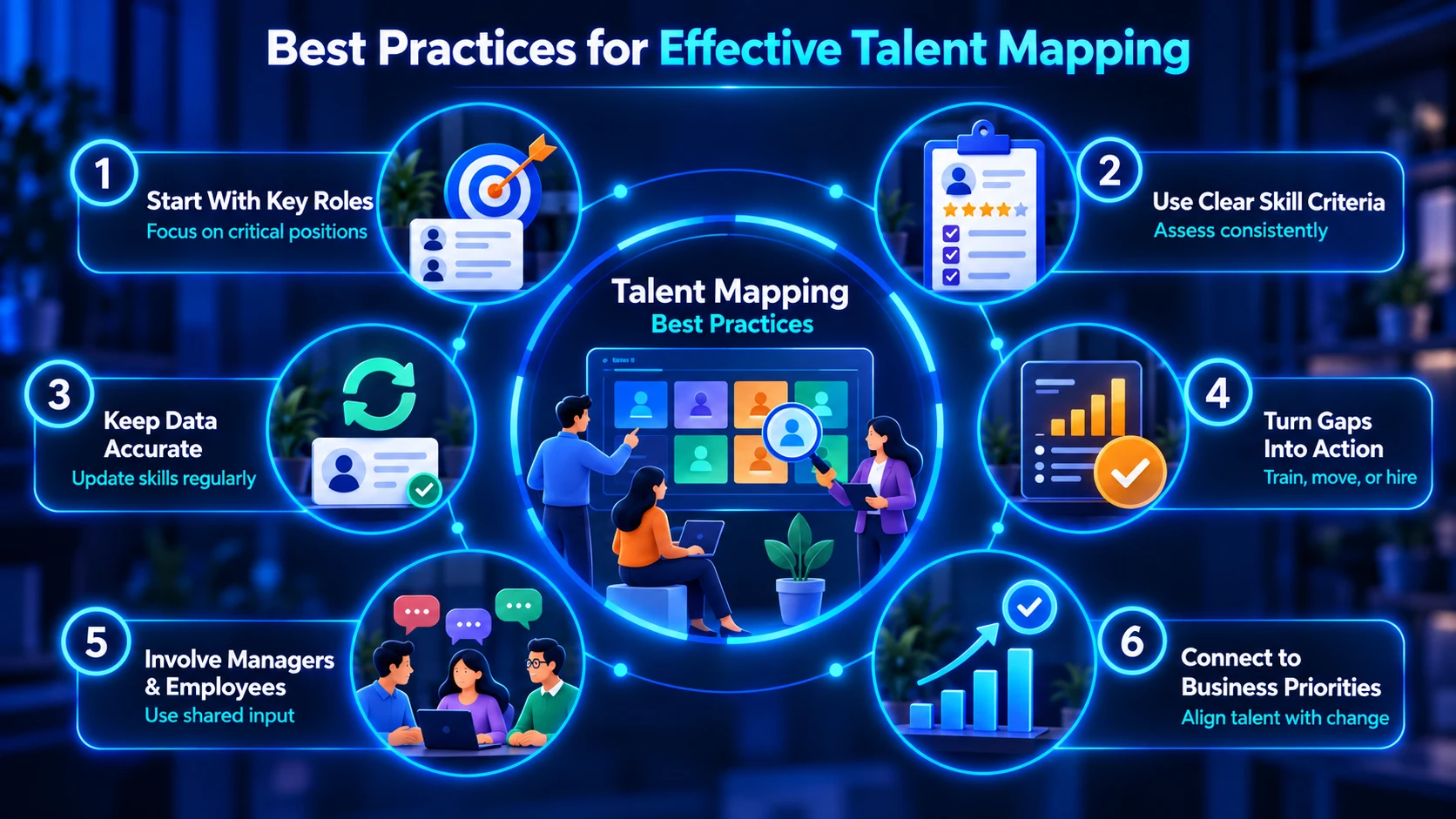
1. Start With the Roles That Matter Most
There is no need to map every role and skill at once. Start with positions that have a strong impact on business operations, growth, or continuity, and expand the process as needed.
This keeps the work manageable and helps teams focus on positions where a talent shortage could cause the most disruption.
2. Use Clear Criteria to Assess Skills
Talent assessments can become inconsistent when managers have different ideas about what each skill level means. Before assessing employees, define each level clearly and, where possible, base it on work people have actually done or skills they have demonstrated.
Job titles and years of experience can provide useful context, but they should not be the only things considered. Employees often build expertise through projects, previous roles, certifications, or hands-on experience that may not be visible in their current job description.
3. Keep Employee Data Accurate
Employees learn new skills, move into different positions, complete training, and take on new responsibilities. Their profiles need to keep up with those changes.
Regular updates help ensure that decisions are based on current information. Rather than creating a separate process, organizations can update talent information during performance discussions, development planning, and role changes.
4. Turn Gaps Into Specific Actions
Skills gaps are a significant challenge for employers. The World Economic Forum’s Future of Jobs Report 2025 found that 63% of employers identify skills gaps as a major barrier to business transformation. This makes it important for organizations to identify capability shortages early and have a clear plan for addressing them.
Once a gap has been identified, decide how it should be addressed. Depending on the situation, the answer could be employee development, internal movement, succession planning, or external hiring. Someone who is close to the required level may need targeted training or more practical experience, while a skill that is not available internally may need to be sourced from outside.
5. Involve Managers and Employees
HR can coordinate the process, but it should not have to provide all the information. Managers know what their teams do day to day, while employees can add useful details about their experience, skills, and areas they want to develop.
Bringing these views together gives the organization a more realistic picture of its workforce and makes development and career planning easier to act on.
6. Connect the Map to Business Priorities
What a business needs from its workforce can change when it enters a new market, adopts new technology, restructures teams, or changes direction. As priorities change, some roles and skills may become more important than they were before.
For that reason, the talent map should be revisited when there are major business changes. This allows HR and managers to update role requirements and adjust talent priorities based on what the business actually needs next.
The Future of Talent Mapping
alent mapping is moving from a static view of roles to a more skills-focused view of what people can do and where those capabilities may be needed next.Emerging trends include:
AI-driven talent analysis: AI can analyze workforce data, identify patterns, compare employee skills with role requirements, highlight potential matches, and support analysis of succession risks and future skill shortages.
Skills-first mapping: Organizations are placing more emphasis on skills, capabilities, transferable experience, and potential rather than relying only on job titles. This can help identify internal employees who may be suitable for future roles even if they have not held the exact position before.
Connected talent data: Recruitment, employee, training, and performance data can be connected to create a more complete view of an employee’s skills, experience, development, and potential.
Proactive talent pipelines: Instead of waiting for a position to become vacant, organizations can build internal and external talent pipelines in advance. These can include employees ready for promotion, employees who need further development, and external candidates with relevant skills.
Human judgment alongside technology: AI can identify patterns and potential matches, but HR professionals and managers still need to consider factors such as career goals, development, working relationships, and the specific requirements of a role when making decisions.
Continuous workforce planning: Talent mapping is becoming a more continuous process as skill requirements and career paths change. Organizations can combine employee data, skills information, market insights, and AI-supported analysis to understand current capabilities, future needs, and gaps.
Conclusion
Talent mapping gives organizations a practical way to understand the people they already have, the strengths they can build on, and the areas that need attention. When the process is well structured, it can support hiring, employee development, internal mobility, succession planning, and longer-term workforce planning.
The real value comes from understanding how talent information relates to the needs of the business. This can help HR teams and managers identify internal opportunities, capability gaps, and areas where additional hiring may be needed.
In the end, talent mapping is about being prepared rather than simply reacting when a role becomes difficult to fill or a capability is suddenly needed. A clear understanding of the people and resources already available gives organizations a stronger starting point for handling change, developing their teams, and planning what comes next.