Back to all blogs
Explore the complete virtual interview guide covering interview types, process, benefits, key features, best practices, and AI-powered hiring tools.

Hiring has changed dramatically over the last few years, and the virtual interview has become a standard part of modern recruitment. Instead of requiring candidates to visit an office for face-to-face meetings, employers now use online platforms to conduct interviews remotely through video calls, structured assessments, and AI-powered screening tools.
A virtual interview allows recruiters and hiring managers to assess candidates from anywhere, making hiring faster, more scalable, and cost-effective. Whether companies are hiring remote employees, expanding globally, or simply improving recruitment efficiency, virtual interviews have become a practical solution across industries.
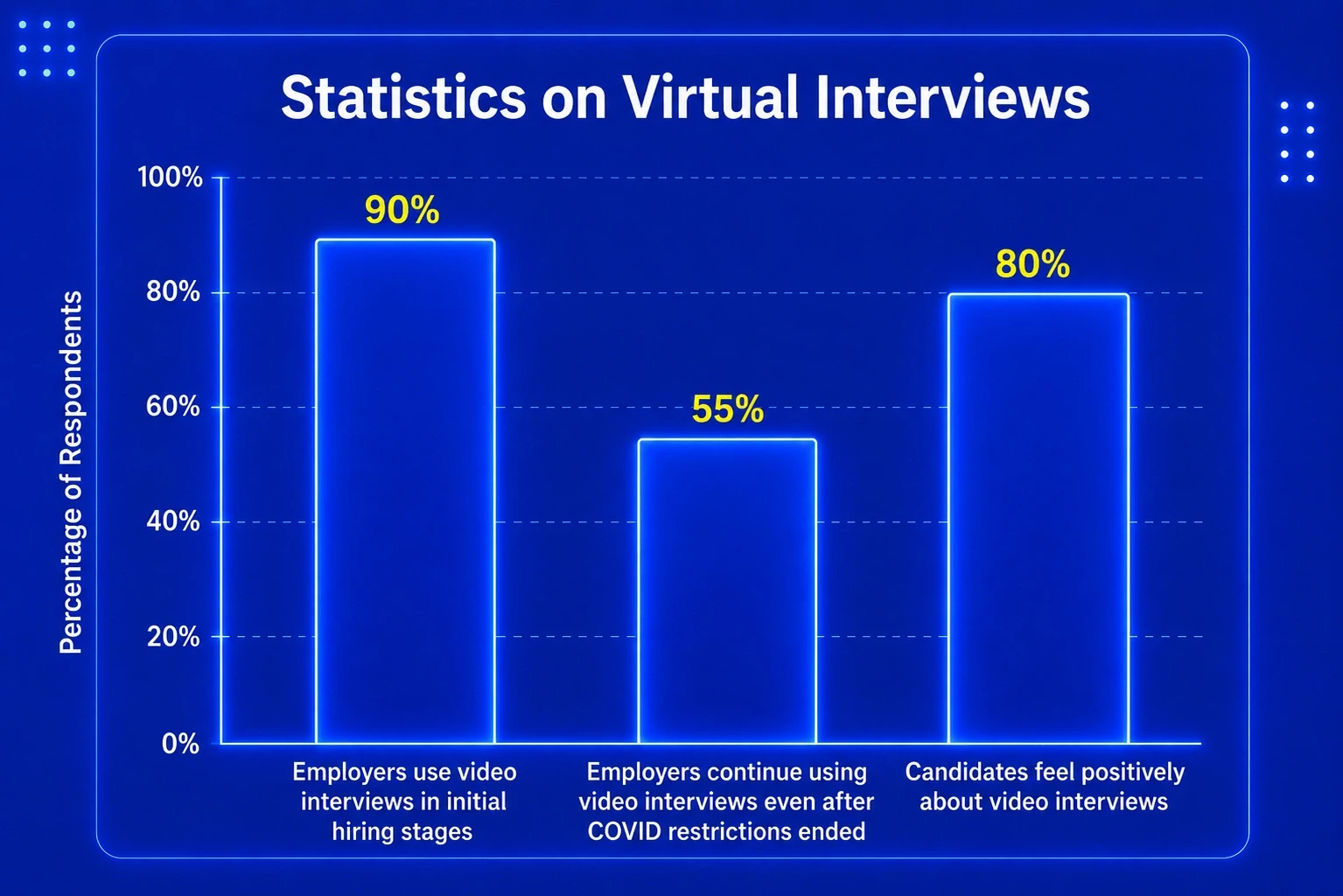
The shift is not temporary. Research shows that 92% of companies now conduct initial interviews virtually, while 84% of candidates prefer virtual first-round interviews because of convenience and flexibility. Additionally, 71% of organizations report reduced interview-to-hire time after adopting virtual hiring methods, proving that digital interviewing is helping businesses hire faster without compromising evaluation quality.
Virtual interviews are also changing how recruiters evaluate talent. Organizations increasingly rely on structured interview workflows, interview intelligence, and AI-driven insights to improve consistency and reduce hiring bias. At the same time, candidates benefit from lower travel costs, easier scheduling, and the ability to interview from any location. According to employer surveys, only a very small percentage of organizations now avoid virtual interviewing completely, showing how deeply it has become embedded in recruitment practices.
In this guide, we will explain what a virtual interview is, how the process works, different types of virtual interviews, benefits, challenges, best practices, and how AI-powered tools help organizations conduct smarter and more structured virtual hiring.
What is a Virtual Interview?
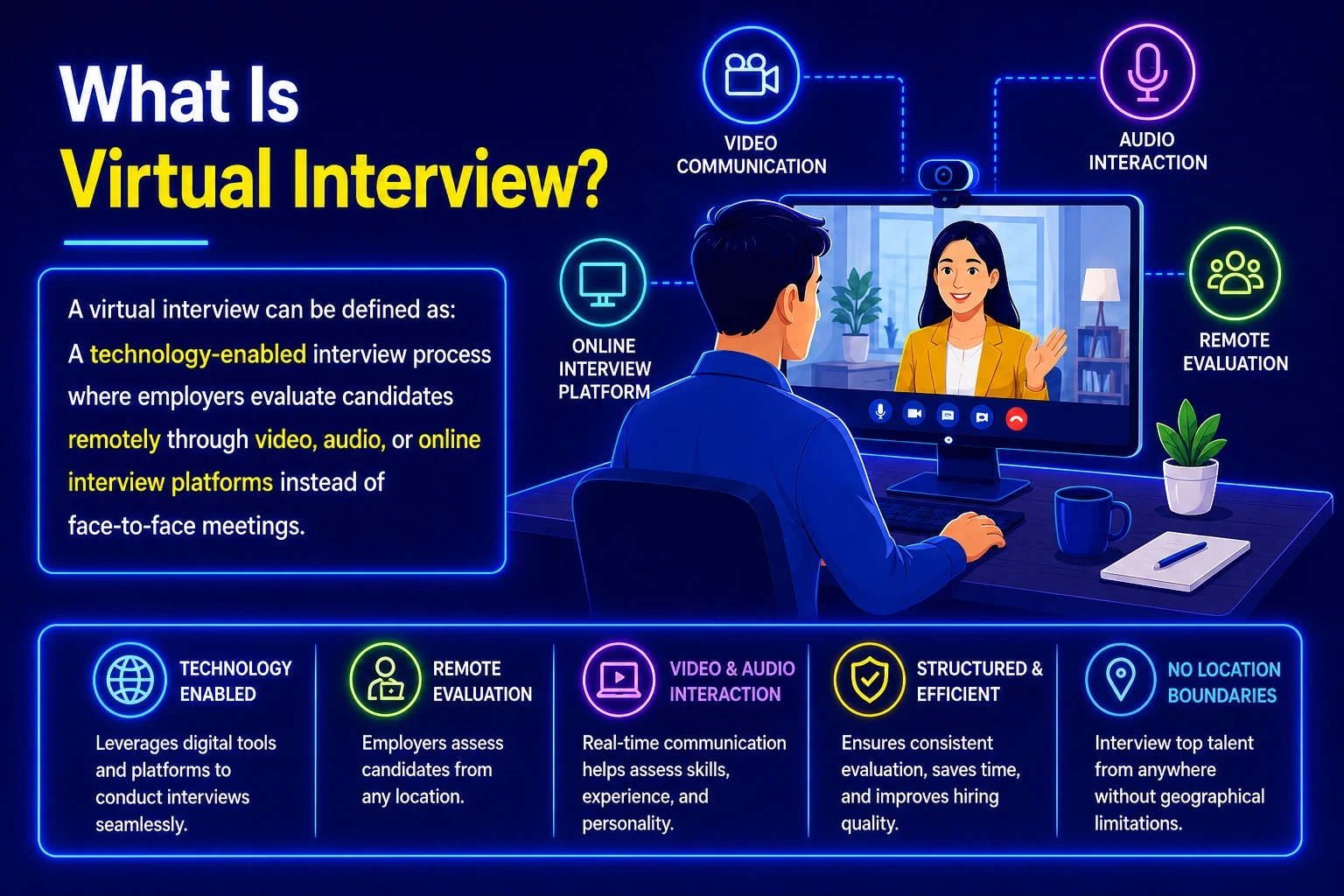
A virtual interview is a job interview conducted remotely using digital communication technology instead of an in-person meeting. Employers and candidates connect through video conferencing platforms, specialized hiring software, or AI-powered interview systems to evaluate skills, experience, and job fit.
In simple terms, the virtual interview meaning refers to an interview process where recruiters assess candidates online from different locations. Rather than meeting at an office, both parties communicate through tools such as Zoom, Microsoft Teams, Google Meet, or dedicated interview platforms.
Virtual interviews became more common during the rise of remote work, but today they are used by organizations of all sizes because they make hiring faster, more flexible, and easier to scale. Companies can interview candidates across cities, countries, and time zones without the delays and costs associated with travel.
For example:
A recruiter schedules a live video interview with a shortlisted candidate through Zoom.
A company sends candidates a one-way video interview where applicants record answers to pre-set questions.
Hiring teams use AI-powered interview tools to analyze responses, communication skills, and interview performance more consistently.
Unlike traditional interviews, virtual interviews often include digital workflows such as automated scheduling, structured interview questions, interview recordings, and real-time collaboration among hiring teams.
How Does a Virtual Interview Work?
A virtual interview process follows a structured online workflow where employers and candidates interact remotely through digital platforms. While the format may differ depending on the company, the overall process is similar to a traditional interview, except everything happens online.
Here is a step-by-step breakdown of how a virtual interview works:
1. Interview Invitation and Scheduling
The process begins when recruiters shortlist candidates and send an interview invitation through email or recruitment software. The invitation typically includes:
Interview date and time
Video meeting link
Platform details (Zoom, Microsoft Teams, Google Meet, or interview software)
Instructions for joining the interview
Any preparation requirements
Many organizations now use automated scheduling tools to reduce back-and-forth communication and simplify interview coordination.
2. Candidate Evaluation with Sherlock AI
During the interview, recruiters need to assess candidates accurately and consistently. Sherlock AI helps hiring teams streamline virtual interview evaluations through AI-powered interview intelligence and structured hiring workflows.
With Sherlock AI, recruiters can evaluate candidates based on several factors, including:
AI-generated interview summaries
Structured interview scorecards
Interview recordings and insights
Bias reduction through standardized evaluation
Unlike traditional virtual interviews that rely heavily on manual feedback, Sherlock AI helps organizations improve hiring consistency through structured interviews, AI-generated insights, and standardized evaluation methods.
This helps recruiters make faster, more confident, and data-driven hiring decisions during virtual interviews.
Hire Smarter with Sherlock AI |
3. Technical Setup Before the Interview
Before the interview begins, both employers and candidates usually test their equipment to avoid technical issues.
This includes checking:
Internet connection stability
Camera and microphone quality
Video conferencing software access
Lighting and background setup
Headphones or audio devices
A smooth technical setup helps create a professional interview experience and reduces disruptions during the discussion.
4. Joining the Virtual Interview
At the scheduled time, candidates join the interview through a meeting link or interview portal.
Depending on the company, the interview may involve:
A recruiter screening round
Hiring manager discussions
Technical interviews
Panel interviews with multiple stakeholders
AI-assisted structured interviews
In some cases, organizations also conduct one-way virtual interviews, where candidates record responses to predefined questions instead of attending a live session.
5. Feedback and Hiring Decision
After the interview, hiring teams review interview notes, feedback, and assessment results before making a decision.
Candidates are usually informed about:
Next interview rounds
Additional assessments
Hiring timelines
Offer status or feedback
For many organizations, virtual interviews significantly reduce hiring delays because recruiters can schedule interviews faster and collaborate remotely across teams.
Types of Virtual Interviews
Virtual interviews come in different formats depending on hiring goals, role requirements, and recruitment stages. While some interviews happen in real time, others allow candidates to respond at their convenience or participate in structured assessments.
Here are the five most common types of virtual interviews used by employers today:
1. One-On-One Video Interview
A one-on-one video interview is a live virtual interview conducted in real time between a recruiter or hiring manager and a candidate.
This format closely resembles a traditional face-to-face interview, except both participants join remotely through video conferencing platforms such as Zoom, Microsoft Teams, or Google Meet.
Recruiters commonly use one-on-one interviews to:
Evaluate communication skills
Understand candidate experience
Assess role suitability
Conduct behavioral and situational interviews
Best for: Initial screening and final-stage candidate discussions.
2. Asynchronous Video Interview
An asynchronous video interview, also called a pre-recorded interview, allows candidates to record responses to predefined interview questions at their convenience.
Instead of attending a live session, applicants receive a list of questions and submit recorded answers through video interview software.
This format helps employers:
Screen a large number of applicants faster
Reduce scheduling conflicts
Standardize early-stage candidate evaluation
Improve hiring efficiency
Best for: High-volume hiring and early-stage screening.
3. Panel Virtual Interview
A panel virtual interview involves multiple interviewers evaluating a candidate during the same online session.
Typically, recruiters, hiring managers, department leaders, or technical experts participate together to assess different competencies and perspectives.
Panel interviews help organizations:
Reduce multiple interview rounds
Gather collaborative feedback
Speed up hiring decisions
Improve evaluation consistency
Best for: Leadership roles and cross-functional hiring.
4. Virtual Assessment Centre
A virtual assessment centre is a structured interview process where candidates participate in multiple evaluations, tests, and exercises remotely.
These assessments may include:
Skill-based evaluations
Group discussions
Problem-solving exercises
Role-play scenarios
Situational judgment tests
Employers use virtual assessment centres to evaluate candidate knowledge, collaboration skills, and overall job readiness more comprehensively.
Best for: Graduate hiring, leadership hiring, and role-specific assessments.
5. Virtual Job Fair
A virtual job fair is an online hiring event where job seekers can connect with multiple employers remotely without attending an in-person event.
Companies use virtual job fairs to:
Meet a large number of candidates
Promote employer branding
Conduct initial screening conversations
Fill roles faster across locations
This format creates opportunities for recruiters and candidates to interact efficiently through video meetings, chat tools, and online event platforms.
Best for: Large-scale hiring and employer outreach.
Statistics on Virtual Interviews
Source: StandOut CV
Benefits of Virtual Interviews
Virtual interviewing has brought several advantages that make recruitment faster, more flexible, and easier to manage. By moving interviews online, organizations can improve hiring efficiency while creating a better experience for candidates.
Here are six key benefits of virtual interviews.
1. Convenience and Accessibility
Organizations can reach a much larger candidate pool by using digital communication platforms. With virtual interviews, geographical limitations no longer restrict hiring decisions.
Recruiters can connect with candidates across different cities, states, or countries without requiring travel, making hiring more accessible and efficient.
Candidates also benefit from the convenience of attending interviews from any location.
2. Fewer Cancellations Accelerating Recruitment
Organizations can simplify interview scheduling and improve communication between recruiters and candidates through virtual hiring. Since interviews happen online, travel issues and location-based scheduling conflicts are significantly reduced.
This streamlined process helps companies reduce cancellations, shorten hiring timelines, and move candidates through recruitment stages more efficiently.
Recruiters can also schedule interviews faster, improving overall hiring speed and candidate engagement.
3. Time and Cost Efficiency
Without the need to conduct in-person interviews, organizations can save substantial time and recruitment costs. Virtual interviews eliminate travel expenses, office logistics, and additional administrative coordination.
Recruiters can also interview candidates from different locations without delays, helping companies make hiring decisions faster.
For candidates, virtual interviews reduce travel time and expenses, creating a more convenient interview experience.
4. Enhanced Schedule Flexibility
Personal and professional commitments can make scheduling interviews challenging for both employers and candidates. Virtual interviews offer greater flexibility by allowing participants to join from any location.
Recruiters can coordinate interviews across different time zones, while candidates can plan interviews around their availability more easily.
This flexibility makes the hiring process more efficient and convenient for everyone involved.
5. Better Process Consistency
Virtual interviews help organizations create a more structured and standardized hiring process. Interview recordings and evaluation frameworks allow recruiters to review discussions and assess candidates more consistently.
With Sherlock AI, hiring teams can improve process consistency through features such as AI-generated interview summaries, structured interview scorecards, interview recordings, and standardized evaluation workflows.
This helps organizations make more informed and reliable hiring decisions.
6. Expanded Candidate Pool
Virtual interviews allow organizations to access talent beyond geographical boundaries. Employers can connect with candidates from different regions without requiring them to travel for interviews.
Candidates can participate in the hiring process remotely, evaluate opportunities from the comfort of their homes, and complete interviews without additional expenses.
This wider reach helps organizations find specialized talent faster and improve recruitment outcomes.
Key Features of a Virtual Interview
New virtual interview platforms come with many features to enhance remote hiring. These features not only replicate the traditional functions of an interview. They also create better ways to improve communication, assessment, and collaboration. These tools help employers conduct comprehensive assessments of candidates.
These platforms also make it easy and professional to interact with applicants. Features such as video conferencing, screen sharing, and assessment integration improve the interview process. Plus, employers can store interview records for future reference.
Here are key features of a virtual interview to consider.
Video and Audio: Video and audio quality are important for conducting successful virtual interviews. Clear communication helps recruiters assess candidates effectively while creating a professional interview experience. High-quality video and audio improve communication between recruiters and candidates and help reduce disruptions during interviews.
Screen Share: Screen-sharing features allow candidates to showcase portfolios, present projects, or demonstrate tasks during interviews. This helps recruiters better evaluate practical skills and compare candidate performance when interviews are recorded for future reference.
Automated Scheduling: Automated scheduling helps organizations avoid calendar clashes and simplifies interview coordination between recruiters and candidates. This feature improves scheduling efficiency, reduces delays, and helps organizations move candidates through the hiring process faster.
Integrated Assessments: Integrated assessments allow recruiters to evaluate candidate skills during or after the interview process. Organizations can use these assessments to conduct technical evaluations, role-specific testing, and practical skill assessments for more informed hiring decisions.
Chat and File Sharing: Chat and file-sharing features create a dedicated space for sharing notes, links, resumes, portfolios, or interview-related documents. This improves communication between recruiters and candidates while keeping the hiring process more organized and collaborative.
Best Practices for a Successful Virtual Interview
A successful virtual interview requires preparation from both recruiters and candidates. Since interviews happen online, technical setup, communication, and structure play an important role in creating a smooth and professional experience.
Here are some best practices for conducting successful virtual interviews.
For Employers
1. Create a Structured Interview Process
A well-defined interview structure helps recruiters maintain consistency across all candidate evaluations.
Organizations should prepare:
Standardized interview questions
Clear evaluation criteria
Defined interview stages
Role-specific assessment frameworks
Structured interviews help improve fairness and decision-making.
2. Test Technology Before the Interview
Technical issues can interrupt interview flow and create a poor experience.
Before the interview, recruiters should ensure:
Internet connection is stable
Camera and microphone are working properly
Interview platform links are functional
Backup communication methods are available
A quick technology check can prevent unnecessary disruptions.
3. Minimize Distractions
Distractions during virtual interviews can affect communication and reduce interview quality.
Before the interview, recruiters should ensure:
Background noise is minimized
Notifications and interruptions are avoided
Lighting and audio quality are clear
The interview environment is professional
A distraction-free setup helps maintain professionalism and improves communication during interviews.
4. Use Structured Evaluation Methods
Consistent evaluation criteria help organizations compare candidates fairly.
Platforms like Sherlock AI help recruiters maintain interview consistency through:
Structured interview scorecards
AI-generated interview summaries
Interview recordings for review
Standardized evaluation workflows
This helps hiring teams make more informed hiring decisions.
For Candidates
1. Test Your Technical Setup
Candidates should test their devices before the interview to avoid technical disruptions.
This includes checking:
Internet connection
Camera and microphone
Headphones or speakers
Video conferencing access
Being technically prepared creates a smoother interview experience.
2. Choose a Professional Environment
A professional interview setup helps candidates create a positive first impression during virtual interviews.
Before the interview, candidates should ensure:
The interview location is quiet and distraction-free
Lighting is clear and professional
Backgrounds look clean and organized
Noise and interruptions are minimized
A professional environment helps candidates stay focused and improves the overall interview experience.
3. Prepare Like an In-Person Interview
Virtual interviews should be treated with the same seriousness as face-to-face interviews.
Candidates should:
Research the company
Practice common interview questions
Keep resumes or notes ready
Dress professionally
Preparation improves confidence and interview performance.
4. Maintain Professional Communication
Good communication plays an important role in virtual interviews and helps create a stronger impression.
During the interview, candidates should ensure:
Eye contact is maintained with the camera
Responses are clear and professional
Active listening is practiced
Interruptions are avoided during discussions
Strong communication skills help candidates build better engagement and perform more confidently during virtual interviews.
Virtual Interview vs Similar Interview Types
Virtual interviews are often compared with other recruitment formats because they share similar goals but differ in how they are conducted. Understanding these differences helps organizations choose the right interview format based on hiring needs and candidate experience.
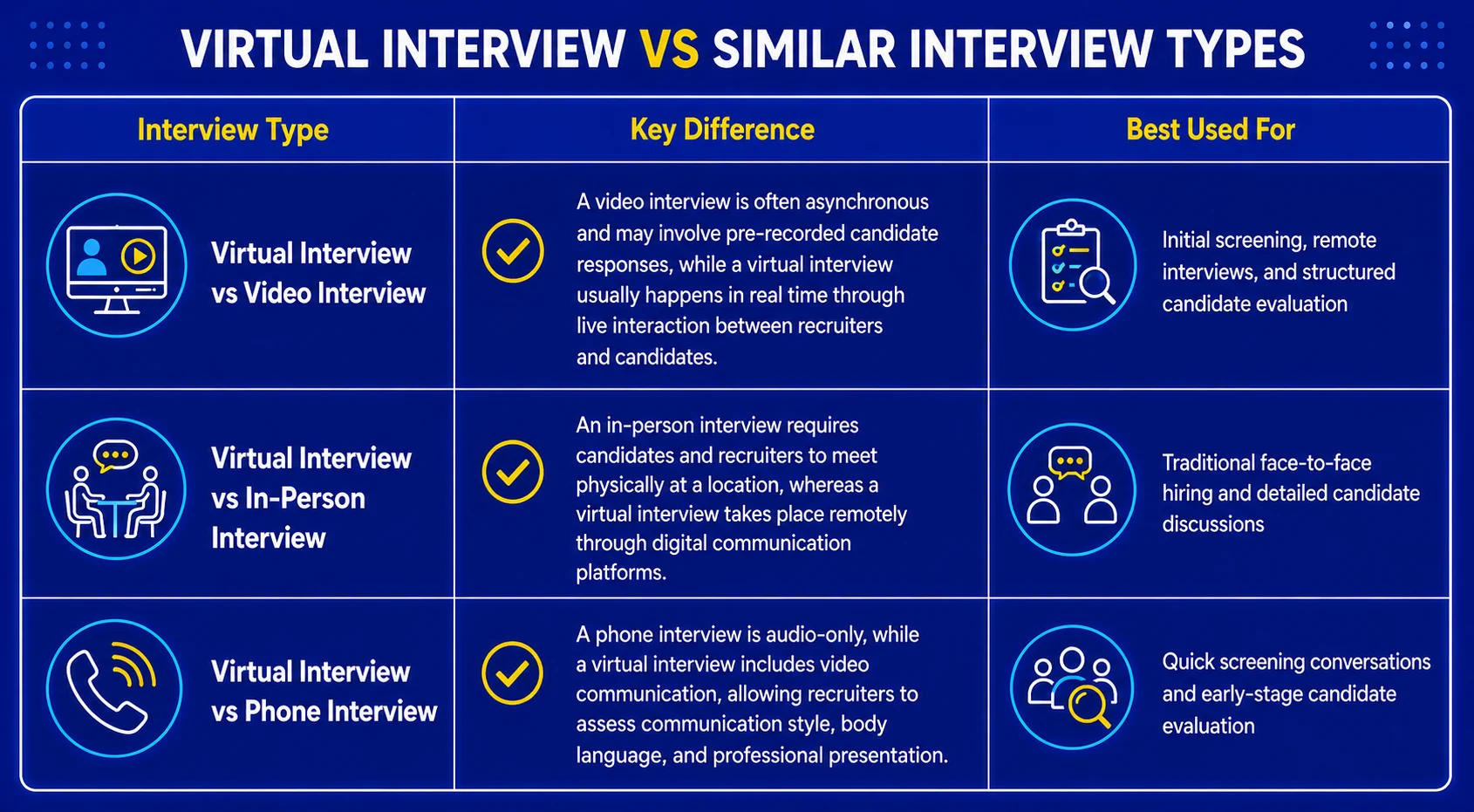
Understanding these distinctions can help organizations build a more effective hiring process by choosing the right interview format for each recruitment stage.
How Sherlock AI Helps in Virtual Hiring
Sherlock AI helps organizations conduct secure, structured, and reliable virtual interviews through interview integrity monitoring, AI-assisted evaluation, and interview intelligence features. Below are the exact Sherlock AI features relevant to virtual hiring.
1. AI Fraud Detection
One of Sherlock AI’s core capabilities is detecting AI-assisted cheating and interview fraud during remote interviews. The platform monitors candidate behavior, audio environments, and device activity to identify suspicious activity that may affect interview integrity. This includes detecting AI-assisted responses and deepfake-related fraud risks during virtual interviews.
This feature helps organizations:
Protect interview integrity
Detect suspicious candidate behavior in real time
Reduce risks of AI-assisted cheating in remote hiring
Conduct more authentic candidate evaluations
2. AI Fluency Observation
When organizations allow candidates to use AI tools during interviews or problem-solving assessments, Sherlock AI evaluates how effectively candidates use AI instead of simply restricting it.
Sherlock becomes contextually aware of AI usage and observes how candidates leverage tools to solve problems, communicate reasoning, and complete tasks. This helps recruiters understand a candidate’s practical AI skills and adaptability in AI-enabled work environments.
This feature helps recruiters:
Evaluate responsible AI usage during interviews
Assess candidate problem-solving with AI assistance
Understand AI fluency levels
Identify candidates who can work effectively with AI tools
3. Notetaking & Insights
Sherlock AI automatically captures interview notes and generates interview insights during virtual interviews, reducing the need for recruiters to manually document conversations.
Instead of relying on separate note-taking tools, hiring teams receive interview documentation and performance-related insights directly within the platform. This makes interviews easier to review and improves collaboration across hiring teams.
This feature helps organizations:
Automatically document interview conversations
Reduce manual note-taking effort
Improve interviewer collaboration
Review candidate performance more efficiently
4. Real-Time Commentary During Interviews
During live interviews, Sherlock AI provides real-time commentary and alerts when suspicious interview activity is detected. This allows interviewers to stay focused on evaluating candidates while Sherlock monitors interview integrity in the background.
This helps organizations:
Monitor interview behavior in real time
Receive alerts for suspicious activity
Improve interview reliability
Focus more on candidate evaluation
5. Calendar & Interview Workflow Integration
Sherlock AI integrates with interview scheduling workflows by connecting with calendars such as Google, Apple, and Outlook. Recruiters can permit Sherlock to automatically join interview meetings and secure the interview process without disrupting existing workflows.
This helps recruiters:
Simplify interview coordination
Integrate Sherlock into existing workflows
Automate secure interview participation
Reduce manual setup during virtual hiring
Sherlock AI helps recruiters move beyond basic video interviewing by combining AI fraud detection, AI fluency observation, automated note-taking, real-time interview commentary, and workflow integrations into one platform.
This allows organizations to conduct virtual interviews more securely, evaluate candidates more effectively, and make better hiring decisions while maintaining interview integrity.
Conclusion
Virtual interviews have transformed modern hiring by making recruitment faster, more flexible, and easier to scale. Organizations no longer need to rely entirely on in-person meetings, as recruiters can evaluate candidates remotely through video interviews, structured assessments, and digital collaboration tools. This shift has helped companies reduce hiring delays, improve scheduling flexibility, and access talent from a much wider geographic pool.
As virtual hiring becomes more common, organizations also face new challenges related to interview consistency, candidate evaluation, and interview integrity. Creating a structured interview process, using standardized evaluation methods, and maintaining a professional candidate experience are essential for making virtual interviews effective. Companies that invest in better workflows can improve both hiring quality and recruitment efficiency.
AI-powered platforms like Sherlock AI further strengthen virtual hiring by helping organizations conduct more structured, secure, and data-driven interviews. Features such as AI fraud detection, AI fluency observation, automated note-taking, real-time interview commentary, and workflow integrations help recruiters improve decision-making while maintaining interview integrity. As remote and hybrid work continue to evolve, virtual interviews will remain an essential part of successful hiring strategies.
Enhance your virtual interview process with AI-powered interview intelligence, fraud detection, automated insights, and structured evaluation workflows. Discover how Sherlock AI helps teams conduct secure, efficient, and high-quality virtual hiring. Explore Sherlock AI and transform the way you hire remotely. |