Back to all blogs
Learn how to build a stronger remote hiring process with 15 proven virtual recruitment strategies covering employer branding, AI screening, interviews, onboarding, and candidate experience.

Remote hiring is no longer a temporary solution. It has become a core talent acquisition strategy for companies looking to hire faster, reduce recruitment costs, and access global talent. As businesses continue to embrace distributed teams, organizations are investing heavily in virtual recruitment strategies that help them attract, assess, and hire the right candidates without traditional face to face interactions.
The shift toward remote hiring is growing rapidly. According to Virtual Vocations, more than 424,778 remote jobs were posted in 2025, making it the strongest year on record for remote work opportunities. This signals continued employer confidence in virtual hiring and distributed workforce models.
At the same time, candidate expectations are changing. Remote and hybrid flexibility now influence where people choose to work, making virtual hiring processes a competitive advantage for employers trying to secure top talent. Research also shows that remote opportunities attract significantly higher application volumes compared to traditional roles, giving businesses access to a broader and more diverse talent pool.
However, successful remote hiring requires more than simply moving interviews online. Companies need clear virtual recruitment strategies for remote hiring that improve candidate experience, maintain hiring quality, reduce bias, and prevent hiring fraud. Recruiters today face challenges such as virtual interview impersonation, AI assisted cheating during assessments, poor candidate engagement, and inconsistent evaluation methods. These issues make a structured and technology enabled recruitment process more important than ever.
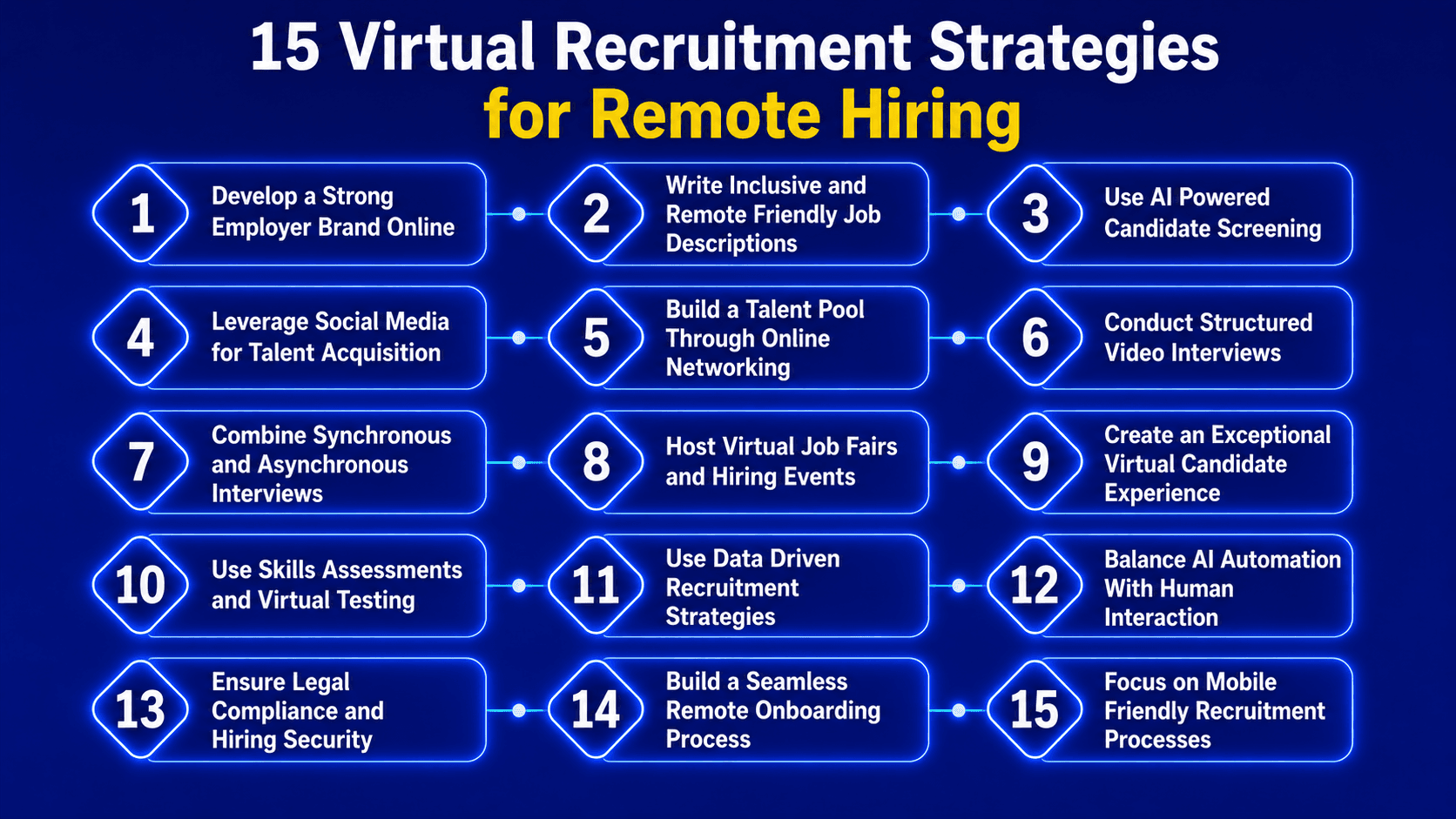
15 Virtual Recruitment Strategies for Remote Hiring
Below we will explore the most effective virtual recruitment strategies modern HR teams use to improve hiring outcomes. From building a strong employer brand and conducting virtual interviews to using AI powered assessments, data driven recruitment, and remote onboarding, this guide will help you create a smarter and more secure remote hiring process.
Whether you are hiring across cities, countries, or fully remote teams, these strategies can help you attract better candidates and make more confident hiring decisions.
1. Develop a Strong Employer Brand Online
One of the most effective virtual recruitment strategies is building a strong employer brand online. In a remote hiring environment, candidates often evaluate companies entirely through digital interactions. Your website, social media presence, employee reviews, career pages, and virtual communication shape how potential candidates perceive your organization.
A strong employer brand helps companies attract high quality remote talent faster. Candidates want to understand your company culture, leadership values, workplace flexibility, growth opportunities, and employee experience before applying. When this information is not easily available online, top candidates may move toward competitors with a stronger digital presence.
To strengthen your employer brand for remote hiring:
Create a dedicated careers page that highlights remote work culture and employee benefits
Share employee success stories, workplace culture, and team achievements across social media channels
Publish behind the scenes content, leadership insights, and company updates
Encourage employees to share authentic workplace experiences on professional platforms
Clearly communicate company values, expectations, and remote work policies
Video content can also improve virtual hiring outcomes. Employee testimonials, team introductions, and workplace culture videos help candidates better understand the organization before interviews. Since remote recruitment reduces face to face interaction, these digital touchpoints help build trust and engagement.
Employer branding also plays an important role in improving candidate confidence. Before attending a virtual interview, most applicants research a company online to assess credibility, culture, and long term career opportunities.
Organizations with strong employer branding often see better application quality, improved offer acceptance rates, and lower hiring costs. In a competitive hiring market, a strong digital presence can become a major advantage for attracting top remote talent.
2. Write Inclusive and Remote Friendly Job Descriptions
A well written job description is one of the most important virtual recruitment strategies for attracting qualified remote candidates. Since applicants cannot experience your workplace in person, job descriptions need to provide clear expectations about responsibilities, communication, work structure, and company culture.
Many organizations lose strong candidates because job descriptions are either too vague, overly complicated, or unintentionally biased. Remote hiring requires even more clarity because candidates need to understand how the role operates in a distributed work environment.
To create effective remote friendly job descriptions, focus on transparency. Clearly explain the role, required skills, expectations, working hours, collaboration methods, and whether the position is fully remote, hybrid, or location specific. If there are timezone requirements or travel expectations, mention them early to avoid confusion during the hiring process.
Inclusive language also plays a major role in attracting diverse talent. Avoid jargon, gender coded language, or unrealistic qualification requirements that may discourage qualified applicants from applying. Instead, focus on essential skills and outcomes rather than creating an overly restrictive list of requirements.
Your job descriptions should also communicate what candidates gain by joining your company. Highlight career growth opportunities, flexibility, learning programs, team culture, and employee benefits. Candidates are more likely to apply when they understand the value your organization offers.
A strong remote job description typically includes:
Clear responsibilities and day to day expectations
Required and preferred qualifications
Work schedule and timezone expectations
Remote work policies and collaboration tools
Compensation, benefits, and growth opportunities
Clear and inclusive job descriptions help organizations attract better applicants, reduce mismatched expectations, and improve hiring efficiency throughout the virtual recruitment process.
3. Use AI Powered Candidate Screening
As hiring volumes increase, manually reviewing hundreds or even thousands of applications can slow down the recruitment process. This is why many organizations are adopting AI powered candidate screening as part of their virtual recruitment strategies to improve hiring speed and efficiency.
AI screening tools help recruiters identify qualified candidates faster by analyzing resumes, skills, experience, job fit, and assessment results. Instead of spending hours sorting applications manually, recruiters can prioritize candidates who best match the role requirements.
In remote hiring, speed matters. Top candidates often receive multiple opportunities at the same time, and delayed communication can result in losing strong talent. AI powered recruitment tools help reduce time to hire by automating repetitive tasks such as resume screening, interview scheduling, candidate communication, and early stage assessments.
However, effective candidate screening goes beyond matching keywords in resumes. Companies should focus on evaluating skills, experience, behavioral patterns, and role specific capabilities rather than relying only on resume filters. A balanced approach helps improve hiring accuracy and reduces the risk of overlooking qualified candidates.
To make AI powered screening more effective:
Use structured evaluation criteria for every role
Combine resume screening with skills assessments
Monitor recruitment data to improve shortlisting accuracy
Reduce bias by standardizing evaluation methods
Keep human review involved for final hiring decisions
For remote hiring, organizations are also increasingly using AI to strengthen hiring integrity. Virtual interviews and online assessments can sometimes involve impersonation, external assistance, or AI generated responses that make candidate evaluation difficult.
Platforms like Sherlock AI help organizations strengthen remote hiring by detecting suspicious behavior during interviews and assessments, helping recruiters make more confident hiring decisions while maintaining fairness.
When used correctly, AI powered screening improves efficiency without removing the human element from recruitment. The goal is not to replace recruiters but to help them make faster and better hiring decisions.
4. Leverage Social Media for Talent Acquisition
Social media has become one of the most effective channels for sourcing remote talent. Traditional job boards still play an important role, but many qualified candidates actively engage on professional networks, industry communities, and social platforms where recruiters can build stronger relationships and improve hiring outcomes.
According to research from CareerArc, 86% of job seekers use social media in their job search, making social recruiting an important part of modern virtual hiring strategies. This growing shift means organizations that actively recruit through social platforms often gain access to a larger and more engaged talent pool.
Professional platforms such as LinkedIn are especially valuable for remote hiring because recruiters can search candidates based on skills, industry experience, certifications, and geographic flexibility. At the same time, platforms such as X, Instagram, GitHub, and niche online communities can help organizations reach specialized talent pools depending on the role.
To improve social media recruitment efforts:
Share job openings with clear remote work expectations
Publish employee stories, company culture content, and workplace updates
Engage with industry conversations and professional communities
Encourage employees to share openings through personal networks
Use targeted campaigns to reach specific talent segments
Content plays a major role in social recruiting success. Candidates are more likely to engage with organizations that consistently share valuable insights, team culture, employee experiences, and growth opportunities. A strong social presence also builds trust, especially in remote hiring where candidates often evaluate organizations online before applying.
Recruiters should also focus on building relationships rather than only posting jobs. Engaging with professionals, joining industry groups, and maintaining talent communities can create a stronger long term hiring pipeline.
When used strategically, social media helps organizations attract better candidates, improve employer visibility, and create a stronger remote hiring process.
5. Build a Talent Pool Through Online Networking
Building a strong talent pipeline is one of the most valuable virtual recruitment strategies for long term hiring success. Instead of starting from scratch every time a position opens, organizations can create a network of qualified candidates who are already familiar with the company and interested in future opportunities.
Online networking helps recruiters connect with both active and passive candidates. While active candidates are actively searching for jobs, passive candidates may not be applying but are open to the right opportunity. Creating relationships early makes future hiring faster and more efficient.
Recruiters can build stronger remote talent pools by participating in industry communities, attending virtual events, hosting webinars, and engaging in professional forums. Platforms such as LinkedIn groups, Slack communities, GitHub, and industry specific online spaces can help organizations connect with specialized talent based on role requirements.
Employee referral programs also play an important role in online networking. Employees often have access to trusted professional networks, helping companies reach qualified candidates faster while improving hiring quality.
To build a stronger virtual talent pool:
Stay connected with past applicants and silver medal candidates
Engage with professionals through online communities and networking groups
Host webinars, virtual meetups, or industry discussions
Encourage employee referrals for remote positions
Build candidate databases for future hiring needs
Creating a long term talent pipeline also improves hiring speed. Instead of restarting sourcing efforts for every role, recruiters can engage pre qualified candidates who already understand the company and its culture.
Companies that invest in online networking often experience lower hiring costs, faster recruitment cycles, and better candidate quality. In remote hiring, where competition for talent is high, building relationships before hiring needs arise can create a major competitive advantage.
6. Conduct Structured Video Interviews
Video interviews have become a standard part of remote hiring, but without a clear structure, they can lead to inconsistent evaluations and poor hiring decisions. Conducting structured video interviews is one of the most effective virtual recruitment strategies for improving fairness, consistency, and candidate assessment.
In many virtual hiring processes, different interviewers ask different questions, evaluate candidates differently, and focus on unrelated criteria. This inconsistency can make it difficult to compare candidates objectively. A structured interview process helps organizations standardize evaluations and improve hiring accuracy.
To conduct more effective virtual interviews, create a consistent framework for every role. Define interview stages, prepare role specific questions, and establish clear evaluation criteria before interviews begin. Every candidate should be assessed against the same skills, competencies, and performance expectations.
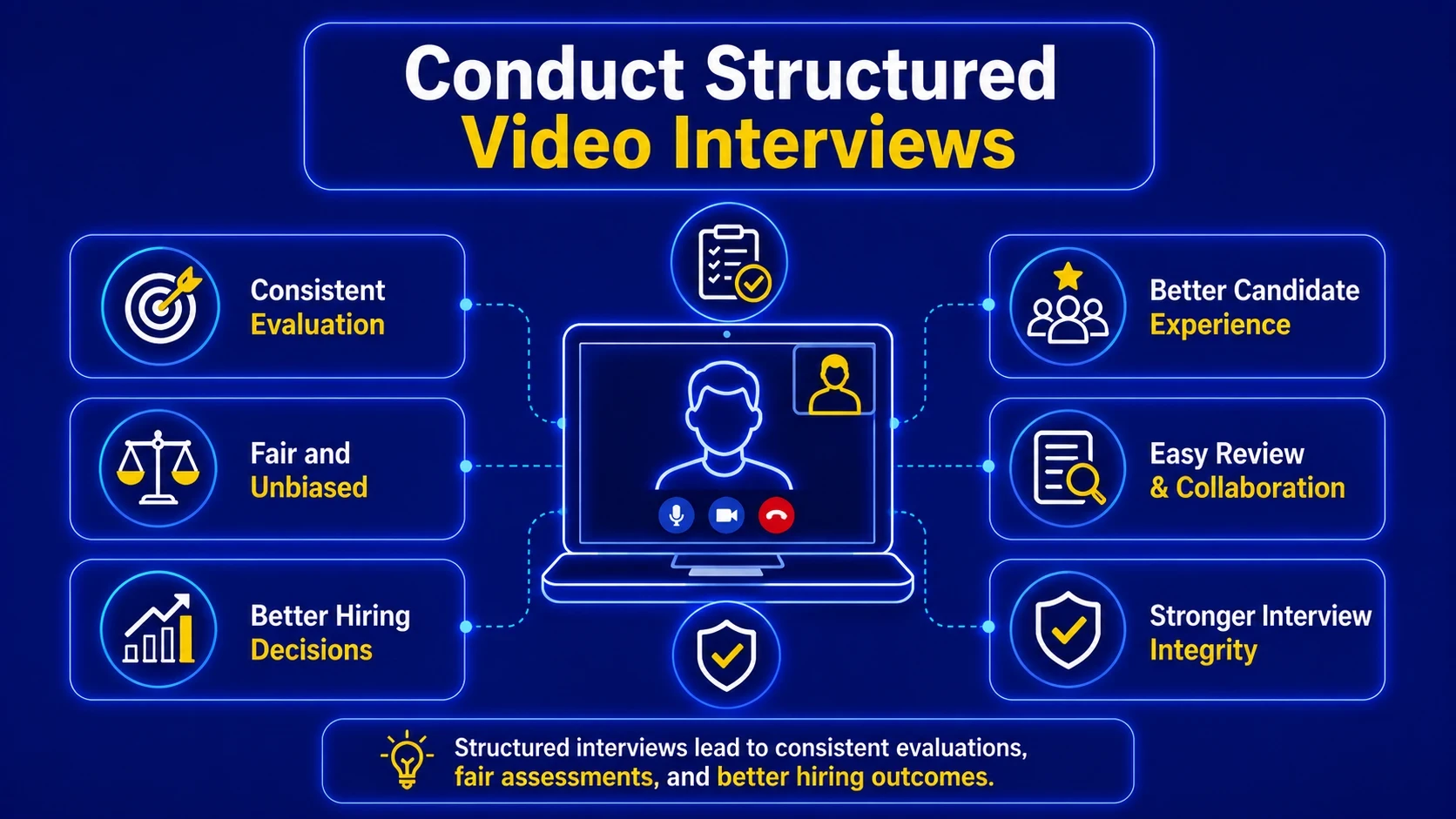
Structured video interviews can help evaluate:
Technical and role specific knowledge
Communication and collaboration skills
Problem solving ability
Cultural and team fit
Adaptability in remote work environments
Recruiters should also create a positive interview experience by sharing schedules in advance, minimizing technical issues, and maintaining clear communication throughout the process. A smooth virtual interview reflects positively on employer branding and improves candidate engagement.
Recording interviews for internal review can also help reduce bias and improve hiring consistency, especially when multiple stakeholders are involved in decision making.
However, remote interviews also introduce new challenges such as impersonation, external assistance, and AI generated responses during interviews. As virtual hiring grows, many organizations are adopting interview integrity tools to strengthen hiring confidence and ensure candidates are evaluated fairly.
A structured video interview process helps organizations make better hiring decisions while creating a more professional and transparent candidate experience.
7. Combine Synchronous and Asynchronous Interviews
One of the most effective virtual recruitment strategies for remote hiring is combining synchronous and asynchronous interviews. This approach helps organizations improve scheduling flexibility, speed up hiring, and create a smoother experience for candidates across different locations and time zones.
Synchronous interviews are live interactions conducted through video calls or phone conversations. These interviews allow recruiters to evaluate communication skills, problem solving ability, cultural fit, and real time responses. Live interviews are especially useful for final stage discussions, technical evaluations, and team interactions.
Asynchronous interviews, on the other hand, allow candidates to respond to pre recorded questions at a convenient time. Recruiters can review responses later, making it easier to screen a large number of applicants without scheduling conflicts.
This combination is particularly useful for remote hiring because candidates may be located in different countries or work across varying time zones. Instead of delaying hiring decisions due to scheduling challenges, organizations can use asynchronous interviews for initial screening and reserve live interviews for shortlisted candidates.
A balanced interview process can include:
Asynchronous video interviews for early stage screening
Live interviews for deeper skill and behavioral evaluation
Technical assessments between interview rounds
Panel discussions for role specific collaboration assessment
Using both formats also improves hiring efficiency. Recruiters spend less time coordinating schedules while candidates gain greater flexibility during the hiring process.
However, organizations should maintain consistency in evaluation standards across both interview types. Candidates should be assessed using clear criteria to ensure fairness and reduce bias.
When used effectively, synchronous and asynchronous interviews help organizations reduce hiring delays, improve candidate experience, and make better remote hiring decisions.
8. Host Virtual Job Fairs and Hiring Events
Virtual job fairs and online hiring events have become effective ways for organizations to connect with a larger talent pool without geographic limitations. As remote hiring continues to grow, companies are increasingly using digital recruitment events to attract candidates, improve employer visibility, and accelerate hiring.
Unlike traditional job fairs, virtual hiring events allow recruiters to engage with candidates from different cities, countries, and professional backgrounds through online platforms. This creates more opportunities to attract qualified remote talent while reducing travel and operational costs.
Virtual job fairs can be especially valuable for organizations hiring at scale, recruiting for specialized roles, or expanding into new markets. They also help companies strengthen employer branding by giving candidates direct access to recruiters, hiring managers, and current employees.
A successful virtual hiring event may include:
Live Q&A sessions with recruiters and hiring managers
Role specific breakout rooms for candidates
Virtual company presentations and workplace culture sessions
Networking opportunities with teams and leadership
Instant application and interview scheduling options
To increase participation, organizations should promote virtual hiring events across career pages, social media channels, email campaigns, and professional communities. Providing clear information about roles, requirements, and event schedules also improves candidate engagement.
Virtual recruitment events can also improve candidate experience by making hiring more accessible and convenient. Candidates can participate from anywhere without travel barriers, helping organizations connect with more diverse talent.
When planned effectively, virtual job fairs help companies build stronger talent pipelines, improve hiring efficiency, and create meaningful engagement with potential candidates before formal interviews begin.
9. Create an Exceptional Virtual Candidate Experience
Candidate experience plays a major role in remote hiring success. In a virtual recruitment process, candidates often interact with your organization entirely through digital channels. Every interaction, from the application process to interview communication, shapes how candidates perceive your company.
A poor experience can lead qualified candidates to drop out of the hiring process or accept offers elsewhere. Delayed responses, unclear expectations, technical issues, and inconsistent communication are some of the most common reasons candidates disengage during virtual hiring.
According to research from CareerPlug, 66% of candidates say a positive interview experience influences their decision to accept a job offer, highlighting the importance of creating a smooth and professional hiring process.
Organizations can improve candidate experience by focusing on communication, transparency, and responsiveness throughout recruitment.
Best practices include:
Clearly outlining every stage of the hiring process
Sending timely updates and interview reminders
Providing transparent timelines and expectations
Reducing unnecessary interview rounds
Offering constructive feedback whenever possible
Ensuring virtual interview platforms work smoothly
Personalization also matters. Candidates appreciate recruiters who communicate clearly, answer questions promptly, and create a human connection despite remote interactions. Even automated communication should feel thoughtful and professional rather than generic.
Candidate experience directly impacts employer branding as well. Job seekers often share hiring experiences online through review platforms and social media, which can influence future applicants.
Companies that prioritize candidate experience often see higher offer acceptance rates, stronger employer reputation, and better long term hiring outcomes. In competitive remote hiring markets, a positive candidate experience can become a key differentiator.
10. Use Skills Assessments and Virtual Testing
Skills assessments and virtual testing are essential virtual recruitment strategies for remote hiring because they help organizations evaluate a candidate’s real abilities rather than relying only on resumes or self reported experience. In remote hiring, where face to face validation is limited, structured testing becomes a reliable way to measure job readiness.
These assessments allow recruiters to evaluate technical skills, problem solving ability, cognitive thinking, and role specific expertise in a standardized way. This ensures that every candidate is measured against the same criteria, improving fairness and consistency in the hiring process.
Common types of virtual assessments include coding challenges, case studies, situational judgment tests, and job simulations. These tools help recruiters filter candidates early in the hiring funnel so only qualified applicants move forward to interview stages.
To make skills assessments more effective, organizations should ensure:
Tests are directly aligned with real job responsibilities
Evaluation criteria are consistent for all candidates
Assessments measure practical application, not just theory
Time requirements are reasonable and candidate friendly
Results are reviewed alongside interview performance
When used correctly, virtual testing improves hiring speed, reduces bias, and increases the likelihood of selecting candidates who can actually perform well in the role. It also helps organizations build a more objective and data supported hiring process, which is critical in remote recruitment environments.
11. Use Data Driven Recruitment Strategies
Data driven recruitment is one of the most effective virtual recruitment strategies for remote hiring because it replaces guesswork with measurable insights. In a virtual hiring environment, almost every stage of recruitment generates data, from job applications and screening results to interview performance and offer acceptance rates.
By analyzing this data, organizations can make more informed decisions and continuously improve their hiring process. Instead of relying on intuition, recruiters can identify patterns, measure performance, and optimize each stage of the recruitment funnel.
Key recruitment metrics include time to hire, cost per hire, candidate drop off rate, source of hire, interview to offer ratio, and quality of hire. These metrics help organizations understand where candidates are entering, where they are dropping off, and which sourcing channels are performing best.
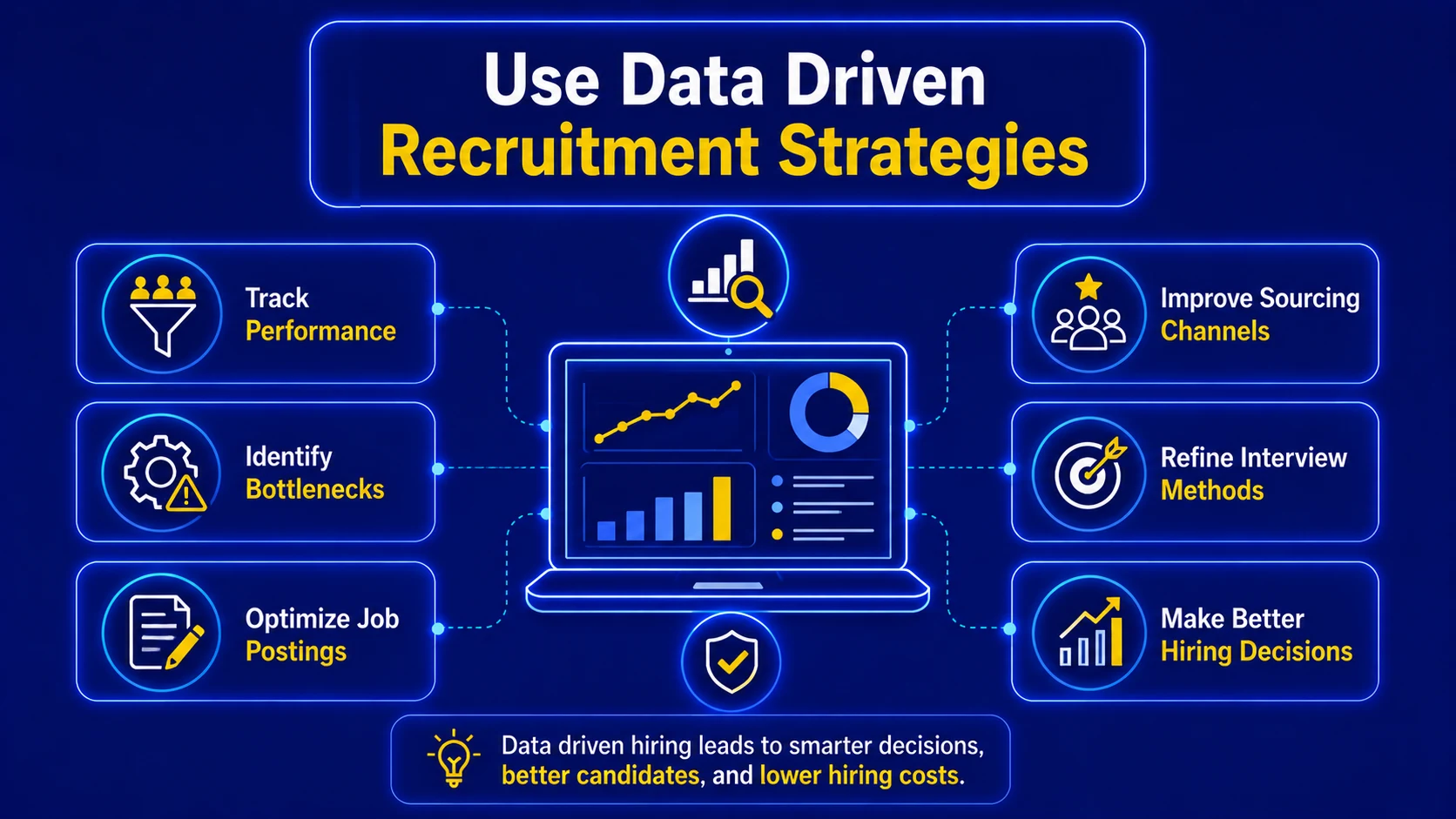
To implement data driven hiring effectively:
Track performance across all stages of the hiring funnel
Identify bottlenecks in the recruitment process
Optimize job postings based on conversion data
Improve sourcing channels using performance insights
Continuously refine interview and selection methods
In remote hiring, data becomes even more valuable because the entire process is digital. This allows recruiters to quickly test, measure, and improve strategies at scale.
Data driven recruitment not only improves efficiency but also enhances decision making quality, helping organizations hire better candidates faster while reducing overall recruitment costs.
12. Balance AI Automation With Human Interaction
Balancing AI automation with human interaction is one of the most important virtual recruitment strategies for remote hiring. While AI tools significantly improve efficiency in sourcing, screening, and scheduling, over automation can make the hiring experience feel impersonal and disconnected for candidates.
AI can handle repetitive and time consuming tasks such as resume screening, interview scheduling, candidate communication, and initial shortlisting. This allows recruiters to focus more on high value activities like interviewing, evaluating soft skills, and building relationships with candidates.
However, hiring is not only a technical process. It also involves understanding motivation, communication style, cultural fit, and long term potential. These aspects are difficult to evaluate using automation alone.
To maintain the right balance, organizations should:
Use AI for repetitive and administrative recruitment tasks
Keep human involvement in interviews and final decisions
Personalize communication at key stages of the hiring process
Avoid fully automated decision making in candidate selection
Ensure candidates still experience meaningful human interaction
In remote hiring, maintaining this balance is especially important because candidates already have limited personal contact with the organization. A human touch helps build trust, improve engagement, and create a more positive candidate experience.
When used correctly, AI enhances recruitment efficiency without removing the human judgment needed for quality hiring decisions.
13. Ensure Legal Compliance and Hiring Security
Ensuring legal compliance and hiring security is a crucial part of virtual recruitment strategies for remote hiring because the entire process relies on digital systems, online communication, and remote data exchange. Without proper compliance measures, organizations risk legal issues, data breaches, and unfair hiring practices.
Remote recruitment involves collecting and processing candidate data, conducting virtual interviews, and storing assessment results online. This makes data privacy and security a top priority throughout the hiring lifecycle. Organizations must ensure that all recruitment activities comply with applicable labor laws, data protection regulations, and equal opportunity standards.
Another important aspect of compliance is fairness in hiring decisions. Companies must ensure that their recruitment processes do not unintentionally discriminate against candidates based on gender, location, background, or other protected attributes. Structured evaluation criteria help maintain consistency and reduce bias.
To strengthen compliance and security in virtual hiring, organizations should focus on:
Following equal opportunity and anti discrimination hiring policies
Securing candidate data storage and access controls
Maintaining transparency in evaluation and selection processes
Ensuring recruitment tools and AI systems are bias checked
Documenting hiring decisions for accountability
In addition to legal compliance, cybersecurity is also important in remote recruitment. Protecting sensitive candidate information from unauthorized access helps build trust and maintain organizational credibility.
A strong compliance framework ensures that virtual hiring processes remain fair, transparent, and legally secure while supporting scalable remote recruitment operations.
14. Build a Seamless Remote Onboarding Process
A seamless remote onboarding process is the final and one of the most important virtual recruitment strategies for remote hiring because it directly impacts employee engagement, productivity, and long term retention. Even after successful hiring, a weak onboarding experience can lead to confusion, low motivation, and early attrition.
In a remote environment, new employees do not have the advantage of in person guidance or informal office interactions. This makes structured onboarding essential for helping them understand their role, tools, team structure, and company expectations.
A strong remote onboarding process ensures that new hires feel connected, informed, and supported from day one. It also helps them become productive faster and integrate smoothly into distributed teams.
Effective remote onboarding should include:
Digital onboarding documentation and welcome kits
Structured training sessions and role specific learning modules
Virtual introductions to team members and stakeholders
Clear communication channels for support and queries
Regular check ins during the initial weeks of employment
Onboarding should not be limited to administrative setup. It should also focus on cultural integration, helping employees understand company values, workflows, and collaboration practices in a remote setting.
Organizations that invest in structured onboarding programs often see higher employee satisfaction, better performance, and improved retention rates. In competitive remote hiring markets, onboarding becomes a key differentiator that strengthens the overall recruitment strategy.
15. Focus on Mobile Friendly Recruitment Processes
Mobile friendly recruitment is an important extension of modern virtual recruitment strategies for remote hiring because a large portion of job seekers now use mobile devices to search for jobs, submit applications, and attend interviews. If the recruitment process is not optimized for mobile users, organizations risk losing qualified candidates due to poor user experience.
A mobile first approach ensures that every stage of the hiring funnel, from job discovery to application submission, works smoothly on smartphones and tablets. This is especially important in remote hiring, where candidates may be applying from different locations and time zones using mobile devices as their primary access point.
If the application process is slow, difficult to navigate, or not responsive on mobile screens, candidates are more likely to abandon the process. This leads to higher drop off rates and reduced application quality.
To create a mobile friendly recruitment experience, organizations should focus on:
Optimizing career pages for mobile responsiveness
Simplifying job application forms for faster completion
Ensuring resume upload and submission works seamlessly on mobile
Using mobile friendly communication channels such as email and messaging apps
Reducing unnecessary steps in the application process
Video interviews and assessments should also be compatible with mobile devices to ensure candidates can participate without technical barriers.
A smooth mobile recruitment experience improves candidate engagement, increases application completion rates, and strengthens employer branding. In competitive remote hiring environments, mobile optimization can directly influence the quality and quantity of applicants.
Companies that prioritize mobile friendly recruitment processes are more likely to attract a wider talent pool and reduce friction throughout the hiring journey.
Sherlock AI for Secure and Reliable Remote Hiring
In remote hiring, one of the biggest challenges is ensuring that the person you are interviewing is genuinely the candidate and that assessments reflect real ability. With increasing cases of impersonation, AI-assisted cheating, and unauthorized external help during virtual interviews, organizations need a stronger layer of trust and verification in their recruitment process.
This is where Sherlock AI comes in.
Sherlock AI helps organizations strengthen remote recruitment by adding an integrity layer to virtual interviews and assessments. It focuses on ensuring that hiring decisions are based on authentic candidate performance and not manipulated inputs.
Key capabilities of Sherlock AI (integrity-focused features)
Real-time detection of suspicious behavior during virtual interviews
Identification of impersonation risks in remote assessments
Monitoring signals that indicate external assistance during interviews
Strengthening fairness and consistency in online hiring evaluations
Helping recruiters validate candidate authenticity before final selection
By integrating Sherlock AI into your recruitment workflow, companies can reduce hiring risks, improve decision confidence, and maintain fairness across all candidates in a remote environment.
Conclusion
Remote hiring is no longer just a convenience it is a core strategic advantage for modern organizations. However, scaling virtual recruitment successfully requires more than digital tools. It demands structure, consistency, fairness, and trust at every stage of the hiring funnel.
One of the most important shifts in this space is the move from traditional intuition-based hiring to structured, data-driven decision making. Organizations that standardize interviews, use skill-based assessments, and track recruitment metrics are better positioned to reduce bias and improve hiring accuracy. This leads to stronger alignment between candidate capability and job requirements, especially in distributed teams.
At the same time, candidate experience has become a defining factor in competitive hiring markets. Clear communication, faster response cycles, and transparent processes directly influence whether top talent accepts an offer or drops out mid-process. In remote environments, even small inefficiencies can impact employer perception and overall hiring success.
As companies scale globally, maintaining hiring integrity becomes increasingly critical. The rise of remote assessments and virtual interviews introduces new risks that must be managed carefully. Strengthening verification, ensuring fairness, and maintaining consistency across all hiring stages helps organizations build long term trust with candidates and protect the quality of their workforce.
Finally, combining structured recruitment strategies with intelligent tools creates a more resilient hiring system. When technology supports decision making without replacing human judgment, organizations can achieve both efficiency and quality. This balanced approach ensures that remote hiring is not only faster but also more reliable and future ready.
Ready to transform your remote hiring process? Build a faster, smarter, and more secure recruitment pipeline with AI-powered virtual hiring strategies and Sherlock AI-driven interview integrity. 👉 Start optimizing your hiring process today and hire with confidence at scale. |
|---|