Back to all blogs
Learn how to assess candidate integrity in interviews with behavioral questions, situational scenarios, follow-ups, and practical evaluation techniques for remote hiring.

Candidate integrity is one of the most important qualities to evaluate during the hiring process. Skills and experience can show whether a candidate is capable of doing the job, but integrity helps determine how they will make decisions, handle mistakes, take responsibility, and act when faced with an ethical challenge.
The challenge is that integrity is difficult to evaluate from a résumé or a polished interview response alone. Candidates may know what an interviewer wants to hear, so hiring teams need to look beyond generic statements and examine how candidates have handled real situations. According to a Checkr survey, 59% of hiring managers suspect candidates have misrepresented themselves during the hiring process, with many pointing to remote interviews and AI-assisted responses as growing risk factors.
The most effective approach combines behavioral interview questions, situational scenarios, follow-up questions, evidence verification, and consistent evaluation across interview stages. For remote interviews, recruiters may also need to consider whether the candidate is independently providing their responses and whether identity or external-assistance risks could affect the evaluation.
This guide explains how to assess candidate integrity in interviews, including the questions to ask, signals to look for, common red flags, and ways technology can support a fairer and more reliable evaluation.
How Do You Assess Candidate Integrity in an Interview?
The best way to assess candidate integrity in an interview is to combine behavioral questions, situational scenarios, follow-up questions, and evidence-based evaluation. Ask candidates to describe real situations involving mistakes, ethical dilemmas, accountability, and difficult decisions. Then use follow-up questions to understand their role, reasoning, actions, and outcomes.
Look for specific examples, ownership of mistakes, consistency, transparency, and sound ethical reasoning rather than relying on confidence, eye contact, or other subjective behaviors. In remote interviews, identity verification and checks for potential external assistance can provide additional context when evaluating whether responses represent the candidate's own work.
What Is Candidate Integrity?
Candidate integrity refers to a person's commitment to honesty, accountability, ethical behavior, and consistent principles when making decisions or handling responsibilities.
In hiring, integrity is particularly important because interviewers cannot observe every decision an employee will make after joining the organization. A candidate may have strong technical skills and relevant experience, but their ability to act responsibly when faced with mistakes, conflicts, pressure, or ethical dilemmas can have a significant impact on the organization.
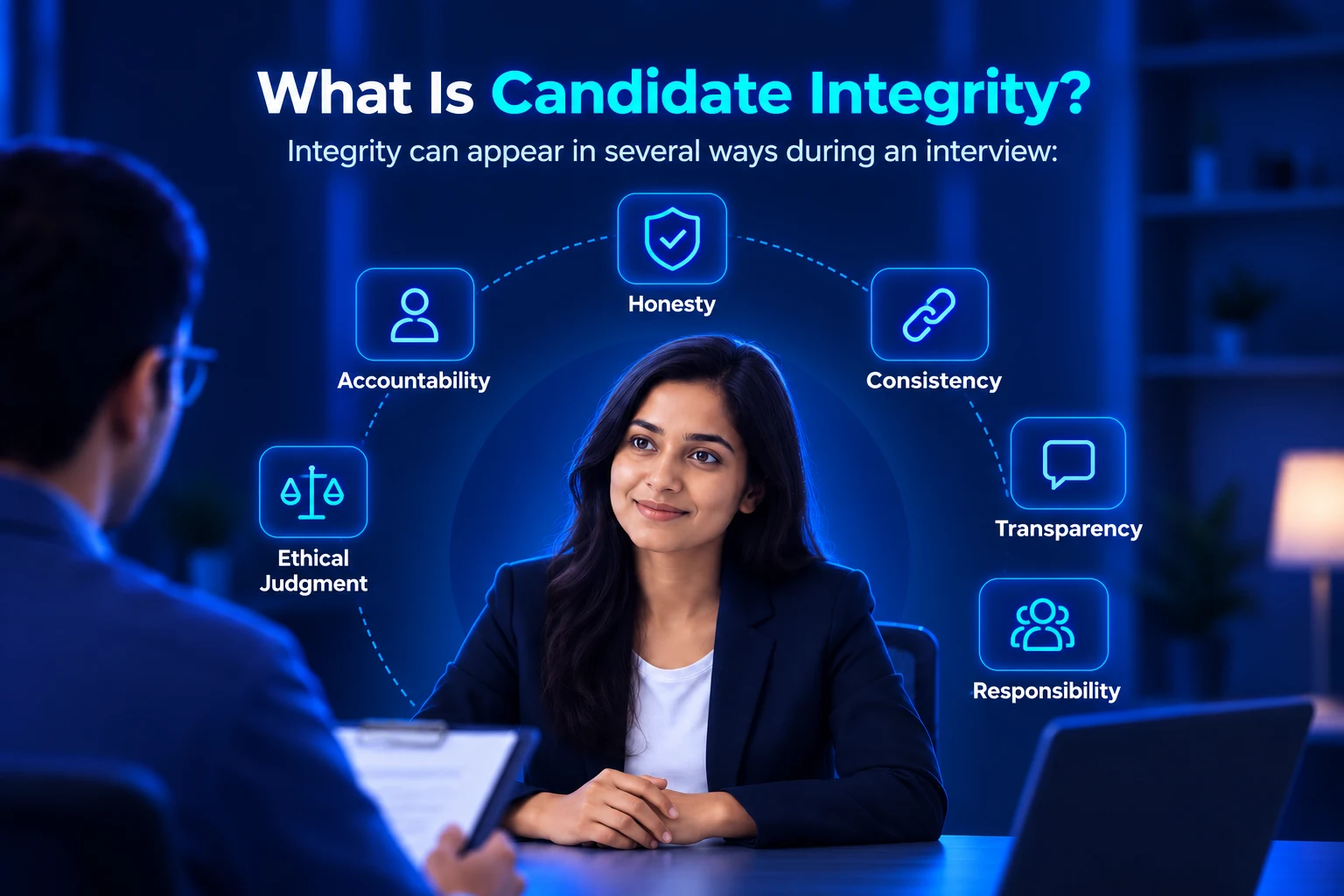
Integrity can appear in several ways during an interview:
Honesty: The candidate provides accurate and transparent information.
Accountability: They take responsibility for mistakes instead of automatically blaming others.
Consistency: Their explanations remain coherent when interviewers ask follow-up questions.
Ethical judgment: They can explain how they approach difficult or ambiguous situations.
Transparency: They are willing to discuss failures, limitations, and lessons learned.
Responsibility: They consider the impact of their decisions on colleagues, customers, and the organization.
No single answer proves that a candidate has high or low integrity. Hiring teams should evaluate patterns across multiple questions, interview stages, and sources of evidence.
Why Integrity Risks Are Rising in Interviews
Recruiters are no longer just evaluating people, they’re evaluating people through layers of technology, where real-time assistance, identity masking, and content generation are increasingly accessible.
Key drivers behind the growing focus on integrity include:
Real-time AI assistance that can generate polished but shallow answers
Proxy interview participation where the selected candidate is not the one evaluated
Deepfake and voice-cloning risks in remote video workflows
Résumé inflation and unverifiable project claims
Authorship gaps between take-home assessments and live problem solving
These challenges also impact fairness. Candidates who rely on external tools gain an artificial advantage over those who present their own work, skewing hiring outcomes and weakening skill benchmarks.
Hiring teams need to look beyond intuition and evaluate a combination of behavioral patterns and technical integrity signals that reveal whether a candidate’s responses are authentic and repeatable.
Read more: Why Interview Integrity Is a Security Issue in 2026
How to Assess Candidate Integrity in Interviews
Assessing candidate integrity requires more than asking direct questions about honesty or ethics. Candidates may give answers they believe interviewers want to hear, so hiring teams should focus on how candidates have handled real situations, made difficult decisions, taken responsibility, and responded to ethical challenges.
A structured approach can help interviewers evaluate integrity more consistently. Behavioral and situational questions, follow-up questions, role-specific scenarios, and consistency checks can reveal how candidates think and act when faced with pressure or uncertainty. The following approaches can help hiring teams build a more complete picture of candidate integrity throughout the interview process.
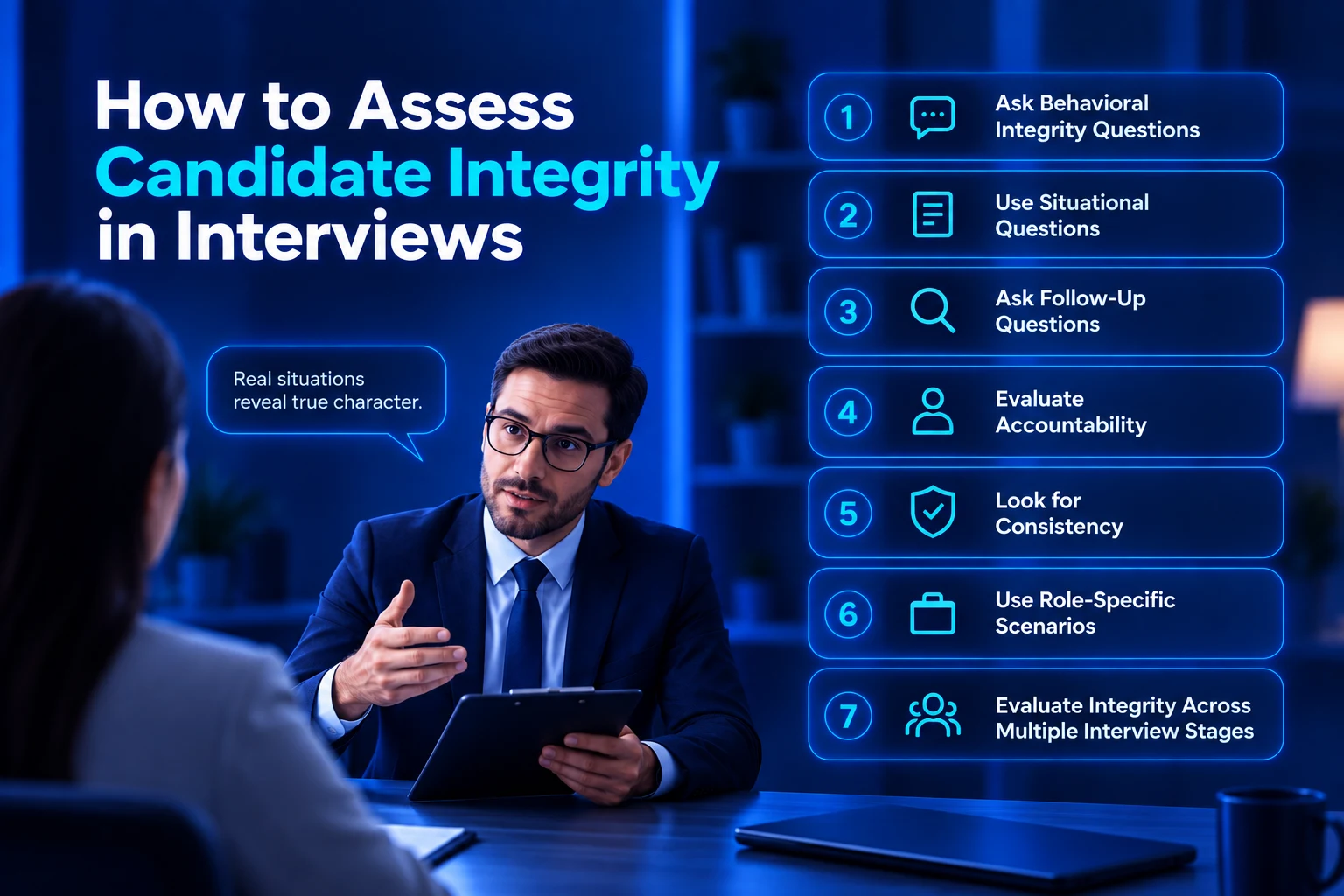
1. Ask Behavioral Integrity Questions
Behavioral questions ask candidates to describe how they handled situations they have actually experienced. They are useful for assessing integrity because they require candidates to explain what they did, why they made a particular decision, and what happened afterward.
Instead of asking a candidate whether they consider themselves honest or ethical, ask them to describe a situation where their integrity was tested.
For example:
Tell me about a time when your integrity was challenged at work. What did you do?
The interviewer can then explore the candidate's specific actions, reasoning, and outcome through follow-up questions.
2. Use Situational Questions
Situational questions present candidates with hypothetical ethical dilemmas and ask how they would respond.
For example:
What would you do if your manager asked you to hide a mistake from a client?
These questions help interviewers understand how candidates approach unfamiliar situations, particularly when there is a conflict between personal responsibility, organizational expectations, and potential consequences.
For stronger evaluations, use scenarios that are relevant to the role rather than generic ethical questions.
3. Ask Follow-Up Questions
A candidate's first answer rarely provides enough information to evaluate integrity. Follow-up questions help interviewers understand the candidate's specific role, reasoning, actions, and outcomes in greater detail.
For example, if a candidate says they handled a difficult ethical situation, the interviewer could ask:
What was your specific responsibility in that situation, and why did you choose that approach?
The interviewer can then explore the candidate's response with questions such as:
What options did you consider?
Who did you tell about the situation?
What happened after you made that decision?
What was the most difficult part of the situation?
What would you do differently today?
Follow-up questions can help distinguish specific, genuine experiences from vague or rehearsed answers. The goal is not to catch candidates in contradictions, but to understand their reasoning, accountability, and ability to reflect on their actions.
4. Evaluate Accountability
Integrity is closely connected to accountability. Candidates who demonstrate integrity are generally willing to acknowledge their decisions, take responsibility for mistakes, and explain what they learned from difficult situations.
For example, an interviewer could ask:
Tell me about a mistake you made at work and how you handled it.
The interviewer can then explore the candidate's response by asking:
What was your role in the situation?
Who did you tell about the mistake?
What steps did you take to address it?
What did you learn from the experience?
Pay attention to whether the candidate takes ownership of their actions or consistently places responsibility on managers, coworkers, or external circumstances.
A candidate admitting a mistake should not automatically be viewed as a negative signal. Their willingness to acknowledge mistakes and take responsibility can provide stronger evidence of integrity than claiming they have never made one.
5. Look for Consistency
Consistency is an important part of evaluating candidate integrity. A candidate's answers should generally align with the experience, responsibilities, and achievements they have described throughout the hiring process.
For example, if a candidate says they led a major project, the interviewer could ask:
What was your specific role in the project, and which decisions did you personally make?
The interviewer can then explore the candidate's response by asking:
What challenges did you encounter?
How did you measure the outcome?
Who else was involved?
What would your team members say about your contribution?
Comparing answers across the résumé, application, assessments, interviews, and work samples can help identify meaningful inconsistencies that may require clarification.
The goal is not to treat every difference in wording or minor detail as evidence of dishonesty. Instead, look for significant and repeated inconsistencies that cannot be reasonably explained.
6. Use Role-Specific Scenarios
Integrity can look different depending on the responsibilities and risks associated with a role. Instead of relying only on general ethical questions, use scenarios that reflect situations the candidate is likely to encounter in the job.
For example, a hiring manager recruiting for a finance role might ask:
What would you do if you noticed an error in a financial report shortly before it was submitted?
For a customer-facing role, the interviewer could ask:
What would you do if a customer offered you something in exchange for making an exception to company policy?
For a technical role:
What would you do if you discovered a security issue that your team had overlooked before a product launch?
Role-specific scenarios help interviewers evaluate how candidates apply ethical judgment to realistic workplace situations. They can also reveal whether a candidate understands the responsibilities and potential consequences associated with the position.
The most effective scenarios should have a genuine decision or trade-off rather than an obvious right answer. Follow up by asking the candidate to explain why they would take a particular approach and what factors they would consider before acting.
7. Evaluate Integrity Across Multiple Interview Stages
Candidate integrity is easier to evaluate when hiring teams look for patterns across the entire hiring process rather than relying on a single interview.
For example, if a candidate describes leading a project during an initial interview, the interviewer can revisit the same experience during a later technical or behavioral interview:
Can you walk me through the specific decisions you made when leading that project?
The interviewer can then compare the candidate's responses with information from:
Résumés and applications
Screening interviews
Technical assessments
Work samples
Later interview rounds
Professional references
A candidate does not need to give identical answers at every stage. However, significant discrepancies in important claims may warrant additional questions or verification.
Evaluating integrity across multiple stages gives hiring teams more opportunities to understand a candidate's experience, accountability, and decision-making while reducing the risk of making an integrity assessment based on a single conversation.
10 Integrity Interview Questions to Ask Candidates
The right interview questions can help reveal how candidates handle ethical challenges, mistakes, responsibility, and pressure. Instead of asking candidates whether they are honest or ethical, ask them to explain how they have handled situations where integrity mattered.
# | Integrity Interview Question | What It Tests | Follow-Up Question |
|---|---|---|---|
1 | Tell me about a time when your integrity was challenged at work. | Ethical judgment and decision-making | What made the situation difficult, and why did you choose that response? |
2 | Tell me about a mistake you made at work and how you handled it. | Honesty and accountability | Who did you tell about the mistake, and what happened afterward? |
3 | Have you ever disagreed with a decision because you believed it was unethical? | Ethical judgment and willingness to speak up | How did you communicate your concern? |
4 | Tell me about a time when you had to admit you were wrong. | Accountability and self-awareness | What did you learn from the experience? |
5 | Have you ever witnessed unethical behavior at work? How did you respond? | Responsibility and professional judgment | What factors influenced your decision? |
6 | Tell me about a time when doing the right thing had a negative consequence for you. | Commitment to ethical principles under pressure | Knowing the outcome now, would you make the same decision? |
7 | What would you do if your manager asked you to hide a mistake from a client? | Ethical decision-making under pressure | How would you approach your manager about the situation? |
8 | Tell me about a situation where you received credit for work that involved other people. | Honesty and recognition of others' contributions | How did you make sure the other people involved received appropriate credit? |
9 | What would you do if you discovered that a coworker was violating an important company policy? | Responsibility and professional judgment | Would your response change if the person were your manager? |
10 | Tell me about a time when you had incomplete information but still had to make an important decision. | Transparency and judgment | What assumptions did you make, and how did you communicate them? |
What to Look for in Candidate Answers
Asking the right questions is only part of assessing candidate integrity. Interviewers should also pay attention to how candidates explain their decisions, describe their actions, and respond to follow-up questions.
Positive Integrity Signals
Look for candidates who:
Take responsibility for their mistakes and decisions
Provide specific examples rather than vague or rehearsed answers
Clearly explain their reasoning and actions
Acknowledge uncertainty or limitations when appropriate
Give credit to others for their contributions
Describe difficult situations honestly, including the consequences
Explain what they learned from challenging experiences
Remain reasonably consistent when asked follow-up questions
Potential Red Flags
Some responses may warrant additional questions or clarification, such as:
Consistently blaming others for problems or failures
Avoiding questions about mistakes or difficult decisions
Giving vague answers without explaining their specific role
Changing important details when asked follow-up questions
Taking disproportionate credit for team accomplishments
Providing overly polished answers without concrete examples
Being unable to explain the reasoning behind an important decision
These signals should not be treated as proof that a candidate lacks integrity. Nervousness, communication style, memory, or unfamiliarity with an interview format can affect how someone responds. Evaluate patterns across the interview and hiring process rather than making an integrity judgment based on a single answer.
Learn more about: Red Flags In Live Interviews Every Recruiter Should Know
Candidate Integrity Interview Scorecard
A structured scorecard can help interviewers evaluate candidate integrity consistently instead of relying on overall impressions. Use the same criteria for candidates applying for the same role and base scores on specific evidence from their responses.
Evaluation Area | What to Look For |
|---|---|
Honesty | Provides transparent and specific answers, including when discussing mistakes or limitations. |
Accountability | Takes responsibility for decisions and outcomes instead of consistently blaming others. |
Ethical Judgment | Explains how they evaluate difficult situations and considers the potential consequences of their decisions. |
Consistency | Provides reasonably consistent information across questions and interview stages. |
Transparency | Clearly communicates relevant information and acknowledges uncertainty when appropriate. |
Self-Awareness | Can identify mistakes, weaknesses, or lessons learned from previous experiences. |
Professional Responsibility | Considers the impact of their actions on colleagues, customers, and the organization. |
Rather than assigning a score based on one answer, consider the candidate's overall pattern across the interview process. A structured scorecard can also help different interviewers compare observations using the same criteria and reduce the influence of subjective impressions.
How Sherlock AI Supports Interview Integrity
Traditional interview questions can help recruiters evaluate a candidate's judgment, accountability, and ethical decision-making. However, remote interviews introduce additional integrity risks, including AI-assisted responses, proxy candidates, identity manipulation, and unauthorized external assistance.
Sherlock AI adds an integrity layer to remote interviews by capturing relevant identity, environment, behavioral, and authorship signals throughout the interview process. Instead of replacing human judgment, Sherlock AI organizes this evidence so hiring teams can review potential risks in context and make more informed decisions.
Before the Interview: Verify Candidates and Establish Baselines
Sherlock AI establishes an integrity baseline before the interview begins by helping verify the candidate's identity and assess the interview environment.
Face matching against submitted identity
Detection of multiple faces or screen substitutions
Identification of virtual machines, remote desktops, or hidden devices
Baseline audio, video, and network quality checks
This gives interviewers greater confidence that the right candidate is participating under expected technical conditions.
During the Interview: Capture Integrity Signals
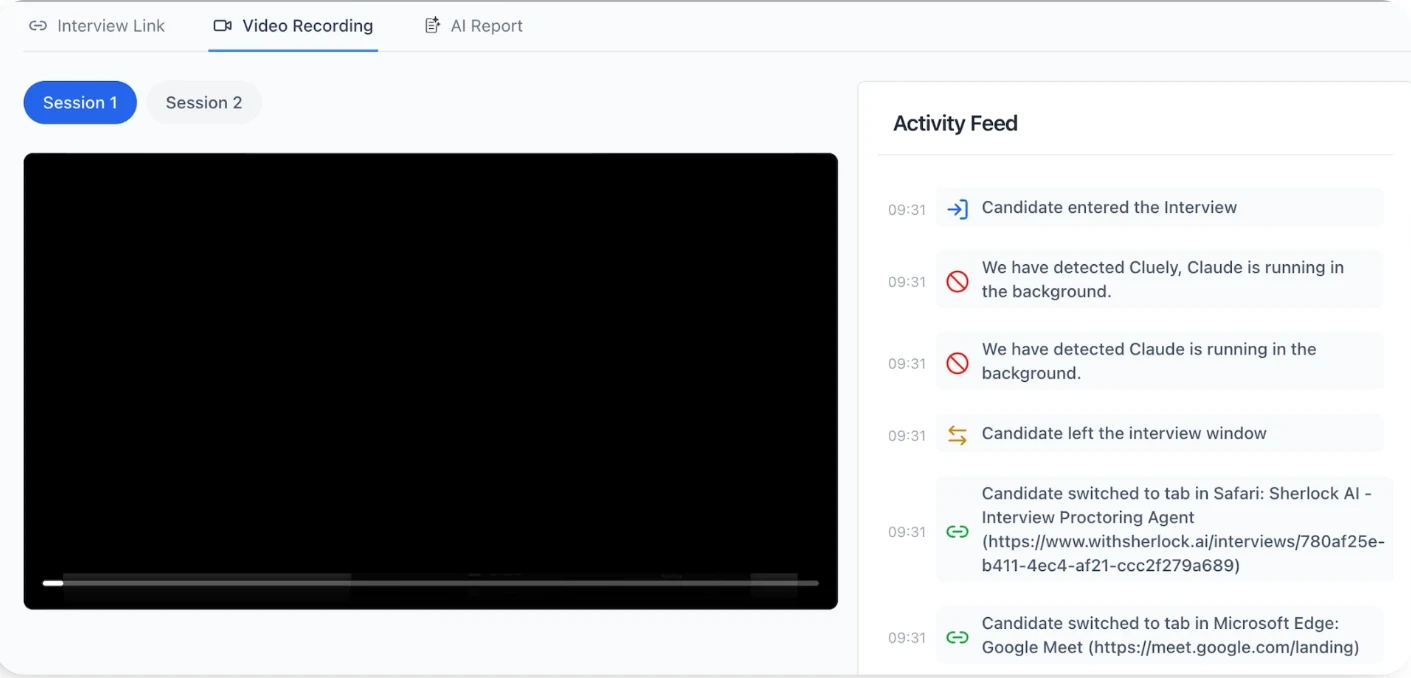
While the interviewer focuses on reasoning, communication, and role fit, Sherlock AI captures relevant signals in the background without interrupting the conversation.
Flags potential proxy behavior or external assistance
Tracks authorship continuity between earlier assessments and live responses
Monitors relevant device, voice, and response signals
Surfaces potential integrity events for later review
This allows interviewers to focus on evaluating the candidate rather than manually monitoring the interview environment.
After the Interview: Review Evidence in Context
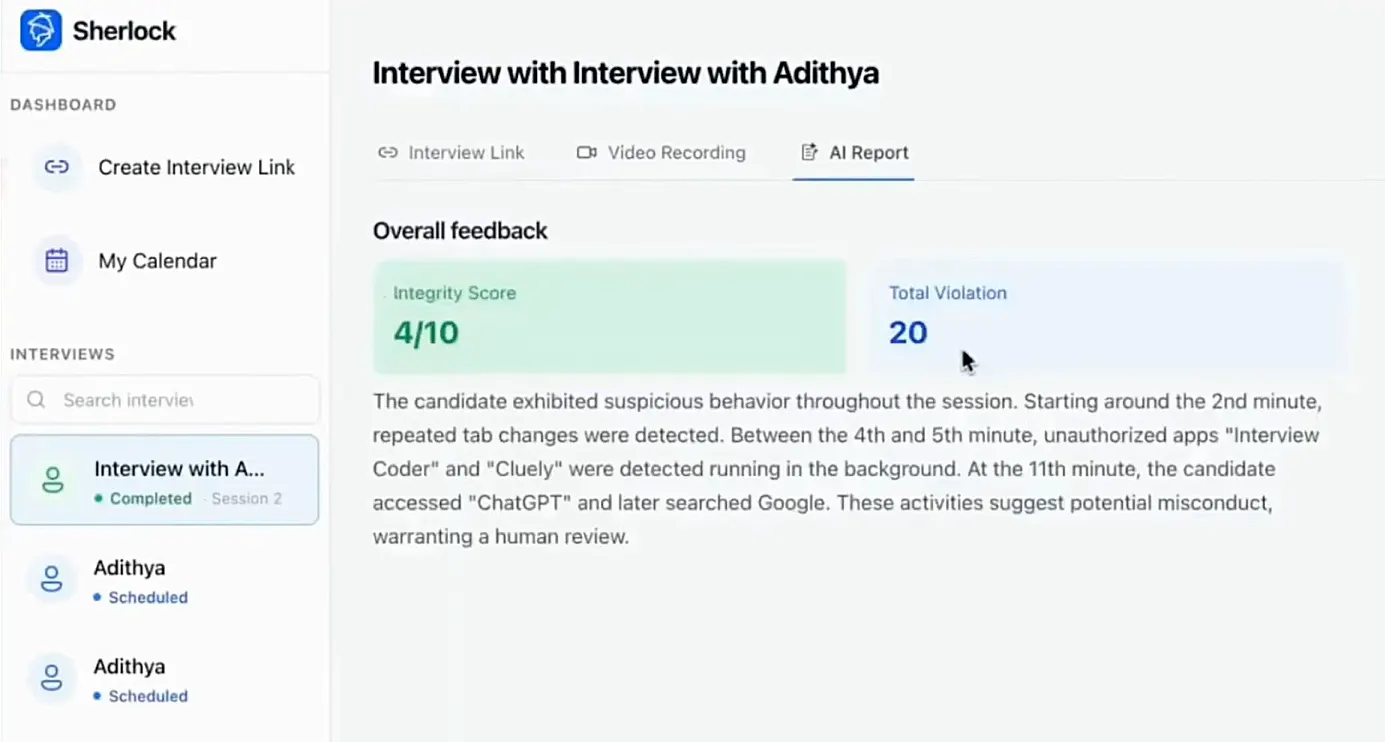
After the interview, Sherlock AI organizes relevant signals into structured outputs that support human review.
Timeline of flagged integrity events
Response pattern summaries
Standardized rubric-based score inputs
Consolidated notes for interview panels
These outputs are not intended to automatically determine whether a candidate has acted dishonestly. Instead, they give hiring teams additional context to determine whether a flagged event represents a genuine concern, a technical issue, or normal candidate behavior.
Maintain Consistency Across Candidates
Applying the same monitoring and documentation framework across candidates can help hiring teams evaluate integrity more consistently.
Sherlock AI helps teams:
Standardize integrity evaluation criteria
Reduce interviewer variability
Compare relevant signals across interview stages
Create a documented record for review
This supports a more structured evaluation process while keeping the final interpretation with the hiring team.
The Outcome: Technology That Supports Human Judgment
An effective interview integrity process should use technology to provide evidence without removing human judgment.
Sherlock AI handles the signal and evidence layer, while recruiters and hiring panels remain responsible for interpreting those signals and making the final hiring decision. This approach helps organizations make remote interviews more consistent, transparent, and defensible while keeping candidate evaluation focused on actual skills, reasoning, and role fit.
Conclusion
Assessing candidate integrity in modern interviews requires more than intuition, it demands a structured, evidence-based approach that combines behavioral evaluation, technical verification, and human judgment. As AI copilots, proxy participation, and deepfake risks reshape the hiring landscape, authenticity can no longer be assumed; it must be validated through reproducible reasoning and consistent performance.
An integrity-first process doesn’t mean treating candidates with suspicion. It means designing interviews that reward genuine thinking, provide clear guidelines, and evaluate patterns rather than isolated moments. When identity checks, structured assessments, and post-interview evidence reviews are built into the workflow, hiring teams can reduce mis-hire risk while maintaining fairness and a positive candidate experience.
With the support of an interview intelligence layer like Sherlock AI, organizations can scale this model without adding friction. Technology captures signals and structures documentation, while humans interpret context and make the final decision.
The result is a hiring process that is not only more secure, but also more equitable, consistent, and defensible, where integrity is measured systematically and judgment remains human.
Want to make your remote interviews more trustworthy? |
|---|
Frequently Asked Questions
1. How do you assess candidate integrity in an interview?
Assess candidate integrity by combining behavioral and situational questions with follow-up questions, evidence verification, and consistency checks across the hiring process. Focus on how candidates handle mistakes, ethical dilemmas, responsibility, and difficult decisions rather than relying on direct questions about whether they are honest.
2. What are the best interview questions to assess candidate integrity?
The best integrity interview questions ask candidates to describe real situations involving ethical challenges, mistakes, accountability, and difficult decisions. Questions such as “Tell me about a time when your integrity was challenged at work” can help interviewers understand a candidate's judgment and actions.
3. What are the signs of integrity in a candidate?
Common signs include taking responsibility for mistakes, providing specific examples, explaining decisions clearly, acknowledging limitations, giving credit to others, and remaining reasonably consistent when answering follow-up questions. Integrity should be evaluated based on patterns rather than a single response.
4. What are red flags when assessing candidate integrity?
Potential red flags include consistently blaming others, avoiding questions about mistakes, providing vague answers, changing important details during follow-ups, taking disproportionate credit for team achievements, or being unable to explain the reasoning behind important decisions. These signals should be investigated further rather than treated as automatic proof of dishonesty.
5. How can behavioral questions help assess candidate integrity?
Behavioral questions ask candidates to describe how they handled real situations in the past. They can reveal how candidates make decisions, respond to mistakes, handle ethical challenges, and take responsibility for their actions. Follow-up questions can provide additional context about their specific role and reasoning.
6. How do you assess integrity in a remote interview?
Remote interview integrity can be assessed using structured questions, identity verification, consistency checks, and appropriate technical signals. Hiring teams can also compare interview performance with previous assessments and work samples to identify meaningful differences in identity, authorship, or performance.
7. How can employers evaluate candidate integrity fairly?
Employers can improve fairness by using consistent questions, evaluation criteria, and scorecards for candidates applying for the same role. Integrity assessments should consider multiple pieces of evidence and avoid making decisions based on subjective behaviors such as eye contact, nervousness, or a single unusual response.
8. Can AI assistance affect candidate integrity assessments?
Yes. Real-time AI assistance can influence a candidate's responses during remote interviews, making it harder to determine whether the answers reflect the candidate's own knowledge and reasoning. Hiring teams can address this by using reasoning-based questions, follow-ups, cross-stage comparisons, and appropriate interview integrity technology.
9. How does Sherlock AI help assess interview integrity?
Sherlock AI helps hiring teams add an integrity layer to remote interviews by capturing relevant identity, environment, behavioral, and authorship signals. It organizes these signals for human review, helping recruiters investigate potential risks while keeping the final hiring decision with the interview panel.